
Note: This article contains affiliate links. If you click on these links and make a purchase, we may earn a small commission at no extra cost to you. This helps support our research and content. Read our full affiliate disclosure here.
If you get water from a private well, the right electric water heater makes daily life easier and reduces the risk of premature failure. Well water can vary in mineral content, pH, and sediment load, and those factors change how quickly a tank recovers and how fast components corrode. This guide highlights a shortlist of top electric water heaters chosen specifically for well water conditions, focusing on durability, recovery performance, and serviceability. Below you will find the best models selected for dependable hot water delivery with features that matter for well systems. We also explain the evaluation criteria used so you can match a heater to your household demand and well water quality.
Top Picks at a Glance
| Best Overall The best all-around choice for most situations | EcoSmart ECO 11 Tankless Water Heater |  |
| Best Quality Built to a higher standard if you want something more solid | Stiebel Eltron Tempra 24 Trend |  |
| Best Value The sweet spot between price and what you get | ThermoMate ET110HC 11kW Tankless |  |
| Best Budget The cheapest option that still gets the job done reliably | xwdzswgs 3000W Tankless Water Heater |  |
| Top Rated A top-rated pick with lots of positive feedback | Bosch Tronic 3000T ES2.5 Mini-Tank |  |
| Most Popular A crowd favorite that many people choose with confidence | Rheem RTEX-18 Tankless Electric Water Heater |  |
| Best Seller A high-volume bestseller chosen again and again | Rheem RTEX-11 Tankless Electric |  |
EcoSmart ECO 11 Tankless Water Heater

| Wattage | 13000 watts |
|---|---|
| Voltage | 220 volts |
| Flow Rate | 3.1 gpm |
| Maximum Temperature | 140 °F |
| Mount Type | Wall |
The EcoSmart ECO 11 is a wall-mounted, 13 kW electric tankless water heater built for point-of-use and low-flow needs like a single bathroom, sink, or small office breakroom. It heats water as it passes through the unit, providing continuous hot water without a storage tank, and uses self-modulating technology to draw only the energy needed to maintain the set temperature. The unit includes a digital temperature control with 1 degree increments and an LED display for easy adjustment. Installation is compact and space-saving compared with tank heaters, and the ECO 11 can deliver roughly 1.3 to 3.1 gallons per minute depending on inlet water temperature, which makes it suitable for one shower in cooler climates or multiple fixtures in warmer climates. Limitations include its modest flow rate for whole-house use and the requirement for a dedicated high-amperage circuit; check electrical capacity and sizing guidance before buying. For customers with low-flow or point-of-use needs who can meet the electrical requirements, it is an efficient, space-saving option.
Best for: Buyers who want an efficient, space-saving electric heater for a single bathroom, sink, or other low-flow point-of-use location and who prioritize energy efficiency and precise temperature control.
Less Ideal for: Homes needing whole-house hot water or multiple simultaneous high-flow fixtures should choose a higher-capacity model or a different system.
- Compact wall-mounted design frees floor space and suits point-of-use installs
- Self-modulating technology adjusts power to demand for improved energy efficiency
- Digital temperature control and LED display let you set temperature in 1°F increments
- Provides continuous on-demand hot water for sinks or single showers without a storage tank
- Limited maximum flow rate makes it unsuitable for whole-house, high-demand hot water needs
- Requires a dedicated high-amperage electrical circuit and proper wiring for safe installation
Verdict: Choose the ECO 11 when you need a compact, energy-efficient tankless heater to reliably supply a single sink or shower with on-demand hot water.
Stiebel Eltron Tempra 24 Trend

| Wattage | 24 KW |
|---|---|
| Voltage | 240 volts |
| Maximum Temperature | 140 °F |
| Maximum Pressure | 150 psi |
| Flow Rate | 0.03 gpm |
The Tempra 24 Trend is a compact, whole-home electric tankless heater designed to deliver continuous on-demand hot water using self-modulating electronics to match power to flow. It is typically hard-wired to a 240V supply and is controlled via a front digital temperature display for precise setpoints; the manufacturer rates it to serve up to two showers in warm climates or about one to one-and-a-half in cooler regions. Notable features include a copper heating system, quiet electronic operation, and auto-modulation that reduces wasted energy when demand is low. For homes on well water the continuous flow design avoids storing and reheating water, and the unit's 24 kW output is adequate for mixed uses in many single-family homes depending on incoming water temperature and simultaneous fixture use. Important limitations are the heavy electrical service requirement and need for proper sizing: the unit requires substantial available amperage and multiple breakers, and performance drops if demand exceeds its flow-temperature rise capability.
Best for: Buyers who prioritize steady on-demand hot water and energy-efficient operation and who can provide the required electrical service and proper sizing for whole-house or multi-shower use.
Less Ideal for: Homes with limited electrical capacity, very cold incoming well water that demands high temperature rises, or households that routinely run multiple high-flow fixtures at once without upsizing.
- On-demand continuous hot water with self-modulating control for energy efficiency
- Digital temperature display for accurate temperature adjustments
- Compact wall-mounted design saves space and needs no venting
- Copper heating elements for durable heat transfer and quiet operation
- Requires significant electrical service and dedicated breakers for installation
- Limited simultaneous high-flow capacity depending on inlet water temperature
Verdict: Choose the Tempra 24 Trend if you want a compact, energy-efficient electric tankless heater that delivers steady on-demand hot water and you can supply the necessary electrical service and correct sizing.
ThermoMate ET110HC 11kW Tankless

| Wattage | 11 KW |
|---|---|
| Voltage | 240 volts |
| Flow Rate | 2.6 gpm |
| Maximum Temperature | 131 °F |
| Maximum Pressure | 150 psi |
The ThermoMate ET110HC is a compact 11kW tankless electric unit intended for point‑of‑use applications like a bathroom sink, small shower, or office break room. It uses self‑modulating electronics to adjust power based on incoming water temperature and flow, producing about 2.15 GPM at a 35°F rise and a maximum outlet temperature near 131°F. The heater separates the heating chamber from the water path to reduce scaling on the element and aims to be leak resistant and low maintenance. Installation requires a 240V supply with a 50A double‑pole breaker and appropriately sized wiring, and the unit mounts on the wall with side water connections. Practical benefits include compact footprint, instant hot water without a storage tank, and claimed high efficiency that can cut water‑heating energy versus a tank. Limitations are the modest flow rate that suits single low‑flow fixtures rather than whole‑house use, and the electrical demand that may require panel upgrades on some well systems.
Best for: Buyers who want an efficient, space‑saving point‑of‑use heater to supply one or two low‑flow fixtures and prioritize minimizing maintenance and energy use.
Less Ideal for: Homes needing a whole‑house hot water source, high simultaneous flow, or those unable to support the required 50A 240V electrical circuit without panel upgrades.
- Compact wall‑mounted design for tight spaces and point‑of‑use installs
- Self‑modulating control adjusts power to flow and inlet temperature for stable output
- Separate heating chamber reduces direct scale buildup on the element
- ETL certified with overheating and no‑water auto‑stop safety features
- Rated flow is low for simultaneous high‑flow fixtures so not suitable as a whole‑house solution
- Requires a high‑amp 240V circuit and correct gauge wiring which may need electrical upgrades
Verdict: A compact, energy‑efficient point‑of‑use tankless heater that delivers low‑maintenance instant hot water for single fixtures when a 50A 240V circuit is available.
xwdzswgs 3000W Tankless Water Heater

| Power Source | ac |
|---|---|
| Heat Output | 131 °F |
| Maximum Temperature | 122 °F |
| Mount Type | Wall |
This compact 3000W tankless unit provides instant point-of-use hot water for sinks and small fixtures by heating water on demand rather than storing it in a tank. It is typically mounted vertically under a sink or near a fixture and is useful where space is limited or when you want near-instant hot water without running a larger heater. Notable features include a digital LED temperature display with ℃/℉ conversion, multiple safety protections such as dry-boil and leakage prevention, IPX4 splash resistance, and a 1/2 inch NPT standard water interface for straightforward plumbing. Practical benefits are quick warm water delivery, a very small footprint, and high stated thermal efficiency, which can reduce standby losses compared with a storage heater. Important limitations are the modest flow performance — it is not suitable for showers or high-flow demands — and the requirement for vertical installation and a sufficiently sized electrical circuit and breaker per the manual. Buyers should also plan routine filter checks to prevent reduced flow and follow installation guidance to avoid dry-burning errors.
Best for: Budget-minded buyers who need a compact point-of-use heater for a single sink or small fixture and value quick hot water without the cost or space of a larger system.
Less Ideal for: Homes relying on well water for whole-house or shower use where higher flow and sustained hot water are needed.
- Instant on-demand hot water for sinks and small fixtures
- Compact wall-mount design saves under-sink space
- Digital LED display with ℃/℉ temperature readout
- Multiple safety protections including dry-boil and leakage prevention
- Low flow capacity makes it unsuitable for showers or multiple fixtures
- Requires vertical installation and specific electrical wiring and breaker capacity
Verdict: A compact, budget-friendly on-demand heater that delivers quick hot water to a single sink with basic safety features.
Bosch Tronic 3000T ES2.5 Mini-Tank
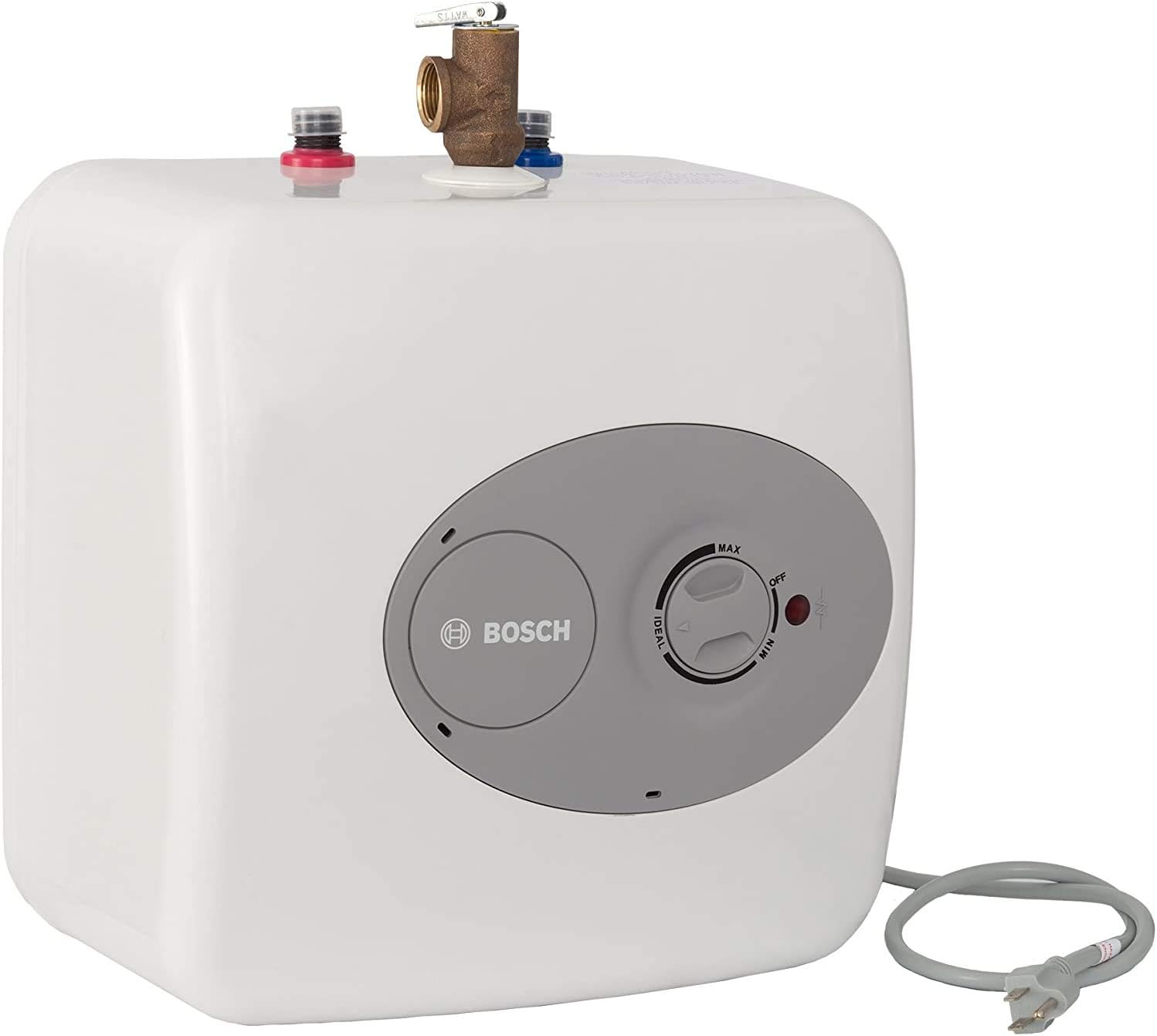
| Capacity | 2.5 gallons |
|---|---|
| Wattage | 1440 watts |
| Voltage | 120 volts |
| Maximum Temperature | 140 °F |
| Efficiency | 98% |
The Bosch Tronic 3000T ES2.5 is a compact point-of-use electric mini-tank that provides near-instant hot water for a sink or small fixture. It is typically mounted under a sink, on a shelf, or on a wall and can plug into a standard 120V outlet for independent installation or be tied into a larger hot water supply to speed delivery. The glass-lined 2.5-gallon tank and 98% thermal efficiency help keep stored water hot while limiting standby losses, and an external dial makes temperature adjustments straightforward. At 1440 watts the heater recovers quickly enough to supply hot water to one or two sinks in normal household use, and the included temperature-and-pressure relief valve adds a safety layer. The unit is lightweight and easy to install with the supplied bracket and cord, but its small capacity means it is not suitable for long continuous hot-water demands and will not replace a main water heater for showers or laundry. For point-of-use needs it balances compact size, reliable construction, and efficient heat retention.
Best for: Buyers who prioritize reliable, compact point-of-use hot water delivery for a sink or small fixture and value durable construction and simple installation.
Less Ideal for: Homes needing continuous hot water for showers, laundry, or multiple fixtures simultaneously should choose a larger-capacity or whole-house heater instead.
- Compact point-of-use design fits under sinks or on walls for near-instant hot water.
- Glass-lined tank improves durability and reduces corrosion risk.
- Plugs into a standard 120V outlet for simple, independent installation.
- High thermal efficiency (98%) reduces standby heat loss and keeps water hot.
- External temperature dial and relief valve for easy control and safety.
- Small 2.5-gallon capacity limits continuous hot-water use to brief tasks.
- 1440W power level means slower recovery than larger electric heaters for heavier demand.
Verdict: A durable, easy-to-install mini-tank that reliably delivers fast hot water at the point of use for sinks and small fixtures.
Rheem RTEX-18 Tankless Electric Water Heater
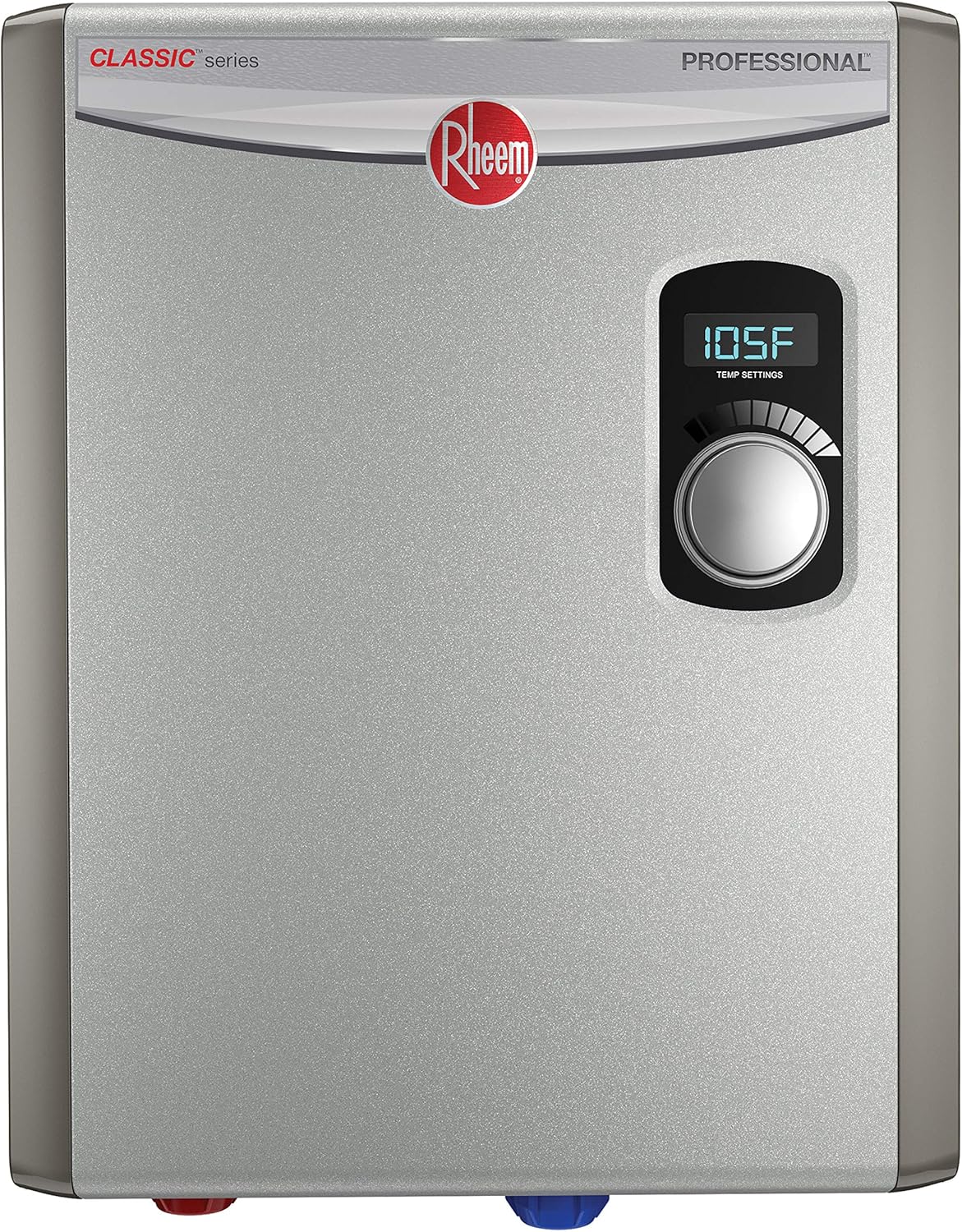
| Wattage | 18000 watts |
|---|---|
| Voltage | 240 volts |
| Flow Rate | 4.4 gpm |
| Maximum Temperature | 140 °F |
| Mount Type | Wall |
The Rheem RTEX-18 is an 18 kW, 240 V tankless electric heater designed to provide continuous hot water for mid-size homes or single-shower whole-home setups. It mounts on the wall and uses Rheem's self-modulating technology and two field-serviceable copper immersion heating elements to adjust power to demand, helping keep operating costs lower than a traditional tank. The unit includes a front LED digital thermostat for precise temperature control up to 140°F and simple bottom 3/4" NPT water connections for installation. In practice it can handle typical shower and sink loads and is rated for up to about 4.4 GPM, so performance will depend on incoming well-water temperature and simultaneous fixtures. Notable benefits are its compact footprint, high reported efficiency, and the ability to avoid venting and standby losses inherent to tanks. Limitations are the electrical requirements (18 kW draws substantial amperage and may need multiple breakers) and reduced flow when groundwater is cold, so sizing for well-water homes should account for inlet temperature and peak demand.
Best for: Buyers who prioritize continuous hot water and energy efficiency and who will plan electrical capacity and proper sizing for a well system.
Less Ideal for: Homes that cannot support the high electrical load or households needing multiple high-flow fixtures at once without supplemental heating.
- Continuous on-demand hot water without a vented tank
- Self-modulating operation adjusts power to actual hot water demand
- Digital LED thermostat with +/-1 degree accuracy for precise temperature control
- Compact wall-mounted design saves space and allows flexible placement
- Requires high electrical capacity and multiple breakers for installation
- Flow rate (up to 4.4 GPM) falls with colder inlet water, limiting simultaneous fixture use
Verdict: Choose the RTEX-18 if you want a compact, energy-smart tankless electric heater that delivers continuous hot water when properly sized and wired for well-water conditions.
Rheem RTEX-11 Tankless Electric

| Wattage | 11 KW |
|---|---|
| Voltage | 240 volts |
| Flow Rate | 2.68 gpm |
| Maximum Temperature | 140 °F |
| Efficiency | 99.8% |
The Rheem RTEX-11 is a compact point-of-use tankless electric heater that provides continuous hot water for a single shower plus one or two sinks in warmer inlet conditions. It mounts on the wall and uses 240V power with digital thermostatic control that adjusts in 1-degree increments up to 140°F, making it easy to set a precise outlet temperature. Because it heats water only when a tap is open, it is more energy efficient than a standing tank and requires no venting, which simplifies indoor installation near the fixture. The unit's 11 kW output and 2.68 gpm flow rate are best suited to blended-flow applications rather than full cold-climate whole-house supply, and installation needs a dedicated 50A double-pole breaker and suitable wiring. Practical benefits include a very small footprint for under-sink or closet installs, straightforward temperature control, and stainless steel construction. Limitations are the modest flow rate for well water with low inlet temperature and the electrical service demands that may require panel upgrades for some homes.
Best for: Buyers who prioritize a reliable, compact point-of-use hot water solution and prefer predictable, factory-built performance with straightforward temperature control.
Less Ideal for: Homes needing whole-house hot water in cold well-water climates or buyers who cannot accommodate the high electrical service and breaker requirements.
- Compact wall-mounted design that saves space and fits near the fixture
- Digital thermostatic control with 1°F increments for precise temperature setting
- No venting required, allowing flexible indoor installation
- Heats on demand for better energy efficiency compared with tank heaters
- Maximum flow rate of 2.68 gpm limits simultaneous hot use in cold well-water conditions
- Requires a dedicated 240V, 50A circuit and appropriately sized wiring which may need electrical upgrades
Verdict: Choose the Rheem RTEX-11 for a dependable, space-saving point-of-use electric heater when you want precise temperature control and on-demand hot water without venting.
Choosing the Right Electric Water Heater for Well Water: Key Factors to Consider
Tank Capacity and Household Demand
Tank size determines how much stored hot water you have before the heater needs to recover. Larger families or homes with simultaneous showers, dishwashing, and laundry need tanks with higher first-hour ratings to avoid running out of hot water.
When choosing capacity, consider peak-hour usage rather than average daily usage. A heater that matches peak demand reduces the chance of cold showers during back-to-back tasks and lessens strain on the well pump from sudden, repeated draws.
Recovery Rate and Element Wattage
Recovery rate depends on element wattage and how much energy the tank can transfer to the stored water in a given hour. Higher-wattage elements raise recovery speed, which matters if your household has recurring high-demand periods.
For well water applications, a steady recovery rate helps the pump cycle predictably and reduces long draws that can stress well hardware. Check element configuration and whether the model supports higher-wattage replacements if you anticipate heavier demand.
Corrosion Resistance and Anode Options
Well water chemistry can accelerate corrosion. A robust corrosion protection strategy starts with the tank coating and continues with the sacrificial anode design. Tanks with thicker glass lining and the option for powered or dual anodes extend service life in mineralized or low‑pH water.
Consider models that allow easy anode access and replacement. In some cases, upgrading to a powered anode or scheduling more frequent anode inspections will be necessary to combat aggressive water chemistry.
Sediment Handling and Drainage
Sediment from sandy or iron-rich wells settles at the bottom of tanks and reduces heating efficiency while accelerating element wear. Good sediment management includes a wide drain valve, bottom sediment reduction features, and designs that allow periodic flushing without complex disassembly.
Routine flushing is essential for well-fed heaters; choose units that make flushing straightforward and that have accessible element covers so you can inspect and clean or replace elements when needed.
Controls, Diagnostics, and Safety Limits
Simple, reliable controls help you maintain consistent temperatures and respond to well-related issues like pressure swings or low feed temperatures. Models with accessible thermostats, clear diagnostic readouts, or straightforward wiring aid troubleshooting.
Safety features such as high-limit switches, pressure relief valves rated for your system, and clear wiring diagrams are important for safe operation with well pumps and controllers.
Insulation and Standby Loss
Better insulation reduces standby heat loss, which is particularly beneficial if your well supply is colder than municipal water. Lower heat loss saves energy and reduces how often the heater needs to fire, which in turn reduces the number of times the well pump is called into action.
Look for tanks with thicker foam or low-conductivity jackets and check the rated standby loss in the specifications. Improved insulation can offset some inefficiencies caused by colder feed temperatures.
How Well Water Affects Electric Water Heater Longevity
Well water varies from site to site and can include higher levels of dissolved minerals, iron, or slightly acidic conditions that accelerate corrosion. These factors shorten tank life if the heater is not selected with corrosion mitigation in mind.
Understanding the specific chemistry of your well—hardness, iron content, and pH—helps you choose a heater with appropriate protective features and a maintenance schedule tailored to your water.
- High mineral content leads to scale buildup on heating elements.
- Iron and manganese can stain and contribute to sediment accumulation.
- Low pH increases corrosion risk to both the tank lining and anode.
Maintenance Practices for Well-Fed Systems
Regular maintenance extends service life and preserves performance. Flush the tank at least once or twice a year depending on sediment levels, inspect and replace sacrificial anodes as needed, and check heating elements for scale.
Keep a service log documenting flushes, anode inspections, and any repairs. That record helps diagnose recurring issues and informs whether water treatment is necessary to protect the heater and plumbing.
- Schedule flushing more frequently if you notice visible sediment or reduced recovery.
- Inspect the anode rod annually for rapid depletion.
- Test water chemistry periodically to detect changes that affect corrosion or scaling.
When to Consider Water Treatment Before the Heater
In many wells, pre-treatment such as sediment filtration or water softening reduces stress on the heater. A simple sediment filter ahead of the heater traps sand and particulates, while softening reduces scale formation on elements and inside the tank.
Decide on treatment based on water test results and maintenance burden. If flushing and element replacements are frequent, installing a targeted pre-treatment system can be more cost-effective over the long term.
- Sediment filters protect against abrasive particles that shorten element life.
- Water softeners reduce scale but may interact with corrosion dynamics; consult water test results.
- Iron filters help prevent staining and excessive sediment buildup.
Installation Tips for Homes on Well Water
Proper installation reduces maintenance headaches. Use a dedicated shutoff and a sediment filter upstream, and install a union or accessible coupling on the supply side to simplify future servicing. Ensure the pressure relief valve and expansion tank are compatible with your system pressure.
Mount the heater in an accessible location with good drainage to make flushing and element access straightforward. Label valves and document element and anode locations for future reference.
- Place a sediment filter on incoming line with a serviceable housing.
- Install an accessible drain and use a large-bore drain valve for easier flushing.
- Confirm wiring and high-limit protections are compatible with your electrical supply.
Matching Element Types to Your Water Conditions
Sheathed elements and easily replaceable designs simplify repairs in mineralized water. Some element materials tolerate scale buildup better than others; choose a heater with accessible element covers and straightforward replacement procedures.
Consider whether the unit supports higher wattage elements if you may need faster recovery, but be aware that higher wattage can lead to faster scale buildup in hard water conditions.
- Removable element designs reduce labor during maintenance.
- Check access clearances before installation to ensure element removal is practical.
- Balance desired recovery against the impact of element wattage on scaling.
How We Chose the Best Electric Water Heater for Well Water
We prioritized attributes that directly affect long-term reliability and daily performance when an electric water heater is fed by well water. Key evaluation criteria included recovery rate and tank capacity to ensure the heater can meet household peak demand, corrosion resistance and anode design because mineral content and pH accelerate tank wear, and accessible maintenance features such as replaceable elements and drainability for sediment-prone supplies. We also considered insulation and standby heat loss to limit energy waste, and control simplicity and diagnostics so homeowners can troubleshoot issues related to well systems and pressure variations. Excluded from consideration were temporary or non-tank solutions that do not provide store-and-recover performance relevant to many well households, and units intended only for point-of-use applications. We focused on units with clear specifications and serviceable components; product durability under mineralized or slightly acidic water and straightforward maintenance were decisive filters. The resulting selections emphasize measurable specs and practical features that matter to owners of well-fed hot water systems.
Our full evaluation process is outlined in our review methodology.
FAQ
How often should I flush an electric water heater on well water?
Frequency depends on sediment levels, but most well-fed heaters benefit from flushing at least once a year. If you see visible sediment, reduced recovery, or noisy operation, increase flushing to twice yearly.
Can I use a standard electric water heater with hard well water?
Yes, but expect more frequent maintenance. Consider models with easy element access and plan for routine flushing and anode checks. Adding sediment filtration or softening can reduce maintenance needs.
What anode type is best for well water?
Sacrificial anodes are common and effective, but in aggressive or mineralized water a powered anode can offer longer protection. The best choice depends on your water chemistry and willingness to monitor and replace components.
Does feed water temperature from the well affect heater performance?
Yes. Colder feed water increases energy required per heating cycle and can lower recovery rate. Thicker insulation and higher-wattage elements help compensate for cold inlet temperatures.
Is pre-filtering necessary for every well?
Not always. If your water tests show sand, iron particles, or high turbidity, a sediment filter is strongly recommended. For low-sediment wells, routine flushing and monitoring may suffice.
Final Verdict
Prioritize recovery rate, corrosion protection, and sediment handling when choosing an electric water heater for well water. Match tank capacity to peak household demand, favor accessible maintenance features, and plan a maintenance cadence based on your well's sediment and chemistry. If feed water shows high mineral or particulate content, factor in pre-treatment or more frequent servicing to preserve heater life. With those tradeoffs in mind, you can select a heater that balances reliable hot water delivery with manageable upkeep.