
Note: This article contains affiliate links. If you click on these links and make a purchase, we may earn a small commission at no extra cost to you. This helps support our research and content. Read our full affiliate disclosure here.
If you want straighter prints, safer operation, and more consistent results with temperature-sensitive filaments, an enclosed 3D printer is a practical upgrade. Enclosures help keep ambient drafts and rapid temperature swings from warping parts, and they can cut down on small particle and odor exposure in shared spaces. This guide shortlists five top enclosed 3D printers under $500 that are well suited for hobbyists, makers, and small workshops. We evaluated these models across print reliability, usable build volume, safety features, and ease of setup so you can match a printer to the parts you want to produce. Read on to see which compact enclosed machines best fit your build needs and workflow preferences.
Top Picks at a Glance
| Best Quality Built to a higher standard if you want something more solid | QIDI Q2 3D Printer |  |
| Best Value The sweet spot between price and what you get | Creality K1C 3D Printer |  |
| Best Budget The cheapest option that still gets the job done reliably | FLASHFORGE Adventurer 5M |  |
| Top Rated A top-rated pick with lots of positive feedback | Bambu Lab P1S 3D Printer |  |
| Most Popular A crowd favorite that many people choose with confidence | FLASHFORGE Adventurer 5M |  |
QIDI Q2 3D Printer

| Build volume | 270 × 270 × 256 mm |
|---|---|
| Chamber temperature | ≤65℃ |
| Print head temperature | ≤370°C |
| Max toolhead speed | ≤600mm/s |
| Filament diameter | 1.75mm |
The QIDI Q2 is an enclosed CoreXY desktop 3D printer that targets users who want faster, higher-temperature capability in a relatively compact package. It delivers a 270 x 270 x 256 mm build volume inside a 65°C active heated chamber and a 370°C-capable nozzle, which together reduce warping and let you print engineering materials like PA, PC, and carbon-fiber blends. The metal CoreXY frame, linear guide rails, and upgraded belts promote stability at higher speeds, and the printer claims up to 600 mm/s head travel for rapid prints when tuned. Practical features include automatic bed-leveling via the nozzle sensor, filament run-out and tangle detection (with the optional QIDI Box), power-loss recovery, an AI camera for remote monitoring, and a triple filtration system for cleaner air during indoor use. The machine is set up for plug-and-play use with QIDI Studio and supports common slicers and file formats. Limitations to note are the learning curve when printing high-temp composites and the need to tune profiles for consistent high-speed quality, plus some advanced multi-material capability requires the separate QIDI Box accessory.
Best for: Buyers who prioritize fast, high-temperature printing and want a stable enclosed machine for engineering materials and prototype work.
Less Ideal for: Casual hobbyists who prefer fully turnkey, low-maintenance printers or those unwilling to tune profiles for advanced filaments or high-speed settings.
- Enclosed chamber with active 65°C heating reduces warping for ABS and engineering filaments.
- 370°C-capable nozzle unlocks high-temperature materials and composites.
- Rigid CoreXY metal frame and linear rails improve stability and surface finish at higher speeds.
- Auto-leveling nozzle sensor and recovery features make long prints more reliable.
- Integrated triple filtration and AI camera support safer indoor use and remote monitoring.
- True high-speed printing requires careful tuning to avoid quality loss at extreme speeds.
- Multi-color/multi-material printing needs the separate QIDI Box accessory.
- Advanced materials and composite filaments may require extra setup and user experience.
Verdict: If you want a compact enclosed printer that can handle high-temp engineering filaments and fast printing with stable results, the QIDI Q2 is a performance-focused choice under $500.
Creality K1C 3D Printer

| Max print temperature | 300°C |
|---|---|
| Build volume | 8.66 x 8.66 x 9.84 inch |
| Extruder type | Clog-free direct extruder |
| Auto leveling | Auto Z offset and auto leveling |
The Creality K1C is an enclosed, nearly plug-and-play 3D printer aimed at speed and convenience for hobbyists and small workshops. It ships mostly assembled so you can power up and start printing within minutes, and built-in auto Z offset and auto leveling remove much of the manual setup fuss. The machine emphasizes fast output with a claimed 600 mm/s top speed and high acceleration, while a clog-free direct extruder with a steel-tipped copper nozzle and titanium-alloy heatbreak supports higher-temperature filaments up to 300°C including carbon-fiber blends. Cooling is handled by multiple fans and dedicated ducts to improve layer bonding and reduce stringing, and an onboard AI camera provides real-time monitoring and basic failure detection plus timelapse recording. Practical benefits include quick first prints, easier handling of engineering filaments, and safer enclosed printing. Limitations to expect are that advertised top speeds are marketing peaks rather than typical everyday print speeds for detailed parts, and the build volume is modest compared with larger desktop models.
Best for: Buyers who want a hassle-minimized, enclosed printer that handles engineering filaments and gets you printing quickly while focusing on practical, repeatable results.
Less Ideal for: Users who need large build volume for big prototypes or who prioritize absolute top-tier surface finish at high speeds should consider larger or more premium machines.
- Ready-to-print out of the box with auto calibration for fast setup
- Clog-free direct extruder with 300°C capability for more filament choices including PLA-CF/PET-CF
- Enclosed frame improves safety, thermal stability, and reduces drafts for better prints
- AI camera enables remote monitoring, failure detection, and timelapse capture
- Claimed 600 mm/s top speed is not representative of detailed print quality or typical speeds
- Relatively small build volume limits large or multiple-part prints
Verdict: If you want an enclosed, practical printer that is ready to run quickly and handles higher-temperature filaments, the Creality K1C is a strong value under $500.
FLASHFORGE Adventurer 5M

| Build Size | 220 x 220 x 220 mm |
|---|---|
| Nozzle Dimension | 0.4mm (0.25/0.6/0.8 optional) |
| Leveling Method | Full-Auto One-Click Leveling |
| Travel Speed and Acceleration | 600mm/s and 20,000mm/s² |
| Connectivity | Wi-Fi; Ethernet; USB; Cloud |
The FLASHFORGE Adventurer 5M is a desktop CoreXY 3D printer designed to speed up small-to-medium prints while keeping setup simple. It uses a fully automatic one-click leveling system so first-layer calibration is hands-off, and a tool-free quick-release nozzle system with multiple diameter options (0.25/0.4/0.6/0.8 mm) for swapping between fine detail and faster extrusion. The printer supports common filaments including PLA, ABS, PETG, TPU and carbon-fiber blends and offers a dual-texture PEI build plate that bends to release parts. Connectivity options include Wi‑Fi, Ethernet, USB and cloud control via Flash Maker and Orca-Flashforge slicer for remote monitoring and batch file transfer. Flashforge claims travel speeds up to 600 mm/s and a robust all-metal CoreXY frame for stability at higher speeds, which helps shorten print times for smaller models. Practical limits to note are the 220 × 220 × 220 mm build volume, which restricts large one-piece prints, and the unit is relatively heavy for bench placement. The Adventurer 5M is a feature-rich enclosed-style machine that focuses on ease of use and faster small-batch production rather than oversized builds.
Best for: Buyers seeking an affordable, easy-to-use enclosed 3D printer that reduces setup time and supports a range of common filaments for hobby or small-batch production.
Less Ideal for: Users who need to print very large parts or who require built-in industrial-grade enclosure features like active air filtration should look at larger or higher-end models.
- Fully automatic one-click leveling eliminates manual calibration for easier first layers.
- Quick-release nozzles in multiple diameters let you switch between precision and speed without tools.
- Wide filament compatibility (PLA, ABS, PETG, TPU, CF) for varied projects.
- Networked connectivity and app/slicer support enable remote monitoring and batch file transfer.
- Dual-texture PEI build plate simplifies part removal and supports PETG printing.
- Build volume limited to 220 × 220 × 220 mm, not suitable for large single-piece prints.
- Some advanced enclosure features like air filtration and silent mode are reserved for Pro/enclosed kits rather than this base model.
Verdict: If you want an under-$500 enclosed-style printer that streamlines setup and swaps nozzles quickly for fast, reliable small-to-medium prints, the Adventurer 5M is a solid choice.
Bambu Lab P1S 3D Printer
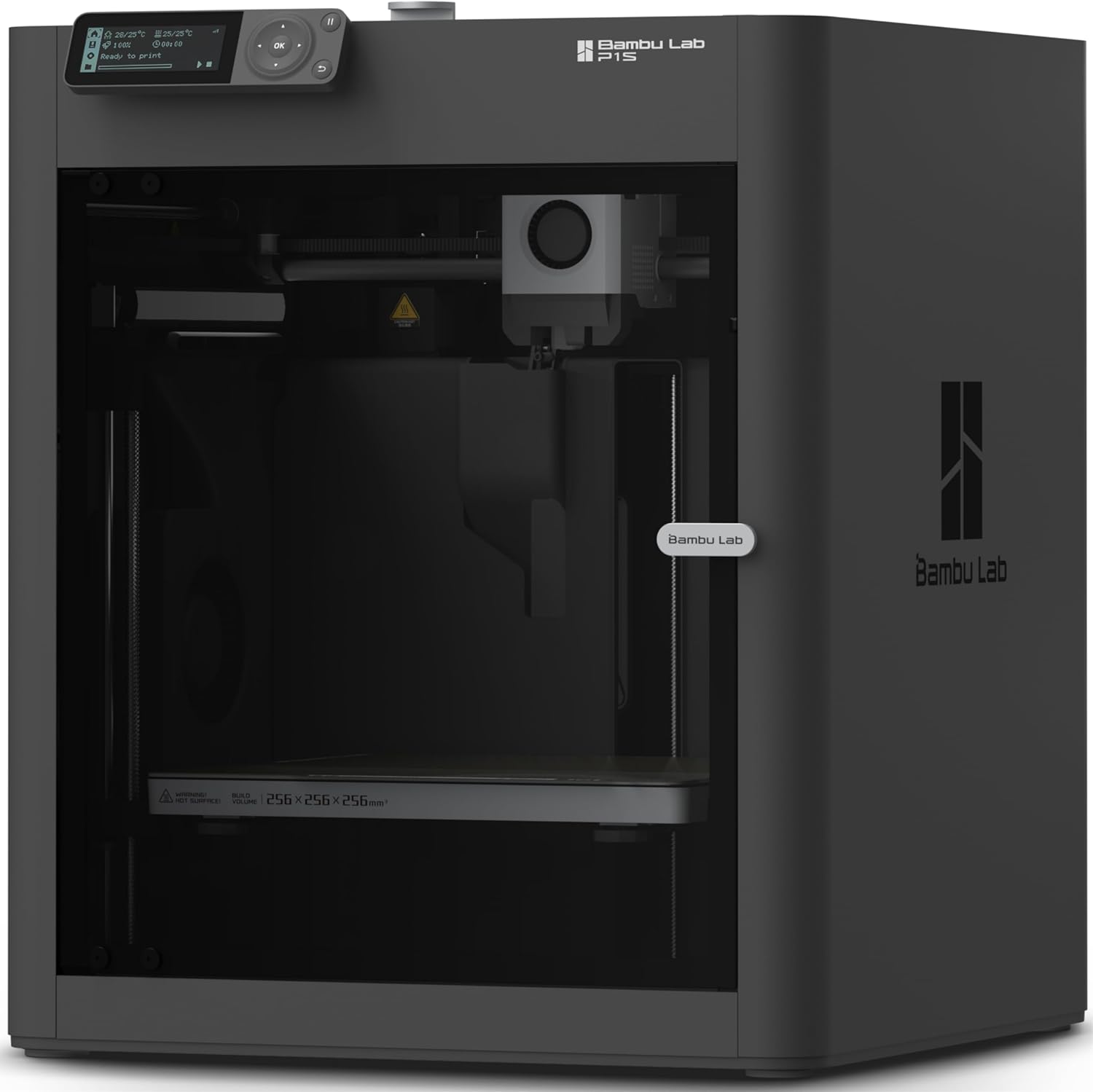
| Build volume | 256×256×256 mm³ |
|---|---|
| Max speed | 500 mm/s |
| Max acceleration | 20 m/s² |
| Supported filaments | PLA, PETG, TPU, PVA, PET, ABS, ASA |
The P1S targets fast, reliable desktop printing in an enclosed CoreXY package. It ships ready-to-use with automatic bed leveling, a direct-drive extruder for flexible and engineering filaments, and a camera for timelapse captures. The enclosed body and support for PLA, PETG, TPU, PVA, ABS and ASA help keep temperatures stable for higher-success prints, while the advertised 500 mm/s top speed and high acceleration are geared toward rapid part production when tuned correctly. Setup is presented as quick and user-friendly, so beginners can reach printing sooner, and the larger 256 mm cubic build volume covers most hobby and functional parts. Limitations to be aware of are that some high-temperature materials like certain polycarbonate blends and reinforced carbon/glass fiber filaments are not recommended, and achieving the fastest speeds requires careful slicer tuning and good filament. For buyers prioritizing consistent, enclosed printing under a compact footprint, the P1S balances speed and practical material support in a beginner-accessible package.
Best for: A buyer who wants a dependable, enclosed desktop printer that minimizes failed first layers and handles common engineering filaments with minimal fuss, while valuing faster print throughput.
Less Ideal for: Users who need to print heavily reinforced or very high-temperature engineering composites, or those who prefer a fully open-source hardware and firmware ecosystem for deep customization.
- Enclosed CoreXY design improves thermal stability for ABS and other temperature-sensitive filaments
- Automatic bed leveling reduces first-layer failures and setup friction
- Direct-drive extruder expands compatibility with flexible filaments like TPU
- Relatively large 256×256×256 mm build volume for the class
- Fast motion capabilities that shorten print times when properly tuned
- Not recommended for carbon- or glass-fiber reinforced filaments
- Top speeds require careful tuning and high-quality filament to avoid quality loss
Verdict: The P1S is the go-to enclosed desktop printer under $500 for buyers wanting reliable, higher-speed prints and broad filament support in a compact, easy-to-setup package.
FLASHFORGE Adventurer 5M
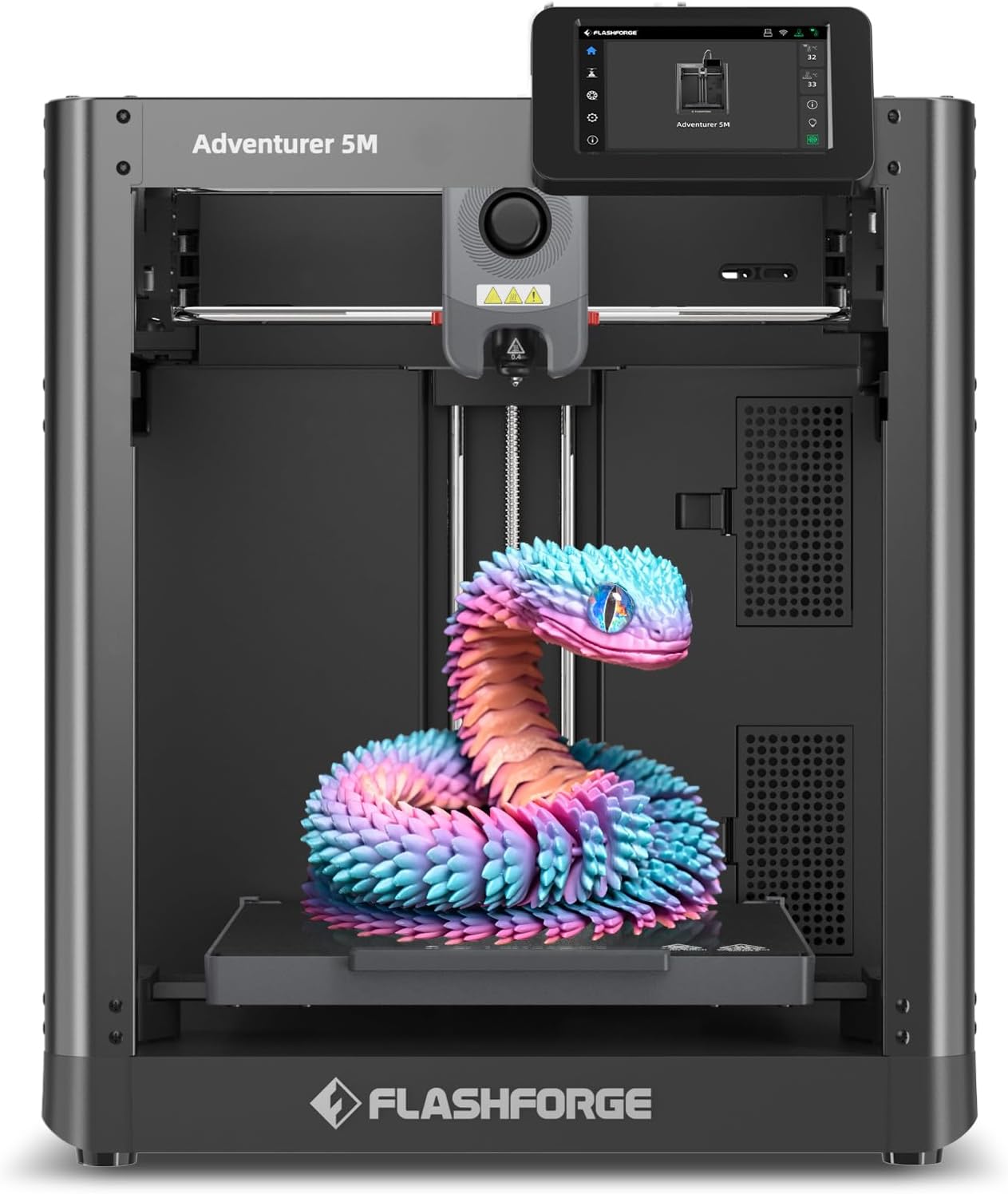
| Build Volume | 220 x 220 x 220 mm |
|---|---|
| Leveling Type | One-Button Auto Leveling |
| Travel Speed | 600 mm/s |
| Extruder Max Temp | Max. 280°C Direct Drive |
| Platform Type | Double-Sided PEI Platform |
The Adventurer 5M is a CoreXY enclosed desktop printer built for faster print cycles without sacrificing usable quality. It uses a 280°C direct extruder with quick 3-second nozzle swaps and a high-flow 32mm³/s nozzle to support engineering filaments such as PLA, ABS, PETG, TPU and carbon-fiber blends, while a dual-sided PEI platform eases part removal. One-click automatic bed leveling, a 35-second warm-up to 200°C, and vibration compensation smooth the setup and improve first-layer reliability, and the Flash Maker mobile app adds remote monitoring. The printer's CoreXY mechanics allow travel speeds up to 600 mm/s and high acceleration for short print times, which benefits rapid prototyping and small production runs. Limitations include a modest 220 mm cubic build volume that constrains large parts and a 280°C max nozzle (vs higher-temp industrial printers) that limits some high-temperature materials; users should also expect routine maintenance like nozzle and platform cleaning to keep reliability high.
Best for: Buyers who want an enclosed, relatively easy-to-use printer that prioritizes speed and reliable first layers for prototyping and small-run production, with remote monitoring for hands-off jobs.
Less Ideal for: Those who need a large-format printer, higher than 280°C extrusion for specialty high-temp polymers, or a no-maintenance plug-and-play device should consider other options.
- CoreXY all-metal structure for faster, accurate movement
- One-click automatic bed leveling for easier first layers
- 280°C direct extruder with quick-change nozzle for versatile filament support
- Dual-sided PEI platform for simpler part removal and adhesion management
- Mobile app remote monitoring and intelligent operation
- 220×220×220 mm build volume limits larger prints
- Max nozzle temperature and features are less than higher-end industrial printers
Verdict: Choose the Adventurer 5M if you want an enclosed CoreXY printer under $500 that speeds up prototyping with reliable auto-leveling and a fast direct extruder.
Choosing the Right Enclosed 3D Printer: Key Factors to Consider
Print Reliability
Consistent print output depends on a rigid frame, precise motion components, and a heated, stable chamber. A well-engineered enclosed 3D printer minimizes vibration and maintains temperature, which reduces layer separation and dimensional errors. Reliability affects how much time you spend troubleshooting versus printing and determines whether the machine is suitable for functional parts.
Look for machines with proven motion systems, robust belts or lead screws, and a dependable hotend and bed combination. Firmware stability and community-tested profiles also matter because they reduce the setup time needed to get consistently good results.
Usable Build Volume
Build volume dictates the maximum part size and influences how many pieces you can batch in a single print. For enclosed printers under $500, there is a tradeoff between chamber size and overall footprint. A slightly smaller but well-utilized build area can be more valuable than a larger but awkwardly proportioned space that is hard to heat evenly.
Consider the typical parts you plan to print and whether you will benefit from a taller or wider build envelope. Also evaluate whether the platen and enclosure allow you to reach into the chamber easily for part removal and maintenance.
Enclosure Quality and Safety Features
The enclosure is the defining feature of this category, so panel fit, door seals, and access points matter. A good enclosure keeps heat in, which improves adhesion for ABS-like materials and reduces warping. It also limits particulate and fume spread within indoor spaces. Venting options and optional filtration are useful if you plan to print thermally aggressive filaments.
Safety features such as door interlocks, insulated panels, and covered hot components reduce burn and pinch hazards. For home or classroom use, these protections lower risk during unattended prints.
Ease of Setup and Maintenance
Even a capable printer is less useful if setup is painful. Straightforward assembly, clear instructions, and reliable bed-leveling routines shorten the time to first good print. User-friendly interfaces, easy filament loading, and accessible maintenance points make day-to-day use more pleasant.
Also consider the availability of replacement parts and the simplicity of common repairs. Machines that allow quick belt tensioning, nozzle changes, or bed surface swaps reduce downtime and long-term frustration.
Material Compatibility
An enclosed machine should expand the range of filaments you can print successfully. Heated beds and a controlled chamber support PETG and ABS more reliably than open printers. Check whether the hotend reaches temperatures needed for your intended filaments and whether the build surface adheres well to those materials.
Bear in mind that true high-temperature materials require specialty hotends and heated enclosures beyond this budget tier. For most hobby uses, compatibility with PLA, PETG, and basic ABS is the practical target within a sub-$500 enclosure.
Choosing the Right Size for Your Workspace
Enclosed printers come in compact footprints and slightly larger boxes. Measure your intended workspace before buying to ensure the cabinet clears shelves and allows air circulation around the unit. Think about access for filament spools and room for removing printed parts.
If you work on many small prints, a wider bed is more efficient. If you frequently print tall objects, prioritize vertical clearance. Also consider whether the enclosure needs to be transported occasionally; lighter, smaller boxes are easier to move.
- Measure clearance for doors and ventilation
- Plan for spool placement and filament path
- Account for reach when removing prints
Bed Surfaces and Adhesion Strategies
The right bed surface reduces first-layer failures. Common options include textured PEI sheets, glass with adhesives, and magnetic spring steel sheets. Each has pros and cons for adhesion and part removal. Textured PEI often provides reliable grip for PLA and PETG, while glass with a glue stick can work well for mixed-material use.
For ABS and other temperature-sensitive materials, use heated beds and an enclosure to avoid warping. Consider whether the printer allows changing bed surfaces easily so you can tailor adhesion methods per material.
- PEI sheets are low-maintenance and generally reliable
- Glass beds produce flat bottoms and are easy to clean
- Removable magnetic beds speed part removal
Ventilation and Filtration Considerations
Enclosures trap heat and particulates, so ventilation options are important if you print in a small room. Some printers include passive vents or ports for external ducting. Others offer built-in filters to reduce odors and ultrafine particles. Decide how much filtration you need based on your filament choices and indoor air concerns.
If you plan to print in a shared indoor area, prioritize models that provide at least basic venting or the ability to attach aftermarket filtration. Proper ventilation reduces odor buildup and can improve long-run reliability of electronic components inside the enclosure.
- Passive vents can be sufficient for PLA
- Activated carbon filters reduce odors from ABS
- Consider a small fan or external fume extractor for heavy use
Firmware, Slicing Profiles, and Community Support
A stable firmware and readily available slicing profiles reduce the time spent tuning prints. Community-contributed settings and troubleshooting tips are especially valuable for budget printers where manufacturer support may be limited. Check whether common slicers include profiles for the machine or whether the community maintains reliable presets.
Good documentation and active user forums shorten learning curves. If you prefer a smoother out-of-the-box experience, prioritize machines with clear setup guides and widely shared sample profiles for the filaments you plan to use.
- Look for community profiles for popular slicers
- Prioritize clear manufacturer setup guides
- Check for firmware updateability and documentation
Routine Maintenance Tips
Regular maintenance keeps an enclosed 3D printer working reliably. Clean the build surface after every few prints, inspect belts and pulleys for proper tension, and periodically check the hotend for filament buildup. Lubricating linear rails and lead screws per manufacturer guidance preserves motion accuracy.
Keep spare consumables such as nozzles, PTFE tubing, and bed adhesives on hand to avoid long downtime. A simple maintenance checklist reduces the chances that a small issue becomes a print-stopping problem.
- Wipe the bed and inspect for residue
- Check belt tension monthly
- Keep spare nozzles and fastening hardware
How We Chose the Best Enclosed 3D Printer
We focused on criteria that matter for enclosed desktop 3D printers priced under $500. First, print reliability: we looked for machines with stable motion systems, heated beds, and enclosed chambers that maintain consistent temperatures for better layer adhesion. Second, usable build volume and form factor: we prioritized printers that maximize printable part size while remaining compact enough for home benches. Third, safety and enclosure quality: we evaluated door and panel fit, filtration or venting options, and any interlocks that reduce exposure to hot components. Fourth, ease of setup and user experience: firmware stability, straightforward bed leveling, clear assembly instructions, and community support influence how quickly you can produce usable parts. Fifth, material compatibility: we considered whether the enclosed environment and hotend/bed capabilities support common filaments such as PLA, PETG, and ABS. We excluded open-frame models, specialty industrial machines, and any units clearly lacking a heated bed or proper chamber sealing. Our selections emphasize balanced performance within the under-$500 budget and suitability for home and hobby use.
Our full evaluation process is outlined in our review methodology.
FAQ
Does an enclosure let me print ABS reliably on a budget printer?
An enclosure helps by maintaining chamber temperature and reducing warping, which makes ABS more feasible. Within a sub-$500 budget, expect basic ABS success for small to medium parts, but large ABS prints may still need more advanced temperature control.
Will an enclosed printer reduce odors and particles?
Enclosures limit the spread of particles and can contain odors, but filtration level varies. Models with vents or carbon filters perform better for odor control, while simple closed boxes mainly reduce ambient spread.
How important is a heated bed in an enclosed machine?
A heated bed is essential for printing materials like PETG and ABS because it helps the first layer adhere and reduces warping. Even with an enclosure, a heated bed improves reliability across a wider range of filaments.
Can I upgrade an enclosed printer later if I want better performance?
Many features can be upgraded, such as adding better bed surfaces, stronger hotends, or improved ventilation. However, major changes like swapping to a high-temperature hotend may be limited by the printer's electronics and frame design.
Is enclosure maintenance different from open-frame printers?
Enclosures require occasional cleaning of internal panels and any filters, and you should monitor temperature buildup around electronics. Otherwise, routine tasks like nozzle cleaning and belt checks remain the same.
Final Verdict
When choosing an enclosed 3D printer under $500, prioritize stable print performance and a usable build volume that matches the parts you intend to produce. Good enclosure quality and basic ventilation extend material options and improve safety, while straightforward setup and community support reduce time spent troubleshooting. Balance chamber size against your workspace and pick the machine that aligns with the filaments and part sizes you print most often. With those tradeoffs in mind, you can confidently select an enclosed printer that delivers repeatable results for hobby and small-workshop projects.