
Note: This article contains affiliate links. If you click on these links and make a purchase, we may earn a small commission at no extra cost to you. This helps support our research and content. Read our full affiliate disclosure here.
Picking the right espresso machine for at home changes how you start mornings and entertain guests. The right machine delivers consistent, well-extracted shots and fits your routine, whether you want quick single cups or a more hands-on barista experience. This guide focuses on compact, user-friendly machines suited to home kitchens and evaluates options based on extraction consistency, steam wand performance, maintenance effort, and long-term reliability. Below are our top shortlisted picks for home espresso machines built around real-world convenience and repeatable shot quality. Read on to see which features and tradeoffs matter most and which machines match different home brewing approaches.
Top Picks at a Glance
| Best Overall The best all-around choice for most situations | De'Longhi Dedica EC680M |  |
| Best Quality Built to a higher standard if you want something more solid | Breville Barista Pro BES878BSS |  |
| Best Value The sweet spot between price and what you get | Gevi 20 Bar Espresso Machine ECMG0 | 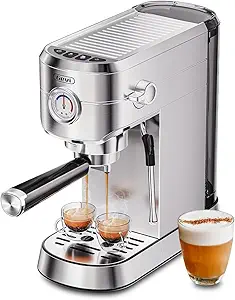 |
| Best Budget The cheapest option that still gets the job done reliably | IMUSA Espresso & Cappuccino Maker |  |
| Top Rated A top-rated pick with lots of positive feedback | Breville Barista Express BES870XL |  |
| Most Popular A crowd favorite that many people choose with confidence | CASABREWS CM5418 Espresso Machine |  |
| Best Seller A high-volume bestseller chosen again and again | atatix EM3111 Espresso Machine |  |
De'Longhi Dedica EC680M
| Output Pressure | 15 bar |
|---|---|
| Capacity | 1 liters |
| Wattage | 1450 watts |
| Coffee Input Type | ground, pod |
| Power Source | electric |
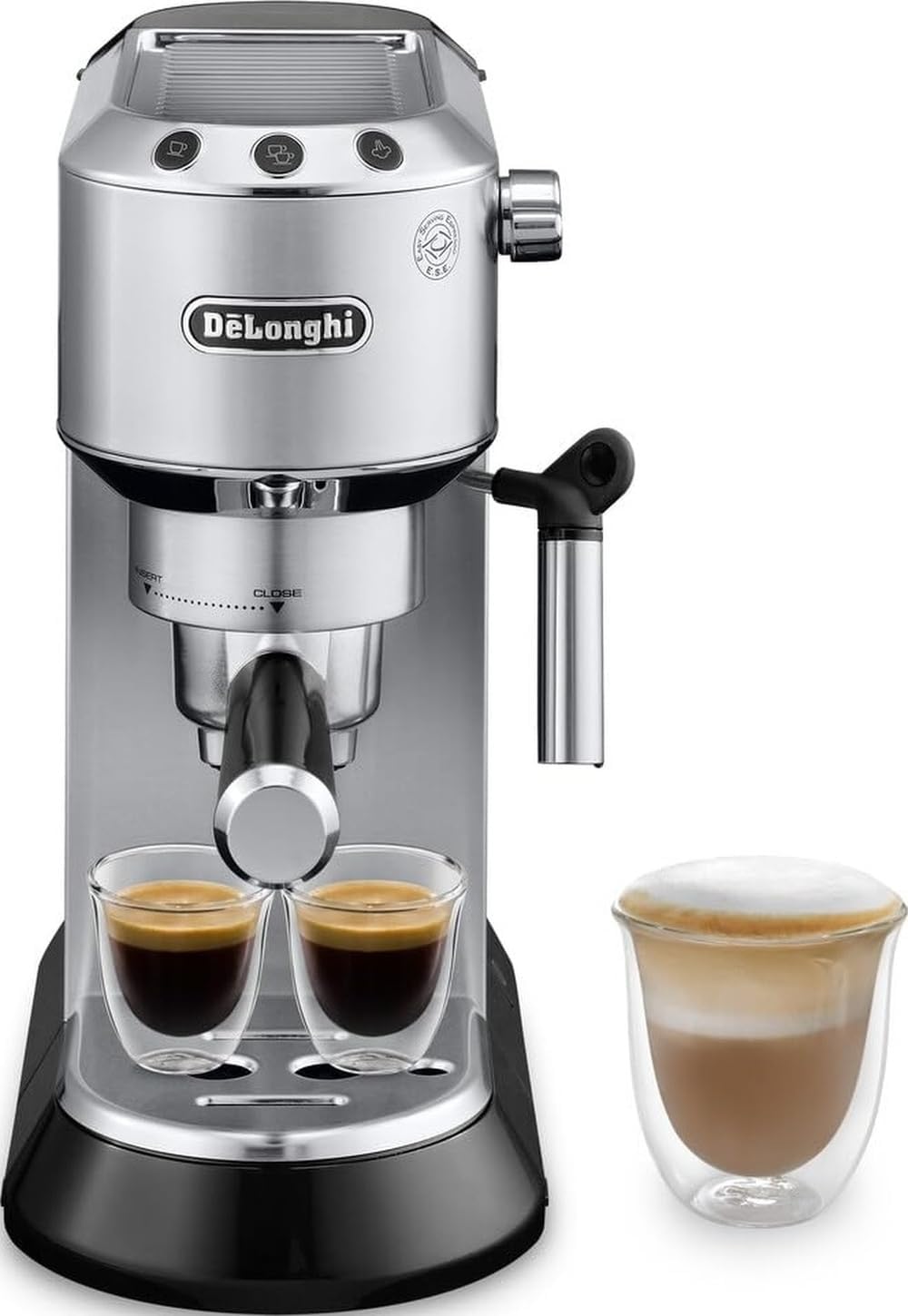
The De'Longhi Dedica EC680M packs espresso-shop capabilities into a slim counter-friendly body designed for daily home use. It uses a 15-bar pump and thermoblock heating to reach brewing temperature quickly, and the 3-in-1 filter holder accepts single/double shots and ESE pods so you can use ground coffee or pods. The manual steam wand creates thick milk foam for cappuccinos and lattes, and the adjustable drip tray fits taller cups up to about 5 inches. Routine tasks are straightforward: fill the removable 1 L water tank, tamp grounds into the filter, brew one or two shots with the flow-stop feature, then froth milk by hand and wipe the wand. The machine is compact and easy to clean with dishwasher-safe parts, but it is a manual-style unit so achieving consistent barista-level shots requires some practice and you will need to manage dosing and tamping yourself. Its small footprint and rapid heat-up make it a strong everyday machine for someone who wants control without a large appliance footprint.
Best for: Buyers who want a full espresso and milk-based drink experience at home in a compact, countertop-friendly machine and are willing to learn basic barista techniques.
Less Ideal for: People who want one-touch, fully automated espresso brewing or an integrated grinder built into the machine.
- 15-bar pump and thermoblock heater for quick warm-up and proper extraction pressure
- Slim 6-inch-wide design frees countertop space in small kitchens
- 3-in-1 filter holder accepts single/double shots and ESE pods for brew flexibility
- Manual steam wand delivers rich milk froth for cappuccinos and lattes
- Removable water tank and dishwasher-safe parts make cleaning easier
- Manual operation requires learning tamping and steaming technique for consistent results
- No built-in grinder so you must pre-grind beans or use pods
Verdict: Buy this if you want a compact, fast-heating espresso machine that delivers real espresso and frothy milk while keeping a small footprint on your countertop.
Breville Barista Pro BES878BSS

| Wattage | 1680 watts |
|---|---|
| Voltage | 120 |
| Coffee Input Type | whole bean, ground |
| Filter Type | Reusable |
| Capacity | 2 liters |
The Breville Barista Pro combines a fast ThermoJet heating system with a built-in conical burr grinder to deliver café-style espresso shots at home. You grind directly into the portafilter with 30 grind settings and dose control, then use the 54mm portafilter and single or double-wall baskets to pull 9-bar extractions after a short low-pressure pre-infusion. The PID temperature control keeps extraction temperatures consistent, and the steam wand produces fine microfoam for lattes and cappuccinos, making the machine useful for both straight espresso and milk-based drinks. The intuitive LCD gives grind and extraction feedback so you can learn and tweak parameters quickly. It is a heavy, stainless steel countertop unit that includes a milk jug, razor dose-trimming tool, and cleaning kit, so initial setup and maintenance are straightforward. Limitations are typical of semi-automatic machines: there is a learning curve to dialing in grind and dose for consistent shots, and the unit occupies significant counter space and weight compared with compact consumer machines.
Best for: Serious home coffee enthusiasts who prioritize extraction control and café-quality drinks and are willing to learn dialing in grind, dose, and steam technique.
Less Ideal for: Casual users who want fully automatic one-touch brewing or a very compact, lightweight machine for limited counter space.
- Integrated conical burr grinder with 30 grind settings and dose control for precise dosing
- ThermoJet heating and PID temperature control for fast heat-up and stable extraction
- Powerful steam wand that textures milk to silky microfoam suitable for latte art
- Includes useful accessories like milk jug, razor dose-trimming tool, and cleaning kit
- Significant size and weight require dedicated countertop space
- Semi-automatic operation requires practice to consistently dial in shots
Verdict: Buy this if you want a fast-heating, grinder-equipped semi-automatic that delivers barista-style espresso and milk-texturing at home.
Gevi 20 Bar Espresso Machine ECMG0
| Output Pressure | 20 bar |
|---|---|
| Wattage | 1350 watts |
| Operation Mode | Semi-Automatic |
| Power Source | AC adapter |
| Capacity | 1 liters |
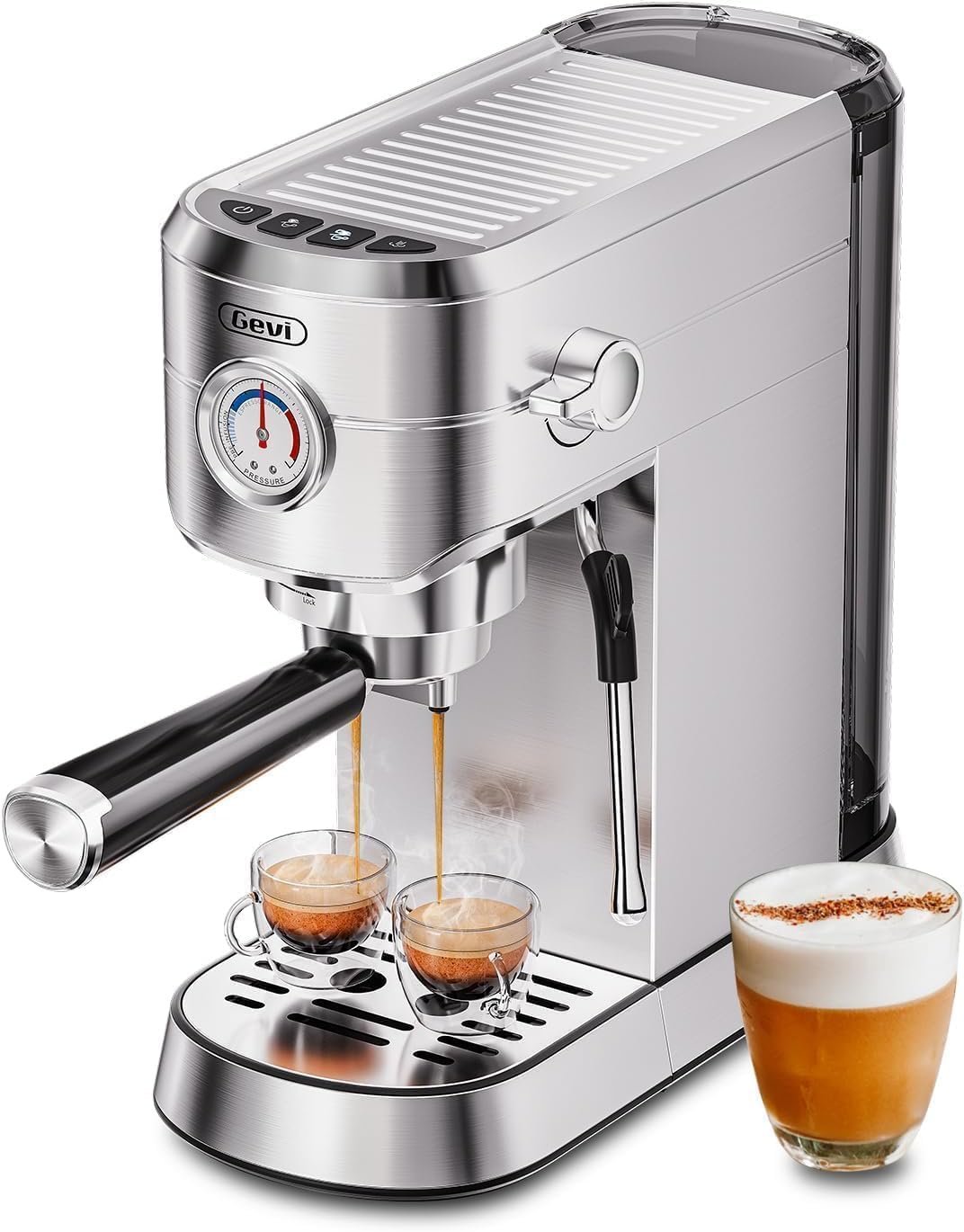
The Gevi 20 Bar Espresso Machine is a countertop semi-automatic unit aimed at making espresso, Americanos, and milk-based drinks at home. It uses a 20‑bar pump with NTC temperature control, a pressure gauge, and pre-infusion to help extract fuller flavor, and a steam wand plus removable froth nozzle for cappuccinos and lattes. The removable 34 oz water tank and cup warmer make routine use convenient, and the stainless steel body feels sturdy for daily use. Controls are button-based and the reusable filter and included portafilters/filters let you use ground coffee with adjustable shot volume. Expect some pump noise and light vibration during extraction because of the high-pressure pump, and the manual cleaning requirements for the portafilter and steam wand mean a little maintenance after each milk drink. This machine balances compact footprint and useful espresso features for home users who want more control than a pod machine without taking up much counter space.
Best for: Buyers who want a compact, hands-on espresso machine that delivers café-style drinks and control without a large commercial footprint, and who are willing to learn basic dosing and steaming techniques.
Less Ideal for: If you prefer fully automatic, one-touch or pod systems for grab-and-go convenience, or want a silent machine for very quiet environments, this manual semi-automatic unit is not the best fit.
- 20‑bar pump with pre-infusion and built-in pressure gauge for more consistent extraction.
- Powerful steam wand and removable froth nozzle for producing microfoam for milk drinks.
- Compact stainless steel housing that fits small countertops while feeling durable.
- Removable 34 oz water tank and cup warmer for everyday convenience.
- Includes portafilter, single and double baskets, tamper, and cleaning tools so you can start brewing right away.
- Uses manual and semi-automatic controls so it requires practice to dial in consistent shots.
- Portafilter parts are not dishwasher-safe and need regular hand-cleaning.
- High-pressure pump causes noticeable noise and slight vibration during operation.
Verdict: A compact, feature-rich semi-automatic espresso machine that gives home users barista-style control and milk steaming in a countertop-friendly package.
IMUSA Espresso & Cappuccino Maker

| Capacity | 4 cups |
|---|---|
| Wattage | 800 watts |
| Operation Mode | Semi-Automatic |
| Other Special Features | Milk Frother, Permanent Filter |
The IMUSA 4-cup Espresso and Cappuccino Maker is a small countertop machine aimed at daily home use. It brews up to four servings of espresso into a glass carafe using a semi-automatic, 5-bar steam system and includes a steam nozzle to froth milk for cappuccinos and lattes. Controls are simple with a three-position selector knob, and the removable drip tray plus permanent filter make cleanup straightforward. At 800 watts it warms and brews quickly while the cool-touch carafe handle improves safety when pouring. Its compact footprint and matte black finish fit small kitchens and casual coffee drinkers who want cafe-style drinks without complex setup. Limitations include modest brew capacity and simplified controls that do not offer the precision or steam power of prosumer machines, and the plastic exterior means it is not built like higher-end stainless steel units. For buyers prioritizing easy, affordable espresso and frothing at home, this machine provides solid functionality for the price.
Best for: Buyers seeking an inexpensive, easy-to-use machine to make espresso-based drinks and froth milk at home without the complexity of prosumer equipment.
Less Ideal for: Anyone who wants commercial-level steam performance, fine-tuned shot control, or larger-capacity brewing for entertaining should consider a higher-end or larger machine.
- Compact 4-cup capacity suits small households and limited counter space
- Built-in steam nozzle produces milk froth for cappuccinos and lattes
- Permanent filter and removable drip tray simplify cleaning and maintenance
- 800-watt heater brings unit to operating temperature quickly
- Limited 4-cup capacity for larger households or frequent entertaining
- Basic controls and construction offer less precision than higher-end espresso machines
Verdict: A compact, budget-friendly machine that delivers straightforward espresso and milk frothing for home drinkers who want cafe-style beverages without complexity.
Breville Barista Express BES870XL

| Wattage | 1600 watts |
|---|---|
| Voltage | 120 |
| Coffee Input Type | whole_beans |
| Power Source | AC adapter |
| Filter Type | Reusable |
The Breville Barista Express BES870XL is a manual, near‑professional espresso maker that grinds, doses, extracts and steams in one compact unit. It uses an integrated conical burr grinder with adjustable grind settings so you can grind directly into the 54mm portafilter, and a thermocoil heating system with PID temperature control for more consistent extraction. Low‑pressure pre‑infusion and single/dual wall filter baskets help produce balanced shots, while the powerful steam wand allows manual microfoam for lattes and cappuccinos. Typical use is hands‑on: you grind, tamp and adjust grind/dose to dial in shots, then steam milk by hand for milk‑based drinks. The machine includes practical accessories like a dosing razor, tamper and water filter, and its stainless steel build feels durable. Expect a learning curve for consistent shot timing and maintenance chores like cleaning the grinder, backflushing and descaling. It is not an automatic one‑touch milk system so it suits users who want control rather than push‑button convenience.
Best for: Buyers who prioritize a reliable, durable machine that gives hands‑on control over grinding, dosing and steaming and who are willing to learn barista technique to get consistent results.
Less Ideal for: People who want fully automatic, one‑touch drink programs or a machine that requires minimal user intervention should look at superautomatic or pod machines instead.
- Integrated conical burr grinder with 16 grind settings for fresh dosing
- PID thermocoil temperature control for steadier extractions
- 54mm stainless steel portafilter and dual/single wall baskets for espresso flexibility
- Powerful steam wand capable of producing microfoam for latte art
- Durable stainless steel construction and useful included accessories (razor, tamper, scoop)
- Requires manual tamping and technique to produce consistent shots
- Regular cleaning and maintenance (grinder, backflush, descaling) needed to sustain performance
Verdict: Choose the Barista Express if you want a factory‑quality, reliable semi‑automatic machine that grinds, extracts and steams in a single durable unit for hands‑on home espresso.
CASABREWS CM5418 Espresso Machine
| Output Pressure | 20 bar |
|---|---|
| Wattage | 1350 watts |
| Operation Mode | Semi-Automatic |
| Coffee Input Type | ground_coffee |
| Filter Type | Reusable |
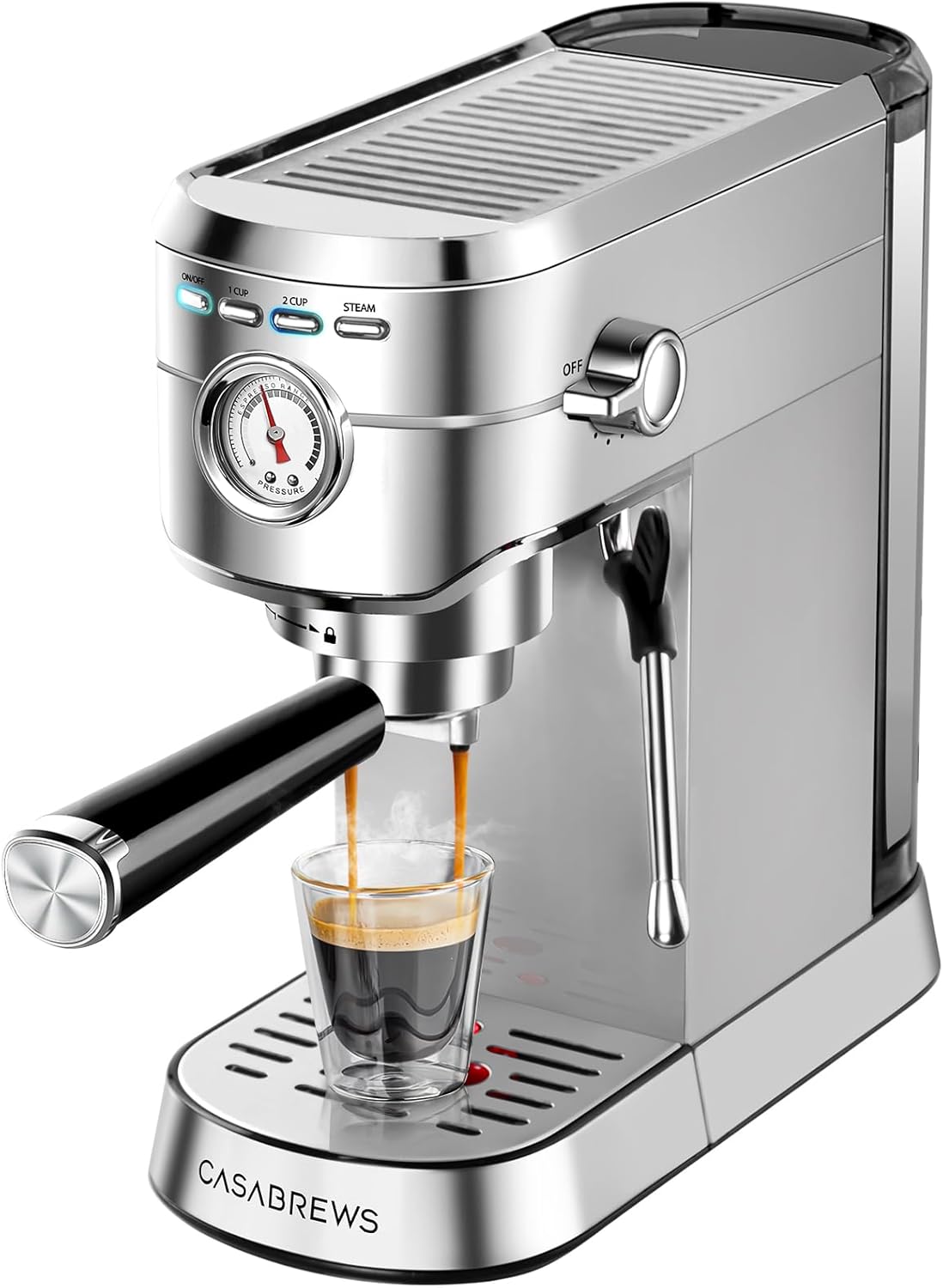
The CASABREWS CM5418 is a slim semi-automatic espresso machine meant for home baristas who want café-style drinks without a large footprint. It uses a 20-bar Italian pump with a built-in pressure gauge and pre-infusion to help produce crema and more balanced extractions, and the 51mm portafilter accepts the included single- and double-shot baskets. The steam wand generates strong steam for microfoam so you can froth milk for lattes and cappuccinos, and the top cup warmer and removable 34 oz water tank make short daily routines easier. Controls are button-based and the machine advises simple steps for cooling after steaming to avoid over-temperature protection. Expect warm-up and steam times typical of a single-boiler, and occasional adjustments to grind, dose, and tamp to dial in consistent flow. The stainless steel body looks durable but the compact single-boiler design means you cannot brew and steam simultaneously and you should allow short recovery time between shots and frothing.
Best for: Buyers who want a compact, influencer-tested home espresso setup that delivers café-style crema and good milk texture while relying on community-tested workflows and support.
Less Ideal for: Those who need commercial‑level throughput, simultaneous brew-and-steam capability, or advanced temperature profiling for precision espresso experiments.
- 20-bar pump with built-in pressure gauge for visible extraction feedback
- Low-pressure pre-infusion to improve flavor balance
- Powerful steam wand capable of producing microfoam for latte art
- Detachable 34 oz water tank for easy refilling and cleaning
- Compact stainless steel body with a cup warmer and removable drip tray
- Single-boiler system requires cooldown between brewing and steaming so you cannot do both at once
- Push-button controls offer less fine control than dedicated PID or pressure-profiled machines
Verdict: A compact, feature-rich home espresso machine that gives visible pressure feedback and strong steaming power for buyers seeking café-quality drinks without a large countertop machine.
atatix EM3111 Espresso Machine

| Output Pressure | 20 bar |
|---|---|
| Wattage | 1350 watts |
| Operation Mode | Semi-Automatic |
| Power Source | AC/DC |
| Filter Type | Reusable |
The atatix EM3111 is a compact semi-automatic espresso maker designed for home use and small offices. It uses a 20-bar pump and dual-wall filters to stabilize extraction and produce crema, while an NTC + PID temperature system aims to hold brewing temperature in the 90–96°C range for more consistent shots. The machine includes a powerful steam wand that produces dense microfoam for lattes and cappuccinos, a 45 oz removable water tank and a stainless steel exterior with cup-warming surface. Controls are simple buttons and a dial, and the package includes one- and two-cup filters, a portafilter, tamper and scoop. For buyers who value everyday reliability, the EM3111 delivers a near-professional feature set in a small footprint, though it is a semi-automatic unit so achieving restaurant-level consistency requires some tweaking and tamping skill. The reusable filter is convenient but users who prefer one-touch programmability or built-in grinders will need a different model.
Best for: Home users who want near-professional brewing controls and a real steam wand in a compact, easy-to-fit machine and who prefer stability and consistent temperature over one-touch automation.
Less Ideal for: People who want a fully automatic, push-button espresso experience with an integrated grinder or those who do not want to learn tamping and manual extraction techniques.
- 20-bar pump with dual-wall filters for stable extraction and good crema
- NTC + PID temperature control for more consistent shot temperatures
- Powerful steam wand capable of producing dense microfoam for milk drinks
- Compact stainless steel body with removable water tank and drip tray for easier cleaning
- Includes portafilter, one- and two-cup filters, tamper and scoop so you can start brewing right away
- No built-in grinder so you must buy or use a separate grinder for fresh grinding
- Semi-automatic workflow requires practice to dial in consistent shots compared with programmable machines
Verdict: Choose the atatix EM3111 if you want a compact home espresso machine that pairs PID temperature control with a strong steam wand for consistent shots and cafe-style milk drinks.
Choosing the Right Espresso Machine for At Home: Key Factors to Consider
Shot Consistency and Temperature Stability
Consistent extraction comes from steady brew temperature and stable pressure. Machines with reliable temperature control avoid sour or bitter shots and make dialing in grind and dose more predictable.
For home use, temperature stability reduces wasted coffee and frustration. If you plan to pull multiple shots back to back or tweak recipes, choose a machine with clear temperature or PID control and a brewing system that maintains steady pressure.
Steam Wand Power and Milk Texturing
A strong, responsive steam wand is essential if you want cappuccinos or microfoam for latte art. Wand power affects how quickly you can stretch and texturize milk and how fine the foam becomes.
Consider wand ergonomics and whether it reaches into different pitcher sizes comfortably. For busy mornings, a faster steam recovery means less waiting between drinks. Also check wand tips and accessible cleaning paths to prevent milk residue buildup.
Ease of Cleaning and Routine Maintenance
Regular cleaning keeps flavor consistent and extends a machine's lifespan. Look for removable brew groups, easy-to-access water reservoirs, and clearly documented descaling intervals and procedures.
Home machines that minimize tools and disassembly for daily and monthly tasks save time. Consider whether the machine has dishwasher-safe parts, simple backflushing capability, or straightforward access to the group head for cleaning.
User Controls and Workflow
Controls determine how quickly you can pull a repeatable shot and make adjustments. Simple paddle or button interfaces work well for straightforward use, while programmable shot volumes and pre-infusion settings suit tinkerers.
Think about the learning curve. If you prefer a hands-off routine, prioritize machines with programmable presets and automatic dosing. If you enjoy the craft, choose a model that provides manual control over pressure and pre-infusion timing.
Size, Capacity, and Kitchen Fit
Home kitchens vary, so machine footprint, water reservoir size, and drip tray capacity matter. A compact machine fits small counters but may require more frequent refilling or emptying.
Measure your available counter space and consider clearance for a steam wand and portafilter. If you entertain or make multiple drinks daily, larger reservoirs and bigger drip trays reduce interruptions and make operations smoother.
Build Materials and Serviceability
Materials like stainless steel, brass, or quality plastics affect durability and heat retention. Metal boilers and brass group heads typically offer better thermal mass than thin plastics.
Serviceability is about how easy it is to get routine parts replaced and whether the machine has simple, documented maintenance points. For a long-term home machine, favor designs with accessible components and straightforward troubleshooting steps.
Manual Vs Semi-Automatic Vs Automatic Home Machines
Home espresso machines fall along a control spectrum. Manual lever machines give the most hands-on extraction experience but require skill to get consistent results. Semi-automatic machines balance manual elements with powered boilers and programmable shot switches, offering a mix of control and convenience. Automatic and super-automatic machines handle dosing and tamping for you, trading craft control for repeatability and speed.
Decide which tradeoff fits your routine. If you want café-level control and plan to practice technique, a semi-automatic or manual machine rewards effort. If you value speed and consistent beverages with minimal fuss, an automatic approach reduces steps and variability.
- Manual: High control, steep learning curve
- Semi-automatic: Balanced control and convenience
- Automatic: Fast, consistent, less hands-on
Grinder Pairing and the Importance of Fresh Grind
An espresso-capable grinder is as important as the machine itself. Fresh, uniform grind size directly affects extraction and crema. Burr grinders are preferred for consistent particle size and ease of dialing in.
When choosing a home setup, plan for space and workflow so the grinder sits near the machine. If you cannot invest in a dedicated grinder right away, look for machines that work acceptably with finer pre-ground roasts, but expect limitations in shot quality and consistency.
- Burr grinders offer repeatable particle size control
- Adjust grind size incrementally when dialing in
- Keep grinder and machine placement ergonomic for daily use
Water Quality and Its Effect on Espresso
Water chemistry affects flavor and machine health. Hard water accelerates scale buildup and can alter extraction taste. Using filtered water with balanced mineral content preserves flavor and reduces descaling frequency.
If your tap water is very hard, consider a low-maintenance filtration option or follow the machine manufacturer's guidelines for descaling. Regular descaling and a clean water supply maintain consistent temperature and pressure performance.
- Test local water hardness to plan maintenance
- Use filters that maintain some mineral content for flavor
- Follow descaling schedule to avoid flow and temperature issues
Countertop Placement and Ventilation
Position the machine on a stable, level surface away from direct sunlight and heat sources. Proper ventilation around the machine helps components remain cool and prevents steam from causing moisture damage to cabinets.
Leave clearance for the steam wand and for removing the water reservoir or drip tray. If you have limited counter space, prioritize models with a vertical footprint and removable parts that are easy to slide out for service.
- Keep a few inches of clearance on all sides for airflow
- Avoid cramped spaces that impede steam wand use
- Place near a power outlet and consider splash protection for cabinetry
Routine Troubleshooting and Common Issues
Many home espresso issues stem from grind, tamp, or temperature rather than the machine itself. Start troubleshooting by checking grind size, dose, and tamping pressure when shots extract too quickly or slowly. Uneven crema or channeling often points to distribution rather than machine failure.
For steam-related problems, check for steam tip blockages and ensure the machine has reached operating temperature. Low water flow or pressure can be a sign of scale buildup, so keep to a regular descaling plan and check filters and water lines.
- Adjust grind and dose before suspecting the machine
- Clean steam tips and group head regularly
- Descale on a schedule if using hard water
How We Chose the Best Espresso Machine for At Home
We prioritized concrete, repeatable performance metrics that matter for everyday home espresso use. Key evaluation points included extraction consistency, measured by the machine's temperature stability and pressure control; milk-frothing capability, judging steam wand power, range of textures achievable, and wand ergonomics; ease of cleaning and routine maintenance, covering removable parts, descaling access, and serviceability; and user workflow, including setup complexity, shot programmability, and recovery time between shots. We also considered build quality and longevity indicators such as boiler or thermoblock design and quality of internal components. Products were excluded if they lacked clear temperature or pressure control, required frequent nonstandard maintenance, or were explicitly intended for commercial use rather than home kitchens. We gave extra weight to machines that balance strong shot results with practical upkeep for home users. The criteria here align with the per-product scoring metrics so readers can compare machines on the same decision dimensions.
Our full evaluation process is outlined in our review methodology.
FAQ
How often should I descale a home espresso machine?
Descale frequency depends on water hardness and usage. Typically, descaling every 2 to 3 months for hard water or every 6 months for soft water keeps scale from impacting flow and temperature stability.
Do I need a built-in grinder on an at-home espresso machine?
A built-in grinder is convenient but not required. A high-quality standalone burr grinder usually offers better control and consistency, though integrated grinders save counter space.
What grind size works best for espresso at home?
Espresso requires a fine, uniform grind. Exact settings vary by grinder and roast, so start with a fine setting and adjust in small steps until shots extract in the target timeframe for your recipe.
Can I use tap water in my espresso machine?
You can use tap water if it is moderately soft. Very hard water increases scale buildup and maintenance. Using a simple filter that preserves some minerals is often the best balance for flavor and longevity.
Why does my steam wand sputter or produce weak steam?
Sputtering typically indicates blockages in the steam tip, low boiler pressure, or insufficient temperature. Clean the tip thoroughly and verify the machine has reached full steam temperature before attempting to froth.
How do I improve crema on home espresso shots?
Crema improves with fresh coffee, correct grind and dose, and stable extraction temperature. Make sure beans are recently roasted, adjust grind finer if extraction is too fast, and check the machine's temperature stability.
Final Verdict
Choosing an espresso machine for at home comes down to the balance you want between hands-on control and everyday convenience. Prioritize temperature stability and steam wand performance if you value café-style shots and milk drinks. If you prefer quick consistency, machines with programmable workflows and easy cleaning will save time. Weigh the tradeoffs of footprint, maintenance, and user controls against how you plan to use the machine. Focus on the scoring dimensions discussed here to match a model to your routine and know that investing in a good grinder and regular maintenance will pay the biggest dividends in shot quality over time.