
Note: This article contains affiliate links. If you click on these links and make a purchase, we may earn a small commission at no extra cost to you. This helps support our research and content. Read our full affiliate disclosure here.
If you pull shots frequently and demand consistent results, choosing the right espresso machine for baristas matters more than a flashy feature list. The right machine affects extraction stability, steam speed, and workflow at the counter, so it shapes both drink quality and service rhythm. This guide shortlists the seven best options for baristas who want pro-level controls, reliable steam performance, and service-ready ergonomics. We evaluate machines on the technical specs and real-world factors that most influence daily cafe use, then summarize the key tradeoffs to help you pick the best fit.
Top Picks at a Glance
| Best Overall The best all-around choice for most situations | De'Longhi La Specialista Arte Evo |  |
| Best Quality Built to a higher standard if you want something more solid | Breville Barista Touch BES880BSS |  |
| Best Value The sweet spot between price and what you get | Gaggia Classic Evo Pro RI9380/46 |  |
| Best Budget The cheapest option that still gets the job done reliably | CASABREWS 3700 Essential |  |
| Top Rated A top-rated pick with lots of positive feedback | Breville Barista Express BES870XL |  |
| Most Popular A crowd favorite that many people choose with confidence | Mr. Coffee Cafe Barista |  |
| Best Seller A high-volume bestseller chosen again and again | CASABREWS CM5418 Espresso Machine |  |
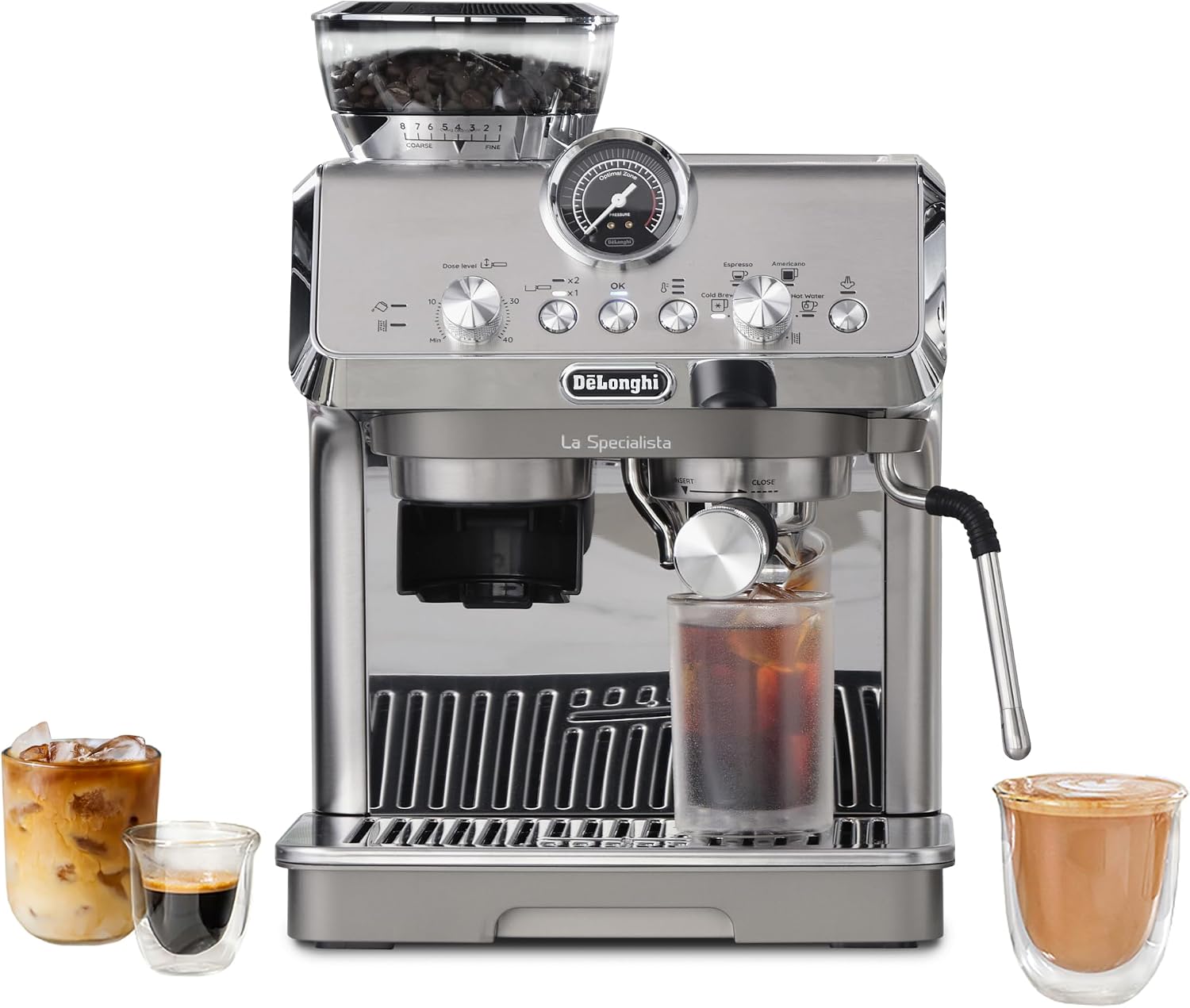
De'Longhi La Specialista Arte Evo
| Wattage | 1550 watts |
|---|---|
| Voltage | 120 volts |
| Output Pressure | 9 bar |
| Coffee Input Type | Whole Bean |
| Filter Type | Reusable |
The La Specialista Arte Evo is a semi-automatic home espresso machine aimed at hands-on users who want cafe-style beverages. It pairs a built-in conical burr grinder with eight grind settings and an integrated dosing/tamping kit so you can grind single or double doses cleanly, then extract espresso using Active Temperature Control and a 15 bar Italian pump that reaches optimal extraction pressure. Notable features include a powerful commercial-style steam wand for microfoam and latte art, a cold extraction mode that produces a cold brew-style cup in under five minutes, and four one-touch presets for espresso, Americano, cold brew, and hot water. The machine is compact for a full-featured unit and has several removable parts that are dishwasher-safe for easier cleanup. Expect a learning curve to dial in grind, dose, and temperature for consistent shots, and a fairly large footprint and weight compared with minimalist single-purpose machines. It excels for buyers who enjoy adjusting settings and want both hot and cold specialty drinks from one machine.
Best for: Buyers who want a single, hands-on machine that combines grinding, precise temperature control, and professional steaming to craft a wide range of espresso and specialty drinks at home.
Less Ideal for: People who prefer a plug-and-play, low-maintenance single-purpose unit or who need a very small, lightweight countertop appliance.
- Built-in conical burr grinder with 8 grind settings for consistent dosing
- Commercial-style steam wand that produces smooth micro-foam for latte art
- Cold Extraction Technology delivers a cold-brew-style cup in under five minutes
- Four beverage presets simplify common drink routines
- Includes barista kit (tamper, dosing funnel, stainless milk jug) for mess-free workflow
- Requires time and practice to dial in grind, dose, and temperature for repeatable results
- Relatively heavy and takes more counter space than compact single-purpose machines
Verdict: Choose the La Specialista Arte Evo if you want a single, all-in-one home machine that combines an adjustable burr grinder, professional steam wand, and fast cold-brew extraction for a true hands-on barista experience.
Breville Barista Touch BES880BSS

| Operation Mode | Fully Automatic |
|---|---|
| Wattage | 1680 watts |
| Human Interface Input | Touchscreen |
| Coffee Input Type | whole_beans |
| Filter Type | Reusable |
The Breville Barista Touch combines an integrated conical burr grinder, touchscreen interface, and an automated milk texturing system to let experienced users and focused home baristas produce consistent espresso, lattes, and cappuccinos. You select a drink or adjust grind, dose, milk texture, and temperature on the intuitive display, the machine grinds and doses automatically, and the ThermoJet heating system brings the group to brewing temperature quickly. The Auto Milk texturing delivers smooth microfoam suitable for latte art while the Razor dose-trimming tool and multiple grind settings give real control over extraction. Practical benefits include rapid heat-up, a reusable filter, and useful accessories like a stainless-steel jug and water filter. The machine is relatively heavy and assumes some willingness to learn tamping technique and routine cleaning to keep the grinder and steam wand performing at their best, and its size may demand dedicated counter space. For buyers who prioritize precise shots and textured milk without separate grinder gear, this machine streamlines the process effectively.
Best for: Aiming for café-quality shots and milk drinks at home, this is for buyers who want precise grind-to-cup control and automated milk texturing without buying separate equipment.
Less Ideal for: Casual coffee drinkers who prefer simple one-touch pods or minimal maintenance should consider simpler or more compact machines instead.
- Integrated conical burr grinder with 30 grind settings for precise dosing
- Touchscreen interface for quick drink selection and parameter adjustments
- Auto Milk texturing produces silky microfoam suitable for latte art
- ThermoJet heating system enables fast heat-up and stable extraction temperature
- Includes useful accessories like stainless-steel milk jug and dose trimming tool
- Heavy and requires significant counter space and a stable setup
- Needs regular cleaning and maintenance of grinder and steam wand to maintain performance
Verdict: If you want a single machine that grinds, doses, and textures milk to deliver consistent, barista-quality espresso drinks at home, the Barista Touch is built for that purpose.
Gaggia Classic Evo Pro RI9380/46
| Operation Mode | Semi-Automatic |
|---|---|
| Output Pressure | 9 bar |
| Wattage | 1200 watts |
| Coffee Input Type | ground, pod |
| Capacity | 2.1 liters |
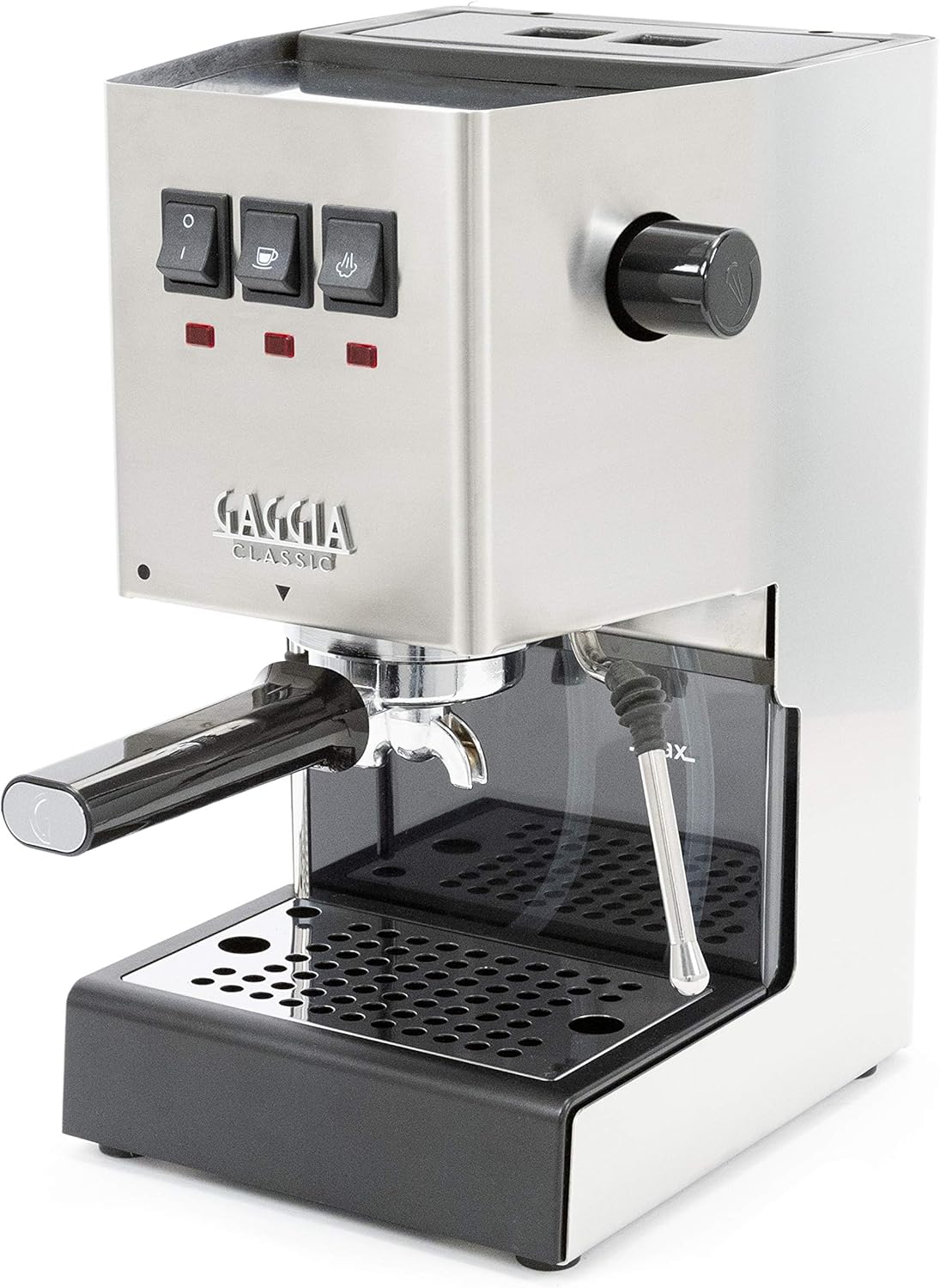
The Gaggia Classic Evo Pro is a made-in-Italy semi-automatic espresso machine aimed at home baristas who want commercial-style performance. It pulls shots at 9 bar pressure through a 58 mm commercial portafilter and offers both commercial single/double baskets plus a pressurized basket for pods or pre-ground coffee. The commercial steam wand and robust boiler let you texture milk for microfoam and latte art, while the updated pump mounting reduces noise and an improved boiler resists scale. The machine has a solid steel housing and includes useful accessories like a tamper and multiple baskets, making it ready for hands-on tuning and maintenance. Important trade-offs are that it is a heavier, more manual machine that requires some skill to dial in shots and regular descaling and cleaning to stay reliable, and it lacks fully automatic dosing or built-in grinders, so you will need a separate grinder for consistent results.
Best for: Buyers who want a durable, serviceable machine that reproduces café-style shots at home and are willing to learn hands-on espresso techniques and maintain the equipment.
Less Ideal for: If you want a fully automatic, low-effort machine with an integrated grinder or are looking for a lightweight travel-friendly unit, this is not the best fit.
- Commercial 58 mm portafilter and baskets for pro-style shots
- Commercial steam wand for proper milk texture and latte art
- Sturdy stainless steel housing built for long-term use
- Includes multiple baskets and tamper so you can start brewing right away
- Updated pump mounting for quieter operation
- No built-in grinder so consistent dosing requires a separate grinder
- Manual operation requires practice to dial in shots and milk steaming
Verdict: Choose the Gaggia Classic Evo Pro if you want a durable, commercial-style semi-automatic that rewards hands-on tuning and delivers café-quality shots at home.
CASABREWS 3700 Essential

| Output Pressure | 20 bar |
|---|---|
| Wattage | 1350 watts |
| Operation Mode | Semi-Automatic |
| Coffee Input Type | Ground |
| Capacity | 43.9 fluid ounces |
The CASABREWS 3700 Essential is a compact stainless-steel semi-automatic espresso machine aimed at home baristas who want café-style drinks without a complicated setup. It brews with a 20-bar Italian pump and uses PID temperature control to stabilize extraction, while a powerful steam wand makes microfoam for lattes and cappuccinos. The machine includes a 51mm portafilter with one- and two-cup stainless steel filters, a removable 43.9 oz tank for easier refills, and a removable drip tray to accommodate taller cups. Controls are button-based with programmable single-cup and double-cup volume memory, and practical features like a built-in cup warmer and low-pressure pre-infusion are included. Expect quick warm-up times and a durable brushed stainless-steel housing that fits small kitchens. Limitations are its single boiler design, which requires short waits between steaming and brewing, and the absence of a pressure gauge for real-time readouts. For the price point it delivers strong extraction and reliable steaming but will not match the speed or simultaneous brew/steam capability of prosumer dual-boiler machines.
Best for: Home baristas focused on getting café-style shots and steamed milk on a budget who value consistent temperature control and straightforward programmable volume buttons.
Less Ideal for: Those who need commercial speed or the ability to steam and brew simultaneously should consider prosumer dual-boiler machines instead.
- 20-bar pump with PID temperature control for consistent extraction
- Powerful steam wand that produces velvety microfoam for milk drinks
- Detachable 43.9 oz water tank and removable drip tray for easy refilling and cleaning
- Includes 51mm portafilter with one- and two-cup stainless steel filters and tamper
- Stainless-steel housing and compact footprint suitable for small kitchens
- Single boiler means you cannot brew and steam at the same time and need short cooldowns between functions
- No pressure gauge to monitor brewing pressure in real time
Verdict: If you want reliable café-style espresso and milk steaming on a budget, the CASABREWS 3700 Essential delivers consistent shots and good microfoam in a compact, easy-to-use package.
Breville Barista Express BES870XL

| Wattage | 1600 watts |
|---|---|
| Voltage | 120 |
| Coffee Input Type | whole_beans |
| Filter Type | Reusable |
| Capacity | 1 cups |
The Breville Barista Express BES870XL combines an integrated conical burr grinder, a 54mm portafilter, and a thermocoil heating system to take beans to espresso in under a minute. Users grind directly into the portafilter with adjustable grind settings and dose control, then use low-pressure pre-infusion and PID temperature control to extract more balanced shots. The steam wand produces manual microfoam for lattes and cappuccinos, and included tools such as a tamper, razor dose trimmer, and cleaning accessories make routine maintenance straightforward. Practical benefits include consistent grind-to-shot workflow, reliable temperature stability for repeatable results, and the ability to learn barista techniques without needing separate equipment. Trade-offs are that it is a manual workflow so it requires practice to nail timing and texture, and it is a single-boiler-style system that limits simultaneous steaming and extraction at the highest level of cafe throughput. For home baristas who prioritize control and built-in grinding, it is a durable, well-equipped machine that performs like a small home café unit.
Best for: Buyers who want a reliable, all-in-one home espresso setup that delivers consistent temperature and grinder integration while they learn barista techniques.
Less Ideal for: People who need automated, push-button convenience for high-volume service or those wanting fully hands-off specialty drink preparation.
- Integrated conical burr grinder with 16 grind settings for on-demand fresh grounds
- Thermocoil heating with PID temperature control for stable extraction
- 54mm stainless steel portafilter and single/dual-wall filter baskets for real espresso doses
- Powerful steam wand capable of manual microfoam for latte art
- Includes practical accessories (tamper, razor dose trimmer, cleaning tools, water filter)
- Manual operation requires practice to consistently dial in shots
- Single-unit heat system limits simultaneous steaming and extraction in high-volume use
Verdict: A dependable, built-in-grinder semi-automatic that gives home baristas temperature-stable shots and the tools to produce cafe-quality espresso and milk drinks.
Mr. Coffee Cafe Barista

| Output Pressure | 15 bar |
|---|---|
| Operation Mode | Semi-Automatic |
| Power Source | electric |
| Coffee Input Type | ground_coffee |
| Filter Type | Reusable |
The Mr. Coffee Cafe Barista is a compact semi-automatic espresso maker designed to deliver cafe-style drinks with minimal fuss. It uses a 15-bar electric pump to extract espresso and offers one-touch selections for single or double shots, plus an automatic milk frother with a removable milk reservoir for cappuccinos and lattes. Typical use is straightforward: fill the water tank, add ground coffee to the single- or double-shot filter, and choose your brew; the machine handles milk frothing automatically, which speeds morning routines. Notable features include a programmable one-touch control panel, a reusable filter, and a removable water and milk tank that simplify filling and cleaning. Performance is best when you use the recommended grind and tamping pressure, and while the 15-bar pump is capable of good extraction, this machine does not offer the same temperature and pressure control or steam power that pros expect from higher-end commercial units. It is a practical, user-friendly option for home baristas who want consistent espresso-based drinks without learning advanced techniques.
Best for: Buyers who want a reliable, easy-to-use machine that produces consistent espresso-based drinks at home with minimal setup and clear user feedback.
Less Ideal for: Serious home baristas seeking professional-level temperature and pressure control or cafes that need a machine built for continuous commercial use.
- 15-bar pump for stronger extraction compared with pump-free machines
- Automatic milk frother with removable reservoir for convenient cappuccinos and lattes
- One-touch controls for single or double shots simplify operation
- Removable water reservoir and reusable filter make filling and cleaning easier
- Limited temperature and steam control compared with higher-end prosumer or commercial machines
- Not designed for precise pressure profiling or heavy daily commercial use
Verdict: A straightforward, user-friendly espresso machine that reliably delivers single or double shots and automatic milk frothing for at-home cafe-style drinks.
CASABREWS CM5418 Espresso Machine
| Operation Mode | Semi-Automatic |
|---|---|
| Wattage | 1350 watts |
| Output Pressure | 20 bar |
| Coffee Input Type | ground_coffee |
| Filter Type | Reusable |
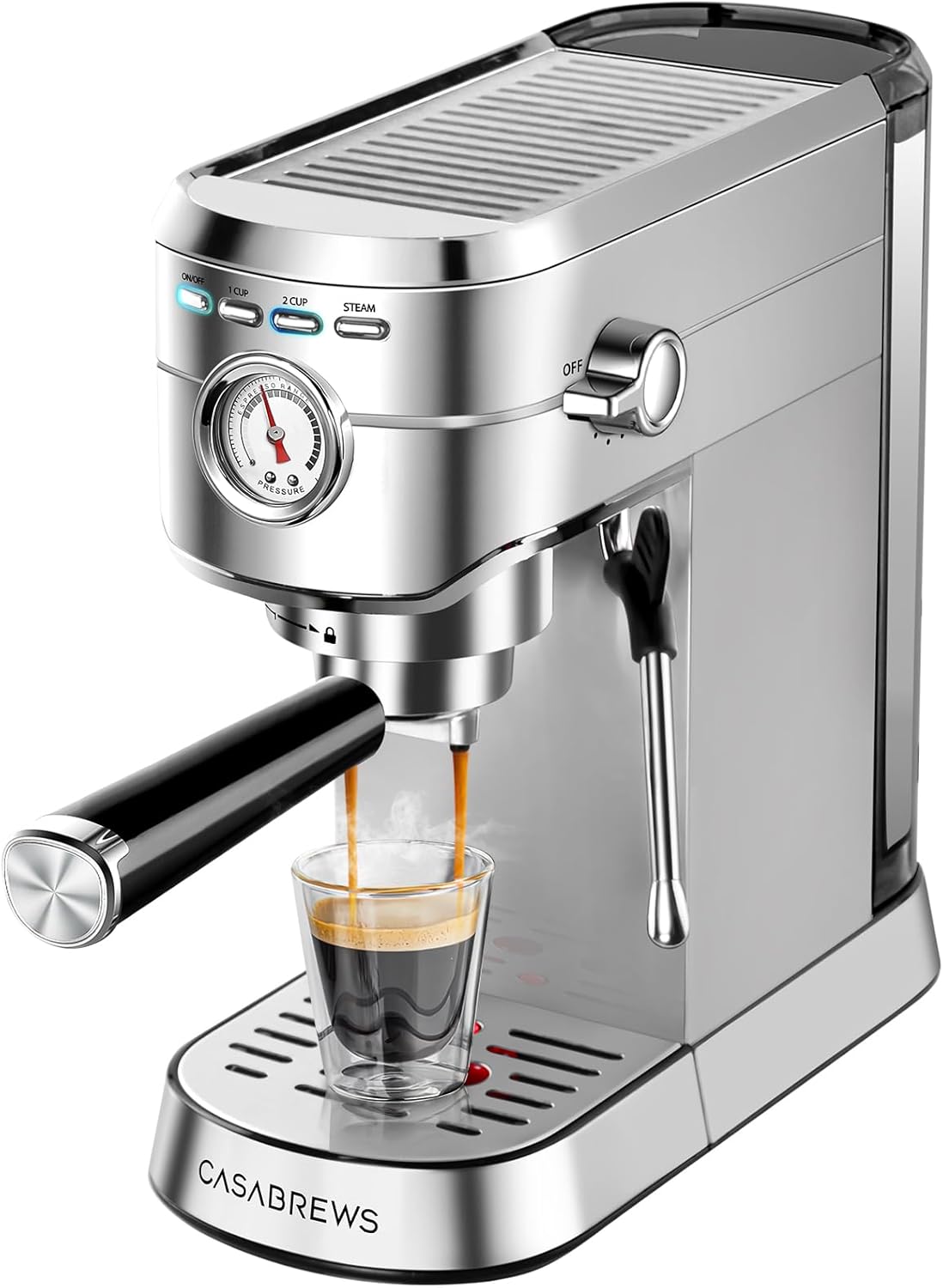
The CASABREWS CM5418 is a compact home-focused semi-automatic espresso machine that aims to deliver café-style espresso and milk drinks. It uses a stable 20-bar Italian pump with a built-in pressure gauge and pre-infusion to help dial in extraction, while a powerful steam wand produces microfoam for lattes and cappuccinos. Typical use is straightforward: fill the removable 34 oz tank, preheat, tamp ground espresso into the 51 mm portafilter, and choose single or double volume with the front buttons. Practical benefits include the pressure feedback for adjusting grind and tamp, a cup-warming rack, and a removable drip tray that fits taller cups for easy cleaning. Trade-offs are the single-boiler design that requires cooldown between steaming and brewing, and its small footprint limits throughput for heavy entertaining. The machine includes reusable filters and a basic tamper kit, so beginners can start without extra purchases, but achieving consistent results will still require attention to grind size and tamping technique.
Best for: Buyers who want a compact, café-style semi-automatic machine that provides pressure feedback and a real steam wand but prefer a straightforward, ready-to-use package for home barista practice.
Less Ideal for: Those who need high-volume commercial throughput or fully automatic, hands-off brewing should consider more advanced dual-boiler or super-automatic machines.
- 20-bar pump with built-in pressure gauge for visual extraction feedback
- Powerful steam wand that creates smooth microfoam for milk-based drinks
- Removable 34 oz water tank and removable drip tray for easy refills and cleaning
- Includes portafilter, one- and two-cup baskets, and tamper so you can start brewing right away
- Single-boiler design requires cooling time between steaming and brewing
- Manual tamping and grind adjustments needed for consistent shots
Verdict: A compact, user-friendly semi-automatic espresso machine that gives home baristas pressure feedback and a strong steam wand for café-style drinks.
Choosing the Right Espresso Machine for Baristas: Key Factors to Consider
Boiler Type and Capacity
The boiler design determines how well the machine sustains steam and extraction simultaneously. Single-boiler machines may struggle when you need continuous milk texturing during busy periods, while heat-exchanger or dual-boiler designs separate brewing and steaming duties for steadier performance.
Capacity matters because a small boiler will drop pressure and temperature faster under back-to-back pulls. Consider the machine's duty cycle relative to your expected service volume to avoid mid-shift performance drops and long recovery times.
Temperature and Pressure Control
Consistent brew temperature and stable pump pressure are the foundations of repeatable extraction. Machines that allow precise temperature adjustment or that include PID control help fine-tune extraction for different beans and roast levels.
Pressure profiling or adjustable pre-infusion options give baristas more control over shot development. If you need to dial in shot character for specialty coffees, these controls can be decisive.
Steam Power and Wand Design
Fast steaming shortens ticket times and makes milk texture more consistent across cups. Look for machines with strong steam pressure, well-designed steam wands, and good tip articulation so you can create microfoam efficiently.
Wand ergonomics and reach also affect workflow. A wand that is hard to position or that lacks angle and length will slow workflow and make consistent steaming harder during busy service.
Grouphead and Portafilter Compatibility
Grouphead construction impacts thermal mass and extraction stability. Commercial-style groupheads with insulated designs or E61-style heat exchange characteristics hold temperature better between shots.
Portafilter size and handle ergonomics matter for comfortable, fast dosing and tamping. Standard commercial diameters and flush portafilters help maintain consistency and fit with common barista tools.
Serviceability and Maintenance
Daily and periodic maintenance keeps performance predictable. Machines that offer easy access to internal components, clear service intervals, and replaceable wear parts reduce downtime and repair costs.
Consider how straightforward routine tasks are, such as backflushing, group seal replacement, and descaling. A machine that is difficult to service can degrade in performance even if it starts strong.
Control Layout and Workflow
Controls should support your service style rather than complicate it. Logical group placement, easily reachable steam wands, and clear dosing interfaces speed up repetitive tasks and reduce errors during peak periods.
Programmability can streamline workflow but only when it is intuitive. Overly complex menus or poorly placed displays can slow down baristas rather than help them, so test the control layout against how you plan to use the machine.
Pro-Level Vs Prosumer Machines
Understanding the difference between pro-level and prosumer machines helps set expectations for durability and performance. Pro-level units are built for continuous service with larger boilers, heavier-duty components, and designs optimized for easy servicing. Prosumer machines borrow some commercial features while targeting lower-volume environments.
If your service is moderate to high volume, a machine designed for cafe use will offer more consistent steam performance and longer lifespan. Prosumer options can be fine for training, pop-ups, or low-volume specialty programs where space and budget are limiting factors.
- Pro-level: higher duty cycle, more robust components, easier service access
- Prosumer: smaller footprint, fewer commercial certifications, suitable for low to medium volume
Setting Up for Consistent Shots
Consistent shots start with stable temperature and consistent dosing. Make sure grouphead temperature is stable before you begin a service run and use a calibrated scale to dose grounds consistently. Tamping pressure and distribution technique should be standardized among baristas to reduce variability.
Regularly backflush and replace group seals as recommended. Even small leaks or worn seals can change extraction dynamics and lead to inconsistent results across consecutive shots.
- Warm up the machine to stable temperature before service
- Use a scale and consistent tamping routine
- Backflush daily and check seals weekly
Milk Steaming Workflow Tips
Efficient steaming depends on both the machine's steam capacity and how you position the pitcher and wand. Purge the wand briefly before and after steaming to keep milk clean and prevent spitback. Use stretched milk batches when appropriate to handle rushes without compromising texture.
Train baristas on pitcher technique and positioning to achieve microfoam quickly. Consistent pitcher sizes and chilled milk help shorten steaming time and improve repeatability.
- Purge wand before each steam
- Use consistent pitcher sizes and chilled milk
- Steam in small batches when service peaks
Routine Maintenance Checklist
Establish a daily, weekly, and monthly maintenance routine that covers backflushing, steam wand cleaning, and boiler checks. Keep a log of any issues and parts replaced to identify recurring problems early. Routine maintenance prevents performance drift that affects shot quality and steam power.
Know the basic service items you can handle in-house and when to call a technician. Replacing wear parts like group gaskets and shower screens at recommended intervals keeps extraction stable and reduces the risk of sudden failures.
- Daily: backflush, wipe and purge wands, check water level
- Weekly: clean group screens, inspect seals
- Monthly: inspect boiler and pressure settings, descale as needed
Water Quality and Pretreatment
Water chemistry has a big impact on extraction and machine longevity. Hard water leads to scale buildup in boilers and heat exchangers, reducing thermal efficiency and increasing service needs. Use a water treatment solution matched to your local water profile to protect components and maintain consistent flavor extraction.
Filtration also affects taste and crema. Properly treated water reduces off-flavors and helps ensure your shots taste as intended from the beans rather than the plumbing.
- Test incoming water hardness before selecting a treatment
- Use filtration that balances scale protection with flavor preservation
- Change filters according to manufacturer or local lab recommendations
How We Chose the Best Espresso Machine for Baristas
We focused on the features that directly affect shot quality, milk steaming, and day-to-day usability for baristas. Key evaluation criteria included boiler and steam system design, grouphead and temperature stability, dosing and pressure controls, build and serviceability, and workflow ergonomics. Each machine on the list needed to demonstrate reliable thermal control under repeated pulls and produce consistent steam pressure for textured milk. We excluded models aimed exclusively at home users with consumer-grade boilers or limited duty cycles. Machines that lack basic serviceability or restrict access to routine maintenance were also filtered out. Our selection prioritized commercial or prosumer designs with clear specification transparency, durable materials, and controls that allow baristas to tune extraction and steam performance. Where relevant, electronic control features and programmability were evaluated for how they translate into repeatable results during busy service periods. The final picks represent a balance between extraction consistency, steam capacity, and practical upkeep requirements that matter for daily barista workflows.
Our full evaluation process is outlined in our review methodology.
FAQ
How much boiler capacity do I need for a small cafe?
Boiler needs depend on expected peak ticket times. For small cafes with moderate back-to-back steaming, a heat-exchanger or small dual-boiler setup usually provides enough steam without long recovery times. If you routinely run continuous milk orders, prioritize larger boilers or true dual-boiler designs.
Is PID control necessary for consistent espresso?
PID control helps stabilize and fine-tune brew temperature, which improves repeatability across shots and different bean profiles. It is not strictly necessary, but it is highly useful if you need tight temperature management for specialty roasts or wide roast-range menus.
How often should I service group seals and shower screens?
Check seals and shower screens weekly for wear and buildup. Many operations replace group gaskets every few months depending on volume and backflushing habits. Proactive replacement prevents extraction inconsistencies and avoids emergency repairs.
Can I steam several pitchers simultaneously?
Simultaneous steaming depends on the machine's steam capacity and wand configuration. High-capacity boilers and multi-wand setups handle parallel steaming better, but for consistent microfoam you may still prefer sequential steaming to control texture and temperature.
What water treatment should I use for espresso machines?
Choose a water treatment system based on local water analysis. A balanced filtration approach that reduces hardness while preserving desirable mineral content is ideal for extraction and machine health. Avoid over-softening water, which can cause corrosion and flat-tasting shots.
Final Verdict
Prioritize machines that match your service volume and the level of control you need over extraction and steam. For busy environments, plumbing and boiler capacity, steam power, and easy service access are the most important tradeoffs. For lower-volume specialty programs, precise temperature control and compact ergonomics may matter more. Balance long-term maintenance and parts accessibility against the performance features you require. Choose the machine that aligns with your workflow priorities so you get consistent shots and reliable steam throughout service.