
Note: This article contains affiliate links. If you click on these links and make a purchase, we may earn a small commission at no extra cost to you. This helps support our research and content. Read our full affiliate disclosure here.
Picking the right espresso machine matters if you want reliable shots and café-style steamed milk without constant tinkering. Whether you plan to pull single-origin shots, make daily lattes, or entertain guests, the machine you choose affects crema, temperature stability, and how much hands-on maintenance is required. This guide shortlists seven espresso machines under $2,500 that balance performance and usability for home baristas. Below you will find top picks chosen for consistent extraction, steam capability, and durability, plus practical criteria to help you match features to your routine. Read on for the factors we weighed and what to expect from each type of machine.
Top Picks at a Glance
| Best Overall The best all-around choice for most situations | Rancilio Silvia Pro X |  |
| Best Quality Built to a higher standard if you want something more solid | Breville Oracle BES980XL |  |
| Best Value The sweet spot between price and what you get | Gevi 20 Bar Espresso Machine ECMG0 | 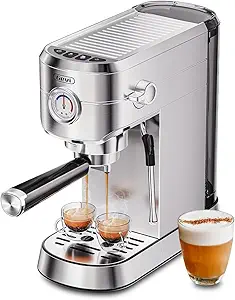 |
| Best Budget The cheapest option that still gets the job done reliably | Imusa Espresso Maker GAU-18202AMZ |  |
| Top Rated A top-rated pick with lots of positive feedback | Breville Barista Express BES870XL |  |
| Most Popular A crowd favorite that many people choose with confidence | CASABREWS CM5418 Espresso Machine |  |
| Best Seller A high-volume bestseller chosen again and again | Ninja Luxe Café Premier ES601 |  |
Rancilio Silvia Pro X

| Operation Mode | Semi-Automatic |
|---|---|
| Wattage | 1000 watts |
| Voltage | 120 volts |
| Coffee Input Type | ground_coffee |
| Capacity | 2 liters |
The Rancilio Silvia Pro X is a heavy-duty home espresso machine that pairs a 1L steam boiler with a 300 ml brew boiler so you can steam milk and pull shots back-to-back. Dual PIDs let you monitor and adjust brew and steam temperatures precisely via the front-facing digital display, and the display also functions as a shot timer. Practical features include adjustable low-pressure preinfusion for more consistent extraction, a programmable wake-up mode, water level alerts, and a removable 2-liter reservoir for easy filling and cleaning. The machine ships with a full accessory set including single and double baskets, a tamper, cleaning tools, and a stainless portafilter, so it is ready for dialing in shots out of the box. Trade-offs are its large footprint and substantial weight, which make it less portable and require dedicated counter space, and the complexity of PID tuning may be more than a casual user needs. For buyers wanting professional-style control and reliable steam performance at home, the Silvia Pro X delivers precise temperature management and consecutive steaming capability.
Best for: Home baristas who prioritize temperature control and café-style workflow and are willing to learn basic PID tuning to improve shot quality and milk texturing.
Less Ideal for: Casual coffee drinkers who want a compact, fuss-free machine or users who need a lightweight travel-friendly option.
- Dual boiler design allows simultaneous brewing and steaming for consecutive drinks
- Separate PID control for brew and steam provides precise temperature stability
- Adjustable low-pressure preinfusion and shot timer help improve extraction consistency
- Includes comprehensive accessories and a stainless portafilter for immediate use
- Large size and heavy weight make it less suitable for small or frequently rearranged kitchens
- PID adjustments and setup have a learning curve for beginners
Verdict: If you want near-professional temperature control and the ability to steam and brew without waiting, the Silvia Pro X is a capable home machine built for serious home baristas.
Breville Oracle BES980XL
| Wattage | 1800 watts |
|---|---|
| Voltage | 120 volts |
| Human Interface Input | Touchscreen |
| Coffee Input Type | whole bean |
| Filter Type | Reusable |
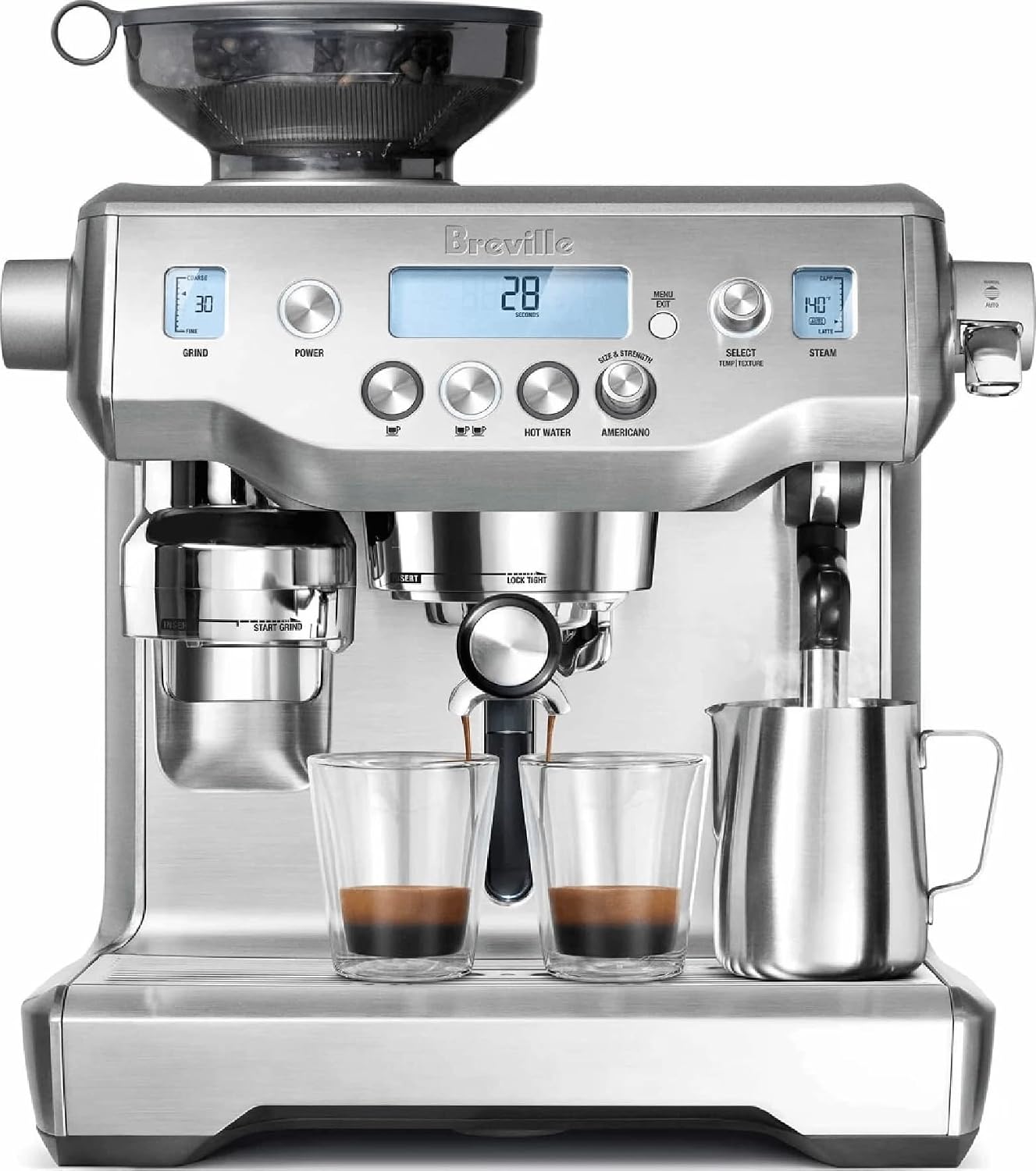
The Breville Oracle BES980XL automates key barista steps while leaving room for manual control, combining an integrated conical burr grinder, auto dose-and-tamp, dual boiler heating, and an LCD touchscreen for shot selection. It is typically used by enthusiasts who want consistent, specialty-level espresso, lattes and cappuccinos without visiting a café: the machine grinds and doses 22 g automatically, runs a controlled pre-infusion followed by 9-bar extraction, and steams milk into fine microfoam with an auto texturing steam wand that also self-cleans. The dual boilers let you extract and steam simultaneously with PID temperature control for stable shots, and the reusable filter and robust stainless steel construction signal long-term durability. The biggest trade-offs are size and complexity: it is heavy and requires counter space, routine cleaning, and a learning curve to dial in grind and milk settings for best results. For buyers focused on performance, it delivers near-commercial features in a home package but demands maintenance and setup attention to reach its full potential.
Best for: Serious home baristas who prioritize shot-to-shot consistency and café-level performance and are willing to invest time in setup and maintenance to get professional results.
Less Ideal for: Casual coffee drinkers who want a compact, low-maintenance machine or buyers on a strict budget seeking a simpler automatic brewer.
- Integrated conical burr grinder with auto grind, dose and tamp for consistent extractions
- Dual boiler system with PID control allows simultaneous extraction and steaming
- Auto microfoam milk texturing with a self-cleaning wand produces latte-art-capable foam
- Touchscreen controls and shot presets simplify repeatable brewing
- Stainless steel construction and reusable filter add durability and lower long-term consumable cost
- Large and heavy footprint requires significant counter space
- Requires regular cleaning and some technical setup to optimize grind and milk settings
Verdict: For buyers after near-commercial espresso performance at home, the Oracle delivers automated grinding, dual-boiler stability, and professional milk texturing in one integrated machine.
Gevi 20 Bar Espresso Machine ECMG0
| Output Pressure | 20 bar |
|---|---|
| Wattage | 1350 watts |
| Power Source | AC adapter |
| Coffee Input Type | ground_coffee |
| Capacity | 1 liters |
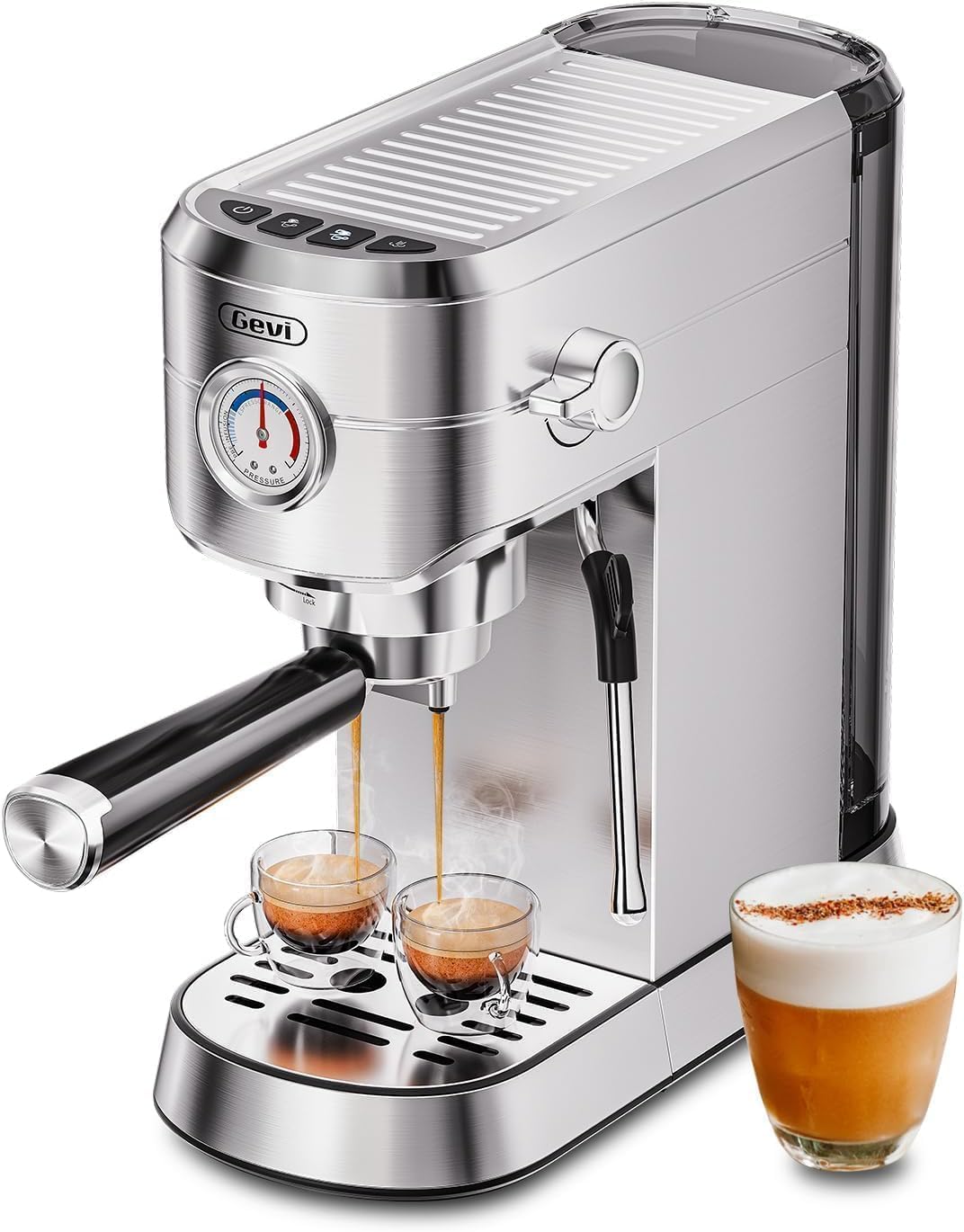
The Gevi 20 Bar Espresso Machine is a compact semi-automatic unit aimed at home or small-office use that brews espresso, americanos, and milk-based drinks. It uses a 20-bar pump with NTC temperature control, a built-in pressure gauge and pre-infusion to help stabilize extraction, and a removable 34 oz water tank for easier refills. The machine includes a steam wand and a removable froth nozzle for quicker milk steaming and cleaning, plus a cup warmer and adjustable shot volume for basic workflow control. Controls are button-based and the stainless steel housing feels durable and counter-friendly in tight kitchens. Practical benefits include consistent pressure readings, decent steam power for microfoam, and reusable filters so you can use your own ground coffee. Limitations are that it is a semi-automatic machine so dialing shots requires some technique, there is vibration and pump noise during operation, and it lacks an integrated grinder or advanced temperature profiling found on higher-end machines. For buyers who want a sturdy, feature-focused machine under a modest budget, it delivers key café features without taking much counter space.
Best for: Buyers who prioritize a compact, durable espresso machine with real pressure control and a capable steam wand and who are willing to pair it with a separate grinder and learn basic shot dialing.
Less Ideal for: People who want a fully automatic or integrated grind-and-brew workflow, or buyers seeking commercial-level temperature profiling and noise-free operation.
- 20-bar pump with pressure gauge and pre-infusion for more consistent extraction
- Powerful steam wand with removable froth nozzle for easier milk texturing and cleaning
- Compact stainless steel build fits small countertops while offering durability
- Removable 34 oz water tank and cup warmer improve daily convenience
- Includes portafilter, 51mm filter baskets, tamper and basic accessories out of the box
- No built-in grinder so a separate grinder is required for fresh dosing
- Semi-automatic operation demands some technique to get repeatable shots
- Pump-driven vibration and noise can be noticeable on thin countertops
Verdict: A compact, stainless-steel semi-automatic that gives real pressure control and strong steam performance for buyers who want café features without large commercial size.
Imusa Espresso Maker GAU-18202AMZ

| Capacity | 4 cups |
|---|---|
| Wattage | 800 watts |
| Operation Mode | Semi-Automatic |
| Filter Type | Permanent |
The IMUSA 4-cup Espresso and Cappuccino Maker is a small countertop semi-automatic machine designed to deliver espresso-style coffee and milk-based drinks at home. It brews up to four servings into a glass carafe using a permanent filter and a 5-bar pump, and it includes a steam nozzle that froths milk for cappuccinos and lattes. Typical use is straightforward: fill the brew basket, select one of the three settings on the control knob, brew into the carafe, and use the steam wand for textured milk. Notable features are the compact footprint, removable drip tray for easier cleaning, and a cool-touch carafe handle for safe pouring. Practical benefits include a simple workflow for everyday espresso-style drinks and lower running complexity than fully manual machines. Limitations are modest pressure compared with higher-end machines, a plastic exterior that is less durable than metal-bodied models, and a smaller capacity that suits singles or small households rather than heavy daily use.
Best for: Buyers seeking an affordable, entry-level way to make espresso-style drinks and milk-based beverages at home who prioritize ease of use and compact size.
Less Ideal for: Those who want professional-level espresso extraction, heavy daily commercial use, or a metal-bodied premium machine should consider higher-end alternatives.
- Compact countertop footprint fits small kitchens
- Built-in steam nozzle produces creamy milk froth for cappuccinos and lattes
- Permanent filter and removable drip tray reduce single-use waste and simplify cleaning
- Simple three-position control makes operation approachable for beginners
- 5-bar pressure is lower than higher-end espresso machines, limiting extraction intensity
- Plastic exterior is less rugged and premium-feeling than metal-bodied models
Verdict: A compact, budget-friendly home espresso maker that delivers basic espresso and frothy milk drinks with minimal fuss.
Breville Barista Express BES870XL

| Wattage | 1600 watts |
|---|---|
| Voltage | 120 |
| Coffee Input Type | whole_beans |
| Filter Type | Reusable |
| Capacity | 1 cups |
The Breville Barista Express BES870XL combines a built‑in conical burr grinder with a semi‑automatic espresso platform to let you go from beans to espresso in about a minute. Users grind directly into a 54mm portafilter with adjustable grind settings and dose control, then extract using Breville's thermocoil heating system and low‑pressure preinfusion for more balanced shots. The steam wand delivers strong steam power for manual microfoam and latte art, and the package includes tamping and dosing tools so you can dial in shots by hand. It is designed for regular home use where hands‑on control matters more than push‑button automation. Expect solid temperature stability thanks to PID-style control, straightforward maintenance with reusable filters, and a durable stainless steel exterior, but plan to invest time learning grind, dose, and steam technique to get consistent café‑level results. The machine is compact enough for a kitchen counter but heavier than consumer drip machines, reflecting its build quality and components.
Best for: Buyers who prioritize dependable, well‑built equipment and want hands‑on control to craft café‑quality espresso and milk drinks at home.
Less Ideal for: Casual users who prefer fully automatic, one‑touch brewing or those unwilling to spend time learning grinder and steaming technique.
- Integrated conical burr grinder with 16 grind settings for fresh dosing
- Thermocoil heating and digital temperature control for stable extractions
- Powerful steam wand capable of producing microfoam for latte art
- Includes useful barista tools (tamper, razor dose tool, scoop)
- Stainless steel construction that feels durable and kitchen‑worthy
- Manual operation requires practice to achieve consistent results
- Single boiler/thermocoil design means simultaneous steaming and brewing is limited
Verdict: Choose the Barista Express if you want a reliable, built‑in grinder plus manual control to consistently pull café‑quality shots at home.
CASABREWS CM5418 Espresso Machine
| Output Pressure | 20 bar |
|---|---|
| Wattage | 1350 watts |
| Operation Mode | Semi-Automatic |
| Coffee Input Type | ground_coffee |
| Filter Type | Reusable |
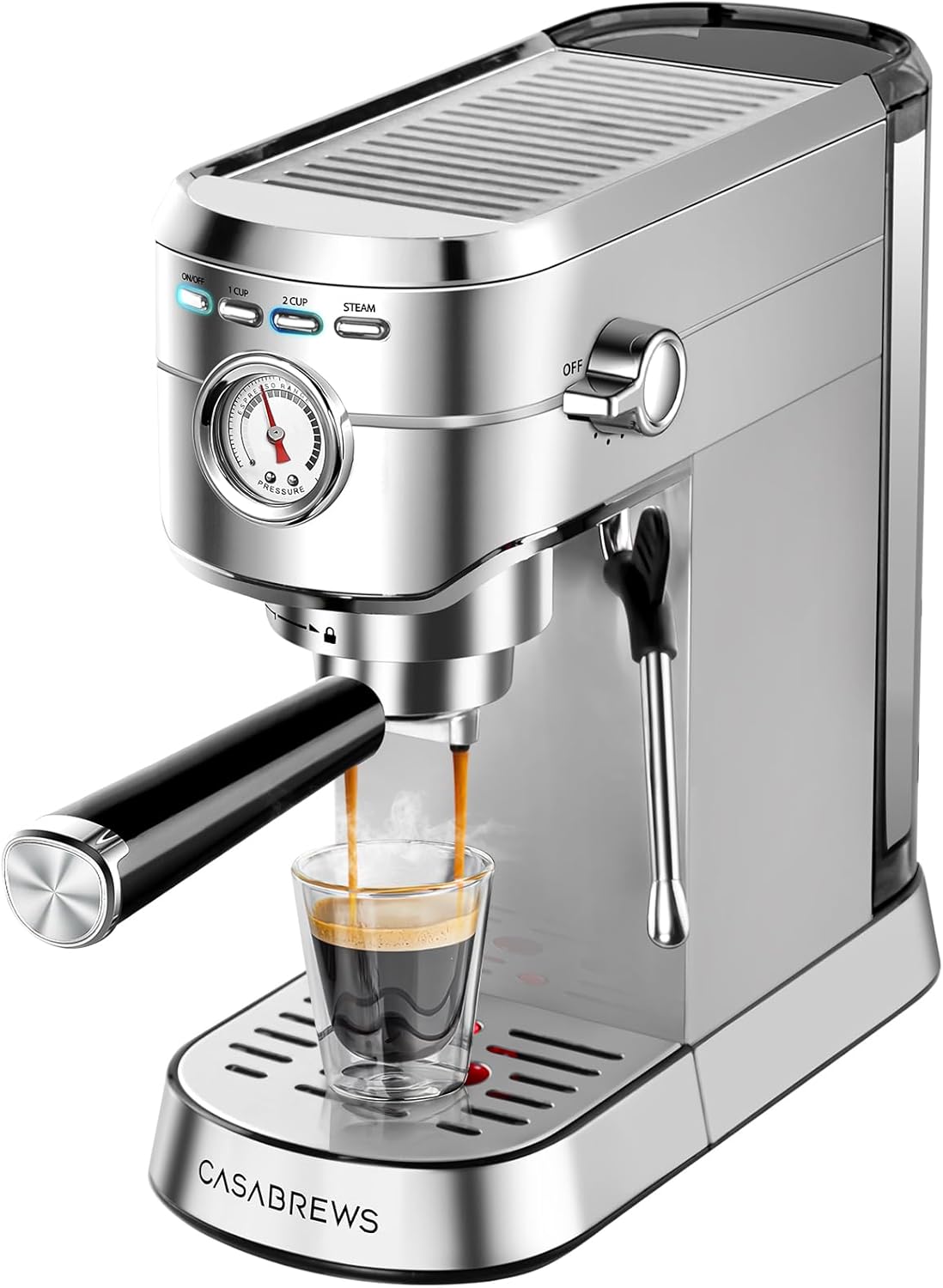
The CASABREWS CM5418 is a compact home espresso machine aimed at recreating café-style drinks without a large footprint. It uses a 20-bar Italian pump and a built-in pressure gauge to help dial in extraction, plus a low-pressure pre-infusion step to improve flavor balance. The included steam wand produces microfoam suitable for lattes and cappuccinos and the top cup warmer and removable 34 oz tank make morning routines easier. Controls are button-based and the machine is semi-automatic, so you adjust grind, dose, and tamp yourself—useful if you want control but not a fully manual workflow. Practical strengths are the slim stainless steel body, reusable filters and a 51 mm portafilter that accept the included single- and double-shot baskets. Expect to spend some time learning grind and tamp to avoid slow pours or pressure warnings, and follow the cooldown steps after steaming milk to prevent over-temperature protection from interrupting brewing. For a home barista who values visual pressure feedback and milk-texturing capability in a budget-friendly package, this machine covers the essentials well.
Best for: Buyers who want a compact, café-style home espresso setup with visible pressure feedback and milk-texturing ability, and who prefer a machine that rewards learning grind and tamp skills.
Less Ideal for: People who need fast, hands-off brewing for many consecutive drinks or who prefer fully automatic, push-button single-step operation.
- 20-bar Italian pump with built-in pressure gauge for visible extraction feedback
- Powerful steam wand capable of producing microfoam for latte and cappuccino texture
- Compact stainless steel body with a removable 34 oz water tank for easy refills
- Includes 51 mm portafilter, single- and double-shot baskets, and a tamper
- Single-boiler design requires cooldown between steaming and brewing, which can slow drink throughput
- Semi-automatic operation demands attention to grind, dose, and tamp for consistent shots
Verdict: A compact, learning-friendly espresso machine that gives visible pressure control and real milk-texturing power for home baristas seeking café-style drinks under a modest budget.
Ninja Luxe Café Premier ES601

| Operation Mode | Fully Automatic |
|---|---|
| Wattage | 1650 watts |
| Coffee Input Type | Ground, Whole Bean |
| Filter Type | Reusable |
The Ninja Luxe Café Premier ES601 is a fully automatic 3-in-1 machine that combines espresso, drip coffee, and rapid cold brew functions into a single countertop unit aimed at simplifying at-home cafe drinks. It grinds whole beans with a built-in conical burr grinder (25 settings) and uses weight-based dosing and an assisted tamper to help deliver consistent shots without deep barista experience. The dual froth system pairs an automated steam wand and magnetic whisk for hands-free microfoam across preset froth programs, and the self-purging steam wand reduces maintenance after steaming. Drip brewing covers single cups up to an 18 oz pitcher and the machine also makes cold-pressed espresso and rapid cold brew for iced drinks. Practical conveniences include a 70 oz removable water reservoir, built-in accessory storage, and several cleaning aids in the box. Trade-offs are its sizable footprint and weight for a home machine and the complexity of features that may require time to learn; this is a premium, appliance-style device rather than a simple pod brewer. For buyers who want guided, repeatable café-style results at home, it delivers a lot of capability in one unit.
Best for: Buyers who want café-quality drinks at home without needing deep barista skills and who prioritize guided, repeatable results and full-feature versatility in a single machine.
Less Ideal for: People who only want a compact, ultra-simple brewer or travel-friendly unit should consider smaller single-purpose machines instead.
- Integrated conical burr grinder with 25 grind settings and weight-based dosing for consistent extraction
- Barista Assist features including assisted tamper and guided prompts reduce guesswork for beginners
- Hands-free dual froth system and self-purging steam wand simplify milk texturing and cleanup
- Three brew modes (espresso, drip, rapid cold brew) cover a wide range of drinks from one machine
- Large removable water reservoir and built-in accessory storage for everyday convenience
- Relatively large and heavy for a consumer countertop machine
- Feature set and controls have a learning curve for users who want simple one-button brewing
Verdict: Choose the ES601 if you want a guided, all-in-one home machine that reliably produces espresso, drip, and cold-brew style drinks with minimal barista skill.
Choosing the Right Espresso Machine: Key Factors to Consider
Boiler Type and Capacity
The boiler setup determines how well a machine handles back-to-back shots and milk steaming. Single boilers are simpler and often cheaper but require waiting or cooling between brewing and steaming. Heat-exchange and dual-boiler systems let you brew and steam simultaneously, which is important if you make multiple milk drinks in a row.
Boiler volume and recovery rate affect how quickly the machine returns to optimal temperature after heavy use. For a home environment where you may prepare several drinks for guests, a larger boiler or faster recovery saves time and preserves consistent shot quality.
Pressure Control and Pump Type
Pressure profile during extraction is central to espresso quality. Machines with reliable vibration pumps are common and can produce excellent shots, but rotary pumps offer quieter operation and steadier pressure under varying flow. Some machines provide adjustable pressure profiling or pre-infusion, which helps develop flavor and reduce channeling in the puck.
Consider whether you want fixed, automated pressure or manual control. Home baristas who experiment with roast levels and grind settings will appreciate machines that let them fine-tune pressure and pre-infusion parameters.
Steam Wand Performance
A steam wand that produces strong, adjustable steam is crucial for achieving microfoam and silky milk for lattes and cappuccinos. Look for wands with good reach and articulation so you can position the pitcher correctly. Tip design and the ability to introduce air cleanly at low power, then increase pressure for texture and heat, make a big difference in milk quality.
Also consider steam recovery time. A machine that takes too long to recover pressure after steaming can interrupt drink workflow and cool the milk. For regular milk-based drinks, prioritize machines with consistent steam pressure and easy-to-clean wand tips.
Temperature Stability and PID Control
Stable brew temperature keeps extraction predictable across multiple shots. Machines with PID temperature control maintain water temperature within narrow tolerances, reducing shot-to-shot variability. This matters when you use different beans or roast profiles that respond differently to temperature.
If you frequently switch between espresso and milk drinks, temperature stability helps avoid over- or under-extraction. PID-equipped machines offer more precise adjustments and fewer surprises when dialing in a shot.
User Interface and Programming
How you interact with the machine affects daily convenience. Manual lever or dial machines offer tactile control for enthusiasts who want hands-on technique. Semi-automatic and programmable machines let you set shot volume, pre-infusion, and temperature curves for repeatable results.
Consider how much automation you want versus manual control. Programmable features speed up routines and reduce variability, while simpler interfaces can be more durable and easier to repair. Clear displays and intuitive controls also shorten the learning curve for new baristas.
Maintenance Requirements and Accessibility
Routine upkeep influences long-term satisfaction. Look for machines with accessible service points, removable drip trays, and user-friendly group head seals. Regular tasks include backflushing, descaling, and replacing gaskets; machines designed for straightforward maintenance lower the barrier to consistent care.
Also evaluate the availability of replaceable parts and how easy it is to disassemble common wear items. A model that is easy to clean and maintain will preserve performance and reduce downtime for repairs.
Single-Boiler Versus Dual-Boiler Options
Understanding the differences between single-boiler, heat-exchange, and dual-boiler designs helps you match a machine to your workflow. Single-boiler units are compact and sufficient for intermittent use, but they require alternating between brewing and steaming. Heat-exchange systems allow simultaneous brewing and steaming by using separate water paths inside one boiler, offering a middle ground for many home users. Dual-boiler machines have separate boilers dedicated to brewing and steaming, which provides the most consistent temperature control and fastest recovery for high-volume use.
If you make several milk drinks in a session or value precise temperature control, a heat-exchange or dual-boiler configuration is worth the investment. For occasional espresso drinkers who prioritize a smaller footprint, a single-boiler model can still produce excellent shots when you plan the workflow.
- Single-boiler: compact, simpler maintenance, limited simultaneous use
- Heat-exchange: simultaneous brewing and steaming, moderate complexity
- Dual-boiler: best temperature control and recovery, higher cost and size
Dialing in Grind and Dose for Consistent Shots
Even the best machine cannot compensate for incorrect grind size or inconsistent dosing. A consistent, high-quality grinder is the other half of the equation. Fine adjustments to grind and dose directly affect extraction time and flavor balance. Aim for a puck yield and shot time that match the machine's pressure profile and the beans' roast level.
When adjusting, change one variable at a time and pull consecutive shots to confirm improvements. Note how changes in tamp pressure, grind setting, and dose alter extraction time and taste. Machines with stable temperatures will make it easier to isolate the effect of grind and dose changes.
- Use a quality grinder with small incremental adjustments
- Track dose and extraction time to build a reliable recipe
- Tamp consistently and clean the group head between shots
Practical Considerations for Kitchen Placement
Size, water source, and ventilation matter when placing an espresso machine at home. Check the machine's footprint against your countertop space and ensure there is enough clearance for the steam wand and portafilter. Some machines require a dedicated water connection or a larger water reservoir; others rely on easy-to-refill tanks.
Noise level and heat output can affect where you install the unit. Rotary-pump machines are usually quieter than vibration-pump alternatives. Also plan for routine waste disposal: accessible drip trays and puck receptacles make daily cleanup less messy.
- Measure counter space and allow room for the steam wand
- Decide on tank fill versus plumbed-in water supply
- Consider noise and ventilation when choosing location
Steaming Techniques and Pitcher Selection
Technique plays a large role in milk texture. Use a pitcher with a tapered lip that supports controlled pouring and a size matched to the volume you usually steam. Position the wand tip just below the surface to introduce air, then submerge slightly to develop microfoam. The right pitcher and technique reduce reliance on raw steam power alone.
Practice is important. Even machines with modest steam pressure can produce excellent microfoam if the pitcher, milk temperature, and technique are aligned. Clean the wand immediately after steaming to prevent milk residue buildup that degrades performance.
- Choose pitcher size based on drink volume
- Control wand depth for air introduction and texturing
- Wipe and purge wand after each use
Long-Term Reliability and Serviceability
Durable materials, straightforward access to wear parts, and a design that allows periodic servicing extend the machine's useful life. Metal group heads, serviceable valves, and clear maintenance points reduce the likelihood of major repairs. Consider whether common wear items are user-replaceable and how easy routine tasks like gasket changes and descaling are.
A machine that is easier to service will remain consistent over years of ownership. Think about spare-part availability and whether the design favors modular repairs rather than complex disassembly.
- Look for serviceable group heads and accessible internals
- Prefer common, replaceable wear items
- Consider build materials and corrosion resistance
How We Chose the Best Espresso Machine
We prioritized machines that deliver repeatable espresso extraction and strong steam performance while remaining practical for home use. Our selection filters favored equipment with proven temperature stability, reliable pressure control, and accessible maintenance needs. Other key criteria included boiler configuration and recovery times, steam wand power and milk texturing capability, and user controls that support both beginners and experienced users. We excluded commercial-only units and compact single-serve appliances that do not meet sustained shot throughput or milk-texturing standards. We also set a strict budget cap to keep all options under $2,500. The evaluation focused on measurable performance dimensions: extraction consistency, steam power and control, build quality and longevity, user ergonomics and programmability, and ease of cleaning and routine maintenance. These practical, kitchen-focused factors guided which models made the shortlist.
Our full evaluation process is outlined in our review methodology.
FAQ
Do I need a separate grinder if I want good espresso at home?
Yes, a quality burr grinder is essential for consistent espresso. Built-in or blade grinders rarely achieve the fine, uniform particle size needed for reliable extraction. Investing in a dedicated grinder makes dialing in shots faster and more repeatable.
Is a dual-boiler machine necessary for home use?
Not always. Dual boilers excel at simultaneous brewing and steaming and offer the best temperature stability, which helps for high-volume or precision-focused routines. For occasional milk drinks, a heat-exchange or single-boiler unit can be sufficient and more compact.
How often should I descale or backflush the machine?
Frequency depends on water hardness and usage. Backflushing with a detergent is typically recommended weekly for machines with a three-way valve, while descaling may be needed every few months if water hardness is high. Regular cleaning maintains flow and flavor consistency.
Can I get café-quality milk texture with a lower-powered steam wand?
Often yes. Technique, pitcher shape, and milk temperature are as important as raw steam power. A well-practiced technique on a modest wand can produce excellent microfoam, though higher-powered wands make the process faster and easier.
What grind settings work best for espresso machines under $2,500?
Coarse settings for espresso are still relatively fine compared with other brewing methods. The exact setting depends on your grinder and beans. Start with a setting that yields a 25 to 30-second extraction for a typical dose and adjust in small increments.
Final Verdict
Focus on the features that align with how you brew. If you routinely steam milk or serve multiple drinks, prioritize steam power, recovery, and a boiler configuration that supports simultaneous use. If countertop space and simplicity matter more, a compact single-boiler or well-tuned heat-exchange unit will serve most home routines. Balance extraction consistency, user controls, and maintenance needs when choosing an espresso machine under $2,500. That trade-off approach will help you find a machine that produces reliable shots and manageable upkeep for years of home brewing.