
Note: This article contains affiliate links. If you click on these links and make a purchase, we may earn a small commission at no extra cost to you. This helps support our research and content. Read our full affiliate disclosure here.
If you make large batches of jerky, fruit chips, or quick-cure snacks, a fast food dehydrator can cut drying time and keep textures consistent. Choosing the right unit matters because faster drying can preserve flavor and food safety, but speed often trades off against evenness, airflow noise, and tray capacity. This guide covers our shortlisted picks for high-speed food dehydrators and explains the performance and convenience traits that matter most. Read on to see the top options and what to watch for when matching a dehydrator to your kitchen and cooking habits.
Top Picks at a Glance
| Best Overall The best all-around choice for most situations | Cosori Stainless Steel Food Dehydrator P501 |  |
| Best Quality Built to a higher standard if you want something more solid | Septree Commercial Dehydrator DBC-18A |  |
| Best Value The sweet spot between price and what you get | Magic Mill Food Dehydrator MFD-5000 |  |
| Best Budget The cheapest option that still gets the job done reliably | Seeutek Food Dehydrator GGJ-BZ-877 |  |
| Top Rated A top-rated pick with lots of positive feedback | Magic Mill Pro Dehydrator MFD-7700 |  |
| Most Popular A crowd favorite that many people choose with confidence | Cosori Food Dehydrator CFD-N051 |  |
| Best Seller A high-volume bestseller chosen again and again | NESCO Snackmaster FD-75A |  |
Cosori Stainless Steel Food Dehydrator P501
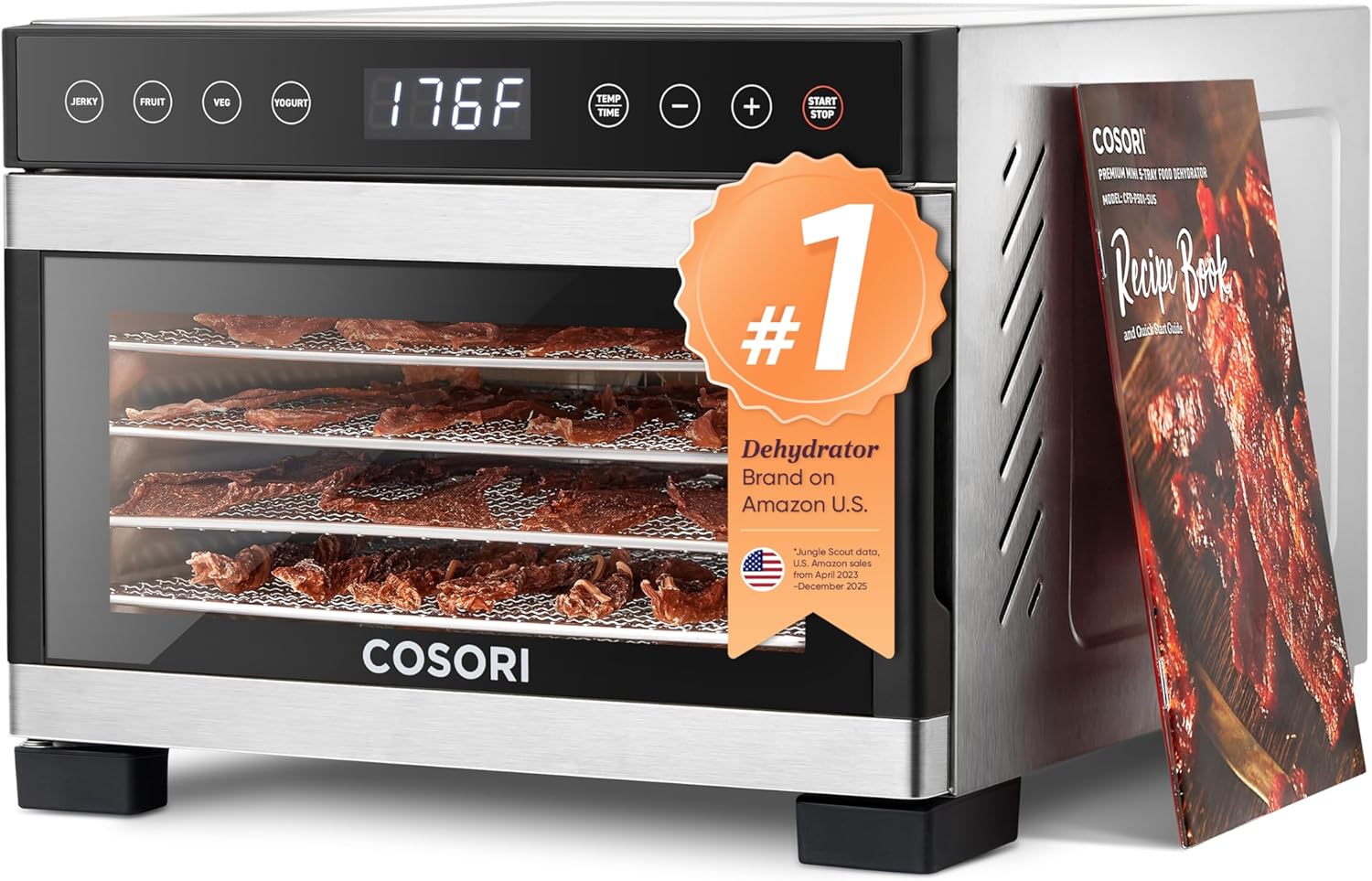
| Wattage | 480 watts |
|---|---|
| Voltage | 110 volts |
| Number of Trays | 5 |
| Temperature Range | 95-176 F |
| Operating Frequency | 60 hertz |
The Cosori P501 is a countertop dehydrator that uses a rear-mounted fan and horizontal airflow to dry foods evenly across five stainless steel trays. You set temperature in 1°F increments from 95 to 176°F and choose one of four presets or a custom time up to 48 hours, which makes it suitable for jerky, fruit leathers, vegetables, and yogurt. The all-stainless-steel food path and included mesh and fruit roll sheets reduce plastic contact, and the compact footprint fits most kitchens while still offering about 3.1 sq ft of drying area. At 480 watts it reaches higher temps recommended for safe beef jerky and the intuitive controls simplify repeatable results. The trade-offs are typical for compact dehydrators: tray capacity is limited compared with commercial units, and the unit can run for many hours which may be noticeable in energy use and ambient heat. For home cooks who want predictable, even dehydration without plastic trays, this model delivers reliable, user-friendly performance.
Best for: Home cooks who want a reliable, easy-to-use dehydrator that delivers even results for jerky, fruit leathers, and snacks while avoiding plastic contact with food.
Less Ideal for: People needing large-scale or professional-volume dehydration or those who want the highest possible throughput per session.
- Precise temperature control from 95 to 176°F in 1°F increments for safe jerky and fine-tuned drying
- Five stainless steel trays and food-safe stainless-steel construction eliminate plastic contact with food
- Rear fan and horizontal airflow design promote even drying across trays
- Includes accessories (mesh screen, fruit roll sheet, recipe book) for multiple dehydration tasks
- Compact countertop footprint that still provides about 3.1 sq ft of drying space
- Limited tray capacity compared with larger or commercial dehydrators
- Runs for long cycles which increases energy use and produces continuous ambient heat
Verdict: The Cosori P501 is a compact, stainless-steel dehydrator that gives home cooks precise temperature control and even drying for making jerky and snacks without plastic touching the food.
Septree Commercial Dehydrator DBC-18A

| Wattage | 2000 watts |
|---|---|
| Voltage | 120 volts |
| Number of Trays | 18 |
| Temperature Range | 70-190 °F |
| Operating Frequency | 60 hertz |
This Septree commercial dehydrator is built for high-volume drying and continuous use. It packs 18 stainless-steel trays and a usable drying area of about 34.4 ft² into a rectangular cabinet with a glass door so you can monitor batches without opening it. Digital controls let you set temperature from 70 to 190°F and a 0.5–24 hour timer with automatic shutoff and overheat protection, and the horizontal airflow design aims to dry trays evenly while keeping noise below 50 dB. Included accessories such as nonstick sheets, fruit roll sheets, hanging racks and hooks make it ready for jerky, fruit leather, herbs and bulk vegetable drying out of the box. The machine is rated for continuous 24/7 operation, which suits commercial kitchens or busy hobbyists, and most trays are dishwasher-safe for easier cleanup. Expect a large footprint and the power draw associated with a 2000 W unit, so plan for dedicated counter or floor space and ensure circuit capacity for heavy daily use.
Best for: Buyers who need fast, reliable high-volume drying for jerky, fruit leather, herbs or commercial kitchen production and value even airflow and continuous run capability.
Less Ideal for: Casual users who only dehydrate small batches or those with limited counter or electrical capacity should consider a smaller, lower-power unit.
- Very large drying area with 18 stainless-steel trays for high throughput
- Digital temperature control (70–190°F) and 0.5–24 hour timer with automatic shutoff and overheat protection
- Horizontal airflow system designed for even drying across all trays
- Most trays and liners are dishwasher-safe for easier cleaning
- Includes useful accessories: fruit roll sheets, hanging racks, hooks, drip tray and heat-resistant gloves
- 2000 W power draw requires a capable circuit and increases operating cost
- Large physical footprint may be difficult to place in small kitchens
Verdict: Choose this Septree if you need a heavy-duty, fast-capacity dehydrator that handles continuous commercial-style drying with precise digital controls.
Magic Mill Food Dehydrator MFD-5000

| Wattage | 240 watts |
|---|---|
| Voltage | 110 volts |
| Number of Trays | 5 |
| Temperature Range | 95-167 °F |
| Material | Stainless Steel (trays) |
The Magic Mill MFD-5000 is a compact countertop dehydrator aimed at everyday home use. It uses a 240W heating element and a digital control panel to set temperature (95 to 167°F) and a timer for up to 48 hours, so you can dehydrate fruit slices, jerky, herbs, and pet treats in batches across its five stackable stainless steel trays. The adjustable tray heights let you fit thicker cuts when needed and the stainless trays plus BPA-free plastic body make it straightforward to clean and dishwasher-safe. Its relatively small footprint makes it suited to kitchens with limited counter space, and the top temperature and long timer range give flexibility for quick drying or low-and-slow preserves. Expect typical dehydrator limitations: because it is a compact, 240W unit it will take longer than larger commercial machines to process very large volumes, and airflow/performance can vary by load and placement. For home cooks wanting a reliable, easy-to-operate machine for regular fruit and jerky batches, it balances controls, tray capacity, and build quality well.
Best for: A practical home cook who wants a straightforward, space-saving dehydrator to make regular batches of fruit, jerky, herbs, or pet treats without fuss.
Less Ideal for: Not a good choice for users who need high-throughput or commercial-scale drying every day.
- Five stainless steel stackable trays let you dry multiple items at once
- Digital timer and temperature control from 95 to 167°F for flexible recipes
- Adjustable tray height accommodates thicker cuts like jerky
- Dishwasher-safe detachable trays simplify cleaning
- 240W power and compact size mean slower drying on large loads compared with commercial units
- Body includes plastic components which may show wear faster than all-metal designs
Verdict: A compact, easy-to-use dehydrator that delivers flexible temperature control and five stainless steel trays for efficient home batch drying.
Seeutek Food Dehydrator GGJ-BZ-877

| Wattage | 240 watts |
|---|---|
| Voltage | 110 volts |
| Number of Trays | 5 |
| Temperature Range | 95-165 °F |
This Seeutek dehydrator is a straightforward countertop unit aimed at home snack makers who want basic, reliable dehydration without complexity. It uses 240 watts and an adjustable thermostat that ranges from 95 to 165°F, so you can dry herbs at low temps or make jerky at higher settings. Five BPA-free trays stack to handle several batches at once and can be rotated to change spacing for thicker items, while the stainless steel body and clear lid make it easy to monitor progress. Controls are simple: a power button and temperature knob, which keeps operation intuitive but means there is no built-in timer. In practice it runs quietly enough for kitchen use and the included recipe book is handy for beginners. The unit is compact and light, which is convenient for tight counters but limits batch size compared with larger machines. If you want a no-frills, budget-friendly dehydrator that delivers consistent drying for fruit, herbs, and jerky, this model covers the essentials well.
Best for: Buyers looking for an inexpensive, easy-to-use dehydrator to make homemade jerky, dried fruit, herbs, and pet treats in small to moderate batches.
Less Ideal for: Those who need to dry very large quantities at once or who want advanced features like programmable timers and app control should consider larger or higher-end models.
- Adjustable temperature range (95–165°F) for different foods
- Five BPA-free trays allow multiple batches and adjustable tray spacing
- Compact stainless steel design is lightweight and easy to store
- Simple controls make it easy for beginners to use
- Included recipe book and user manual help with getting started
- No built-in timer so sessions require manual monitoring
- Smaller footprint limits throughput for large-volume dehydrating
Verdict: A budget-friendly, compact dehydrator that gives reliable, adjustable-temperature drying for home snacks without complexity.
Magic Mill Pro Dehydrator MFD-7700

| Wattage | 600 |
|---|---|
| Voltage | 120 |
| Number of Trays | 7 |
| Material | Stainless Steel |
The Magic Mill Pro is a heavy-duty countertop dehydrator built for frequent use and even drying. Its all-stainless-steel interior, exterior, and trays resist warping and staining, and the 600W rear fan with rear-mounted heating delivers consistent airflow so you do not need to rotate trays for uniform results. The digital control panel lets you set temperatures from 95 to 176°F in 1° increments and run up to 48 hours in 30-minute steps, and a keep-warm mode holds finished batches at 95°F for up to 24 hours. Included accessories such as mesh screens and a fruit roll tray expand what you can dry without extra purchases. Safety features include ETL listing and overheat protection with automatic shutoff, which helps when running long jerky or batch jobs. It is larger and heavier than plastic hobby units, so it takes more countertop space and is less portable, but that stainless build and the precise controls make it a dependable choice for regular home or small commercial dehydrating.
Best for: Buyers who prioritize a durable, reliable dehydrator for frequent batch drying and consistent results will appreciate this model's stainless construction and precise controls.
Less Ideal for: If you need a lightweight, highly portable unit for occasional use or have very limited counter space, a smaller plastic or stackable dehydrator would be a better fit.
- Full stainless-steel construction resists warping and is food-safe
- 600W rear fan and rear heat provide consistent, even drying across trays
- Digital temperature control in 1°F increments for precise, repeatable results
- 48-hour timer with auto shutoff plus 24-hour keep-warm mode for long runs
- Includes 7 full-size stainless trays, 2 mesh screens, and a fruit roll/drip tray
- Heavier and bulkier than compact plastic dehydrators, taking more countertop space
- No built-in door window for quick visual checks without opening the unit
Verdict: Choose the Magic Mill Pro when you want a sturdy, factory-quality stainless-steel dehydrator that delivers consistent, precise drying for regular or large-batch use.
Cosori Food Dehydrator CFD-N051

| Wattage | 350 watts |
|---|---|
| Voltage | 120 volts |
| Number of Trays | 5 |
| Temperature Range | 95-165 F |
| Operating Frequency | 60 hertz |
The Cosori CFD-N051 is a compact, round countertop dehydrator designed for making jerky, fruit leather, herbs, and yogurt at home. It ships with five large BPA-free trays and a 50-recipe booklet, and trays can be expanded to seven with optional accessories. Temperature is adjustable from 95 to 165 F in 1 F increments and the timer runs up to 48 hours in 30-minute increments, which lets you tailor drying for thick cuts or delicate fruit. The unit uses 350 watts and is constructed from food-safe polypropylene, which feels sturdy compared with thin clear-shell designs, and it operates quietly under 47 dB for overnight cycles. Practical benefits include adjustable tray heights for thicker items and a straightforward control layout for precise drying. Limitations are that the plastic construction is not oven-grade glass or stainless steel and the capacity is modest for large batches, so serious jerky makers or bulk processors may need larger commercial equipment.
Best for: Buyers who want a reliable, user-friendly home dehydrator for occasional to regular batches and who value precise temperature control and quiet overnight operation.
Less Ideal for: People who need commercial-scale capacity or a heavy-duty stainless steel unit for continuous large-batch production should consider larger or professional models.
- Precise temperature control from 95 to 165 F in 1 F increments for customized drying
- Includes five BPA-free trays and expands to seven trays with optional accessories
- Quiet operation under 47 dB suitable for overnight use
- Sturdy food-safe polypropylene construction and adjustable tray heights for thicker items
- Plastic body may feel less premium than metal or glass alternatives
- Moderate capacity not ideal for large-batch or commercial dehydrating
Verdict: A quiet, precise countertop dehydrator that fits home cooks who want accurate temperature control and expandable tray capacity for small to medium batches.
NESCO Snackmaster FD-75A

| Wattage | 600 watts |
|---|---|
| Voltage | 120 volts |
| Number of Trays | 5 |
| Temperature Range | 95°F–160°F |
The NESCO FD-75A Snackmaster is a straightforward home dehydrator built for reliable, everyday use. Its top-mounted fan and patented Converga-Flow airflow push warm air across trays for even drying without rotating them, which simplifies multi-tray batches. The adjustable thermostat (95 to 160 F) covers delicate herbs through jerky temperatures, and the unit ships with five BPA-free trays plus fruit roll sheets, clean-a-screens, and jerky seasoning so you can start right away. At 600 watts the heater gets to drying temps quickly but uses modest power compared with larger commercial units. The compact round footprint fits on a kitchen counter and the opaque exterior limits light exposure to help protect nutrients. The tray system expands up to 12 trays if you want to scale up, though extra trays are sold separately. Expect straightforward setup and easy batch runs, but note the plastic housing and basic controls mean this is focused on dependable home use rather than precision lab-style drying.
Best for: Buyers who want a reliable, no-frills home dehydrator that consistently handles weeknight snacks and small-batch jerky without complicated setup.
Less Ideal for: Users needing industrial capacity, advanced digital controls, or metal-bodied construction for heavy daily use should consider more robust units.
- Top-mounted fan with Converga-Flow delivers even drying without rotating trays
- Adjustable thermostat from 95 to 160 F for flexibility across fruits, herbs, and meats
- Expandable tray system from 5 up to 12 trays for larger batches
- Includes starter accessories (fruit roll sheets, clean-a-screens, jerky seasoning) to begin immediately
- Plastic exterior and basic controls lack the premium durability and finesse of higher-end models
- Additional trays must be purchased separately to expand capacity
Verdict: A dependable, easy-to-use dehydrator that dries evenly and covers everything from fruit leather to jerky for risk-averse home cooks.
Choosing the Right Fast Food Dehydrator: Key Factors to Consider
Drying Speed Versus Evenness
A high-speed dehydrator shortens run times, which is useful when you need frequent small batches or faster turnaround for perishables. However, increasing airflow or temperature to speed drying can create uneven moisture removal across trays.
You should consider whether the unit compensates for faster drying with uniform airflow design or adjustable settings that let you balance speed and consistency. Evenness matters for food safety and final texture because underdried sections can spoil while overdried parts become brittle.
Temperature Control and Accuracy
Precise temperature control ensures predictable drying times and protects sensitive foods from heat damage. For fast dehydrating, the thermostat must reach target temperatures quickly and maintain them steadily during long cycles.
Look for clear, adjustable controls and readouts so you can set temperatures appropriate to the food type. Accuracy reduces the need for repeated checks and lowers the risk of under- or over-drying when you push for faster cycles.
Tray Capacity and Usable Drying Area
Capacity determines how much you can process per run and affects overall throughput. A dehydrator with tall stackable trays or large single-layer trays lets you dry more at once, which is essential if you rely on the machine for bulk snack prep.
Consider the usable tray area and whether trays are perforated or solid with mesh inserts. The tray spacing affects airflow around pieces; closely packed trays may slow drying or force you to do more runs.
Airflow Design and Fan Placement
Airflow path dictates how evenly moisture is removed. Top, rear, or bottom-mounted fans each have different benefits for speed and uniformity. Models designed for rapid drying often use higher-velocity airflow combined with baffling to distribute air across trays.
Check whether the dehydrator uses forced convection with a dedicated fan and whether airflow patterns minimize cold spots. Good airflow reduces cycle time and avoids reloading trays mid-cycle.
Materials, Cleaning, and Maintenance
Frequent fast cycles mean more cleaning. Trays and screens should be easy to remove and wash, and materials should tolerate repeated exposure to moisture and food acids. Dishwasher-safe components save time when you dehydrate often.
Also consider how the unit handles stuck-on sugars or marinades. Smooth surfaces and accessible fan housings reduce the time needed for upkeep and keep the machine operating efficiently.
Noise, Energy Use, and Practicality
Faster drying can increase fan speed and energy use, and noisy fans may be problematic in small homes. Balance the benefit of shorter runs with the practicalities of where you will operate the dehydrator and how often.
Look for units that provide good throughput without excessive power draw, and pay attention to reported noise levels and energy efficiency when comparing machines for frequent use.
How Fast Drying Affects Different Foods
Not all foods respond the same to fast drying. Thin slices of fruit, vegetable chips, and small jerky strips tolerate higher airflow and slightly elevated temperatures better than thick cuts or dense purees. Fast drying works best when pieces are uniform in thickness so moisture exits at a similar rate.
Delicate items like herbs or leafy greens benefit from lower temperatures even when you want a faster overall cycle. The strategy is to increase airflow while keeping temperature moderate. For high-moisture meats, follow recommended temperature ranges to ensure safety as you speed up the process.
- Fruits and vegetables: thin, uniform slices dry fastest and most evenly.
- Meats: thin strips at recommended temperatures reduce spoilage risk during faster cycles.
- Herbs: use airflow rather than heat to shorten drying without burning volatile oils.
Tray Types and Layout Tips
Tray construction changes how you load the machine. Perforated plastic or stainless trays promote good air circulation, while solid trays with mesh inserts can be useful for small pieces. Removable trays make it easier to rearrange during a run if you notice uneven drying.
When faster drying is your goal, avoid stacking pieces vertically or overlapping slices. Arrange items in a single layer with consistent spacing. Rotating or swapping tray positions mid-run can help if airflow is stronger in certain zones.
- Leave space between items for airflow.
- Use uniform slice thickness for consistent drying times.
- Rotate trays if your model shows hot or cool spots.
Temperature and Time Guidelines for Speed
To reduce run time safely, raise airflow before increasing temperature. Higher fan speeds accelerate moisture removal without stressing foods as much as high heat. When adjusting temperature, follow established safe minimums for meats and know that thin items require less time than thicker ones.
Use the dehydrator's timer and an external thermometer or probe when possible to validate internal temperatures. Shorter cycles save time but demand closer attention early in the run to prevent overdrying.
- Increase fan speed first to retain food texture.
- Confirm internal temperatures for meat before assuming safety.
- Check progress periodically during the first few fast cycles to learn your machine's behavior.
Workflow for Frequent Batch Production
If you make snacks regularly, plan a workflow that minimizes idle time. Pre-slice and uniformly marinate or prep items so multiple trays can be loaded quickly. Use stacking or multiple racks if the unit supports it to maximize throughput per cycle.
Consider doing a small test batch when using a new recipe or new settings. That helps you dial in time and temperature, reduces waste, and optimizes the schedule for larger consecutive runs.
- Prep multiple trays before starting to reduce downtime.
- Run test batches when changing recipes or settings.
- Schedule longer runs overnight if noise and energy use are acceptable.
Maintaining Performance Over Time
Regular cleaning and maintenance keep heating elements and fans operating efficiently. Remove food residue promptly and inspect trays and seals for wear. Clean air intakes and vents to prevent reduced airflow that lengthens drying time.
If removable parts are dishwasher-safe, incorporate that into your routine. Replace worn screens or cracked trays to avoid uneven drying, and consult the manual for any recommended periodic checks or lubrications.
- Clean trays and screens after each major use.
- Inspect fan and vent areas for buildup monthly.
- Replace damaged components to preserve airflow and heat distribution.
How We Chose the Best Fast Food Dehydrator
We shortlisted models that deliver faster-than-average drying without sacrificing evenness or food safety. Selection focused on measurable, repeatable attributes: drying speed under typical loads, airflow design and temperature stability, total tray capacity and usable tray area, ease of cleaning and tray access, and controls that let you dial in time and temperature precisely. We excluded units that relied on vague claims of "fast" without documented temperature control or consistent airflow, and we did not consider models with poor build quality or materials that complicate cleaning. Our evaluation weighted four to six concrete dimensions that affect daily use: how quickly and evenly a unit dries different foods, whether the thermostat and timer maintain setpoints, how much food you can process per run, and how straightforward maintenance and sanitation are. Noise and energy efficiency were factored as practical considerations for home use. These criteria guided inclusion and ranking so the list favors systems that genuinely speed up dehydrating tasks while remaining reliable and safe.
Our full evaluation process is outlined in our review methodology.
FAQ
Can I speed up drying by only increasing temperature?
Increasing temperature alone can shorten drying time but also risks overdrying or cooking delicate foods. A better approach is to increase airflow first and adjust temperature modestly while monitoring progress.
How do I know when food is fully dehydrated in a fast cycle?
Check for consistent texture and lack of moisture pockets. Thin fruit should be pliable and not sticky, jerky should bend without tearing, and vegetables should snap or feel dry. For meat, follow recommended internal temperature guidelines during processing.
Is a noisy fan normal in a fast dehydrator?
Higher fan speeds often produce more noise. Some increase in sound is expected with units designed for faster airflow. If noise is excessive, consider relocating the unit or choosing lower fan settings when speed is not essential.
Do fast dehydrators use much more energy?
Faster drying can mean higher short-term energy use due to stronger fans and quicker heat-up. However, shorter run times can offset that increase. Energy consumption depends on cycle length and unit efficiency.
How should I prep thick cuts to dry faster?
Slice thicker pieces thinly and uniformly, or use partial blanching for some vegetables to reduce moisture before placing them in the dehydrator. Uniform thickness is the most effective single step to speed drying.
Final Verdict
When speed is a priority, prioritize models with well-designed airflow and accurate temperature control. Capacity and tray layout determine how much you can process per run, so match those to the volume you expect to dry. Be prepared to balance fan speed, temperature, and loading technique to preserve texture and safety. If you dry frequently, choose a unit with easy-to-clean trays and robust construction so performance stays consistent over time. Focus on the tradeoffs between throughput and evenness, and pick the dehydrator that best fits your workflow and daily batch sizes.