
Note: This article contains affiliate links. If you click on these links and make a purchase, we may earn a small commission at no extra cost to you. This helps support our research and content. Read our full affiliate disclosure here.
If you make fruit leather at home, the right food dehydrator can be the difference between chewy, flavorful sheets and sticky, inconsistent results. A dehydrator built for fruit leather produces steady low heat, good airflow, and enough flat tray space to hold multiple sheets while maintaining consistent drying across the surface. This guide covers the top shortlisted food dehydrators for fruit leather, chosen for how well they handle purees, hold steady temperatures, and support easy cleanup. Below you will find our top picks and an explanation of the features we prioritized, so you can pick a model that fits your batch size and kitchen habits.
Top Picks at a Glance
| Best Overall The best all-around choice for most situations | Magic Mill Pro Food Dehydrator MFD-7700 |  |
| Best Quality Built to a higher standard if you want something more solid | Excalibur 8-Tray Dehydrator DH08SCSS13 |  |
| Best Value The sweet spot between price and what you get | NESCO Snackmaster FD-75A |  |
| Best Budget The cheapest option that still gets the job done reliably | Commercial Chef Food Dehydrator CCD100W6 |  |
| Top Rated A top-rated pick with lots of positive feedback | Cosori Stainless Steel Dehydrator CP267-FD |  |
| Most Popular A crowd favorite that many people choose with confidence | Elite Gourmet EFD319 Dehydrator |  |
| Best Seller A high-volume bestseller chosen again and again | Cosori Compact Food Dehydrator CFD-N051-W |  |
Magic Mill Pro Food Dehydrator MFD-7700

| Wattage | 600 |
|---|---|
| Voltage | 120 |
| Number of Trays | 7 |
| Material | Stainless Steel |
The Magic Mill Pro is a full-stainless food dehydrator built for multi-batch drying at home. It uses a 600W rear fan and rear-mounted heating to push consistent airflow across seven full-size stainless trays, so you can dry fruit leather, herbs, and jerky without rotating trays. The digital control panel offers 1°F increments between 95 and 176°F, which makes it easy to dial low temps for delicate fruit leather or higher temps for chewier snacks, and the 48-hour timer with auto shutoff is useful for long recipes. Included mesh screens and a fruit roll tray simplify small items and leather making, and the keep-warm mode holds finished food at 95°F for up to 24 hours. The all-stainless interior and trays feel durable and food-safe, and ETL listing and overheat protection add safety confidence. The unit is fairly large and heavier than plastic models, so it takes countertop space and may be overkill for very occasional users.
Best for: Buyers who want a reliable, long-running dehydrator for frequent batch drying and want precise temperature control to make consistent fruit leather, herbs, and jerky.
Less Ideal for: People who only plan to dry small amounts occasionally or need a very compact, lightweight machine for limited counter space should consider smaller units.
- All-stainless interior and seven full-size stainless trays for durable, food-safe drying.
- 600W rear fan and rear heat deliver even airflow across trays without rotation.
- Digital temperature control in 1°F increments from 95–176°F for precise drying.
- 48-hour timer with auto shutoff plus a keep-warm mode for long recipes and finished batches.
- Includes mesh screens and a fruit roll/drip tray for herbs and fruit leather.
- Larger and heavier stainless construction requires significant counter or storage space.
- Higher power and full-steel build make it less portable than compact plastic dehydrators.
Verdict: A durable, precision-controlled stainless-steel dehydrator designed for making consistent fruit leather and multi-batch drying at home.
Excalibur 8-Tray Dehydrator DH08SCSS13

| Wattage | 700 watts |
|---|---|
| Voltage | 120 |
| Number of Trays | 8 |
The Excalibur 8-Tray compact dehydrator is built for serious dehydrating tasks like fruit leather, jerky, herbs and pet treats. It offers 7.2 square feet of drying space across eight chrome trays and uses Excalibur's Hyperwave Pulse technology with Horizontal Parallax air flow to promote even drying without rotating trays. The LED control panel sets temperatures from 85°F to 165°F and an 80-hour digital timer with automatic shutoff so you can run long, low-temperature sessions for smooth, pliable fruit leather. The clear glass French door makes it easy to check progress and the stainless-steel housing feels durable for frequent use. At 700 watts it moves enough air for consistent results, though the unit is fairly large for small kitchens. Included mesh and crumb trays help with sticky purees, but cleaning chrome trays can take time compared with removable plastic tray systems. If you plan to make long batches of fruit leather or regular preserves, the Excalibur delivers reliable, even dehydration and precise control that favors performance-oriented users.
Best for: Home cooks who prioritize consistent, high-quality dehydration and need enough capacity to run multi-tray batches of fruit leather, jerky, or preserves on a regular basis.
Less Ideal for: People with very limited counter space or those who only plan occasional, single-sheet fruit leather runs should consider a smaller or more compact model.
- Large 7.2 sq ft drying area across eight trays for big batches
- Patented air-flow system for even drying without rotating trays
- Wide temperature range (85°F–165°F) and 80-hour digital timer with auto shutoff
- Clear glass door lets you monitor fruit leather without opening the unit
- Chrome trays and stainless finish require more manual cleaning than some plastic tray systems
- Relatively large footprint compared with travel or ultra-compact dehydrators
Verdict: Choose this Excalibur if you want a performance-focused dehydrator that delivers even, large-batch results ideal for fruit leather and regular preservation projects.
NESCO Snackmaster FD-75A

| Wattage | 600 watts |
|---|---|
| Voltage | 120 volts |
| Number of Trays | 5 |
| Temperature Range | 95–160 °F |
The NESCO Snackmaster FD-75A is a straightforward home dehydrator built for reliable, even drying without rotating trays. Its top-mounted fan and Converga-Flow system force air across each tray, which helps prevent hot spots and keeps flavors from mixing — useful when making single-ingredient fruit leathers. The adjustable thermostat (95 to 160°F) lets you dial in gentler temperatures for delicate fruit leathers or higher settings for jerky, and the included fruit roll sheets and Clean-A-Screens mean you can start small-batch projects right away. The unit ships with five BPA-free trays and can expand up to 12 trays if you need to scale up for larger batches. At 600 watts it heats quickly while remaining compact enough for countertop storage, though the opaque exterior limits visibility during runs. This model is practical and no-nonsense: it focuses on consistent drying performance and useful starter accessories rather than extra bells and whistles.
Best for: Buyers who want a reliable, easy-to-use dehydrator for making fruit leather and other snacks at home and who value consistent drying and included starter accessories.
Less Ideal for: Users seeking a premium metal-bodied or highly compact travel unit, or those who need a model with a built-in timer or digital controls.
- Converga-Flow system and top-mounted fan for even drying without tray rotation
- Adjustable thermostat from 95 to 160°F for precise control of fruit leathers and jerky
- Expandable tray system (5 included, up to 12) for scaling batch size
- Includes fruit roll sheets and Clean-A-Screens so you can make fruit leather and small items immediately
- Opaque exterior prevents visually monitoring progress without opening the unit
- Plastic construction may feel less durable than metal-bodied models
Verdict: A practical, expandable dehydrator that delivers consistent, no-fuss drying and includes the accessories you need to start making fruit leather right away.
Commercial Chef Food Dehydrator CCD100W6
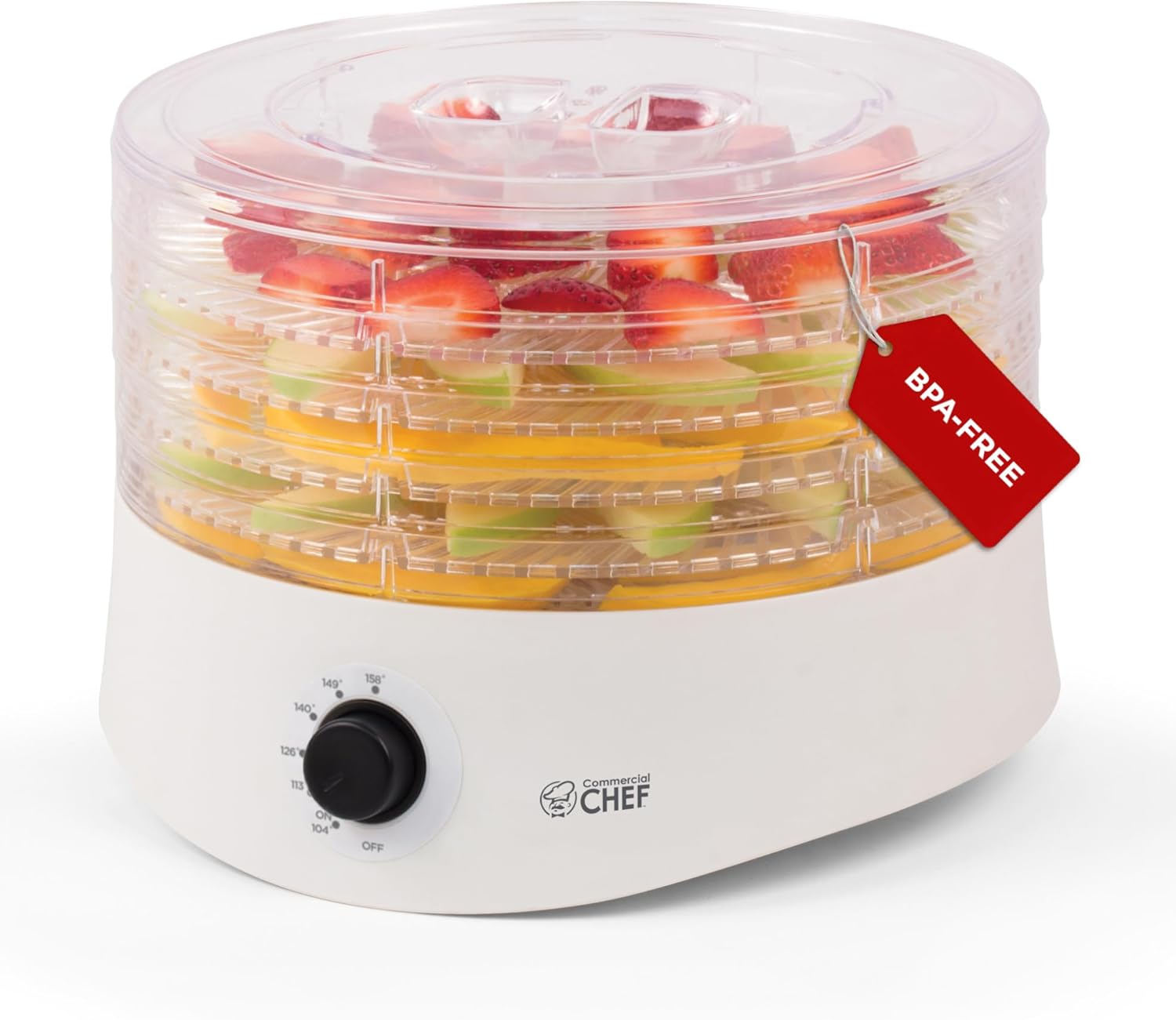
| Wattage | 280 watts |
|---|---|
| Voltage | 120 volts |
| Number of Trays | 5 |
| Temperature Range | 104˚F – 158˚F |
The Commercial Chef CCD100W6 is a small, round countertop dehydrator designed for basic home drying tasks like fruit leather, chips, herbs, and jerky. It uses a top-mounted fan and heating element to circulate air through five BPA-free reversible trays so you can stack or create extra clearance for thicker pieces. A mechanical temperature knob covers 104 to 158 degrees Fahrenheit, which is the right range for low‑and‑slow drying of fruit purees and thin slices, and a power indicator makes operation obvious. At 280 watts the unit runs modestly efficient for its size and stores easily in a pantry when not in use. Practical limits include the modest tray diameter and only two tray-height settings, so large batches of fruit leather may require layering or multiple runs, and the plastic housing means you should avoid very high-heat or greasy applications. For someone focused on affordable, straightforward home dehydrating this machine covers the essentials without extra bells and whistles.
Best for: Buyers who want an affordable, no-frills dehydrator for occasional homemade fruit leather, fruit chips, and small jerky batches and who prioritize simple operation and compact storage.
Less Ideal for: Users who plan large-volume dehydrating, frequent commercial use, or need precise digital timers and many rack-height options should consider a larger or more feature-rich model.
- Five BPA-free reversible trays let you fit thicker pieces or increase drying area.
- Adjustable thermostat (104°F–158°F) for low-temperature fruit leather and jerky drying.
- Compact, lightweight design that stores easily and uses only 280 watts.
- Simple mechanical controls and power indicator make it easy to operate.
- Relatively small tray diameter limits batch size for wide fruit leather strips.
- Only two tray-height positions reduce flexibility for very thick items.
Verdict: An inexpensive, compact dehydrator that reliably handles small to medium fruit leather and snack batches with simple, effective controls.
Cosori Stainless Steel Dehydrator CP267-FD

| Wattage | 600 watts |
|---|---|
| Number of Trays | 6 |
| Temperature Range | 95-165 F °F |
| Voltage | 120 volts |
The Cosori CP267-FD is a countertop dehydrator built for batch work, using six stackable stainless steel trays and a rear-mounted fan to circulate air evenly without rotating trays. You set temperature precisely between 95 and 165°F and run the digital timer up to 48 hours, which makes it easy to dry fruit leather, jerky, herbs, and larger volumes in one session. The 600 W motor with upgraded airflow aims for faster, more even drying, and the brushless fan keeps noise under 48 dB so it can run overnight without being intrusive. Included accessories such as a mesh screen and fruit roll sheet simplify small-item drying and keep food off the tray surfaces, and most removable parts are dishwasher safe for easier cleanup. The unit is heavy and made of stainless steel, so it feels durable but takes more counter space and has some weight to move. If you prioritize steady, reliable drying and large batch capacity for fruit leather, this model delivers consistent results with user-friendly controls.
Best for: Buyers who want a dependable, high-capacity dehydrator for frequent or large-batch fruit leather and snack prep and who prioritize consistent, precise drying over a compact footprint.
Less Ideal for: People who only need an occasional small dehydrator or who need a lightweight, ultra-compact unit for limited counter space should consider smaller models.
- Six stainless steel trays provide large 6.5 ft² drying area for batch drying
- Digital temperature control from 95–165°F and 48-hour timer for precise drying
- Rear-mounted fan and upgraded airflow for even, hands-off drying
- Brushless motor rated below 48 dB for quiet overnight operation
- Includes mesh screen and fruit roll sheet for fruit leather and small items
- Relatively heavy and takes notable counter or storage space
- Larger footprint may be overkill for users who only dry occasional small batches
Verdict: Choose this Cosori if you want a sturdy, quiet, large-capacity dehydrator that delivers precise, repeatable results for making fruit leather and other batch snacks.
Elite Gourmet EFD319 Dehydrator

| Wattage | 350 watts |
|---|---|
| Voltage | 120 volts |
| Number of Trays | 5 |
| Temperature Range | 95°F–158°F |
The Elite Gourmet EFD319 is a countertop food dehydrator aimed at home cooks who want to preserve fruit, herbs, and make jerky or snacks. It uses a 350W base-mounted fan and horizontal airflow to circulate heat evenly through five BPA-free clear trays, and the stacking height can be expanded to fit thicker pieces. A simple dial adjusts temperature across a 95°F–158°F range, which covers the common settings needed for fruit leather, chips, herbs, and meat. Trays and lid are removable and top-rack dishwasher safe, and the transparent design lets you check progress without opening it. The unit is compact enough for small kitchens or RVs and runs on standard 120V. Limitations are the single dial control without a digital timer or precise display and a maximum listed temperature rather than a continuous numeric readout, so you may need to monitor run times manually for consistent fruit leather thickness and texture. For everyday home dehydrating the EFD319 delivers predictable, even drying in a space-saving package.
Best for: Buyers who want a reliable, space-saving dehydrator for regular home use—especially for fruit leather, herbs, and small batches of jerky—and who value proven performance over digital controls.
Less Ideal for: Users who need fully programmable cycles, precise digital temperature control, or large-capacity commercial drying should look at more advanced or professional models.
- Five clear, BPA-free stackable trays that expand to fit thicker cuts or larger batches
- Adjustable temperature dial covering 95°F–158°F for fruits, herbs, and jerky
- Horizontal airflow with a 350W fan for even heat distribution across trays
- Removable trays and lid are dishwasher safe for easier cleanup
- Compact footprint suitable for small kitchens and RVs
- No digital timer or precise temperature display so drying requires manual timing
- Single heating zone means you must rotate or rearrange heavily loaded trays for very uniform results over long cycles
Verdict: A compact, straightforward dehydrator that reliably dries fruit leather and small batches of snacks with even airflow and easy-clean trays.
Cosori Compact Food Dehydrator CFD-N051-W

| Wattage | 350 watts |
|---|---|
| Voltage | 120 volts |
| Number of Trays | 5 |
| Temperature Range | 95-165 F |
| Operating Frequency | 60 hertz |
The Cosori Compact Food Dehydrator is a user-friendly countertop unit built for making fruit leather, jerky, and dried herbs at home. It uses a 350W heater and fan with a wide temperature range of 95 to 165°F adjustable in 1°F increments and a timer that runs up to 48 hours in 30-minute steps, which helps when drying thick fruit purees into leather without overcooking. The unit ships with five BPA-free trays and supports adding two more for larger batches, and its adjustable tray heights let you fit thicker pieces or stack for storage. Construction uses food-safe polypropylene and the machine is designed to run quietly at under 47 dB, so it can operate overnight. Practical limits include its compact round footprint, which may require multiple cycles for very large batches, and the plastic exterior that, while sturdy, is not stainless steel. The included recipe book is helpful for beginners but advanced users may want separate drying charts for different fruits and thicknesses.
Best for: Buyers who want a reliable, easy-to-use dehydrator for making fruit leather at home and value precise temperature control and quiet overnight operation.
Less Ideal for: Large-scale producers or users who need industrial capacity or a metal-bodied commercial machine for heavy daily use should look at larger commercial dehydrators.
- Precise temperature control to 165°F in 1°F increments for accurate drying.
- Five BPA-free trays with optional expansion to seven for larger batches.
- Adjustable tray heights accommodate thick fruit purées and uneven pieces.
- Quiet operation under 47 dB suitable for overnight drying.
- Includes a 50-recipe cookbook and user manual to get started.
- Compact round footprint limits single-batch capacity for very large fruit leather runs.
- Plastic construction instead of metal may show wear faster with heavy use.
Verdict: A dependable, quiet countertop dehydrator with fine temperature control that makes consistent fruit leather for home cooks.
Choosing the Right Food Dehydrator for Fruit Leather: Key Factors to Consider
Temperature Control and Stability
Accurate low-temperature settings are essential when making fruit leather because purees require long, gentle drying to remove moisture without cooking. Units with digital thermostats or well-calibrated analog dials let you set and maintain the recommended 120°F to 140°F range, reducing the chance of scorching edges while the center remains tacky.
Temperature stability also affects batch consistency. A dehydrator that fluctuates widely forces you to check and rotate trays frequently, adding time and introducing variability between sheets.
Airflow Design and Heat Distribution
How a dehydrator moves air across trays determines whether fruit leather dries evenly. Models with rear-mounted or top-mounted fans that push air across flat trays tend to produce more uniform results than designs that rely on passive convection alone. Look for units that describe an even airflow pattern or that have multiple venting channels.
Poor heat distribution creates problems like dry, brittle edges and a still-tacky center. For fruit leather, even, gentle airflow helps moisture escape steadily from the entire sheet, yielding consistent texture and flavor concentration.
Tray Size, Shape, and Capacity
Fruit leather requires flat, wide surfaces so you can spread puree into sheets. Consider tray dimensions and whether the trays accommodate full-size sheets or require cutting the puree into smaller portions. Larger trays reduce the number of dehydrator runs needed for the same yield, which matters if you make fruit leather in batches.
Also check how many trays the unit supports and the spacing between them. Too little clearance can slow drying or force you to run fewer sheets per batch. Removable and stackable trays improve workflow when drying multiple sheets over several runs.
Ease of Cleaning and Maintenance
Fruit purees can be sticky and staining. Trays that are dishwasher-safe or have nonstick surfaces make cleanup much easier and reduce the time between batches. Smooth interior surfaces and removable components let you reach corners and remove dried-on bits without specialized tools.
Maintenance also includes how easy it is to access the fan and heating element for occasional cleaning. Units that require disassembly for basic upkeep add friction to regular use and may discourage frequent home production.
Noise, Footprint, and Kitchen Fit
Dehydrators run for many hours, so noise level matters if you keep the unit in or near living spaces. Quieter fans are less disruptive, especially on long drying cycles. Consider the unit's physical footprint and storage requirements; a model that sits comfortably on a counter but stores compactly is preferable if you lack permanent appliance space.
Evaluate the appliance's weight and handle placement if you plan to move it when full. A heavy, awkwardly shaped dehydrator is harder to manage during setup and cleanup.
Build Quality and Warranty
Higher-quality materials and solid construction contribute to consistent temperature performance over time. Look for sturdy tray rails, corrosion-resistant finishes, and well-sealed doors to prevent heat loss. A reliable warranty and accessible customer support provide assurance for a frequently used appliance and indicate manufacturer confidence in long-term performance.
Durable components reduce the likelihood of warped trays or failed fans after repeated high-humidity drying cycles that are typical when making fruit purees.
Preparing Puree and Spreading Techniques
Texture and consistency of the puree directly affect drying time and the final mouthfeel. For most fruits, cook softer fruits lightly to concentrate flavor, then purée until smooth and strain to remove seeds when necessary. Thicker purees hold shape better on the tray and reduce run-off.
Use a nonstick sheet or parchment trimmed to the tray size to make removal easier. Spread puree in an even layer, typically 1/8 to 1/4 inch thick depending on fruit water content. A small offset spatula or the back of a spoon works well to feather edges and prevent raised ridges that dry unevenly.
- Test a small tray first to confirm thickness and drying time.
- Rotate trays mid-cycle if your dehydrator has known hot spots.
- Label sheets with fruit type and start time to track drying progress.
Drying Times and How to Judge Doneness
Drying time depends on puree thickness, ambient humidity, and the dehydrator's airflow. Typical fruit leather dries in 4 to 10 hours. Check for pliable dryness: the leather should be tack-free to the touch, still flexible, and not wet in the center.
If the leather tears when bent, it is over-dried and will be brittle once cooled. If it sticks to your finger or to neighboring sheets, it needs more time. Allow sheets to cool slightly on the tray before peeling to reduce stretching or tearing.
- Thinner layers dry faster and can take less than 4 hours.
- High-humidity environments extend drying time significantly.
- Denser fruits like mango often need more time than berries.
Food Safety and Storage for Fruit Leather
Properly dehydrated fruit leather is shelf-stable for a limited time if stored correctly. Cool the sheets completely, then roll them in parchment or place them flat in airtight containers. For longer storage, vacuum sealing and refrigeration extend freshness and minimize mold risk.
Make sure the puree reaches a low enough water activity through complete drying. If you detect off-odors, visible mold, or unusually tacky texture after storage, discard the batch. Clean trays and internal surfaces between batches to avoid cross-contamination.
- Label storage containers with date and fruit type.
- For long-term storage, keep fruit leather refrigerated or frozen.
- Avoid rehydrating by storing in a cool, dry place away from direct sunlight.
Common Troubleshooting Tips
If edges dry faster than centers, try thinning the puree slightly or increasing airflow by using trays with more spacing. Also ensure the tray is level so the puree does not pool to one side. Rotating trays during the cycle can help mitigate uneven drying.
Sticky centers often mean the temperature was too low or the layer was too thick. Raise the temperature slightly within the safe range and extend drying time, or scrape and spread the puree more thinly next time.
- If trays warp, check that they are rated for repeated high-humidity use.
- Use a small oven thermometer to verify actual internal temperature if results are inconsistent.
- If you notice condensation on the door, increase airflow or shorten tray stacking.
How We Chose the Best Food Dehydrator for Fruit Leather
We focused on features that directly affect how well a dehydrator makes fruit leather, prioritizing temperature accuracy, airflow design, tray capacity and layout, ease of cleaning, and durability. Temperature accuracy matters because fruit leather needs low, steady heat for several hours to dry evenly without burning. Airflow and tray layout influence whether sheets dry uniformly or develop wet spots and edges that overcook. Capacity and tray shape determine how many sheets you can dry per run and whether the machine fits common baking-sheet-sized parchments. Ease of cleaning and simple tray removal reduce the time between batches and make fruit puree cleanup manageable. Durability and warranty coverage indicate how long a dehydrator will maintain consistent operation under repeated use. We excluded models that lack fine temperature control or that only support very small, rounded trays unsuitable for flat fruit leather sheets. Units missing simple, removable trays or those that use unreliable fan designs were not considered. The final list contains dehydrators that balance steady low-heat performance, usable flat drying area, and straightforward maintenance.
Our full evaluation process is outlined in our review methodology.
FAQ
What is the best temperature to dry fruit leather?
Most fruit leather dries well between 120°F and 140°F. Lower temperatures preserve more fresh flavor but take longer, while higher temps speed drying but increase the risk of uneven edges or a cooked taste.
How long does fruit leather typically take to dry?
Drying time usually ranges from 4 to 10 hours depending on puree thickness, fruit type, and humidity. Thinner spreads and lower ambient humidity shorten drying time, while thick layers and rainy weather extend it.
Can I use baking sheets instead of dehydrator trays?
Some dehydrators accept trim-to-fit parchment that sits on flat trays, but full baking sheets may not fit. Using trays sized for flat sheets is preferable to ensure even airflow and proper drying.
How do I prevent fruit leather from sticking to the tray?
Line trays with nonstick sheets or parchment and allow the leather to cool before peeling. Lightly oiling a tray is not recommended because it can change texture and flavor; nonstick liners provide the best release.
Is it safe to preserve fruit leather without added sugar?
Yes, drying preserves fruit by removing moisture rather than relying on sugar for preservation. Purees with higher acidity or sugar will taste sweeter and sometimes dry differently, but safety depends on reaching low enough moisture levels and storing properly.
Final Verdict
When choosing a dehydrator for fruit leather, prioritize steady low-temperature control, even airflow across flat trays, and enough tray area to match your batch output. Balance those requirements with ease of cleaning and the unit's footprint so that frequent use fits your kitchen routine. Focus on features that reduce hands-on time and deliver consistent sheets from run to run. With the right combination of temperature stability, tray size, and airflow design, you can produce evenly dried, flavorful fruit leather reliably.