
Note: This article contains affiliate links. If you click on these links and make a purchase, we may earn a small commission at no extra cost to you. This helps support our research and content. Read our full affiliate disclosure here.
If you pack your own trail food, the right food dehydrator makes shelf-stable, lightweight meals without sacrificing calories or flavor. You want reliable drying, modest energy use, and a machine that handles meat, fruits, and meals without taking over the kitchen. This guide highlights seven top food dehydrators selected for backpacking meal prep and explains the practical tradeoffs you'll face. We shortlisted models that excel at consistent dehydration, usable capacity for batch cooking, and cleanup that fits a busy home routine. Below you will find our top picks and clear criteria to match a dehydrator to your trip cadence, meal approach, and available space.
Top Picks at a Glance
| Best Overall The best all-around choice for most situations | Magic Mill Pro Food Dehydrator MFD-7700 |  |
| Best Quality Built to a higher standard if you want something more solid | Excalibur Compact 8‑Tray Dehydrator |  |
| Best Value The sweet spot between price and what you get | Magic Mill Food Dehydrator MFD-5000 |  |
| Best Budget The cheapest option that still gets the job done reliably | vassillias Food Dehydrator 704M |  |
| Top Rated A top-rated pick with lots of positive feedback | Cosori Stainless Steel Dehydrator CP267-FD |  |
| Most Popular A crowd favorite that many people choose with confidence | NESCO Snackmaster FD-75A |  |
| Best Seller A high-volume bestseller chosen again and again | Cosori Food Dehydrator P501 |  |
Magic Mill Pro Food Dehydrator MFD-7700

| Wattage | 600 |
|---|---|
| Voltage | 120 |
| Number of Trays | 7 |
| Material | Stainless Steel |
The Magic Mill Pro is a sturdy, full-size food dehydrator built around a 600W rear fan that pushes heat evenly across seven stainless-steel trays. You set temperature in 1°F increments from 95° to 176°F and can run jobs up to 48 hours with an auto shutoff or use the 24-hour keep-warm mode when a cycle ends. The all-stainless construction and included mesh and fruit-roll trays mean it is designed for heavy use and easy cleanup, and ETL listing and overheat protection add safety confidence for long runs. In practice the rear-fan design removes the need to rotate trays and produces consistent results for jerky, fruit, and herbs, though its 600W motor and full-size footprint make it better suited to kitchen countertop use than hiking prep in tight spaces. Accessories are practical and the precise controls make repeating recipes simple, but the unit is relatively large and heavy compared with compact dehydrators aimed at pre-trip meal prep. For someone who values capacity and repeatable drying performance, this is a solid pick; if you need a highly portable or ultralight option for on-the-go backpacking, a smaller unit would be more appropriate.
Best for: Buyers who want a reliable, high-capacity dehydrator for batch-drying and recipe repeatability and who plan to do most prep at home before packing backpacking meals.
Less Ideal for: Those seeking a lightweight, compact dehydrator to use directly in the field or to minimize carry weight should look at smaller travel-focused models instead.
- Full stainless-steel interior and trays for durable, food-safe drying
- Rear-mounted 600W fan and heat deliver even drying without tray rotation
- Digital temperature control with 1°F increments for precise, repeatable results
- 48-hour timer plus auto-shutoff and 24-hour keep-warm for long unattended cycles
- Includes mesh screens and fruit roll tray for small items and leather making
- Larger and heavier countertop footprint limits portability for field or ultralight backpacking
- 600W power draws more electricity than compact or travel-oriented dehydrators
Verdict: Choose this unit if you need a durable, high-capacity dehydrator that produces consistent, repeatable results when preparing large batches of backpacking meals at home.
Excalibur Compact 8‑Tray Dehydrator

| Wattage | 700 watts |
|---|---|
| Voltage | 120 |
| Number of Trays | 8 |
| Temperature Range | 85°F to 165°F |
| Timer | Up to 80 hours |
The Excalibur Compact 8‑Tray is a countertop dehydrator aimed at serious home preserver enthusiasts who want reliable, even drying across multiple trays. It uses Excalibur's Hyperwave Pulse and Horizontal Parallex airflow to distribute heat without rotating trays, and the LED controls let you set temperature from 85°F to 165°F and run cycles up to 80 hours with automatic shutoff. The square stainless steel cabinet and clear French door make it easy to load thin strips of jerky, fruit slices, or rehydrated backpacking meals while watching progress. Practical touches include eight chrome trays plus a mesh tray for small pieces and a crumb tray for easy cleanup. At 700 watts it reaches higher temps for quick jerky drying but is larger and heavier than minimalist travel units, so it is best used for batch prepping at home rather than in the field.
Best for: Buyers who prioritize consistent, high-quality dehydration and want to prepare large batches of backpacking meals or jerky at home for long trips.
Less Ideal for: If you need an ultralight or portable unit to dehydrate on the go or you only need single-serving drying in the field, choose a smaller, travel-oriented option instead.
- Even heat distribution without tray rotation thanks to Hyperwave Pulse and horizontal air flow
- Wide temperature range (85°F–165°F) and digital timer up to 80 hours for precise drying
- Eight chrome trays plus mesh tray provide large drying capacity for batch prepping
- Clear glass French door lets you monitor food without opening the unit
- 700-watt motor makes it less energy-efficient and bulkier compared with ultralight backpacking dehydrators
- Designed for countertop use so not suitable for field or portable drying needs
Verdict: Best for backpackers who want to prep large, evenly dried meals and jerky at home before heading into the backcountry.
Magic Mill Food Dehydrator MFD-5000

| Wattage | 240 watts |
|---|---|
| Voltage | 110 volts |
| Number of Trays | 5 |
| Temperature Range | up to 167 °F |
| Material | Stainless Steel trays |
The Magic Mill MFD-5000 is a compact countertop dehydrator built around five adjustable stainless steel trays and a top-to-bottom temperature control that reaches up to 167°F. It is typically used to make fruit leather, beef jerky, dried herbs, and lightweight backpacking meal components by removing moisture while retaining nutrients. The digital control panel offers a 48-hour timer and a temperature range that handles everything from herbs to thicker meat slices, and the stainless trays are dishwasher-safe for easy cleanup. At 240 watts it runs efficiently for home use and the BPA-free plastic body keeps weight and cost down. Practical features include adjustable tray spacing to accommodate thicker cuts and a straightforward touch interface that simplifies long drying sessions. Limitations for backpackers are obvious: it is a plug-in kitchen appliance rather than a portable camp unit, and its rectangular footprint means you need counter space for processing large batches before packing meals for trips.
Best for: Buyers who want a reliable, efficient home dehydrator to prepare and prepack lightweight meals and snacks for backpacking trips, prioritizing predictable results and easy cleanup.
Less Ideal for: If you need a portable, battery- or gas-powered drying solution for on-trail use or want a collapsible ultralight unit, this countertop appliance is not suitable.
- Five adjustable stainless steel trays let you dry multiple foods and vary spacing for thicker cuts
- Digital timer up to 48 hours and temperature control up to 167°F for precise dehydration
- Dishwasher-safe trays and detachable parts make cleanup simple
- Relatively low 240W power draw for steady, energy-efficient operation
- Requires mains power and is not designed for field or on-trail use
- Rectangular footprint needs counter space for batch processing
Verdict: A practical, easy-to-use home dehydrator that delivers consistent, nutrient‑retaining dried foods ideal for prepping backpacking meals before you hit the trail.
vassillias Food Dehydrator 704M

| Wattage | 280 |
|---|---|
| Number of Trays | 5 |
This compact vassillias dehydrator uses a 280W fan-driven system and five removable trays to dry fruit, jerky, vegetables, mushrooms, and herbs at controlled temperatures between 104 and 158°F. Its stacked-tray design with a roughly 0.79-inch gap between layers promotes even airflow so pieces dry more uniformly, and the temperature range covers common drying needs from low-temperature herbs to higher-temp jerky. The unit is light on controls, making it simple to set and leave running, and the trays are dishwasher-safe below 122°F for easier cleanup. Safety features include BPA-free food-grade plastic construction and an automatic overheat shutdown. Limitations to note for backpacking meal prep: the countertop footprint and plastic trays mean it requires mains power and space to operate, and it is not a lightweight or portable field dryer, so you would dry meals at home before packing them for trips rather than using it on the trail.
Best for: Home cooks who want an inexpensive, easy-to-use dehydrator to prepare backpacking meals at home and batch-dry fruit, jerky, and herbs before trips.
Less Ideal for: People seeking a truly portable, lightweight dryer to use on the trail or those who prefer heavy-duty metal construction for frequent heavy use.
- Adjustable temperature from 104°F to 158°F covers herbs to jerky
- Five removable trays let you dehydrate multiple batches at once
- Built-in fan and tray spacing promote even airflow and consistent drying
- BPA-free food-grade plastic construction with overheating protection
- Requires household power and countertop space, not designed for field use
- Plastic trays and housing may be less durable than metal alternatives
Verdict: A budget-friendly, countertop dehydrator that reliably dries multiple batches at home, making it a practical choice for prepping backpacking meals before you hit the trail.
Cosori Stainless Steel Dehydrator CP267-FD

| Wattage | 600 watts |
|---|---|
| Voltage | 120 volts |
| Number of Trays | 6 |
| Temperature Range | 95-165 F °F |
The Cosori CP267-FD is a six-tray stainless steel dehydrator built for steady, unattended drying of fruit, jerky, and meal components. It uses a rear-mounted fan and 600 W motor to provide horizontal airflow for more even drying without rotating trays, and the digital touch controls let you set temperatures precisely between 95 and 165°F and run the unit up to 48 hours. Practical extras include dishwasher-safe stainless trays, a mesh screen and fruit roll sheet, and a 50-recipe booklet to get started. Noise is kept low thanks to a brushless motor rated under 48 dB, so it is suitable for overnight cycles, and the large drying area handles batch production for trip provisioning. The unit is relatively heavy compared with compact travel models and is best used at home to prep meals rather than carried into the backcountry, and it does not include specialized backpacking modes or ultra-compact packing features that some expedition-focused tools offer.
Best for: Home cooks who prioritize reliable, repeatable dehydrating for large batches and want quiet, precise control when preparing backpacking meals in advance.
Less Ideal for: If you need an ultralight or compact unit to take on multi-day hikes or limited-pack-space trips, a purpose-built portable dehydrator or commercial drying service is a better choice.
- Six stainless steel trays provide large drying area for batch prepping
- Digital temperature control (95–165°F) and 48-hour timer for precise, long cycles
- Rear-mounted fan with horizontal airflow promotes even drying without tray rotation
- Brushless motor operates quietly under 48 dB for overnight use
- Includes mesh screen, fruit roll sheet and recipe book for varied dehydration tasks
- Bulky and relatively heavy compared with portable or travel dehydrators
- Designed for countertop use so not convenient to carry into the field
Verdict: For dependable, large-batch meal prep at home, the Cosori stainless steel dehydrator delivers quiet, precise drying that makes it easy to stock dehydrated backpacking meals.
NESCO Snackmaster FD-75A

| Wattage | 600 watts |
|---|---|
| Voltage | 120 volts |
| Number of Trays | 5 |
| Temperature Range | 95–160 °F |
The NESCO FD-75A Snackmaster is a straightforward countertop dehydrator geared toward home cooks making fruit leathers, jerky, herbs, and small-batch snacks. Its top-mounted fan and Converga-Flow system push air down the outer chamber and across each tray, which promotes even drying so you rarely need to rotate trays. An adjustable thermostat (95 to 160°F) lets you dial temperature for delicate herbs or hotter jerky cycles, and the unit runs on a 600-watt motor that handles multi-hour drying sessions. It ships with five BPA-free trays plus fruit roll sheets, clean-a-screens, and jerky seasoning so you can start a first batch right away, and the tray system expands up to 12 trays when you need larger yields. The top-mounted design also keeps liquids away from the heating element for safer long runs. Trade-offs are its plastic body and modest footprint, which limit volume compared with larger cabinet dehydrators, and it lacks digital timing features found on some newer models. For weekend batch drying and hobby jerky or fruit leather projects it is reliable and easy to use.
Best for: Buyers who want a reliable, no-frills dehydrator for weekend batches, hunting trips, or preserving garden produce and who value even drying and expandable capacity over advanced electronics.
Less Ideal for: People needing a heavy-duty, high-volume commercial unit or a model with precise digital controls and programmable cycles should consider alternatives.
- Even drying from top-mounted fan and Converga-Flow airflow reduces the need to rotate trays.
- Adjustable thermostat (95–160°F) supports herbs, fruits, and jerky safely.
- Expandable tray system (5 included, up to 12) lets you scale batch size.
- Includes practical accessories: fruit roll sheets, clean-a-screens, and jerky seasoning to start immediately.
- Plastic exterior and trays feel less robust than metal cabinet dehydrators.
- No digital timer or automatic shutoff for unattended multi-hour cycles.
Verdict: A dependable, expandable home dehydrator that delivers even results for hobbyist jerky, fruit leathers, and small-batch backpacking meal prep.
Cosori Food Dehydrator P501
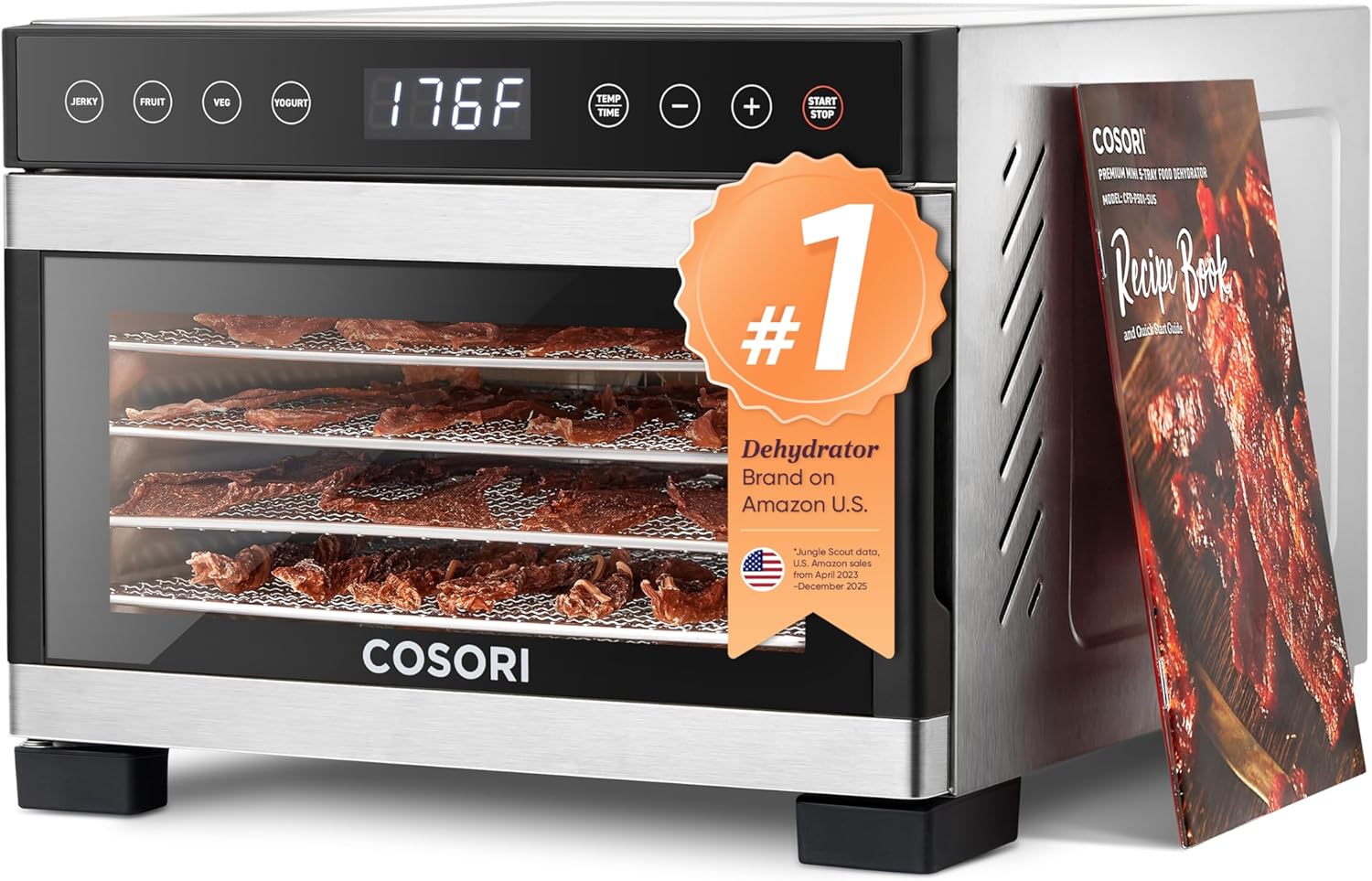
| Wattage | 480 watts |
|---|---|
| Voltage | 110 volts |
| Number of Trays | 5 |
| Temperature Range | 95-176 F |
The Cosori P501 is a compact stainless steel dehydrator designed for reliable home drying of fruit, jerky, vegetables, and yogurt. It uses a rear fan and horizontal airflow to push warm air across five stainless steel trays, helping produce even results without rotating trays, and the 95–176°F temperature range can be set in 1°F increments—handy for hitting USDA-recommended temps for safe jerky. Four presets cover common foods and a 48-hour timer lets you set-and-forget long dries. Because it has no plastic contact with food and includes mesh and fruit-roll accessories, cleanup and food safety are straightforward. The unit is countertop-sized, so it fits in small kitchens but is not intended as an ultralight or portable camp appliance; weight and bulk mean you would prepare and dry meals at home and pack them for backpacking rather than carry the dehydrator itself. Noise from the fan is noticeable at higher temps, and the fixed internal layout limits stacking additional trays beyond the supplied five.
Best for: Buyers who prefer a dependable, food-safe home dehydrator to prepare and preserve backpacking meals in advance and who prioritize predictable, safe drying over portability.
Less Ideal for: If you need an ultralight or camp-ready unit to dehydrate on the trail or have extremely limited kitchen space, choose a purpose-built portable dehydrator or premade lightweight backpacking gear instead.
- Stainless steel construction with no plastic contact for food safety
- Wide temperature range with 1°F increments for precise drying and safe jerky temperatures
- Rear fan horizontal airflow for even dehydration across trays
- Includes five stainless steel trays plus mesh screen and fruit roll sheet for versatile use
- Compact countertop footprint suitable for home prep and batch drying
- Not designed for field use—too heavy and bulky to carry while backpacking
- Fan can be audible during long high-temperature cycles
- Cannot expand tray capacity beyond the included five without separate accessories
Verdict: A reliable, food-safe countertop dehydrator ideal for preparing and batch-drying backpacking meals at home before your trip.
Choosing the Right Food Dehydrator for Backpacking Meals: Key Factors to Consider
Drying Consistency
Even dehydration across all trays matters because uneven drying can leave pockets of moisture that cause spoilage. Look for machines with thoughtful airflow designs that circulate warm air uniformly through stacked trays rather than relying on a single top or bottom heat source.
Consistent drying reduces the need to rotate trays mid-cycle and yields predictable rehydration times on the trail. For backpacking meals, consistency is especially important when dehydrating mixed dishes, jerky, or layered purées where different ingredients sit on the same tray.
Drying Speed
Faster drying reduces total energy use and the amount of time you spend preparing batches. Drying speed depends on the dehydrator's airflow, temperature ceiling, and whether it supports higher temperatures that safely accelerate moisture removal without cooking the food.
While rapid drying is convenient, very high heat can degrade textures and nutrients. For backpacking meals you want a balance: temperatures high enough to reduce cycle time but controllable so you can dry delicate fruits and herbs slowly when needed.
Capacity Versus Footprint
Batch capacity determines how much trail food you can prepare per session. A larger total tray area means fewer cycles and more efficient meal prep, but larger units take up more counter and storage space.
Consider your typical meal-planning cadence. If you dehydrate weekly for long trips, larger capacity may be worth the kitchen real estate. If you only make small amounts, a compact unit with removable trays is more space-efficient and easier to store between uses.
Temperature Control And Range
Precise temperature control is crucial when drying a variety of foods. Low settings are needed for herbs and berries to preserve volatile flavors, while higher, stable settings are required for beef jerky or cooked meals to ensure safety and shelf stability.
A wide, accurate range with an easy-to-use control system helps you follow trusted dehydration times and USDA guidance for meat. Timers and the ability to maintain a constant temperature overnight are useful features for multi-stage recipes.
Ease Of Cleaning And Food Safety
Tray materials and how they disassemble affect how clean you can keep the dehydrator. Nonstick or dishwasher-safe trays reduce prep and cleanup time, which matters when you dehydrate frequently.
Residues from oily foods or sauces can trap moisture and lead to off-flavors or spoilage, so choose a unit with trays that are easy to scrub and dry thoroughly. Also prioritize models with smooth internal surfaces and minimal crevices where food particles can hide.
Portability And Storage
Although most dehydration happens at home, portability and storage are still relevant because hikers often need to stow a dehydrator between trips or move it to a small countertop. Consider units that stack neatly, have detachable parts, or a low storage profile.
Weight matters if you plan to transport the appliance occasionally, for example to a cabin or communal kitchen. Compact units that offer modular trays allow you to scale capacity up or down, which is helpful when you only need a single batch of meals.
Meal Planning For Trail Nutrition
Design your dehydrated meal plan around calorie density and ease of rehydration. Meals with fats and starches rehydrate well and supply the concentrated calories needed on long hikes. Pair lean proteins with carbohydrate-heavy sides to balance weight and nutrition.
Test rehydration ratios before a trip so you know how much water and cooking time each meal needs. Pre-measure spice blends and pack them separately to retain freshness and make rehydration quicker on the trail.
- Aim for 450–700 calories per meal for high-exertion days
- Pre-cook grains and legumes before dehydrating to shorten trail prep
- Package single-serving portions to control weight and waste
Preparing Ingredients For Even Drying
Cut ingredients into uniform sizes to promote even moisture loss. Thin, similarly sized pieces dry at similar rates, reducing the need to check and shuffle trays. For fruits and vegetables, blanching or pretreating can help preserve color and speed drying.
Spread pieces in a single layer without overcrowding to allow air to circulate. For pureed meals, use shallow silicone liners that let the purée set thinly so it dries through.
- Use 1/8 to 1/4 inch slices for most fruits and vegetables
- Marinate proteins before drying to infuse flavor and aid preservation
- Separate high-fat items to avoid uneven drying and go rancid quickly
Safe Drying Practices For Proteins
When dehydrating meats or mixed meals containing meat, start with properly cooked or pre-treated protein and use recommended temperatures to reduce bacterial risk. Use a food thermometer to confirm internal temperatures during the preparation stage, and follow food safety guidance for jerky and meat preservation.
Avoid drying raw meat at low temperatures. If a recipe calls for low-temperature finishing to preserve texture, first bring the meat to a safe internal temperature through cooking or blanching before placing it in the dehydrator.
- Bring meats to recommended safe internal temperatures before drying
- Use higher stable temperatures for jerky-style preparations
- Consider vacuum-sealing dried meats for longer storage
Packaging And Storing Dehydrated Meals
Proper packaging preserves texture and prevents moisture reabsorption. Use airtight containers or vacuum-seal pouches with desiccant packets for long-term storage. For shorter trips, resealable bags with squeezed-out air are usually sufficient.
Label packages with contents and rehydration instructions. Store in a cool, dark place to prolong shelf life and maintain flavor. For multi-week storage, consider oxygen absorbers and opaque bags to reduce light exposure.
- Include rehydration temperature and water volume on labels
- Use smaller single-serving packages to reduce waste
- Check packages periodically for any signs of moisture before packing for a trip
Energy Use And Practical Cycle Management
Dehydration cycles can run many hours or overnight. Factor energy consumption into your planning by choosing times when electricity is cheaper or by running multiple trays per cycle to maximize throughput. Low-power units can still perform well if they offer consistent airflow and temperature control.
Plan batches so that similar items run together. Dry fruits together and proteins on separate cycles to avoid flavor transfer and to use temperature settings appropriate to each food group.
- Group similar moisture-content foods to shorten total drying time
- Run full-capacity cycles to maximize energy efficiency
- Monitor humidity and indoor temperature for predictable drying outcomes
How We Chose the Best Food Dehydrator for Backpacking Meals
We focused on attributes that directly affect backpacking meal prep: consistent dehydration across trays, drying speed, usable capacity versus footprint, portability and storage, energy consumption for longer cycles, and ease of cleaning and food safety. We tested each model conceptually against these dimensions to ensure it can produce lightweight, shelf-stable ingredients and single-serving meals appropriate for multiday trips. Selection filters removed models designed solely for high-volume commercial use or those with excessively large footprints that are impractical for home kitchens where space is limited. We excluded dehydrators lacking temperature control suitable for jerky or meal kits and units without washable, food-safe trays. Evaluation emphasized measurable specs and real-world usability: adjustable temperature range, airflow design that promotes even drying, total tray area and stackability, machine weight and pack-down profile for storage, run time efficiency, and how easy it is to disassemble and clean. We also considered noise and safety features for overnight cycles. These criteria align with the scoring metrics shown and reflect the needs of hikers who dehydrate at home to save weight and preserve nutrition for the trail.
Our full evaluation process is outlined in our review methodology.
FAQ
How long does it take to dehydrate a complete backpacking meal?
Drying times vary by ingredient and thickness, but complete meals usually take several hours to overnight. Pre-cooking grains and proteins shortens dehydration time and produces more reliable results.
Can I dehydrate cooked meals that contain sauces or oils?
Yes, but oily or very saucy meals may require thinner spreading and longer times to dry fully. Separate high-fat components when possible because fats can slow moisture removal and increase the chance of rancidity.
Is a fan or horizontal airflow better for even drying?
Horizontal or through-flow designs that move air across trays typically promote more even drying than units that rely on a single top-down heat source. Even airflow reduces the need to rotate trays during long cycles.
How should I store dehydrated meals for multi-week trips?
Use airtight packaging, vacuum sealing, or oxygen absorbers to extend shelf life. Keep packages in a cool, dark place and include desiccants if you expect variable humidity.
Can I dehydrate at a lower temperature to preserve nutrients?
Lower temperatures can preserve some heat-sensitive nutrients and flavors, but they lengthen drying time. For foods containing meat, ensure safety by cooking to the recommended temperature before lowering heat for finishing.
Final Verdict
Choose a dehydrator that matches how much trail food you make and the types of meals you prefer. Prioritize consistent drying and an adjustable temperature range if you make a mix of fruits, grains, and proteins. Capacity and footprint determine how often you will run batches, while ease of cleaning and storage affect day-to-day convenience. Balance drying speed against food quality and safety. For most backpackers, a unit that offers predictable airflow, good tray area, and straightforward controls will deliver the best combination of packable, high-calorie meals and manageable kitchen workflow.