
Note: This article contains affiliate links. If you click on these links and make a purchase, we may earn a small commission at no extra cost to you. This helps support our research and content. Read our full affiliate disclosure here.
If you have limited counter space but want the flexibility to dry fruit, herbs, jerky, and snacks at home, a compact food dehydrator can be a smart investment. Compact models are designed to deliver consistent low-heat airflow in a smaller footprint so you can dry batches without dedicating a whole cabinet or large appliance area. This guide covers seven shortlisted compact food dehydrators that excel at reliable drying, simple controls, and efficient use of space. We evaluated each unit on drying performance, noise and energy use, build quality, and daily ease of use to help you pick the best option for your kitchen. Read on for the key considerations and practical tips to get the most from a compact dehydrator.
Top Picks at a Glance
| Best Overall The best all-around choice for most situations | Hamilton Beach 5‑Tray Dehydrator |  |
| Best Quality Built to a higher standard if you want something more solid | Septree Compact Food Dehydrator DSC-04A |  |
| Best Value The sweet spot between price and what you get | Magic Mill Food Dehydrator MFD-5000 |  |
| Best Budget The cheapest option that still gets the job done reliably | vassillias Food Dehydrator 5-Tray |  |
| Top Rated A top-rated pick with lots of positive feedback | Cosori Stainless Steel Dehydrator P501 |  |
| Most Popular A crowd favorite that many people choose with confidence | Elite Gourmet 5‑Tray Dehydrator EFD329WD |  |
| Best Seller A high-volume bestseller chosen again and again | Cosori Compact Food Dehydrator CFD-N051-W |  |
Hamilton Beach 5‑Tray Dehydrator

| Wattage | 500 watts |
|---|---|
| Number of Trays | 5 |
| Temperature Range | 100-160 °F |
| Voltage | 110 |
The Hamilton Beach 5-Tray Digital Food Dehydrator is a compact countertop unit for making jerky, fruit chips, herbs and fruit leather at home. It uses a 500-watt base-mounted heater and quiet fan to deliver consistent airflow so you generally do not need to rotate trays, and the clear vented lid lets you monitor progress without disrupting drying. Temperature is adjustable from 100 to 160°F and the digital timer runs from 1 to 48 hours with auto shutoff, which covers most home dehydration tasks. The five BPA-free stackable trays provide about 4.2 sq. ft. of drying surface and include a mesh screen for herbs plus a solid sheet for fruit leather. Trays and lid are dishwasher safe for easier cleanup, though the mesh screen requires hand washing. At its size it tucks under cabinets and has nonslip feet, making it a good fit for small kitchens, but it is made of plastic so it is not the most heavy-duty build if you expect daily commercial use.
Best for: Buyers who want a compact, easy-to-use dehydrator for home kitchen snacks and occasional batch cooking, and who value steady, even drying and simple digital controls.
Less Ideal for: Not the best choice for heavy commercial use or users seeking metal construction, advanced presets, or smart connectivity features.
- Five stackable BPA-free trays provide about 4.2 sq. ft. of drying area for multiple batches
- Digital temperature control (100–160°F) and 1–48 hour timer with auto shutoff for precise drying
- 500-watt base-mounted heater and quiet fan promote even airflow so trays usually do not need rotating
- Includes mesh screen for herbs and a solid tray for fruit leather to expand recipe options
- Dishwasher-safe trays and lid speed cleanup (mesh screen is hand-wash)
- Plastic construction is lightweight but less durable than metal-bodied units
- No preset programs or app connectivity for guided dehydration workflows
Verdict: A compact, user-friendly dehydrator that delivers reliable, even drying and enough tray space for most home snack-making needs.
Septree Compact Food Dehydrator DSC-04A

| Wattage | 400 watts |
|---|---|
| Voltage | 120 volts |
| Number of Trays | 4 |
| Temperature Range | 70-190 °F |
The Septree DSC-04A is a small, countertop food dehydrator built for everyday home use and modest batch drying. It uses a rear-mounted fan and 400W heater to circulate air across four 304 stainless steel trays, and the digital control panel sets temperature from 70 to 190°F and a 24-hour timer in 30-minute steps. In practice it handles fruit chips, herbs, and one- to two-batch jerky runs efficiently thanks to the tight interior that concentrates heat and the even airflow that reduces tray rotation. The unit is easy to clean with removable stainless trays and comes with silicone sheets, storage containers, gloves, and a recipe book for immediate use. Downsides are its limited tray capacity for large-volume preserving and its compact footprint which slows very large loads compared with commercial or higher-capacity models. For everyday home cooks who want consistent drying without complex setup, it is a capable, user-friendly option.
Best for: Home cooks who prioritize consistent, controllable drying and want a compact, easy-to-use machine for snacks, herbs, and occasional jerky or fruit leather batches.
Less Ideal for: People who need high-volume or commercial-scale drying or who plan to run very large batches frequently should choose a larger-capacity model.
- Accurate digital controls with 70–190°F range and 24-hour timer for flexible recipes.
- Rear-mounted fan and 360-degree airflow design promote even drying across all trays.
- Stainless steel food-grade trays and BPA-free polycarbonate body are durable and easy to clean.
- Includes silicone sheets, storage containers, gloves, and a recipe book so you can start drying right away.
- Four-tray capacity limits batch size compared with larger dehydrators.
- Not intended for continuous heavy commercial use due to compact wattage and capacity.
Verdict: A compact, performance-focused countertop dehydrator that delivers even, controllable drying for home snack and preservation projects.
Magic Mill Food Dehydrator MFD-5000

| Wattage | 240 watts |
|---|---|
| Voltage | 110 volts |
| Number of Trays | 5 |
| Temperature Range | 95-167 °F |
The Magic Mill MFD-5000 is a compact countertop dehydrator that makes drying fruits, herbs, vegetables and jerky straightforward. It uses a 240W heater with a digital control panel to set temperature (95 to 167°F) and a 48-hour timer, and the top-down airflow and five adjustable stainless steel trays let you run multiple foods at once or raise tray spacing for thicker cuts. The stainless trays and dishwasher-safe detachable design make cleanup simple, and the BPA-free plastic housing keeps the unit lightweight and easy to move. Because it is small and designed for home use, it is best for batch sizes typical of household cooks rather than large-volume commercial work, and the fixed maximum temperature and single-zone control mean you cannot independently dry different items at different temperatures simultaneously. Still, the combination of adjustable trays, straightforward controls, and mostly metal food-contact surfaces delivers reliable, practical drying for home cooks looking to preserve snacks, herbs, or pet treats.
Best for: Home cooks who want a compact, no-nonsense dehydrator to make snacks, herbs, jerky, or pet treats on a regular basis while minimizing counter space and cleanup effort.
Less Ideal for: People who need commercial-scale capacity, multi-zone temperature control, or heavy-duty continuous use should look at larger, professional dehydrators.
- Five stainless steel stackable trays allow drying several types of food at once
- Digital timer up to 48 hours and adjustable temperature up to 167°F for flexible drying cycles
- Detachable trays are easy to clean and dishwasher safe
- Compact footprint and lightweight housing suitable for small kitchens
- Single-zone temperature control prevents running different foods at different temperatures simultaneously
- Not intended for large-scale or commercial dehydrating needs
Verdict: A compact, easy-to-clean home dehydrator that delivers flexible temperature and long timers for everyday batch drying.
vassillias Food Dehydrator 5-Tray

| Wattage | 280 |
|---|---|
| Number of Trays | 5 |
| Material | Plastic |
This compact dehydrator uses a 280W fan and five removable BPA-free trays to dry fruit, jerky, vegetables, mushrooms, and herbs with even airflow and consistent results. Temperature is adjustable from 104°F to 158°F, which covers low-temperature uses like herbs and higher temps for jerky, and the unit includes an automatic overheat shutoff for safety. The stacked-tray design with roughly 0.79 inch between layers keeps the footprint small while still letting you process multiple batches at once, and the trays are removable for straightforward cleaning. It is a simple, countertop-focused machine without advanced controls or timers, so you manage run times manually and should watch dishwasher temperature guidance to avoid melting. For buyers who want a basic, space-saving dehydrator that produces reliable dried snacks, this model delivers practical functionality at an entry-level price, but power users seeking precise digital controls or larger capacity will find it limited.
Best for: Buyers on a tight budget who need a space-saving, easy-to-use dehydrator for occasional batches of fruit, herbs, and jerky and who prioritize simplicity over advanced features.
Less Ideal for: Frequent, large-batch users or those who want precise digital timers, stainless steel construction, or significantly higher capacity should consider larger or more feature-rich models.
- Adjustable temperature range from 104°F to 158°F for versatile drying
- Five removable BPA-free trays make loading and cleaning easier
- 280W fan-driven design promotes even airflow for consistent drying
- Compact, countertop-friendly footprint suitable for small kitchens
- No digital timer or advanced controls so run time must be monitored manually
- Plastic construction may feel less durable than metal-bodied units
Verdict: A compact, budget-friendly 5-tray dehydrator that provides adjustable temperatures and reliable airflow for everyday home drying tasks.
Cosori Stainless Steel Dehydrator P501
| Wattage | 480 watts |
|---|---|
| Voltage | 110 volts |
| Number of Trays | 5 |
| Temperature Range | 95-176 F °F |
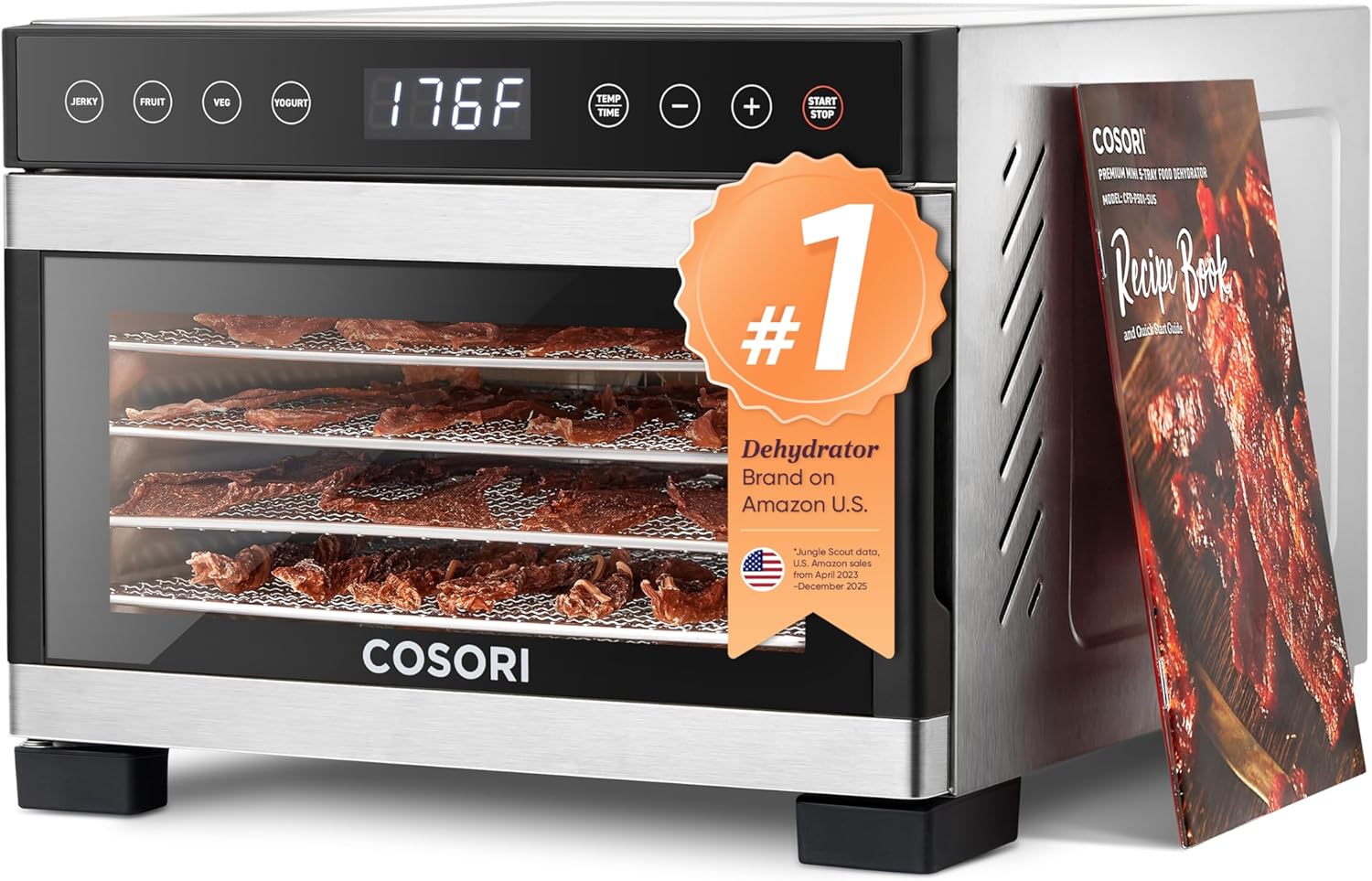
The Cosori P501 is a compact countertop dehydrator built around a rear-fan horizontal airflow system and five stainless steel trays, which gives about 3.1 ft² of drying space for small to medium batches. You set temperature in 1°F increments from 95°F to 176°F and use one of four presets (jerky, fruit, vegetables, yogurt) or a manual timer up to 48 hours. The stainless steel trays and no-plastic-food-contact design make it easy to load, clean, and keep food tasting neutral, while the rear fan aims to keep drying even across all trays so you rarely need to rotate them. Its 480-watt heater reaches USDA-recommended temps for safe beef jerky, and included accessories like a mesh screen and fruit roll sheet expand use. Trade-offs for a reliability-focused buyer are modest: the unit is compact so throughput is limited compared with larger models, and it is not explicitly marketed with smart controls or advanced diagnostics, so troubleshooting is manual. For routine home dehydrating—snacks, herbs, and small jerky batches—the P501 is a practical, well-built option that emphasizes straightforward, consistent performance.
Best for: Buyers who prioritize consistent, straightforward performance and durable food-contact materials for regular home dehydrating of snacks, herbs, and jerky.
Less Ideal for: Users who need high-volume commercial throughput or remote/smart control features should consider larger or connected models instead.
- Stainless steel trays and no-plastic-food-contact design for cleaner flavor and easier cleaning.
- Precise temperature control from 95–176°F in 1°F increments for food-specific drying and safe jerky temps.
- Rear horizontal airflow for more even dehydration across trays without frequent rotation.
- Includes useful accessories and presets for common foods (mesh screen, fruit roll sheet, recipe book).
- Compact footprint suitable for countertop storage and everyday use.
- Smaller drying capacity than larger, commercial-style dehydrators, limiting batch size.
- Lacks smart features or automated diagnostics, so monitoring and adjustments are manual.
Verdict: A compact, stainless-steel countertop dehydrator focused on reliable, even drying and food-safe construction for home snack and jerky making.
Elite Gourmet 5‑Tray Dehydrator EFD329WD
| Wattage | 350 watt-hours |
|---|---|
| Number of Trays | 5 |
| Temperature Range | 95 to 158 °F |
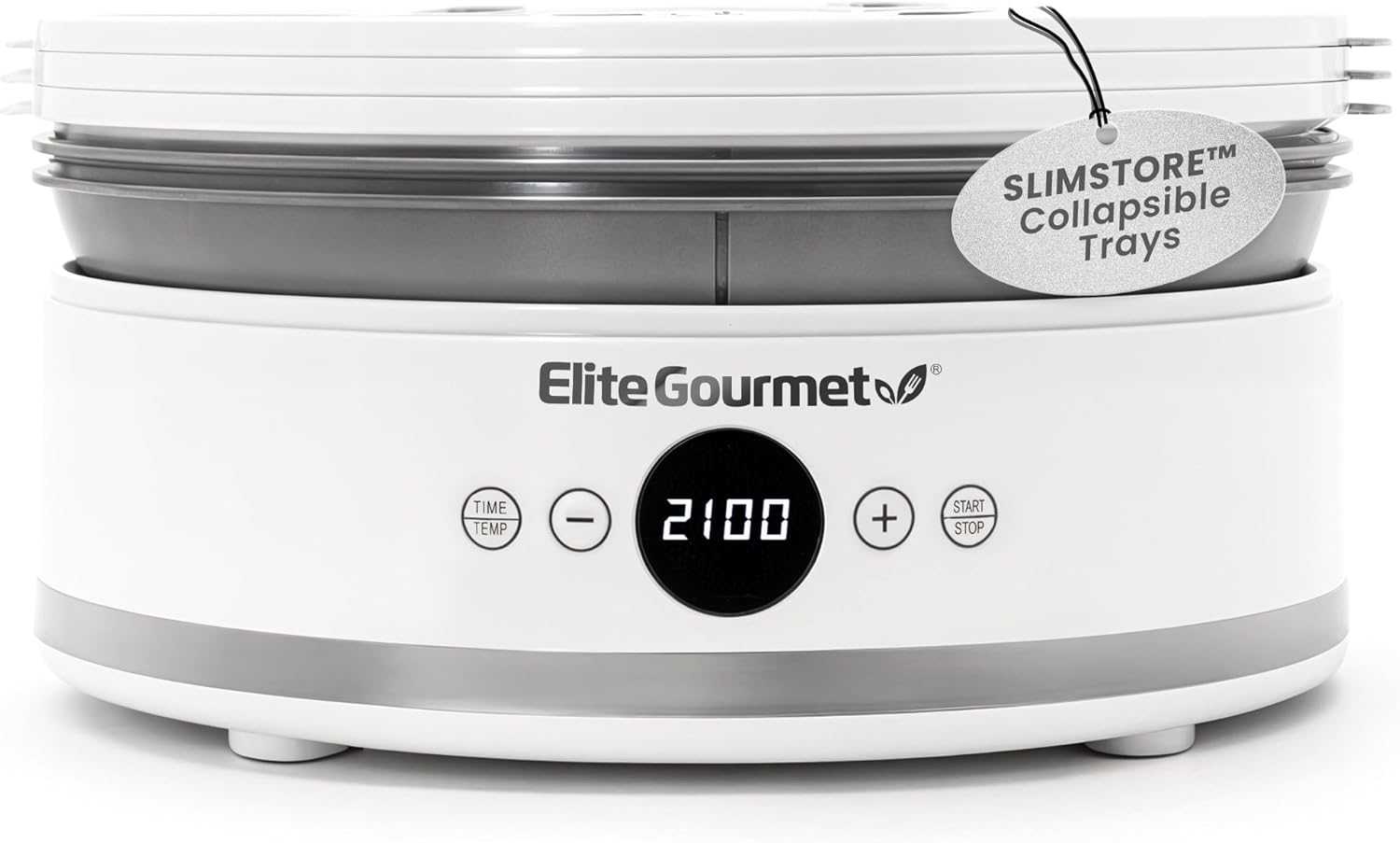
The Elite Gourmet EFD329WD is a compact 5-tray digital dehydrator designed for everyday home use. It heats from 95 to 158 F and uses a base-mounted fan and heater to push warm air upward through five BPA-free SlimStore collapsible trays, which maximizes circulation and nests for storage. The unit includes a digital timer that runs up to 48 hours in 30-minute increments, making it suitable for fruit leathers, herbs, jerky, and longer low-temperature jobs. At 350 watts it provides enough power for steady drying while remaining relatively economical to run, and the dishwasher-safe trays simplify cleanup. Limitations include a relatively small total drying area compared with larger cabinet dehydrators and a plastic construction that may feel less durable than metal alternatives, but its space-saving footprint and straightforward controls make it a practical choice for first-time dehydrator buyers or households that need occasional batch drying.
Best for: Buyers who want a compact, easy-to-use dehydrator with digital controls for occasional home drying of fruits, herbs, and jerky and who value space-saving storage and straightforward operation.
Less Ideal for: People who need to dry very large batches frequently or who prefer a heavy-duty metal cabinet dehydrator for long-term commercial or heavy home use.
- Adjustable temperature from 95 to 158 F for a wide range of foods
- Digital timer up to 48 hours with 30-minute increments for precise drying
- Five BPA-free SlimStore collapsible trays that nest for compact storage
- Base-mounted fan and heater that promote even upward airflow
- Dishwasher-safe trays for easier cleanup
- Plastic construction may be less durable than metal cabinet dehydrators
- Smaller total drying area than larger, non-compact models
Verdict: A compact, user-friendly 5-tray dehydrator that balances adjustable digital controls and space-saving storage for reliable home use.
Cosori Compact Food Dehydrator CFD-N051-W

| Wattage | 350 watts |
|---|---|
| Voltage | 120 volts |
| Number of Trays | 5 |
| Temperature Range | 95-165 F °F |
The Cosori Compact Food Dehydrator is a round, countertop unit designed for drying fruit, meat, herbs, and pet treats using low-temperature air circulation. It ships with five large BPA-free trays and a 50-recipe booklet, and tray heights are adjustable so you can fit thicker cuts or collapse them for storage. Temperature is adjustable from 95 to 165°F in 1°F increments and the timer runs up to 48 hours in 30-minute steps, which gives precise control for jerky, fruit leather, and herbs. The 350W motor is quiet at under 47 dB, and the polypropylene construction aims for durability versus fragile clear-shell designs. Practical limits include the compact footprint that restricts batch size unless you add optional trays, and polypropylene parts may stain with long-term use on strongly colored foods. The unit is simple to operate and well suited to small-batch home dehydrating where consistent temperature and quiet operation matter.
Best for: A cautious buyer who wants reliable, easy-to-use dehydrating for small batches of snacks, jerky, and herbs with precise temperature control and quiet operation.
Less Ideal for: Those who need to process large volumes at once or prefer all-metal, commercial-grade equipment for heavy daily use.
- Precise temperature control from 95 to 165°F in 1°F increments for consistent results
- Five BPA-free trays with adjustable height for varying food thicknesses
- Quiet operation under 47 dB suitable for overnight runs
- Includes recipe book and user manual to help beginners get started
- Compact, lightweight design that is easy to store and move
- Compact capacity limits large-batch dehydrating unless you purchase extra trays
- Plastic (polypropylene) construction can discolor over time with strongly pigmented foods
Verdict: Buy this if you want a compact, quiet home dehydrator that gives precise temperature control for reliable small-batch results.
Choosing the Right Compact Food Dehydrator: Key Factors to Consider
Drying Consistency
Even airflow and reliable temperature control determine how uniformly foods dry. In compact dehydrators, internal airflow patterns can be more constrained than in larger models, so look for units with either rear-mounted fans that promote crossflow or top-mounted systems designed to distribute heat across trays.
Poor airflow causes uneven moisture levels between trays, extending run times and increasing the risk of spoilage. For predictable results, choose a dehydrator with adjustable temperature settings and a well-designed fan path to minimize the need for tray rotation and oversight.
Footprint and Tray Capacity
Compact models must balance usable drying area with small external dimensions. Consider both the unit's footprint and the number and size of trays; a tall slim dehydrator can offer the same capacity as a squat model but will occupy less counter depth.
Also assess tray spacing. If you plan to dry bulky items or leafy herbs, more vertical clearance between trays matters. Removable and stackable trays that nest for storage are valuable for kitchens with limited cabinet space.
Temperature Range and Precision
Different foods require different drying temperatures and times. A precise temperature control range lets you dry delicate herbs at low heat and denser items like meat safely at higher settings. Look for units with clearly marked temperature steps or a digital thermostat to set and hold the desired temperature.
Inconsistent or overly coarse temperature control forces you to monitor cycles closely and can produce inconsistent texture or color. A reliable thermostat reduces guesswork and improves repeatability across batches.
Ease of Cleaning and Maintenance
Dehydrators need routine cleaning to remove food residue, sugars, and oils that accumulate on trays and in the fan housing. Removable, dishwasher-safe trays or trays made from nonstick materials speed cleanup and reduce maintenance time.
Consider how easy it is to access the interior for periodic wiping and whether components like screens and drip trays disassemble without tools. Simpler maintenance encourages regular use and extends the appliance lifespan.
Noise Level and Energy Consumption
Because dehydrating cycles often last many hours, noise and power draw affect comfort and operating cost. Compact dehydrators are typically lower wattage than full-size units, but fan design and motor quality can make a big difference in audible operation.
Review typical run-time power use and choose a unit with quieter fan operation if the machine will run while you are at home. Energy-efficient models keep long-run electricity consumption manageable and make frequent use more practical.
Build Quality and Safety Features
Solid construction, stable feet, and heat-resistant materials reduce the risk of wobble, warping, and premature wear. Check for BPA-free plastics, metal trays or reinforced polymer trays, and secure lid fittings.
Safety features like automatic shutoff on overheating, cool-touch exteriors, and grounded plugs are important, especially for unattended long runs. Durable design reduces the likelihood of replacements and supports consistent, safe operation over time.
How to Prepare Foods for Best Results
Proper preparation shortens drying time and yields better texture. Slice fruits and vegetables uniformly to the same thickness so they dry at the same rate. For tender items like mango or apple, aim for slices about 1/8 to 1/4 inch thick; for denser items like sweet potato, slightly thinner slices help ensure even drying.
Blanch or pretreat some foods as needed. For example, citrus or apple slices benefit from an acid dip to retain color, and some vegetables blanch briefly to denature enzymes that can affect texture. Pat items dry before loading trays to avoid pooling and to improve airflow around pieces.
- Arrange items in a single layer without overlap to ensure free airflow.
- Rotate trays mid-cycle if necessary but aim to pick a unit with uniform airflow to avoid this step.
- Use mesh screens for small items like herbs and seeds to prevent them from falling through trays.
Typical Drying Times and Temperature Guidelines
Drying times vary with humidity, slice thickness, and the specific dehydrator. As a general starting point, fruits typically dry between 6 and 12 hours at 125°F to 135°F, vegetables between 6 and 10 hours at 125°F to 135°F, and jerky at 145°F to 160°F depending on thickness. Herbs often dry quickly at low temperatures around 95°F to 105°F.
Monitor the first few batches to establish your appliance's baseline. Record time and temperature for favorite recipes so you can reproduce results reliably. If pieces are still pliable or tacky near the expected end time, extend drying in short increments and recheck.
- Low and slow yields better texture and flavor retention for most foods.
- Higher temperatures speed drying but can toughen or brown proteins and delicate fruits.
- Use a food-safe thermometer or the machine's built-in thermostat to confirm temperatures.
Storage and Rehydration Tips
Fully dried foods should be cool and dry before storage. Store in airtight containers in a cool, dark place to preserve flavor and prevent moisture uptake. For longer-term storage, consider vacuum sealing to extend shelf life and protect against humidity.
To rehydrate, soak dried fruits or vegetables in warm water until pliable, or simmer gently in soups and stews. For jerky, brief steaming or simmering will plump protein without overcooking. Check texture during rehydration to avoid making items soggy.
- Label containers with date and contents to track freshness.
- Rotate stored dried goods by date and check periodically for signs of moisture.
- Keep herbs in smaller containers to limit air exposure when you open them frequently.
Common Troubleshooting and Maintenance
If items are drying unevenly, first inspect tray layout and avoid stacking pieces. Next, verify the unit is level and that vents are clear. If uneven drying persists, run a short test with plain wet towels on alternate trays to observe airflow patterns.
For odors or sticky residue, run an empty cycle with a mild vinegar solution to help break down sugars, then follow with a plain warm-water rinse. Replace or deep-clean mesh screens periodically to prevent buildup that can restrict airflow.
- Clean trays after each use to prevent residue buildup.
- Check seals and fan intake for lint or food particles.
- If a unit runs louder than expected, inspect for loose screws or tray misalignment.
How We Chose the Best Compact Food Dehydrator
We selected compact food dehydrators based on a focused set of practical, measurable criteria that reflect real home use. First, drying performance was a top filter: we prioritized units with consistent temperature control and uniform airflow so batches dry evenly without frequent tray rotation. Second, footprint and storage mattered for the compact category; we favored designs that offer ample drying capacity relative to their counter or cabinet footprint. Third, usability factors were applied: intuitive controls, removable trays for easy loading and cleaning, and clear airflow paths received weight in the selection. Reliability and build quality were also considered, including the durability of trays and the stability of fan/motor assemblies. Noise and energy consumption were evaluated because compact units often run for many hours; quieter, energy-efficient designs scored higher. We excluded oversized or professional-grade dehydrators that do not meet the compact size criteria and any models lacking adjustable temperature control or with permanently sealed trays that impede cleaning. The final picks balance drying efficacy, user convenience, and compact practicality.
Our full evaluation process is outlined in our review methodology.
FAQ
How long does it take to dehydrate fruit in a compact dehydrator?
Drying time depends on slice thickness, fruit water content, and humidity. Most fruits dry in about 6 to 12 hours at mid-range temperatures. Thinner slices and lower humidity shorten the time, while thicker pieces and humid conditions extend it.
Can I make jerky safely in a compact dehydrator?
Yes, but follow recommended temperatures and food-safety practices. Use lean cuts, marinate and pat dry, and operate at a higher temperature range appropriate for meat to reduce bacterial risk. Check that the unit can reach and maintain the required temperature.
Is it safe to leave a dehydrator running overnight?
Many compact dehydrators are designed for long unattended runs, but you should confirm safety features like stable feet and thermal protection. Place the unit on a heat-resistant surface and ensure good ventilation around it for overnight cycles.
Do compact dehydrators use a lot of electricity?
Compact models typically use less power than full-size units, but energy use accumulates over long cycles. Choose a lower-wattage, efficient fan design for frequent use, and consider drying during off-peak hours if you want to limit running costs.
How do I tell when food is fully dehydrated?
Fully dehydrated items are leathery to brittle depending on the food. Fruits should be pliable and not sticky; vegetables often become brittle or crisp. Remove a sample, let it cool, and check for any residual moisture pockets before storing to avoid spoilage.
Final Verdict
Compact food dehydrators offer a practical way to preserve produce and make snacks without taking over kitchen space. Prioritize consistent airflow, an appropriate tray layout for the items you plan to dry, and reliable temperature control to get repeatable results. Balance footprint against tray capacity and look for easy-to-clean components and acceptable noise levels. Ultimately, choose the compact dehydrator that matches the types of foods you will dry most often and the space you have available. Paying attention to drying consistency and maintenance needs will help you get predictable results and long-term value from whichever unit you pick.