
Note: This article contains affiliate links. If you click on these links and make a purchase, we may earn a small commission at no extra cost to you. This helps support our research and content. Read our full affiliate disclosure here.
Picking the right food dehydrator for the money matters when you want consistent, safe results without overspending. A good dehydrator preserves flavor, minimizes energy use, and fits your typical batch size, whether you are drying fruit, herbs, or homemade jerky. This guide covers the top shortlisted units that balance drying performance, temperature control, and operating cost. We evaluated models for airflow, capacity, and ease of cleaning so you can choose the best fit for ordinary home use. Read on to see the main tradeoffs and practical differences among the top picks.
Top Picks at a Glance
| Best Overall The best all-around choice for most situations | Magic Mill Pro Food Dehydrator MFD-7700 |  |
| Best Value The sweet spot between price and what you get | Cosori Food Dehydrator CFD-N051 |  |
| Best Budget The cheapest option that still gets the job done reliably | Commercial CHEF Food Dehydrator CCD100W6 |  |
| Top Rated A top-rated pick with lots of positive feedback | PSIIDAN Food Dehydrator FD-1033 |  |
| Most Popular A crowd favorite that many people choose with confidence | Cosori Food Dehydrator CP267 |  |
| Best Seller A high-volume bestseller chosen again and again | NESCO Snackmaster FD-75A |  |
Magic Mill Pro Food Dehydrator MFD-7700

| Wattage | 600 |
|---|---|
| Voltage | 120 |
| Number of Trays | 7 |
| Material | Stainless Steel |
The Magic Mill Pro is a sturdy, kitchen-focused dehydrator built around a 600W rear fan that pushes heat evenly across seven full-size stainless steel trays. It is typically used for making jerky, fruit leather, herbs, and batch drying because the rear-mounted fan avoids hot spots and removes the need to rotate trays. The digital control panel offers 1°F increments between 95 and 176°F and a 48-hour timer in 30-minute steps, plus a keep-warm mode and automatic shutoff for unattended runs. The all-stainless interior and trays, plus included mesh screens and a fruit roll tray, make cleanup and small-item drying straightforward and reduce plastic contact with food. Practical limits are its countertop footprint and 600W power, which is strong for household use but not intended for industrial throughput, and the unit's weight and metal build mean it is less portable than lightweight plastic models. For cooks who want repeatable, even dehydration and durable construction, this model covers the essentials well.
Best for: Buyers who want a durable, reliable home dehydrator that produces consistent batches and precise temperature control for jerky, fruit, and herbs without frequent supervision.
Less Ideal for: People who need an ultra-compact or lightweight travel-friendly dehydrator or who require commercial-scale drying capacity.
- Rear-mounted 600W fan delivers even airflow across all trays without tray rotation
- Full stainless steel interior and 100% stainless trays reduce plastic contact and improve durability
- Digital temperature control in 1°F increments up to 176°F for precise, repeatable results
- 48-hour timer with 30-minute steps plus keep-warm and auto shutoff for unattended drying
- Includes mesh screens and fruit roll tray for drying herbs and making fruit leather
- Heavier, all-metal construction makes it less portable than lighter plastic units
- Footprint may be large for very small kitchens
Verdict: A solid, stainless-steel 7‑tray dehydrator that delivers even, precise drying for home cooks looking for durability and reliable results.
Cosori Food Dehydrator CFD-N051

| Wattage | 350 watts |
|---|---|
| Voltage | 120 volts |
| Number of Trays | 5 |
| Temperature Range | 95-165 F |
| Operating Frequency | 60 hertz |
The Cosori CFD-N051 is a user-friendly countertop dehydrator designed for small-batch drying of fruit, jerky, herbs, and snacks. It includes five BPA-free trays, adjustable tray heights, and a 95–165°F temperature range that you can set in 1°F increments, which helps dial in textures for everything from soft fruit leathers to safer beef jerky. A 48-hour timer (in 30-minute steps) and quiet fan (under 47 dB) make it practical for long runs overnight, while the unit's polypropylene construction feels sturdy compared with flimsy clear-shell models. The compact round footprint fits most counters and the ability to expand to seven trays lets you scale capacity without replacing the machine. Limitations include a modest 350W heater, which means larger loads will dry more slowly than high-wattage commercial units, and the plastic body may discolor over heavy use. The included recipe book and simple controls make this a sensible choice for someone who wants reliable, everyday dehydrating without specialty gear.
Best for: Buyers who want a compact, reliable dehydrator for regular home use and who value precise temperature control and quiet, unattended drying.
Less Ideal for: People who need industrial-speed drying or very large capacity for commercial production should look at higher-wattage or commercial-grade machines.
- Five BPA-free trays with adjustable heights for varied ingredient thicknesses
- Temperature control in 1°F increments up to 165°F for precise drying
- Timer up to 48 hours with 30-minute steps for unattended long cycles
- Quiet operation under 47 dB suitable for overnight runs
- Expandable to seven trays for increased capacity without buying a new unit
- 350W power delivers slower drying on very large loads compared with commercial units
- Polypropylene exterior may stain or show wear over extended heavy use
Verdict: A practical, quiet countertop dehydrator that delivers precise temperature control and expandable capacity for everyday home drying.
Commercial CHEF Food Dehydrator CCD100W6
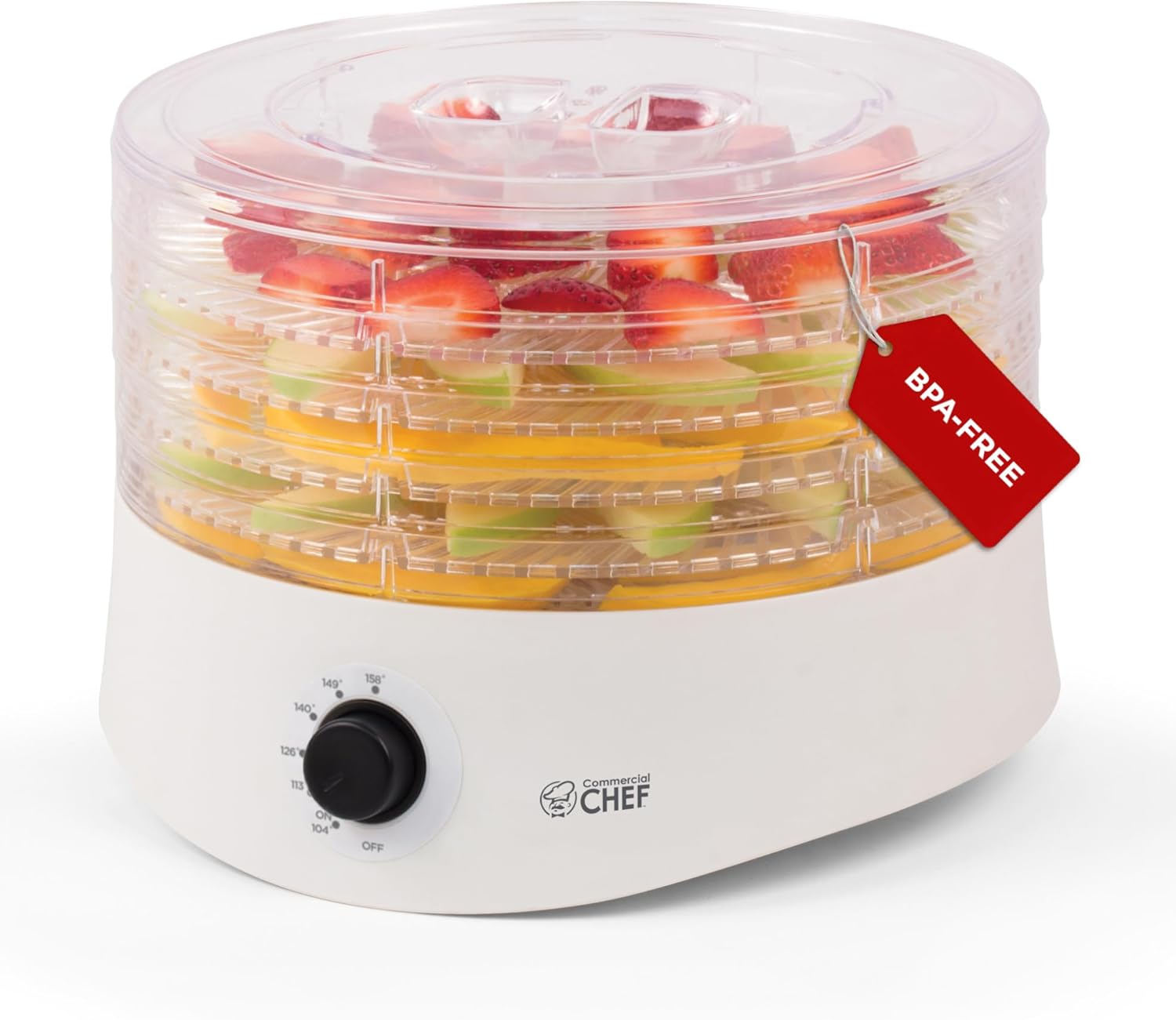
| Wattage | 280 watts |
|---|---|
| Voltage | 120 volts |
| Number of Trays | 5 |
| Temperature Range | 104˚F – 158˚F |
The Commercial CHEF CCD100W6 is a small, straightforward countertop dehydrator that removes moisture from fruit, vegetables, herbs and meat using a top-down airflow and an adjustable mechanical thermostat. It is typically used for making snacks and jerky at home and features five reversible BPA-free round trays that can be set at two heights to accommodate thicker pieces. The temperature knob spans 104 to 158 F, which covers common dehydration ranges, and the 280W heater keeps the unit compact and energy modest. Setup and cleaning are simple since the trays are hand-washable and the unit is lightweight for storage. The trade-offs are its modest tray diameter and single heat zone, so larger batches or very thick slabs of meat will take longer than higher-capacity models, and there is no digital timer or preset programs. For buyers focused on an affordable, no-frills machine that reliably dries small to medium batches, this model delivers predictable results without complexity.
Best for: Buyers on a budget who want a simple, reliable dehydrator for making small to medium batches of dried fruit, herbs and jerky without fuss or advanced features.
Less Ideal for: People who need to dehydrate large volumes at once, want precise digital controls or timer-based automation, or who prefer multiple cooking zones for faster, uniform drying.
- Five reversible BPA-free trays allow flexible spacing for different foods
- Adjustable thermostat covers 104 to 158 F for a wide range of dehydration needs
- Compact, lightweight design that is easy to store and move
- Simple mechanical controls make it easy for beginners to use
- Relatively small tray diameter limits batch size for large or flat items
- Single heat zone and no digital timer or presets reduce automation and convenience
Verdict: A budget-friendly, no-frills dehydrator that reliably handles small to medium batches of snacks and jerky with simple controls.
PSIIDAN Food Dehydrator FD-1033

| Wattage | 650 watts |
|---|---|
| Number of Trays | 8 |
| Temperature Range | 167 °F |
The PSIIDAN FD-1033 is a countertop electric dehydrator built for multi-batch home use, offering eight stainless steel trays plus a mesh tray and drip tray for small or juicy items. It uses a 650W motor and 360 degree airflow to speed drying while the adjustable temperature up to 167°F and a 48-hour timer let you tailor cycles for jerky, fruit leather, herbs, and vegetables. Practical touches include a viewing light to check progress without opening the door, one-touch controls with auto shut-off, and dual-layer insulation that keeps the exterior cool during long runs. Trays are stainless steel for easy wiping and the included recipe guide helps beginners get consistent results. Expect quiet operation and straightforward cleanup, though the unit is a countertop appliance and requires the full timer range for longer recipes. For buyers who prioritize consistent, even drying and family-safe features, this model delivers reliable performance in a compact footprint.
Best for: Buyers who want a dependable, family-safe dehydrator that produces consistent results for jerky, fruit, and herbs and value easy cleanup and simple controls.
Less Ideal for: Large-scale users needing commercial capacity or those who want higher maximum temperatures for very thick or dense meats.
- Eight stainless steel trays provide large drying capacity and durable surfaces that wipe clean.
- 650W motor with 360 degree airflow for faster, more even drying across trays.
- Adjustable temperature up to 167°F and a 48-hour timer allow precise control for varied foods.
- Dual-layer insulation keeps the exterior cool for safer long runs and family use.
- Includes mesh tray, drip tray, and recipe guide so you can start dehydrating right away.
- Compact countertop size limits batch size compared with some cabinet-style commercial dehydrators.
- Temperature top is 167°F which may require longer cycles for very thick cuts of jerky.
Verdict: A reliable, easy-to-use countertop dehydrator that delivers consistent, even drying for home cooks who prioritize dependable performance and safety.
Cosori Food Dehydrator CP267

| Wattage | 600 watts |
|---|---|
| Voltage | 120 volts |
| Number of Trays | 6 |
| Temperature Range | 95-165 F |
The Cosori Food Dehydrator CP267 is a countertop dehydrator built around six stainless steel trays and a rear-mounted fan that uses horizontal airflow to dry foods evenly without tray rotation. It is typically used for making jerky, fruit leather, dried herbs, and large batch snacks thanks to about 6.5 ft² of drying area and a 600 W motor that shortens drying time compared with lower‑powered models. The digital control panel lets you set temperature precisely from 95 to 165°F and run the timer up to 48 hours, which helps reproduce consistent results across multiple loads. Practical benefits include dishwasher-safe metal trays, a included mesh screen and fruit roll sheet, and a relatively quiet brushless motor rated under 48 dB for overnight runs. Limitations are the unit's bulk on a crowded counter and its weight, which make it less portable, and the lack of specialized presets for specific foods means some users will adjust times by trial and error.
Best for: Buyers who want a reliable, high-capacity dehydrator for frequent batch drying and value precise temperature control and quieter operation backed by strong user feedback.
Less Ideal for: If you need a lightweight, highly portable unit for occasional use or want one with many automatic presets, a simpler or smaller model would be a better fit.
- Six stainless steel trays provide large 6.5 ft² drying area for batch dehydrating
- 600 W motor with rear horizontal airflow for faster, more even drying
- Digital controls with 95–165°F range and up to 48‑hour timer for precise runs
- Dishwasher-safe trays and included mesh screen and fruit roll sheet simplify cleanup
- Brushless motor operates quietly (under 48 dB) so it can run overnight
- Relatively heavy and bulky, which reduces portability and countertop flexibility
- No dedicated food presets, so beginners may need to experiment with times
Verdict: A high-capacity, precise and quiet stainless steel dehydrator that is a strong value for buyers who plan to dehydrate large batches regularly.
NESCO Snackmaster FD-75A

| Wattage | 600 watts |
|---|---|
| Voltage | 120 volts |
| Number of Trays | 5 |
| Temperature Range | 95°F–160°F |
The NESCO FD-75A Snackmaster is a straightforward home dehydrator aimed at hobbyists who want reliable, even drying without fuss. Its top-mounted fan and Converga-Flow system push air across each tray so you do not need to rotate trays and flavors stay separated, which simplifies multi-item runs like fruit and jerky. The adjustable thermostat (95°F–160°F) covers herbs, fruit leathers and meat safely, and the included fruit roll sheets, clean-a-screens and jerky seasoning make it usable right out of the box. Five BPA-free trays are provided and the system expands up to 12 trays when you need larger batches. At 600 watts it delivers steady drying power while the opaque exterior helps preserve nutrients. The design is plastic but food-safe, and the top-mounted fan keeps liquids from reaching the heater for safer long sessions. If you want a no-nonsense, expandable dehydrator for occasional to frequent home use, this model balances practicality and accessories, though heavier-duty commercial needs will outgrow it.
Best for: Buyers who want a reliable, easy-to-use home dehydrator that handles fruit, herbs and jerky with even drying and useful starter accessories.
Less Ideal for: Those needing a heavy-duty or commercial-capacity dehydrator for continuous large-scale production should look at higher-power, metal-bodied models.
- Converga-Flow airflow with top-mounted fan for even drying without rotating trays
- Adjustable thermostat from 95°F to 160°F for a wide range of foods
- Expandable tray system from 5 up to 12 trays to scale batch size
- Includes useful accessories (fruit roll sheets, clean-a-screens, jerky seasoning) to start immediately
- Plastic construction may feel less durable than metal commercial units
- 600-watt motor is adequate for home use but slower than higher-power dehydrators
Verdict: A practical, expandable home dehydrator that delivers even, no-rotate drying and useful starter accessories for risk-averse buyers seeking dependable results.
Choosing the Right Food Dehydrator for the Money: Key Factors to Consider
Drying Consistency and Airflow
Consistent drying across all trays matters because uneven airflow leads to some pieces that are still moist while others are overcooked. Look for units with a proven method of circulating air, whether that is through a rear-mounted fan with vertical airflow or a bottom-up system with a well-designed duct. Even heat distribution reduces the need to rotate trays mid-cycle and produces predictable texture and shelf life.
If you plan to dry different foods in the same batch, consistent airflow is especially important. Thin slices and thicker pieces require the same drying environment to finish at similar times, so choose a dehydrator that minimizes hot spots.
Temperature Range and Accuracy
A wide, accurate temperature range is important because different foods have different safe and optimal drying temperatures. Low-temperature settings are useful for delicate herbs and preserving enzymes in some foods, while higher, stable heat is necessary for safe jerky and for reducing overall drying time.
Temperature accuracy affects safety and texture. Units with clear, reliable thermostats and minimal fluctuation will give you repeatable results and reduce the guesswork involved in multi-stage drying processes.
Operating Cost and Energy Use
Energy consumption becomes significant if you dehydrate often or run long cycles overnight. Wattage alone does not tell the full story; efficient units combine sensible wattage with good insulation and airflow so they run less while maintaining temperature. Consider typical cycle length for your recipes and factor in the running time when comparing units.
Lower operating cost also ties into size. A smaller, efficient dehydrator can be cheaper to run for small batches, while a larger unit may be more efficient per pound for big batches. Match capacity to your usual workload to avoid wasted electricity.
Capacity, Tray Size, and Expandability
Tray count and usable surface area determine how much you can dry in one run. If you plan to preserve seasonal produce in bulk, larger capacity or expandable trays are valuable. For occasional snacking-size batches, a compact unit with fewer trays will be quicker to heat and use less energy.
Flexible tray design that allows spacing adjustment or partial loading reduces wasted space and accommodates irregular items like herbs or thick-cut jerky.
Build Quality and Ease of Cleaning
Durable materials and simple construction extend the life of the unit and reduce maintenance headaches. Removable trays that are dishwasher-safe or easy to rinse make frequent use practical. Smooth tray surfaces and accessible interiors cut down drying residue and mold risk.
Also consider how easy it is to remove and replace trays quickly. A cumbersome tray system can slow you down when preparing multiple batches or rotating slices during drying.
Controls and Usability
Controls that are intuitive and provide clear feedback help you set precise time and temperature without confusion. Digital timers and thermostats add repeatability, while simple analog dials can be more robust and easier to repair. Look for readable markings and predictable responsiveness.
Additional usability features such as built-in timers with auto-shutoff, audible alerts, or transparent lids to check progress can improve the everyday experience without adding complexity.
Best Uses and Common Recipes
Food dehydrators suit a range of tasks beyond fruit leathers and jerky. They are handy for drying herbs, making crispy vegetable chips, preserving mushrooms, and creating crunchy snacks. Each use has different ideal slice thickness and temperature settings, so adapting your process will yield better results.
For jerky, aim for higher, stable heat and consistent airflow. For fruit leathers and herbs, lower temperatures and slower drying preserve flavor and nutrients. Small differences in slice thickness or spacing matter more than minor model differences, so prep technique greatly affects outcomes.
- Herbs and leafy greens: low temp, short cycles, single-layer trays
- Fruit slices: medium temp, uniform thickness, occasional tray rotation
- Jerky: higher temp, steady airflow, safe internal dryness testing
Kitchen Footprint and Storage
Consider where the dehydrator will live when not in use. Tall stackable models save countertop space but may be awkward to store in low cabinets. Box-style units with removable trays can fit more easily on a shelf. If you have limited storage, choose a compact unit or one with collapsible trays.
Noise and vent location also affect placement. Rear-venting units need clearance behind them and may produce different sound profiles compared with top- or bottom-venting models. Think about leaving the unit on a heat-resistant surface during long cycles.
- Vertical models: smaller footprint, may require tray rotation
- Box or horizontal models: larger footprint, often more even drying
Maintenance and Food Safety
Regular cleaning prevents cross-contamination and off-flavors. Remove food debris promptly and sanitize trays between different food types, especially when switching between raw meat and produce. Dishwasher-safe trays save time and reduce buildup.
Monitor for moisture pockets after a cycle and allow the dehydrator to cool before storing. If you preserve long-term, condition dried foods and check humidity levels to ensure stable storage life.
- Sanitize trays after raw meat use
- Air-dry the unit fully before storage to avoid mold
- Store dried foods in airtight containers in a cool, dry place
Speed Versus Quality Tradeoffs
Faster drying can be tempting but may compromise texture and flavor. Higher temperatures shorten cycles but can harden edges or reduce aromatic compounds in delicate fruits and herbs. Lower, slower drying generally yields better flavor retention and more uniform texture.
Choose a unit that matches your priority. If speed is essential for large-batch preservation, favor models with stronger airflow and higher reliable heat. If quality and nuanced flavor are your goals, prioritize precise temperature control and gentle airflow.
- Faster cycles: higher heat, stronger airflow
- Higher quality: lower heat, longer drying time
Accessories That Make a Difference
A few simple accessories improve versatility. Fine-mesh sheets prevent small items from falling through trays and are useful for herbs and powders. Jerky racks or trays with wider spacing help with meat drying, and fruit leather trays or sheets create uniform sheets without sticking.
Stackable extender rings or extra trays allow you to scale capacity for seasonal runs without buying a larger single unit. Nonstick liners and silicone mats reduce cleanup and prevent delicate items from tearing when removed.
- Mesh sheets for herbs and powders
- Jerky racks for lean, even meat drying
- Extra trays or rings for bulk runs
How We Chose the Best Food Dehydrator for the Money
We focused on practical, measurable criteria that matter when buying a food dehydrator for budget-conscious cooks. First, drying performance: we looked for consistent temperature control and even airflow that prevent under- or over-drying across multiple trays. Second, energy efficiency and operating cost: lower wattage without sacrificing steady heat reduces monthly running costs for frequent use. Third, capacity and tray flexibility: units that handle realistic batch sizes and allow rearrangement or expansion earn higher marks. Fourth, build and maintenance: durable materials, easy-to-clean trays, and simple controls reduce long-term hassle. Finally, safety and temperature range: precise low-temperature settings for herbs and higher stable heat for jerky are both essential. We excluded specialty commercial dehydrators and units that lack oven-safe or dishwasher-friendly components, since those options are outside the typical home buyer's scope. Our shortlist favors models that strike a balance between initial cost, dependable drying results, and manageable energy use. The evaluation prioritized concrete specs and real-world usability over brand cachet.
Our full evaluation process is outlined in our review methodology.
FAQ
How long does it take to dehydrate food?
Drying time varies greatly by food type, slice thickness, humidity, and temperature. Thin herb leaves may dry in a few hours, while fruit slices and jerky typically take 6 to 12 hours or more. Expect longer cycles in humid conditions and plan accordingly.
Can I put meat in a food dehydrator for jerky?
Yes, dehydrators are commonly used for jerky, but use the recommended higher temperature settings and follow safe handling practices. Preheating and using a marinade with proper acidity can help, and some recipes call for a brief oven step to ensure safe internal temperature before storing.
Are all trays dishwasher-safe?
Not all trays are dishwasher-safe. Many models offer removable, dishwasher-safe trays, but some use materials that require hand washing. Check care instructions for the unit you choose and plan for regular cleaning to avoid buildup.
Does a higher wattage mean faster drying?
Higher wattage can translate to more available heat, but drying speed also depends on airflow design and temperature accuracy. An efficiently designed lower-watt unit may outperform a higher-watt model with poor airflow.
How do I store dehydrated food long-term?
Store fully dried food in airtight containers away from light and heat. For extended shelf life, use oxygen absorbers or vacuum sealing and keep items in a cool, dry location. Check periodically for signs of moisture or spoilage.
Final Verdict
When choosing a food dehydrator for the money, prioritize consistent drying performance, accurate temperature control, and operating efficiency. Match capacity to your typical batch size and favor units with easy-to-clean trays and practical controls. Expect tradeoffs between speed and final flavor; decide whether you want faster cycles or gentler drying for higher quality. With those priorities clear, you can pick a model that delivers reliable results without unnecessary cost.