
Note: This article contains affiliate links. If you click on these links and make a purchase, we may earn a small commission at no extra cost to you. This helps support our research and content. Read our full affiliate disclosure here.
If you plan to make jerky, cured sausages, or long-term dried meat, the right food dehydrator for meat matters. Meat needs steady temperatures, even airflow, and reliable safety features to dry thoroughly without overcooking or leaving pockets of moisture that invite spoilage. This guide covers seven shortlisted dehydrators chosen for their temperature accuracy, airflow design, and build quality. We focus on features that affect meat safety and texture, including drying range, tray layout, and cleaning practicality. Read on to see the evaluation criteria and what to look for when picking a dehydrator for meat.
Top Picks at a Glance
| Best Overall The best all-around choice for most situations | Magic Mill Pro Dehydrator MFD-7700 |  |
| Best Quality Built to a higher standard if you want something more solid | Excalibur Performance 10-Tray Dehydrator |  |
| Best Value The sweet spot between price and what you get | Magic Mill Food Dehydrator MFD-5000 |  |
| Best Budget The cheapest option that still gets the job done reliably | vassillias Food Dehydrator 5-Tray |  |
| Top Rated A top-rated pick with lots of positive feedback | PSIIDAN Food Dehydrator FD-1033 |  |
| Most Popular A crowd favorite that many people choose with confidence | Cosori Food Dehydrator CP267-FD |  |
| Best Seller A high-volume bestseller chosen again and again | Cosori Stainless Steel Dehydrator P501 |  |
Magic Mill Pro Dehydrator MFD-7700

| Wattage | 600 |
|---|---|
| Voltage | 120 |
| Number of Trays | 7 |
| Material | Stainless Steel |
The Magic Mill Pro Dehydrator is built for serious home drying with a full stainless interior, seven full-size stainless trays, and a powerful 600W rear fan designed to deliver even airflow without rotating trays. It is typically used for making jerky, fruit leather, herbs, and other low-moisture snacks; the 1-degree incremental digital temperature control (95°–176°F) makes it easy to dial in the precise heat needed for safe, reproducible jerky batches. A 48-hour timer with auto shutoff and a 24-hour keep-warm mode means you can run long sessions and walk away, and included mesh screens plus a fruit roll tray expand what you can dry without extra purchases. The ETL listing and built-in overheat protection add safety for long runs. The main limitations are its countertop footprint and weight compared with compact models, and higher wattage that draws more power during extended cycles, but for anyone prioritizing even drying and durable stainless construction it performs well for meat-focused drying tasks.
Best for: Buyers who want a robust, meat-capable dehydrator that prioritizes even drying, repeatable temperature control, and durable stainless construction for frequent jerky and large-batch drying.
Less Ideal for: Anyone who needs an ultra-compact, lightweight unit for occasional or single-person use or who must minimize countertop footprint and power consumption.
- Full stainless steel interior and trays for durable, food-safe drying
- Rear-mounted 600W fan and heater that promote even drying across all trays
- Precision digital temp control in 1°F increments up to 176°F suitable for jerky
- 48-hour timer with auto shutoff plus 24-hour keep-warm for unattended long cycles
- Includes mesh screens and fruit roll tray so small items and leathers are ready to dry out of the box
- Larger and heavier than compact dehydrators, requiring more counter or storage space
- 600W power draw can be significant over multi-hour or multi-day runs
Verdict: Choose this stainless 7-tray dehydrator if you want a powerful, meat-ready machine that delivers even, repeatable drying for jerky and large batches.
Excalibur Performance 10-Tray Dehydrator

| Number of Trays | 10 |
|---|---|
| Wattage | 800 watts |
| Temperature Range | 85°F to 165°F |
| Voltage | 120 |
The Excalibur Performance 10-Tray Dehydrator is built for serious home dehydration projects, especially meat and jerky. It uses a horizontal airflow system with patented Hyperwave Pulse technology to circulate thermostatically controlled warm air across ten stainless steel trays so you can dry large batches without rotating racks. The LED control panel lets you set precise temperatures between 85°F and 165°F, program two drying phases and run cycles up to 80 hours, while a progress bar and top glass window make it easy to monitor without opening the door. Included stainless steel trays and a three-year limited warranty add to the premium feel. At 16 square feet of drying space and 800 watts of power it handles whole cuts and multiple trays of jerky in one run, but the unit is sizable and relatively heavy so it needs a dedicated counter or storage spot. For users who want fast small-batch portability, a smaller or countertop model may be more convenient.
Best for: Home cooks focused on high-volume, consistent jerky and meat drying who prioritize even results and programmable control over compact size.
Less Ideal for: Casual users who need a small, portable dehydrator for occasional fruit or snack batches or those with very limited counter space.
- Large 10-tray capacity provides 16 square feet of drying space for big batches
- Horizontal airflow with Hyperwave Pulse promotes even drying without tray rotation
- Precise digital controls with 85°F–165°F range and dual-phase programming
- Stainless steel trays and glass door let you monitor and use durable, food-safe materials
- Relatively large and heavy which requires substantial counter or storage space
- Higher power draw and longer cycles compared with compact dehydrators
Verdict: Choose this unit if you want a heavy-duty, programmable dehydrator that can handle large jerky batches with even, factory-quality drying.
Magic Mill Food Dehydrator MFD-5000

| Wattage | 240 watts |
|---|---|
| Voltage | 110 volts |
| Number of Trays | 5 |
| Temperature Range | 95-167 °F |
The Magic Mill MFD-5000 is a compact countertop dehydrator built around five stackable stainless steel trays and a digital control panel that sets temperature and a 48-hour timer. It is typically used for making jerky, drying fruit, herbs, and pet treats; the top-to-bottom airflow and 240W motor remove moisture without high heat, and the adjustable tray heights let you handle thicker cuts of meat. Stainless steel trays and food-safe construction make it easy to clean and dishwasher-safe, while the 95 to 167°F range covers most dehydration needs for both fruits and lean meats. Its modest footprint fits small kitchens but limits batch size compared with larger machines, so plan multiple runs for large quantities. The control panel is straightforward but lacks advanced presets for specific meats, so users should follow recipes or a probe thermometer for consistent jerky results. For buyers who want a reliable, easy-to-clean unit that handles small to medium meat batches well, this dehydrator is a practical choice.
Best for: Buyers who want a compact, easy-to-clean dehydrator to make small to medium batches of jerky and dried foods with straightforward digital controls and adjustable tray spacing.
Less Ideal for: People who need to dehydrate large volumes at once or require commercial-scale throughput and automated meat-specific presets.
- Five stainless steel, food-safe trays that are dishwasher-safe for easy cleaning
- Digital timer up to 48 hours and adjustable temperature up to 167°F for flexible drying
- Adjustable tray heights accommodate thicker slices for jerky or large fruit pieces
- Compact footprint suitable for small kitchens and countertop use
- Limited capacity compared with larger commercial-style dehydrators
- No dedicated presets for specific meat types, requiring manual monitoring for best results
Verdict: A compact, practical dehydrator that delivers easy-to-clean stainless trays and flexible temperature and timer control for reliably making small to medium batches of jerky and dried foods.
vassillias Food Dehydrator 5-Tray

| Wattage | 280 |
|---|---|
| Number of Trays | 5 |
| Material | Plastic |
This countertop dehydrator uses a 280W fan and stacked trays to circulate air for consistent drying of jerky, fruit leather, herbs, and vegetables. It offers adjustable temperature from 104°F to 158°F so you can set lower temps for herbs and fruit or higher temps for safely drying thin slices of meat; the unit also has an automatic shutoff on abnormal temperature for safety. The five removable BPA-free trays provide a straightforward, space-saving layout and are easy to clean, and the modest footprint fits small kitchens. Practical limits include modest total capacity compared with large cabinet dehydrators and a plastic housing that will not dissipate heat as well as metal models, so expect longer run times for larger batches. For basic home jerky and snack-making on a tight budget, this unit gives reliable, user-friendly performance without complicated controls.
Best for: Home cooks who want an affordable, easy-to-use appliance for making occasional jerky and dried snacks without taking up much counter space.
Less Ideal for: Those who need commercial-scale capacity or very fast large-batch drying should look at larger cabinet or commercial dehydrators instead.
- Adjustable temperature range (104°F–158°F) for different foods
- Five removable BPA-free trays that clean easily
- 280W fan provides even airflow for consistent drying
- Compact countertop design that saves space
- Plastic construction may retain heat and limit heavy-duty, high-volume use
- Smaller overall capacity than vertical cabinet dehydrators
Verdict: A budget-friendly, compact dehydrator that handles home jerky and snacks well thanks to adjustable temps and even airflow.
PSIIDAN Food Dehydrator FD-1033

| Wattage | 650 watts |
|---|---|
| Number of Trays | 8 |
| Temperature Range | 167 °F |
The PSIIDAN FD-1033 is a countertop food dehydrator built for making jerky and other dried foods in larger batches. It uses a 650W motor and 360-degree airflow across eight stainless steel trays to promote even drying, while a temperature control up to 167°F and a 48-hour timer let you handle slow jerky cures and delicate herbs alike. The unit includes a mesh tray for small items and a drip tray for juicy fruits, and its stainless trays wipe clean quickly. Practical safety features include dual-layer insulation to keep the exterior cool during long runs and an auto shut-off that prevents overcooking. It also runs quietly and has an interior light so you can monitor progress without opening the door. The main limits are that the max temperature is moderate compared with some commercial jerky units and the dehydrator is designed for countertop use rather than heavy industrial loads, so very large batches may require multiple cycles.
Best for: Buyers who prioritize dependable, consistent drying for home jerky and snack-making and want a safe, quiet unit that handles multi-tray batches with minimal monitoring.
Less Ideal for: Commercial users or anyone who needs single-batch industrial volumes or temperatures above 167°F should look at pro-series dehydrators instead.
- Eight stainless steel trays provide large drying capacity and easy cleanup
- 650W motor with 360-degree airflow promotes even drying across trays
- Adjustable temperature up to 167°F and a 48-hour timer support slow jerky and delicate items
- Dual-layer insulation keeps the exterior cool during extended runs
- Includes mesh and drip trays so small or juicy items dry properly
- Maximum temperature tops out at 167°F which is lower than some high-heat commercial dehydrators
- Designed for countertop home use so it may require multiple batches for very large jerky projects
Verdict: A reliable, quiet home dehydrator that delivers even multi-tray drying and safety features ideal for making jerky and large batches of snacks.
Cosori Food Dehydrator CP267-FD

| Wattage | 600 watts |
|---|---|
| Number of Trays | 6 |
| Temperature Range | 95-165 F °F |
| Voltage | 120 volts |
The Cosori CP267-FD is a countertop dehydrator built around six stainless steel trays and a rear-mounted fan that circulates air horizontally for even drying. It runs at 600 watts and offers a digital control panel with an adjustable temperature range from 95 to 165 F and a timer up to 48 hours, which covers typical jerky and meat dehydration cycles. The stainless housing and included mesh screen and fruit roll sheet reduce plastic contact and make cleanup easier since trays are dishwasher safe. The upgraded airflow and brushless motor help speed drying while keeping noise below 48 dB, so you can run long jerky batches overnight without a loud motor. Compared with vertical-stack designs, the horizontal airflow reduces the need to rotate trays but the unit is fairly large on the counter and heavier than basic models. For serious jerky makers, the precise temperature control and roomy tray area make consistent results straightforward, but expect to sacrifice some countertop space for that capacity.
Best for: Home cooks who plan to make jerky or larger meat batches and prioritize consistent, controllable drying with low noise and easy cleanup supported by many positive user reviews.
Less Ideal for: Buyers who need a compact or ultra-lightweight dehydrator for occasional light use or who require integrated meat temperature probes and commercial-scale throughput.
- Six stainless steel trays provide large drying area suitable for batch jerky production
- Precise digital temperature control from 95–165 F and 48‑hour timer for long meat dehydration cycles
- Rear horizontal airflow and 600W motor promote even, faster drying without manual tray rotation
- Brushless motor designed for quiet operation under 48 dB and dishwasher-safe trays for easier cleanup
- Relatively heavy and takes substantial counter space compared with compact models
- No built-in probe for internal meat temperature monitoring
Verdict: Choose this Cosori if you want roomy, quiet, precision-controlled dehydration that reliably handles multiple jerky batches at home.
Cosori Stainless Steel Dehydrator P501
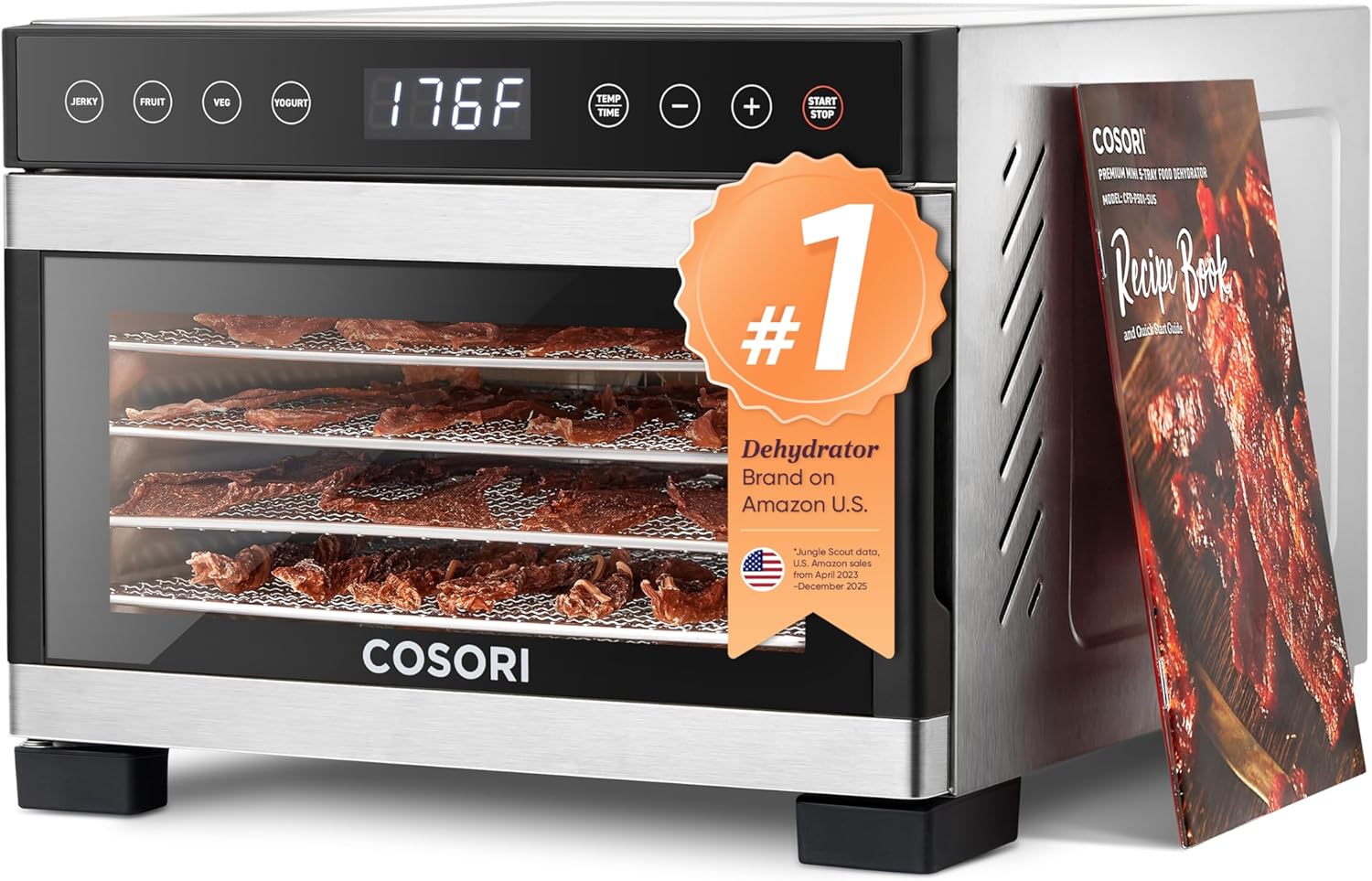
| Wattage | 480 watts |
|---|---|
| Voltage | 110 volts |
| Number of Trays | 5 |
| Temperature Range | 95-176 F °F |
The Cosori P501 is a stainless steel countertop dehydrator designed for home jerky makers and general food preservation. It uses a rear-mounted fan and horizontal airflow to push warm air through five stainless trays, delivering about 3.1 ft² of drying space so you can run multiple batches at once. Temperature is adjustable from 95 to 176°F in 1°F increments and there are four presets (jerky, fruit, vegetables, yogurt) plus a 48-hour timer, which helps hit USDA-recommended temps for safe meat dehydration. The all-metal interior and included mesh and fruit-roll sheets avoid plastic contact with food, and the compact rectangular footprint fits most counters. At 480 watts it brings food up to target temperatures reasonably quickly, though powerful drying can take several hours for thick cuts. If you want precise temperature control and easy-to-use presets for making beef jerky at home, this model is a practical, user-friendly choice; expect typical dehydrator run times and occasional tray rotation for the most even results.
Best for: Buyers who prioritize food safety, reliable temperature control, and straightforward presets for making homemade jerky and other dried foods will appreciate this dehydrator.
Less Ideal for: Large-scale or commercial jerky producers who need very high throughput or the fastest drying times should consider larger-capacity or commercial machines.
- Stainless steel construction with no plastic contact for food safety.
- Wide temperature range to 176°F with 1°F increments for precise control.
- Five stainless steel trays provide ample drying space for batch jerky making.
- Rear fan and horizontal airflow designed for even dehydration across trays.
- Includes useful accessories: mesh screen, fruit roll sheet, and recipe book.
- Not the fastest unit—large or thick meat cuts require many hours to dehydrate.
- Relatively compact tray area may require multiple small batches for large-volume needs.
Verdict: A stainless steel, preset-equipped home dehydrator that gives risk-averse cooks precise temperature control and plastic-free food contact for safe, reliable jerky and dried foods.
Choosing the Right Food Dehydrator for Meat: Key Factors to Consider
Temperature Range and Stability
Meat dehydration requires both a low steady drying temperature and the ability to reach higher temperatures for initial pathogen reduction. Look for a unit that lists specific temperature settings and holds them within a few degrees over several hours. Stable control reduces the risk of under-dried spots and produces consistent texture across a batch.
A dehydrator that drifts widely in temperature forces you to monitor and rotate trays more frequently, increasing labor and raising the chance of inconsistent results. For home meat drying, being able to set and trust the dial or digital controller is essential for safety and repeatability.
Airflow Design
Even airflow is critical to prevent cold spots where moisture lingers. Units with rear or bottom-mounted fans and well-designed baffle systems tend to move air more uniformly across trays. Consider whether air flows horizontally over the trays or vertically through stacked trays, and how that affects placement of thicker cuts or mixed batches.
A balanced airflow design also shortens drying time and reduces the need to shuffle trays. If thin strips and thicker pieces will be dried in the same load, strong, even circulation will help them finish closer together, simplifying scheduling and improving batch consistency.
Tray Size, Quantity, and Configuration
Capacity matters both for single-batch volume and for how you arrange pieces for optimal drying. Wider trays let strips lie flat without overlapping, while multiple shallow trays increase surface area. Removable and adjustable tray spacing makes it easier to accommodate larger items like whole sausages or denser cuts.
Also consider whether trays are stackable and easy to load. A dehydrator with flexible tray options reduces wasted runs and lets you scale batch size without crowding, which is important for consistent drying and time efficiency.
Material and Ease of Cleaning
Meat handling requires frequent, thorough cleaning to prevent cross-contamination. Look for trays and components that are dishwasher-safe or crafted from nonporous materials that resist staining and odor retention. Smooth surfaces and minimal seams speed cleanup and reduce places where meat juices can collect.
Units with removable trays and accessible interiors make it easier to sanitize between batches. The less effort required to keep the unit hygienic, the more likely you are to maintain safe drying practices over time.
Safety Features and Controls
Dehydrating meat involves long runs and elevated temperatures. Features such as reliable timers, overheat protection, and clear temperature readouts reduce risk and simplify monitoring. A programmable timer or auto shutoff is helpful for unattended drying cycles that may run overnight.
Controls should be intuitive so you can set the right profile quickly. Safety features also include materials rated for food contact and well-ventilated casings that prevent the unit exterior from becoming excessively hot during extended use.
Noise, Energy Use, and Long-Term Reliability
Fans run for many hours during meat drying, so noise level affects comfort if the dehydrator operates in or near living spaces. Consider models with quieter motors if you plan long overnight cycles. Energy efficiency matters for frequent use; a more efficient unit will cost less to run over time.
Durability ties to motor quality, tray construction, and warranty coverage. A robust unit built for long runs reduces the likelihood of mid-cycle failures that spoil batches and waste ingredients.
Preparing Meat for Safe Dehydration
Start by trimming excess fat because fat does not dehydrate well and can lead to rancidity. Slice meat thinly and uniformly to encourage consistent drying times. Marinating and seasoning are optional, but if you use a cure mixture follow a tested recipe that specifies salt and cure levels for safety.
Pat pieces dry before they go into the dehydrator to remove surface moisture that could slow the process. For extra safety, consider briefly heating strips in an oven or pan to raise the internal temperature before moving them to low-temperature drying, when a recipe calls for it.
- Trim visible fat for longer shelf life
- Slice to uniform thickness for even drying
- Consider a preheat step for pathogen reduction when recommended
Best Tray Habits and Loading Tips
Avoid overlapping pieces; even a small gap between strips promotes airflow and consistent drying. For mixed-thickness loads, place thinner pieces where airflow is strongest and rotate trays during long runs if airflow is uneven.
Use mesh liners or a nonstick surface for sticky marinades, but ensure they do not block airflow. Label trays with load time and start time if you run multiple batches to track progress accurately.
- Leave space between pieces
- Rotate trays when needed to counteract uneven airflow
- Use breathable liners to protect delicate marinades
Sanitation and Post-Drying Storage
Clean trays and interiors promptly after use to remove meat residue. Hand-wash or run dishwasher-safe parts according to manufacturer guidance and sanitize contact surfaces with a food-safe solution. Allow parts to dry fully before reassembly to avoid trapping moisture.
Once dried, cool meat completely and test pieces for dryness by bending; properly dried jerky should bend and crack but not snap. Store in airtight containers in a cool, dark place or refrigerate for longer shelf life.
- Sanitize trays and interior after each use
- Cool and test dryness before storage
- Use airtight containers and cool storage to extend shelf life
Troubleshooting Uneven Drying
If you notice inconsistent drying across trays, first inspect airflow paths and fan operation. Confirm the unit is level and that vents are not blocked. Reorienting trays or swapping top and bottom positions halfway through a cycle often remedies uneven results.
If problems persist, try smaller batch sizes to allow better air circulation and reduce thickness of stacked pieces. In some cases, using a different drying temperature or adding a short preheat step will produce more uniform finishes for particularly dense cuts.
- Check vents and fan function
- Rotate or swap trays mid-cycle
- Reduce batch size or slice thinner to improve airflow
Using Timers and Temperature Profiles
Plan drying runs with both temperature and time in mind rather than relying on a single fixed schedule. Many meat recipes call for an initial higher-temperature period followed by a long low-temperature dry. Use the dehydrator timer to avoid over-drying and reduce hands-on monitoring.
Keep a log of temperature settings, run times, and results for different cuts and marinades. Over time you will build reliable profiles that match the unit's behavior and your desired texture.
- Follow time-and-temperature recipes for meat
- Use timers to prevent over-drying
- Record successful profiles for repeatable results
How We Chose the Best Food Dehydrator for Meat
We selected units that meet common home-but-serious meat-drying needs by applying practical, measurable filters. First, we required precise temperature control across the range needed for meat, including low drying temps and higher settings for initial pasteurization. Second, we prioritized airflow design that minimizes hot or cold spots so strips dry evenly. Third, we evaluated construction and tray layout for easy cleaning and sanitary handling of raw meat. Fourth, we considered capacity and tray configuration for common batch sizes without excessive tray swapping. Finally, we looked at durability, warranty structure, and the presence of safety features such as auto-shutoff or overheat protection. We excluded units that lack a temperature range suitable for safe meat dehydration, have poor user feedback about uneven drying, or use materials difficult to sanitize. The resulting picks emphasize temperature accuracy, airflow uniformity, easy-to-clean surfaces, and sensible capacity for home jerky makers. These are the concrete dimensions we used to compare and rank each model.
Our full evaluation process is outlined in our review methodology.
FAQ
What temperature is safe for dehydrating meat?
Safe meat dehydration typically involves an initial heating step to at least a moderate temperature to reduce pathogens, followed by a sustained lower drying temperature. Exact temps can vary by recipe, but reliable control and consistent heat for the recommended time are critical.
How long does it take to dehydrate jerky?
Drying time depends on thickness, moisture content, and airflow. Thin strips often finish in several hours while thicker pieces can take much longer. Expect to check progress periodically rather than relying on an exact hour count.
Can I dehydrate cured or marinated meat safely?
Yes, provided you follow tested cure or marinade recipes that include appropriate salt or curing agents when required. Proper sanitation, temperature control, and full drying to the recommended texture are also important for safety.
How do I tell when meat is fully dried?
Correctly dried jerky bends and cracks but does not snap into pieces. Interior should not be tacky. Pull a thicker piece and allow it to cool; if moisture collects or the center feels soft, it needs more time.
Is it better to use mesh trays or solid trays for meat?
Mesh trays promote faster airflow and typically shorten drying times, but they may let small drips pass through. Solid trays with inserts work fine if you allow extra time and maintain good airflow. Choose based on ease of cleaning and the type of meat you plan to dry.
Can I dry meat overnight unattended?
Many people run long overnight cycles, but ensure your unit has reliable temperature control and safety features like timers or auto shutoff. Check the manufacturer's guidance and perform trial runs while present to confirm consistent behavior before fully unattended use.
Final Verdict
Choose a dehydrator for meat by prioritizing accurate temperature control and even airflow first, then consider capacity and how easy the unit is to clean. Acceptable tradeoffs include smaller capacity for better circulation or a slightly louder fan for faster, more uniform drying. Build a few trial profiles for your favorite cuts and use good sanitation to keep results safe. Focus on the features that directly affect meat safety and consistency, and you will be able to produce reliable jerky and preserved meats at home with confidence.