
Note: This article contains affiliate links. If you click on these links and make a purchase, we may earn a small commission at no extra cost to you. This helps support our research and content. Read our full affiliate disclosure here.
If you want to preserve fruits, make jerky, or craft homemade dried herbs without taking over the kitchen, a small food dehydrator can be a practical solution. You will get faster drying cycles, lower energy use, and a smaller footprint than full-size machines, which matters when counter and storage space are limited. This guide covers six shortlisted small food dehydrators chosen for reliable drying performance, straightforward controls, and easy upkeep. We evaluate airflow and temperature control, build and tray layout, and cleaning convenience to help you find the best compact dehydrator for your home needs.
Top Picks at a Glance
| Best Overall The best all-around choice for most situations | Magic Mill Food Dehydrator MFD-5000 |  |
| Best Quality Built to a higher standard if you want something more solid | Magic Mill Pro Food Dehydrator MFD-7700 |  |
| Best Value The sweet spot between price and what you get | Cosori Compact Food Dehydrator CFD-N051-W |  |
| Best Budget The cheapest option that still gets the job done reliably | vassillias Food Dehydrator 5-Tray |  |
| Top Rated A top-rated pick with lots of positive feedback | Cosori Stainless Steel Dehydrator P501 |  |
| Most Popular A crowd favorite that many people choose with confidence | Elite Gourmet 5-Tray Digital Dehydrator EFD329WD |  |
Magic Mill Food Dehydrator MFD-5000

| Wattage | 240 watts |
|---|---|
| Voltage | 110 volts |
| Number of Trays | 5 |
| Temperature Range | 95-167 °F |
The Magic Mill MFD-5000 is a small electric dehydrator designed for everyday home use. It uses a 240 W heater and a top temperature of 167°F with a digital timer that runs up to 48 hours, so you can dehydrate fruit slices, jerky, herbs and pet treats across five stackable stainless steel trays. The trays are food-grade stainless steel and adjustable in height to accommodate thicker pieces, and the control panel lets you set time and temperature with simple buttons. The unit's compact footprint and dishwasher-safe removable trays make it easy to store and clean, and the BPA-free plastic body keeps weight down. Expect steady, even drying for small batches, though the compact size limits total capacity compared with larger cabinet dehydrators and the top temperature is adequate but not extremely high. For home cooks who want a straightforward, reliable machine for occasional to moderate dehydrating, the MFD-5000 delivers practical performance without complicated controls.
Best for: Buyers who want an easy-to-use, compact dehydrator for small to moderate batches of fruit, herbs, jerky and pet treats and value simple digital controls and stainless steel trays.
Less Ideal for: Users who need to process very large volumes regularly or require higher maximum temperatures for thick cuts or rapid commercial-style drying should consider larger or higher-heat models.
- Five adjustable food-grade stainless steel trays for drying different items at once
- Digital timer up to 48 hours and temperature control to 167°F for precise drying
- Compact, lightweight design with removable trays that are dishwasher-safe for easy cleaning
- 240-watt power provides steady drying while retaining nutrients according to the listing
- Small overall capacity compared with larger cabinet-style dehydrators
- Upper temperature limit may be lower than some specialized jerky-focused models
Verdict: A compact, user-friendly dehydrator with stainless steel trays and a 48-hour digital timer that’s ideal for balanced home use and small-batch drying.
Magic Mill Pro Food Dehydrator MFD-7700

| Wattage | 600 |
|---|---|
| Voltage | 120 |
| Number of Trays | 7 |
The Magic Mill Pro is a heavy-duty countertop dehydrator aimed at batch drying at home. It uses a 600W rear fan and rear-mounted heating to push consistent airflow across seven full-size stainless steel trays, eliminating the need to rotate trays and reducing hot spots for more even results with jerky, fruit, herbs, and vegetables. Temperature is adjustable from 95 to 176°F in 1°F steps, which helps dial in low-and-slow settings for herbs or higher temps for chewier snacks, and the digital 48-hour timer with auto-shutoff and a Keep Warm mode makes long runs hands-off. Construction is stainless inside and out with food-grade trays, mesh inserts for small items, and a fruit roll/drip tray for easier cleanup. Practical limitations are its footprint and weight compared with very compact plastic units and the lack of Bluetooth or app controls for remote monitoring, but for someone prioritizing consistent, repeatable performance and durable materials this unit delivers professional-style results in a home kitchen.
Best for: Buyers who value consistent, professional-style drying and durable, food-safe construction for frequent batch dehydrating in a home kitchen.
Less Ideal for: Anyone who needs the smallest possible countertop unit for occasional use or wants app-based remote control and monitoring features.
- Powerful 600W rear fan provides consistent, even airflow across all trays
- Full stainless steel interior, exterior, and trays for durability and food-safe surfaces
- Precise digital temperature control in 1°F increments from 95–176°F for repeatable drying
- Seven full-size trays plus mesh screens and a fruit roll tray for flexible batch and small-item drying
- 48-hour timer with auto-shutoff and Keep Warm mode supports long unattended cycles
- Larger footprint and heavier construction than compact plastic dehydrators
- No wireless connectivity or remote monitoring features
Verdict: If you want repeatable, even drying and a durable stainless build for frequent home batch dehydrating, this Magic Mill model is the performance-focused choice.
Cosori Compact Food Dehydrator CFD-N051-W

| Wattage | 350 watts |
|---|---|
| Voltage | 120 volts |
| Number of Trays | 5 |
| Temperature Range | 95-165 F °F |
| Operating Frequency | 60 hertz |
The Cosori Compact Food Dehydrator is a round, tabletop unit designed for drying fruit, jerky, herbs, and snacks at home. It ships with five large BPA-free trays, a recipe book, and a user manual, and you can expand capacity to seven trays with optional accessories. Temperature is adjustable from 95 to 165°F in 1°F increments and run time can be set up to 48 hours in 30-minute steps, which makes it straightforward to tailor drying profiles for different foods. The polypropylene construction feels sturdy compared with flimsy clear-shell models, and the unit is designed to run quietly under 47 dB so it can operate overnight. At 350 watts the dehydrator is energy efficient for small batches, but the round footprint and fixed tray sizes limit how much you can stack bulky cuts of meat without trimming or rearranging. Controls are precise but basic, so prosumers wanting loaded digital presets or commercial-scale throughput may find it small for heavy use.
Best for: Buyers who want a compact, practical dehydrator for occasional to regular home use and value precise temperature control and quiet operation for overnight drying.
Less Ideal for: Not a good fit for users needing commercial capacity, heavy daily throughput, or advanced preset-rich controls for professional food production.
- Precise temperature control 95–165°F in 1°F increments for tailored drying
- Includes five BPA-free trays plus recipe book and manual for immediate use
- Expandable to seven trays with compatible Cosori accessories
- Quiet operation under 47 dB suitable for overnight cycles
- Relatively low 350W power draw for small-batch dehydration
- Round fixed-tray layout can require trimming or rearranging for large or irregular pieces
- Controls are functional but lack advanced preset customization for complex recipes
Verdict: A quiet, precise countertop dehydrator that maximizes small-batch home drying with expandable trays and fine temperature control.
vassillias Food Dehydrator 5-Tray

| Wattage | 280 |
|---|---|
| Number of Trays | 5 |
| Material | Plastic |
This compact dehydrator is aimed at hobby cooks who want to make jerky, dried fruit, herbs, and vegetable chips without a lot of fuss. It uses a rear-mounted fan and five removable trays to promote even airflow and holds modest batches at a time. Temperature is adjustable from 104°F to 158°F so you can dehydrate delicate herbs at low heat or dry meat for jerky at higher temps, and the unit includes automatic shutoff for abnormal overheating. Trays are BPA-free plastic and lift out for easy cleaning, and the slim footprint fits on most countertops. Expect modest capacity and plastic construction rather than heavy-duty metal, so it is best for occasional use or small-batch dehydration rather than heavy daily production. The simple controls and safety features make it a practical, budget-friendly option for someone starting with home dehydration.
Best for: Buyers looking for an affordable, no-frills dehydrator to make small batches of jerky, fruit leather, and herbs on a countertop will appreciate this unit.
Less Ideal for: Not a good choice for users who need high-volume or commercial-style dehydration or who prefer all-metal, heavy-duty appliances.
- Adjustable temperature range (104°F–158°F) for different foods
- Five removable BPA-free trays for easy cleaning and small-batch flexibility
- Rear fan design promotes more even airflow across trays
- Compact countertop footprint fits small kitchens
- Built-in overheating protection adds safety during long cycles
- Plastic construction less durable than metal alternatives
- Limited batch capacity compared with larger dehydrators
Verdict: A budget-friendly, compact 5-tray dehydrator that gives newcomers simple, adjustable drying for small batches.
Cosori Stainless Steel Dehydrator P501
| Number of Trays | 5 |
|---|---|
| Temperature Range | 95-176 F |
| Wattage | 480 watts |
| Voltage | 110 volts |
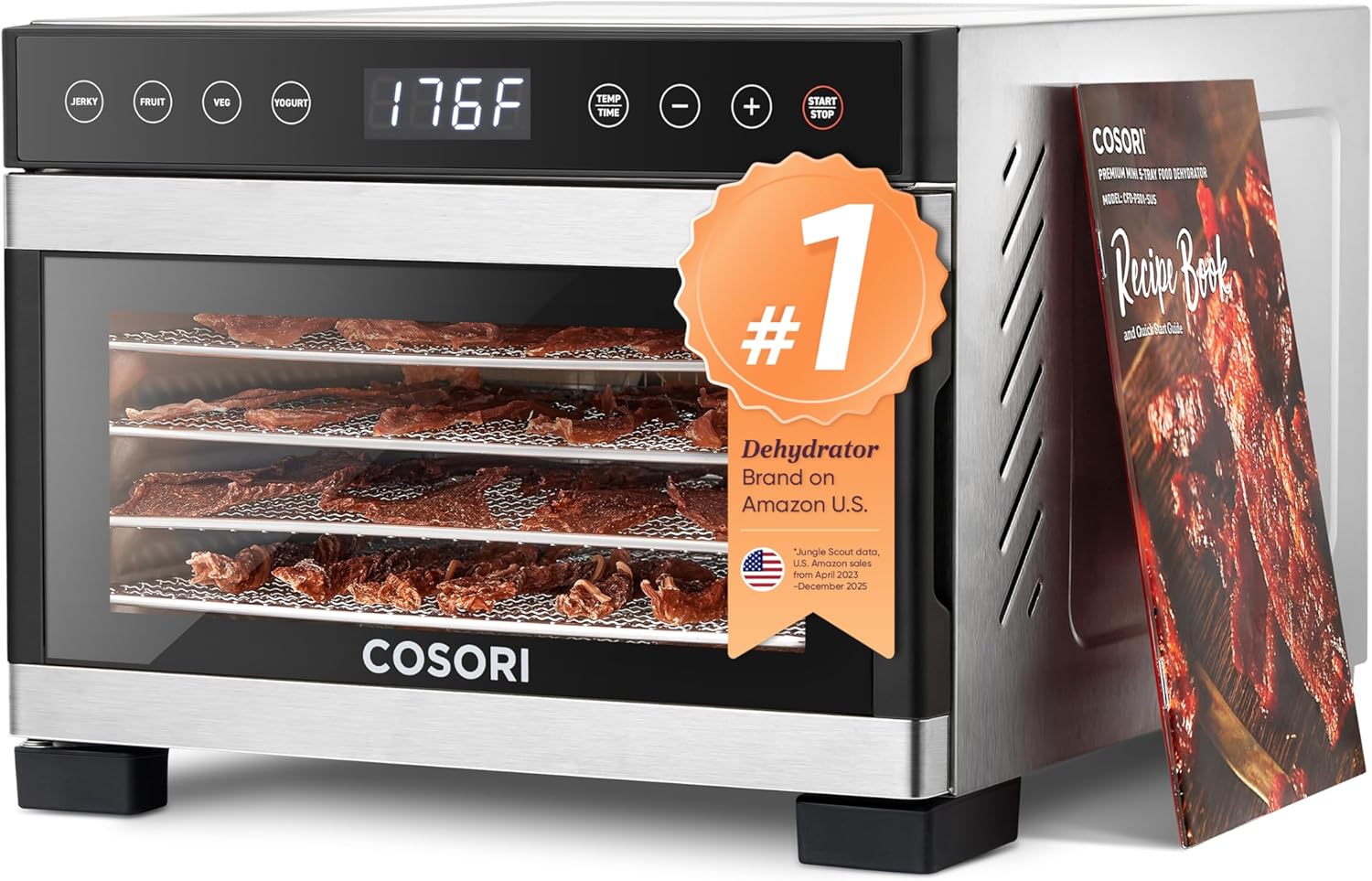
The Cosori P501 is a compact stainless steel dehydrator built for regular home use. It holds five stainless trays that provide about 3.1 ft² of drying space and uses a rear-mounted fan with horizontal airflow to circulate heat evenly across trays, which helps avoid hotspots when making jerky, fruit leather, dried vegetables, or yogurt. Temperature is adjustable from 95 to 176°F in 1°F increments and there are four presets for jerky, fruit, vegetables, and yogurt, plus a 48-hour timer for long batches. The stainless-steel construction and a no-plastic-contact design make it easier to keep food-safe surfaces and simplify cleaning compared with plastic units. At 480 watts it dries efficiently without excessive power draw, but its compact footprint limits single-batch capacity compared with larger cabinet dehydrators. The control panel is straightforward, and included accessories like a mesh screen and fruit roll sheet increase versatility. If you prioritize consistent, reliable drying and a durable metal build for everyday kitchen use, this model delivers; if you need very large-capacity or commercial throughput, consider larger machines instead.
Best for: Buyers who want a durable, everyday countertop dehydrator that delivers consistent, food-safe results and straightforward controls for regular home use.
Less Ideal for: Users who need commercial throughput or very large single-batch capacity should look at larger cabinet-style dehydrators designed for heavy use.
- Five stainless steel trays provide layered drying without plastic contact.
- Precise temperature control from 95 to 176°F with 1°F increments for safe jerky and delicate items.
- Rear horizontal airflow promotes even dehydration across all trays.
- Includes useful accessories: mesh screen, fruit roll sheet, and recipe book for beginner-friendly use.
- Stainless steel construction is easy to clean and more durable than plastic alternatives.
- Compact capacity limits batch size for heavy users or large families.
- Not intended for commercial-scale dehydration or very frequent high-volume use.
Verdict: Choose the Cosori P501 if you want a reliable, stainless-steel countertop dehydrator that produces even, food-safe results for regular home batches.
Elite Gourmet 5-Tray Digital Dehydrator EFD329WD
| Wattage | 350 watt-hours |
|---|---|
| Number of Trays | 5 |
| Temperature Range | 95 to 158 °F |
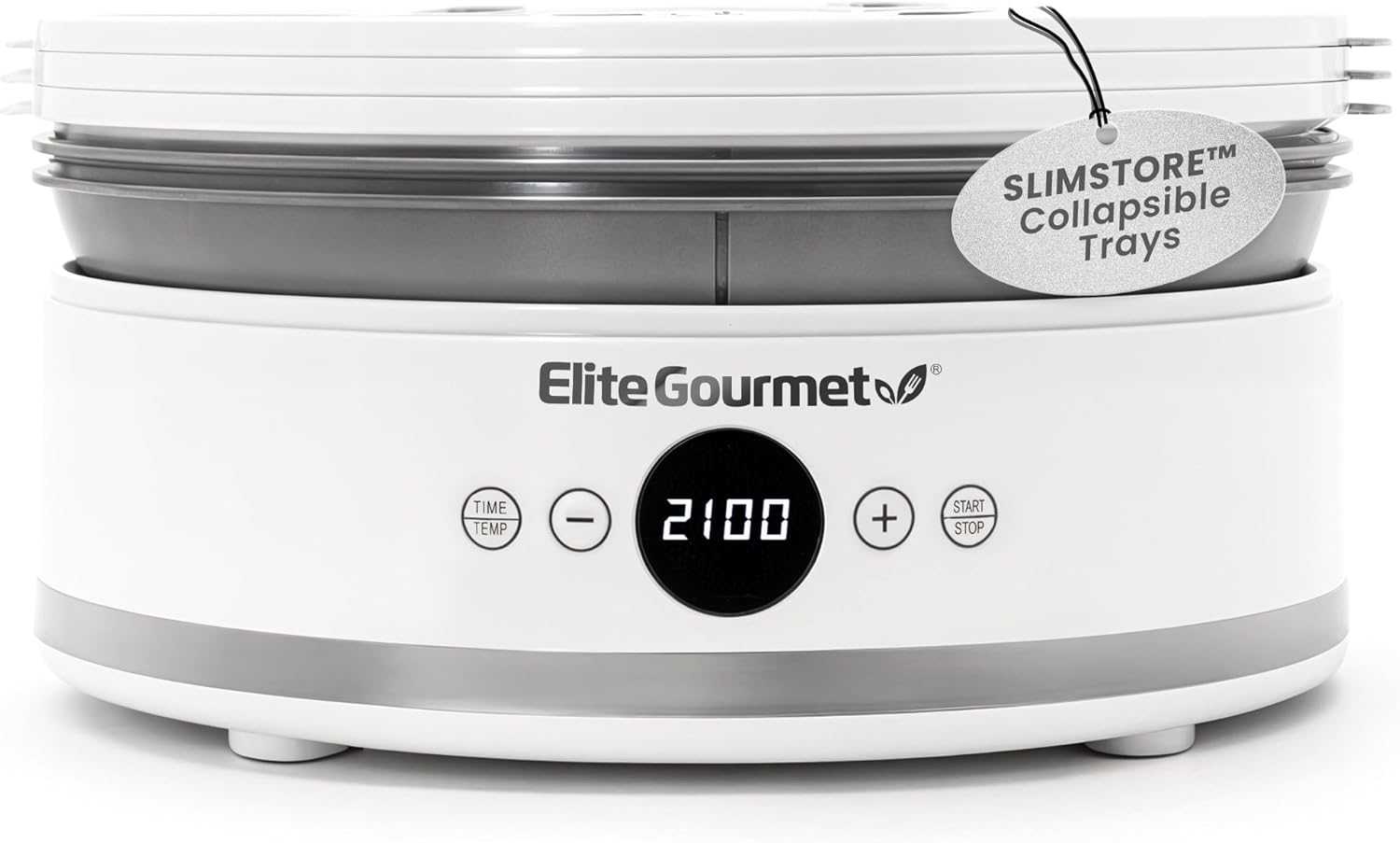
The Elite Gourmet 5-Tray Digital Dehydrator (EFD329WD) is a countertop unit built for straightforward home dehydrating. It uses a base-mounted fan and 350 watts of power to push warm air up through five BPA-free SlimStore trays, giving about 410 square inches of total drying surface for small batches. Controls include a digital timer up to 48 hours in 30-minute steps and an adjustable temperature range from 95 to 158 F, which covers typical settings for fruits, vegetables, and jerky. The collapsible trays nest together for compact storage and are dishwasher-safe for easy cleanup. Practical benefits include even airflow from the bottom-heated design, clear temperature control for recipe accuracy, and a modest footprint that suits apartment kitchens. Limitations are its small overall capacity compared with larger stack-style or commercial dehydrators and the plastic construction, which may feel less durable than metal units for heavy use. For buyers wanting simple, reliable home dehydrating for occasional batches, this model covers the essentials without unnecessary complexity.
Best for: Buyers who prioritize a compact, easy-to-use home dehydrator with clear digital controls and modest batch capacity, and who value peer-reviewed reliability when choosing small kitchen appliances.
Less Ideal for: People who need to dry very large quantities regularly or who prefer a heavy-duty metal commercial-style dehydrator for continual high-volume use.
- Five collapsible BPA-free trays provide ample drying surface for small batch dehydrating and compact nested storage.
- Digital timer up to 48 hours with 30-minute increments for precise drying control.
- Adjustable temperature range (95 to 158 F) covers common settings for fruits, herbs and jerky.
- Base-mounted fan and heater create upward airflow for more even drying across trays.
- Plastic construction may feel less robust than metal units for frequent heavy use.
- Smaller total capacity limits large-batch dehydration compared with tower-style commercial dehydrators.
Verdict: A compact, user-friendly 5-tray dehydrator that delivers controlled, even drying for small home batches.
Choosing the Right Small Food Dehydrator: Key Factors to Consider
Drying Consistency
Consistent low-heat airflow and stable temperature are essential to produce evenly dried snacks without hotspots or under-dried centers. Uneven airflow can lead to some trays finishing much sooner than others, forcing you to rotate trays frequently and increasing hands-on time.
For small dehydrators, look for models that combine a tuned fan with a well-distributed tray layout or internal baffling to equalize airflow. Good consistency reduces drying time variance and improves food safety when drying proteins like beef jerky.
Temperature Range and Accuracy
A useful temperature range lets you dry a wide variety of foods, from low-heat herbs to higher-temperature jerky. Accuracy matters because a thermostat that runs hot can overcook delicate fruits, while one that runs cool will prolong drying and risk spoilage.
Digital controls often provide tighter setpoints and repeatable results, while basic dial controls are simpler but may be less precise. Consider how closely the unit holds the selected temperature in practice, especially if you plan to dry meat or create crisp fruit leathers.
Tray Layout and Capacity
Tray size and the number of trays determine how much food you can process per batch. Small dehydrators trade capacity for compactness, so evaluate actual tray area rather than just the tray count.
Removable, stackable trays that allow airflow between layers are preferable. If you expect to make large batches occasionally, choose a unit with more trays or easily expandable stacking options to avoid many short runs.
Ease of Cleaning
Sticky sugars, oils, and herb debris build up on trays and interiors, so cleaning should be straightforward to keep the unit sanitary. Trays that are dishwasher-safe or have smooth, nonstick surfaces reduce maintenance time.
A design with minimal crevices and a removable drip tray for sticky residues simplifies cleanup. Consider how easy it is to disassemble the fan housing or interior surfaces for occasional deep cleaning.
Noise Level and Energy Efficiency
Because small dehydrators often sit on counters near living spaces, fan noise can affect where and when you run the unit. Quieter fans make overnight or continuous drying less intrusive.
Energy efficiency matters for long drying cycles. Units that dry at sensible temperatures with efficient airflow finish faster and use less power overall, which is useful if you plan to run the dehydrator frequently.
Build Quality and Safety Features
Durable materials and a stable base matter in a machine that runs for many hours. Look for BPA-free plastics or food-safe stainless steel where food contacts the device.
Safety features such as an automatic shutoff, thermal cutoff, or secure lid help prevent overheating or accidental burns. A compact machine with good ventilation and protected fan openings reduces the risk of foreign-object entry and improves longevity.
How Small Dehydrators Fit Into a Kitchen Routine
Small food dehydrators are designed for occasional to moderate use when counter and storage space are limited. They are well suited to single-batch snack production, herb drying, and small-batch jerky or fruit leather projects. Because they use less space and typically draw less power, they are a good match for apartment kitchens and infrequent home cooks.
To incorporate a small dehydrator into your routine, plan for longer run times but smaller outputs. Pre-slicing food uniformly and pre-treating items like apples or peaches can shorten cycles and produce more consistent results. Stagger batches so you can load, dry, and store finished goods without crowding your prep area.
- Use uniform slice thickness to reduce drying time variance
- Pre-treat fruits susceptible to enzymatic browning for better color
- Rotate trays periodically if the unit lacks perfectly even airflow
Best Practices for Preparing Food
Preparation directly affects drying quality. Slice foods evenly, blanch or soak when recipes call for it, and pat surfaces dry before loading trays. For herbs, whole leaves or small sprigs dry more quickly than bundles, so spread them in a single layer without overlapping.
For proteins, follow safe handling and marinating practices, and use recommended temperatures to reduce bacterial risk. Pre-treat fruits that oxidize with lemon juice or other acidulated solutions to preserve color and flavor.
- Aim for consistent slice thickness using a mandoline or sharp knife
- Arrange food in a single layer to ensure unobstructed airflow
- Avoid crowding trays; overlapping increases drying time and unevenness
Storage and Shelf Life of Dried Foods
Correctly dried and cooled foods stored in airtight containers will last much longer than fresh items, but storage conditions matter. Keep dried goods in a cool, dark place and use moisture-absorbing packets for long-term storage of sensitive items like dried fruit chips.
Check dried foods for signs of residual moisture before storing. If items feel tacky or limp after the recommended drying time, return them to the dehydrator for additional drying. Label containers with drying dates and rotate older batches first to maintain freshness.
- Use vacuum-sealed bags or airtight jars for best longevity
- Store in small portions to avoid repeated exposure to humidity
- Rehydrate briefly for use in cooked dishes or snacking
Common Mistakes to Avoid
Rushing to load too many items, using uneven slices, or skipping pre-treatment steps are frequent causes of poor results. Small dehydrators are more sensitive to overcrowding, which reduces airflow and creates uneven drying.
Another common error is underestimating run time. Many foods require several hours to dry fully, and stopping early leads to spoilage in storage. Be prepared to test for dryness and extend cycles when necessary.
- Do not stack trays or overlap items in an attempt to speed throughput
- Avoid using high temperatures that can cook rather than dry delicate foods
- Do not assume drying times from large units will match small dehydrator performance
Maintenance Tips to Keep Your Dehydrator Performing
Regular cleaning after each use prevents residue buildup and off-flavors. Wipe the interior and wash trays according to the manufacturer instructions. If the fan housing is accessible, remove crumbs and dust periodically to maintain airflow.
Inspect trays for warping or cracks and replace them if they compromise airflow or cleanliness. Keep vents clear and store the unit in a dry place when not in use to extend its service life.
- Clean sticky fruit residues promptly to prevent stubborn stains
- Run a short, empty cycle after deep cleaning to dry interior parts
- Store trays separated or nested to avoid warping from pressure
How We Chose the Best Small Food Dehydrator
We evaluated a broad set of compact dehydration units and narrowed the field by applying practical, buyer-focused filters. First, we limited candidates to machines with a small footprint and tray capacity appropriate for apartment kitchens and occasional home use. Next, we prioritized consistent temperature control and airflow design because those directly affect drying time and the final texture of foods. Ease of cleaning and removable-tray design were required, since residue and sticky sugars are common with fruit and jerky. Quiet operation and reasonable energy draw were considered for everyday convenience. Durability of materials and user safety features were part of the selection, along with clear, usable controls for setting timers and temperatures. We excluded large, commercial-grade units and devices lacking stable temperature control or with trays that are difficult to wash. The resulting picks represent compact dehydrators that balance drying performance, cleanliness, and home-friendly convenience.
Our full evaluation process is outlined in our review methodology.
FAQ
How long does it usually take to dry fruit in a small dehydrator?
Drying time often depends on slice thickness and moisture content. Typical fruit slices take 6 to 12 hours, while thin apple or banana chips can finish sooner. Expect variability and plan to check for dryness rather than rely on a fixed time.
Can I safely dry meat or jerky in a small dehydrator?
Yes, provided the dehydrator can reliably reach and maintain temperatures recommended for meat drying. Use appropriate marinating and food-safety practices and follow guidelines for preheating or oven pasteurization if required.
Are the trays dishwasher-safe or easy to clean?
Many small dehydrators use removable trays that are dishwasher-safe or have nonstick finishes for easy cleaning. Check the product specifications for dishwasher compatibility and consider tray material when evaluating maintenance effort.
Will a small dehydrator produce the same results as a larger model?
Small units can deliver comparable results for many foods, but they usually have less capacity and sometimes less uniform airflow. For occasional home use and small batches, quality is often similar, though you may need more frequent batches for larger yields.
Can I run a small dehydrator overnight?
Running overnight is common because many items need long cycles. Ensure the unit is on a stable surface, clean, and not obstructed, and that the temperature control is reliable. Quieter fans are preferable for overnight use.
Final Verdict
Choosing a small food dehydrator is about balancing capacity, drying reliability, and upkeep. Prioritize units with stable temperature control and an airflow design that minimizes hotspots if you value consistent results. If you need low maintenance, give extra weight to tray materials and how easy they are to clean. In short, pick a compact dehydrator that matches the batch sizes you expect to run and offers the control accuracy you need for the foods you plan to dry. That approach will deliver dependable results without wasting counter space or time.