
Note: This article contains affiliate links. If you click on these links and make a purchase, we may earn a small commission at no extra cost to you. This helps support our research and content. Read our full affiliate disclosure here.
If you grow, cook with, or preserve peppers, choosing the right food dehydrator makes the difference between vibrant, flavorful dried chiles and brittle, uneven results. A dehydrator built for peppers must handle thin-walled pods and thicker varieties without overcooking or trapping moisture that leads to mold. This guide lists seven shortlisted food dehydrators for peppers that excel at steady airflow, accurate temperature management, and practical tray capacity for hobby and small-scale kitchen use. We evaluated models on the controls, drying uniformity, build and cleaning ease, and footprint to help you pick the right pick for your drying routine. Read on to find a dehydrator that suits how many peppers you process and how you plan to store the finished product.
Top Picks at a Glance
| Best Overall The best all-around choice for most situations | Magic Mill Pro Food Dehydrator MFD-7700 |  |
| Best Quality Built to a higher standard if you want something more solid | Excalibur 8-Tray Dehydrator DH08SCSS13 |  |
| Best Value The sweet spot between price and what you get | Hamilton Beach Digital Food Dehydrator |  |
| Best Budget The cheapest option that still gets the job done reliably | Commercial CHEF Food Dehydrator CCD100W6 |  |
| Top Rated A top-rated pick with lots of positive feedback | Cosori Stainless Steel Dehydrator CP267-FD |  |
| Most Popular A crowd favorite that many people choose with confidence | NESCO Snackmaster FD-75A |  |
| Best Seller A high-volume bestseller chosen again and again | Magic Mill Food Dehydrator MFD-5000 |  |
Magic Mill Pro Food Dehydrator MFD-7700

| Wattage | 600 |
|---|---|
| Voltage | 120 |
| Number of Trays | 7 |
| Material | Stainless Steel |
The Magic Mill Pro is a full-stainless-steel dehydrator built for multi-batch home use and consistent drying. It uses a 600W rear-mounted fan and rear heating to push air evenly across seven full-size stainless trays so you do not need to rotate trays for uniform results, which is especially helpful when drying dense items like peppers or thick jerky. The digital control lets you set temperature in 1°F increments from 95 to 176°F, and a 48-hour timer with auto-shutoff and a Keep Warm hold mode simplifies long runs for hotter or low-and-slow recipes. Included mesh screens and a fruit roll tray expand what you can dry without mess. The all-stainless interior and trays are food-safe and easy to wipe down, and ETL listing and overheat protection add safety for overnight batches. Downsides are its substantial power draw and countertop footprint compared with more compact hobby units, and the stainless finish means it is heavier to move than plastic models.
Best for: Buyers who want a durable, high-capacity dehydrator that delivers consistent, repeatable drying for large pepper batches and other snacks and value precise temperature control and safety features.
Less Ideal for: Avoid this model if you need a lightweight, ultra-compact unit for occasional small batches or if counter space and low power draw are the top priorities.
- Rear-mounted fan and heater for even airflow across all trays without rotation
- Precision digital temperature control in 1°F steps up to 176°F for repeatable pepper and jerky recipes
- Seven full-size stainless steel trays provide large batch capacity
- All-stainless interior and trays are food-safe and easier to clean than plastic
- 48-hour timer with auto-shutoff plus Keep Warm hold mode for unattended long runs
- Relatively heavy and takes more countertop space than compact dehydrators
- Higher wattage means greater energy use during long cycles
Verdict: Choose this Magic Mill if you need a heavy-duty, precise, multi-tray dehydrator that reliably handles large pepper drying jobs.
Excalibur 8-Tray Dehydrator DH08SCSS13

| Number of Trays | 8 |
|---|---|
| Wattage | 700 watts |
| Voltage | 120 |
| Drying Space | 7.2 sq ft |
| Temperature Range | 85°F to 165°F |
The Excalibur 8-Tray dehydrator is a countertop unit built for steady, even drying of fruits, vegetables, meats, and especially produce like peppers. It uses patented Hyperwave Pulse technology with horizontal parallax airflow to push heat evenly across eight chrome trays so you do not need to rotate them during long cycles. The digital LED control lets you set temperatures between 85°F and 165°F and run up to an 80-hour timer with automatic shutoff, which is useful when drying thick or dense peppers slowly to preserve flavor. The clear French door makes visual checks easy, and the compact footprint is designed to fit under cabinets while still offering 7.2 square feet of drying area. Practical limitations are its 700-watt power draw and mostly metal construction that can be heavier to move; also large batches will still take many hours, so plan for long unattended runs. Overall it is a reliable, performance-focused dehydrator for serious home preserving and hot-pepper projects.
Best for: Home cooks and preservers who want consistent, professional-style drying results and plan to process whole batches of peppers or other produce regularly.
Less Ideal for: Casual users who only dry small amounts infrequently or need a lightweight, highly portable unit for occasional use.
- Even airflow with Hyperwave Pulse and horizontal parallax design eliminates tray rotation
- Wide temperature range (85°F–165°F) for delicate herbs to thick peppers
- Large drying area across eight chrome trays provides 7.2 sq ft of space
- Digital timer up to 80 hours with automatic shutoff for unattended long cycles
- Clear glass French door lets you monitor progress without opening the unit
- 700-watt power consumption may be high for some kitchens
- Unit is relatively heavy and less portable than small stackable dehydrators
- Long drying cycles required for dense produce mean extended countertop use
Verdict: Choose the Excalibur 8-Tray if you need even, bag-free drying and precise long-run temperature control for serious pepper drying and preservation projects.
Hamilton Beach Digital Food Dehydrator

| Wattage | 500 watts |
|---|---|
| Number of Trays | 5 |
| Temperature Range | 100-160 °F |
| Voltage | 110 |
This Hamilton Beach dehydrator is a straightforward, user-friendly machine for making jerky, fruit leather, herbs, and dried peppers. It uses a 500-watt base-mounted heater and quiet fan to provide consistent airflow so you typically do not need to rotate trays, and the five stackable BPA-free trays give up to 4.2 square feet of drying space for multiple pepper varieties at once. Temperature is adjustable from 100 to 160°F and the digital timer runs from 1 to 48 hours with auto shutoff, which simplifies longer pepper-drying cycles. The clear vented lid makes it easy to monitor progress without disturbing airflow, and included accessories like a mesh screen and fruit leather sheet increase versatility for small items and purees. Trays and lid are dishwasher safe for cleanup, though the mesh screen requires hand washing. The unit is plastic-bodied and compact enough to tuck under cabinets, so it fits well in modest kitchens but is not a heavy-duty commercial unit for very large batches.
Best for: Home cooks who want a reliable, easy-to-use dehydrator to dry small to medium batches of peppers and other snacks with consistent results and minimal monitoring.
Less Ideal for: People who need to dry large commercial volumes of peppers or require a metal-bodied, heavy-duty appliance built for continuous, high-capacity use.
- Five stackable BPA-free trays provide up to 4.2 sq. ft. of drying area for batch drying peppers.
- Adjustable 100–160°F temperature range suits low-and-slow drying for different pepper heat and thickness.
- Digital 1–48 hour timer with auto shutoff makes multi-hour drying hands-off and safe.
- Base-mounted 500-watt heater and quiet fan deliver even airflow so trays usually do not need rotation.
- Clear vented lid and included mesh screen and fruit leather tray add monitoring and versatility.
- Plastic construction and compact capacity limit suitability for very large or commercial pepper batches.
- Mesh screen must be hand washed while trays and lid are dishwasher safe, adding a small cleaning hassle.
Verdict: A practical, no-frills 5-tray dehydrator that reliably dries peppers and small-batch snacks with adjustable temps and a long digital timer.
Commercial CHEF Food Dehydrator CCD100W6
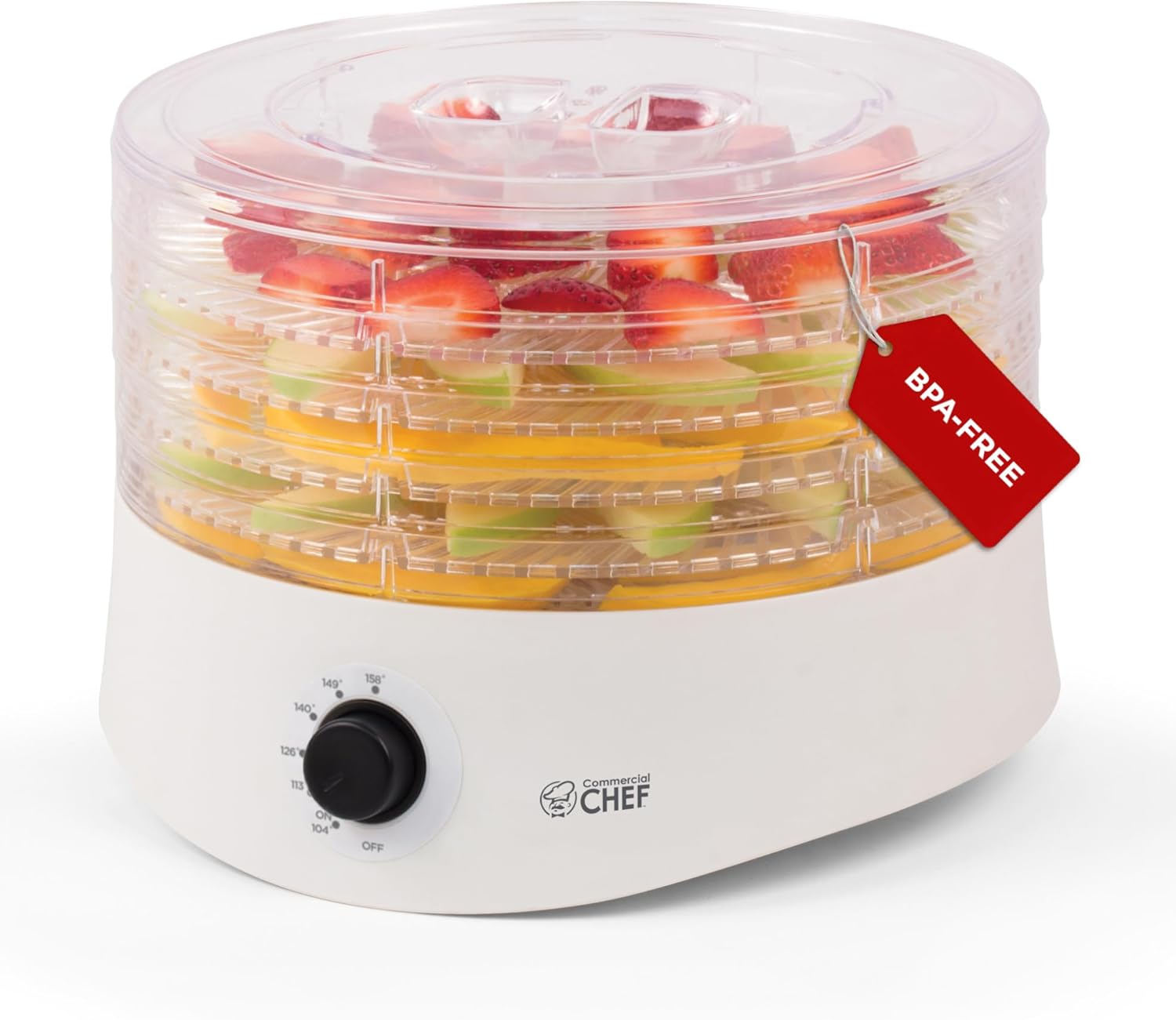
| Wattage | 280 watts |
|---|---|
| Voltage | 120 volts |
| Number of Trays | 5 |
| Temperature Range | 104˚F – 158˚F |
The Commercial CHEF CCD100W6 is a small, budget-friendly dehydrator designed for home use and works well for batches of peppers, fruit, herbs, and jerky. It uses a 280W heater and a fan-driven airflow system to circulate heat evenly through five reversible 9.25-inch BPA-free trays, and the mechanical temperature control adjusts from 104 to 158 F so you can low-dry chilies or push temperatures for meat. Tray reversibility and two height settings make it easy to fit thicker slices or longer pepper halves, and the simple power indicator and knob keep operation straightforward. Its plastic construction and compact footprint make it lightweight and easy to store, though that same small size limits batch capacity compared with larger stack-style or horizontal-flow units. Expect clearer results when you run longer drying cycles and rotate trays by hand if you crowd them. For someone looking to dehydrate peppers without spending much, this model offers reliable basic performance with minimal complexity.
Best for: Buyers on a tight budget who need a straightforward dehydrator for small to medium pepper batches and occasional fruit or herb drying and who prefer simple, no-frills operation.
Less Ideal for: Gardeners or cooks who need to process large harvests at once or who want heavy-duty, commercial-grade drying capacity should look at larger horizontal or stack dehydrators.
- Five BPA-free reversible trays let you fit thicker pepper pieces and increase drying flexibility
- Adjustable thermostat (104–158 F) supports low-temperature drying for chilies and higher temps for meats
- Compact, lightweight design is easy to store and move
- Simple mechanical controls and power indicator make it beginner-friendly
- Small overall capacity limits large batches or long pepper harvests
- Plastic exterior and parts may feel less durable than metal alternatives
Verdict: A low-cost, easy-to-use dehydrator that suits budget buyers wanting reliable small-batch pepper drying.
Cosori Stainless Steel Dehydrator CP267-FD

| Wattage | 600 watts |
|---|---|
| Voltage | 120 volts |
| Number of Trays | 6 |
| Temperature Range | 95-165 F |
| Operating Frequency | 60 hertz |
This Cosori stainless steel dehydrator is built for steady, hands-off drying of large batches thanks to six stacked stainless trays and a rear-mounted 600W fan that promotes horizontal airflow for even results. You set temperatures from 95 to 165°F with a precise digital control and a timer up to 48 hours, which is handy for slow-drying peppers, herbs, and jerky without checking constantly. The all-stainless housing and dishwasher-safe trays keep food from contacting plastic and make cleanup straightforward. Noise is low enough to run overnight at under 48 dB, and included accessories such as a mesh screen and fruit roll sheet widen what you can dry. Expect a relatively large countertop footprint and the unit is heavier than compact models, so it is best placed in a semi-permanent spot. It also lacks rotating trays, so arranging slices for optimal airflow matters for the most uniform drying. For anyone who wants dependable, quiet, full-batch dehydration, this model delivers consistent, kitchen-grade results.
Best for: Buyers who prioritize reliable, repeatable drying for full batches of peppers and other produce and want a robust, low-noise machine they can leave running for long cycles.
Less Ideal for: If you need an ultra-compact or lightweight unit for occasional single-sheet snacks or have very limited counter/storage space, consider smaller or collapsible dehydrators instead.
- Six stainless steel trays provide large 6.5 ft² drying capacity for batch dehydration
- Precise digital temperature control from 95–165°F and 48-hour timer for low-and-slow drying
- Rear-mounted fan and horizontal airflow promote more even drying without rotating trays
- Stainless steel construction and dishwasher-safe trays reduce plastic food contact and simplify cleaning
- Quiet brushless motor operates below 48 dB, suitable for overnight runs
- Relatively heavy and bulky compared with compact countertop dehydrators
- No tray rotation feature, so users must arrange items to avoid uneven drying
Verdict: A sturdy, quiet, full-capacity stainless-steel dehydrator that reliably handles large pepper batches with precise temperature and long-timer control.
NESCO Snackmaster FD-75A

| Wattage | 600 watts |
|---|---|
| Voltage | 120 volts |
| Number of Trays | 5 (expandable to 12) |
| Temperature Range | 95°F–160°F |
The NESCO FD-75A Snackmaster is a straightforward home dehydrator that uses a top-mounted fan and the brand's Converga-Flow system to push air evenly across trays so you rarely need to rotate food. It ships with five BPA-free trays plus fruit roll sheets, clean-a-screens, and jerky seasoning so you can start making fruit leather, dried herbs, or jerky right away, and the system expands up to 12 trays for larger batches. The adjustable thermostat (95 to 160°F) makes it easy to dial in lower temperatures for delicate herbs and peppers or higher settings for safely drying meats. At 600 watts the unit reaches drying temperatures reasonably quickly while the top fan design keeps liquids away from the heating element and reduces hot spots. For pepper drying it offers even airflow and tray flexibility, though the opaque exterior means you cannot monitor color changes without opening the unit, and plastic construction is less durable than heavier metal models. For routine home use it balances simplicity, included accessories, and capacity well.
Best for: Buyers who want a reliable, easy-to-use dehydrator for home batches of fruits, peppers, herbs, or jerky and who value even airflow and included accessories to get started quickly.
Less Ideal for: Those seeking a heavy-duty commercial machine or a unit with a clear viewing window for continuous visual monitoring should consider other options.
- Converga-Flow top-mounted airflow provides even drying across trays without rotation
- Adjustable thermostat from 95°F to 160°F for precise control by ingredient
- Expandable from 5 to 12 trays for scaling batch size
- Includes useful accessories (fruit roll sheets, clean-a-screens, jerky seasoning) to start immediately
- Opaque exterior prevents visual monitoring of color changes during drying
- Plastic construction is less heavy-duty than metal alternatives
Verdict: A practical, expandable home dehydrator that delivers even airflow and temperature control, making it a solid choice for drying peppers and small-to-medium batches.
Magic Mill Food Dehydrator MFD-5000

| Wattage | 240 watts |
|---|---|
| Voltage | 110 volts |
| Number of Trays | 5 |
| Temperature Range | 95-167 °F |
The Magic Mill MFD-5000 is a countertop food dehydrator built for straightforward home use. It uses a 240W heating element and a digital control panel to set temperatures from 95 to 167°F and a timer up to 48 hours, which makes it suitable for slow-drying peppers, fruits, herbs, and meats. Five stainless steel stackable trays are adjustable to create more space for thicker pepper slices, and the tray construction is dishwasher-safe for easier cleanup. The unit emphasizes food-safe materials with stainless-steel trays and a BPA-free plastic body, and the top-down airflow design helps even drying across layers. Practical limitations include a relatively compact tray footprint that may require multiple batches for large harvests and a single-zone temperature control that does not allow separate settings per tray. For cautious buyers who prioritize simple, reliable operation and easy cleaning, this model delivers consistent results for home pepper dehydration without complicated controls.
Best for: Home cooks who want a fuss-free, food-safe dehydrator to reliably dry peppers and small batches of produce with easy-to-use digital controls and simple cleaning.
Less Ideal for: Growers or canners who need to process very large harvests at once or who require independent temperature zones for different foods should consider larger or multi-zone units.
- Adjustable digital temperature up to 167°F and 48-hour timer for precise drying cycles
- Five stainless steel, food-safe trays that are dishwasher-safe for easy cleaning
- BPA-free plastic body with stainless-steel base provides a durable, food-safe build
- Adjustable tray heights let you fit thicker pepper slices or variable produce
- Compact tray footprint means larger pepper batches may require multiple drying runs
- Single-zone temperature control cannot set different temperatures for separate trays
Verdict: A simple, food-safe dehydrator with precise digital controls that is a reliable choice for home pepper drying and small-batch jerky or fruit prep.
Choosing the Right Food Dehydrator for Peppers: Key Factors to Consider
Temperature Control and Stability
Peppers vary widely in thickness and moisture content, so a dehydrator with a wide, accurate temperature range matters. Low-temperature settings near 95°F to 115°F allow delicate air-drying for thin, aromatic varieties, while higher stable settings up to about 160°F help dry thick-walled peppers more quickly without prolonged exposure that can darken color.
Stable regulation prevents repeated cycling that raises and lowers humidity inside the chamber, which can lengthen drying times and produce uneven textures. Digital thermostats or precise analog dials with reliable feedback reduce guesswork and let you follow drying charts for different pepper types.
Airflow Design and Distribution
Even airflow eliminates damp spots where peppers can linger moist and develop off-flavors or mold. Look for designs that either use vertical, bottom, or rear-mounted fans engineered for gentle, consistent circulation rather than high-velocity blasts that can case-harden the outer skin before interior moisture leaves.
Well-designed airflow also supports mixed loads. If you plan to dry both small hot chiles and larger bell-style peppers in one batch, adjustable tray spacing and consistent circulation across trays keep drying times predictable and reduce the need to rotate trays frequently.
Tray Capacity and Configuration
Tray count, tray footprint, and whether trays are solid or mesh will affect how many peppers you can process per run and how thinly you must slice. Mesh trays are ideal for whole or halved peppers since they allow air to contact more surface area and reduce drying time for smaller pods.
Capacity also ties to batch planning. High-capacity units reduce total drying cycles for a large harvest but take more counter or storage space. Removable and stackable trays that are easy to rearrange or remove let you customize spacing for mixed sizes and speed up loading and unloading.
Build Material and Ease of Cleaning
Peppers can be sticky or leave oils and pigments that stain surfaces. Trays and housings made from food-grade, nonreactive materials simplify cleaning and long-term food safety. Dishwasher-safe trays save time, while smooth interiors reduce trapped debris.
Durability of components matters because repeated drying cycles expose plastics and seals to heat and food acids. Look for sturdily made trays and a design that allows disassembly for a thorough wash to prevent lingering odors between batches.
Drying Speed and Batch Predictability
How quickly a dehydrator removes moisture affects texture, color, and flavor concentration. Faster drying reduces time at intermediate humidity levels where enzymes and microbes can act, but too fast can case-harden and lock moisture inside. Predictable timing is important if you process harvests regularly and want consistent results.
Consider whether the unit provides timing controls, low-temperature settings for slow drying, and the ability to dry a mix of pepper types without constant monitoring. Reliable charts or documented drying times for common pepper varieties are helpful features for planning batch schedules.
Noise, Footprint, and Kitchen Practicality
Dehydrators run for many hours or overnight, so noise level affects where you can place one. Quieter fans and vibration-dampening designs are better for small homes or when running a dehydration cycle near living spaces.
Footprint and storage are practical concerns. If you only process peppers occasionally, a compact stackable model that stores upright may be best. Regular dryers should fit into the space where you plan to run them without blocking ventilation or creating heat buildup in the room.
Preparing Peppers for Consistent Drying
Proper preparation reduces drying time and improves final texture. Wash and thoroughly dry peppers, then decide whether to de-stem, halve, or slice based on size. Thin-walled hot peppers can often be left whole with a few slits to allow moisture to escape; thicker peppers benefit from halving or rings to expose more surface area.
Uniform pieces dry at similar rates. When mixing varieties, group peppers by thickness so thin pods do not over-dry while larger ones finish. Pat or air-dry cut surfaces before loading trays to reduce initial humidity spikes inside the dehydrator.
- Remove stems and seeds if you want milder dried peppers and easier storage.
- Score whole peppers to allow internal moisture to escape.
- Arrange pieces in a single layer without overlap for best airflow.
Loading and Tray Management Tips
Space items so air can move freely around each piece. Crowding slows drying and increases the chance of uneven results. Use mesh trays for slices and small pods; solid trays or parchment can be useful for sticky or pulpy cuts.
If your dehydrator lacks perfectly uniform airflow, rotate trays mid-cycle and swap top-to-bottom positions to even out differences. Keep a simple log of tray placement and times for repeatable batches.
- Avoid stacking peppers directly on top of each other.
- Check and reposition trays halfway through long cycles for best uniformity.
Drying Times and How to Test for Doneness
Drying times vary by pepper variety, slice thickness, humidity, and temperature. Small, thin chiles can dry in 4 to 8 hours at moderate temperatures, while thick-fleshed varieties may need 10 to 18 hours or more at slightly higher settings. Expect longer cycles in high ambient humidity.
Use tactile and visual cues rather than strictly timing. Properly dried hot peppers usually feel leathery and pliable, sometimes brittle depending on your intended use. For long-term storage, aim for a brittle, cracker-dry texture with no lingering soft spots. Cool a sample piece to room temperature before sealing to avoid trapping residual moisture.
- Thin slices dry faster and are useful for powders.
- Whole or halved peppers require more time but preserve shape and oils.
Storing Dried Peppers Safely
Cool and dry your peppers completely before storage to avoid trapped moisture. For short-term use, airtight jars in a cool, dark pantry work well. For long-term preservation, vacuum sealing or storing with desiccant packs reduces chance of rehydration and preserves volatile flavor compounds.
Label containers with date and variety. Even properly dried peppers can lose color and flavor over many months, so rotate stock and use older batches first for best culinary results.
- Avoid storing in warm or humid areas.
- Use oxygen absorbers or desiccants for multi-year storage plans.
Using Dried Peppers in Cooking
Dried peppers can be rehydrated by soaking in warm water for 15 to 30 minutes, then pureed for sauces or chopped into stews. Toasting briefly in a dry skillet before rehydrating deepens flavor and adds a smoky note.
Grinding dried peppers into flakes or powders concentrates heat and makes them pantry staples. Store ground powders separately from whole dried pods, as increased surface area accelerates flavor loss.
- Rehydrate in broth or oil for richer flavor.
- Toast seeds lightly to use as a spicy finishing crunch.
How We Chose the Best Food Dehydrator for Peppers
We focused on attributes that directly affect how well a dehydrator handles peppers of all sizes. Primary evaluation criteria included temperature range and accuracy because peppers need both low-heat dehydration for slow drying and higher settings for thicker pods. Airflow design and circulation were weighed heavily since even drying prevents pockets of retained moisture that cause spoilage. Tray capacity and configurability mattered for users drying single batches of small peppers or mixed loads with large pods. Ease of cleaning and dishwasher-safe components were included to reflect real-world upkeep. Noise level and footprint were considered for kitchen practicality and apartment use. We excluded models that lack steady temperature control, have inconsistent airflow, or offer insufficient tray flexibility for varied pepper sizes. We also filtered out machines with poor serviceability or unreliably documented specifications. The shortlisted dehydrators are those that meet the measurable criteria above and offer a balance of drying consistency, usable capacity, and straightforward operation.
Our full evaluation process is outlined in our review methodology.
FAQ
What temperature is best for drying peppers?
It depends on pepper thickness. Low settings near 95°F to 115°F work for thin pods to retain volatile aromas, while thicker peppers usually need 125°F to 160°F. Use a temperature the dehydrator can hold steadily.
Can I dry whole peppers without slicing?
Yes for small, thin-walled varieties if you make slits for airflow. Larger or thick-walled peppers should be halved or sliced to ensure even drying and avoid long internal drying times.
How do I prevent mold when dehydrating peppers?
Ensure peppers are fully dried before storage and avoid overloading trays. Maintain steady airflow and temperature, and cool pieces to room temperature before sealing. If ambient humidity is high, extend drying time or use a desiccant in storage.
Is it better to use mesh or solid trays?
Mesh trays speed drying by allowing air to contact more surface area, which is helpful for small pieces or slices. Solid trays can be useful for pulpy cuts or to catch seeds, but they may slow drying slightly.
How long do dried peppers keep their flavor?
Stored sealed in a cool, dark place, whole dried peppers can retain good flavor for 6 to 12 months, with gradual loss afterward. Grinding or crushing increases flavor loss due to greater exposure to air.
Final Verdict
When selecting a food dehydrator for peppers, prioritize stable temperature control and a circulation design that delivers even airflow across trays. Match capacity and tray configuration to how many peppers you plan to process and whether you typically dry whole pods or slices. Consider ease of cleaning, noise, and countertop fit so the unit is practical for regular use. Balance drying speed against the risk of case-hardening by choosing a machine with adjustable settings and predictable performance. With the right dehydrator and simple preparation techniques, you can preserve peppers that keep color, heat, and flavor for months of cooking and seasoning.