
Note: This article contains affiliate links. If you click on these links and make a purchase, we may earn a small commission at no extra cost to you. This helps support our research and content. Read our full affiliate disclosure here.
If you plan to make jerky at home, the right dehydrator changes the outcome from mediocre to reliably safe and tasty. A Home Food Dehydrator for Jerky controls temperature and airflow so meat dries evenly, reduces spoilage risk, and preserves flavor and texture. This guide presents a shortlist of top options that suit different batch sizes and kitchen setups. We evaluate each model for drying performance, temperature stability, airflow design, and how simple it is to clean and maintain. Read on to find the dehydrator that fits your jerky goals and home kitchen.
Top Picks at a Glance
| Best Overall The best all-around choice for most situations | Excalibur Compact 8-Tray Dehydrator |  |
| Best Quality Built to a higher standard if you want something more solid | Magic Mill Pro Food Dehydrator MFD-7700 |  |
| Best Value The sweet spot between price and what you get | Magic Mill Food Dehydrator MFD-5000 |  |
| Best Budget The cheapest option that still gets the job done reliably | Rosewill Food Dehydrator RHFD-15001 |  |
| Top Rated A top-rated pick with lots of positive feedback | Cosori Stainless Steel Dehydrator CP267-FD |  |
| Most Popular A crowd favorite that many people choose with confidence | NESCO Snackmaster FD-75A |  |
| Best Seller A high-volume bestseller chosen again and again | Cosori Stainless Steel Dehydrator P501 |  |
Excalibur Compact 8-Tray Dehydrator

| Wattage | 700 watts |
|---|---|
| Voltage | 120 |
| Number of Trays | 8 |
| Temperature Range | 85°F to 165°F |
| Maximum Timer | 80 hours |
The Excalibur Compact 8-Tray is a countertop dehydrator built for serious home preservation including jerky, fruits, vegetables, and pet treats. It provides eight chrome trays plus a mesh tray for small pieces, delivering 7.2 square feet of drying area in a compact footprint that fits under most cabinets. Excalibur's Hyperwave Pulse technology and Horizontal Parallex airflow aim to give even drying across trays without tray rotation, while the LED control panel lets you set temperatures between 85°F and 165°F and run cycles up to 80 hours with automatic shutoff. The stainless-steel exterior and glass French door let you monitor progress and feel confident in the build quality, and the included digital recipe book helps with basic jerky protocols. Expect steady, predictable results for longer jerky runs, but note the unit is fairly large and uses a 700-watt motor that will run for many hours during meat drying. Noise is moderate and cleaning chrome trays takes a little effort compared with stackable sheet systems. For someone making regular batches of jerky, the machine balances capacity, control, and finish well.
Best for: Home cooks who want a reliable, higher-capacity dehydrator for making multiple or larger jerky batches and who value precise temperature control and even drying.
Less Ideal for: Casual users who only make small, occasional snacks or who need an ultra-compact, lightweight unit for infrequent use.
- Large drying area with eight chrome trays for batch jerky production
- Patented airflow technology designed for even drying without rotating trays
- Wide temperature range and up to 80-hour digital timer with automatic shutoff
- Stainless-steel build and clear glass door for durability and easy monitoring
- Relatively high continuous power draw (700 watts) during long drying cycles
- Chrome trays require hand cleaning and take up counter/storage space
Verdict: A roomy, well-built dehydrator with precise temperature control and even airflow that makes it a strong choice for home jerky makers who run regular, larger batches.
Magic Mill Pro Food Dehydrator MFD-7700

| Wattage | 600 |
|---|---|
| Voltage | 120 |
| Number of Trays | 7 |
| Material | Stainless Steel |
The Magic Mill Pro is a heavyweight, performance-focused countertop dehydrator aimed at multi-batch drying and jerky making. Its full-stainless-steel interior and seven full-size stainless trays make it durable and easy to load for large batches, while the 600W rear fan and rear heat deliver consistent airflow so you rarely need to rotate trays. The digital control offers 1°F increments between 95 and 176°F, which helps dial in precise temps for herbs, fruit leather, or the higher heat settings jerky recipes need. A 48-hour timer with auto shutoff and a 24-hour keep-warm mode makes long runs safe and convenient. Included mesh screens and a fruit-roll tray expand what you can dry without extra purchases. The unit is ETL listed and features overheat protection, but its stainless construction and seven trays make it heavier and bulkier than compact plastic units, so it takes more countertop or storage space. For serious home jerky makers who want repeatable results and long unattended runs, this model delivers consistent, predictable drying.
Best for: Home cooks who prioritize consistent, repeatable drying and plan to make medium-to-large batches of jerky or other preserved snacks and want a durable, high-performance machine.
Less Ideal for: Casual users who only dry small amounts occasionally or need a lightweight, compact dehydrator for limited counter space should consider smaller models.
- Full stainless steel interior and seven full-size stainless trays for durable, food-safe multi-batch drying
- 600W rear fan and rear heat provide even airflow across trays so rotation is usually unnecessary
- Digital temperature control in 1°F increments up to 176°F for precise, repeatable jerky settings
- 48-hour timer with auto shutoff plus 24-hour keep-warm lets you run long recipes unattended
- Includes mesh screens and a fruit-roll/drip tray so you can dry small items and fruit leather without extra accessories
- Larger, heavier stainless construction requires more counter or storage space
- No mention of adjustable airflow or multiple drying zones beyond the single rear-fan system
Verdict: If you want precise, consistent jerky results and durable, multi-batch capacity, this stainless 7‑tray dehydrator is built for performance.
Magic Mill Food Dehydrator MFD-5000

| Wattage | 240 watts |
|---|---|
| Voltage | 110 volts |
| Number of Trays | 5 |
| Temperature Range | 95-167 °F |
The Magic Mill MFD-5000 is a compact countertop dehydrator designed for steady home use and small-batch jerky making. It uses a 240W drying system and a top control panel to set temperatures between 95 and 167°F and run times up to 48 hours, which covers most fruit, herb, and meat dehydration needs. Five adjustable stainless steel trays let you stack multiple layers and raise tray height for thicker cuts, while the BPA-free plastic housing and detachable trays make cleanup straightforward and dishwasher-safe. The unit is fairly small, so it fits easily on a kitchen counter and works well for weekend jerky batches or preserving produce without taking up much space. Because airflow and heat are limited by the compact footprint, expect longer drying cycles for large or dense meat strips compared with larger commercial dehydrators. Still, for a home user focused on consistent results and easy operation, the MFD-5000 strikes a practical balance of capacity, safety, and simple controls.
Best for: Buyers who want a practical, space-conscious dehydrator for occasional to regular home jerky and snack-making and who prioritize easy controls and simple cleanup.
Less Ideal for: Users who need to dry very large volumes or produce commercial quantities quickly should choose a larger, higher-capacity dehydrator instead.
- Five stainless steel stackable trays allow multi-layer drying and adjustable spacing for thicker cuts
- Digital timer and temperature control reach up to 167°F and 48-hour runtime for long jerky cycles
- Detachable trays are dishwasher-safe for easier cleaning
- Compact footprint fits on most countertops and is easy to store
- 240W motor and compact size can mean longer drying times for large or dense meat batches
- BPA-free plastic body may not feel as heavy-duty as full-metal commercial units
Verdict: A compact, easy-to-use dehydrator that delivers reliable temperature control and multi-tray drying for home jerky makers who value convenience and countertop-friendly size.
Rosewill Food Dehydrator RHFD-15001

| Wattage | 350 watts |
|---|---|
| Voltage | 120 |
| Number of Trays | 5 |
| Temperature Range | 95 – 158 °F |
The Rosewill RHFD-15001 is a budget-friendly countertop dehydrator that uses a base-mounted fan and horizontal airflow to dry foods across five stackable trays. It runs on 350 watts with a temperature range of 95 to 158°F, letting you set lower temps for herbs and fruits or higher temps for jerky and thicker cuts of meat. The clear, round housing and large viewing window make it easy to monitor progress without opening the unit, and the BPA-free trays are dishwasher-safe for simple cleanup. Because it is compact and energy-efficient, it is well suited to occasional home use and hobby projects like fruit leathers or pet treats. Limitations include modest capacity compared with larger vertical or commercial units and a single-speed fan that may require longer drying times for very thick jerky; users making frequent large batches may prefer a higher-capacity model.
Best for: Home cooks on a tight budget who want a simple, energy-efficient dehydrator for occasional batches of jerky, fruit, and herbs.
Less Ideal for: Users who plan to dehydrate large volumes regularly or who need faster commercial-style drying should consider higher-capacity or multi-speed units.
- Adjustable 95–158°F temperature for a range of foods including jerky and herbs
- Five stackable BPA-free trays provide flexible drying space
- Base-mounted fan with horizontal airflow for more even drying
- Dishwasher-safe removable parts simplify cleanup
- Low 350W power draw suitable for home kitchens
- Smaller overall capacity compared with larger or commercial dehydrators
- Single fan speed can lengthen drying time for thick cuts of meat
Verdict: A cost-conscious, compact dehydrator that covers home jerky and snack needs with simple controls and low energy use.
Cosori Stainless Steel Dehydrator CP267-FD

| Wattage | 600 watts |
|---|---|
| Voltage | 120 volts |
| Number of Trays | 6 |
| Temperature Range | 95-165 F |
| Operating Frequency | 60 hertz |
The Cosori CP267-FD is a countertop stainless steel dehydrator built for batch drying and easy everyday use. It uses a rear-mounted 600W fan and upgraded horizontal airflow to dry evenly across six stainless trays without tray rotation, and the brushless motor keeps noise under 48 dB so it can run overnight. You control temperature precisely between 95 and 165°F and set the timer up to 48 hours on a touch panel, which is helpful for slow jerky cycles that need long, consistent heat. Included accessories like a mesh screen and fruit roll sheet increase versatility, and most parts are dishwasher-safe for straightforward cleanup. The unit is sizeable and aimed at larger batches, so it is most convenient where counter space is available. If you need rapid single-tray snacks or a very compact unit for occasional use, this larger, heavier stainless model may be more appliance than required.
Best for: Home cooks who make jerky or large dried batches regularly and prioritize a durable, quiet, easy-to-control dehydrator for consistent results.
Less Ideal for: Casual users who only dry small amounts or need a compact, lightweight unit for occasional snacks should consider smaller models instead.
- Six stainless steel trays provide large drying area for batch jerky production
- Rear-mounted 600W fan with horizontal airflow promotes even drying without rotating trays
- Digital temperature control from 95–165°F and 48-hour timer for precise, long jerky cycles
- Brushless motor runs quietly under 48 dB for overnight dehydrating
- Dishwasher-safe trays and included mesh/fruit roll accessories simplify cleanup and versatility
- Relatively heavy and takes significant counter space compared with compact dehydrators
- No tray rotation option, so very unevenly loaded trays may still need occasional rearranging
Verdict: Choose this Cosori stainless steel dehydrator if you want a quiet, high-capacity machine with precise temperature and long-timer control for consistent homemade jerky.
NESCO Snackmaster FD-75A

| Wattage | 600 watts |
|---|---|
| Voltage | 120 volts |
| Number of Trays | 5 (expandable to 12) |
| Temperature Range | 95°F–160°F |
The NESCO FD-75A Snackmaster is a straightforward home dehydrator aimed at small-batch jerky and snack making. It uses a top-mounted fan and NESCO's Converga-Flow system to push air down an exterior chamber and across each tray for even drying without rotating trays. The unit ships with five BPA-free trays, two fruit roll sheets, two clean-a-screens, and jerky seasoning samples, and the trays expand up to 12 for larger batches. An adjustable thermostat ranges from 95 to 160 F, giving control needed for delicate herbs up through meat-safe drying. At 600 watts the FD-75A reaches working temps quickly, and the top fan design keeps juices out of the heater for safer long runs. The plastic housing and opaque exterior help protect heat-sensitive nutrients, though the machine is basic — it lacks digital controls or a timer and relies on manual monitoring for precise end points. For casual jerky makers and gardeners who value dependable, even airflow and easy expansion, this is a solid, no-frills choice.
Best for: Buyers who want a reliable, easy-to-use dehydrator for making jerky and snacks in small to medium batches and who prioritize even airflow and proven performance backed by many user reviews.
Less Ideal for: Users seeking gourmet-level precision with digital controls, timed programs, or a fully stainless steel commercial build should consider higher-end models instead.
- Converga-Flow airflow and top-mounted fan deliver even drying without rotating trays
- Adjustable thermostat (95°F–160°F) supports both herbs and meat drying
- Expandable from 5 to 12 BPA-free trays for scaling batch size
- Includes useful starter accessories like fruit roll sheets, clean-a-screens, and jerky seasoning
- Basic analog controls with no digital timer or presets
- Plastic exterior and manual operation may require closer monitoring for consistent precision
Verdict: A dependable, expandable dehydrator that delivers even airflow and the temperature range needed for consistent home-made jerky.
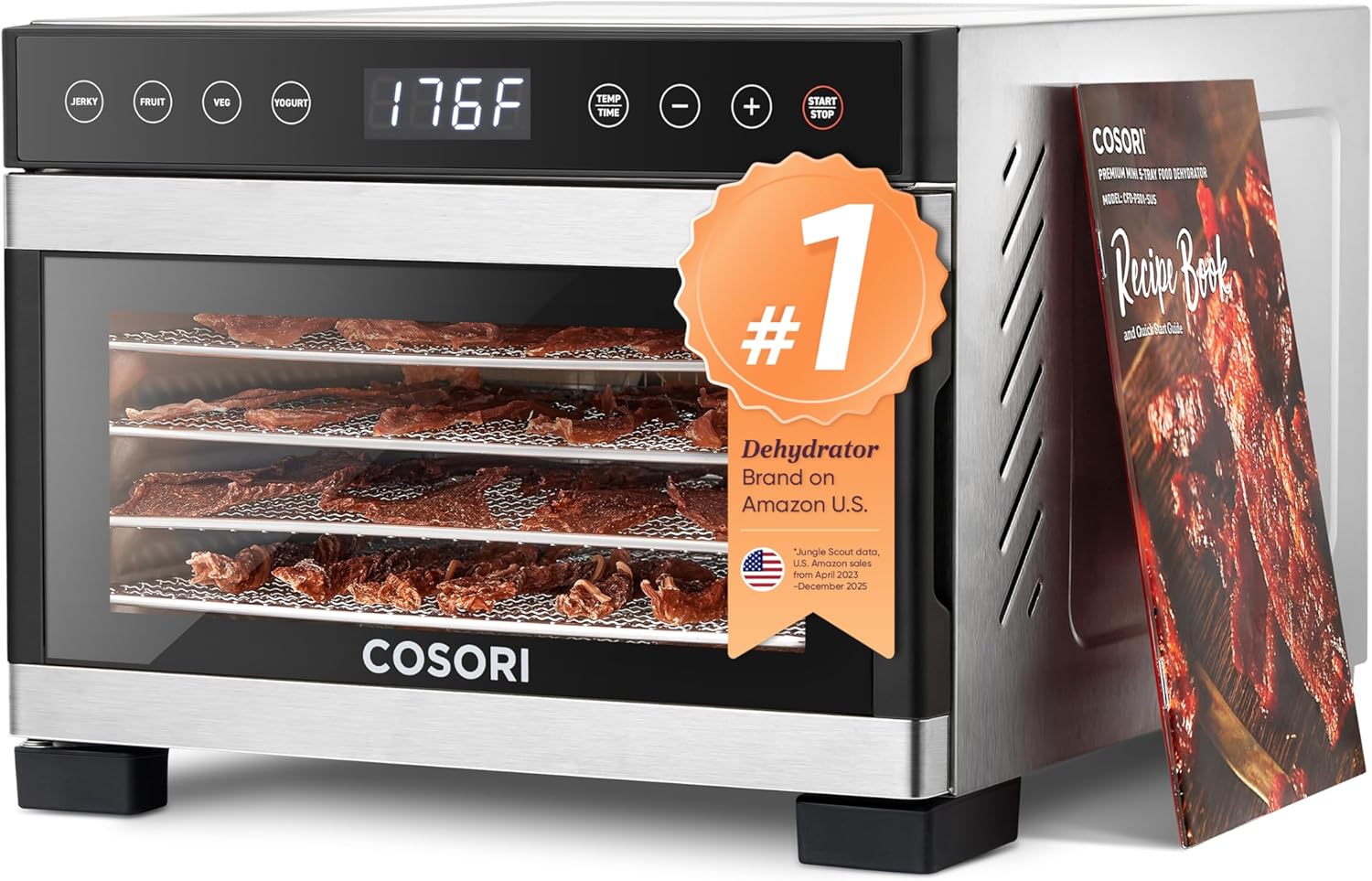
Cosori Stainless Steel Dehydrator P501
| Wattage | 480 watts |
|---|---|
| Voltage | 110 volts |
| Number of Trays | 5 |
| Temperature Range | 95-176 F |
| Operating Frequency | 60 hertz |
The Cosori P501 is a compact stainless steel dehydrator designed for countertop use and small-batch jerky and snack making. It offers five stainless steel trays that provide about 3.1 ft² of drying area and a rear-mounted fan with horizontal airflow to promote even dehydration across trays. Temperature is adjustable from 95 to 176°F in 1°F increments and a 48-hour timer plus four presets simplify common tasks like jerky and fruit leather. Included mesh screen and fruit roll sheet expand what you can dry and there is no plastic contact with food, which is reassuring for long low-temperature runs. At 480 watts the unit reaches safe jerky temperatures reasonably quickly, and the stainless construction cleans more easily than plastic models. The trade-offs are its bench footprint and single-fan design, which is typical at this price and means very large loads may need rotating or longer drying times; it also lacks advanced smart features. For buyers focused on reliable, food-safe jerky drying with precise temperature control, this is a sensible, low-risk choice.
Best for: Buyers who prioritize food-safe materials, precise temperature control, and straightforward preset controls for reliably making jerky and dried snacks at home.
Less Ideal for: People who need very large commercial capacity or remote/smart control features should look at larger or connected units instead.
- Precise temperature control from 95 to 176°F in 1°F increments for safe jerky drying
- Five stainless steel trays and no plastic contact with food for food-safe drying and easier cleaning
- Rear horizontal airflow promotes even dehydration across multiple trays
- Comes with mesh screen, fruit roll sheet, and recipe book for immediate use
- Single-fan design can require tray rotation or longer cycles for very large loads
- No smart connectivity or advanced automation features
Verdict: A practical, food-safe stainless steel dehydrator with precise temperature control and preset jerky programs that removes guesswork for home jerky makers.
Choosing the Right Home Food Dehydrator for Jerky: Key Factors to Consider
Temperature Range and Stability
A reliable temperature range matters because jerky requires consistent low to moderate heat for many hours to dehydrate safely. Narrow temperature swings prevent under-dried spots where bacteria can survive and help avoid overcooking the exterior while the interior remains moist.
Look for a dehydrator that offers manual or digital control with clear markings and minimal fluctuation. Timers and the ability to hold set points for long runs are valuable when you cannot monitor the unit constantly.
Airflow Design and Tray Layout
How air moves through the dehydrator determines how evenly strips of meat dry. Horizontal airflow units can produce more uniform drying across trays, while vertical airflow models often need tray rotation to avoid hot or cool spots.
Tray spacing and the availability of mesh or perforated trays affect how well air circulates around each piece. Consider whether the layout lets you stack extra trays or remove trays for larger cuts without blocking airflow.
Capacity and Batch Size
Capacity matters based on how much jerky you plan to make at once. Larger trays or more stackable tiers reduce the number of dehydrator cycles needed for big batches, while compact units are easier to store and better for occasional use.
Also consider tray dimensions: long, narrow trays may be awkward for slicing uniform strips, while wide trays let you lay out larger pieces flat. Choose a size that matches your typical recipe yield and kitchen storage limits.
Material Safety and Construction
Materials that contact food should resist warping and off-gassing at drying temperatures. Stainless steel or high-heat-rated plastics provide safer long-term performance than low-temperature plastics that can soften or leach odors.
Solid construction also affects cleaning and durability. Hinges, seals, and tray supports should hold up to repeated runs and cleaning cycles without loosening or degrading.
Ease of Cleaning and Maintenance
Because jerky involves raw meat, every surface that touches the product must be easy to clean and sanitize. Removable trays and drip pans that are dishwasher-safe or simple to scrub make post-run cleanup faster and reduce contamination risk.
Consider whether the unit has many small crevices or fixed screens that trap grease. Simpler interior geometry shortens cleaning time and helps you maintain safe food-handling habits.
Controls, Timers, and User Ergonomics
Clear controls and an accurate timer let you run long dehydrating cycles without constant supervision. Digital controls with audible alerts help you maintain consistent processes, while simple knobs offer reliability and fewer failure points.
Ergonomic considerations also include how easy it is to load trays, view progress through a window, and reach controls when the unit is on a counter or in a cupboard.
Preparing Meat for Jerky
Proper preparation starts with trimming visible fat and slicing meat into uniform strips. Fat does not dehydrate well and can become rancid over time, so removing as much as possible improves shelf life and texture.
Marinating and seasoning should be done in a food-safe container and for a duration that matches your recipe. After marinating, pat strips dry before arranging them on trays to avoid excessive drips that lengthen drying time.
- Slice to uniform thickness for consistent drying
- Trim fat to reduce spoilage and greasy texture
- Pat dry before placing on trays to minimize dripping
Safe Drying Temperatures and Food Safety Tips
Maintain a steady drying temperature appropriate for meat to reduce bacterial risk. Using a device with a reliable temperature readout helps ensure internal meat temperatures reach the levels recommended by food-safety guidance during the early phase of drying.
Rotate trays mid-cycle if the unit has known hot spots and use a thermometer when testing initial batches. Cool and store finished jerky in airtight containers once fully dry and allow it to rest to stabilize moisture before sealing.
- Use a probe or oven thermometer to verify temperature stability
- Rotate trays if needed to compensate for uneven airflow
- Store fully dried jerky in airtight containers after cooling
Maximizing Yield Without Sacrificing Quality
To produce more jerky per run, think in terms of efficient tray loading and consistent slicing. Avoid overlapping pieces and make use of additional trays if your unit supports them without blocking airflow.
Batching smaller, evenly sized pieces usually dries more predictably than packing a tray full of varied-sizing strips. If you need faster turnaround, consider thinner cuts or preheating the dehydrator for a short time before loading.
- Avoid overlapping to ensure uniform drying
- Prepare trays in advance to speed loading
- Use consistent slice thickness to reduce variable dry times
Cleaning and Post-Run Care
Clean trays and surfaces promptly after cooling to prevent residue buildup and odors. Removable parts that are dishwasher-safe simplify maintenance, but hand washing with hot, soapy water is usually effective.
Check seals and fan vents regularly for grease accumulation and wipe them down as needed. Proper drying between uses prevents mold and keeps odors from transferring to future batches.
- Wash trays immediately after use, preferably in hot water
- Inspect and clean vents and fan housings occasionally
- Allow all parts to dry completely before reassembly
Troubleshooting Uneven Drying
If some strips finish much sooner than others, first verify that slices are uniform thickness. Next, assess airflow by observing whether the unit has obvious hot or cool zones and rotate trays accordingly.
If uneven drying persists, reduce tray load or rearrange pieces so air circulates around each strip. In some cases, adding a small gap between stacks or removing overloaded trays resolves the issue.
- Check slice uniformity before blaming the machine
- Rotate trays mid-cycle to even out hot spots
- Reduce tray load if airflow seems restricted
How We Chose the Best Home Food Dehydrator for Jerky
We shortlisted devices based on attributes that matter specifically for drying meat. First, temperature control and stability were required because safe jerky needs sustained low- to moderate-heat drying rather than wide temperature swings. Second, airflow design and rack arrangement were considered so strips dehydrate evenly without excess turning. Third, capacity and tray size were important for users who want to batch-cook jerky versus those making occasional small treats. Fourth, ease of cleaning and removable, food-safe surfaces mattered because raw meat handling requires thorough sanitation. Fifth, construction quality and material safety were checked to avoid plastics that degrade at drying temperatures. Finally, we considered user ergonomics such as control readability and whether timers or alarms were provided. We excluded devices intended only for herbs, fruits, or purely decorative uses that do not maintain steady temperatures suitable for meat drying. We also filtered out units lacking clear temperature ranges or with non-food-safe interior finishes. The final selections balance performance, safety-focused features, and practical daily use for jerky makers.
Our full evaluation process is outlined in our review methodology.
FAQ
What temperature should I use to dry jerky?
Many successful jerky recipes use steady, moderate heat in the dehydrator's recommended meat range. Use a model with an accurate temperature control and verify with a thermometer to ensure safe initial heating and consistent drying.
How long does jerky take in a home dehydrator?
Drying time commonly ranges from several hours to more than a day depending on slice thickness, humidity, and airflow. Thinner strips dry faster, and consistent temperatures reduce variability between runs.
Do I need to preheat the dehydrator before loading meat?
Preheating for a short period can help establish a stable temperature and reduce early drying variability, but it is not always required. If you preheat, load trays carefully to avoid temperature drops caused by cold meat.
Can I use the same trays for fruits and meat?
You can, but ensure trays are thoroughly cleaned and sanitized between uses to avoid cross-contamination of flavors and bacteria. Consider reserving specific trays for raw meat if you plan frequent jerky production.
How do I know when jerky is done?
Finished jerky should be dry but still slightly pliable, with no moist spots. Test by removing a piece and letting it cool; if it cracks and crumbles it may be over-dried, while soft or cool interior indicates under-drying.
Final Verdict
Choosing a Home Food Dehydrator for Jerky comes down to prioritizing accurate temperature control, even airflow, and easy-to-clean construction. Decide whether you need large capacity for batch runs or a compact unit for occasional snacks, and weigh tradeoffs such as extra trays versus storage footprint. Focus on models with stable setpoints, food-safe materials, and simple maintenance features to reduce risk and streamline production. With the right balance of those traits, you can produce consistent, safe, and flavorful jerky at home.