
Note: This article contains affiliate links. If you click on these links and make a purchase, we may earn a small commission at no extra cost to you. This helps support our research and content. Read our full affiliate disclosure here.
Choosing the right heated floor thermostat matters for comfort, energy use, and the long-term health of your floor heating system. The wrong controller can lead to uneven warmth, excessive cycling, or inefficient energy consumption, while the right one keeps walking surfaces comfortable and utility bills in check. This guide presents seven top shortlisted heated floor thermostats chosen for accuracy, sensor options, and installation flexibility. Below you will find focused advice on what to look for, how units differ by control method and sensors, and practical considerations for installation and daily use. Use the evaluation criteria to compare controls and pick the right fit for your setup.
Top Picks at a Glance
| Best Overall The best all-around choice for most situations | Nuheat nVent AC0056 Thermostat |  |
| Best Quality Built to a higher standard if you want something more solid | SunTouch ConnectPlus Thermostat |  |
| Best Value The sweet spot between price and what you get | BOWSEN Programmable Thermostat |  |
| Best Budget The cheapest option that still gets the job done reliably | Walfront Electric Floor Thermostat |  |
| Top Rated A top-rated pick with lots of positive feedback | Schluter Ditra-Heat-E-RT Thermostat |  |
| Most Popular A crowd favorite that many people choose with confidence | Honeywell TH115-AF-GA/U Thermostat |  |
| Best Seller A high-volume bestseller chosen again and again | Schluter Ditra-Heat-E-WiFi Thermostat |  |
Nuheat nVent AC0056 Thermostat

| Controller Type | Programmable Touchscreen Thermostat |
|---|---|
| Voltage | 120 volts, 240 volts |
| Display Size | 3.5 inches |
| Included Components | Floor Heat Sensor |
| Protection | Class A GFCI |
The Nuheat nVent AC0056 is a 7-day programmable touchscreen thermostat made specifically for electric radiant floor heating systems. It uses a 3.5-inch color touchscreen and a floor heat sensor to control underfloor temperature, and the early-start scheduling adjusts power-on times so the floor reaches the set temperature by the scheduled time. It supports both 120V and 240V systems and includes Class A GFCI protection for added safety on wet-area installations. The unit offers Wi-Fi and RF connectivity for remote monitoring and energy use tracking, plus diagnostic tests and a setup wizard that simplify commissioning. In practice this thermostat works well for bathrooms, kitchens, and other tiled floors where even warmth and reliable safety controls matter, and the touchscreen makes daily adjustments straightforward. Limitations are typical of dedicated floor thermostats: it controls floor temperature rather than room air temperature and requires correct sensor placement and wiring during installation to perform reliably.
Best for: Buyers who want a purpose-built, programmable thermostat to manage radiant heated floors and value straightforward touchscreen controls, scheduling, and built-in safety features.
Less Ideal for: Those seeking a thermostat that primarily regulates room air temperature or a general-purpose smart thermostat for whole-home HVAC control should consider other types of controllers.
- 7-day programmability with early-start to have floors warm on schedule
- Supports both 120V and 240V floor heating cables for installation flexibility
- Built-in Class A GFCI protection improves safety for bathroom and wet-area installs
- 3.5-inch color touchscreen and setup wizard make programming and diagnostics easier
- Controls floor sensor temperature rather than ambient room temperature
- Requires proper sensor placement and correct wiring during installation
Verdict: Choose the Nuheat nVent AC0056 when you need a dedicated, programmable touchscreen thermostat that safely and reliably controls electric radiant floor heating.
SunTouch ConnectPlus Thermostat

| Connectivity Technology | Wi-Fi |
|---|---|
| Controller Type | Amazon Alexa, Google Assistant |
| Power Source | mains cord (not batteries) |
| Screen Size | 4.3 inches |
| Voltage | 120 volts |
The SunTouch ConnectPlus is a feature-rich smart thermostat designed specifically for electric floor heating zones. It mounts on the wall and uses a 4.3 inch capacitive touchscreen for local control, while the Watts Home app provides remote monitoring, scheduling and energy-use reports. The unit supports both floor and air sensing, warm-weather shutoff and floor maximum temperature protection to safeguard different floor coverings. It also integrates with Amazon Alexa and Google Assistant for voice commands and includes automatic clock setting, weather compensation and notifications. Practical benefits include flexible 7-day programming, away mode and diagnostic tools that make setup and troubleshooting easier for installers and homeowners. Limitations to note are that it is built for single-zone floor heating and requires mains power and proper wiring for GFCI and relay features, so it is not a drop-in replacement for all HVAC thermostats and may need professional wiring for multi-stage or multi-zone systems.
Best for: Buyers who prioritize precise performance and remote control for an electric floor heating zone and want advanced features like energy monitoring and floor protection.
Less Ideal for: Homeowners seeking a multi‑zone controller or a thermostat for whole‑house HVAC systems should look at multi-zone or HVAC-specific solutions instead.
- Dedicated floor and air sensing with max floor temperature protection for safer, more accurate floor warming control
- Wi‑Fi connectivity and Watts Home app for remote scheduling, monitoring and notifications
- 4.3" capacitive touchscreen with portrait or landscape mounting for easy local use
- Compatibility with Amazon Alexa and Google Assistant for simple voice control
- Built-in GFCI and relay designed for 120/240V electric floor systems
- Designed for a single heating zone so not suitable for controlling multiple zones from one unit
- Requires mains wiring and correct relay/load sizing which may need professional installation
Verdict: Choose the ConnectPlus when you want a high-performance, app‑connected thermostat that gives precise, safe control of a single electric floor heating zone.
BOWSEN Programmable Thermostat
| Voltage | 120/240 VAC |
|---|---|
| Wattage | 3600 watts (max at 240V) |
| Connectivity Technology | Wired |
| Display Type | LCD |
| Controller Type | Push Button |
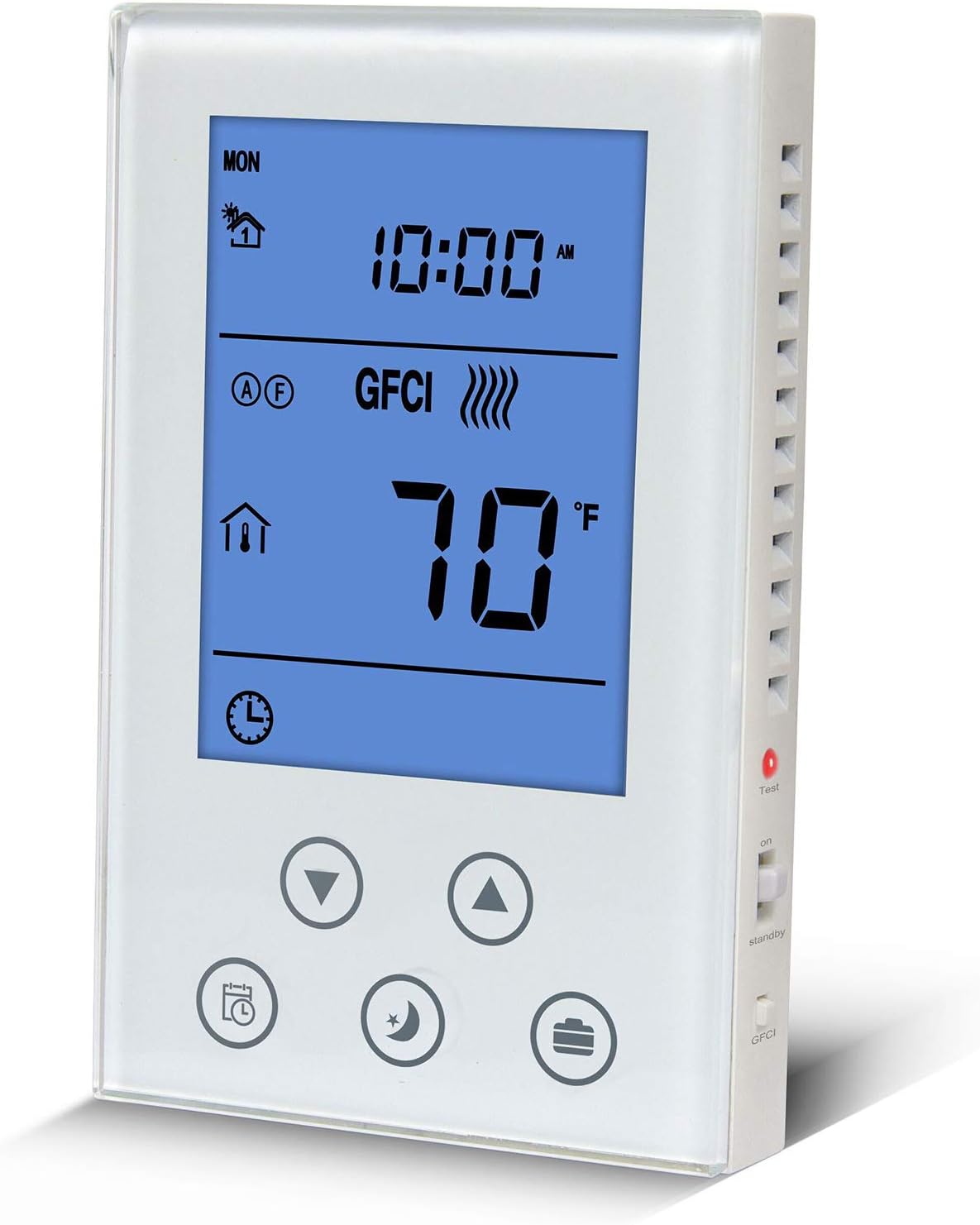
This BOWSEN programmable thermostat is built for electric radiant floor systems and combines a 7-day schedule, dual sensing of floor and air temperatures, and an integrated Class A GFCI for safety. Install it as a wall-mounted controller to manage underfloor heating on either 120V (1800W) or 240V (3600W) circuits; the large backlit LCD and push-button controls make daily adjustments and programming straightforward. The built-in self-testing GFCI adds a layer of protection against ground faults and can be tested via the side toggle, which is useful in wet-room installations or where code requires a protected circuit. Practical features include an on/standby switch to shut down the system for the off-season and a clear alarm if leakage above the threshold is detected. Limitations to note are the wired-only connectivity and reliance on push-button input rather than a touchscreen, and the product requires correct wiring and occasional GFCI resets if leakage is present. For installers and homeowners looking for a straightforward, safety-focused floor thermostat, it covers the essentials without extra smart-home complexity.
Best for: Homeowners or contractors who want a reliable, safety-focused thermostat for electric radiant floors and value straightforward programming and built-in GFCI protection.
Less Ideal for: Buyers seeking a smart, app-controlled thermostat or touchscreen interface should consider alternatives with wireless connectivity and remote control features.
- Dual temperature sensing monitors both floor and air for more accurate comfort control.
- Built-in Class A GFCI with self-test adds electrical safety for wet or floor-heated environments.
- 7-day programmable schedule and backlit LCD let you set daily temperature routines and readouts easily.
- Supports both 120V and 240V systems with up to 3600W load capacity for common residential installations.
- Wired-only control with push-button interface lacks Wi‑Fi or app-based scheduling.
- May require troubleshooting or resets if GFCI repeatedly trips due to leakage, indicating possible wiring or floor cable issues.
Verdict: Choose this thermostat when you need a practical, installer-friendly controller for electric underfloor heating that pairs simple programmable scheduling with built-in GFCI safety.
Walfront Electric Floor Thermostat

| Controller Type | Push Button |
|---|---|
| Additional Features | Auto-Scheduling, Lockable, Programmable, Temperature Display |
| Temperature Control Type | Programmable |
| Connectivity Technology | Wired |
| Display Type | LED |
This Walfront programmable floor heating thermostat is a basic, user-friendly controller for electric underfloor systems. It mounts to the wall and uses both internal and external sensors so you can monitor and control ambient and floor temperature separately, which helps avoid overheating and keeps rooms comfortable. The LED display is bright enough for night viewing and the push-button interface provides straightforward programming with 0.5°C resolution and adjustable hysteresis for tighter cycling control. Safety and convenience features include child lock, power-off memory to retain settings, and a flame-retardant plastic panel. Installation is wired and intended to be simple for standard electric floor systems, and the unit ships with a sensor probe, screws, and a manual. The thermostat is practical for basic zoning and retrofit installs but lacks wireless connectivity or app control and depends on correct wiring for full functionality, so it is best where simple, reliable temperature control is the priority rather than smart-home integration.
Best for: Buyers who want an affordable, no-frills thermostat to reliably control electric underfloor heating and prioritize accurate local sensing and simple wall-mounted controls.
Less Ideal for: If you need wireless smart-home integration, remote scheduling from a phone, or multi-zone cloud management, choose a Wi-Fi enabled model instead.
- Dual internal and external sensors for accurate floor and room temperature monitoring
- Clear LED display with night visibility for easy readout
- Programmable control with 0.5°C accuracy and adjustable hysteresis for stable cycling
- Safety features including child lock and power-off memory preserve settings
- Includes sensor probe and mounting screws for straightforward installation
- Wired-only connectivity with no Wi-Fi or app control
- No advanced scheduling or remote access beyond onboard programming
Verdict: A budget-friendly programmable thermostat that delivers accurate floor and room control for electric heated floors without the complexity of smart-home features.
Schluter Ditra-Heat-E-RT Thermostat

| Display Size | 3.5 inches |
|---|---|
| Voltage | 240 volts |
| Controller Type | Touchscreen |
| Power Source | Corded Electric |
| Connectivity Technology | QR Code |
The Schluter Ditra-Heat-E-RT is a wall-mount thermostat built specifically for Ditra-Heat-E floor heating cables that combines a 3.5" touchscreen, programmable schedules, and an integrated ground fault circuit interrupter for safety. Installers will appreciate that it accepts both 120V and 240V connections and ships with the GFCI, floor sensor, and required cables to tie into in-floor heating circuits. The touchscreen makes daily adjustments and scheduling straightforward, and the unit logs energy usage so homeowners can see runtime and consumption trends. The built-in GFCI removes the need for a separate field-installed device, simplifying compliance and enhancing protection in wet-floor areas. The main limitations are that it is designed for Schluter Ditra-Heat-E systems specifically and lacks wireless connectivity beyond a QR code for settings access, so remote control or smart-home integration is not available. For buyers prioritizing safe, factory-quality control and clear local programming for heated floors, this thermostat delivers a focused, reliable solution.
Best for: Homeowners and installers who want a reliable, factory-quality thermostat for Schluter Ditra-Heat-E floor heating that emphasizes safety and straightforward local programming.
Less Ideal for: Buyers who need remote access, cloud-based control, or a thermostat compatible with non-Ditra-Heat systems should consider other smart or universal models.
- Integrated GFCI improves electrical safety without a separate device
- Programmable touchscreen with 3.5-inch display for easy setup and scheduling
- Supports both 120V and 240V Ditra-Heat-E heating cables for flexible installations
- Energy tracking and logging help monitor and optimize runtime
- No built-in Wi-Fi or direct smart-home integration for remote control
- Intended for Ditra-Heat-E systems only, not a universal floor thermostat
Verdict: Choose this thermostat when you need a dependable, safety-focused controller made specifically for Schluter Ditra-Heat-E heated floors.
Honeywell TH115-AF-GA/U Thermostat

| Controller Type | Digital Programmable |
|---|---|
| Connectivity Technology | Wi-Fi |
| Power Source | AC |
| Voltage | 120 volts |
| Wattage | 3600 |
The Honeywell TH115-AF-GA/U is a wall-mounted, digital programmable thermostat made for electric radiant floor systems that offers three control modes: ambient, floor, or ambient with floor temperature limits. It is typically used to schedule heating across a seven-day cycle and to prevent floors from exceeding a set surface temperature by pairing the thermostat with the included floor sensor. The unit runs on 120/240V line power, provides button-based control with a 1.5-inch digital display, and includes built-in GFCI protection for safer floor-cable installations. Practical benefits include clear scheduling options for different days of the week and the added safety of ground-fault protection, which is important for wet-area floor heating. Limitations are its basic, utilitarian interface without a touchscreen or advanced connectivity beyond simple app control listing, and it is focused solely on direct line-voltage electric floor systems rather than low-voltage or hydronic setups.
Best for: Buyers who prioritize reliable, safety-minded control for electric radiant floor heating and want a programmable thermostat with integrated GFCI and clear scheduling.
Less Ideal for: Do not choose this if you need smart-home ecosystem integration, a touchscreen, or if your heating is low-voltage or hydronic rather than line-voltage electric.
- 7-day programmable scheduling for weekday/weekend or custom day control
- Three selectable control modes including floor sensor limits for surface protection
- Built-in GFCI adds integrated electrical safety for electric floor heating installations
- Simple digital display and button controls that are easy to operate and set up
- No modern smart-home integrations beyond basic app/connectivity listing and no touchscreen interface
- Designed specifically for line-voltage electric floor systems so not suitable for low-voltage or hydronic systems
Verdict: Choose the TH115-AF-GA/U when you need a dependable, programmable line-voltage floor thermostat with built-in GFCI protection for safer electric radiant floors.
Schluter Ditra-Heat-E-WiFi Thermostat

| Connectivity Technology | Wi‑Fi |
|---|---|
| Display Size | 3.5 inches |
| Power Source | Battery Powered (1 AAA) and hardwired |
| Voltage | 240 volts |
The Schluter Ditra-Heat-E‑WiFi is a wall‑mounted touchscreen thermostat made to control electric radiant floor heating systems up to a 15 amp load. It pairs with Schluter heating cables (120V or 240V) and includes a floor temperature sensor so you can set and maintain comfortable surface temperatures with its pre‑set schedule or a custom program. Connect it to your home network to monitor and change settings from the mobile app or integrate with voice assistants. The built‑in Class A GFCI provides an added safety layer for wet‑area installations and the 3.5‑inch color display is easy to read and operate. For larger installations that exceed 15 amps you can add the compatible power module to keep a single control point. Expect a professional electrical install since it must be mounted in an electrical box and hardwired by a qualified electrician. The thermostat focuses on reliable, code‑conscious operation rather than flashy extras, making it a good choice for homeowners who want straightforward control and safety for heated floors.
Best for: Homeowners who prioritize safe, code‑aware control of electric floor heating and want Wi‑Fi remote access and simple scheduling for everyday comfort.
Less Ideal for: People looking for a DIY plug‑and‑play thermostat or those who need to control very large heating loads without adding external power modules.
- Designed specifically for electric radiant floor systems with included floor sensor for accurate surface control
- Wi‑Fi and app control plus voice assistant compatibility for remote adjustments
- Built‑in Class A GFCI adds electrical safety appropriate for wet areas
- Programmable schedules and touchscreen display simplify daily use
- Supports both 120V and 240V cables and can be paired with a power module for larger loads
- Requires professional hardwired installation in an electrical box; not a simple drop‑in replacement
- Max single‑thermostat load is 15 amps without adding a power module
Verdict: Buy this thermostat if you want a safety‑focused, app‑controllable thermostat built specifically to manage Schluter electric radiant floor systems.
Choosing the Right Heated Floor Thermostat: Key Factors to Consider
Temperature Measurement Method
Where and how temperature is measured has a direct effect on comfort and control responsiveness. Some thermostats use a floor sensor only, which measures surface temperature and prevents overheating of finishes. Others use an ambient air sensor, or both, letting you balance floor warmth and room air temperature. Floor sensors typically sit in a conduit beneath the flooring surface, providing steady readings but slower response. Ambient sensors react faster to changes in room conditions, which can be helpful when you need quick adjustments.
Understanding the measurement method matters because floor heating recovers slowly; a thermostat that reads surface temperature will avoid overshoot but may require different set points than an air-based controller. If you have temperature-sensitive flooring, prioritize accurate floor sensing and a thermostat that supports calibration of the sensor.
Control Logic and Algorithms
The thermostat's control strategy determines how it maintains target temperatures. Basic on/off thermostats switch power at fixed thresholds and are simple to set up, but they can cause frequent cycling and wider temperature swings. More advanced units use proportional-integral-derivative style control, adaptive learning, or predictive recovery, which smooth power output and reduce overshoot.
For underfloor systems, smoother control reduces thermal stress on flooring materials and improves energy efficiency. Look for thermostats with adjustable cycle periods, hysteresis settings, or adaptive recovery to match the thermal inertia of your floor assembly.
Wiring and Installation Requirements
Installation ease and compatibility with your existing wiring are major practical concerns. Thermostats vary in required power sources, relay ratings, and whether they need neutral wires or external relays for high-current loads. Some controllers integrate relays rated for typical electric floor loads, while others require a separate contactor or relay for higher-capacity circuits.
Consider whether the thermostat supports the sensor type you have, fits standard electrical boxes, and offers clear wiring diagrams. If you are retrofitting, choose a unit with flexible wiring options and accessible technical documentation to minimize installation time and potential rework.
User Interface and Scheduling
How you set temperatures and schedules affects daily convenience and energy use. A straightforward interface with clear buttons or a responsive touchscreen makes routine adjustments painless. Scheduling features let you program lower temperatures for night or away periods and higher temperatures for occupied times, which leads to energy savings without sacrificing comfort.
Some thermostats include simple preset schedules while others offer multi-event daily programming, vacation modes, or smartphone connectivity. Choose an interface that matches your comfort habits and the complexity you are willing to manage.
Sensor Placement and Length
The physical placement and cable length of the floor sensor influence both reading accuracy and installation flexibility. Floor sensors should be embedded at the correct depth and location to read a representative temperature for the heated area. A sensor installed too close to a heat source or edge may report skewed temperatures, causing poor control behavior.
Longer sensor leads provide more routing options and easier access to the thermostat location but may add installation complexity if not neatly managed. Confirm that the thermostat supports the sensor resistance and type you plan to use and that replacement sensors are available from common sources.
Safety Features and Certifications
Safety features such as maximum floor temperature limits, ground-fault protection compatibility, and proper relay ratings are essential when dealing with electric floor heating. Thermostats should offer configurable maximum floor temperature limits to protect flooring materials and prevent overheating. Additionally, compatibility with GFCI or residual current devices ensures electrical safety in wet or high-humidity areas.
Look for units that clearly document safety settings and compliance with relevant residential electrical standards. These features reduce risk during long-term operation and may be required by local electrical codes.
Wiring Scenarios and Installer Tips
Plan the wiring before you buy. Identify whether your electrical feed will be routed through the thermostat box and confirm relay ratings match the circuit load. For higher amperage circuits, you may need an external contactor controlled by the thermostat.
When running floor sensor wiring, avoid bundling sensor cables with power conductors to reduce electrical noise. Label both ends of each sensor and test continuity before finishing the floor to make post-install troubleshooting simpler.
- Verify relay ampacity and whether a neutral wire is required
- Route sensor cable away from heat sources and high-current wiring
- Use conduit for sensor placement under tile or stone floors
- Test the sensor in-place before final floor installation
Matching Thermostat Settings to Floor Construction
Different floor assemblies have different thermal response times. Thin floor coverings over plywood reach setpoints faster than thick stone slabs. Adjust cycle period and hysteresis settings to match how quickly your floor warms and cools.
If your thermostat supports separate floor and air setpoints, use the floor sensor to protect delicate finishes and the room sensor to maintain perceived comfort. In many setups a slightly lower floor setpoint with an air-based comfort target achieves good results.
- Short cycle periods for fast-responding floors
- Longer cycles and adaptive control for high thermal mass floors
- Use calibration features to correct sensor offsets
Energy-Saving Strategies with Heated Floors
Underfloor heating can be energy efficient when controlled intelligently. Favor thermostats with programmable schedules and adaptive recovery to avoid heating an empty home. Lowering floor setpoints during sleep or away periods yields steady savings without sacrificing comfort.
Consider using setback schedules rather than large, frequent temperature swings. Because floors heat slowly, large setpoint changes can require long recovery periods that consume more energy. Small, consistent setbacks are usually more efficient.
- Use multi-event daily programming for occupancy patterns
- Enable adaptive recovery if available to reach setpoints efficiently
- Prefer modest setback temperatures to reduce recovery load
Sensor Types and Placement Best Practices
Choose a sensor type supported by your control unit and compatible with your floor finish. Most installations use a floor probe in conduit placed at a mid-point of the heated area, away from edges and localized heat sources. For spot-controlled zones, place the sensor where typical foot traffic occurs to reflect real-use temperatures.
Ambient sensors should be mounted at typical thermostat height and away from drafts or direct sunlight. If both floor and ambient sensors are used, follow manufacturer's guidance for which sensor takes priority under different modes.
- Embed floor probes in conduit for future replacement
- Avoid sensor placement near doors or windows
- Place sensors where they represent typical room conditions
Retrofitting Considerations for Existing Floors
When retrofitting thermostat control to an existing heated floor, determine whether the existing sensor and wiring are compatible. In many cases, replacing an old controller with a modern thermostat improves scheduling and accuracy without changing the heating elements.
If the original installation lacks a floor sensor, you may need to install conduit and a new probe during a renovation. Plan for routing and access to minimize floor disturbance and coordinate with flooring contractors if applicable.
- Confirm sensor type and resistance before replacement
- Plan conduit runs before laying new floor finishes
- Test new control behavior with the floor at operating temperature
How We Chose the Best Heated Floor Thermostat
We focused on technical accuracy, installation flexibility, user controls, reliability, and efficiency when selecting thermostats for this list. Accuracy matters because floor heating responds slowly and small temperature offsets produce noticeable comfort differences. We prioritized units with proven temperature measurement approaches and clear calibration options. Installation flexibility was another filter. We preferred thermostats that support common wiring configurations, separate floor and ambient sensors, and easy in-wall mounting. Control options were evaluated for precision and convenience, including simple thermostats with programmable schedules and models with advanced PID or adaptive control logic. Durability and reliability in typical home environments guided our choices, with attention to robust relay designs and quality sensor wiring. Energy-related features such as adaptive recovery, scheduling, and minimum cycle times were considered because they affect both comfort and long-term operating cost. We excluded controllers intended only for radiant hydronic manifolds or industrial floor systems, and we did not include basic on/off wall switches that lack temperature sensing. The final list emphasizes thermostats suited to electric underfloor warming and similar residential installations.
Our full evaluation process is outlined in our review methodology.
FAQ
Do I need a floor sensor or is an air sensor enough?
It depends on your priorities. A floor sensor prevents overheating the floor surface and is best for temperature-sensitive finishes. An air sensor provides faster response for perceived room comfort. Many installations use both to balance surface protection and ambient comfort.
Can I replace my old thermostat with a modern controller?
Often yes, provided the new thermostat supports your wiring and load requirements. Check relay ampacity, whether a neutral is required, and sensor compatibility. For high-current circuits you may need an external contactor.
How should I set schedules for efficiency?
Use modest setbacks during sleep and away periods and avoid drastic temperature swings. Program multiple daily events to match occupancy and enable adaptive recovery when available to reach setpoints more efficiently.
What safety features should I look for?
Look for configurable maximum floor temperature limits, compatibility with ground-fault protection, and appropriately rated relays. Clear documentation of safety settings and compliance with residential electrical standards is also important.
Will a smart thermostat save energy with underfloor heating?
Smart features can help by enabling precise schedules, remote control, and adaptive recovery, but savings depend on usage patterns and how well the control matches the floor's thermal characteristics. Intelligent scheduling usually yields the biggest efficiency gains.
Final Verdict
Prioritize thermostats that match your floor type and installation constraints. Temperature measurement method, control algorithm, and wiring compatibility will determine how comfortable and efficient your heated floor performs. Balance precision with installer needs and safety settings to protect flooring materials. Focus on reliable sensor placement, appropriate control logic for your thermal mass, and scheduling features that fit your daily routine. With those tradeoffs in mind you can confidently choose a heated floor thermostat that provides consistent comfort and reasonable operating costs.