
Note: This article contains affiliate links. If you click on these links and make a purchase, we may earn a small commission at no extra cost to you. This helps support our research and content. Read our full affiliate disclosure here.
Choosing the right indoor thermostat affects comfort, energy use, and how easily you manage temperature across your home. The right unit gives dependable temperature sensing, integrates with existing heating and cooling equipment, and offers controls that match how you live. This guide shortlists the top pick thermostats for typical household setups and evaluates each on accuracy, compatibility, and ease of use. Read on to see the shortlisted options and the criteria we used to evaluate them.
Top Picks at a Glance
| Best Overall The best all-around choice for most situations | Honeywell Home X2P Programmable Thermostat RTH20B |  |
| Best Quality Built to a higher standard if you want something more solid | Honeywell Home RTH6580WF Wi‑Fi Thermostat |  |
| Best Budget The cheapest option that still gets the job done reliably | Aowel AW701 Thermostat |  |
| Top Rated A top-rated pick with lots of positive feedback | ecobee Smart Thermostat Essential |  |
| Most Popular A crowd favorite that many people choose with confidence | Google Nest Thermostat |  |
| Best Seller A high-volume bestseller chosen again and again | Riseem S3001 Nonprogrammable Thermostat |  |
Honeywell Home X2P Programmable Thermostat RTH20B

| Compatibility | Single‑Stage, 1 Heat/1 Cool |
|---|---|
| Scheduling | 5‑2 day or non‑programmable option |
| Power Source | 2 AA batteries (C‑wire supported, 24 VAC) |
| Display Type | Backlit LCD |
| Control Type | Touchpad touch controls |
The Honeywell Home X2P (RTH20B) is a straightforward programmable thermostat for single‑stage 1 heat/1 cool systems that brings basic scheduling and clear controls to an entry to mid‑level installation. It is typically wall mounted and powered by two AA batteries while also supporting a C‑wire for continuous 24 VAC power. The unit offers 5‑2 day scheduling (with non‑programmable option), a large backlit LCD for easy reading, touchpad controls, and optional reminders for filter changes and humidity monitoring. Installation is simplified if you use Honeywell's UWP wall plate, and the interface is geared toward users who want set‑and‑forget temperature control rather than advanced smart home integration. Limitations include support only for single‑stage systems and no built‑in advanced Wi‑Fi features beyond the basic connectivity notes, so it is not suited for complex multi‑stage HVAC setups or users seeking app‑first climate control. For straightforward homes that need dependable programmable scheduling, this thermostat covers the essentials reliably.
Best for: Buyers who want a reliable, easy‑to‑use programmable thermostat that simplifies daily temperature control with straightforward scheduling and clear on‑unit controls.
Less Ideal for: Homes with multi‑stage HVAC systems, advanced zoning needs, or buyers who want full-featured smart thermostat app control and integrations.
- Clear, backlit LCD with large font for easy daily use
- 5‑2 day scheduling with non‑programmable option for simple set‑and‑forget control
- Filter change reminders and selectable display settings for maintenance and customization
- Works with standard single‑stage heating and cooling systems and supports C‑wire power
- Limited to single‑stage HVAC systems and not suitable for multi‑stage or zone control
- No advanced smart features or full app ecosystem for remote control beyond basic connectivity notes
Verdict: A dependable, user‑friendly programmable thermostat that delivers straightforward 5‑2 day scheduling and clear on‑device controls for single‑stage homes.
Honeywell Home RTH6580WF Wi‑Fi Thermostat

| Connectivity Technology | Wi-Fi |
|---|---|
| Power Source | Corded Electric |
| Voltage | 24 volts |
| Display Type | LED |
| Number of Batteries | 2 AA batteries required. |
The Honeywell Home RTH6580WF is a Wi‑Fi 7‑day programmable thermostat designed to replace a conventional wall thermostat and give you remote control from a smartphone or voice assistant. Install it as a DIY upgrade to control heating and cooling schedules for furnaces, heat pumps and central AC systems; the unit requires a C‑wire. Everyday use centers on the large backlit LED display and the Total Connect Comfort or Honeywell Home app, where you can program four time periods per day, set temporary holds, and adjust settings on the go. Integration with Alexa and Google Assistant makes simple voice commands possible, and Smart Response technology estimates cycle times to reach target temperatures more consistently. As an ENERGY STAR certified model it can support utility programs for additional savings. Limitations to note are the need for a C‑wire and lack of compatibility with electric baseboard heat, and the interface is functional rather than touchscreen modern. For buyers who want dependable scheduling, remote access, and basic smart features without a steep learning curve, this thermostat delivers sensible performance.
Best for: Buyers who prioritize reliable temperature control and remote scheduling for central heating and cooling systems and want straightforward smart-home integration.
Less Ideal for: Homes that rely on electric baseboard heating or owners who need a touchscreen color display and advanced remote sensors.
- Remote control via Honeywell/Total Connect Comfort app for changes on the go
- Works with voice assistants like Amazon Alexa and Google Assistant
- 7‑day flexible programming with large backlit display for easy local control
- ENERGY STAR certified and includes Smart Response technology for more consistent comfort
- Requires a C‑wire for power so older homes may need an adapter
- Not compatible with electric baseboard (120–240V) heating systems
Verdict: Choose this Honeywell if you want a practical, energy‑aware Wi‑Fi thermostat that gives dependable remote scheduling and voice control for central HVAC systems.
Aowel AW701 Thermostat

| Power Source | Battery Powered |
|---|---|
| Temperature Control Type | Heating and Cooling |
| Compatibility | Conventional single-stage systems (1H/1C) |
| Display Type | LCD, blue backlit |
| Connectivity Technology | RH/RC, C, W, Y, G |
The Aowel AW701 is a straightforward non-programmable thermostat designed for single-stage 1 heat/1 cool central systems. It provides basic temperature and humidity readouts on a clear blue backlit LCD and uses 2 AAA batteries so most installations do not require a common wire. Primary controls are large push buttons and the unit includes technician-adjustable heating and cooling swing, temperature calibration, and an optional 3-minute compressor delay to protect equipment. The universal sub-base and labeled terminals make wiring simple for DIY replacement of older thermostats, and the low-battery indicator and easy-access battery compartment reduce maintenance hassle. Limitations include no scheduling or smart-home integration despite a listed connectivity protocol, and it is incompatible with multistage, heat-pump, line-voltage, and many specialty systems, so it only fits conventional single-stage setups. For buyers wanting a basic, visible, and easy-to-install thermostat on a tight budget, the AW701 covers essentials without extras.
Best for: Buyers who need a low-cost, no-frills replacement thermostat for a conventional single-stage central heating and cooling system and value simple installation and an easy-to-read display.
Less Ideal for: Those who want programmable schedules, smartphone control, or support for multistage or heat-pump HVAC systems should look at more advanced models.
- Simple, easy-to-read blue backlit LCD with temperature and humidity display
- Battery powered with no C-wire required for most installations
- Universal wall-mount sub-base and clearly labeled terminals for straightforward DIY wiring
- Adjustable heating/cooling swing and temperature calibration for fine control
- Selectable 3-minute compressor delay to protect HVAC equipment
- Non-programmable with no scheduling or advanced smart-home features
- Not compatible with multistage systems, heat pumps, or line-voltage baseboard heating
Verdict: Aowel AW701 is a budget-friendly, easy-to-install thermostat that provides clear temperature and humidity readouts for conventional single-stage systems.
ecobee Smart Thermostat Essential

| Connectivity Technology | Wi-Fi |
|---|---|
| Power Source | Battery Powered |
| Display Type | LCD |
| Control Type | Touchpad Control |
| Compatibility | Works with Apple HomeKit, Google Assistant, Alexa |
The ecobee Smart Thermostat Essential is a pared-down smart thermostat that focuses on reliable temperature control and energy savings without extra bells. It mounts to the wall and connects over Wi‑Fi so you can change setpoints from the color touchscreen or the ecobee mobile app, and it works with Siri, Alexa, and Google Assistant for voice control. Built-in eco+ features like schedule assistant, indoor humidity detection, and time-of-use preconditioning help reduce energy use, and the unit is Energy Star certified. Installation is designed for DIY, and ecobee provides a compatibility checker and an optional Power Extender Kit for homes without a C-wire. The Essential supports most 24 VAC HVAC systems and can work with optional SmartSensors to manage temperature in remote rooms. Trade-offs are that it is a basic model compared with higher-end ecobee units — it lacks some advanced sensors and on-device extras — but for steady daily use it delivers dependable remote scheduling, straightforward controls, and modest energy savings.
Best for: Buyers who prioritize a dependable, easy-to-install smart thermostat that integrates with major voice assistants and focuses on steady energy savings rather than advanced extras.
Less Ideal for: Users who want the most feature-rich ecobee option with built-in room sensors, air quality monitoring, or advanced on-device functionality should consider a higher-tier model.
- Wi‑Fi connectivity with app and voice assistant control for remote adjustments
- Energy Star certified with eco+ features to reduce heating and cooling usage
- Easy DIY wall-mount installation with compatibility checker and optional PEK for no C‑wire setups
- Clear color touchscreen for simple local control
- Fewer built-in sensors and premium features than higher-end ecobee models
Verdict: A reliable, straightforward smart thermostat that delivers remote control, voice integration, and energy-saving features for buyers who want dependable performance without premium extras.
Google Nest Thermostat
| Connectivity Technology | Bluetooth, Wi-Fi |
|---|---|
| Power Source | Battery Powered |
| Display Type | LCD |
| Control Type | Remote Control, Voice Control |
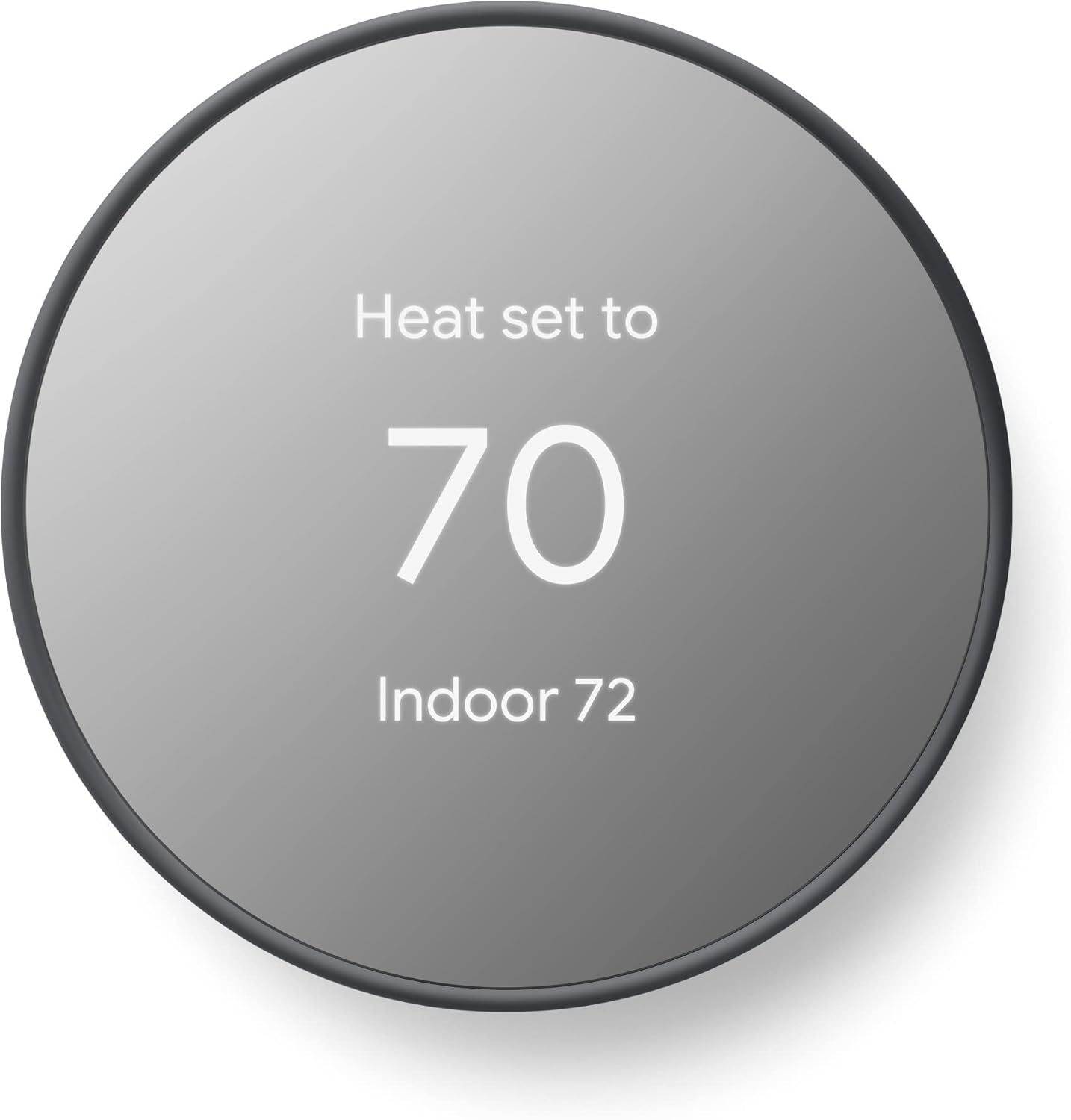
The Google Nest Thermostat is a compact smart thermostat that replaces a traditional wall unit and lets you control heating and cooling from the Google Home app or voice assistants. It is typically used to create schedules, set Eco Temperatures when the house is empty, and receive HVAC alerts that can flag potential issues. Key features include Wi‑Fi and Bluetooth connectivity, app and voice control, a small 2-inch LCD display with a touch bar for local adjustments, and battery power with two A batteries included. Practical benefits are straightforward setup designed for DIY installation in about 30 minutes, remote temperature control from anywhere, and automated suggestions from Savings Finder to help reduce energy use. The thermostat works without a C wire in many homes but may require a C wire or power accessory for certain HVAC systems, and some advanced features depend on working internet and compatible voice devices. It also focuses on energy-saving automation rather than learning highly detailed personal routines, which keeps it simpler but less customizable than higher-end learning thermostats.
Best for: Buyers who want an affordable, easy-to-install smart thermostat that provides app and voice control and focuses on energy savings rather than advanced learning behavior.
Less Ideal for: People who need deep, automatic learning of complex routines or who prefer a thermostat guaranteed to work on every specialized HVAC configuration without additional wiring.
- Remote control and scheduling via Google Home app for on-the-go adjustments
- Energy-saving features like Eco Temperature and Savings Finder that suggest schedule tweaks
- Works with voice assistants and Matter-certified platforms for hands-free control
- Designed for quick DIY installation and includes mounting hardware and batteries
- May need a C wire or power accessory for some HVAC systems
- Relies on internet and compatible voice devices for some remote and voice features
Verdict: A cost-conscious smart thermostat that delivers easy DIY setup, app and voice control, and practical energy-saving features for most homes.
Riseem S3001 Nonprogrammable Thermostat

| Controller Type | Push Button |
|---|---|
| Temperature Control Type | Conventional Single Stage Systems |
| Power Source | 24VAC (with battery backup) |
| Display Type | LCD |
The Riseem S3001 is a straightforward wall-mounted thermostat designed for single-stage heat/cool systems. It offers a clear backlit LCD, push-button controls, and both 24VAC power input plus 2x AA battery backup so it keeps settings during power interruptions and often does not require a common wire. Installation is aimed at DIYers with a universal sub-base and large terminal blocks that the manufacturer says can be wired in about 30 minutes for compatible systems. The thermostat supports separate heating and cooling swing adjustments to help stabilize cycling and can maintain temperature accuracy to about plus or minus 1 degree F. It does not offer programming, Wi-Fi, or multi-stage and heat-pump compatibility, so it is best used as a simple replacement or for homes that only need manual temperature control. If you want a basic, reliable device that is easy to install and operate, this unit covers the essentials without extra features.
Best for: Buyers who want a simple, dependable room thermostat to replace a basic factory unit and prefer a no-frills device that is easy to install and operate.
Less Ideal for: Users seeking smart connectivity, scheduling, or support for multi-stage or heat pump systems should choose a different model with those capabilities.
- Simple push-button interface with backlit LCD for easy daily use
- Dual power options (24VAC or 2 AA batteries) so it works without a C-wire in many setups
- Designed for quick DIY install with universal sub-base and large terminal blocks
- Accurate temperature control to about +/-1°F and separate heat/cool swing adjustment
- Nonprogrammable with no smart/Wi-Fi features for remote control or scheduling
- Not compatible with multistage systems, heat pumps, mini splits, or high-voltage baseboard setups
Verdict: Choose the Riseem S3001 when you want an easy-to-install, reliable nonprogrammable thermostat for a single-stage heating and cooling system.
Choosing the Right Indoor Thermostat: Key Factors to Consider
Temperature Accuracy & Sensor Placement
Accurate temperature sensing determines whether your home actually reaches the setpoint you expect. A thermostat that measures poorly or is placed near heat sources, drafts, or direct sunlight will cycle the HVAC improperly and cause discomfort. Consider whether the unit uses a single internal sensor, offers remote sensors for different rooms, or supports averaging across sensors.
Sensor placement affects performance. Install the thermostat on an interior wall away from vents, windows, and appliances. If you need whole-home balance, choose a thermostat that supports remote sensors or room averaging so living spaces and bedrooms maintain consistent temperatures.
System Compatibility And Wiring
Thermostats must match your HVAC system type and wiring to control heating and cooling correctly. Confirm support for your system: single-stage heat/cool, multi-stage heat or cooling, heat pumps, and whether your system requires a common C-wire for power. Some modern units need a C-wire or a power adapter; others work around missing C-wire setups but may offer limited features.
Understanding your furnace or air handler wiring prevents installation headaches. If you have a multi-zone or multi-stage system, select a thermostat that expressly lists compatibility with the same number of stages and the same control signals to avoid incomplete control or additional interface modules.
Control Interface And Connectivity
How you interact with the thermostat impacts daily convenience. Options include a physical touchscreen or buttons, mobile app access, and voice control through smart home systems. Evaluate whether you want cloud-based features or prefer local controls for privacy and reliability.
Connectivity also affects remote access, scheduling, and firmware updates. Wi-Fi-enabled thermostats offer mobile control and remote temperature monitoring. Check whether the thermostat supports the smart home platforms you already use and whether the app offers straightforward scheduling and overrides.
Energy Management And Scheduling
Energy-related features can reduce utility bills and align comfort with occupied periods. Look for flexible scheduling, geofencing, and adaptive or learning modes that adjust setpoints based on habits. Some thermostats provide energy reports or estimated savings so you can track the impact of changes.
Consider how automated features interact with manual overrides. A thermostat that aggressively changes schedules can be annoying if it ignores short manual adjustments. Choose a product with clear controls for enabling or pausing energy-saving modes when needed.
Installation And Maintenance
Installation complexity varies from simple mount-and-connect jobs to setups that need an adapter, extra wiring, or professional assistance. Check whether the thermostat supports standard mounting hardware and whether the manufacturer provides clear wiring diagrams and in-app guidance. If you are replacing an old unit, compatibility with existing wall plates and wiring reduces installation time.
Maintenance considerations include battery replacement, firmware updates, and cleaning. Thermostats with rechargeable batteries or line power reduce battery hassles, while regular firmware updates can add features and security improvements over time.
User Interface And Accessibility
The clarity of the user interface affects day-to-day adjustments. A readable display and intuitive menu structure make setpoint changes and scheduling easier for all household members. Consider whether the display is backlit for low-light viewing and whether the touch targets are large enough for quick use.
Accessibility also includes language options, contrast settings, and whether the companion app mirrors the on-device controls. If multiple people will manage the thermostat, check for multi-user access and permission levels to prevent accidental schedule changes.
Wiring Scenarios And What They Mean
Before buying, identify your thermostat wiring colors and the functions they serve. Common wires include R or Rh for power, W for heating call, Y for cooling call, G for fan, and C for common power. If you have a heat pump, you may also see O or B for reversing valves.
Knowing the exact wires helps determine if a thermostat needs an adapter or if it will support all system features. For instance, missing a C-wire often limits continuous power to Wi-Fi radios and advanced features, though there are solutions to bridge that gap.
- Label each old wire before removal and photograph the terminal block.
- If you see more than five wires, you likely have multi-stage or supplemental systems.
- Use manufacturer wiring guides to map wires to the new thermostat terminals.
Remote Sensors: When They Help
Remote temperature sensors are useful when the thermostat location does not represent the typical living areas, such as corridors or rooms with unrepresentative heat loads. Adding remote sensors lets the thermostat average temperatures or prioritize a specific room.
Consider how many sensors you need and where to place them. Sensors are helpful for multi-bedroom homes or open-plan spaces where a single sensor cannot reflect comfort across all zones.
- Use sensors in bedrooms to ensure sleep-time comfort.
- Place sensors away from direct sunlight and heat sources.
- Check battery life and mounting options for remote sensors.
Schedules, Learning Modes, And Practical Use
Thermostat scheduling ensures comfort during occupied hours and energy savings during absences. Basic schedules let you set temperature setpoints across the day, while learning modes adapt automatically based on observed behavior. Consider whether you prefer manual schedules or a learning approach that gradually shapes itself to routines.
In practice, learning modes reduce the need to manage schedules but may take days to adapt. Make sure the thermostat allows easy manual overrides and has clear feedback on upcoming automatic changes so you are never surprised by an unexpected setpoint shift.
- Use geofencing sparingly to avoid false triggers based on brief absences.
- Combine schedules with temporary hold functions for unusual days.
- Review energy reports periodically to tweak setpoints for savings.
Security And Firmware Updates
Connected thermostats are networked devices, so security and timely firmware updates matter. Regular updates patch vulnerabilities and improve features. Check whether the manufacturer issues frequent updates and whether updates occur automatically or require user initiation.
Network security practices, such as strong router passwords and guest networks for IoT devices, help protect thermostats from unauthorized access. Consider the privacy policy around data collected for energy reporting or learning features.
- Prefer devices that support secure Wi-Fi standards and encrypted connections.
- Isolate thermostats on a separate IoT network if possible.
- Review the update history if available to understand maintenance cadence.
Accessibility And Multiuser Management
Households often need multiple people to manage temperature. Look for thermostats that support multiple user accounts, each with appropriate permissions. Clear on-device controls combined with a companion app make it easy for everyone to adjust comfort without disrupting schedules.
Accessibility features such as large fonts, voice control support, and simple menus reduce friction for elderly or visually impaired users. Confirm that the device offers localized language support if needed.
- Enable family or guest accounts with view-only or limited control when available.
- Use voice control where hands-free operation is helpful.
- Check for physical controls that remain functional without app access.
How We Chose the Best Indoor Thermostat
We prioritized thermostats that deliver accurate temperature sensing and reliable control across common home heating and cooling setups. Key editorial filters included compatibility with standard HVAC systems, including conventional furnaces, heat pumps, and multi-stage equipment, and whether the thermostat supports common wiring configurations. We evaluated ease of setup and daily use, focusing on intuitive interfaces and available remote-control options such as app or voice-based control. Energy management features were a separate criterion, including scheduling flexibility, learning modes, and measurable energy-saving functions. Build quality and long-term reliability were considered based on available specifications and manufacturer feature sets. We excluded specialty commercial controllers, industrial HVAC equipment, and devices that require proprietary wiring not typical in residential installations. Our list emphasizes products that balance precise temperature control, broad compatibility, and straightforward operation.
Our full evaluation process is outlined in our review methodology.
FAQ
Do I always need a C-wire for a modern thermostat?
Often modern thermostats require a C-wire for continuous power to run Wi-Fi radios and advanced features. Some units provide alternative power options or adapters, but these can limit functionality or require additional installation steps.
Can a smart thermostat control a heat pump?
Usually smart thermostats support heat pumps, but you must confirm support for your specific heat pump configuration and reversing valve wiring. Ensure the thermostat lists heat pump compatibility and the number of compressor stages it can manage.
How do remote temperature sensors affect comfort?
Remote sensors let the thermostat measure temperature where people spend most time rather than only at the thermostat location. They improve comfort balance in multi-room homes, especially when the thermostat is in an unrepresentative spot.
Will a thermostat learning mode save energy automatically?
Learning modes can save energy by adapting schedules to actual occupancy patterns, but savings depend on household routines and how aggressively the algorithm adjusts setpoints. Manual tuning and reviewing energy reports often produce the best results.
Is professional installation required?
Not always. Many homeowners can install a thermostat with a basic understanding of wiring and manufacturer instructions. Professional installation may be wise for complex systems, multi-stage setups, or when unfamiliar wiring is present.
How often should I update thermostat firmware?
You should apply firmware updates as they become available. Regular updates improve security and can add new features. Whether updates are automatic or manual depends on the device.
Final Verdict
Focus on match between your HVAC wiring and the thermostat features, prioritize accurate sensing and the control methods you will actually use, and factor in energy-management tools if savings matter. Tradeoffs include simpler installations versus richer connectivity and automation. Choose a thermostat that fits your system type, supports the sensors or schedules you want, and offers an interface that household members will use consistently.