
Note: This article contains affiliate links. If you click on these links and make a purchase, we may earn a small commission at no extra cost to you. This helps support our research and content. Read our full affiliate disclosure here.
If you collect wine or need dependable long-term storage, a high-end freestanding wine cooler is one of the most important investments you can make. The right cooler stabilizes temperature and humidity, reduces vibration, and protects labels and corks so bottles age as intended. This guide covers seven shortlisted options that represent the top choices in the high-end freestanding category, selected for their control, capacity, and build quality. Below you will find the evaluation criteria we used and practical notes to help match a cooler to your space and cellar goals.
Top Picks at a Glance
| Best Overall The best all-around choice for most situations | ORYMUSE 24 Inch Wine Fridge HXYC510A |  |
| Best Quality Built to a higher standard if you want something more solid | Zephyr Presrv 24" Wine Fridge |  |
| Best Value The sweet spot between price and what you get | Ca'Lefort 24" Wine Fridge CLF-WS24 |  |
| Best Budget The cheapest option that still gets the job done reliably | Koolatron 10 Bottle Wine Cooler |  |
| Top Rated A top-rated pick with lots of positive feedback | Velieta 24-Inch Wine Cooler KMHJ510 |  |
| Most Popular A crowd favorite that many people choose with confidence | Ivation 18-Bottle Wine Cooler |  |
| Best Seller A high-volume bestseller chosen again and again | Ivation 12-Bottle Wine Cooler |  |
ORYMUSE 24 Inch Wine Fridge HXYC510A
| Capacity | 15.8 cubic feet |
|---|---|
| Bottle capacity | 200 Bottles |
| Temperature range | 40-65°F (5-18°C) |
| Cooling method | Compressor |
| Installation Type | Built-In or Freestanding |
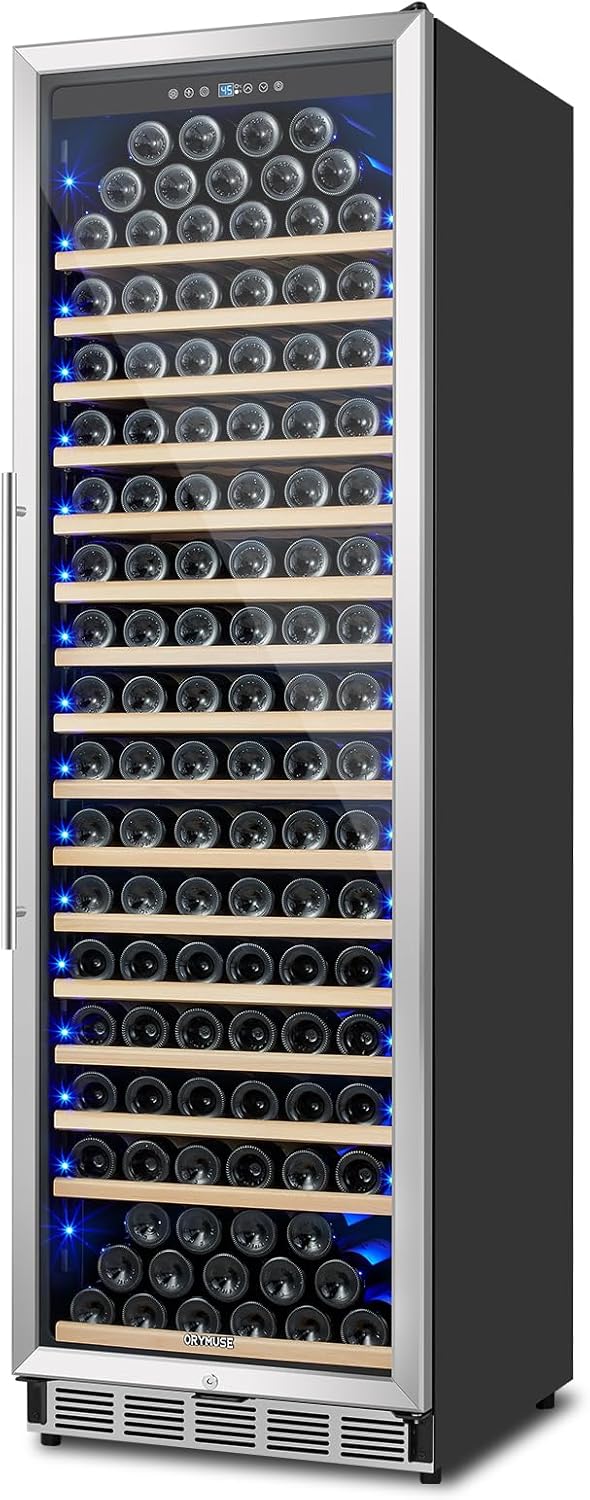
The ORYMUSE 24-inch wine fridge is a large-capacity compressor cooler aimed at serious collectors who need stable, even temperatures and visual display. It uses an upgraded compressor plus an internal circulation fan to move air across 16 beechwood shelves so bottles cool consistently without frost, and the advertised 40 to 65°F range lets you store both whites and reds. The dual-layer tempered glass door and built-in lock make it suitable for display and secure storage, and the temperature memory feature restores your last setting after power interruptions. Practical touches include automatic defrost, ETL compliance, and the option to install it freestanding or built-in. Trade-offs are size and footprint: this is a large unit that requires planning for placement and is heavier and more permanent than compact models, and it carries the complexity and energy use of a full compressor system. For buyers who want a display-quality, high-capacity cooler with reliable temperature control, this unit delivers useful features at a high-end scale.
Best for: Serious home collectors or entertaining hosts who need a high-capacity, display-ready wine cooler that holds a large inventory and keeps bottles at consistent, cellar-style temperatures.
Less Ideal for: Casual wine drinkers with limited space or those who want a compact, low-noise countertop or small undercounter fridge should consider smaller units instead.
- Very large capacity for up to 200 standard Bordeaux bottles on 16 beechwood shelves
- Compressor cooling with circulation fan for faster, more even temperature control
- Temperature memory restores last setpoint after power interruptions
- Double-layer tempered glass door with key lock for display and security
- Can be installed freestanding or built-in and meets ETL specification
- Large physical footprint requires dedicated space and installation planning
- Compressor-based system consumes more energy and produces more weight and operational noise than small thermoelectric units
Verdict: Buy this if you want a high-capacity, display-ready compressor wine cooler that maintains consistent cellar temperatures for a large collection.
Zephyr Presrv 24" Wine Fridge

| Configuration | Freezerless |
|---|---|
| Cooling Method | Active Cooling Technology |
| Number Of Shelves | 6 |
| Refrigerant | R-600A |
| Installation Type | Countertop |
The Zephyr Presrv 24" is a single-zone wine fridge built to store standard 750ml bottles at a stable temperature for home bars or kitchens. It uses active cooling technology, a reversible glass door with dual-pane low-e argon-filled glass, and six wooden shelves sized to accommodate larger-diameter bottles like Pinot Noir and Champagne. The interior lighting offers three color choices to show off the collection, and the unit includes a keyed lock for security. In practice this model fits under a counter or stands alone, keeps bottles organized on the wooden racks, and provides consistent cooling thanks to its active system and R-600A refrigerant. Trade-offs are the single temperature zone, which limits storing two very different wine types at once, and its modest net capacity relative to full-size cellar units. For someone prioritizing reliable temperature control, premium finishes, and presentation in a compact footprint, this fridge performs well; buyers who need multi-zone flexibility or larger commercial capacity should look elsewhere.
Best for: Buyers who want a compact, performance-focused single-zone wine fridge that maintains steady temperatures and showcases a curated bottle collection under a counter or as a freestanding unit.
Less Ideal for: People who need separate temperature zones for mixed wine storage or those who require large commercial-scale capacity.
- Active cooling technology for steady temperature control
- Large-diameter wooden racks accommodate wider bottles
- Dual-pane, low-e argon-filled glass door improves insulation
- Reversible door and keyed lock add installation flexibility and security
- Three-color LED interior lighting for display and visibility
- Single-zone design cannot maintain separate temperatures for red and white wines
- Net capacity is relatively modest compared to larger cellars
Verdict: Choose this Zephyr Presrv if you want a well-built, single-zone 24" wine fridge that delivers steady cooling and polished presentation for a curated home collection.
Ca'Lefort 24" Wine Fridge CLF-WS24

| Capacity | 5.65 cubic feet |
|---|---|
| Bottle capacity | 61 Bottle |
| Temperature range | 40-65°F |
| Installation type | Built-in, Under Counter, Freestanding |
| Cooling method | Compressor (rotary scroll) |
The Ca'Lefort 24" Wine Fridge is a built-in undercounter cooler aimed at home collectors who want a reliable, mid-size storage unit. It uses a rotary scroll compressor with automatic defrost and front ventilation to maintain an adjustable 40 to 65°F range via a digital control panel, and the double-glazed stainless steel door with UV protection helps limit light exposure. Six removable sapele wood shelves make organizing standard 750ml bottles and a few larger-format bottles straightforward, and three-color LED lighting gives simple display options. Practical touches include power-failure memory, low-noise operation, and a front vent that allows true built-in installation. Expect solid temperature stability for everyday aging and serving, though the unit is single-zone so it is best when storing similar styles at one setpoint rather than both whites and reds at their ideal temps. The finish and door framing read as higher-end for the price range, but buyers who need dual-zone flexibility or a larger capacity should look elsewhere.
Best for: Buyers who want a reliable undercounter wine fridge that balances capacity, temperature control, and a refined look for a home bar or kitchen installation.
Less Ideal for: Collectors who need dual-zone control for storing whites and reds separately or those wanting very large long-term storage capacity.
- Holds up to 61 standard 750ml bottles, suitable for medium-sized collections
- Digital temperature control with 40–65°F range and power-failure memory
- Double-glazed stainless steel door with UV protection to reduce light exposure
- Front ventilation and built-in installation option fit undercounter spaces
- Removable wooden shelves that adjust for different bottle sizes
- Single-zone cooling limits storing whites and reds at different temperatures
- No lock included for security
Verdict: A well-rounded 24-inch undercounter wine fridge that delivers solid temperature stability and good capacity for home collectors who store one primary wine style.
Koolatron 10 Bottle Wine Cooler

| Capacity | 1 cubic feet |
|---|---|
| Size | 10 Bottle |
| Temperature Range | 50-66°F |
| Cooling Method | Thermoelectric |
| Included Components | 5 Removable Wire Shelves |
The Koolatron 10 Bottle Wine Cooler is a small freestanding thermoelectric fridge designed to keep bottles at ready-to-serve temperatures without vibrations or loud compressor noise. It is typically used on a countertop or table to free up refrigerator space and display a modest collection using four removable wire shelves and soft interior LED lighting. The mirrored, UV-blocking glass door protects wine from light damage while the external touch controls and digital display let you adjust temperature and light without opening the door. Thermoelectric cooling runs quietly and with fewer moving parts than compressor units, which helps reliability in low-vibration environments, though its cooling range is best for short- to medium-term storage rather than long-term cellar aging. Practical benefits include easy placement, adjustable shelving for different bottle sizes, and a lock for security, while limitations are modest capacity and less aggressive cooling in warm rooms compared with compressor models.
Best for: Buyers who prioritize quiet, low-vibration cooling and want a reliable, compact wine fridge for countertop use and short- to medium-term storage.
Less Ideal for: Collectors who need long-term aging conditions, large capacity, or strong cooling performance in hot environments should look at compressor-based cellar units instead.
- Thermoelectric cooling provides quiet, low-vibration operation suitable for preserving sediment
- Mirrored UV-blocking glass door protects bottles from light exposure
- External touch controls with digital display allow temperature and light adjustments without opening the door
- Removable wire shelves let you reconfigure interior to fit larger or irregular bottles
- Compact freestanding design fits on countertops or in small spaces
- Limited 10-bottle capacity is small for larger collections
- Thermoelectric system is less effective at cooling below ambient temperature in very warm rooms
- Short factory warranty period
Verdict: Choose this compact thermoelectric cooler if you want a quiet, low-vibration countertop wine fridge that reliably stores a small collection at serving temperatures.
Velieta 24-Inch Wine Cooler KMHJ510

| Configuration | Freezerless |
|---|---|
| Cooling Method | Compressor |
| Defrost System Type | Automatic |
| Installation Type | Built-in/Freestanding |
| Lock Type | Key |
The Velieta 24-inch wine cooler is a compressor-based refrigerator designed to store a large collection with professional-style temperature control and a front-vent that allows either freestanding or built-in installation. It offers an upgraded large-capacity interior with two roomy shelves that can accommodate larger bottles such as Pinot or Champagne, a digital LED display for setting the temperature, and a keyed lock plus a carbon purification system to reduce odors. The unit emphasizes quiet operation with energy-efficient, low-vibration compressors and a sturdy door seal to help maintain consistent internal temperature. Practical benefits include flexible installation, simple digital controls, and features aimed at protecting and preserving bottles for long-term storage. Important limitations are that the listing mixes overall capacity figures (15.8 cu ft) with a much smaller stated refrigerator net capacity, so buyers should confirm exact bottle count for their needs, and the product does not list an energy efficiency rating or detailed vibration specs common on higher-end cellar units.
Best for: Buyers who value a quiet, professionally controlled cooler for a sizable wine collection and want built-in or freestanding flexibility while relying on multiple product features and reviews to confirm performance.
Less Ideal for: Collectors who need factory-rated energy efficiency, precise vibration specs, or guaranteed cellar-grade performance without independently verifying capacity and specs.
- Large internal capacity with removable shelves to fit larger bottles
- Compressor cooling with low-vibration, whisper-quiet operation
- Front-vent design supports built-in or freestanding installation
- Digital LED temperature display and professional temperature control
- Security lock and carbon purification system to protect and freshen stored bottles
- Listing provides inconsistent capacity numbers, requiring buyers to verify actual bottle capacity
- No official energy efficiency rating provided
Verdict: Choose this cooler if you want a large-capacity, quiet compressor wine refrigerator with flexible installation and protective features for an expanding collection.
Ivation 18-Bottle Wine Cooler

| Capacity | 1.8 cubic feet |
|---|---|
| Bottle Capacity | 18 Bottle |
| Temperature Range | 41°F–64°F |
| Cooling Method | Compressor |
| Defrost System Type | Automatic |
The Ivation 18-Bottle Wine Cooler is a compact freestanding unit that uses a compressor and internal fan to keep temperatures steady between 41°F and 64°F, making it suitable for storing reds, whites, and sparkling wines. It typically sits on the floor or a countertop and is configured as a single-zone cooler with six wire racks that are removable to fit different bottle sizes. Notable features include a double-paned thermopane glass door that reduces UV exposure, a digital touch display with lock, soft LED interior lighting, and automatic defrost for low-maintenance operation. The compressor design and inverter help the cooler maintain set temperatures even when ambient room temperature fluctuates, which is valuable for long-term storage and reliability-focused buyers. Trade-offs are its single-zone layout, which does not allow separate temperatures for whites and reds, and modest capacity, which limits it to small collections or secondary storage. Energy consumption is moderate and the unit is intended as a dedicated wine fridge rather than a full-size cellar.
Best for: Buyers who prioritize a reliable, temperature-stable freestanding cooler for a small collection or secondary wine storage and want a low-maintenance unit with clear digital controls.
Less Ideal for: Collectors who need a large-capacity or dual-zone cellar for storing multiple wine types at different temperatures should consider larger or dual-zone models instead.
- Compressor cooling with internal fan for stable, consistent temperatures
- Double-paned thermopane glass door that helps block UV and insulates the interior
- Digital touch controls with lock and clear LCD for easy temperature management
- Removable wire racks accommodate different bottle sizes and simplify loading
- Single-zone design cannot maintain different temperatures for whites and reds
- Limited 18-bottle capacity may be too small for larger collections
Verdict: Choose this Ivation cooler when you want a compact, compressor-driven freestanding unit that keeps a small wine collection at stable, reliable temperatures.
Ivation 12-Bottle Wine Cooler
| Capacity | 1.2 cubic feet |
|---|---|
| Temperature Range | 41-64°F |
| Power | 95W / 1.2 Amps |
| Cooling Method | Compressor |
| Refrigerant | R-600A |
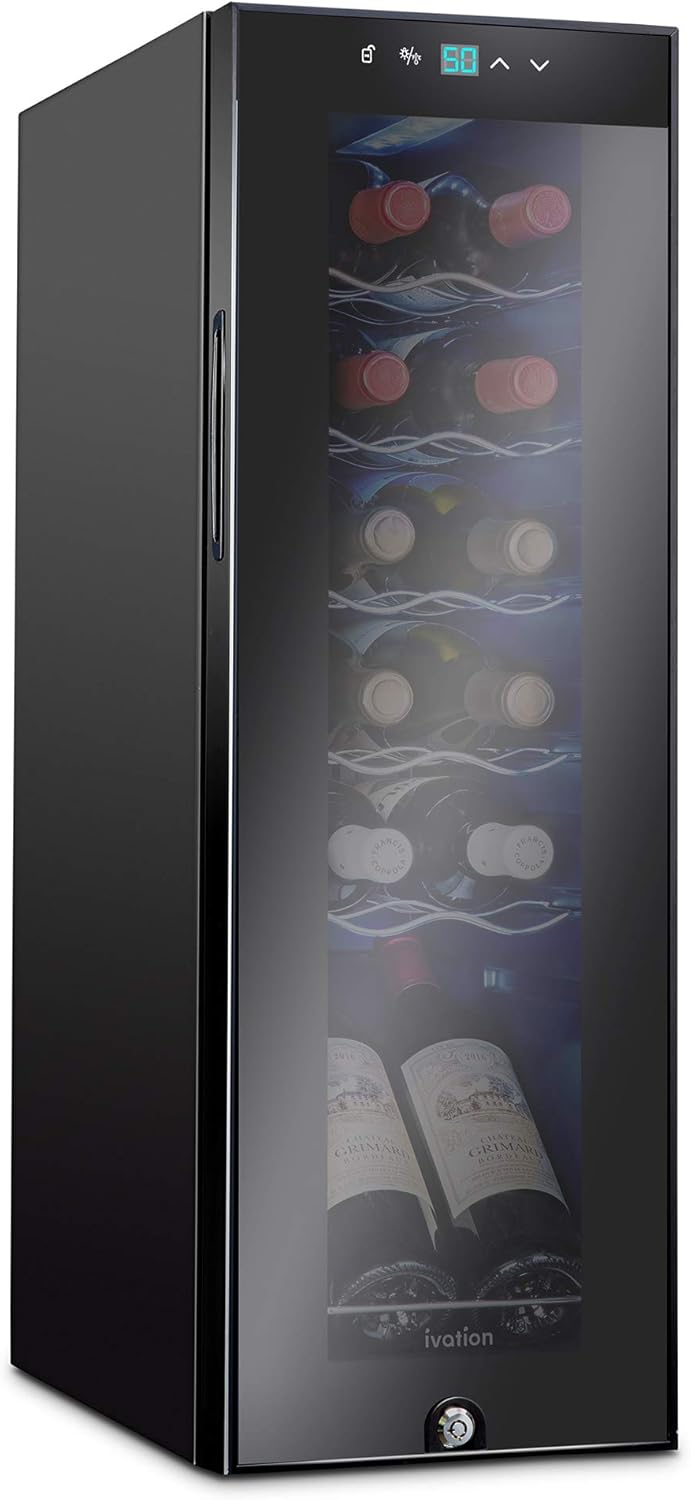
This Ivation 12-bottle cooler uses a compressor cooling system and internal fan to hold a stable 41–64°F range, making it suitable for both chilling and longer-term storage. It installs freestanding and has six removable wire racks so you can fit standard 750 ml bottles or rearrange for larger formats. The digital touch display shows temperature in Fahrenheit or Celsius and can be locked to prevent accidental changes, while the double-paned UV-resistant glass and rubber gasket help keep light and air out. Vibration-reducing compressor operation preserves sediment and the interior LED provides soft illumination for inspections without harsh heat. As a compact unit it draws modest power (rated 95W) and includes a keyed lock for security. Limitations include a small 1.2 cu ft capacity that restricts larger fermentation batches and single-zone control that prevents separate temperature settings for multiple products. The unit is best when you need a reliable, quiet compressor fridge with precise temperature stability in a compact footprint rather than a higher-capacity or dual-zone system.
Best for: Buyers seeking a compact, performance-focused compressor fridge that holds steady temperatures for precise fermentation or small-batch aging and who prioritize stability and quiet operation.
Less Ideal for: Those who need higher capacity, multiple temperature zones, or to run several fermentations at different setpoints simultaneously should look at larger or dual-zone units.
- Compressor cooling with inverter ensures stable, low temperatures suitable for fermentation control.
- Wide adjustable temperature range (41–64°F) with digital touch controls and lock for set-and-forget operation.
- Double-paned UV-resistant glass and airtight gasket protect contents from light and external air.
- Removable wire racks allow flexible bottle arrangement and easier cleaning.
- Quiet, vibration-reducing operation that minimizes disturbance to sediments or sensitive contents.
- Small 1.2 cubic foot capacity limits the number and size of fermentation vessels you can fit.
- Single temperature zone cannot maintain different temperatures for multiple simultaneous projects.
Verdict: Choose this cooler when you want a compact, compressor-driven fridge that delivers stable, low-temperature control for small-batch fermentation and precision cooling.
Choosing the Right High-End Freestanding Wine Cooler: Key Factors to Consider
Temperature Range and Stability
A cooler's ability to hit and hold a target temperature is the core of preserving wine. Look for units with narrow variance from setpoint and a dependable thermostat or electronic controller. Stability matters more than absolute low temperatures for most cellaring needs because frequent swings accelerate cork degradation.
For high-end freestanding coolers, dual-zone designs can accommodate both reds and whites, but confirm that each zone maintains its own consistent conditions. Consider how long the unit can recover to set temperature after the door opens and whether it can sustain performance in your ambient room temperature.
Vibration Isolation and Noise
Mechanical vibration and excessive operating noise can both harm stored wine and disrupt living areas. High-end units should feature compressors or cooling systems mounted with effective dampening and well-designed internal shelving that reduces contact with vibrating surfaces.
Noise specifications and real-world reports can reveal whether a cooler is suitable for placement near kitchens or living rooms. If the cooler will be in a furniture area, prioritize models with low dBA ratings and proven vibration control to avoid disturbing sediment and labels.
Capacity and Shelving Layout
Capacity is not just the number of bottles listed on a spec sheet. Shelf style, bottle orientation, and usable interior depth determine how many standard 750 ml and larger-format bottles actually fit. High-end freestanding coolers often use premium wood or metal shelves that slide smoothly and allow single-bottle access without disturbing neighbors.
Think about your collection mix. If you store many Bordeaux-style bottles, a compact-depth unit may suffice. For larger-format or magnum bottles, confirm shelf spacing and whether shelves are adjustable or removable to create flexible zones.
Door Construction and UV Protection
Door glazing and seals impact both thermal performance and light exposure. Tinted, low-iron glass with multiple panes reduces UV transmission and improves insulation. A tight gasket and quality hinge keep cold air in and warm air out, lowering runtimes and improving temperature stability.
If your cooler will be in a bright room or near windows, UV protection becomes especially important to prevent light-struck flavors. Also evaluate whether doors are reversible and how the handle and seal design fit your installation plan.
Controls, Lighting, and Usability
Intuitive controls and useful features reduce the chance of accidental setting changes and make daily use easier. Digital thermostats with clear readouts, lockable control panels, and preset modes are common in higher-end units. Interior lighting should be soft and UV-safe so viewing bottles does not expose them to harmful light.
Consider maintenance needs such as how to access and clean condensate drains, replace filters if present, and change light bulbs. Look for features that simplify loading and organization like full-extension shelves, bottle stops, and labeling-friendly shelf fronts.
Energy Efficiency and Operating Cost
High-end performance should not come at runaway operating cost. Insulation quality, compressor efficiency, and door design all influence how much energy a cooler uses. Energy-efficient components reduce electricity consumption and can lower lifetime operating expenses.
Also consider how often the unit will run in your ambient climate. Units sited in warmer rooms or near heat sources will run more and consume more power, so prioritize models with good insulation and efficient cooling systems for long-term savings.
Sizing Your Cooler to Space and Collection
Measure both the installation footprint and the interior storage requirements before selecting a freestanding cooler. External dimensions must allow for airflow clearance around the unit as specified by the manufacturer, and you should plan for door swing or reversible hinges.
Match cooler capacity to your collection growth. A unit that is nearly full from day one limits reorganization and makes it harder to maintain even conditions. Leave headroom for future acquisitions and for temporary restaurant or gift bottles that may be larger than typical retail formats.
- Allow clearance for ventilation and power cord routing.
- Account for thicker doors or trim in tight spaces.
- Plan shelf adjustments for magnums or larger formats.
Dual-Zone Vs Single-Zone: Which to Choose
Single-zone coolers are fine if you primarily store one style of wine or keep bottles at the same serving temperature. They offer simpler controls and sometimes more interior volume at a given footprint. For collectors who routinely store both reds and whites at their ideal serving temperatures, dual-zone units provide separate environments that can be set independently.
Consider how you use the bottles. If you rotate bottles frequently between hosts and dinner, a single-zone set to the most commonly used temperature may be practical. If you are aging bottles long term, separate zones help maintain proper conditions for different varietals without compromise.
- Single-zone: simpler controls, often higher usable capacity.
- Dual-zone: flexible storage for different temperature needs.
- Verify zone separation to avoid thermal bleed between compartments.
Installation, Venting, and Floor Protection
Freestanding coolers need adequate airflow, so avoid enclosing them in cabinetry unless the design explicitly allows it. Position the unit on a level, stable surface and consider a drip pan or protective mat if condensate or occasional leaks are a concern.
If the cooler will sit on wood or soft flooring, add a protective base to prevent indentations. Also inspect power availability and use dedicated circuits if required in your home to avoid nuisance tripping when the cooler cycles.
- Keep vents unobstructed for proper compressor cooling.
- Use a level to prevent rattles and ensure door alignment.
- Place on a protective mat if floor damage is a risk.
Maintenance and Long-Term Care
Routine maintenance helps preserve optimal performance. Clean door gaskets and interior surfaces periodically with mild detergent and water to prevent mold and odors. Check condensate drains and evaporator pans for blockages and clean as recommended by the manufacturer.
Plan for occasional professional service if the compressor or sealed system requires attention. Regularly monitor temperature readouts and log fluctuations to spot early signs of failing components before bottles are affected.
- Inspect seals annually and replace when leakage appears.
- Clean interior and shelves seasonally to remove dust and spills.
- Keep ventilation pathways clear of dust and debris.
Lighting and Display Considerations
Light exposure impacts wine quality, so choose coolers with low-UV LED lighting and doors that limit visible light transmission. Interior lighting should be user-activated or dimmable to minimize continuous exposure when viewing bottles.
If the cooler doubles as a display piece, look for adjustable shelf finishing and lighting color that flatters labels without compromising protection.
- Prefer LED lights rated for low UV emission.
- Use motion or push-button lighting when possible.
- Tinted glass helps protect labels while showcasing bottles.
How We Chose the Best High-End Freestanding Wine Cooler
We prioritized features that matter for long-term bottle care and daily usability. Temperature accuracy and stability were essential, so we focused on units with tight control ranges and reliable cooling systems. Vibration isolation and compressor design were considered next; excessive vibration can disturb sediment and accelerate aging problems. Capacity and internal layout were weighed to ensure options accommodate standard 750 ml bottles and different storage schemes such as single-bottle or deep-storage racks. Materials and construction were evaluated for durability and insulation performance, including door glazing and gasket quality. Noise level and energy efficiency were considered because high-end freestanding units are often placed near living spaces. We also assessed usability details such as rack design, lighting options, programmable zones, and ease of maintenance. Units that lacked stable temperature control, used poor insulation, or had limited or nonstandard bottle capacity were excluded. The final list reflects a balance of precise climate control, build quality, storage flexibility, and real-world convenience.
Our full evaluation process is outlined in our review methodology.
FAQ
How cold should I set a cooler for long-term red wine storage?
Long-term red wine storage typically benefits from a steady temperature between 55 and 59 degrees Fahrenheit. Stability is more important than hitting a particular number, so choose settings that the cooler can maintain with minimal fluctuation.
Can I put a freestanding wine cooler in my kitchen next to appliances?
You can place a freestanding cooler in a kitchen, but avoid direct heat sources and allow proper ventilation. High ambient heat from ovens or dishwashers increases runtime and can challenge the cooler's ability to hold stable temperatures.
Is a compressor or thermoelectric cooler better for high-end storage?
Compressor systems generally provide stronger and more consistent cooling for long-term storage and larger capacities. Thermoelectric units are quieter and simpler but are usually better suited for smaller, secondary storage in stable ambient conditions.
Do I need humidity control in a freestanding wine cooler?
Many high-end coolers maintain suitable humidity passively through insulation and limited airflow, but explicit humidity control is helpful in drier climates or if bottles are stored for many years. Proper humidity prevents corks from drying and permits optimal aging.
How should I arrange bottles to minimize temperature variation?
Distribute bottles evenly and avoid tightly stacking them near the door. Use full-extension shelves to minimize door-open time and place long-term storage bottles deeper inside where conditions are most stable.
Final Verdict
Selecting a high-end freestanding wine cooler requires balancing temperature stability, vibration control, and the right storage layout for your collection. Prioritize units with proven temperature accuracy, solid insulation, and shelving that fits the bottle formats you use most. Consider where the cooler will live, how it will be loaded, and the maintenance required to keep it performing over years. Focus on the performance metrics that protect bottle integrity rather than aesthetic extras alone. With the right combination of capacity, climate control, and build quality, you can confidently choose a freestanding cooler that supports both short-term serving and long-term aging.