
Note: This article contains affiliate links. If you click on these links and make a purchase, we may earn a small commission at no extra cost to you. This helps support our research and content. Read our full affiliate disclosure here.
When knives dull, cooking slows and risks increase. A Home Electric Knife Sharpener can restore a blade quickly and with consistent angles so you can get back to efficient, safer prep. The right sharpener reduces the time and effort needed to maintain a full set of kitchen knives while protecting edges from excessive material loss. This guide highlights our shortlisted top picks across common home needs. We evaluated each option on practical criteria like sharpening speed, edge retention, and user safety to help you choose the best electric sharpener for regular kitchen use. Read on for the evaluation approach and practical buying guidance before the product list.
Top Picks at a Glance
| Best Overall The best all-around choice for most situations | Presto EverSharp Electric Knife Sharpener 08810 |  |
| Best Quality Built to a higher standard if you want something more solid | Work Sharp MK2 Knife Sharpener |  |
| Best Value The sweet spot between price and what you get | SHARPAL Electric Knife Sharpener 198H |  |
| Best Budget The cheapest option that still gets the job done reliably | LCVXYERQ Electric Knife Sharpener |  |
| Top Rated A top-rated pick with lots of positive feedback | Chef'sChoice Trizor 15XV |  |
| Most Popular A crowd favorite that many people choose with confidence | Presto EverSharp Electric Knife Sharpener 08800 |  |
| Best Seller A high-volume bestseller chosen again and again | Narcissus Electric Knife Sharpener QN-M866 |  |
Presto EverSharp Electric Knife Sharpener 08810

| Material Type | Plastic, Sapphirite wheels |
|---|---|
| Grit Type | Light,Medium,Fine |
| Voltage | 120 volts, 60 Hz |
| Included Components | 08810 |
The Presto EverSharp 08810 is a countertop electric knife sharpener that guides blades through three progressive stages—coarse, medium and fine—with an extra-fine ceramic wheel for a polished edge. It is used by sliding the blade through the appropriate blade-thickness guide (thick, medium, thin) so the machine holds the correct angle; suction-cup feet help keep the unit stable while sharpening. The multi-stage sequence removes nicks and re-establishes a bevel quickly, then refines and polishes the edge for everyday kitchen knives, fillet knives and hunting blades. Practical benefits include fast, repeatable sharpening without the skill and time required for manual stones, and the thickness selector makes it easier to treat different blade types. Limitations are that it is a bulky countertop device made mostly of plastic and it only supports standard straight-edge sharpening motions, so it is not suitable for serrated knives or very specialty edges that need custom angles.
Best for: Home cooks who want a simple, repeatable way to restore and maintain straight-edge knives without learning whetstone technique, and owners of mixed kitchen and outdoor knives who value speed and convenience.
Less Ideal for: Sharpening enthusiasts who prefer full control with stones, or anyone needing a tool for serrated, tapered or custom-angled knives.
- Three-stage grinding plus extra-fine ceramic honing for a complete edge restoration
- Blade thickness selector with guides holds the correct sharpening angle for consistent results
- Suction-cup feet improve stability during use
- Works on a variety of straight-edge knives including kitchen, hunting and fillet knives
- Not designed for serrated or specialty blade geometries
- Mostly plastic construction and relatively large footprint for countertop storage
Verdict: Choose the Presto EverSharp 08810 when you want fast, repeatable, three-stage electric sharpening that restores kitchen and sport knives with minimal effort.
Work Sharp MK2 Knife Sharpener

| Included components | Abrasive Belts, Knife Sharpener |
|---|---|
| Material Type | Plastic |
| Grit Type | Medium |
| Model Number | WSKTS2 |
The Work Sharp MK2 is an electric belt-based sharpener designed to quickly restore and reshape edges on kitchen knives, pocket knives, scissors, axes, and other tools. It uses flexible abrasive belts that conform to a blade edge, letting you both grind and polish depending on belt choice, and the included edge guide helps maintain consistent angles along the cutting edge. A two-speed motor provides extra power for heavy-duty tasks such as lawnmower blades or axes while a lower speed gives more control for delicate kitchen knives. The unit is compact and easy to set up, with replacement belts included so you can move from coarse grinding to finer finishing without buying add-ons immediately. Because it is belt-driven rather than a fixed-wheel system, it excels at re-profiling and handling varied blade shapes but requires some user attention to technique to avoid removing too much metal. It is best suited for someone who wants fast, repeatable sharpening for a range of tools rather than a purely hands-on whetstone experience.
Best for: Buyers who prioritize fast, repeatable edge restoration across knives and tools and want a power-driven system that handles heavy re-profiling as well as routine sharpening.
Less Ideal for: If you prefer traditional whetstone honing, a fully manual workflow, or need a purely precision stropping-only setup, this electric belt system is not the best fit.
- Flexible abrasive belts conform to different blade shapes for consistent contact along the edge
- Two-speed motor gives extra power for heavy grinding tasks and more control for knife finishing
- Edge guide helps maintain repeatable sharpening angles to simplify the process
- Compact, ready-to-use system with replacement belts included for coarse-to-fine work
- Belt system can remove material quickly if used aggressively so technique matters
- Not a passive guided stone system for users who prefer purely manual whetstone control
Verdict: Choose the MK2 if you want a compact, belt-driven electric sharpener that delivers fast, repeatable edge restoration for knives and a wide range of tools.
SHARPAL Electric Knife Sharpener 198H

| Material Type | Monocrystalline Diamonds, Pure Ceramic |
|---|---|
| Grit Type | Coarse, Extra Fine |
| Included Components | AC to DC 12V power supply adapter, electric sharpener |
| Model Number | 198H |
The SHARPAL 198H is a compact three-stage electric sharpener that guides blades through preset 20-degree angles to restore and hone kitchen and outdoor knives. Stage one uses coarse grit for reshaping dull edges, stage two refines, and stage three offers a manual ceramic stropping stage for finishing or bolstered handles. It sharpens both sides simultaneously for faster, consistent results and collects metal filings in removable magnetic receptacles for easier cleanup. The unit includes a 12V adapter and has thermal cutout protection to prevent motor overheating during prolonged use. Practical users will appreciate the beginner-friendly one-handed operation, relatively quiet motor under 65 dB, and the use of monocrystalline diamond and pure ceramic wheels for durable abrasion. Limitations include difficulty reaching the full blade length on knives with thick bolsters and the need to follow light, even strokes to avoid wheel binding; very hard steels may require more pulls than softer steels. For routine home maintenance this sharpener speeds up resharpening while reducing the skill required compared with manual stones.
Best for: Buyers who want a low-effort, reliable way to keep everyday kitchen and outdoor knives sharp without learning manual sharpening techniques and who favor predictable, repeatable results.
Less Ideal for: Users seeking precise angle control for specialty or Japanese 15-degree knives, or those who need to sharpen very long blades or complex bolstered handle profiles.
- Three-stage system (coarse, refine, manual ceramic) for reshaping and finishing edges
- Simultaneous dual-side sharpening for consistent results and faster processing
- Monocrystalline diamond and ceramic wheels provide durable cutting action
- Removable magnetic receptacle collects filings for easier cleanup
- Built-in thermal protection prevents overheating during extended use
- May not reach the full blade length on knives with thick bolsters
- Requires light, consistent pressure and multiple pulls for very dull or hard-steel blades
Verdict: If you want fast, repeatable edge restoration at home with minimal skill, the SHARPAL 198H delivers a three-stage, easy-to-use solution.
LCVXYERQ Electric Knife Sharpener
| Included Components | three extra grinding wheels |
|---|---|
| Material Type | Stainless Steel |
| Grit Type | Fine,Rough |
| Item Weight | 2.2 pounds |
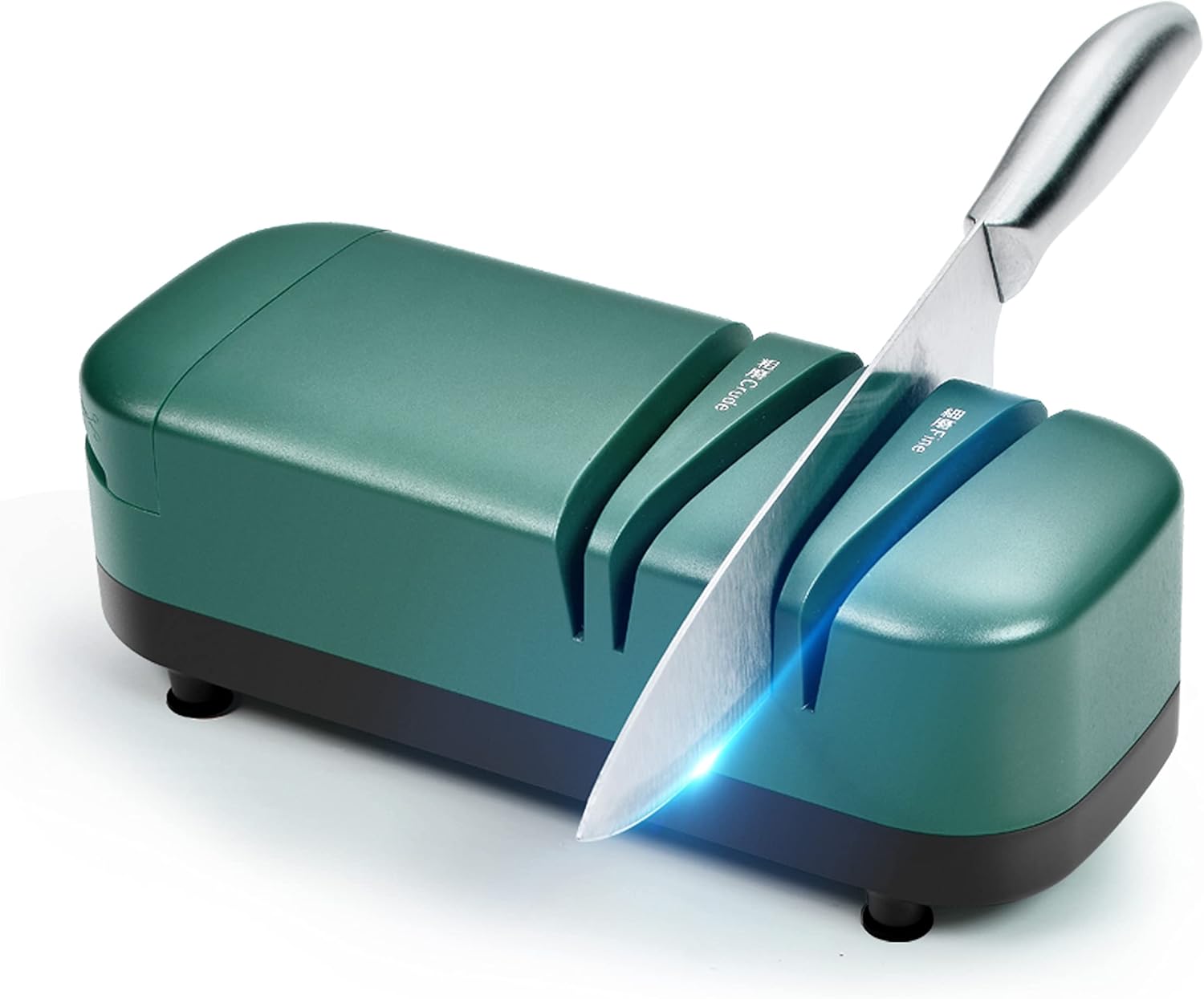
This compact electric sharpener uses a two-stage rough-and-fine system to restore dull stainless steel kitchen knives quickly and with minimal effort. You slide the blade through the coarse slot to reprofile a blunt edge, then finish in the fine stage for a smoother, sharper result; the unit also has a side slot for scissors and a slotted screwdriver. It is designed for home use and claims noticeable sharpening in about 30 seconds, and the included three extra grinding wheels and cleaning brushes make maintenance straightforward. The device is not suitable for ceramic or serrated blades, and because it is a powered, guided sharpener it removes metal to form the edge rather than honing. Its small footprint and simple pull-through operation make it easy for budget-minded cooks who want fast, repeatable results without learning freehand techniques, though buyers seeking professional-level control or compatibility with delicate blade types should consider other methods.
Best for: Buyers who want an inexpensive, easy-to-use electric sharpener for everyday stainless steel kitchen knives and occasional scissors sharpening without learning freehand techniques.
Less Ideal for: People who need to sharpen ceramic or serrated knives, or users who want precise, professional freehand sharpening control.
- Two-stage coarse and fine wheels for faster regrinding and smoother finishing
- Built-in scissors sharpening and slotted screwdriver sharpening adds versatility
- Includes three extra grinding wheels and cleaning brushes for maintenance
- Compact, easy pull-through operation suitable for quick kitchen touch-ups
- Not compatible with ceramic or serrated blades
- Powered removal sharpening offers less control than freehand sharpening methods
Verdict: A budget-friendly electric sharpener that delivers fast, repeatable sharpening and basic scissors sharpening for everyday stainless steel kitchen knives.
Chef'sChoice Trizor 15XV

| Sharpening Stages | 3 |
|---|---|
| Abrasive Type | 100% Diamond Abrasives |
| Edge Angle | 15 degrees |
| Compatible Knife Types | Straight-edge and serrated knives |
The Chef'sChoice Trizor 15XV is a purpose-built electric sharpener that converts typical 20-degree factory edges to a finer 15-degree Trizor edge and maintains straight and serrated blades. It uses three stages: two diamond-plated stages for rapid shaping and honing and a patented stropping/polishing stage for a refined, razor-like finish. Precision angle guides and flexible spring guides keep the blade aligned automatically, so sharpening is consistent and repeatable without guessing the angle. Typical use is quick: first-time sharpening takes about a minute and touch-ups only seconds, making it practical for regular kitchen maintenance. The all-diamond abrasives deliver fast material removal with long-lasting grinding surfaces, and the unit handles most household straight-edge and serrated knives. Limitations include its fixed 15-degree target which is ideal for Western knives converted to a thinner edge but may not suit all specialty blades, and the electric design means you need countertop space and power to use it.
Best for: Buyers who prioritize reliable, repeatable sharpening and want a durable electric system that consistently produces a very sharp 15-degree edge for everyday kitchen knives.
Less Ideal for: Shoppers who need variable-angle sharpening for specialty blades or who prefer manual whetstones and full control over bevel geometry should consider other options.
- Creates a consistent 15-degree Trizor edge for very sharp slicing
- Uses 100% diamond abrasives for fast sharpening and long wear
- Three-stage system includes a stropping/polishing stage for a refined finish
- Automatic angle guides eliminate guesswork and make results repeatable
- Fixed 15-degree edge target may not suit specialty or thicker factory edges
- Requires countertop space and electrical power to operate
Verdict: Choose the Trizor 15XV when you want a dependable, all-diamond electric sharpener that delivers a consistent, razor-sharp 15-degree edge with minimal effort.
Presto EverSharp Electric Knife Sharpener 08800

| Material Type | Plastic, Sapphirite wheels |
|---|---|
| Grit Type | Fine |
| Included Components | knife sharpener |
| Item Type Name | Electric Knife Sharpener |
The Presto EverSharp 08800 is an easy-to-use two-stage electric knife sharpener that brings dull kitchen and sporting knives back to a razor edge. Stage 1 uses sapphirite grinding wheels to reestablish the correct bevel while Stage 2 fine-hones and polishes the edge for a smoother cutting surface. Built-in blade guides hold the knife at preset angles so you simply draw the blade through each slot a few times; three suction cups and a nonslip base keep the unit steady during use. It handles most alloy, carbon, and stainless blades and even some non-electric serrated knives, making it practical for routine home maintenance rather than professional restoration. The compact plastic housing keeps it lightweight and countertop-friendly, but the coarse grinding action can remove significant metal if overused, so it is best used sparingly on very dull blades. The unit is powered by 120V AC and includes receptacles to catch filings for easier cleanup.
Best for: Buyers who want a simple, proven countertop tool to keep everyday kitchen and sport knives sharp with minimal technique and reassurance from a longstanding brand and many user reviews.
Less Ideal for: If you need precision angle control for high-end knives, work with fully serrated or ceramic blades, or perform professional-level restorations, choose a professional sharpening system or whetstone instead.
- Two-stage system (grind then hone) for a sharper, polished edge
- Sapphirite wheels use the same ultra-hard material as professional shops
- Preset blade guides produce consistent sharpening angles without guesswork
- Nonslip base with suction cups and filing receptacles for safer, cleaner operation
- Not suitable for fully serrated knives or delicate specialty blades
- Plastic housing and fixed angles limit customization compared with professional systems
Verdict: A straightforward, reliable two-stage electric sharpener that quickly restores a razor edge on most common non-serrated knives for home use.
Narcissus Electric Knife Sharpener QN-M866

| Included Components | Adapter, Knife sharpener |
|---|---|
| Material Type | Carborundum |
| Grit Type | Fine |
| Power | 30 W DC motor |
| Voltage | 100-240 V |
The Narcissus QN-M866 is a compact two-stage electric sharpener made for everyday home blades. You use it by pulling a knife through the coarse slot to re-form the edge, then through the fine slot to polish and remove burrs, and a side slot handles scissors. Its 30 W DC motor and suction feet keep operation steady, and a metal dust collection box reduces cleanup. The wide 100–240 V adapter and ergonomic handle make it simple to set up and hold while sharpening. In practice it restores usable sharpness in a few pulls and is much faster and less skill-dependent than whetstones. Limitations: it is intended for straight-edged kitchen knives only, so very thin, serrated, or specialty blades may not be compatible, and users who prefer fully custom edge angles or professional reprofiling will miss the control of manual systems.
Best for: Safety-minded home cooks who want a fast, low-skill way to keep everyday straight-edged knives sharp without learning stone techniques.
Less Ideal for: Sharpening specialists, professional chefs, or hobbyists who need precise angle control or who work primarily with serrated and specialty blades.
- Two-stage coarse and fine slots restore and polish edges quickly
- Built-in scissors slot adds useful multi-function sharpening
- Metal dust collection box simplifies cleanup
- 30 W DC motor with suction feet provides stable, continuous operation
- 100–240 V wide voltage adapter works with different power systems
- Not suitable for serrated or very thin specialty blades
- Limited control over exact edge angle compared with manual sharpening
Verdict: A straightforward, low-effort two-stage sharpener that gets household straight-edged knives back to working sharpness quickly and reliably.
Choosing the Right Home Electric Knife Sharpener: Key Factors to Consider
Sharpening Stages and Abrasives
The number and type of stages determine how much metal is removed and how fine the final edge will be. Coarse stages remove nicks and re-establish bevels quickly, while finer stages polish and refine the edge. Look for clearly separated coarse-to-fine progressions and quality abrasive materials that match your knives' steels.
A unit with only a single abrasive stage may restore basic cutting ability but will not produce a long-lasting, keen edge. Conversely, too-aggressive abrasives without good angle control can shorten blade life by removing excess material. For home use, a three-stage system—coarse, medium, and fine or polishing—covers most needs without overcomplicating operation.
Angle Control and Consistency
Consistent bevel angle is the single biggest determinant of a repeatable, sharp edge. Home electric sharpeners use guides, fixed angle slots, or adjustable systems to set the bevel. Fixed-angle guides are simple and reliable but must match the knives you own; adjustable or stepped systems offer more flexibility for varying blade types.
If you have higher-end or specialty knives, ensure the sharpener can achieve the appropriate angle without forcing the blade into an incorrect geometry. Inconsistent or sloppy guides can lead to uneven wear and a dulling edge despite frequent use.
Safety Features and Ergonomics
Electric sharpeners rotate abrasives at high speed and bring metal edges close to users' hands. Good safety design minimizes that risk with guarded slots, non-slip bases, and intuitive blade paths that keep fingers away from moving parts. Ergonomics also matters during repeated use; a stable footprint and comfortable grip make sharpening safer and more precise.
Consider models with clear user-facing indicators for stage sequence and those that require minimal hand pressure, which reduces the chance of slips. Removable or protected housings for the abrasive elements make occasional maintenance safer.
Blade Compatibility
Not all sharpeners suit every blade type. Straight European and Asian kitchen knives, Western heavy blades, and serrated knives each have different geometry needs. Verify whether the sharpener is intended for stainless and high-carbon steels and whether it can address thin Japanese-style blades without overgrinding.
If you rely on serrated knives, look for units that include a serration-specific stage or a compatible manual honing rod. Using the wrong system for thin or hollow-ground blades can ruin edge profiles, so match the sharpener to the knives you actually own.
Maintenance and Consumables
Abrasive wheels and belts wear over time, and some units require replacement parts or occasional calibration. Check how easy it is to access and replace consumables, whether replacement parts are standard sizes, and whether cleaning the unit is straightforward.
Dust and metal filings accumulate with use; models with removable trays or washable covers simplify upkeep. Consider the long-term convenience of maintenance when choosing between sealed, low-maintenance models and more serviceable designs that trade user replaceability for initial cost savings.
How Electric Sharpeners Work
Home electric sharpeners use abrasive wheels, belts, or rods powered by a motor to abrade metal and re-create a cutting bevel. Typical units guide the blade along a controlled path so the operator does not need to maintain a consistent hand angle, which is useful for cooks who want fast, repeatable results.
Most devices sequence from coarse to fine abrasives. The coarse stage reshapes the edge and removes nicks, the medium stage refines geometry, and the fine or polishing stage produces a smoother, keener finish. Understanding this process helps you choose a unit with the right abrasive types for your knives.
- Abrasive wheels versus belts: wheels typically last longer; belts can be faster for large material removal.
- Stepped slots vs adjustable guides: stepped slots simplify use; adjustable systems fit a wider range of knives.
- Polishing stage importance: a final polishing stage reduces burrs and improves cutting feel.
Protecting Knife Life While Sharpening
Over-sharpening or aggressive abrasives remove unnecessary metal and shorten a blade's usable life. Prioritize units with progressive abrasives and gentle polishing stages that maintain edge angles without excessive stock removal.
Technique also matters. Minimal pressure and only as many passes as needed are the best practice. For infrequent touch-ups, a medium or fine-only pass may preserve geometry better than repeated coarse regrinding.
- Use the coarse stage only to repair chips or reprofile.
- Finish with the fine/polishing stage to remove burrs.
- Avoid multiple full coarse passes on thin blades.
Routine Care and Troubleshooting
Keep the unit clean of metal dust by emptying trays and wiping housings after use. Accumulated filings can affect motor cooling and create inconsistent results. Inspect abrasive elements for glazing or uneven wear and rotate or replace them according to the manufacturer guidance.
If a sharpener produces uneven edges or grinding noise, check blade alignment, ensure the guide slots are intact, and verify the abrasive surfaces are not contaminated. Small adjustments to blade pressure and insertion angle often fix common inconsistencies.
- Wipe down housings and trays after each session.
- Check abrasives for glazing after heavy use.
- Confirm base feet remain non-slip for stable operation.
When to Seek Professional Sharpening
Some damage is best handled by specialized sharpening services. Deep chips, complex factory-edge geometries, and blades with compound grinds or temper issues often need bench tools and skilled hands to restore correctly.
If you are unsure whether a home unit can safely reprofile a valuable or specialty blade, a professional evaluation preserves the knife's integrity and prevents irreversible mistakes.
- Deep chips or bent tips often require professional tools.
- High-end specialty steels may need specific abrasives and expertise.
- Consider pro service for one-time major repairs rather than repeated home regrinding.
How We Chose the Best Home Electric Knife Sharpener
We focused on features that directly affect everyday performance and long-term blade health. First, we measured sharpening speed and consistency by looking for designs that produce repeatable bevels without multiple passes. Second, we weighed edge retention by prioritizing abrasive stages and angle control that preserve steel rather than remove excessive material. Third, we evaluated build and user safety, including motor quality, stable bases, and guarded guide systems that protect fingers and keep blades aligned. Fourth, ease of use and maintenance were considered, emphasizing simple setup, clear stage progression, and accessible cleaning. Finally, we looked at compatibility across common kitchen knife geometries and whether the unit accommodates both straight and serrated edges or at least offers a serration-friendly stage. We excluded tools intended primarily for professional sharpening services, bench grinders, and manual-only systems. Units that lacked clear angle control, had flimsy housings, or did not provide multi-stage abrasive options were removed from consideration. The resulting picks reflect devices that balance speed, preservation of blade steel, and safe repeatable results.
Our full evaluation process is outlined in our review methodology.
FAQ
Will an electric sharpener ruin my knives?
Not if used correctly. Overusing coarse stages or applying too much pressure can remove excess metal. Use progressive stages sparingly and match the angle guidance to your knife to preserve edge geometry.
Can electric sharpeners handle serrated knives?
Some units include a serration-specific stage or a manual rod for serrations. Not all electric sharpeners are suitable for serrated edges, so choose a model that explicitly supports them or maintain serrations with a dedicated tool.
How often should I sharpen kitchen knives with an electric unit?
It depends on use. Many home cooks need a full sharpening only a few times per year, with light touch-ups more frequently. Rely on cutting performance rather than a calendar schedule; stones or strops can be used between electric sessions for minor realignment.
Are there blade types I should not use with a home electric sharpener?
Very thin Japanese-style blades and certain specialty bevels can be sensitive to aggressive abrasive systems. If a sharpener cannot achieve an appropriate low angle or if it lacks a fine polishing stage, avoid using it on delicate-edge knives.
How do I know when the abrasive wheels need replacement?
Signs include glazing that stops material removal, uneven sharpening results, increased noise, or visible erosion of the abrasive surface. Regular inspection and following the manufacturer's wear guidelines will keep performance consistent.
Final Verdict
Prioritize consistent angle control and a multi-stage abrasive progression when choosing a home electric sharpener. Those two factors most directly affect how quickly you can restore edges and how long the edge will hold between sessions. Safety features and ease of maintenance are also important tradeoffs: a slightly slower, well-guarded unit that preserves blade steel is often a better long-term choice than a fast but aggressive system. Decide based on the knives you actually use, how often you will sharpen, and whether you need serration support. Focus on models that balance preservation with convenient results to keep kitchen knives performing well without unnecessary wear.