
Note: This article contains affiliate links. If you click on these links and make a purchase, we may earn a small commission at no extra cost to you. This helps support our research and content. Read our full affiliate disclosure here.
If you want to preserve garden produce, make healthy snacks, or create long-lasting emergency foods, the right Stainless Steel Food Dehydrator matters. A well-designed stainless steel dehydrator delivers steady airflow, even heat distribution, and a hygienic interior that resists staining and odor retention. This guide highlights seven shortlisted units that represent the top choices in the category, with attention to drying performance, construction, maintenance, and energy use. Below you will find concise evaluations and a clear explanation of the features that matter most when choosing a stainless steel model.
Top Picks at a Glance
| Best Overall The best all-around choice for most situations | Excalibur 8-Tray Dehydrator DH08SCSS13 |  |
| Best Quality Built to a higher standard if you want something more solid | LEM BigBite 10-Tray Dehydrator |  |
| Best Value The sweet spot between price and what you get | Magic Mill Food Dehydrator MFD-5000 |  |
| Best Budget The cheapest option that still gets the job done reliably | OSTBA Food Dehydrator FD-1019 |  |
| Top Rated A top-rated pick with lots of positive feedback | Cosori Stainless Steel Dehydrator CP267-FD |  |
| Most Popular A crowd favorite that many people choose with confidence | Magic Mill Pro Food Dehydrator MFD-7070 |  |
| Best Seller A high-volume bestseller chosen again and again | Cosori Stainless Steel Dehydrator P501 |  |
Excalibur 8-Tray Dehydrator DH08SCSS13

| Wattage | 700 watts |
|---|---|
| Voltage | 120 |
| Number of Trays | 8 |
| Temperature Range | 85°F to 165°F |
| Timer | Up to 80 hours |
The Excalibur 8-Tray dehydrator is a countertop stainless-steel unit built for home preservation projects from jerky to fruit leather. It uses Excalibur's Hyperwave Pulse technology with horizontal parallax airflow to promote even drying across eight chrome trays without rotating them, and the clear glass French door makes it easy to monitor progress. The LED control panel lets you set temperatures from 85°F to 165°F and run cycles up to 80 hours with automatic shutoff when the timer finishes. Its compact footprint is designed to fit under standard cabinets while still providing 7.2 square feet of drying area, and included accessories such as a mesh tray expand what you can dry. On the downside, it is a dedicated dehydrator so it takes countertop space during use and at 700 watts it draws moderate power during long runs. For cooks who want reliable, even results and a durable stainless finish, this model balances capacity and precise controls for everyday preservation tasks.
Best for: Home cooks who want a durable, countertop dehydrator that consistently delivers even drying for jerky, fruits, vegetables, and batch food preservation.
Less Ideal for: People who need a multi-function appliance or have very limited countertop space and prefer compact, storable gadgets.
- Even drying across trays thanks to Hyperwave Pulse and horizontal parallax airflow
- Wide temperature range (85°F–165°F) and 80-hour timer for precise control
- Large usable drying area (7.2 sq ft) in a compact footprint that fits under cabinets
- Durable stainless-steel construction with clear glass door for easy monitoring
- Includes eight chrome trays plus mesh and crumb trays for versatile drying options
- Requires significant countertop space while in use and is not a multi-use oven replacement
- Consumes 700 watts during long dehydration cycles
Verdict: Choose this stainless-steel Excalibur if you want a reliable, even-drying home dehydrator with generous capacity and precise temperature and timer controls.
LEM BigBite 10-Tray Dehydrator

| Wattage | 800 watts |
|---|---|
| Voltage | 120 volts |
| Number of Trays | 10 |
| Material | Stainless Steel |
The LEM BigBite 10-Tray is a countertop dehydrator built for serious home drying projects like jerky, fruit leathers, and vegetable chips. It uses an 800-watt heating element with a rear-mounted fan and horizontal airflow vents to promote even drying across ten stainless-steel trays and offers a 95 to 176 F temperature range adjustable in 2-degree increments. The digital control panel and 30-minute to 24-hour timer let you dial in precise settings for different foods, and the transparent swinging glass door with magnetic closure makes tray access and progress checks simple. Trays and the drip tray are removable and dishwasher-safe which speeds cleanup after heavy use. At about 10 square feet of drying area and durable stainless-steel housing, it is built for repeat, high-volume batches, though its 800-watt motor means it draws a steady amount of power during long runs and the unit is fairly large on a counter. For users who want a robust, no-nonsense stainless unit that handles multi-tray loads reliably, this model delivers predictable, professional-style results.
Best for: Home cooks who prioritize consistent, high-capacity drying and want a durable stainless-steel machine capable of producing jerky and bulk batches of dried fruit or vegetables.
Less Ideal for: Casual users who only dehydrate small amounts occasionally or need a compact, space-saving unit better suited to infrequent use.
- Stainless-steel housing and trays for durable, food-safe performance
- Rear-mounted fan and horizontal airflow designed to promote even drying across all trays
- Digital controls with 2-degree increments and 30-minute to 24-hour timer for precise settings
- Large 10-tray capacity providing about 10 sq. ft. of drying area for batch drying
- Removable dishwasher-safe trays and drip tray simplify cleanup
- 800-watt power draw requires continuous energy during long dehydration cycles
- Relatively large footprint may take significant counter space
Verdict: Choose the LEM BigBite 10-Tray if you need a heavy-duty stainless-steel dehydrator that delivers even, reliable results for large or frequent batches.
Magic Mill Food Dehydrator MFD-5000

| Wattage | 240 watts |
|---|---|
| Voltage | 110 volts |
| Number of Trays | 5 |
| Temperature Range | 95-167 °F |
The Magic Mill MFD-5000 is a countertop food dehydrator built around five stackable stainless steel trays and a digital control panel for time and temperature. It is used to dry fruit, herbs, jerky, and pet treats by circulating heat at set temperatures between 95 and 167°F for up to 48 hours; the adjustable tray spacing lets you fit thicker cuts when needed. The stainless trays and BPA-free plastic body make it straightforward to load and clean, and the unit's 240W heater moves moisture out without lengthy warm-up times. Practical features include dishwasher-safe trays, a simple touch control for precise timing, and a compact rectangular footprint that fits most counters. Limitations are its modest capacity for large batches compared with cabinet-style models and the top temperature cap of 167°F which may slow very thick meat jerky for some users. For anyone wanting an easy-to-use, stainless-steel-tray dehydrator for regular home use, it balances performance and convenience well.
Best for: Buyers who want a reliable, countertop stainless-steel-tray dehydrator that is easy to operate and clean and who prioritize consistent home drying for snacks, herbs, and occasional jerky.
Less Ideal for: People who need to process very large volumes at once or who require higher-temperature commercial-style dehydration should consider larger cabinet units or commercial machines.
- Five stainless steel stackable trays for even drying and easy cleaning
- Digital timer and temperature control up to 167°F for precise drying cycles
- Dishwasher-safe detachable trays simplify cleanup
- Adjustable tray height accommodates thicker slices or varied foods
- Compact rectangular design fits easily on most countertops
- Smaller batch capacity than full-size cabinet dehydrators
- Maximum temperature of 167°F may lengthen time for very thick jerky
Verdict: A compact, user-friendly stainless-steel-tray dehydrator that delivers dependable home drying with precise digital controls.
OSTBA Food Dehydrator FD-1019

| Wattage | 400 watts |
|---|---|
| Voltage | 120 |
| Number of Trays | 5 |
| Temperature Range | 95-160℉ |
The OSTBA FD-1019 is a compact 5-tray stainless steel dehydrator aimed at everyday home use. It runs on 400W and offers a 95–160°F temperature range with a digital 1–48 hour timer and auto shut-off, so you can dry fruits, herbs, jerky, and vegetables with predictable results. The unit uses a 360° airflow system driven by the motor to circulate heat evenly across the trays, and the embedded stainless steel trays are dishwasher-safe for easy cleanup. Trays rotate 180° to change spacing for thicker cuts, and the BPA-free housing and non-slip feet add practical convenience. At its size and power this dehydrator is well suited for small batches and casual snack-making but will take longer or require multiple cycles for large volumes compared with higher-watt, multi-tier commercial units. Noise and heat are modest given the wattage, and the included recipe book helps get started quickly.
Best for: Buyers looking for an affordable, stainless-steel tray dehydrator for occasional home use and small-batch drying of fruits, herbs, and jerky.
Less Ideal for: People who need to dry large volumes frequently or want a higher-capacity, faster commercial-style dehydrator should consider larger, more powerful models.
- Five embedded stainless steel trays resist rust and are dishwasher-safe
- Wide 95–160°F temperature range with a 48-hour digital timer and auto shut-off
- 360° airflow design promotes consistent drying across all trays
- Compact footprint and cord storage make it easy to store in small kitchens
- 400W motor and compact size limit throughput for large batches
Verdict: A budget-friendly stainless steel 5-tray dehydrator that delivers even, reliable drying for small home batches.
Cosori Stainless Steel Dehydrator CP267-FD

| Wattage | 600 watts |
|---|---|
| Number of Trays | 6 |
| Temperature Range | 95-165 F |
| Voltage | 120 volts |
The Cosori CP267-FD is a six-tray stainless steel dehydrator designed for batch drying fruits, jerky, herbs, and fruit rolls. It uses a rear-mounted 600W fan and horizontal airflow to circulate heat evenly across all six dishwasher-safe trays, and the digital touch panel lets you set temperatures from 95 to 165 F and a timer up to 48 hours for slow, precise drying. The stainless housing and metal trays reduce plastic contact with food and are easier to clean than many plastic units, while the included mesh screen and fruit roll sheet expand what you can dehydrate. Noise is kept low thanks to a brushless motor rated under 48 dB, so overnight runs are practical. The main compromises are its bulk and weight compared with compact units and the fixed internal tray spacing that can limit very thick cuts unless sliced thin. For buyers who value stable performance, even airflow, and durable construction, this model delivers reliable, repeatable results for regular home dehydrating tasks.
Best for: Home cooks who want a durable, factory-quality stainless steel dehydrator that delivers consistent, even drying for regular batch use and low-noise overnight runs.
Less Ideal for: People with very limited counter or storage space or those who primarily need an ultra-compact unit for occasional single-tray drying.
- Six stainless steel trays provide large 6.5 ft² drying area for batch dehydration.
- Digital temperature control from 95–165 F with a 48-hour timer enables precise, low-temp drying.
- Rear-mounted 600W fan and horizontal airflow promote even drying across trays without manual rotation.
- Stainless steel construction and dishwasher-safe trays reduce plastic contact and simplify cleaning.
- Brushless motor rated under 48 dB keeps operation quiet enough for overnight use.
- Relatively heavy and large footprint compared with compact dehydrators.
- Fixed tray spacing limits capacity for very thick items without slicing thin.
Verdict: Buy this Cosori stainless steel dehydrator if you want a reliable, quiet, and durable six-tray unit that delivers even, precise drying for regular home use.
Magic Mill Pro Food Dehydrator MFD-7070

| Wattage | 600 |
|---|---|
| Voltage | 60 volts |
| Number of Trays | 7 |
| Temperature Range | 158 °F |
| Material | Stainless Steel |
The Magic Mill Pro MFD-7070 is a countertop food dehydrator built around seven extra-large stainless steel trays and a rear-mounted fan that promotes consistent air circulation so you rarely need to rotate racks. It is typically used for making jerky, fruit leather, dried herbs, and granola; the unit includes mesh and fruit roll trays for smaller or sticky items and a transparent door to monitor progress. A digital thermostat and countdown timer let you set exact drying temperatures and run times, and an automatic shutoff plus a keep-warm mode simplify multi-hour dehydration sessions. The stainless steel construction and dishwasher-safe trays make cleanup straightforward, and built-in overheat protection adds a safety layer. Limitations include a single temperature value listed in the specs rather than a wide range and a relatively high 600W power draw that may matter for long runs, and the unit is fairly large on a kitchen counter. For buyers who want roomy capacity, durable materials, and hands-off drying, this machine delivers a practical, safety-minded solution for home dehydration projects.
Best for: Home cooks who prioritize durable stainless construction, large batch capacity, and predictable, hands-off drying backed by safety features and clear user feedback.
Less Ideal for: People with very limited counter space or those who need a compact travel-friendly dehydrator should look at smaller models instead.
- Seven extra-large stainless steel trays provide high batch capacity and durable, food-safe surfaces.
- Rear-mounted fan with airflow circulation yields more even drying without rotating trays.
- Digital thermostat and countdown timer with automatic shutoff and keep-warm simplify long dehydration cycles.
- Included mesh and fruit roll trays increase versatility for small items and sticky mixes.
- Trays are dishwasher safe and the stainless housing wipes clean for easier maintenance.
- Specified temperature listed as a single value rather than a detailed range in product info.
- Relatively high 600W power draw during extended dehydration runs.
- Large countertop footprint may be bulky in small kitchens.
Verdict: Choose the Magic Mill Pro MFD-7070 when you want a roomy, stainless-steel dehydrator that delivers even, low-effort drying with safety-minded features.
Cosori Stainless Steel Dehydrator P501
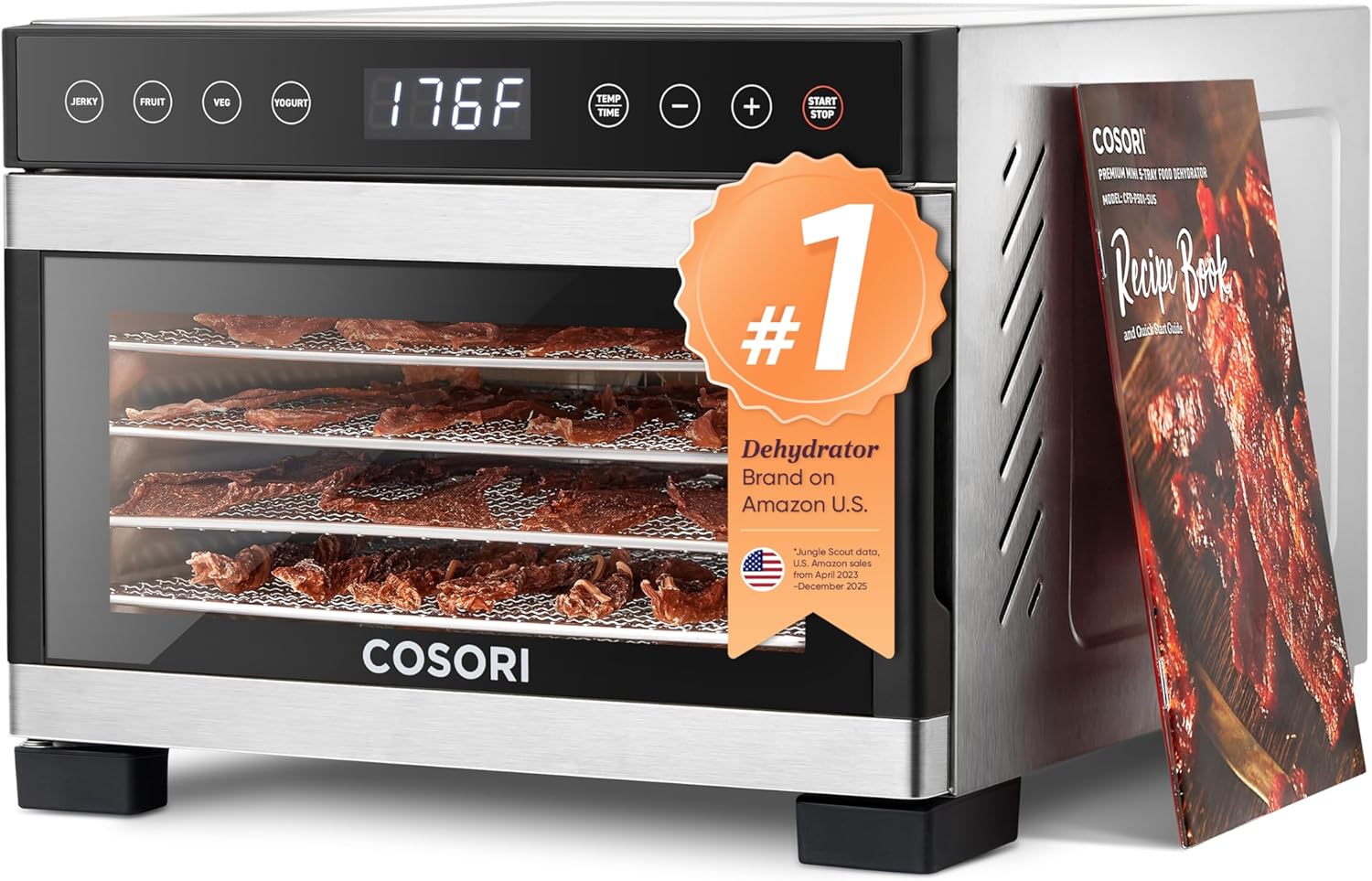
| Wattage | 480 watts |
|---|---|
| Voltage | 110 volts |
| Number of Trays | 5 |
| Temperature Range | 95-176 F |
The Cosori P501 is a compact stainless steel dehydrator designed for everyday home use. It dries fruit, vegetables, jerky, and yogurt across five stainless steel trays and offers 3.1 square feet of drying area, making it easy to run small to medium batches on a kitchen counter. Temperature is adjustable from 95 to 176°F in 1°F increments, and four presets simplify common tasks while the 48-hour timer handles long cures like jerky. The rear-mounted fan with horizontal airflow promotes even drying across trays, and the all-stainless food path reduces concerns about plastic contacting food. Setup and cleaning are straightforward because the trays are removable and the unit is compact. Limitations include a modest 480-watt heater that lengthens drying time versus higher-power models and the interior capacity is best for moderate rather than commercial volumes. Noise from the fan is present but typical for this class. For cautious buyers seeking a durable, easy-to-use stainless steel dehydrator, the P501 delivers predictable, safe results without complicated controls.
Best for: Buyers who want a reliable, easy-to-use stainless steel dehydrator for home kitchen use and who prioritize food-safe materials and predictable, even drying.
Less Ideal for: People who need to process large volumes regularly or want the fastest possible drying times for commercial use should consider larger, higher-power machines.
- All stainless steel construction with no plastic contact where food sits
- Precise temperature control from 95 to 176°F in 1°F increments
- Five stainless steel trays provide 3.1 ft² drying area for medium batches
- Rear fan and horizontal airflow for more even dehydration
- Includes presets, mesh screen, fruit roll sheet, and recipe book
- 480-watt power can mean longer drying cycles compared with higher-watt units
- Compact capacity may be limiting for large or commercial batch drying
Verdict: Choose the Cosori P501 if you want a compact, all-stainless home dehydrator that prioritizes food-safe construction and precise temperature control for consistent results.
Choosing the Right Stainless Steel Food Dehydrator: Key Factors to Consider
Drying Performance and Temperature Control
Temperature accuracy and stable airflow directly affect how evenly foods dry and how long cycles take. A dehydrator with a precise thermostat and options for lower or higher temperatures lets you handle a wider range of foods, from delicate herbs to thick fruit leathers.
Uneven heat or fluctuating temperatures force you to rotate trays more often and increase the risk of under- or over-drying. Look for units that provide a clear temperature readout or simple presets tied to consistent internal circulation. For long runs, stable control reduces guesswork and waste.
Stainless Steel Construction and Durability
Stainless steel interiors and structural components resist staining, odor absorption, and warping over time better than many plastics. That matters when you process strongly scented items or frequently run long drying cycles.
Consider the grade and finish of the stainless surfaces, how trays attach or stack, and whether critical structural parts like the heating chamber and fan housing are metal. A sturdier enclosure also reduces vibration and extends service life.
Tray Capacity and Flexibility
Tray count, tray size, and whether trays are adjustable determine how much you can dehydrate in a single batch and how versatile the machine is for different food sizes. Removable or adjustable trays let you dehydrate larger cuts or create more airflow for thinly sliced items.
Also evaluate tray material and spacing: stainless or mesh trays provide different airflow characteristics and cleaning approaches. Capacity impacts how you plan batches and affects total runtime and energy consumption.
Cleaning and Maintenance
Ease of cleaning affects day-to-day convenience and long-term hygiene. Stainless steel interiors typically wipe clean more easily than porous plastics and are less likely to retain odors from strong foods like garlic or fish.
Check whether trays are dishwasher-safe, how easily the fan and heating element can be accessed for cleaning, and whether the design minimizes crevices where residue collects. Regular maintenance needs determine how often you will need to deep-clean the unit.
Noise, Safety, and Usability
Noise level influences where you can comfortably run the dehydrator. A quieter motor broadens placement options in a home. Safety features such as automatic shutoff, overheat protection, and stable feet are important when operating for many hours.
Usability also includes control layout, readable displays, and whether presets or timers meet typical drying recipes. Intuitive operation shortens the learning curve for new users and reduces mistakes that affect results.
Energy Use and Long-Run Cost
Dehydrators commonly run for many hours, so energy efficiency impacts ongoing operating cost. A well-designed unit balances wattage with effective airflow to minimize run time while achieving the same dryness level.
Consider wattage, thermostat accuracy, and whether the unit recovers temperature quickly after door openings or large load changes. Efficient machines reduce electricity usage and lead to lower cumulative costs over years of regular use.
How Stainless Steel Changes Maintenance
Stainless steel interiors simplify cleanup and resist long-term staining from fruits and herbs. Because the surface is nonporous, residue is less likely to embed, making wiping and occasional deeper cleans more effective.
If the dehydrator includes stainless mesh trays, they are usually durable but can trap small particles. A routine rinse and occasional soak prevent build-up. For models with removable metal trays, hand washing with a mild detergent and a soft brush restores airflow pathways without damaging the finish.
- Wipe interior after each use to reduce odor transfer.
- Soak stubborn residue from trays before scrubbing.
- Avoid abrasive cleaners that can scratch protective finishes.
Maximizing Batch Efficiency
To minimize total runtime and energy consumption, plan batches by thickness and moisture content. Thinner slices dry faster and more evenly. When processing mixed loads, group similar items or stagger runs to avoid overlong cycles caused by a single high-moisture item.
Stacking trays with sufficient spacing and avoiding overcrowding ensures even airflow. Some users pre-treat or blanch certain foods to speed dehydration and improve texture; consult recipes for recommended prep and drying times.
- Slice foods uniformly for consistent results.
- Avoid overfilling trays to maintain airflow.
- Run similar-humidity items together when possible.
Temperature Ranges and Common Uses
Different foods need different temperatures. Low settings are appropriate for herbs and delicate fruits to preserve flavor, while higher settings suit meat jerky and thick fruit leathers. Look for models that allow fine-grained temperature selection or provide well-calibrated presets.
Many home dehydration recipes include both temperature and timing ranges rather than precise minutes. Expect to check items periodically toward the end of a run and adjust based on texture rather than strictly following a single time value.
- Herbs: low temperature, short time.
- Fruits: moderate temperature, medium time.
- Meats: higher temperature with careful food-safety attention.
Placement, Ventilation, and Noise Considerations
Place the dehydrator on a stable, heat-resistant surface with ample clearance for ventilation. Proper airflow around the unit helps it maintain temperature and improves efficiency. Avoid enclosed cupboards or tight spaces that trap heat.
If noise is a concern, test operating sound with the unit empty before committing to long runs. Fan and motor noise varies with design and insulation, so quieter motors make it more practical to run overnight or in living areas.
- Allow several inches of clearance on all sides.
- Avoid placing under cabinetry that traps heat.
- Consider vibration-damping pads for hard surfaces.
Recipes and Prep Tips for Better Results
Consistent slicing and pre-treatment improve texture and flavor outcomes. For fruits, consider light sugar or citric acid dips to preserve color. For vegetables, blanching can reduce drying time and help maintain color and nutrients.
Rotate trays periodically if you notice uneven drying, and test items for brittleness or chewiness rather than relying solely on time. Keep notes on batch size, temperature, and run time to refine future sessions.
- Label batches with date, temp, and time for repeatable results.
- Use uniform slice thickness for predictable drying.
- Allow finished items to condition in sealed containers before long-term storage.
How We Chose the Best Stainless Steel Food Dehydrator
We prioritized selection filters that reflect everyday use and longevity for home dehydration. First, drying performance and temperature consistency were central: we looked for units with reliable thermostat control and even airflow that produce predictable moisture removal across trays. Second, build quality guided inclusion, favoring stainless steel interiors and frames or critical components designed to resist corrosion and odor retention. Third, usability factors were considered, including tray capacity and flexibility, intuitive controls, and how straightforward routine cleaning and maintenance are. Fourth, energy efficiency and run-time characteristics mattered because dehydrators often operate for many hours. Finally, safety and warranty coverage were weighed to ensure practical home reliability. We excluded models that relied predominantly on plastic interiors, had inconsistent temperature control, or lacked clear service/support details. The list concentrates on machines that balance consistent dehydration, durable stainless construction, sensible user controls, and manageable energy use. These criteria align with the scoring labels below and reflect what will most affect long-term ownership and results.
Our full evaluation process is outlined in our review methodology.
FAQ
What temperature should I use for drying fruit?
Most fruits dry well at moderate temperatures that preserve flavor and color. Common recommendations fall into a moderate range rather than very high heat. Exact times depend on slice thickness and moisture content, so monitor progress and test for dryness.
Can I put stainless trays in the dishwasher?
Many stainless trays are dishwasher-safe, but check care guidance for your specific unit. Hand washing prevents long-term spotting and preserves finish, especially if trays have fine mesh that can trap particles.
How long do dehydrator cycles typically take?
Cycle lengths vary widely based on food type, slice thickness, and temperature. Expect runs from a few hours for thin herbs to more than a day for thick fruit leathers. Monitor texture and moisture rather than relying solely on elapsed time.
Is stainless steel really worth it over plastic?
Stainless steel offers better resistance to staining and odor absorption, and it generally withstands long runs and higher temperatures without warping. That said, plastic models can be lighter and less expensive, so the choice depends on how often and intensively you plan to use the dehydrator.
How do I store dehydrated food safely?
Cool and dry the finished product completely before storing. Use airtight containers in a cool, dark place and consider vacuum sealing for very long-term storage. Properly dried items will have low residual moisture and should show no signs of spoilage before sealing.
Final Verdict
When selecting a stainless steel food dehydrator, prioritize consistent temperature control, durable construction, and ease of cleaning. Those factors determine the machine's reliability, the consistency of your results, and how much time you spend on maintenance. Balance tray capacity and energy efficiency against the space you have and how frequently you will run long drying cycles. Focusing on these tradeoffs will help you pick a unit that meets routine preservation needs and stands up to regular use.