
Note: This article contains affiliate links. If you click on these links and make a purchase, we may earn a small commission at no extra cost to you. This helps support our research and content. Read our full affiliate disclosure here.
Picking the right remote thermostat can noticeably improve comfort and energy efficiency across your home. A good unit gives accurate temperature sensing where you actually live, communicates reliably with your HVAC system, and offers controls that match how you want to manage heating and cooling. This guide highlights seven shortlisted remote thermostats that represent the best balance of sensing accuracy, connectivity, and user-friendly controls for whole-home use. We evaluated each option against practical criteria buyers care about, including temperature accuracy, wireless performance, and installation needs. Read on for the features and tradeoffs that matter most when choosing a remote thermostat.
Top Picks at a Glance
| Best Overall The best all-around choice for most situations | ecobee Smart Thermostat Enhanced |  |
| Best Quality Built to a higher standard if you want something more solid | ecobee Smart Thermostat Premium |  |
| Best Value The sweet spot between price and what you get | Sensi Lite Smart Thermostat ST25 | 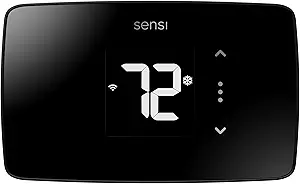 |
| Best Budget The cheapest option that still gets the job done reliably | Riseem STN701W Smart Thermostat |  |
| Top Rated A top-rated pick with lots of positive feedback | Sensi Smart Thermostat ST55 |  |
| Most Popular A crowd favorite that many people choose with confidence | Google Nest Thermostat |  |
| Best Seller A high-volume bestseller chosen again and again | Amazon Smart Thermostat |  |
ecobee Smart Thermostat Enhanced

| Connectivity Technology | Wi-Fi |
|---|---|
| Controller Type | Amazon Alexa, Android, Apple HomeKit, Google Assistant, iOS |
| Power Source | Corded Electric |
| Voltage | 24 volts |
| Display Type | LCD |
The ecobee Smart Thermostat Enhanced is a wall-mounted, hardwired smart thermostat that lets you control heating from the app, voice assistants, or the touch display and aims to reduce energy use with auto‑scheduling and eco+ optimizations. It uses built-in radar occupancy sensing and optional remote sensors to detect which rooms are occupied, preheat or precool before you arrive, and adjust setpoints when you are away or asleep. Dual-band Wi‑Fi and broad smart home integration with Alexa, Siri, Google Assistant, and HomeKit make remote control and voice commands convenient, while the included power extender kit simplifies DIY installs on systems missing a C‑wire. Practical benefits include energy savings via automated schedule suggestions, centralized control from a phone or Apple Watch, and a hardwired design that avoids battery changes. Limitations are that compatibility must be checked against your HVAC type before purchase and installation may still require basic wiring familiarity despite the PEK being included.
Best for: Buyers who want a remote‑controllable, voice‑ready thermostat that actively adjusts comfort using occupancy sensing and who value energy savings through automated scheduling.
Less Ideal for: Homes with nonstandard HVAC control voltages or users who prefer a completely plug‑and‑play, battery‑powered thermostat without any wiring work.
- Built-in radar occupancy sensing and support for remote sensors to target comfort where people are
- Dual-band Wi‑Fi and app control enable full remote control from smartphone and Apple Watch
- Works with Alexa, Google Assistant, and HomeKit for voice control and smart home automation
- Includes Power Extender Kit and trim/backplate for easier DIY installation on many systems
- Hardwired design removes the need for routine battery replacements
- Not compatible with line voltage, millivolt, or some low‑voltage control systems so compatibility check is required
- May require basic wiring skills for installation even with the included PEK
Verdict: A feature‑rich smart thermostat for buyers who want reliable remote and voice control plus occupancy‑based comfort and energy savings.
ecobee Smart Thermostat Premium

| Connectivity Protocol | Wi‑Fi |
|---|---|
| Controller Type | Amazon Alexa, Siri, Google Assistant, HomeKit |
| Power Source | Battery Powered |
| Voltage | 24 volts |
| Included Components | SmartSensor, Power Extender Kit, backplate, wire labels |
The ecobee Smart Thermostat Premium is a high-end smart thermostat that manages heating and cooling while adding air quality monitoring, radar-based occupancy detection, and built-in voice control. It installs on standard 24VAC systems and includes a Power Extender Kit for homes without a C‑wire, plus a SmartSensor to detect and correct hot or cold spots. Dual-band Wi‑Fi, app control, and compatibility with Siri, Alexa, Google Assistant, HomeKit, and SmartThings let you adjust schedules and temps remotely and integrate the thermostat into routines. The large LCD and metal finish give it a premium look, and live doorbell view and smoke alarm alerts extend its smart-home role. Practical benefits include potential energy savings through occupancy-aware scheduling and air quality alerts that prompt filter changes. Drawbacks are that some advanced features require an ecosystem connection or subscription for security alerts, and installation still needs a basic familiarity with HVAC wiring despite included PEK and labels.
Best for: Buyers who prioritize energy savings and precise, occupancy‑driven comfort and want a thermostat that integrates tightly with voice assistants and smart‑home routines.
Less Ideal for: Someone who wants a bare‑bones, no‑frills thermostat or who prefers to avoid cloud‑connected features and ecosystem dependencies.
- Built‑in air quality monitor provides alerts and filter reminders
- Includes SmartSensor to reduce hot and cold spots
- Built‑in voice assistant and speaker for hands‑free control and audio
- Dual‑band Wi‑Fi and broad smart home integration for remote control and automations
- Power Extender Kit and wiring labels included for easier DIY installation
- Some security and advanced home‑health features require linking to ecobee services or a subscription
- Premium metal design and features add complexity compared with basic thermostats
Verdict: A feature‑rich, voice‑enabled thermostat built for buyers who want occupancy‑aware comfort, air‑quality monitoring, and tight smart‑home integration.
Sensi Lite Smart Thermostat ST25
| Connectivity Technology | Wi-Fi |
|---|---|
| Control Method | App, Touch, Voice |
| Power Source | Battery or C-wire |
| Number of Batteries | 2 AAA |
| Specific Uses For Product | Air Conditioner, Boiler, Furnace, Heat Pump |
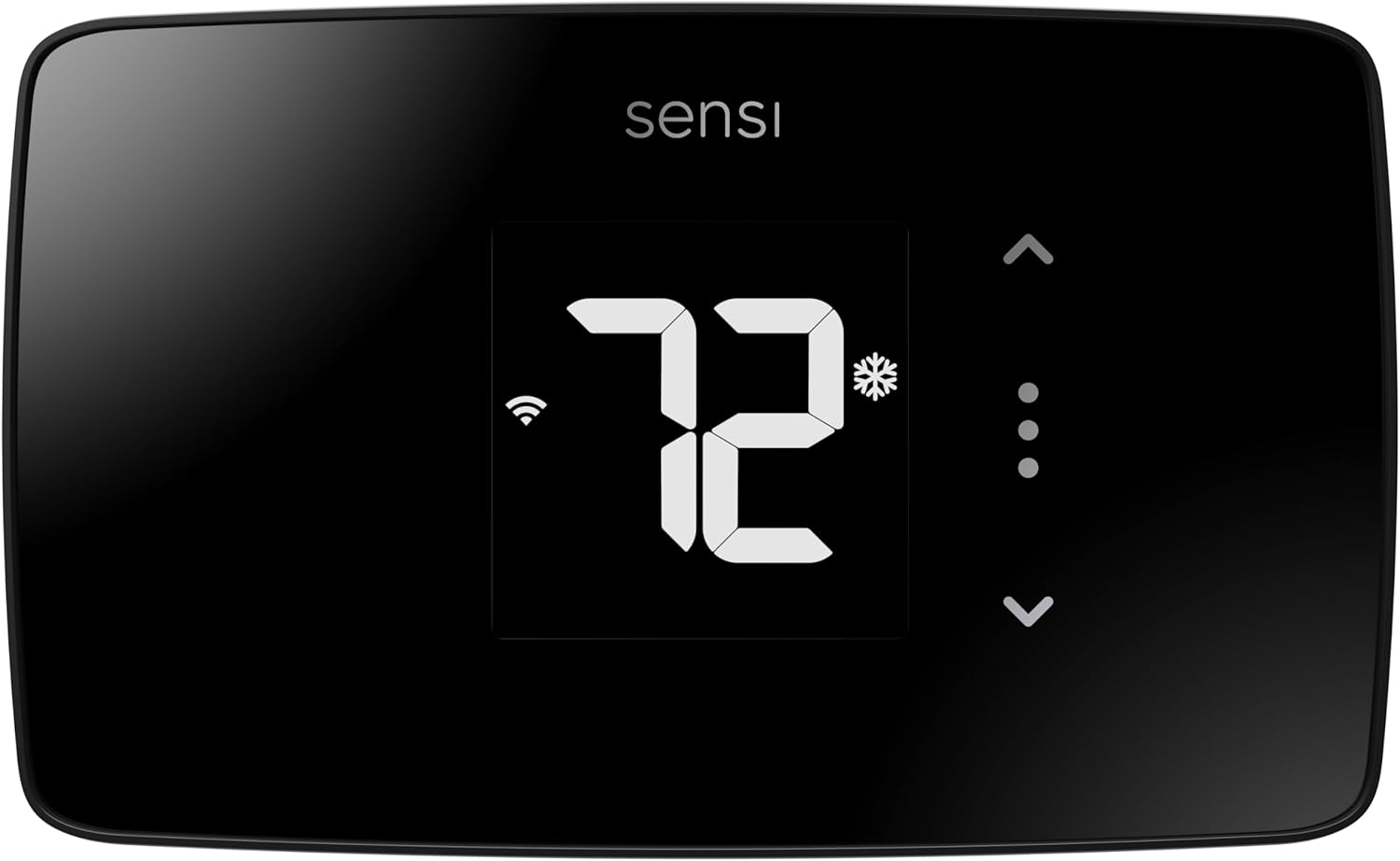
The Sensi Lite is a budget-focused smart thermostat that brings remote control and basic scheduling to most home HVAC setups. It pairs to 2.4 GHz Wi‑Fi and is controlled via a well-rated mobile app, and also supports voice assistants like Alexa and Google Assistant for hands-free adjustments. Installation is designed for DIY users with a built-in level and step-by-step guide, and it can run on included AAA batteries or a C-wire when required by certain systems. Notable features include programmable schedules, geofencing, usage reports aimed at energy savings, and a privacy policy that pledges not to sell user data. Practical benefits are straightforward: easy remote temperature changes, simple scheduling to reduce runtime, and ENERGY STAR certification for potential energy savings. Limitations are its pared-down LCD display and basic feature set compared with higher-end models, and some heat-only or heat/cool systems will still need a C-wire for reliable power.
Best for: Buyers who want an affordable, no-fuss remote thermostat to cut HVAC runtime and control temperature from a phone or voice assistant without paying for premium extras.
Less Ideal for: Users who need a touchscreen color display, advanced HVAC integrations, or extensive programmability should consider higher-end models instead.
- Easy DIY installation with built-in level and step-by-step instructions
- Remote control and scheduling via a top-rated mobile app
- Works with Alexa and Google Assistant for voice control
- Runs on included AAA batteries and supports C-wire for systems that need it
- ENERGY STAR certified and includes geofencing and usage reports for energy savings
- Simple LCD and limited advanced features compared with premium smart thermostats
- Requires a C-wire for some system types which may complicate installs for a few users
Verdict: A straightforward, energy-minded smart thermostat that gives reliable remote control and scheduling without unnecessary complexity.
Riseem STN701W Smart Thermostat
| Connectivity Technology | Wi‑Fi |
|---|---|
| Power Source | Corded Electric (24V AC) |
| Display Type | LCD |
| Control Type | App Remote Control or Button Control |
| Programming | 7‑day programmable |
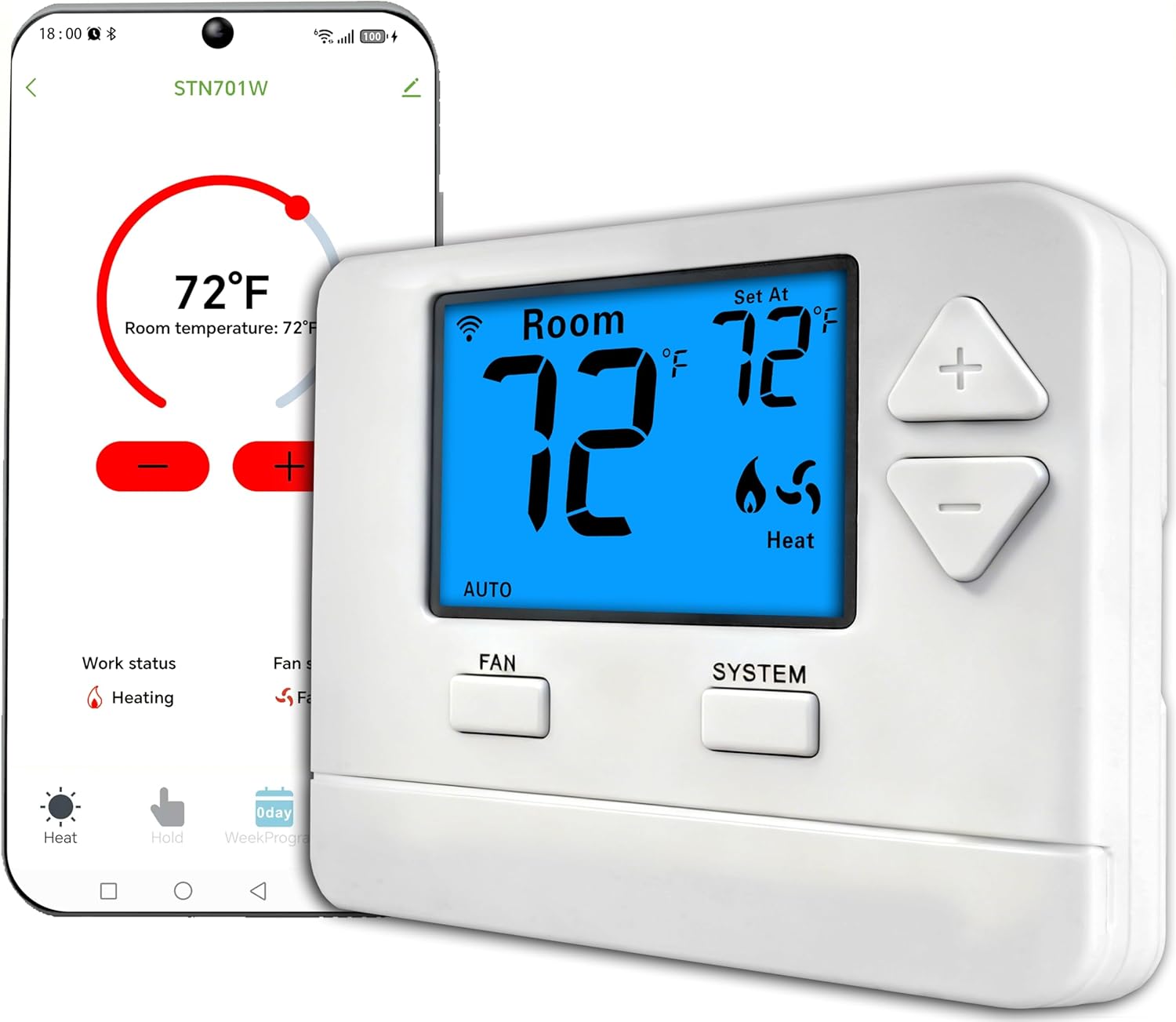
The Riseem STN701W is a budget-oriented Wi‑Fi thermostat designed for homes with single-stage heat/cool systems and a required C-wire. It connects to your network so you can change temperature and schedules from the companion app or the front-panel buttons, and it supports 7-day programming to set different routines for each day. The LCD display and simple control layout make daily adjustments straightforward, and included mounting hardware and cable labels help during install. Because it needs 24V power from a C-wire it is not suitable for battery-only setups, and compatibility is limited to 1H/1C systems so multi-stage HVAC or heat-pump setups are unsupported. Expect a basic feature set aimed at saving energy through scheduled setbacks rather than advanced learning or integrations. For buyers on a tight budget who need core smart control and remote scheduling, this thermostat provides the essentials without extra bells and whistles.
Best for: Buyers who prioritize low upfront cost and want basic smart control and scheduling for a conventional single‑stage HVAC system.
Less Ideal for: Homes without a C‑wire or owners who need multi‑stage, heat pump, or advanced learning thermostat features should look elsewhere.
- Wi‑Fi connectivity and app control for remote temperature adjustments
- 7‑day programmable schedule for customized daily setpoints
- Simple LCD interface and button controls for easy local use
- Includes mounting screws, anchors, cable labels and manual to simplify installation
- Requires a C‑wire and 24V power so it will not run on batteries
- Compatible only with single-stage (1H/1C) systems, not multi-stage or heat pump systems
Verdict: A no‑frills, budget smart thermostat that gives remote app control and 7‑day scheduling for single‑stage systems that have a C‑wire.
Sensi Smart Thermostat ST55

| Connectivity Technology | Wi-Fi |
|---|---|
| Control Method | App, Touch, Voice |
| Temperature Control Type | Programmable, Smart/Remote |
| Power Source | Corded Electric |
| Number of Batteries | 2 AA batteries required. (included) |
The Sensi Smart Thermostat ST55 is a Wi‑Fi programmable thermostat designed to replace a conventional wall thermostat and give remote control of HVAC systems via the Sensi mobile app and voice assistants. It installs with a simple DIY workflow and includes mounting hardware, wire stickers, and batteries, and it works with common systems such as furnaces, heat pumps, boilers, and air conditioners. Key features include 2.4 GHz Wi‑Fi connectivity for remote access, usage reports and smart alerts that surface performance and maintenance reminders, and Energy Star certification aimed at reducing HVAC energy use. The unit keeps a familiar button-based interface and LED display so it fits into traditional thermostat locations without major wall work. Limitations to note are that advanced touchscreen controls are not present on this model and some installations may still require a C‑wire depending on the HVAC setup, so professional help could be needed in a minority of homes.
Best for: Buyers who prioritize a reliable, no‑frills smart thermostat that delivers remote control, energy savings, and proven HVAC compatibility with a straightforward DIY install.
Less Ideal for: Users who want a full touchscreen interface, highly stylized hardware, or advanced thermostat features beyond scheduling and usage reports.
- Energy Star certified with features designed to reduce HVAC energy use
- 2.4 GHz Wi‑Fi and app/voice control for remote monitoring and adjustments
- Easy DIY installation with included hardware and step‑by‑step app guidance
- Provides usage reports, smart alerts, and maintenance reminders
- No color touchscreen interface; uses button controls and an LED display
- Some HVAC setups may still require a C‑wire or professional installation
Verdict: A dependable, Energy Star certified smart thermostat that gives reliable remote control and useful HVAC insights with an easy DIY install.
Google Nest Thermostat
| Connectivity Technology | Bluetooth, Wi-Fi |
|---|---|
| Control Type | Remote Control, Voice Control |
| Power Source | Battery Powered |
| Display Type | LCD |
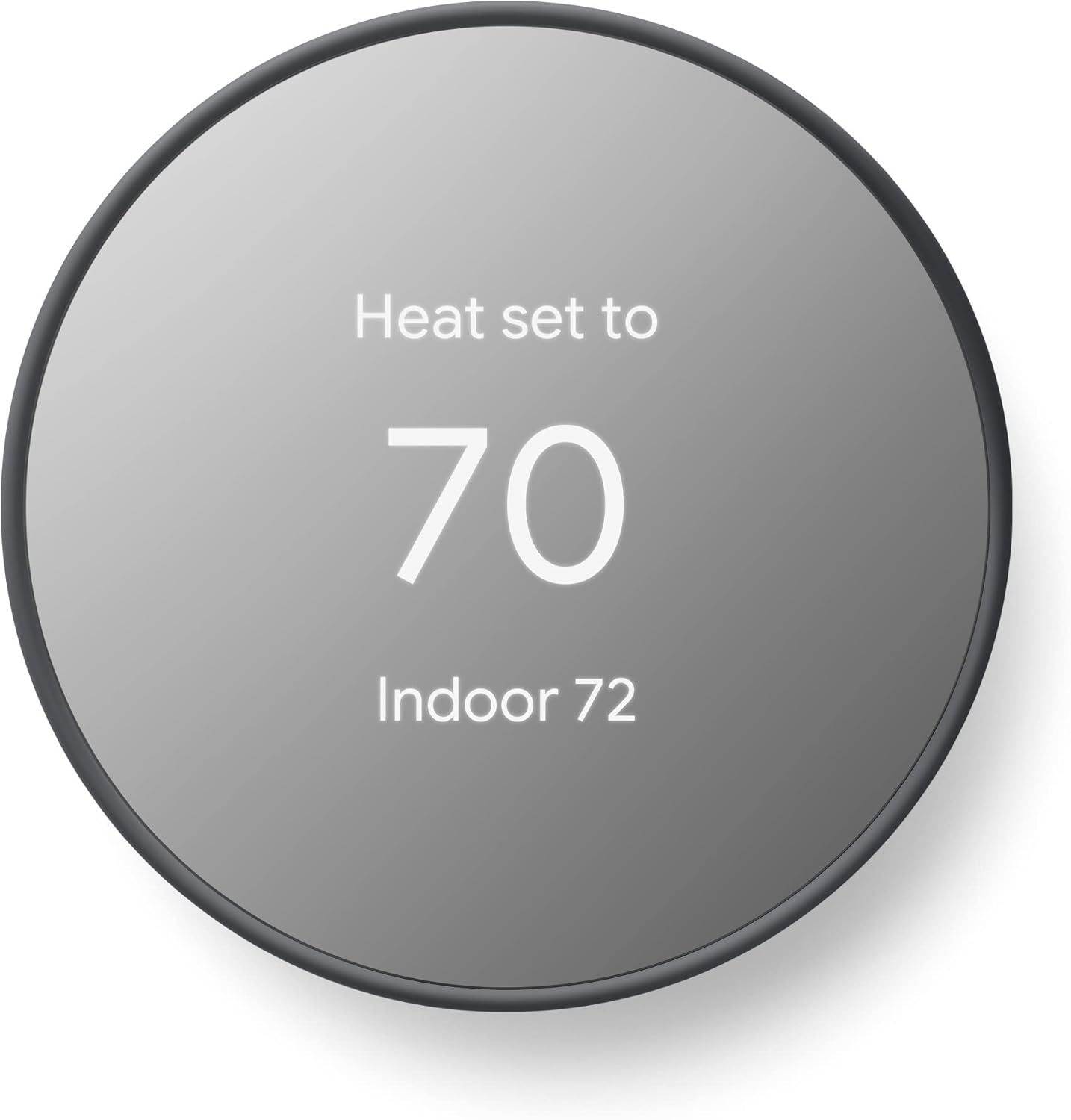
The Google Nest Thermostat is a compact smart thermostat designed for everyday home heating and cooling control via the Google Home app, voice assistants, or its touch side bar. It is typically mounted on a wall and used to set schedules, adjust temperature remotely, and receive HVAC alerts. Notable features include Wi‑Fi and Bluetooth connectivity, support for Google Assistant and other Matter‑certified voice assistants, Savings Finder suggestions, and basic HVAC monitoring that can flag potential issues. Installation is intended to be DIY-friendly and often completes in about 30 minutes, and the unit can operate without a C wire in many homes though some systems will need one or a power accessory. Practical benefits are simple remote control from a phone, automatic Eco Temperatures when the home is empty, and app suggestions to trim energy use. Limitations include dependence on working internet and compatible voice hardware for remote voice control and alerts, and some HVAC configurations may require extra wiring or professional help to power the device.
Best for: Buyers who prioritize easy remote access, simple app-driven scheduling, and smart energy-saving suggestions backed by strong brand ecosystem and social proof.
Less Ideal for: People with nonstandard or high‑voltage HVAC systems or those who need a thermostat that operates fully offline without internet dependence.
- Remote control from the Google Home app for on‑the‑go temperature adjustments
- Supports voice control with Google Assistant and Matter‑certified assistants
- Energy-saving features like Savings Finder and automatic Eco Temperatures
- DIY installation designed to be completed in about 30 minutes
- Includes batteries, mounting screws, and a steel plate for simple setup
- Requires working Wi‑Fi and internet for remote features and some voice functions
- May need a C wire or power accessory for certain HVAC systems
Verdict: A compact, app‑centric smart thermostat that makes remote temperature control and basic energy savings easy for most homes.
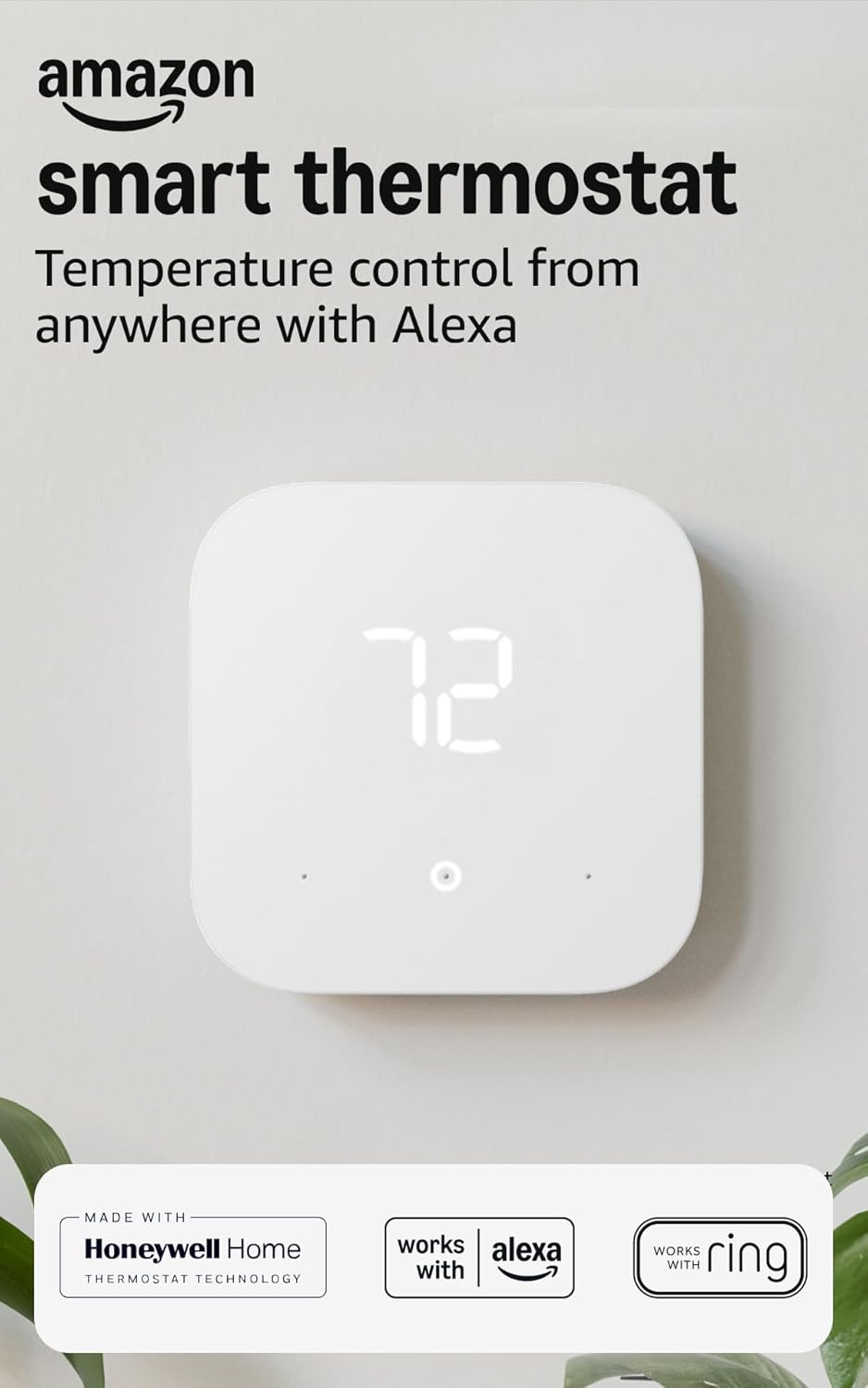
Amazon Smart Thermostat
| Requires | C-wire |
|---|---|
| Works with | Alexa and Ring |
| Technology | Honeywell Home thermostat technology |
| App control | Alexa app remote control |
The Amazon Smart Thermostat is a straightforward Wi‑Fi thermostat that brings basic smart control and Alexa integration to a conventional HVAC system. It installs on a standard C-wire setup and pairs with the Alexa app to let you change temperature remotely, run schedules for home/away/sleep modes, and use presence or compatible Alexa devices to adjust heating and cooling automatically. The unit relies on Honeywell Home thermostat technology for core thermostat functions and exposes energy-saving features and rebate information through the Amazon ecosystem. Setup is guided in the Alexa app, which simplifies DIY installation and ongoing control for users who already use Alexa devices. Limitations include the need for a C-wire and dependence on the Alexa app for advanced features, so it is not a fully independent touchscreen thermostat for users who prefer native device-only programming. For those seeking a simple, voice-first remote thermostat that emphasizes easy setup and energy savings, it delivers sensible functionality without complicated extras.
Best for: Buyers who want a low-friction upgrade from a conventional thermostat and prioritize simple remote control, Alexa voice commands, and guided DIY installation.
Less Ideal for: Anyone who wants a thermostat that operates fully standalone without a smart home platform or who lacks a C-wire and does not want to install one.
- Easy Alexa integration for voice control and routines
- Remote control and scheduling via the Alexa app
- Energy-saving features and eligibility information for local thermostat rebates
- Requires a C-wire for installation
- Advanced features depend on the Alexa ecosystem rather than built-in thermostat controls
Verdict: Choose this thermostat if you want a simple, reliable Alexa-first replacement that makes remote control and basic energy savings easy.
Choosing the Right Remote Thermostat: Key Factors to Consider
Sensor Accuracy
Accurate temperature sensing is the primary reason to add remote thermostats. Small differences in where the thermostat measures versus where people spend time can lead to rooms that feel too hot or too cold. Look for devices with reliable sensors and clear calibration options so you can fine-tune readings for the actual room environment.
Good accuracy reduces short cycling and unnecessary HVAC runtime, which helps both comfort and energy use. If the remote thermostat reports average room temperature across multiple sensors, understand whether the system allows per-sensor offsets or prioritization so the control logic reflects actual occupancy patterns.
Wireless Connectivity
Remote thermostats rely on wireless links between sensors and the main thermostat or hub. Connectivity performance affects responsiveness and how consistently temperature data reaches the controller. Consider the wireless protocol used, expected range, and whether devices support mesh networking or repeaters for larger homes.
Interference from metal ductwork, thick walls, or other electronics can reduce range. Choose a system with clear signal-strength indicators or documented range estimates, and plan sensor placement to maintain line-of-sight where practical.
Installation and Compatibility
Installation can vary from simple battery-powered sensors to systems that require wiring to the main thermostat or HVAC. Check whether the remote thermostat works with your current thermostat type and control wiring. Some solutions are designed to work with common residential HVAC systems without extra modules, while others may need a compatible base unit.
Ease of installation affects cost and whether you can do the work yourself. Also think about mounting options, plate sizes, and whether the sensor placement will be practical in rooms where it will be exposed to sunlight or drafty zones that skew readings.
Control Options and Scheduling
A remote thermostat is more useful when its data integrates into meaningful control logic. Look for systems that let you prioritize sensors, create comfort schedules, or trigger modes based on occupancy. Mobile app quality, thermostat faceplate usability, and voice or smart-home integration are important if you want remote control or automated routines.
Scheduling granularity matters when you want different day and night setpoints or zoning behavior. Systems that allow room-specific hold functions or temporary overrides make it easier to respond to changing use without disrupting long-term schedules.
Power Source and Battery Life
Sensor power affects maintenance frequency and placement flexibility. Battery-powered sensors are easy to locate but require periodic replacement. Devices that support long-life batteries or rechargeable options reduce upkeep. Some remote sensors draw power from the thermostat base or use low-voltage wiring, which can eliminate battery concerns but restrict mounting locations.
Consider whether the main thermostat requires a common wire or offers power-sharing to keep batteries out of the equation. Also check that low-battery alerts are clear so sensors do not silently fail and leave rooms uncontrolled.
Build Quality and Environmental Tolerance
Remote sensors are often installed in high-traffic rooms, near windows, or above appliances where temperatures can swing. Durable construction and stable performance across normal household temperature and humidity ranges matter for long-term reliability. Look for clear specifications on operating temperature and humidity ranges and consider units with protective enclosures if installing in kitchens or sunrooms.
A well-built sensor resists drift and maintains calibration longer, reducing the need to recalibrate or replace units. Consider whether the manufacturer documents expected sensor drift and how to recalibrate if necessary.
Where to Place Remote Sensors
Placement strongly affects how useful remote sensors are. Mount sensors where occupants spend most of their time, avoiding direct sunlight, drafts, and heat sources that create misleading readings. Hallways and stairwells often report different temperatures than living rooms or bedrooms, so prioritize common living spaces when you can.
For multi-sensor setups, distribute units to represent hot and cool spots. If you plan to rely on a single remote sensor for whole-room control, place it centrally at about eye level on an interior wall. Test placements for several days and check that reported temperatures match perceived comfort before finalizing locations.
- Avoid direct sunlight, vents, and appliance exhausts
- Mount away from exterior walls and windows when possible
- Place at typical head height rather than near the ceiling
- Use multiple sensors to capture temperature variance in large rooms
Balancing Energy Savings and Comfort
Remote thermostats can improve energy efficiency by preventing the main thermostat from responding to a single biased location. To realize savings, combine accurate sensing with sensible schedules or setback strategies that reduce runtime during unoccupied periods. Be aware that aggressive setbacks can lead to delayed recovery and occupant discomfort if your HVAC system is undersized.
If energy savings are a priority, favor systems that support multi-sensor averaging or occupancy-based control so you avoid overconditioning one room at the expense of others. Confirm how the system handles conflicting sensor inputs and whether you can configure priority rooms.
- Use setback schedules during predictable absence
- Prefer averaged or prioritized sensor logic for whole-home balance
- Monitor actual runtime changes after installation to validate savings
Integration With Smart Home Ecosystems
Many remote thermostats offer apps, APIs, or smart-home integration that extend control beyond the physical thermostat. If you already use a home automation platform, check compatibility and whether sensors expose temperature and battery-level data to other devices. Integration enables automations such as turning off fans when windows open or adjusting setpoints based on presence sensors.
Consider whether the thermostat supports local control versus cloud-only operation. Local integrations reduce latency and keep basic controls functioning during internet outages, while cloud services sometimes provide richer remote access and analytics.
- Check platform compatibility before purchase
- Prefer devices that expose sensor data for automation
- Understand local versus cloud control tradeoffs
Maintenance and Long-Term Reliability
Plan for periodic checks of sensor batteries and connectivity status. Establish a routine to inspect signal strength and battery indicators, especially during seasonal changes when temperature demands increase. Firmware updates are another maintenance aspect; choose a product that receives regular software support to address bugs and improve security.
Long-term reliability also depends on how easy it is to replace sensors or swap batteries. Systems with clear diagnostic tools simplify troubleshooting and reduce the likelihood of undiscovered sensor failures that can undermine comfort.
- Replace batteries before seasonal peaks
- Monitor firmware update policies and support channels
- Keep spare sensors or batteries if your setup is critical
How We Chose the Best Remote Thermostat
We focused on the practical capabilities that determine how well a remote thermostat performs in real homes. Evaluation prioritized temperature sensing accuracy and calibration options because local sensor reliability is the core purpose of remote thermostats. Connectivity and wireless reliability were weighed heavily to ensure consistent communication between remote sensors, the thermostat head, and the HVAC controller. Installation flexibility and compatibility were assessed to reflect common wiring and mounting scenarios in existing homes. User controls and scheduling features were included to measure day-to-day usability and energy management potential. Build quality and power options were reviewed to judge long-term reliability and battery life. We excluded devices that require proprietary HVAC modules or extensive professional integration beyond ordinary homeowner wiring. Units were also screened out if they lacked basic sensor calibration or offered no dependable wireless link between sensor and base. The final list balances ease of setup, sensing performance, and communications reliability so the included thermostats suit most homeowner needs.
Our full evaluation process is outlined in our review methodology.
FAQ
Can a remote thermostat sensor control the HVAC independently?
Usually the remote sensor provides temperature input to the main thermostat rather than directly controlling HVAC equipment. The thermostat uses that sensor data according to its configuration, so independent control typically requires system features that allow sensor prioritization or holds.
How far away can I place a remote sensor from the thermostat?
Range varies by product and home layout. Typical wireless sensors work well across a single-story house but may need repeaters or closer placement in multi-story homes, thick-walled homes, or when metal obstacles are present. Check the manufacturer's stated range and test signal strength during setup.
Do remote sensors need regular calibration?
Many sensors remain accurate without frequent calibration, but temperature offsets can occur over time or because of placement. Choose units with simple calibration or offset settings and recheck accuracy if readings drift or if occupants report comfort issues.
Will remote thermostats increase HVAC runtime?
They can increase runtime if sensors are placed in cooler or hotter spots than usual, prompting more conditioning. Proper placement and averaging or prioritization reduce this risk. The goal is better-targeted control that improves comfort without unnecessary runtime.
Are battery-powered sensors reliable long term?
Battery-powered sensors are reliable when batteries are replaced on a maintenance schedule. Look for long-life batteries, low-power wireless protocols, and clear low-battery alerts to avoid unexpected sensor downtime.
Final Verdict
Choose a remote thermostat by prioritizing accurate sensors and a communication method that reliably links those sensors to your HVAC controller. Balance installation convenience and power options against the need for precise placement and long-term maintenance. If you want both comfort and energy savings, favor systems that support multiple sensors with clear prioritization or averaging and that offer straightforward scheduling and diagnostics. With those tradeoffs in mind, you can confidently pick a remote thermostat that improves comfort where you live most while keeping maintenance manageable.