
Note: This article contains affiliate links. If you click on these links and make a purchase, we may earn a small commission at no extra cost to you. This helps support our research and content. Read our full affiliate disclosure here.
If you need quick hot water for a single fixture, a Mini Tank Water Heater can be a smart, space-saving solution. These compact tanks store a small reserve of hot water close to the point of use so you waste less water waiting for heat and avoid long piping runs. Choosing the right unit matters for reliability, installation complexity, and how much hot water you actually get between recovery cycles. This guide covers seven shortlisted mini tank water heaters that perform well for typical household tasks and one-off installs. We'll evaluate them on recovery speed, safety features, ease of installation, and energy efficiency to help you pick the best option for your setup.
Top Picks at a Glance
| Best Overall The best all-around choice for most situations | ThermoMate ES 6.5-Gallon Mini Tank |  |
| Best Quality Built to a higher standard if you want something more solid | Stiebel Eltron SHC 2.5 Mini-Tank |  |
| Best Value The sweet spot between price and what you get | Fisoceny 2.5 Gallon Water Heater |  |
| Best Budget The cheapest option that still gets the job done reliably | DYRABREST Mini Tank Water Heater SY-E29 |  |
| Top Rated A top-rated pick with lots of positive feedback | Bosch Tronic 3000 T ES2.5 Mini-Tank |  |
| Most Popular A crowd favorite that many people choose with confidence | BISELONG BI-2.5 Mini Tank Water Heater | 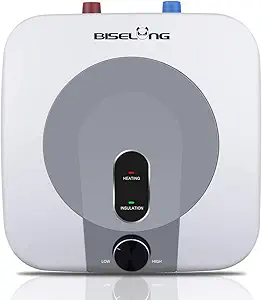 |
| Best Seller A high-volume bestseller chosen again and again | ThermoMate ES 2.5-Gallon Mini Tank |  |
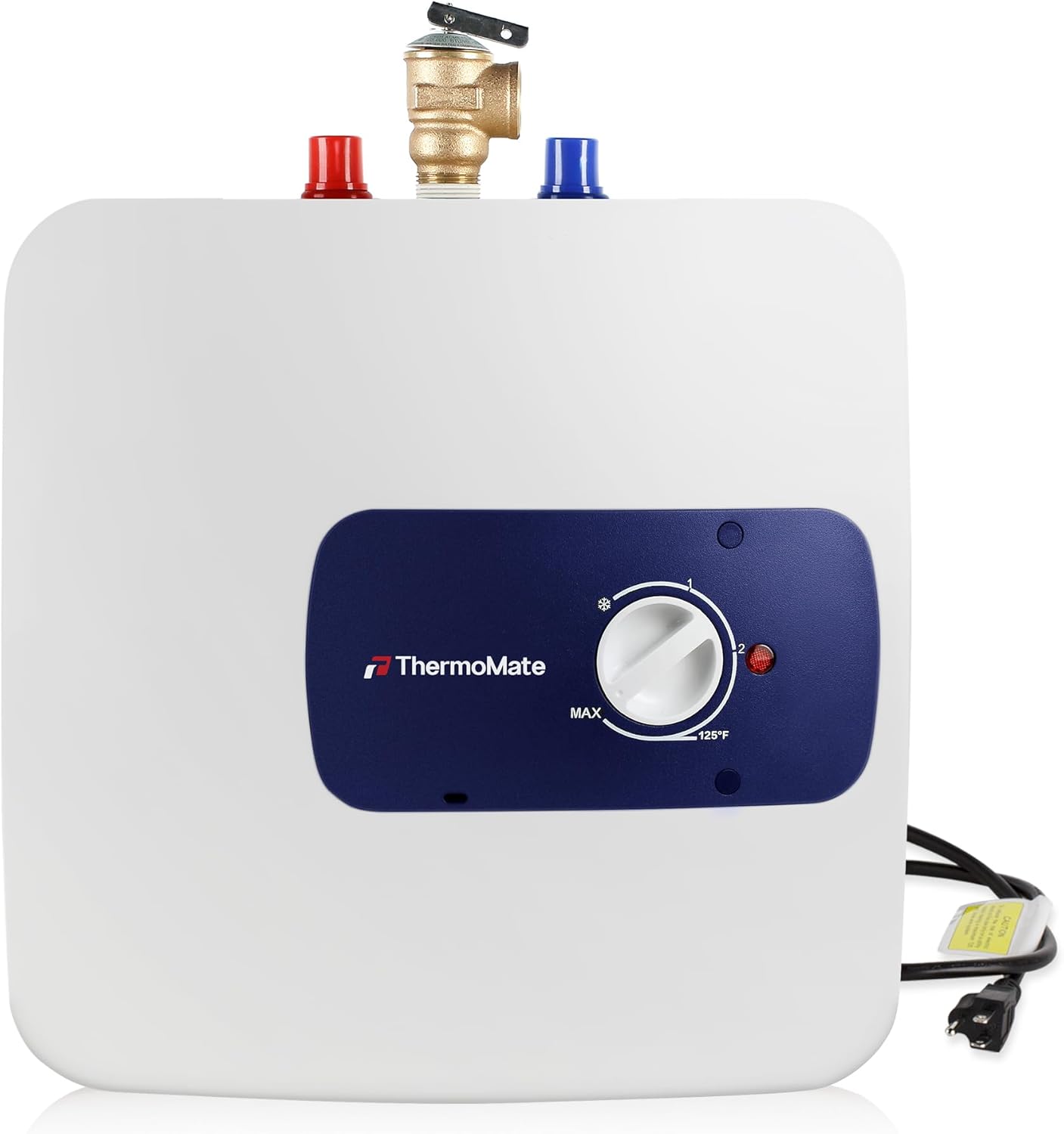
ThermoMate ES 6.5-Gallon Mini Tank
| Capacity | 6.5 gallons |
|---|---|
| Power | 1440W |
| Voltage | 120 volts |
| Maximum Temperature | 149 °F |
| Max. Water Pressure | 150 psi |
The ThermoMate ES 6.5-gallon mini tank stores and preheats a small volume of water so you get near-instant hot water at a sink or single fixture without routing to the main water heater. It plugs into a standard 120V outlet and uses a 1440W element with an adjustable thermostat that offers three temperature settings up to about 149°F, plus a freeze-protect mode. The glass-lined tank and included T&P relief valve and mounting kit make wall or floor installation straightforward for under-sink use, and the unit is UL listed. Because it is a point-of-use tank, it is best for boosting one faucet or serving a small appliance rather than supplying showers or multiple taps simultaneously; the product is not intended for shower service. Practical benefits include rapid recovery for short hot-water bursts, compact footprint for tight spaces, and simple plug-in electrical requirements so no hardwiring is needed. Buyers should expect limited capacity by design and plan installations around a single application.
Best for: Buyers who want a compact, easy-to-install hot-water booster for a single sink or small appliance and value quick access to hot water without rewiring.
Less Ideal for: Homes that need a whole-house solution, multiple simultaneous hot-water outlets, or enough capacity for showers should choose a larger or whole-house option.
- Plug-in 120V design avoids hardwiring and fits standard outlets
- Adjustable thermostat with three temperature levels up to 149°F
- Glass-lined tank and included T&P relief valve for corrosion resistance and safety
- Compact wall-or-floor mountable footprint for under-sink point-of-use installation
- 6.5-gallon capacity is too small to serve showers or multiple fixtures
- Not suitable for high-flow applications that require 1.5–2.5 gpm or more
Verdict: A compact, plug-in mini tank that gives fast, reliable hot water at a single fixture without hardwiring, ideal for under-sink booster use.
Stiebel Eltron SHC 2.5 Mini-Tank

| Capacity | 2.5 gallons |
|---|---|
| Wattage | 1300 watts |
| Voltage | 120 volts |
| Flow Rate | 2.5 gpm |
| Maximum Pressure | 150 psi |
The Stiebel Eltron SHC 2.5 is a plug-in mini-tank that mounts under or near a sink to provide immediate hot water for handwashing, kitchen prep, or other point-of-use needs. It draws 1300 watts from a standard 120V outlet and holds about 2.5 gallons, so it supplies several quick uses of hot water before needing to recover. The unit includes a mounting bracket, T and P valve, and a glass-lined tank for corrosion resistance, and its compact flat-back design minimizes space behind sinks. Practical benefits include fast recovery for a small tank and low standby heat loss compared with larger tanks, plus straightforward installation without special wiring. Limitations are inherent to the size: it will not support long multi-person showers or whole-house demands and requires sufficient inlet flow to reach the listed 2.5 gpm. For buyers focused on reliable point-of-use performance this model balances compact footprint, decent recovery, and simple installation, but expect to pair it with low-flow fixtures or use it only where short bursts of hot water are needed.
Best for: Buyers who need a reliable, high-performance point-of-use heater to deliver immediate hot water at a sink or small appliance without rewiring or sacrificing recovery speed.
Less Ideal for: Homes or fixtures that require sustained hot water for showers, multiple simultaneous uses, or whole-house supply should choose a larger or dedicated tank or tankless solution.
- Compact plug-in design mounts under or near sink for point-of-use hot water
- Glass-lined steel tank for corrosion resistance and durability
- Uses standard 120V outlet with 11.3A draw so no special wiring required
- Included mounting bracket and T&P valve simplify installation
- 2.5-gallon capacity limits continuous hot-water runs and larger applications
- Flow rate and recovery are constrained by its 1300W power level, so high-flow fixtures will exhaust the tank quickly
Verdict: If you want a compact, performance-focused point-of-use heater that plugs into a standard outlet and delivers quick hot water at a sink, the Stiebel Eltron SHC 2.5 is a strong choice.
Fisoceny 2.5 Gallon Water Heater

| Capacity | 2.5 gallons |
|---|---|
| Wattage | 1500 watts |
| Voltage | 120 volts |
| Maximum Temperature | 149 °F |
| Maximum Pressure | 108 psi |
This Fisoceny 2.5-gallon mini tank heater stores and reheats a small volume of water with a 1500W element, producing usable hot water in roughly 5 to 8 minutes after refill. It mounts under a sink or can be floor-mounted and is typically plumbed to a single fixture such as a kitchen tap or RV sink using the included 1/2" fittings and a 3-way diverter. Notable features are the stainless steel tank with seamless welding, a mechanical temperature knob adjustable from 86 to 149 F, safety protections including a pressure relief valve, overheat and anti-dry-burn safeguards, and a claimed 95% heating efficiency with upgraded insulation that helps retain heat for hours. Practical benefits include a small footprint for tight spaces, relatively fast recovery for low-flow uses, and basic safety features for household use. Limitations are the very low flow rate (0.25 gpm) and small capacity, which prevent continuous high-volume uses like showers and mean you should avoid running long hot-water draws at once.
Best for: Buyers who need a reliable, space-saving source of on-demand hot water for a single sink, RV, or small kitchenette and prioritize easy installation and energy-efficient standby performance.
Less Ideal for: Homes or situations that require sustained high-flow hot water such as full bathroom showers or simultaneous multi-fixture use.
- Compact 2.5-gallon tank fits under sinks and in RVs for space-constrained installs
- 1500W heating element reaches usable hot water in about 5–8 minutes
- Stainless steel seamless tank construction with multiple safety features including pressure relief and overheat protection
- Includes installation kit with hoses and 1/2" fittings and a 3-way diverter for straightforward hookup
- Very low flow rate (0.25 gpm) and small capacity make it unsuitable for showers or continuous high-demand use
Verdict: A compact, energy-efficient mini tank that provides quick hot water for a single sink or RV where space and simple installation matter most.
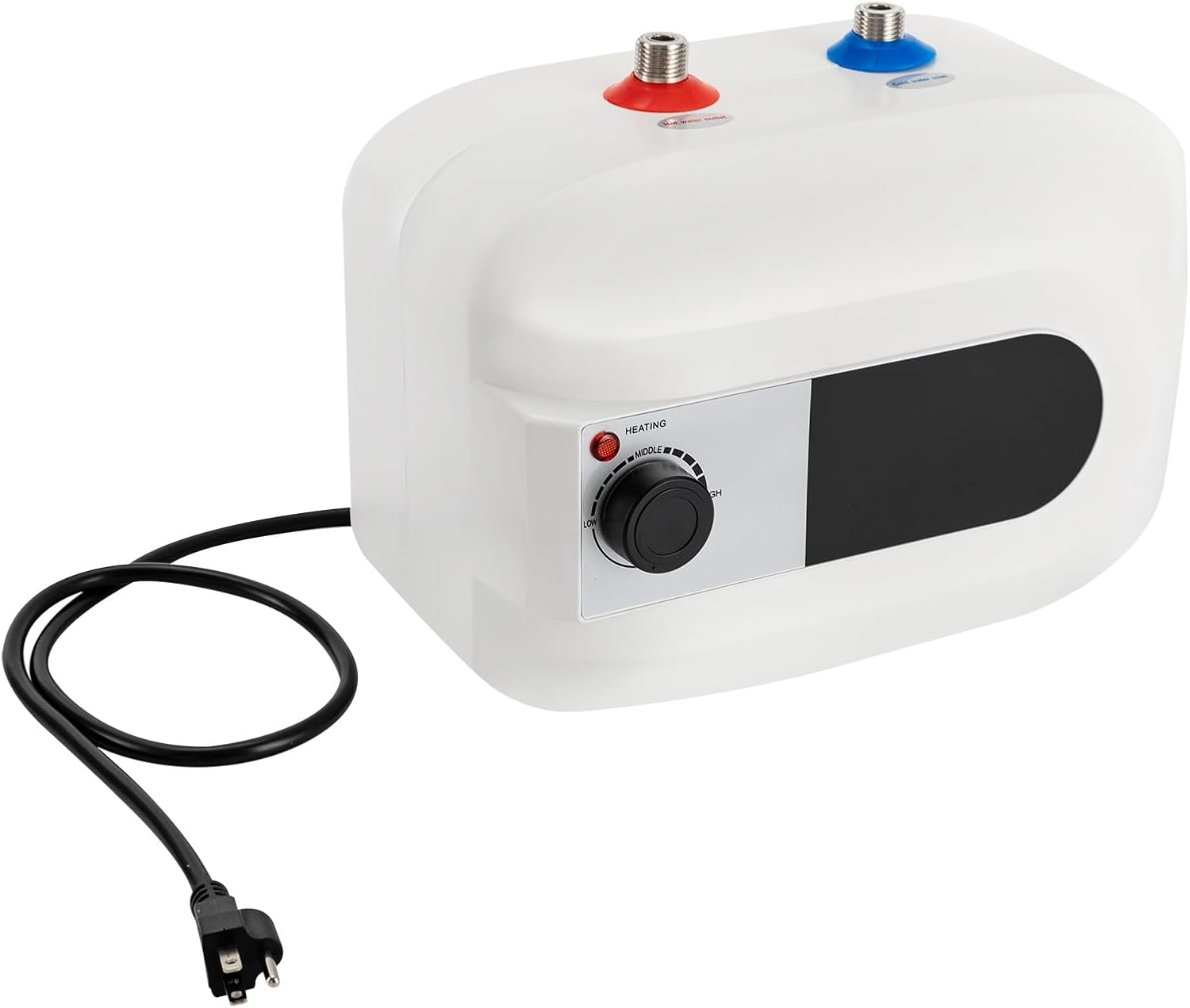
DYRABREST Mini Tank Water Heater SY-E29
| Capacity | 1.6 gallons |
|---|---|
| Wattage | 1500 watts |
| Voltage | 110 volts |
| Maximum Temperature | 149 °F |
| Maximum Pressure | 108.78 psi |
This compact 1.6-gallon mini tank heater delivers fast, on-demand hot water for sinks, small kitchens, bathrooms, and RVs by using a 1500W heating element and a stainless steel inner liner. It mounts under the sink and automatically replenishes cold water while maintaining temperature within an adjustable 86 to 149°F range via a simple control knob. Insulation (polyurethane foam) and a stainless steel tank help reduce standby heat loss, and built-in protections include overtemperature, overpressure, and anti-dry-burn shutoffs plus an IPX4 splash rating. Installation requires basic plumbing and an appropriate power outlet and the unit ships with a safety valve and hose. Limitations are its small 1.6-gallon capacity, which suits single-point uses but will run out under heavy simultaneous demand, and the short power cord and inlet hose may require repositioning or small extensions during installation. For buyers needing a compact, budget-friendly local hot-water source, this is a practical choice.
Best for: Buyers looking for an inexpensive, space-saving hot-water solution for a single sink, small kitchen, bathroom, or RV who prioritize quick local hot water over whole-home capacity.
Less Ideal for: Homes or households that need hot water for multiple fixtures at once or who want a whole-house solution should choose a larger tank or point-of-use system.
- Compact under-sink form factor fits tight spaces and RVs
- 1500W element heats quickly for single-point use
- Stainless steel inner liner with polyurethane insulation reduces heat loss
- Safety features including overtemperature, overpressure, anti-dry-burn protections and IPX4 rating
- 1.6-gallon capacity is small and can be depleted with multiple fixtures
- Short power cord and inlet hose may need adjustment or extension during installation
Verdict: A budget-friendly, compact under-sink mini tank that provides fast local hot water for one-point uses like sinks and small kitchens.
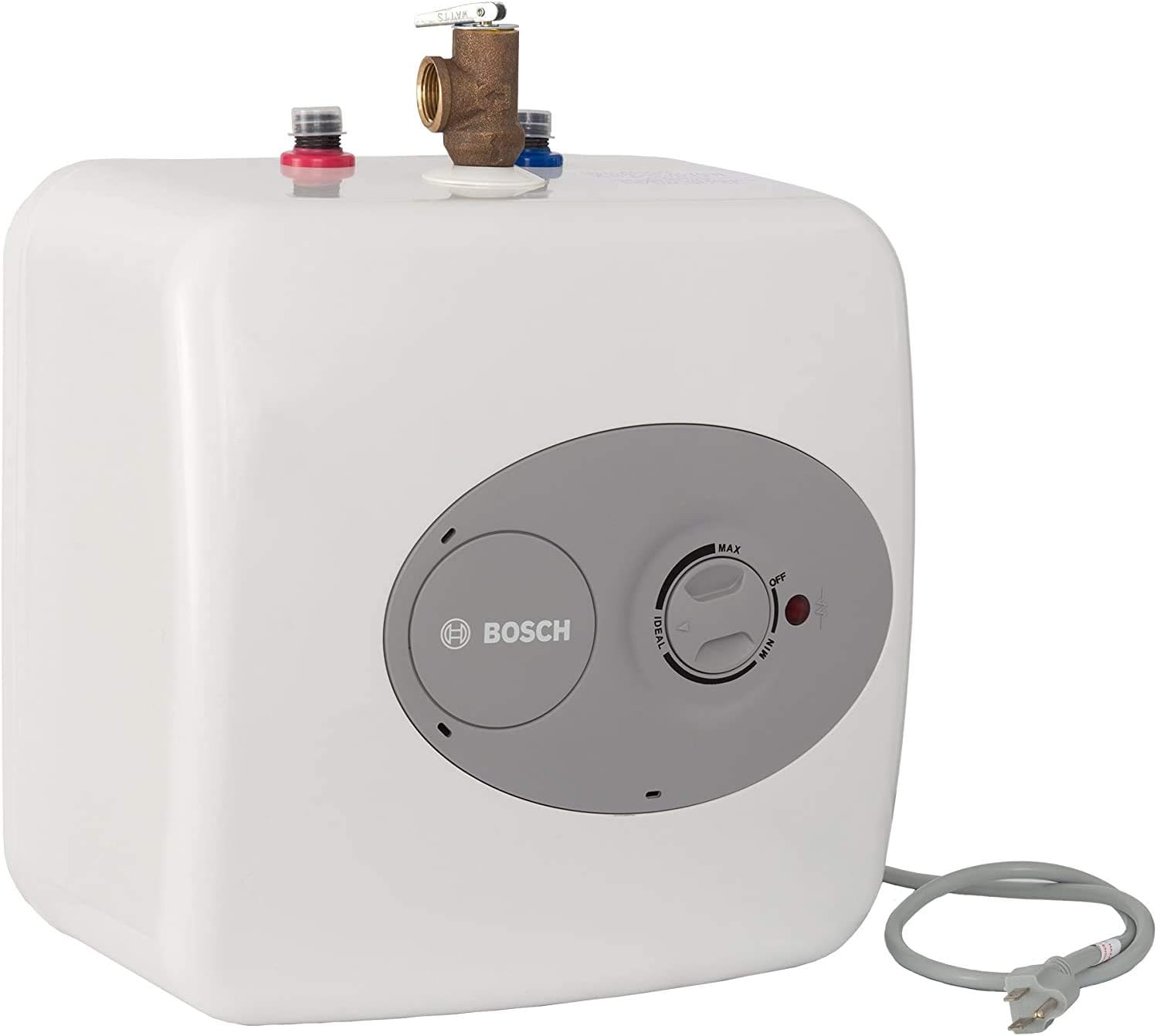
Bosch Tronic 3000 T ES2.5 Mini-Tank
| Capacity | 2.5 gallons |
|---|---|
| Wattage | 1440 watts |
| Voltage | 120 volts |
| Maximum Temperature | 140 °F |
| Efficiency | 98% |
The Bosch Tronic 3000 T ES2.5 is a compact point-of-use electric mini-tank that supplies hot water directly at the sink to reduce wait time and supplement a larger water heater. It mounts on a shelf, wall, or floor and can be plugged into a standard 120V outlet or hardwired, which simplifies independent installation under vanities. The 2.5-gallon glass-lined tank and 1440-watt element deliver a fast recovery rate suitable for one or two nearby fixtures and the external temperature dial plus a temperature-and-pressure relief valve make it straightforward to set and maintain safe output. Practical benefits include high thermal efficiency and a small footprint that blends in when left visible. Limitations are inherent to its size: it will not support whole-house demand or long continuous use, and capacity will be exhausted quickly under heavy draw, requiring time to recover between uses.
Best for: Buyers who prioritize a reliable, compact solution to eliminate long waits for hot water at a single sink and want a straightforward, low-complexity installation and operation.
Less Ideal for: Homes needing whole-house hot water or heavy simultaneous use across multiple bathrooms and showers should choose a larger or tankless option instead.
- Compact 2.5-gallon tank fits under sinks and in tight spaces
- Glass-lined tank for durability and corrosion resistance
- Can plug into a 120V outlet for easy independent installation
- External temperature dial and T&P relief valve for simple control and safety
- High thermal efficiency reduces standby heat loss
- Small capacity limits continuous hot water for multiple or high-flow fixtures
- 1440W element offers modest flow heating compared with higher-wattage units
Verdict: Choose this Bosch mini-tank when you want a reliable, easy-to-install point-of-use heater to get fast hot water at a single sink.
BISELONG BI-2.5 Mini Tank Water Heater

| Capacity | 2.5 gallons |
|---|---|
| Wattage | 1500 watts |
| Voltage | 120 volts |
| Maximum Temperature | 149 °F |
| Mount Type | wall mount or shelf mount |
The BISELONG BI-2.5 is a small electric storage heater made for under-sink or confined installations like RVs and food trucks. It stores 2.5 gallons of hot water and uses a 1500 W heating element to recover temperature in minutes, with a reported maximum temperature of 149°F and a built-in thermostat to hold set temperature. The unit mounts on a shelf or wall and includes basic fittings such as a T-tube, hose, safety valve and a plug-style power cord to simplify installation. Practical benefits include fast recovery for one or two nearby sinks, compact footprint that tucks into cabinets, and multilayer safety features such as overtemperature and dry-heat protection. It also uses thicker 304 stainless lining and upgraded heating components intended to improve durability and reduce scale. Important limitations are its small capacity, which means it is only suited for near-sink uses and will not supply whole-house needs, and it requires a dedicated 120 V circuit wired per instructions for safe operation.
Best for: Buyers who want a reliable under-sink or small-space hot-water source with quick recovery and visible user feedback from other customers, and who prioritize safety features and sturdier internal components.
Less Ideal for: People needing hot water for whole-house use, large tubs, or long simultaneous runs across multiple fixtures should choose a larger tank or different system.
- Compact 2.5-gallon tank fits under sinks or in small service spaces
- 1500 W heating element provides quick temperature recovery and up to 149°F output
- Includes installation accessories (T-tube, hose, safety valve) for easier setup
- Thicker stainless steel inner tank and upgraded heating tube for improved durability
- Multiple built-in safety protections including overtemperature and dry-heat protection
- Only 2.5 gallons of storage, so it can run out quickly under heavy use
- Requires a dedicated 120 V/15–20 A circuit and proper installation for safe operation
Verdict: Choose this mini tank when you need a compact, fast-recovering under-sink heater with upgraded internals and built-in safety for localized hot-water needs.
ThermoMate ES 2.5-Gallon Mini Tank

| Capacity | 2.5 gallons |
|---|---|
| Wattage | 1440 |
| Voltage | 120 volts |
| Maximum Temperature | 149 °F |
| Maximum Pressure | 150 psi |
The ThermoMate ES 2.5-gallon mini tank heats and stores a small supply of hot water for point-of-use installations like kitchen or bathroom sinks. It plugs into a standard 120V outlet and uses a 1440W Incoloy 800 heating element and a titanium glass-lined tank to deliver fast recovery and corrosion resistance. The adjustable temperature range up to 149°F and a built-in T&P relief valve provide basic safety and control, while the compact wall-or-floor mount design saves space under cabinets. Because it stores a modest volume, it works best as a booster or for a single faucet rather than whole-house use or showers. Installation is straightforward with 1/2" NPT fittings and a plug-in cord, but you should ensure the outlet location and plumbing access fit your layout. For buyers who want reliable, UL-listed point-of-use hot water with durable internal components, this ES model is a practical choice; buyers needing higher flow or multiple fixtures should consider a larger tank or tankless unit instead.
Best for: Buyers who want a reliable, factory-quality point-of-use heater to supply instant hot water to a single sink or fixture and who prioritize safety certifications and durable internal components.
Less Ideal for: Homes needing hot water for showers, multiple fixtures, or larger simultaneous loads should choose a larger tank or a dedicated tankless system instead.
- UL listed with included T&P relief valve for basic safety compliance
- Incoloy 800 heating element and glass-lined tank for improved corrosion resistance
- Plug-in 120V design simplifies installation without hardwiring
- Compact wall-or-floor mount form factor that fits under sinks
- 2.5-gallon capacity too small to support showers or multiple simultaneous fixtures
- 1440W power limits recovery and maximum flow compared with higher-watt models
Verdict: A compact, UL-listed 2.5-gallon mini tank that delivers reliable point-of-use hot water with durable components and simple plug-in installation.
Choosing the Right Mini Tank Water Heater: Key Factors to Consider
Recovery Speed
Recovery speed measures how quickly the unit can reheat water after the stored hot volume is used. Faster recovery means more continuous hot water for back-to-back uses, such as two quick showers or successive dishwashing cycles. Recovery depends on the heating element wattage and thermostat control accuracy. When you evaluate recovery, consider your typical demand pattern and whether the unit will feed a single sink, a remote shower, or act as a buffer for a larger system.
If you often run several fixtures in short succession, prioritize higher wattage and faster recovery. For occasional point-of-use needs, slower recovery may be acceptable if the stored volume meets your immediate demand.
Usable Tank Capacity
The nominal tank volume tells you how much hot water is immediately available, but usable capacity depends on the temperature rise you require and the thermostat's cutoff. A larger nominal tank gives more reserve, but size and space constraints often limit your choices. Think about the typical flow rates at the fixtures you plan to serve and how long you need hot water before the recovery cycle kicks in.
Also factor in the temperature you mix at the faucet. If you prefer hotter setpoints, effective usable volume will be lower. For a sink or single shower, a small-capacity tank sized to match peak draw is usually adequate; for repeated tasks, choose the next size up or a unit with faster recovery.
Installation Ease
Installation ease covers physical mounting, plumbing connections, electrical needs, and access for maintenance. Compact mini tanks vary in mounting style and required clearances. Units with integrated brackets and common plumbing fittings reduce install time. Check whether the unit is designed for horizontal or vertical mounting and ensure the chosen orientation fits your space.
Electrical requirements matter too. Some mini tanks use standard 120V circuits while others require 240V. If you need a dedicated circuit or special wiring, that adds installation cost and complexity. Consider accessibility for future service when positioning the unit.
Energy Efficiency
Energy efficiency affects ongoing operating cost and standby heat loss. Insulation thickness, tank lining, and thermostat accuracy all influence how much energy is needed to maintain stored temperature. Higher insulation reduces standby loss, which matters if the unit sits idle for long periods.
Also evaluate controls that reduce consumption, such as adjustable thermostats or vacation modes. For point-of-use service, the overall electrical draw per gallon of usable hot water and the standby loss profile are the most meaningful efficiency indicators.
Safety Features and Build Quality
Safety features protect against overheating, excessive pressure, and premature failure. Required elements include a reliable thermostat, a high-limit cutoff, and a pressure-temperature relief device. Good internal materials and corrosion-resistant linings extend service life and reduce the risk of leaks.
Build quality also influences maintenance needs. Look for clear access to replaceable parts such as heating elements and thermostats. Units with robust fittings and quality electrical connections reduce the chance of failure under routine use.
Where Mini Tank Water Heaters Make Sense
Mini tank water heaters are best for point-of-use situations where routing hot water from a central tank would be inefficient or slow. Typical uses include supplying a bathroom sink, a remote laundry tap, or a single compact shower where space is tight. They can also work as a buffer to reduce hot-water wait time at fixtures far from the main heater.
Consider whether you want the mini tank to be the primary source for a fixture or to supplement an existing system. For the latter, install near the outlet to minimize heat loss in the run and speed up hot-water delivery.
- Ideal for single-sink or single-shower applications
- Useful in garages, workshops, and small apartment kitchens
- Can reduce water waste by shortening wait times
Mounting and Placement Tips
Plan placement so plumbing runs are short and the unit is accessible for maintenance. Check manufacturer clearances for the relief valve and electrical connections. Many mini tanks offer wall-mount brackets; confirm the mounting option matches stud spacing or use appropriate anchors for masonry.
Avoid installing the unit in unheated spaces unless it has freeze protection. If mounting above a living area, consider a drain pan routed to an appropriate drain in case of leaks. Place the unit where the TPR valve discharge can be safely routed.
- Wall-mount near the point of use to reduce lag
- Provide service clearance for element and thermostat access
- Use a drain pan if installation is above finished space
Plumbing and Electrical Considerations
Confirm inlet and outlet connection sizes and whether adapters are needed for your existing plumbing. Some units include flexible connectors and shutoff valves, which simplify installation. Use dielectric unions if connecting to dissimilar metals to avoid corrosion.
Review electrical specs early. 120V models work with standard circuits but may heat more slowly. 240V models heat faster but require a dedicated breaker and proper wire gauge. Ensure wiring, breakers, and grounding meet local codes.
- Match plumbing fittings to avoid leaks and extra adapters
- Verify required circuit amperage and wire gauge
- Consider adding a dedicated shutoff valve for easier service
Maintaining a Mini Tank Water Heater
Routine maintenance keeps a mini tank running reliably. Periodic checks of the pressure-temperature relief valve and visual inspection for corrosion or leaks are simple but important. If the unit has a replaceable anode rod, inspect it on a schedule similar to full-size tanks to slow internal corrosion.
Flush the tank occasionally if your water is hard to prevent sediment buildup against the heating element. Follow the manufacturer's guidance for element access and replacement to ensure safe servicing.
- Test TPR valve annually
- Flush tank based on local water hardness
- Keep access space for element and thermostat replacement
Common Installation Pitfalls to Avoid
Underestimating the electrical requirements is a frequent mistake. Installing a unit that needs 240V on a 120V circuit will limit performance and create a hazardous situation. Likewise, ignore clearance requirements and you may block access to service points.
Another common issue is improper orientation. Some units are engineered for vertical mounting only. Installing them horizontally can impair operation and void warranties. Finally, failing to use a drain pan when required risks damage to finished spaces.
- Do not mix up 120V and 240V requirements
- Follow mounting orientation instructions closely
- Always install a drain pan if the unit sits above finished areas
How We Chose the Best Mini Tank Water Heater
We selected candidates that suit common single-fixture and auxiliary hot-water needs and then filtered for practical reliability and real-world installability. Primary evaluation focused on recovery speed, storage capacity relative to typical demand, and energy efficiency because those determine usable hot water and operating cost. Installation and mounting flexibility were evaluated to reflect how easy each unit is to integrate into tight spaces or existing plumbing. Safety features such as temperature-pressure relief, thermostat accuracy, and built-in high-limit protection were required for inclusion. Materials and corrosion resistance were considered to estimate service life without relying on long-term lab testing. Units that lacked basic plumbing fittings or required uncommon electrical configurations were excluded to keep the list useful to most installers and DIYers. Finally, we prioritized models with clear documentation and accessible replacement parts to reduce long-term maintenance risk.
Our full evaluation process is outlined in our review methodology.
FAQ
How long does hot water last in a mini tank?
Duration depends on tank size, set temperature, and flow rate. For a small sink-focused tank, expect enough hot water for several minutes at typical faucet flow. Higher flow fixtures or hotter setpoints will deplete usable volume faster.
Can a mini tank supply a shower?
Some mini tanks can support a single low-flow shower for a short period, but many are sized for sinks. If you plan to serve a shower, prioritize larger usable capacity and faster recovery or choose a unit designed for that application.
Do mini tanks need regular maintenance?
Yes. Basic maintenance includes periodically testing the pressure-temperature relief valve, checking for leaks, and flushing the tank if you have hard water. If the unit includes a sacrificial anode, inspect and replace it on a schedule to slow corrosion.
Are mini tanks energy efficient?
They can be efficient for point-of-use applications because they reduce hot water waiting losses in long runs. However, standby heat loss matters if the unit sits idle for long periods. Choose a well-insulated model and use reasonable thermostat settings for best efficiency.
What electrical circuit do mini tanks require?
Requirements vary. Some operate on standard 120V circuits while others need 240V and a dedicated breaker. Check the unit's specifications and confirm your wiring and breaker capacity before installation.
Final Verdict
For single fixtures and compact installations, prioritize recovery speed, usable tank capacity, and straightforward installation. Tradeoffs typically involve tank size versus recovery rate and the electrical work required to achieve faster heating. Safety features and good insulation reduce long-term risk and operating cost. Choose the configuration that matches your typical flow rates and space constraints to ensure reliable hot water without unnecessary complexity.