
Note: This article contains affiliate links. If you click on these links and make a purchase, we may earn a small commission at no extra cost to you. This helps support our research and content. Read our full affiliate disclosure here.
Choosing the right inexpensive programmable thermostat matters because a clear schedule and reliable temperature control can reduce wasted heating and cooling without adding complexity. If you want straightforward programming, consistent performance, and predictable energy savings, the right budget thermostat makes a noticeable difference in day-to-day comfort and utility use. This guide highlights our shortlisted picks for inexpensive programmable thermostats and explains the features and tradeoffs to consider when picking one for your home. Below you will find compact evaluations that focus on setup, programming, compatibility, and long-term reliability to help you decide which low-cost programmable thermostat suits your needs.
Top Picks at a Glance
| Best Overall The best all-around choice for most situations | Heagstat H705 Programmable Thermostat |  |
| Best Quality Built to a higher standard if you want something more solid | Honeywell Home RTH7600D Thermostat |  |
| Best Value The sweet spot between price and what you get | LUX PSP511LC Programmable Thermostat |  |
| Best Budget The cheapest option that still gets the job done reliably | Flylin Week Programmable Thermostat |  |
| Top Rated A top-rated pick with lots of positive feedback | Riseem STN615 Programmable Thermostat |  |
| Most Popular A crowd favorite that many people choose with confidence | Suuwer S705 Programmable Thermostat |  |
| Best Seller A high-volume bestseller chosen again and again | Honeywell Home X2P Programmable Thermostat RTH20B |  |
Heagstat H705 Programmable Thermostat

| Temperature Control Type | 1 Heating and 1 Cooling |
|---|---|
| Power Source | 24VAC, Battery Powered |
| Display Type | LCD |
| Connectivity Technology | Wired |
| Programmable | 5-1-1 day |
The Heagstat H705 is a straightforward, budget-oriented programmable thermostat that handles single-stage heating and cooling for standard forced-air systems. You program separate schedules for weekdays and weekends with four periods per day, and the large backlit LCD and one-button wake light make set up and daily use simple. It runs on 24VAC hardwire power or two AAA batteries so it can be installed where a common wire is unavailable, and the universal sub-base and labeled terminals simplify DIY wiring. Practical features include adjustable temperature swing and calibration, selectable air filter and compressor delay reminders, and a low-battery indicator. Limitations are its single-stage only design and lack of support for heat pumps, multi-stage systems, line-voltage or electric baseboard heat, and advanced smart features like remote app control or learning. For buyers wanting a low-cost, no-frills programmable thermostat that improves schedule-based energy management, the H705 covers the essentials cleanly; it is not suitable if you need multi-stage compatibility or Wi-Fi remote control.
Best for: Buyers who want an affordable, easy-to-install programmable thermostat to add schedule-based control and clearer temperature display without needing smart home connectivity.
Less Ideal for: People who require Wi-Fi remote control, learning features, or support for heat pumps and multi-stage HVAC systems should choose a different model.
- Simple 5-1-1 day programming with four periods per day for basic schedule control
- Dual power option works with 24VAC or two AAA batteries so no C-wire is required
- Large backlit LCD and one-button wake light for easy readability
- Universal sub-base and labeled terminals make DIY installation straightforward
- Selectable reminders and adjustable temperature calibration for precise control
- Only supports single-stage conventional systems and is incompatible with heat pumps or multi-stage HVAC
- No Wi-Fi or smartphone control and lacks advanced smart features
Verdict: A low-cost, easy-to-install programmable thermostat that gives reliable schedule control and clear display for standard single-stage HVAC systems.
Honeywell Home RTH7600D Thermostat

| Controller Type | Touch |
|---|---|
| Program Mode | 7-Day |
| Power Source | Battery Powered or Wired (24 volts) |
| Display Type | Digital backlit touchscreen |
| Number of Batteries | 1 AAA required |
The RTH7600D is a straightforward 7-day programmable thermostat with a large backlit touchscreen and menu-driven setup for four periods per day. It is designed to learn how long your heating and cooling systems take to reach setpoints with Honeywell Smart Response Technology, then preheat or precool so rooms hit programmed temperatures at the expected times. The unit supports auto changeover between heating and cooling, filter change reminders, a compressor short-cycle protection delay, and shows current and set temperatures simultaneously on the screen. Installation is simple for homeowners comfortable with low-voltage wiring and it can run on one AAA battery or wired 24V power. Limitations: it lacks Wi-Fi or app control, so scheduling and adjustments must be done at the thermostat, and it does not provide remote monitoring or energy-reporting features found on newer smart models.
Best for: Buyers who want reliable, performance-focused scheduled temperature control with a clear touchscreen interface and proven thermostat algorithms rather than connected smart features.
Less Ideal for: People who need Wi-Fi access, smartphone control, voice assistant integration, or remote energy reports should choose a connected smart thermostat instead.
- Large, backlit touchscreen with easy menu-driven programming
- Smart Response Technology adapts preheating/cooling to reach setpoints on time
- Auto changeover and compressor protection reduce manual switching and prevent short-cycling
- Battery or 24V wired power options simplify installation in most homes
- No Wi-Fi or remote/app control for scheduling or monitoring
- Does not include advanced energy-reporting or learning features found in connected thermostats
Verdict: Choose this thermostat if you want a dependable, performance-oriented programmable unit with a large touchscreen and Smart Response timing without paying for connected smart features.
LUX PSP511LC Programmable Thermostat

| Programming | 5/2-day, 4 periods/day |
|---|---|
| Power Source | 2 AA batteries (included) |
| Display Type | Backlit LCD |
| Voltage | 24 volts of alternating current |
| Control Type | Push button / mechanical knob |
The LUX PSP511LC is a straightforward 5/2-day programmable thermostat aimed at buyers who want simple scheduling without smart-home complexity. It offers separate weekday and weekend programs and up to four periods per day for heating and cooling, plus a lighted LCD for visibility and a keypad lockout to prevent accidental changes. The unit runs on two AA batteries and mounts to the wall, using push-button controls and a mechanical speed-dial interface that makes setup and daily adjustments familiar and fast. Notable practical benefits include clear temperature control from 45 to 90 F and compatibility with common 24VAC systems found in standard furnaces and air conditioners. Limitations include lack of Wi‑Fi app control or learning features, no humidity sensing, and incompatibility with multi-stage heat pumps, line-voltage systems without a transformer, and some hydronic systems, so it is not suitable for complex HVAC setups. For homeowners who want a reliable, no-frills programmable thermostat to cut energy use with manual scheduling, this model delivers sensible features at a low complexity level.
Best for: Buyers who prioritize a low-complexity, manually programmable thermostat to reduce energy use via scheduled setpoints and who value straightforward installation and controls.
Less Ideal for: Users who want smart-home integration, remote control, or advanced multi-stage HVAC compatibility should consider a smarter or more fully featured model.
- 5/2-day programming with up to four periods per day for tailored weekday and weekend schedules
- Backlit LCD and simple speed-dial/push-button controls for easy viewing and adjustments
- Battery powered with included batteries for straightforward installation without a C-wire
- Keypad lockout prevents accidental or unauthorized changes
- Compatible with standard 24VAC HVAC systems for broad basic system support
- No Wi‑Fi or remote app control for scheduling or monitoring
- Not compatible with multi-stage heat pumps, many line-voltage systems, or some hydronic setups
- No advanced sensors like humidity or occupancy detection
Verdict: A reliable, no-frills 5/2 programmable thermostat that lets budget-minded buyers set distinct weekday and weekend schedules without smart-home complexity.
Flylin Week Programmable Thermostat
| Connectivity Technology | Wired |
|---|---|
| Display Type | LCD |
| Power Source | Corded Electric |
| Probe Sensor | NTC (10K) 1% |
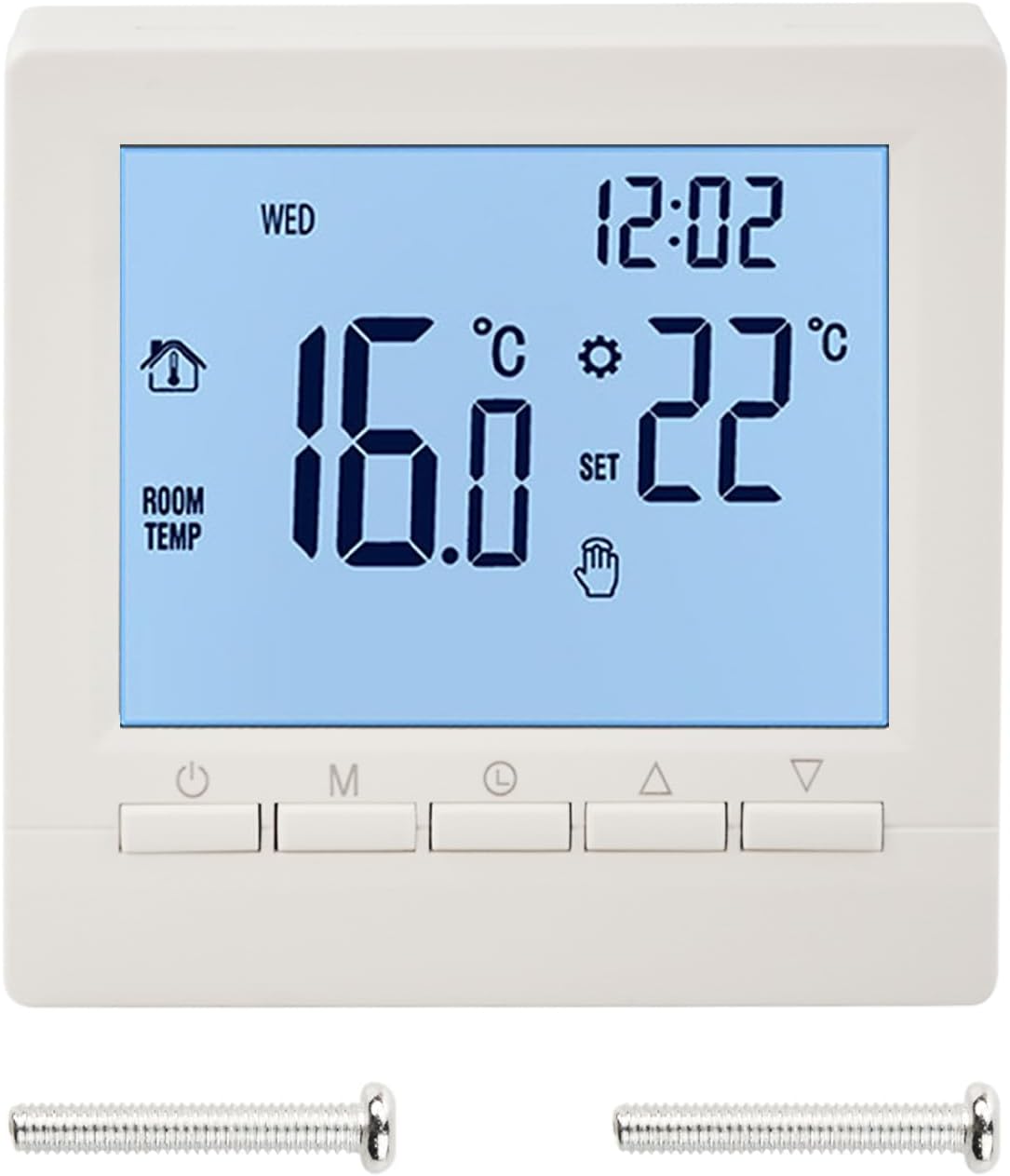
The Flylin Week Programmable Thermostat is a basic wired wall thermostat designed to run a 5+2 weekly schedule for simple home heating control. You set temperatures using touch buttons and a mechanical knob, then program separate weekday and weekend routines; the unit stores settings through power loss so you do not have to reconfigure after outages. It includes an NTC probe sensor, a relay output for low-voltage heating or water heating applications, and a child lock for safety. Practical benefits include straightforward programming for users who want a predictable schedule, frost protection to guard against freezing conditions, and very low standby power consumption. Expect an entry-level fit and finish with plastic construction and simple LCD readout rather than a high‑end touchscreen or Wi‑Fi features, and the relay is sized for light loads so complex HVAC systems or high-current equipment are not supported.
Best for: Buyers seeking a low-cost, no-frills programmable thermostat to set reliable weekday and weekend temperature schedules and protect homes from freeze conditions.
Less Ideal for: People who want smart features like Wi‑Fi, app control, or support for complex high-current HVAC systems should look at more advanced models.
- 5+2 week programmable schedule for weekday/weekend temperature control
- Data memory preserves settings during power outages
- Child lock prevents accidental or unauthorized changes
- Frost protection helps prevent frozen pipes
- Wired-only design with no Wi‑Fi or remote control
- Relay output rated for light loads only, not for high‑current HVAC equipment
Verdict: A budget-friendly wired programmable thermostat that delivers simple weekday/weekend scheduling, power-fail memory, and frost protection for basic heating systems.
Riseem STN615 Programmable Thermostat

| Temperature Control Type | 24V Conventional Multi Stage Thermostat |
|---|---|
| Power Source | Dual Power Supply (24VAC or 2 AAA batteries) |
| Display Type | LCD |
| Program Type | 5-1-1 Day Programmable |
| Control Type | Button Control |
The Riseem STN615 is a straightforward programmable thermostat aimed at basic heating and cooling control for 24V residential systems. It provides 5-1-1 day programming so you can set weekday, Saturday and Sunday schedules, and its large backlit LCD and simple button controls make daily adjustments easy. The unit supports single- and multi-stage forced-air systems, heat pumps without auxiliary heat, and other common 24V setups, and it can run from 24VAC or two AAA batteries so it will keep time through minor power interruptions. Installers will appreciate the universal sub-base and clearly labeled terminal block that can speed up a typical wall-mount swap in under 30 minutes. Notable extras include adjustable temperature swing, selectable compressor delay protection and an easy-access battery compartment. Limitations include no Wi-Fi or remote control, no support for line-voltage or mini-split systems, and it lacks advanced zoning or learning features, so buyers should treat it as a reliable, no-frills replacement rather than a smart-home centerpiece.
Best for: Buyers who prioritize a dependable, easy-to-install programmable thermostat for standard 24V heating and cooling systems and who want simple schedule control without smart-home extras.
Less Ideal for: People who need Wi-Fi connectivity, app-based remote scheduling, or compatibility with line-voltage or mini-split HVAC systems should look elsewhere.
- 5-1-1 day programmable schedule for weekday/Sat/Sun flexibility
- Dual power operation (24VAC or 2xAAA batteries) preserves function during power loss
- Universal sub-base and large terminal blocks simplify installation
- Backlit LCD and button controls are easy to read and operate
- Adjustable temperature differential and selectable compressor delay for system protection
- No Wi-Fi, app control, or smart-home integration
- Not compatible with line-voltage, mini-split, or dual-fuel systems
Verdict: A no-frills, installation-friendly programmable thermostat that delivers reliable 24V heating and cooling control for buyers who want dependable performance over smart features.
Suuwer S705 Programmable Thermostat

| Power Source | 24VAC or 2 AAA batteries |
|---|---|
| Control Type | Push Button |
| Display Type | Digital, 4.5 inch backlit LCD |
| Programmable | 5-1-1 day, 4 periods per day |
| Compatibility | Single-stage heating and cooling (1H/1C) |
The Suuwer S705 is a straightforward 5-1-1 day programmable thermostat designed for conventional single-stage (1 heat/1 cool) systems. It provides separate weekday and weekend schedules with four periods per day, a large 4.5-inch blue backlit LCD for easy reading, and selectable 5-minute compressor delay protection to protect equipment. The unit can run on 24VAC or two AAA batteries so many homes can install it without a dedicated common wire, and it includes features like separate heat/cool swing adjustment, ambient temperature correction, and reminders for low battery and filter changes. Practical benefits include simple programming for habitual temperature setbacks, clear on-screen information that helps older users, and protection settings that reduce short-cycling risk. Limitations are its single-stage compatibility only and explicit incompatibility with multi-stage, line-voltage, mini-split, and many heat-pump setups, so it is not a fit for more complex HVAC systems or those needing Wi-Fi or smart-home features.
Best for: Buyers who want a low-cost, proven programmable thermostat with straightforward scheduling and a clear display and who value reliability and simple, local control over smart features.
Less Ideal for: Homeowners with multi-stage HVAC, mini-split, line-voltage, or advanced heat-pump systems or those who need remote control, app integration, or smart energy tracking.
- 5-1-1 day programming with four periods per day for weekday/weekend scheduling
- Large 4.5-inch backlit LCD that is easy to read
- Dual power options (24VAC or 2 AAA batteries) so a common wire is not required in many installs
- Selectable 5-minute compressor delay protection to prevent short cycling
- Compatible only with single-stage conventional systems and explicitly incompatible with multistage, mini-split, line-voltage, and many heat-pump systems
- No Wi-Fi or smart-home connectivity for remote control or energy reports
Verdict: A budget-friendly programmable thermostat that delivers simple, reliable scheduling and an easy-to-read display for homes with single-stage HVAC systems.
Honeywell Home X2P Programmable Thermostat RTH20B

| Controller Type | Push Button |
|---|---|
| Temperature Control Type | Programmable |
| Display Type | LCD |
| Power Source | Battery Powered |
| Number of Batteries | 2 AA batteries required. |
The Honeywell Home X2P (RTH20B) is a straightforward programmable thermostat built for single-stage 1 heat/1 cool systems. It provides 5-2 day scheduling or a non-programmable mode, a large backlit LCD for easy reading, and options to set filter-change reminders and display preferences. Installation is conventional wall-mount with battery power from two AA cells and it supports common conventional systems including forced air and hot water heat while excluding electric baseboard heat. The interface uses touchpad controls and push-button operation, which keeps programming simple rather than feature-heavy. Practical benefits include clear daily scheduling, a readable screen for quick temperature checks, and Energy Star certification on this model which can help with steady energy use. Limitations are its lack of smart features like Wi-Fi control, no advanced multi-stage or heat-pump programming beyond single-stage support, and reliance on batteries rather than a built-in hard power option, which may require occasional battery changes. For buyers wanting a reliable, no-frills programmer, this covers the essentials without complexity.
Best for: Buyers who want a dependable, easy-to-program thermostat with clear on-device controls and predictable performance without smart-home features.
Less Ideal for: Users who need remote app control, multi-stage or advanced heat-pump compatibility, or prefer a thermostat that is powered through the HVAC C-wire.
- Simple 5-2 day scheduling for weekday/weekend programming
- Large backlit LCD and clear font for easy daily use
- Filter change reminders and customizable display settings
- Compatible with common single-stage conventional heating and cooling systems
- Not Wi-Fi enabled so no remote control or app scheduling
- Designed for single-stage systems only and not for electric baseboard heat
- Powered by AA batteries rather than a wired power option
Verdict: A dependable, no-frills programmable thermostat that gives straightforward scheduling and clear on-device controls for buyers who prioritize simplicity and reliability.
Choosing the Right Inexpensive Programmable Thermostat: Key Factors to Consider
Programming Complexity
How the thermostat handles schedules directly affects whether you will actually use its energy-saving features. Simple models use preset weekday/weekend or 7-day schedules with large, labeled buttons. More flexible units offer multiple program periods per day but may require more time to learn.
If you prefer set-and-forget convenience, prioritize a thermostat with a straightforward interface and clear on-screen prompts. If you want fine-grained control, look for units that support multiple periods per day and easy overrides without losing the programmed schedule.
Installation Compatibility
Budget programmable thermostats must fit the wiring and control system in your home. Most inexpensive units are designed for common single-stage heating and cooling systems, but wiring labels and terminal layouts vary. Check whether the thermostat requires a C-wire or supports batteries, and whether it has terminals for heat, cool, fan, and common functions.
Incorrect wiring can prevent the thermostat from powering on or controlling your system properly. Look for clear wiring diagrams and compatibility notes, and consider whether you are comfortable doing a simple DIY install or prefer professional help.
Temperature Sensing And Placement
Thermostat accuracy depends on the quality of the sensor and where the unit is mounted. Budget units often use a single internal sensor, so placement away from direct sunlight, drafts, or heat sources matters more than with thermostats that offer remote sensors.
A poorly placed thermostat will cycle the HVAC system inefficiently and create hot or cold spots in the home. Choose a model with proven sensor stability and plan your installation location to reflect typical room conditions for the most consistent comfort.
User Interface And Display
A readable display and intuitive controls make daily adjustments and schedule setup faster. Many inexpensive thermostats feature monochrome LCDs and a handful of buttons; clear labeling and contrast determine how easily you can program temperature changes and overrides.
Backlit screens, large fonts, and tactile buttons reduce the likelihood of programming errors. If you expect to adjust settings frequently, prioritize units with easier on-device navigation rather than relying solely on an app or external tools.
Energy Management Features
Not all inexpensive programmable thermostats offer the same tools for reducing energy use. Key features to look for include multiple daily program periods, automatic return from temporary hold, vacation or holiday modes, and setback temperature limits to prevent extreme adjustments.
These features determine whether the thermostat will actively reduce runtime during unoccupied hours or simply provide manual control. The more automation it provides without complex setup, the more likely you are to realize energy savings.
Durability And Warranty
Longevity and manufacturer support matter for a device you interact with every day. Build quality, the materials used for buttons and terminals, and the stated warranty length are good indicators of expected lifespan.
A longer warranty and solid construction reduce the chance of early replacement and can make a slightly higher upfront cost worthwhile. Also consider availability of replacement parts or documentation when assessing long-term ownership.
Choosing The Right Schedule Type
Programmable thermostats commonly provide either 5-2, 5-1-1, or 7-day scheduling. A 5-2 schedule has one set for weekdays and another for weekends, which is quick to set up. A 7-day schedule lets you customize each day individually and is useful for households with varying daily routines. Decide how consistent your daily pattern is before selecting a device.
If you work regular hours and only need a simple temperature drop during the day, a 5-2 thermostat will save time during setup and still capture most savings. If family schedules vary, a 7-day model avoids frequent manual overrides.
- 5-2: Best for consistent weekday/weekend routines
- 5-1-1: Good for slight weekend variation
- 7-day: Best for variable daily schedules
Battery Versus Hardwired Power
Inexpensive programmable thermostats often offer battery-only power or optional hardwiring with a C-wire. Battery models are easier to install in homes without a common wire but require occasional battery replacement, which might interrupt scheduled holds if batteries run low.
Hardwired units draw steady power and are more stable for maintaining schedules and display features, but they require a compatible wiring setup. Consider your comfort with wiring and whether a battery backup is available when choosing between power options.
- Battery power: Easier retrofit, requires periodic battery changes
- C-wire: Stable power, recommended for continuous operation
Using Temporary Holds And Overrides
Temporary hold functions let you make a short-term change without rewriting the programmed schedule. Look for thermostats where a temporary hold automatically expires and returns to the program at the next period, preventing forgotten overrides from negating energy savings.
Some units offer indefinite or timed holds. Timed holds can be set for a specific number of hours which is handy for unexpected changes in occupancy, while indefinite holds require manual reactivation of the schedule.
- Timed hold: Returns automatically after a set duration
- Indefinite hold: Useful for long deviations but easy to forget
Maintenance And Troubleshooting Tips
Basic maintenance includes replacing batteries on battery-powered models, keeping the thermostat free of dust, and ensuring vents and returns in the vicinity are unobstructed. Periodic checks of the schedule and temperature calibration help maintain efficiency over time.
If the thermostat does not seem to control the system correctly after install, recheck wiring labels and terminal connections. For persistent issues, consult the installation documentation or a qualified technician to avoid damage to HVAC components.
- Replace batteries annually or when low-battery indicator appears
- Keep the unit mounted on an interior wall away from direct heat sources
- Verify wiring against the system type before powering on
When To Consider Upgrading Later
An inexpensive programmable thermostat is a solid first step toward automated temperature control, but you may later want features like remote access, learning algorithms, or multi-zone control. Plan your initial choice around immediate needs, then evaluate whether advanced features would provide additional value for your household.
If you anticipate adding remote sensors, multi-stage HVAC equipment, or integrated home automation later, choose a unit with clear upgrade paths or that does not block future compatibility.
- Advanced features worth upgrading for: remote monitoring, geofencing, multi-zone support
- Check whether your HVAC system will require a more capable controller in the future
How We Chose the Best Inexpensive Programmable Thermostat
We evaluated inexpensive programmable thermostats using criteria that reflect real homeowner priorities for budget-class controls. First, ease of programming was a primary filter because many buyers choose a programmable unit to automate temperature changes; we favored models with simple, intuitive schedules and clear on-device controls. Second, installation compatibility and wiring flexibility mattered; units that work with common single-stage systems and offer clear wiring guides scored higher. Third, thermostat accuracy and reliable temperature sensing were judged to estimate how well the device maintains setpoints. Fourth, energy-saving features such as multiple daily schedules, setback options, and vacation modes were required to quantify potential savings. Fifth, build quality and long-term reliability were considered through documented materials, warranty terms, and typical expected lifespan in this product class. We excluded smart thermostats that require cloud connectivity, proprietary hubs, or subscription services because the goal was straightforward, inexpensive programmable models. Units lacking essential scheduling features or with documented compatibility issues were also removed from consideration. The remaining picks scored well across installation simplicity, programming clarity, temperature control, energy features, and durability.
Our full evaluation process is outlined in our review methodology.
FAQ
Does an inexpensive programmable thermostat save energy?
Often yes. By automatically lowering heating or cooling during unoccupied hours, programmable thermostats reduce runtime. Savings depend on how consistently the schedule is used and the temperature setbacks applied.
Do I need a C-wire for a basic programmable thermostat?
It depends. Many budget models run on batteries and do not require a C-wire, but hardwired units or models with larger displays may need a common wire for continuous power.
How hard is installation for a typical homeowner?
Installation is usually straightforward with clear terminal labels and wiring diagrams. If you are comfortable turning off power at the breaker and matching wire colors to labeled terminals, you can often do a DIY install. Otherwise, professional installation is a safe choice.
What schedule type is best for irregular routines?
A 7-day programmable thermostat offers the most flexibility because it allows different schedules for each day, which is helpful for households with varying daily patterns or frequent schedule changes.
Will a programmable thermostat work with my heating and cooling system?
Usually for common single-stage heating and cooling systems, inexpensive programmable thermostats are compatible. Verify terminal support for your system functions and whether a C-wire is required to ensure proper operation.
Final Verdict
For most households, prioritize ease of programming and installation compatibility when choosing an inexpensive programmable thermostat. Decide whether you need simple weekday/weekend schedules or full 7-day flexibility, and choose a power option that matches your wiring to avoid frequent battery changes. Balance energy-saving features with usability. A straightforward model that you will actually program and use often delivers more benefit than a feature-rich unit that is confusing to operate. Focus on reliable temperature sensing, solid build quality, and clear setup documentation to make a confident choice.