
Note: This article contains affiliate links. If you click on these links and make a purchase, we may earn a small commission at no extra cost to you. This helps support our research and content. Read our full affiliate disclosure here.
If you serve juice commercially, the right juicer affects speed, waste, and long-term uptime. A commercial juicer must handle heavy daily cycles, deliver consistent yield, and be easy to maintain so staff time is minimized. This guide shortlists the top commercial juicers for business use, focusing on machines that balance throughput, extraction efficiency, and serviceability for a professional setting. Below you will find the best options selected for busy environments along with the evaluation criteria we used and practical tips for choosing a machine that fits your operation.
Top Picks at a Glance
| Best Overall The best all-around choice for most situations | NAMA J2 Cold Press Juicer |  |
| Best Quality Built to a higher standard if you want something more solid | Tribest Greenstar Pro GS-P502 |  |
| Best Value The sweet spot between price and what you get | Breville Juice Fountain Compact BJE200XL |  |
| Best Budget The cheapest option that still gets the job done reliably | Juilist Centrifugal Juicer AMR526 |  |
| Top Rated A top-rated pick with lots of positive feedback | Breville Juice Fountain Plus JE98XL |  |
| Most Popular A crowd favorite that many people choose with confidence | Hamilton Beach Big Mouth Juicer |  |
| Best Seller A high-volume bestseller chosen again and again | EanOruus 3-in-1 Cold Press Juicer |  |
NAMA J2 Cold Press Juicer

| Wattage | 200 watts |
|---|---|
| Power Source | Corded Electric |
| Voltage | 120 |
| Capacity | 30 fluid ounces |
| Number of Speeds | 1 |
The NAMA J2 is a compact masticating juicer built for steady, hands-free cold-press extraction. It uses a single auger running at about 50 RPM driven by a 200 W motor and a wide self-feeding hopper so you can load a full recipe and walk away, which is useful for batch prep or busy kitchen counters. The slow, low-heat process maximizes juice yield from leafy greens and soft fruits while producing less pulp, and the included strainers and juice containers make collecting and separating juice straightforward. Cleanup is simplified by quick-release parts, a spinning brush, and mostly dishwasher-safe-looking components though the manufacturer recommends hand wash only. At roughly 30 fl oz capacity and a modest footprint, the J2 fits behind a prep station without dominating counter space. Limitations are its single speed operation and lower power compared with commercial-grade juicers, so it is best for moderate daily use rather than nonstop high-volume commercial runs. Noise is low and build materials like stainless steel and Tritan give it a durable feel, but businesses that need heavy continuous throughput should consider more industrial units.
Best for: Buyers who want a reliable, easy-to-use cold-press juicer for steady daily batch juicing in a small cafe or office kitchen where hands-free operation and high yield matter more than industrial throughput.
Less Ideal for: Not a good fit for high-volume commercial operations that require continuous heavy-duty use and adjustable speed control for varied produce types.
- Self-feeding wide hopper enables hands-free loading and continuous processing of recipes
- Slow 50 RPM single-auger design increases juice yield and preserves nutrients and flavor
- Compact footprint and quiet 200 W motor suitable for counter use in busy environments
- Includes strainers, juice and pulp containers plus a cleaning brush for easier post-use cleanup
- Stainless steel and Tritan parts offer durable, long-lasting construction
- Single fixed speed limits control for tougher produce or custom texture settings
- Rated and marketed for home/regular use rather than continuous commercial throughput
Verdict: A compact, hands-free cold-press juicer that maximizes yield and convenience for moderate daily juicing in small commercial or office settings.
Tribest Greenstar Pro GS-P502
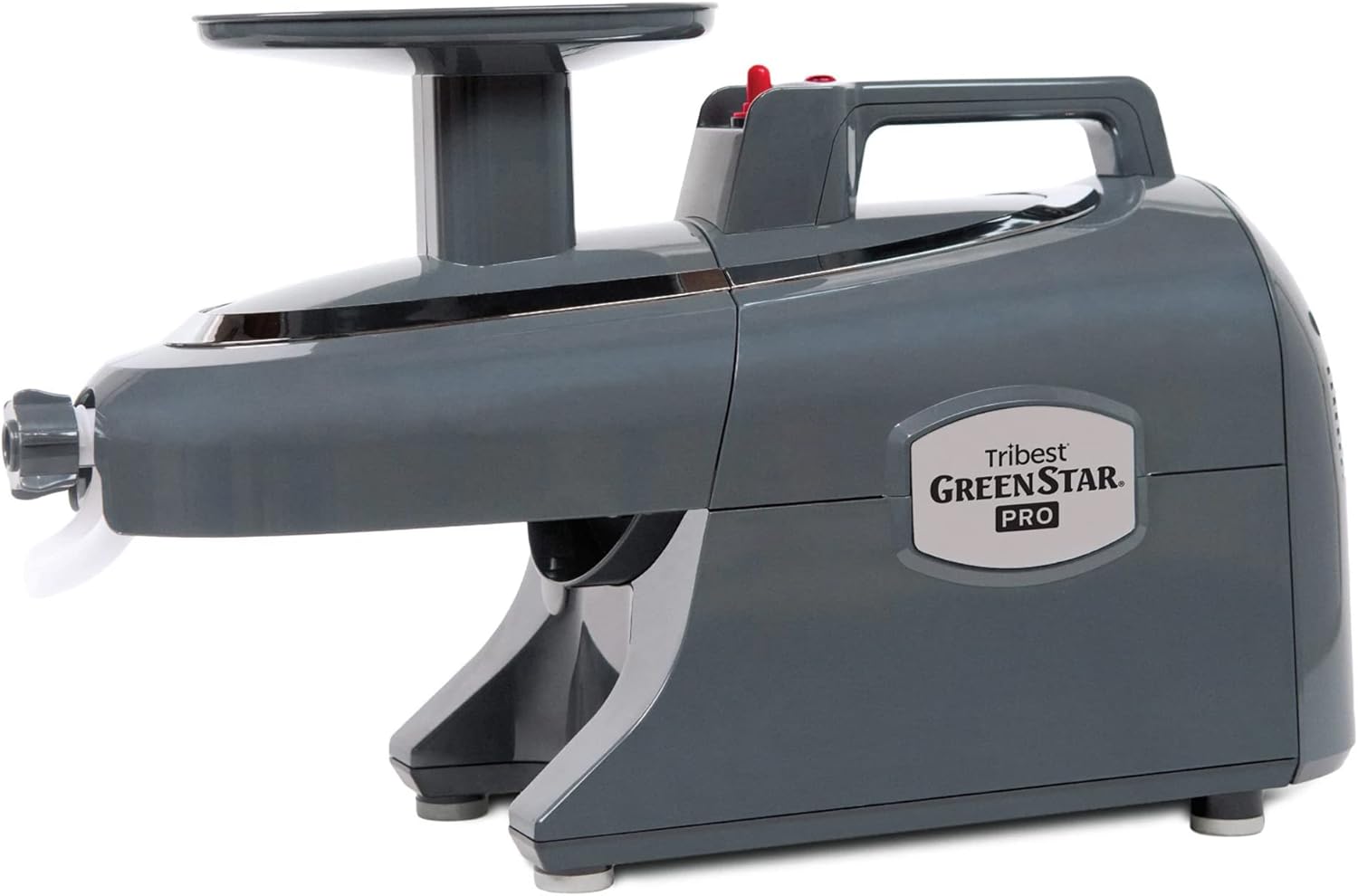
| Wattage | 165 watts |
|---|---|
| Maximum Power | 200 watts |
| Power Source | Corded Electric |
| Voltage | 120 |
| Capacity | 750 ml |
The Tribest Greenstar Pro GS-P502 is a heavy-duty twin-gear cold press juicer built for high-yield, nutrient-preserving extraction in a commercial setting. Its stainless steel jumbo twin gears run at a low 110 RPM and use magnetic and bioceramic technology to crush, mix, and press produce over a three-stage process that reduces oxidation and lets juice keep longer. The unit includes fine and coarse screens, homogenizing and breadstick blanks, and accessories for making nut butters, sorbets, and sauces, so it doubles as a versatile food processor for small-batch production. A safety interlock prevents operation when the hood is removed and a reverse function helps clear jams from fibrous items. Expect relatively slow throughput compared with high-speed centrifugal machines but higher yields and better-preserved enzymes and minerals, and plan for hand-washing parts. The GS-P502 is NSF commercial certified and built from stainless steel components, making it durable for repeated use, though its weight and manual cleaning needs mean it suits back-of-house or dedicated juicing stations rather than quick grab-and-go counters.
Best for: Small commercial kitchens and juice bars that prioritize maximum nutrient retention, higher yields, and versatile cold-press capabilities over speed.
Less Ideal for: Operations that need very high throughput, minimal cleaning time, or a lightweight portable juicer should consider faster centrifugal or simpler models instead.
- Jumbo stainless steel twin gears with magnetic and bioceramic tech for higher yield and reduced oxidation
- Three-stage low-speed extraction preserves enzymes and allows juice storage up to 72 hours
- NSF commercial certification and durable stainless steel construction for repeated commercial use
- Includes fine and coarse screens plus homogenizing blanks for nut butters, sorbets, and other preparations
- Reverse function and safety interlock reduce jams and improve operational safety
- Requires hand-washing and more hands-on cleaning than many countertop juicers
- Slower throughput compared with high-speed centrifugal juicers, limiting per-hour volume
- Heavy and relatively large footprint, less suitable for mobile or limited-space setups
Verdict: Choose the Greenstar Pro GS-P502 when you need a durable, commercial-grade cold-press juicer that maximizes yield and preserves nutrients for professional juice production.
Breville Juice Fountain Compact BJE200XL

| Capacity | 25 fluid ounces |
|---|---|
| Wattage | 700 watts |
| Feed chute | 3 inch extra wide |
| Number of Speeds | 1 |
| Included components | 25oz Juice Jug; Cleaning Brush |
The Breville Juice Fountain Compact is a space-saving centrifugal juicer built to make quick, everyday juice from whole produce. It uses a titanium-reinforced cutting disc and stainless steel micro‑mesh filter basket to extract juice, while the 3-inch extra‑wide chute reduces prep time by allowing many fruits and some vegetables to be fed whole. The included 25 fl oz jug has a built‑in froth separator for smoother pours, and pulp is collected inside the unit to conserve counter space. At 700 watts with a simple button control and cord storage, setup and cleanup are straightforward and most removable parts are dishwasher safe. The single‑speed design keeps operation simple but limits fine control over extraction for very leafy greens or hard root vegetables compared with multi‑speed models. Its compact footprint and modest capacity suit regular individual or small-team use rather than large-volume commercial juicing. For buyers prioritizing quick prep, easy cleaning, and a reliable factory‑quality extraction system in a compact package, this is a practical choice.
Best for: Buyers who need a reliable, compact juicer that minimizes prep and cleanup for regular small-batch use in busy kitchens or small business settings.
Less Ideal for: Operations that require continuous high-volume production or precise speed control for varied ingredients should choose a larger multi-speed commercial model.
- 3-inch wide feed chute reduces prep by accepting many whole fruits
- Titanium-reinforced disc and stainless steel filter for efficient juice extraction
- Integrated froth separator in the jug for smoother pours
- Compact design with cord storage conserves counter space
- Most removable parts are dishwasher safe for easier cleaning
- Single speed limits control for very leafy greens or heavy-duty commercial loads
- 25 fl oz jug and compact pulp bin are small for high-volume juicing
Verdict: A compact, efficient centrifugal juicer that saves prep time and counter space, ideal for everyday small-batch juicing in busy work settings.
Juilist Centrifugal Juicer AMR526

| Maximum Power | 800 watts |
|---|---|
| Wattage | 400 watts |
| Feed Chute | 3" |
| Number of Speeds | 3 |
| Material | Stainless Steel |
The Juilist Centrifugal Juicer AMR526 is a straightforward countertop juicer built to process fruits and many vegetables quickly. It uses a high-speed motor (400W nominal, 800W peak) and a 3" wide feed chute to reduce prep time by allowing larger pieces or halved fruit to be fed without extensive cutting. Three speed settings plus a pulse-style high speed let you adjust for soft or harder produce, and the stainless steel cutting disc with micro-mesh filter aims to improve yield while keeping pulp separation simple. The unit is compact and designed for easy assembly and cleaning, with dishwasher-safe accessories and a cleaning brush included. Safety features include a double safety lock, non-slip base, and automatic overheat protection. Expect typical centrifugal juicer trade-offs: higher-speed extraction is faster but produces foam and slightly less juice clarity than a slow-masticating model, and it is not suitable for frozen items or very fibrous, low-juice greens without blending prep. For quick, budget-friendly juicing of common fruits and root vegetables this model delivers usable juice fast and cleans up without fuss.
Best for: Buyers who need an affordable, fast juicer for making everyday fruit and vegetable juices quickly and with minimal prep and cleanup.
Less Ideal for: Users who prioritize maximum juice clarity, very high yields from leafy greens, or plan to juice frozen ingredients should consider a slow masticating or specialty machine instead.
- 3" wide feed chute reduces chopping and speeds prep
- Three speed settings plus high pulse for different produce types
- Compact footprint fits small counters
- Stainless steel cutting disc and micro-mesh filter aim to boost juice yield
- Dishwasher-safe parts and included brush make cleaning easier
- Centrifugal design produces more foam and less clarity than slow juicers
- Not intended for frozen items, sugar cane, or very fibrous low-juice greens
Verdict: A budget-friendly, fast centrifugal juicer that makes everyday fruit and root-vegetable juices quickly with easy cleanup.
Breville Juice Fountain Plus JE98XL

| Wattage | 850 watts |
|---|---|
| Number of Speeds | 2 |
| Power Source | Corded Electric |
| Blade Material | Stainless Steel |
| Capacity | 1 liters |
The Breville Juice Fountain Plus JE98XL is a fast centrifugal juicer built for quick extraction of juice from whole fruits and many vegetables. It uses an 850 watt motor and a titanium-reinforced disc with a stainless steel micro-mesh basket to separate juice from pulp, while a 3-inch extra-wide chute reduces prep time by allowing whole or large pieces to be fed without extensive cutting. Two speed settings let you choose lower RPMs for soft fruits and leafy greens and higher speed for harder produce, and the included 35.2 fl oz jug has an integrated froth separator to deliver smoother pours. Cleanup is straightforward since many removable parts are dishwasher safe and the pulp container detaches for emptying. Trade-offs are typical for a centrifugal design: it juices quickly but yields slightly less fiber and shelf life than slow masticating machines, and it can be louder during operation. For places that need fast throughput and simple maintenance, it delivers reliable, repeatable performance.
Best for: Small commercial setups or business owners who need a reliable, fast juicer for high-volume, short-prep juicing and who prioritize speed and easy maintenance over maximum yield.
Less Ideal for: Operations that require the highest possible juice yield, minimal oxidation, or very quiet equipment should consider a slow masticating or commercial-grade juicer instead.
- Fast extraction with an 850W motor suitable for quick juicing sessions
- 3-inch wide chute reduces prep time by accommodating larger pieces or whole fruits
- Two-speed control for handling both soft and hard produce
- Stainless steel micro-mesh filter and titanium-reinforced disc for efficient juice separation
- Detachable parts are dishwasher safe and the froth-separating jug simplifies pouring
- Centrifugal design produces less long-term shelf-stable juice and slightly lower nutrient retention than slow juicers
- Can be relatively loud when running at high speed
Verdict: Choose this model when you need a dependable, fast centrifugal juicer that minimizes prep time and is easy to maintain for steady daily use.
Hamilton Beach Big Mouth Juicer

| Maximum Power | 800 watts |
|---|---|
| Number of Speeds | 1 |
| Capacity | 20 fluid ounces |
| Blade Material | Stainless Steel |
The Hamilton Beach Big Mouth juicer is a straightforward centrifugal machine built for quick, everyday juice prep. It uses an 800 W motor and a 3" wide feed chute so you can process whole apples, celery bunches, and other produce with minimal pre-cutting, and the stainless steel micromesh filter separates pulp for smoother juice. Typical use is simple: load produce, switch on the single-speed control, and collect juice in the included container while pulp drops into the bin. Removable, dishwasher‑safe parts and a cleaning brush make cleanup easier than many competitors. For small commercial settings that need fast throughput of basic fruit and vegetable juices, its power and large chute reduce prep time and increase yield. Limitations include a single speed control with centrifugal extraction, which can produce more foam and slightly lower yield from leafy greens versus slow masticating machines, and the mostly plastic construction may feel less heavy‑duty under continuous, high-volume use.
Best for: Buyers who prioritize fast throughput and minimal prep for basic fruit and vegetable juices and who value machines with strong user reviews and predictable performance.
Less Ideal for: Operators who need the highest juice yield from leafy greens, very low foam juice, or a heavy‑duty metal build for nonstop commercial production should consider other commercial‑grade or masticating models.
- Extra‑large 3" feed chute reduces prep time by fitting whole fruits and vegetables
- 800 watt motor delivers strong extraction for firm and soft produce
- Stainless steel micromesh filter yields smoother, pulp‑reduced juice
- Removable parts are dishwasher safe and include a cleaning brush for easier cleanup
- Includes a juice container/pitcher so you can start juicing right away
- Centrifugal single‑speed design can create foam and is less efficient with leafy greens compared with masticating juicers
- Predominantly plastic construction may not feel as durable under continuous commercial use
Verdict: A fast, easy‑to‑use centrifugal juicer that saves prep time with a 3" chute and delivers reliable extraction for small business juice service.
EanOruus 3-in-1 Cold Press Juicer

| Capacity | 100 fluid ounces |
|---|---|
| Maximum Power | 250 watts |
| Power Source | ac |
| Voltage | 110 volts |
This EanOruus masticating juicer is built for high-volume kitchen use, combining a single-auger slow press with two strainers so you can extract juice, make nut milk and prepare frozen fruit sorbet. The 6.5-inch wide chute and 100 oz hopper let you load whole fruits and large batches, which reduces prep time and suits a business that needs steady output without constant refilling. A 250 W AC brushless motor promises consistent torque for fibrous produce and includes auto-reverse and overheat protection to reduce jams and motor stress during extended runs. Detachable parts and a removable pulp outlet simplify cleaning, though the product care notes hand wash only which adds cleanup time versus dishwasher-safe components. At about 12 pounds with plastic/PC construction and plastic blades, it looks designed for daily use but not heavy industrial workloads; the included accessories cover common tasks but professional kitchens seeking fully metal internals or commercial-grade duty cycles may want a higher-spec model. For businesses wanting a quiet, versatile, batch-friendly juicer that balances performance and ease of use, this is a practical midrange choice.
Best for: Business owners who need a quiet, versatile juicer that handles large batches and multiple functions while minimizing prep interruptions and operational risk.
Less Ideal for: High-volume commercial kitchens that require industrial-grade, all-metal construction and continuous heavy-duty operation should consider purpose-built commercial juicers instead.
- Extra-large 100 oz hopper reduces refills for batch juicing
- 6.5-inch wide chute accepts whole fruits to cut prep time
- 250 W AC brushless motor delivers steady torque for fibrous ingredients
- Auto-reverse and overheat protection help prevent jams and motor damage
- Includes interchangeable strainers for juice, nut milk and sorbet
- Key removable parts require hand washing rather than dishwasher-safe cleaning
- Plastic blade and polycarbonate construction are less robust than all-metal commercial units
Verdict: A quiet, batch-friendly masticating juicer with a large hopper and reliable motor protections that fits businesses needing versatile daily juicing without stepping up to full commercial equipment.
Choosing the Right Juicer for Business: Key Factors to Consider
Throughput and Output Capacity
Throughput determines how much juice the machine can produce in an hour and directly affects service speed during peak periods. Consider realistic hourly output based on continuous use rather than brief test-cycle specs, and match capacity to your busiest shift plus a margin for unexpected demand.
Also think about the feeding system and whether the machine requires frequent stopping to clear pulp. Machines with larger feed chutes or batch-hopper options reduce interruptions and labor. If your operation serves many customers quickly, prioritize higher throughput even if the machine is larger or requires a more robust power supply.
Extraction Efficiency and Yield
Extraction efficiency affects raw ingredient costs because better yield means more juice per pound of produce. Look for designs that maximize liquid extraction while minimizing wet pulp leftover. Efficiency varies by fruit and vegetable type, so expect differences between citrus, leafy greens, and harder produce.
Higher extraction can justify a higher upfront cost through reduced ingredient waste over time. Consider machines with adjustable settings or different filter plates that can be tuned for specific produce to improve overall yield.
Duty Cycle, Motor Cooling, and Reliability
Commercial environments demand machines that can run for extended periods without overheating. Duty cycle and motor cooling design indicate how long a juicer can operate before needing rest. Look for explicit continuous-duty ratings or industrial-grade motors and cooling features that prevent thermal shutdowns during peak service.
Reliability also ties to overall construction quality, including bearings, seals, and shaft strength. Equipment built with heavier tolerances tends to resist wear from high-frequency use and abrasive produce over months and years.
Cleaning Time and Sanitation
Frequent cleaning is inevitable in a food service environment, so choose a juicer with parts that disassemble quickly and are easy to rinse or sanitize. Short cleaning cycles reduce staff labor and turnaround time between orders, and fewer small crevices reduce bacterial harborage points.
Also consider whether parts are dishwasher-safe or designed for soak-and-scrub with common sanitizers. Faster, more thorough cleaning lowers daily operating costs and helps maintain food safety compliance.
Serviceability and Replacement Parts
Downtime from a broken part costs lost sales in a business. Prioritize models with readily available replacement parts, clear service documentation, and accessible internal components for quick repairs. Machines with modular parts and user-replaceable wear items minimize out-of-service intervals.
Ask about the typical lifespan of wear components and whether common items like seals, blades, or filters are stocked widely. A robust service network or straightforward parts ordering process is a practical advantage for commercial users.
Footprint, Noise, and Utility Requirements
Space and utilities affect placement and daily operation. Measure the machine footprint and ensure it fits your prep area without obstructing workflows. Consider noise levels that might disturb customers or staff and whether you need acoustic mitigation.
Check electrical and water requirements. Some commercial juicers need dedicated circuits or specific voltage. Also confirm drainage or pulp disposal plans so the machine integrates with your back-of-house processes.
Matching Juicer Type to Menu Needs
Different juicer mechanisms favor certain produce and menu styles. Centrifugal-style extraction is often faster for hard fruits, while mastication or cold-press methods excel with leafy greens and produce where yield and nutrient retention matter. Choose the mechanism that aligns with the kinds of juices you serve most frequently.
If your menu includes a mix of citrus, root vegetables, and leafy greens, favor flexible designs or units that handle multiple produce types without frequent tool changes. For high-demand single-product concepts, a purpose-built machine optimized for that produce can be more efficient.
- Fast-feed systems shorten prep time for front-of-house service
- Cold-press methods generally increase yield for leafy produce
- Specialized citrus extractors can outperform general-purpose units on throughput
Workflow Integration and Placement
Plan where the juicer will sit relative to service counters, refrigeration, and dishwashing. Positioning affects how quickly staff can restock produce and clear pulp. Ideally, place the juicer near prep sinks and waste collection to streamline cleaning.
Consider whether the juicer can be used in an open-service area. Machines that require frequent maintenance or are noisy are often better placed in a back-prep station. Also plan for power access and any needed splash-protection around the unit.
- Place close to sinks for fast cleaning
- Ensure electrical supply meets continuous-duty requirements
- Allow clear access for staff to disassemble and service components
Routine Maintenance Best Practices
Establish a daily and weekly maintenance schedule that includes cleaning, inspection of wear parts, and lubrication where recommended. Small, consistent checks prevent larger failures and extend service life. Train staff on safe disassembly and reassembly procedures to avoid damage.
Keep a small stock of common consumables on site and document part numbers so replacements are ordered before stockouts. Logging operating hours and any service incidents helps predict when parts will need replacement.
- Daily rinse and sanitization after service
- Weekly inspection of seals and cutting surfaces
- Record keeping of operating hours and maintenance actions
Health, Safety, and Compliance
Commercial foodservice equipment must support routine sanitation and safe operation. Choose models with smooth, food-safe finishes and minimal crevices that can trap residue. Verify that disassembly for cleaning does not require tools in normal daily operations.
Consider local health code requirements for juice service, such as cold-holding temperature and labeling. Machines that make cleaning and temperature control straightforward reduce compliance risk and inspection headaches.
- Prefer tool-free disassembly for daily cleaning
- Confirm food-contact surfaces meet local regulatory expectations
- Plan for proper cold storage of freshly pressed juice
Scaling Up: When to Add a Second Machine
If peak queues are consistently long or staff spends excessive time clearing pulp and cleaning between orders, adding a second machine can increase resilience and throughput. Having two units also allows for rotation for deep cleaning without halting service.
A second machine can be a strategic choice when expanding menu complexity. Use service logs and hourly production figures to decide whether incremental capacity or upgraded throughput in a single machine is the better investment.
- Monitor peak-hour output before deciding to scale
- A second unit reduces risk from single-machine failures
- Consider cross-training staff to operate multiple units
How We Chose the Best Juicer for Business
We shortlisted juicers that meet commercial demands by applying strict, category-specific filters. First, we prioritized continuous-duty construction and rated units for build materials and cooling design to ensure they tolerate prolonged daily use. Second, we evaluated extraction efficiency using manufacturer-stated yield characteristics and design factors that affect juice recovery. Third, throughput and feed-system capacity were considered to determine realistic output per hour for a typical commercial shift. Fourth, ease of cleaning and parts accessibility were assessed because downtime reduces revenue in a business setting. Finally, serviceability and parts availability were weighed to reduce long-term maintenance risk. Products were excluded if they were intended only for home or light domestic use, lacked clear continuous-duty ratings, or did not provide adequate documentation on parts and serviceability. The final selection reflects machines that balance durable construction, measurable extraction performance, high throughput, and practical upkeep requirements.
Our full evaluation process is outlined in our review methodology.
FAQ
How do I estimate the right juicer capacity for my business?
Estimate peak orders per hour and multiply by average ounces per serving to get a required hourly output. Add a 20 to 30 percent buffer for variability and downtime to choose a machine with a comfortable margin.
What maintenance schedule should I follow for a commercial juicer?
Perform a daily clean and sanitization after service, inspect wear parts weekly, and follow manufacturer guidance for motor and seal checks. Keeping a log of maintenance tasks helps identify issues before they cause downtime.
Are cold-press juicers worth it for a commercial setting?
Cold-press machines often yield more juice from leafy greens and can preserve nutrients better, but they may be slower or require more frequent cleaning. Their value depends on menu composition and whether higher yield offsets lower throughput.
How noisy are commercial juicers, and does noise affect placement?
Noise varies by mechanism and motor size. High-speed centrifugal units tend to be louder than slow-press models. If noise could disturb customers, place the machine in a back-prep area or choose a quieter design.
What should I keep on hand for common repairs?
Stock common wear items such as seals, filter plates, blades, and fasteners. Also keep basic tools and cleaning brushes on hand. Knowing part numbers and having a supplier relationship speeds repairs.
Final Verdict
For business use, prioritize machines that balance high throughput with strong extraction efficiency and straightforward maintenance. The right choice depends on your menu mix, peak demand, and available prep space. Expect tradeoffs between speed and yield and plan for routine cleaning and spare parts to minimize downtime. Focus on duty-cycle ratings, ease of servicing, and realistic hourly output to choose a juicer that keeps service fast and predictable.