
Note: This article contains affiliate links. If you click on these links and make a purchase, we may earn a small commission at no extra cost to you. This helps support our research and content. Read our full affiliate disclosure here.
If you make carrot juice regularly, the right juicer for carrots changes how much juice you get, how much prep and cleanup you do, and how many nutrients make it into the glass. This guide focuses on models that handle firm root vegetables efficiently and reliably, so you can get smooth, high-yield carrot juice without fuss. Below are our top shortlisted juicers for carrots, selected for extraction efficiency, ease of cleaning, and everyday durability. Read on to see which features matter most and which juicer type suits your routine.
Top Picks at a Glance
| Best Overall The best all-around choice for most situations | Ninja NeverClog Cold Press Juicer JC151 |  |
| Best Quality Built to a higher standard if you want something more solid | Canoly C16 Cold Press Juicer |  |
| Best Value The sweet spot between price and what you get | nutribullet Juicer NBJ50100 |  |
| Best Budget The cheapest option that still gets the job done reliably | GDOR Centrifugal Juicer GS378 |  |
| Top Rated A top-rated pick with lots of positive feedback | Breville Juice Fountain Plus JE98XL |  |
| Most Popular A crowd favorite that many people choose with confidence | Hamilton Beach Big Mouth Juicer 67601A |  |
| Best Seller A high-volume bestseller chosen again and again | Juilist Centrifugal Juicer AMR526 |  |
Ninja NeverClog Cold Press Juicer JC151

| Maximum Power | 150 watts |
|---|---|
| Number of Speeds | 2 |
| Capacity | 24 fluid ounces |
| Included Components | 24 oz juice jug, 36 oz pulp container, 2 pulp filters |
The Ninja NeverClog JC151 is a compact masticating juicer designed to handle fibrous produce like carrots, celery, and leafy greens with minimal clogging. Its 150-watt high-torque motor turns a slow auger to extract juice gently, which helps preserve nutrients and reduce foam while producing higher yields than many centrifugal models. Two interchangeable pulp filters let you choose Less Pulp for smoother juice or Lots of Pulp for thicker, fiber-rich blends, and the one-touch Start/Stop plus Reverse program helps clear jams during heavy juicing. The upgraded 24 oz juice jug and 36 oz pulp container let you make larger batches for meal prep or family servings, and dishwasher-safe juice-contact parts simplify cleanup. Practical downsides are its relatively slow processing speed compared with fast centrifugal juicers and a moderate motor power that may require patience for very large volumes; it is built more for quality and yield than speed. Overall it is a capable cold-press option for daily vegetable and carrot juicing where nutrient retention and pulp control matter.
Best for: Buyers who want higher-yield, nutrient-focused juices from carrots and other fibrous vegetables and are willing to trade speed for smoother, less-foamy results and easy pulp control.
Less Ideal for: If you prioritize rapid single-glass juicing or need a high-throughput unit for heavy daily commercial use, a faster centrifugal or commercial juicer would be a better fit.
- High-torque 150W motor and auger that efficiently extracts juice from fibrous vegetables like carrots
- Two interchangeable pulp filters for customizable pulp level and texture
- Larger 24 oz juice jug and 36 oz pulp container for batch juicing
- Reverse function and one-touch controls to help clear jams and simplify operation
- Dishwasher-safe juice-contact parts for easier cleanup
- Slower processing speed compared with centrifugal juicers, so larger volumes take more time
- 150W motor is designed for steady cold-press extraction rather than very fast commercial throughput
Verdict: Choose the Ninja JC151 if you want a carrot-friendly cold press juicer that maximizes yield and pulp control for nutrient-rich batches rather than speed.
Canoly C16 Cold Press Juicer

| Maximum Power | 250 watts |
|---|---|
| Power Source | ac |
| Number of Speeds | 45 |
| Capacity | 2.65 liters |
The Canoly C16 is a single-auger cold press juicer built for extracting juice, making frozen fruit sorbets, and producing nut or oat milk. It uses a 250 W AC brushless motor and a long auger to gently press produce, which boosts yield and preserves nutrients for hard items like carrots. A 6-inch extra-wide feed chute reduces prep by letting larger fruit and long vegetables go in with less cutting, and the included 3-in-1 strainers switch between juice, sorbet, and milk modes. Practical touches include an auto-reverse to clear jams, a hands-free large hopper for batch runs, and mostly tool-free disassembly with dishwasher-safe parts for easier cleanup. Limits to note: it is a masticating-style machine so extraction is slower than fast centrifugal juicers, and the unit is relatively heavy to move. For carrot-heavy routines you get higher juice yield and quieter operation, but expect longer run times per batch compared with high-speed models.
Best for: Buyers who prioritize maximum juice yield and nutrient retention from carrots and other hard produce and who value quieter, batch-friendly juicing sessions.
Less Ideal for: Those who want fast single-serving juice in under a minute or need a lightweight, easily storable counter appliance should consider a high-speed centrifugal model instead.
- High-yield cold-press extraction suited for hard vegetables like carrots
- 6-inch extra-wide feed chute reduces chopping and speeds prep
- Auto-reverse and long auger design cut down clogging during tough juicing
- Dishwasher-safe, tool-free removable parts make cleanup straightforward
- Slower extraction speed compared with centrifugal juicers
- Relatively heavy and less portable for moving between counters
Verdict: Choose the Canoly C16 when you want quiet, high-yield cold-press extraction for carrots and other hard produce over raw speed.
nutribullet Juicer NBJ50100

| Maximum Power | 800 watts |
|---|---|
| Number of Speeds | 2 |
| Capacity | 1.5 liters |
| Power Source | Corded Electric |
The NutriBullet Juicer is a compact centrifugal machine built for quick, everyday juicing of whole fruits and vegetables. Its 800W motor and two-speed control let you handle softer produce at low speed and harder items like carrots at high speed, while the 3-inch feed chute reduces prep by fitting many whole pieces. Juice collects in a 27oz sealing pitcher with a froth separator and the self-contained 1.5L pulp basin simplifies continuous juicing and cleanup; removable parts including the stainless steel sieve are dishwasher-safe. A no-drip spout and sealing lid make it easy to pour or store juice for up to 48 hours. Because it is a centrifugal design, it is fast but produces more foam and slightly less yield than slow masticating juicers and is best used shortly after juicing for peak freshness. The unit is straightforward to operate and maintain, making it a time-saving choice for daily carrot and mixed-vegetable juices.
Best for: Buyers who want a fast, low-prep juicer for daily carrot and mixed-vegetable juices and value easy cleanup and quick results.
Less Ideal for: Those seeking maximum juice yield, minimal foam, or the quietest operation should consider a slow masticating juicer instead.
- Large 3-inch feed chute reduces chopping and speeds prep
- 800W motor with two speeds handles hard produce like carrots
- Sealing 27oz pitcher with froth separator lets you pour and store juice
- Self-contained 1.5L pulp basin and dishwasher-safe parts simplify cleanup
- No-drip spout prevents countertop messes during pouring
- Centrifugal design produces more foam and somewhat lower yield than slow masticating juicers
- Not the quietest option during high-speed operation
Verdict: A fast, easy-to-use centrifugal juicer that lets you juice carrots and other produce with minimal prep and cleanup.
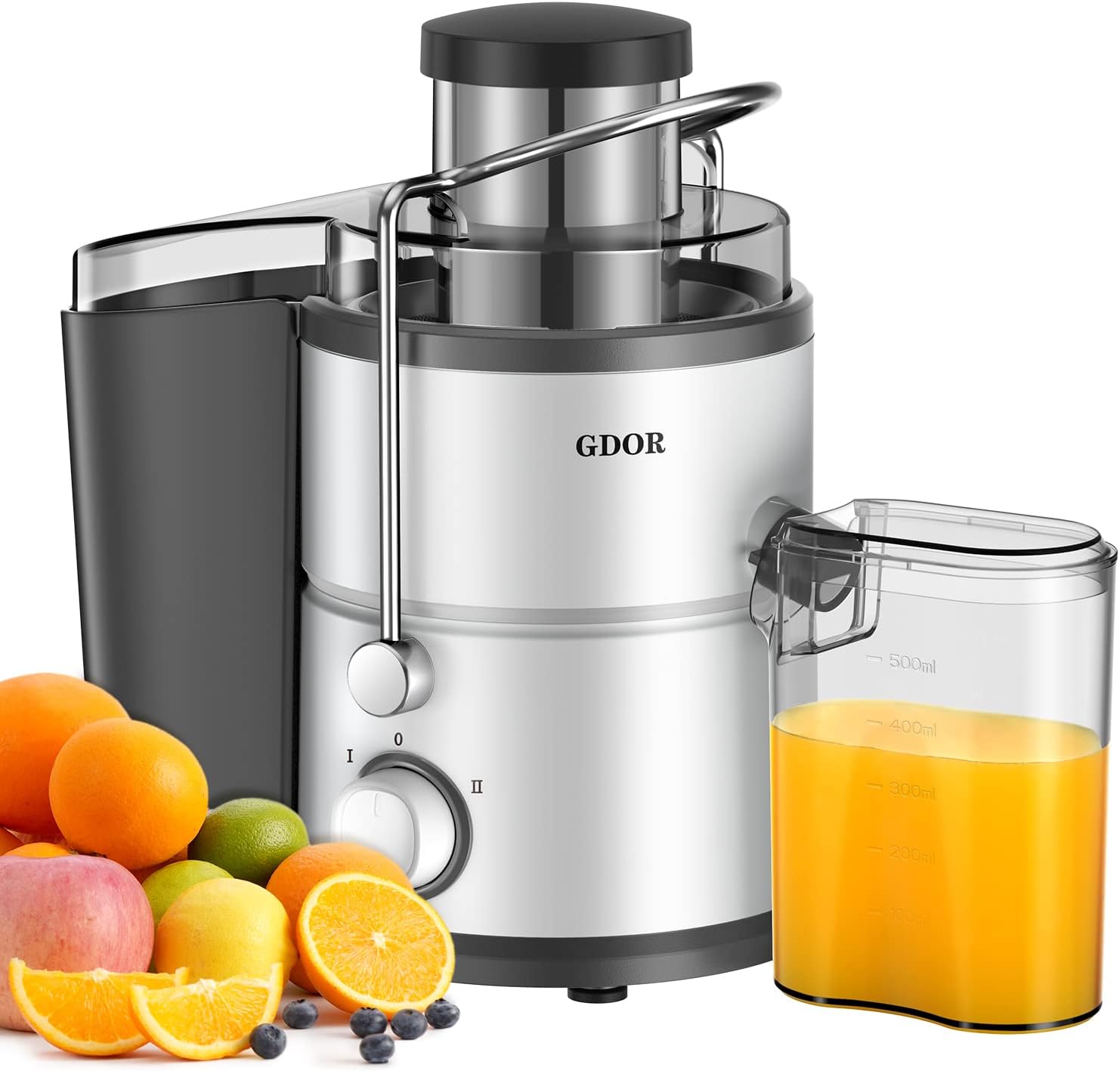
GDOR Centrifugal Juicer GS378
| Maximum Power | 800 watts |
|---|---|
| Number of Speeds | 2 |
| Power Source | ac |
| Voltage | 120 volts |
The GDOR GS378 is a budget-friendly centrifugal juicer designed to handle quick home juicing tasks. Its 800W motor and dual-speed control let you switch between a lower RPM for soft fruits and a higher RPM for harder produce like carrots, and the 3-inch wide chute reduces prep by fitting many whole pieces. The included 17 oz juice jug has a built-in foam separator to cut down on froth, and the anti-drip spout and non-slip feet help keep countertops tidy while running. Safety-minded touches include a locking arm, micro switch protection, and automatic overheat shutdown, which are useful if you juice frequently. Cleanup is straightforward because many parts are dishwasher-safe and a brush is supplied, but as a centrifugal unit it will produce more pulp and slightly less yield than slow masticating models and can be louder during operation. For straight carrot juice on a budget the GS378 offers good speed and convenience with sensible safety features, though extractors seeking maximum yield or ultra-quiet operation may prefer a different juicer type.
Best for: Someone wanting an inexpensive, fast juicer that handles carrots and other hard produce without extensive prep time and who prioritizes convenience and safety on a budget.
Less Ideal for: If you want the highest possible juice yield, very quiet operation, or primarily leafy green extraction, a slow masticating juicer would be a better choice.
- 800W motor with dual speeds for both soft and hard produce
- 3-inch wide feed chute reduces chopping and speeds prep
- Built-in foam separator and anti-drip spout for cleaner pours
- Safety features including locking arm, micro switch, and overheat protection
- Dishwasher-safe parts and included cleaning brush simplify cleanup
- Centrifugal design yields more pulp and slightly lower juice extraction compared with slow juicers
- Operation can be relatively loud during high-speed use
Verdict: A practical, budget-friendly centrifugal juicer that makes fast carrot juice with minimal prep and useful safety features.
Breville Juice Fountain Plus JE98XL

| Maximum Power | 850 watts |
|---|---|
| Number of Speeds | 2 |
| Power Source | Corded Electric |
| Blade Material | Stainless Steel |
| Capacity | 1 liters |
The Breville Juice Fountain Plus JE98XL is a straightforward centrifugal juicer built for fast, everyday juicing of harder produce like carrots as well as softer fruits. It uses an 850 watt motor with a titanium-reinforced disc and stainless steel micro-mesh filter basket to extract juice quickly, and the 3-inch feed chute reduces prep by allowing many items to be juiced whole or with minimal cutting. Two speed settings let you choose low for leafy greens and soft fruit and high for firm items such as carrots and apples, while the included 35.2 fl oz juice jug with integrated froth separator keeps pours cleaner. Cleanup is made easier by a detachable pulp container and dishwasher-safe parts, but being a centrifugal model it produces more foam and slightly less long-term nutrient retention than a slow masticating juicer. The unit is fairly heavy and takes counter space, yet its fast operation and practical attachments make it a reliable choice for someone who wants quick carrot juice without complex setup.
Best for: Buyers who want fast, reliable daily carrot and mixed-vegetable juicing with minimal prep and straightforward operation.
Less Ideal for: People seeking the highest nutrient yield or the quietest possible operation should consider a slow masticating juicer instead.
- Powerful 850W motor for efficient extraction from hard vegetables like carrots
- 3-inch extra-wide chute reduces prep time by fitting many whole fruits and vegetables
- Two speed controls let you switch between soft and hard produce
- Included juice jug with froth separator produces clearer pours
- Dishwasher-safe removable parts simplify cleanup
- As a centrifugal juicer it generates more foam and may extract slightly fewer nutrients than slow juicers
- Relatively heavy and requires dedicated counter space
Verdict: A fast, no-nonsense centrifugal juicer that reliably handles carrots and other hard produce with minimal prep.
Hamilton Beach Big Mouth Juicer 67601A

| Maximum Power | 800 watts |
|---|---|
| Power Source | Corded Electric |
| Number of Speeds | 1 |
| Material | Plastic, Stainless Steel |
| Capacity | 5 pounds |
The Hamilton Beach Big Mouth Juicer is a centrifugal extractor built for fast, everyday juicing of hard produce like carrots and apples. Its 800W motor and stainless steel strainer spin produce at high speed to separate juice from pulp, and the 3-inch feed chute lets you juice whole apples, large carrot pieces, or bunches of celery with little prep. Parts that contact juice are removable and dishwasher safe, and a cleaning brush is included to clear the strainer basket. The large pulp bin cuts down on emptying during bigger batches, but high-speed centrifugal extraction can produce more foam and slightly less yield from leafy greens compared with slow press machines. The unit is single-speed with a simple knob control and includes motor overload protection to prevent overheating during heavy use. For someone juicing carrots regularly, this model delivers quick results and easy cleanup, though those seeking quieter operation or maximum cold-press yield may prefer a masticating juicer instead.
Best for: Buyers who want fast, low-prep juicing of carrots and other hard produce and value proven user feedback and dependable performance.
Less Ideal for: Those prioritizing maximum juice yield from leafy greens, quieter operation, or the slow cold-press texture and nutrient retention of masticating juicers should consider other types.
- Large 3-inch feed chute reduces pre-cutting of carrots and whole fruits.
- 800W motor handles hard produce for higher juice throughput.
- Dishwasher-safe removable parts and included cleaning brush simplify cleanup.
- Large pulp bin allows longer continuous juicing sessions.
- Stainless steel strainer and blade for durable cutting and extraction.
- Centrifugal design can create more foam and extract slightly less from leafy greens compared with slow juicers.
- Single-speed control limits fine-tuning for different produce types.
Verdict: If you want quick, low-prep carrot juicing with strong motor performance and easy cleanup, this Hamilton Beach centrifugal juicer is a practical, reliable choice.
Juilist Centrifugal Juicer AMR526

| Maximum Power | 800 watts |
|---|---|
| Wattage | 400 watts |
| Feed Chute | 3" |
| Number of Speeds | 3 |
| Material | Stainless Steel |
The Juilist centrifugal juicer is a countertop extractor aimed at quick, everyday juice prep. It accepts large pieces through a 3" wide feed chute so you can juice carrots and other long produce with minimal chopping, and the motor delivers a stated maximum of 800W with a 3-speed selector (including a pulse/high setting) to handle soft or harder items. A stainless steel cutting disc and micro-mesh filter are intended to improve extraction and the company claims better yield versus comparable 800W machines. The unit is compact, has dishwasher-safe accessories and comes with a cleaning brush, a visible window to watch extraction, and safety features like a double lock and overheat protection. Expect fast juicing and straightforward one-button control, but note this is a centrifugal model so it will produce more foam and slightly less dry pulp than a slow masticating juicer, and very fibrous or frozen items are not recommended. For routine carrot and mixed fruit/vegetable juices it is a convenient, easy-to-clean option that minimizes prep time.
Best for: Buyers who prioritize quick, low-effort juicing for everyday use and want an appliance that is easy to operate and maintain while handling whole carrots without extensive prep.
Less Ideal for: People seeking maximum dry-pulp extraction or the quietest, lowest-foam juicing experience should consider a slow masticating juicer instead.
- 3" wide feed chute reduces chopping for long produce like carrots
- Three-speed control including a pulse/high setting for soft and hard fruits and vegetables
- Stainless steel cutting disc and micro-mesh filter for improved extraction
- Dishwasher-safe accessories and included cleaning brush simplify cleanup
- Safety features include automatic overheat protection and a double safety lock
- Centrifugal design tends to produce more foam and slightly lower juice yield than slow masticating juicers
- Manufacturer guidance advises against juicing very fibrous or frozen items
Verdict: A fast, user-friendly centrifugal juicer that handles carrots and everyday produce with minimal chopping and easy cleanup, ideal for cautious buyers who want reliable, simple juicing.
Choosing the Right Juicer for Carrots: Key Factors to Consider
Extraction Method
The extraction method—masticating, centrifugal, or triturating—directly affects how carrots are processed. Masticating juicers use a slow auger to crush and press carrots, typically producing higher yield and drier pulp but taking longer per batch. Centrifugal machines spin rapidly to cut and separate juice, so they often work faster but can leave wetter pulp and more foam.
Choosing the right method matters because carrots are dense and fibrous. If you want maximum juice and nutrient retention from carrots, favor slower, high-torque methods. If speed and convenience are more important and you juice carrots infrequently, a faster centrifugal option may be acceptable.
Motor Power and Torque
Motor power and torque determine whether a juicer can handle whole or large carrot pieces without bogging down. Carrots require sustained torque to push fibrous material through the cutting and straining system; insufficient torque leads to clogging, lower yield, and more user intervention.
Look for motors designed to maintain speed under load and with good cooling. Higher-rated motors are not a guarantee of better carrot juice, but torque-oriented designs and thermal protection make a difference for frequent carrot juicing.
Feed Chute Size and Prep Time
Feed chute size affects how much prep you must do before juicing. A larger chute lets you insert longer carrot pieces or fewer cuts, saving time. Smaller chutes increase prep work because carrots need trimming and chopping to fit.
Consider how much prep you are willing to do each session. If you juice multiple carrots at once every morning, a wider feed chute reduces hassle. Also note whether the design encourages steady feed or forces frequent stopping to clear jams.
Pulp Management and Dryness
Pulp dryness is a practical measure of extraction efficiency: drier pulp means more juice extracted from the same amount of produce. For carrots, well-designed screens and pressing mechanisms yield noticeably drier pulp, stretching your supply and lowering waste.
Also consider how the machine handles pulp removal. Some designs automatically eject pulp into a container for continuous juicing, while others require manual emptying. Ease of emptying impacts how comfortable you are juicing larger batches.
Cleaning and Maintenance
Cleaning frequency and complexity strongly influence long-term satisfaction. Juicers that disassemble quickly and have dishwasher-safe components reduce the friction of daily use. Fine mesh screens and tight internal passages can trap carrot fibers and require brushing or soaking.
Check whether the manufacturer supplies a cleaning brush, and whether parts resist staining from carrot pigments. Routine maintenance such as occasional seal replacement or lubrication for gears should also be easy to perform to keep the unit reliable.
Build Quality and Materials
Materials in contact with juice affect durability and safety. Look for BPA-free plastics, stainless steel cutting elements, and robust housings that resist warping. Heavier, well-built units tend to vibrate less and deliver steadier feed when juicing dense carrots.
Durable construction also reduces noise and long-term wear. Consider warranty coverage and accessory availability as further indicators of a product built for regular carrot juicing.
Why Carrots Are Different From Soft Fruits
Carrots are dense, fibrous, and low-moisture compared with many fruits. That affects how they behave in a juicer: they require consistent pressure or sharp cutting to break down cell walls and release liquid. Expect different performance from machines optimized for soft produce.
Because of these physical traits, carrots benefit from juicers that emphasize torque, low-speed crushing, or extended contact with the strainer. Understanding that distinction helps you prioritize extraction method and motor design when choosing a model.
- Dense structure means more torque needed to avoid clogging
- Fibers can tangle in screens and strainers, affecting maintenance
- Lower inherent moisture means drier pulp is a key efficiency metric
Prep Tips for Better Carrot Juice
To get the most from any juicer, trim carrot ends, remove thick or woody sections, and cut to lengths that match the feed chute. Peeling is optional; leaving the skin on preserves nutrients but may increase cleanup if the skin is dirty.
If your juicer struggles with whole carrots, pre-chop into smaller sticks. Alternating carrots with a softer fruit or a small amount of water can help maintain feed and reduce stalling in centrifugal models.
- Trim and cut carrots to fit the feed chute
- Consider leaving skin on after washing to retain nutrients
- Alternate with softer produce to improve feed in some machines
How to Reduce Foam and Oxidation
Foam and oxidation affect mouthfeel and color shortly after juicing. Slow-speed extraction generally produces less foam, while high-speed centrifugal action often incorporates more air into the juice, causing faster discoloration.
To minimize these effects, juice carrots at the end of a session if you are combining with other produce, drink the juice soon after extraction, or store it in an airtight container in the refrigerator. Some users add lemon juice to slow browning, though this alters flavor.
- Drink fresh for best color and flavor
- Use airtight containers to slow oxidation
- Prefer low-speed extractors to reduce foam
Batch Size and Workflow Considerations
Think about how much juice you will make in one session. Daily single-glass use has different demands than preparing several days of juice at once. Larger batch work favors machines with continuous pulp ejection and larger juice containers.
Also consider counter space and how quickly you can assemble, run, and clean the unit. A machine that is cumbersome to clean or requires long cool-downs interrupts workflow and discourages frequent juicing.
- Continuous-ejection designs are better for larger batches
- Smaller, quicker machines suit single-glass daily routines
- Factor in disassembly time when planning morning workflows
Common Maintenance Tasks
Regular maintenance keeps a juicer performing well when used with carrots. Expect to rinse or soak screens, brush out trapped fibers from strainers, and periodically inspect seals and feed components for wear. Lubrication points on mechanical gears may need occasional attention on some slow-gear units.
Storing parts properly after cleaning prevents residual staining and odor. Replace worn screens and seals promptly to maintain yield and hygiene.
- Rinse parts immediately to avoid dried-on carrot residue
- Use supplied brushes to clean fine mesh screens
- Inspect seals and replace when cracked or misshapen
How We Chose the Best Juicer for Carrots
We shortlisted juicers that excel at processing dense root vegetables, with an emphasis on real-world extraction rates and user effort. Primary evaluation criteria included measured juice yield when juicing carrots, the robustness of the feed and cutting mechanisms for fibrous produce, and the degree of pulp dryness after extraction. We also prioritized models with straightforward disassembly and dishwasher-safe parts to reduce maintenance time, plus motor durability and thermal management for frequent use. We excluded models designed primarily for soft fruits or single-purpose citrus juicing that lack the torque or cutting geometry needed for carrots. We ignored compact novelty machines that sacrifice extraction efficiency for form factor. Our selection favors machines with clear evidence of consistent performance on carrots, durable materials in the juice path, and sensible ease-of-cleaning features. Where available, we also considered safety features and warranty coverage as indicators of long-term reliability.
Our full evaluation process is outlined in our review methodology.
FAQ
Can I juice whole carrots without peeling them?
Often you can juice carrots without peeling if they are well washed. Unpeeled carrots retain more nutrients, but thicker or waxed skins may cause more residue and need extra cleaning.
Which juicer type gives the driest carrot pulp?
Slow, masticating-style juicers and twin-gear designs usually produce drier pulp from carrots because they crush and press fibers more thoroughly than high-speed centrifugal units.
How often should I clean the juicer when juicing carrots daily?
Clean removable parts after each use to prevent staining and fiber buildup. Wipe down the housing and run water through the openings if recommended, and do a deeper clean weekly depending on frequency.
Will juicing carrots damage a low-powered juicer?
Juicing many carrots in a row can strain low-powered units and cause overheating or clogging. Choose a juicer with sufficient torque and thermal protection if you plan frequent carrot-only sessions.
Can I use the juicer for carrot-based smoothies or purees?
Juicers are designed to separate liquid from fiber, so they do not produce the same texture as a blender. For smoothies or purees with carrot, a high-powered blender is a better tool.
Final Verdict
When choosing a juicer for carrots, prioritize extraction efficiency and motor torque first, then consider feed-chute size and ease of cleaning. Those tradeoffs determine whether you get maximum juice with manageable prep and maintenance or a faster, lower-yield experience. Decide based on your typical batch size and how much time you want to spend on prep and cleanup. Pick a model that balances pulp dryness, reliable performance under load, and simple maintenance to make carrot juicing a consistent part of your routine.