
Note: This article contains affiliate links. If you click on these links and make a purchase, we may earn a small commission at no extra cost to you. This helps support our research and content. Read our full affiliate disclosure here.
If you drink celery juice regularly, the right juicer makes a big difference in yield, nutrient retention, and how much time you spend cleaning up. Celery is fibrous and watery, so you want a machine that separates fiber efficiently without wasting liquid or overheating the produce. This guide covers the top short-listed juicers for juicing celery, focusing on machines that deliver high extraction, easy cleaning, and reliable daily performance. Below you will find the evaluation criteria we used and practical buying guidance to help you pick the right juicer for your routine.
Top Picks at a Glance
| Best Overall The best all-around choice for most situations | Breville Juice Fountain Plus JE98XL |  |
| Best Quality Built to a higher standard if you want something more solid | Omega MM900HDS Masticating Juicer |  |
| Best Value The sweet spot between price and what you get | Ninja NeverClog Cold Press Juicer JC151 |  |
| Best Budget The cheapest option that still gets the job done reliably | GDOR Centrifugal Juicer GS378 |  |
| Top Rated A top-rated pick with lots of positive feedback | Breville Juice Fountain Cold XL |  |
| Most Popular A crowd favorite that many people choose with confidence | Hamilton Beach Big Mouth Juicer 67601A |  |
| Best Seller A high-volume bestseller chosen again and again | Juilist Centrifugal Juicer AMR526 |  |
Breville Juice Fountain Plus JE98XL

| Power | 850 watts |
|---|---|
| Number of Speeds | 2 |
| Feed Chute | 3 inch extra-wide |
| Capacity | 35.2 fl oz juice jug |
The Breville Juice Fountain Plus JE98XL is a straightforward centrifugal juicer designed for quick extraction of fruits and vegetables. It uses an 850 watt motor and a titanium-reinforced disc with a stainless steel micro mesh filter to pull juice rapidly, while the 3-inch wide chute reduces prep because many ingredients can be fed whole. Two speeds let you run softer, leafy items at low speed and denser produce at high speed, and the included 35.2 fl oz jug has a built-in froth separator to deliver clearer juice. Cleanup is simplified by a detachable pulp container and dishwasher-safe parts, and the cord stores neatly under the base. As a centrifugal model it excels at fast extraction and high throughput, but it will produce more foam and slightly less long-term nutrient retention compared with slower masticating juicers, and it can be louder during operation. For everyday kitchen use it is easy to operate and maintain, making it a practical choice for those who value speed and convenience over the absolute maximum yield.
Best for: Buyers who want a fast, easy-to-use juicer for regular home use and value quick prep and simple cleanup over maximum yield.
Less Ideal for: Those who prioritize the highest possible juice yield, minimal foam, or the quietest operation should consider slow masticating juicers instead.
- Extra-wide 3-inch chute reduces prep by allowing larger pieces or whole produce
- 850W motor and reinforced cutting disc for fast extraction
- Two-speed control for handling soft leafy items and harder produce
- Integrated froth-separating juice jug for clearer pours
- Dishwasher-safe parts and detachable pulp container for easier cleanup
- Centrifugal design yields more foam and slightly lower long-term nutrient preservation than slow juicers
- Generally louder than masticating juicers during operation
Verdict: Choose the JE98XL if you want fast, low-prep celery and produce juicing with easy cleanup and a froth-reduced pour.
Omega MM900HDS Masticating Juicer

| Wattage | 200 watts |
|---|---|
| Power Source | Corded Electric |
| Number of Speeds | 1 |
| Capacity | 0.8 liters |
The Omega MM900HDS is a single-auger, cold-press masticating juicer built to extract high yields from celery and other produce with minimal heat and oxidation. It runs at a slow speed and uses triple-stage masticating technology plus a special celery end cap to squeeze more juice and leave drier pulp, and a second standard end cap handles other fruits and vegetables. The large feed chute and extra-large feed tray cut prep time, and most removable parts are top-rack dishwasher safe for easier cleanup. Its 200-watt motor and corded power source provide steady torque for leafy greens and fibrous stalks, and Omega backs it with a long parts and performance coverage. Expect slower output than centrifugal machines and a batch-oriented workflow rather than continuous high-volume juicing, and the unit is relatively heavy and takes some counter space. For buyers focused on nutrient retention and maximum celery yield, this juicer delivers reliable, hands-on performance.
Best for: Buyers who prioritize maximum nutrient retention and the highest juice yield from celery and leafy greens and who accept a slower, batch-style juicing routine.
Less Ideal for: Anyone who needs very fast, high-volume juicing or a lightweight, highly portable juicer for occasional use.
- Designed specifically for celery with a dedicated end cap to increase juice yield
- Low-speed masticating action reduces heat and oxidation to preserve nutrients
- Triple-stage extraction squeezes more juice and leaves drier pulp
- Large feed chute and extra-large feed tray reduce prep time
- Most removable parts are top-rack dishwasher safe for easier cleaning
- Slower throughput compared with high-speed centrifugal juicers
- Relatively heavy and takes notable counter space
Verdict: If you want the best practical celery extraction and nutrient-preserving cold-press performance, this Omega masticating juicer is built for that purpose.
Ninja NeverClog Cold Press Juicer JC151

| Maximum Power | 150 watts |
|---|---|
| Number of Speeds | 2 |
| Capacity | 24 fluid ounces |
| Power Source | Corded Electric |
The Ninja NeverClog JC151 is a slow masticating cold-press juicer designed to extract juice from fibrous fruits and vegetables with minimal clogging. It uses a 150-watt high-torque motor and an auger to press produce at low speed, which helps preserve nutrients and reduce foam while handling tough ingredients like celery, kale, and carrots. Two interchangeable pulp filters let you choose less pulp for smoother juice or lots of pulp for thicker, fiber-rich drinks, and the reverse function helps clear jams and improve extraction. The included 24 oz juice jug and 36 oz pulp container make it practical for small batches or family servings, and most juice-contact parts are dishwasher safe for easier cleanup. Its compact footprint fits on typical countertops, but the unit is not the fastest option for large daily volumes and a few users may prefer a heavier-duty commercial model for continuous high-volume juicing. For home users focused on nutrient retention and reliable celery extraction, this is a capable, easy-to-use choice.
Best for: Home users who want reliable cold-pressed juice from fibrous vegetables and prioritize nutrient retention, straightforward controls, and manageable cleanup for small to medium batches.
Less Ideal for: People who need a heavy-duty commercial juicer or very fast throughput for large daily volumes should consider a higher-capacity model instead.
- High-torque 150W auger handles fibrous produce like celery effectively
- Two interchangeable pulp filters for customizable juice texture
- Large 24 oz juice jug and 36 oz pulp container for batch juicing
- Reverse function reduces jams and helps maximize extraction
- Most juice-contact parts are dishwasher safe for easier cleanup
- Not designed for commercial continuous high-volume juicing
- Slower throughput compared with centrifugal juicers
Verdict: If you want a countertop cold-press juicer that reliably handles celery and other fibrous greens with minimal clogging and easy cleanup, the Ninja NeverClog JC151 is a practical home choice.
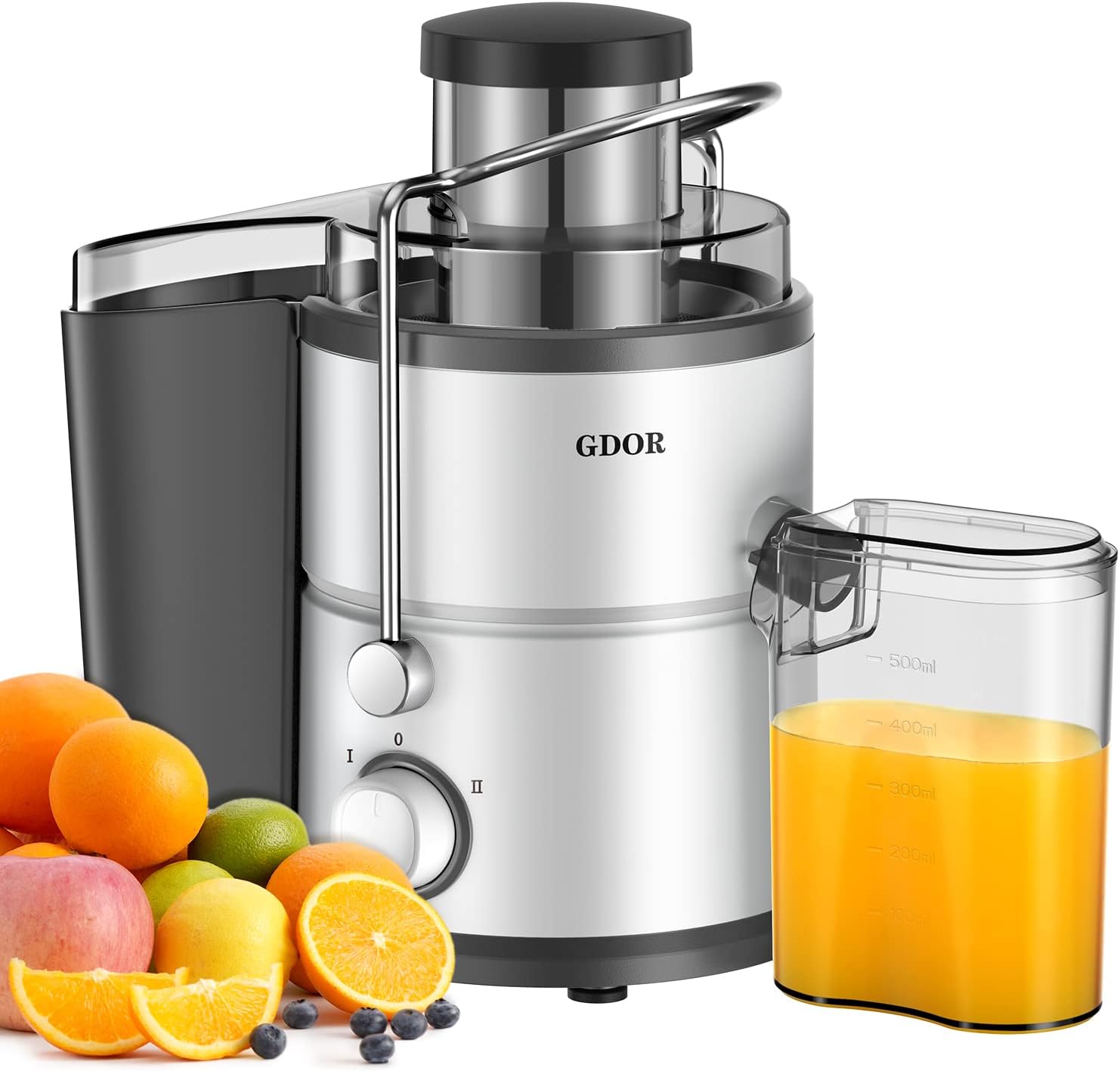
GDOR Centrifugal Juicer GS378
| Maximum Power | 800 watts |
|---|---|
| Number of Speeds | 2 |
| Power Source | ac |
| Voltage | 120 volts |
The GDOR GS378 is an 800W centrifugal juicer designed to make quick, everyday juices from whole fruits and vegetables without a lot of prep. It uses a wide 3-inch feed chute so you can toss in larger pieces or smaller whole items, and a dual-speed knob (low for soft produce, high for hard produce) to handle celery, carrots, apples and similar ingredients. A built-in foam separator and 17 oz juice jug reduce froth and mess while the anti-drip spout and included cleaning brush simplify cleanup. Safety features such as a locking arm, micro switch protection and thermal overload cut-off add reassurance during heavier use. Because it is a centrifugal model, it extracts quickly but will produce more foam and slightly less yield than slow cold-press alternatives, and it can be louder during high-speed operation. For someone prioritizing quick preparation and an affordable price point, it delivers practical daily performance for juices like celery blends, but those chasing maximum nutrient yield or very quiet operation may prefer a masticating unit instead.
Best for: Buyers on a tight budget who want a fast, low-effort juicer for everyday celery blends and mixed vegetable juices rather than a premium slow juicer.
Less Ideal for: Users who prioritize maximum juice yield, minimal oxidation, or very quiet operation should consider a masticating juicer instead.
- 3-inch wide feed chute reduces prep time by allowing larger pieces and some whole fruits
- 800W motor with dual speeds adapts for both soft and hard produce
- Built-in foam separator and anti-drip spout cut down on mess and froth in the juice jug
- Multiple safety features including locking arm and overheat protection increase user safety
- Centrifugal extraction typically yields less juice and more foam than slow masticating juicers
- Can be noisy at high speed during tougher produce juicing
Verdict: A cost-conscious centrifugal juicer that makes quick, no-fuss celery and vegetable juices with a wide chute and useful safety features.
Breville Juice Fountain Cold XL

| Capacity | 70 fluid ounces |
|---|---|
| Power | 1200 watts |
| Feed chute | 3.5 inch extra-wide |
| Settings | 2 speeds |
The Breville Juice Fountain Cold XL is a high-capacity centrifugal juicer built for frequent home use and large batches. It accepts whole fruits and vegetables through a 3.5-inch extra-wide chute so prep time is minimal, and the Cold Spin Technology with a precision mesh filter aims to reduce heat during extraction to preserve nutrients. The unit offers two speed settings and up to 1200 watts of power for tougher produce, while a Quiet setting reduces mechanical noise for more comfortable use. A 70 fl oz seal-and-store jug and detachable juice nozzle make it easy to collect or pour juice without drips, and the rear pulp bin helps keep countertops tidy. Cleaning still requires some disassembly and hand-washing of parts, and the machine is relatively heavy and large compared with compact models, so it needs a stable spot on the counter. For anyone who wants fast, high-volume juicing with reduced prep and noise, this model performs reliably with leafy greens and fibrous produce when run at appropriate speed.
Best for: Buyers who prioritize dependable, high-volume juicing and want to minimize prep time while maintaining nutrient-conscious extraction for daily use.
Less Ideal for: Those with very limited counter space or who want a lightweight, fully dishwasher-safe compact juicer should consider other options.
- Extra-wide 3.5-inch chute reduces pre-cutting and speeds prep
- Cold Spin Technology and precision mesh filter help limit heat during extraction
- 70 fl oz seal-and-store jug lets you juice large batches and store juice for days
- Quiet setting reduces mechanical noise by about 40% for calmer operation
- Requires hand-washing of parts and some disassembly to clean
- Relatively heavy and large, taking notable counter or storage space
Verdict: Choose this model if you need a reliable, high-capacity juicer that minimizes prep and preserves nutrients while handling large batches.
Hamilton Beach Big Mouth Juicer 67601A

| Maximum Power | 800 watts |
|---|---|
| Power Source | Corded Electric |
| Number of Speeds | 1 |
| Included Components | Cleaning Brush, Dishwasher Safe Parts |
| Capacity | 5 pounds |
The Hamilton Beach Big Mouth Juicer is a centrifugal juicer built for quick home juicing using a large 3-inch feed chute so you can process whole apples, celery stalks, and other produce with minimal prep. Its 800 watt motor spins a stainless steel strainer basket to extract juice rapidly, sending pulp to a roomy pulp bin while producing mostly smooth, pulp-reduced juice. Assembly and cleanup are straightforward because most removable parts are dishwasher safe and it ships with a cleaning brush to clear the strainer. The single-speed knob makes operation simple, and built-in motor overload protection helps prevent damage if the machine is pushed too hard. Expect strong performance on firm produce and decent yields from softer items and leafy greens when used with the recommended technique of sandwiching greens between harder pieces. Trade-offs are typical of centrifugal designs: it is fast but introduces more foam and slightly less juice retention from fibrous leafy vegetables compared with slow masticating models.
Best for: Buyers who prioritize fast, low-effort juicing and want a proven, well-reviewed machine that handles whole fruits and most vegetables with minimal prep.
Less Ideal for: People whose top priority is maximum yield from leafy greens or the lowest-foam cold-pressed juice should consider a slow masticating juicer instead.
- Extra-large 3-inch feed chute reduces pre-cutting and speeds prep
- 800W motor provides strong high-speed extraction for hard produce
- Dishwasher-safe removable parts and included cleaning brush simplify cleanup
- Large pulp bin holds more waste so you can juice longer between empties
- Stainless steel strainer and blade for durable, food-contact components
- Single speed limits control for delicate leafy greens compared with slow juicers
- Centrifugal extraction can create foam and slightly lower yield on fibrous celery and greens
Verdict: Choose this model if you want a fast, easy-to-use centrifugal juicer that accepts whole produce and reliably handles celery with minimal prep.
Juilist Centrifugal Juicer AMR526

| Maximum Power | 800 watts |
|---|---|
| Wattage | 400 watts |
| Number of Speeds | 3 |
| Capacity | 400 ml |
| Feed Chute | 3" |
The Juilist centrifugal juicer is a countertop high-speed juicer built to process common fruits and vegetables quickly. It uses a stainless steel cutting disc and micro-mesh filter to separate juice at up to 800W peak power with three speed settings for soft, firm, and maximum-extraction tasks. The 3" wide mouth reduces prep because many items can be fed whole or in large pieces, and the visible window helps you monitor extraction. Accessories such as a cleaning brush and dishwasher-safe parts simplify cleanup, and safety features include a double lock arm and automatic overheat protection. For celery and other fibrous greens the high-speed setting and titanium-reinforced filter can produce usable juice, though centrifugal machines typically leave more pulp and extract slightly less than slow masticating models. The unit is compact and sturdy-looking with straightforward one-button controls, but it is best suited to quick daily juice prep rather than maximum yield for high-fiber produce or long continuous runs.
Best for: Buyers who want a reliable, easy-to-use countertop juicer for daily fruit and vegetable juices and who prioritize quick prep, simple cleanup, and basic safety features.
Less Ideal for: Users focused on extracting the highest possible yield from celery, wheatgrass, or other very fibrous greens should consider a slow masticating juicer instead.
- 3" wide feed chute reduces prep time by allowing larger pieces or whole fruits and vegetables
- Three speed settings (including pulse) let you adjust for soft or fibrous produce
- Stainless steel cutting disc and reinforced filter for durability and effective shredding
- Dishwasher-safe parts plus a cleaning brush make maintenance easier
- Compact footprint fits small countertops and includes visible window to monitor juicing
- As a centrifugal juicer it will leave more pulp and deliver lower juice yield on very fibrous greens compared with slow masticating machines
- Not recommended for frozen items or very hard produce like sugar cane or pomegranate
Verdict: A practical, compact centrifugal juicer that delivers fast, easy daily juices with minimal prep and simple cleanup, making it a low-risk choice for everyday juicing.
Choosing the Right Juicer for Juicing Celery: Key Factors to Consider
Extraction Yield
How much liquid you get from a given weight of celery directly affects cost per glass and how many stalks you need. Higher-yield juicers use slow masticating or efficient centrifugal designs to press more liquid out of fibrous stalks. When yield is higher, you waste less produce and spend less time prepping extra celery to hit desired serving sizes.
Yield also ties to pulp dryness. A machine that leaves wetter pulp is not extracting as much juice, which matters especially if you juice daily and track servings or nutrition.
Fiber Separation Quality
Celery is stringy and can produce a grainy texture if the juicer does not separate fiber well. Good separation yields a smooth juice with minimal stringy bits, making the drink more pleasant and easier to strain if desired. Separation quality affects mouthfeel and may change how quickly juice oxidizes or separates in storage.
Consider whether you want a very clear juice or if you are okay with a bit of fine pulp. Some machines include a secondary strainer or fine-mesh screen to improve clarity without sacrificing yield.
Ease Of Cleaning
Daily juicing means frequent cleaning, so machines that are quick to disassemble and rinse will actually be used more often. Look for parts that are dishwasher-safe or have simple tool-free removal. Narrow feed chutes that trap strings and small crevices add cleaning time.
Evaluate whether the juicer's screens and augers can be brushed clean easily and whether the manufacturer provides a cleaning brush. If cleanup is laborious, many users revert to less frequent juicing, which defeats the purpose of daily celery juice routines.
Motor Heat & Speed Control
Heat can accelerate oxidation and potentially reduce heat-sensitive nutrients during extraction. Machines with slower, cooler masticating action help preserve enzymes and vitamins compared with models that spin at high RPMs and generate more heat. Variable speed control can be useful for managing different produce types, but for celery a steady, low-speed setting often yields the best balance of extraction and nutrient preservation.
Also consider motor duty cycle and thermal protection if you plan to run consecutive batches without long cool-down periods.
Build Durability
Frequent juicing puts strain on mechanical parts, so robust materials and construction matter. Look for solid housings, reinforced gearing, and food-safe plastics or metal where parts contact the produce. Durable bearings and well-engineered seals reduce the chance of premature failure or leaks.
Durability also influences resale value and long-term maintenance. Machines built with replaceable wear parts can be serviced more easily, extending useful life for daily users.
Countertop Footprint & Noise
Where you store and run the juicer affects how practical it is for daily use. Larger masticating machines often have better yield but bigger footprints that may not fit small kitchens. Consider a machine's height and depth if you store it under cabinets or on a small counter.
Noise matters if you juice early in the morning. Some high-speed centrifugal units are louder, while slow masticating models tend to run quieter. Balance the tradeoff between footprint, noise, and performance when choosing a machine for daily celery juicing.
Why Celery Presents Unique Juicing Challenges
Celery is mostly water but also contains long fibrous strings that can clog screens and create a pulpy texture. That combination means a juicer must both separate fibers efficiently and collect near-clear liquid without wasting the water content trapped in stalks.
Different juicer technologies handle celery differently. Slow, single-auger masticating machines tend to shear and press fibers gently to extract more liquid, while fast centrifugal units rely on speed to force juice through a screen. Each approach has tradeoffs for yield, texture, and nutrient preservation.
- Fibrous strings can wind around augers or clog narrow chutes
- Water content makes yield improvements very noticeable
- Texture and clarity depend on screen fineness and separation method
Prep Tips to Improve Yield and Reduce Clogging
Trim leafier or woody ends and cut stalks to the length recommended by the manufacturer to avoid jamming. Removing large knots or tough bases helps feed celery through the chute more consistently.
If your juicer has a narrow feed tube, consider pre-chopping stalks into shorter pieces. For wide-chute designs you can often feed longer pieces, which speeds up processing. Avoid tightly bundling stalks, as that can trap air and reduce extraction efficiency.
- Trim and core any thick, woody sections
- Cut stalks into manageable lengths for your feed chute
- Alternate celery with small pieces of softer produce to reduce fiber buildup if recommended by the manufacturer
Cleaning Workflow for Daily Celery Juicing
Create a rinse-and-brush routine immediately after juicing to prevent pulp from drying on screens and augers. Rinsing right away dramatically shortens cleaning time and preserves the fine mesh of strainers.
Use the included cleaning brush or a soft bottle brush to dislodge strings from screens. If parts are dishwasher-safe, place them on the top rack, but still rinse first to remove large fibers. Regular deep cleaning of seals and internal crevices prevents odors and buildup over time.
- Rinse parts immediately to avoid dried-on pulp
- Brush screens gently to avoid damaging fine mesh
- Periodically inspect seals and tight joints for trapped fibers
Storage and Routine: Making Celery Juicing Practical
If you plan to juice daily, dedicate a short subset of countertop space to the machine so setup and tear-down times are minimal. Storing frequently used parts together reduces the friction of starting a juicing routine each day.
Batch juicing for a day or two can save time but expect changes in taste and nutrient profile over time due to oxidation. Use airtight containers and keep juice chilled to slow degradation if you choose to prepare multiple servings at once.
- Keep parts accessible to encourage daily use
- Use airtight bottles and refrigerate juice promptly
- Label and date stored batches and consume within recommended freshness windows
Dealing With Pulp and Using Leftover Fiber
Even efficient juicers produce pulp. Consider ways to reuse it rather than discard it. Pulp can be added to compost, used in vegetable stocks, or incorporated into baked goods to reduce waste.
If sensory texture bothers you, push juice through a fine strainer after extraction. This can remove residual strings but will reduce overall yield. Decide whether clarity or total volume is more important for your personal preference.
- Compost or repurpose pulp for stocks and baking
- Fine straining improves clarity at the cost of some yield
- Dry pulp can be dehydrated for shelf-stable uses
How We Chose the Best Juicer for Juicing Celery
We evaluated juicers specifically on attributes that matter when extracting celery juice frequently. Primary filters included extraction efficiency, which reflects how much liquid you can get from stalks without excessive pulp loss, and fiber separation quality to produce a smooth, drinkable juice. We also prioritized ease of cleaning because celery juice is often part of a daily routine and machines that take long to service reduce real-world usability. Other criteria were motor heat and speed control to avoid nutrient degradation from high heat, build quality and durability to withstand frequent use, and chute and feed design that affects prep time. We tested for consistent performance on fibrous produce and assessed how straightforward assembly and disassembly are for cleaning. Capacity and countertop footprint were considered for users with limited space. Excluded from consideration were units designed only for soft fruits or single-use gadgets that lack durability. We did not include blenders or appliances that cannot separate fiber effectively because they do not produce the clear celery juice most buyers expect. The final shortlist reflects machines that balance high yield, low maintenance, and durable construction.
Our full evaluation process is outlined in our review methodology.
FAQ
Is a slow masticating juicer better for celery than a centrifugal model?
Often yes. Slow masticating juicers generally extract more liquid from fibrous produce and produce less foam and separation. Centrifugal machines can be faster but may leave wetter pulp and more fiber in the juice.
How do I clean fibers out of the juicer screen quickly?
Rinse parts immediately after use and scrub the screen with the provided brush while still wet. For stubborn strings, a soak in warm water loosens fibers before a second brushing.
Can I store celery juice safely for later consumption?
You can store celery juice chilled in airtight containers for short periods. Freshly made juice is best consumed quickly because oxidation and nutrient loss increase over time, but refrigeration slows these changes.
Will juicing celery remove all the fiber?
No. Juicing separates most insoluble fiber into a pulp fraction, but small amounts of fine pulp often remain in the liquid. If you need virtually no fiber, a secondary fine straining step will reduce residual particles.
Does juicing celery damage nutrients due to heat?
High-speed motors can generate heat that slightly increases oxidation, so lower-speed extraction is generally better for preserving heat-sensitive nutrients. For daily celery juicing, choose a machine with cooler operation if nutrient retention is a priority.
Final Verdict
For regular celery juicing, prioritize machines that deliver high extraction yield and reliable fiber separation while being quick to clean. Expect tradeoffs between footprint, speed, and clarity: slow masticating designs usually favor yield and nutrient preservation, while fast units save time but may sacrifice some liquid and texture. Decide whether daily convenience or maximum yield matters more to you, then use the scoring criteria above to compare shortlisted models. A durable, easy-to-clean juicer with good extraction will make celery juicing a sustainable habit rather than a chore.