
Note: This article contains affiliate links. If you click on these links and make a purchase, we may earn a small commission at no extra cost to you. This helps support our research and content. Read our full affiliate disclosure here.
If you want consistent, creamy nut milk without canned additives, choosing the right juicer matters. A juicer designed for nut milk extracts fine suspended solids and separates liquid cleanly, which affects texture, shelf life, and how much milk you get from a given batch. This guide shortlists the top juicers for nut milk and explains the practical tradeoffs between extraction efficiency, cleaning time, and durability. Each pick has been evaluated against user-focused criteria so you can pick the unit that fits your kitchen workflow and the types of nuts or seeds you plan to use. Read on for the factors we used and what to expect from the best machines.
Top Picks at a Glance
| Best Overall The best all-around choice for most situations | AMZCHEF Cold Press Juicer ZM1939 |  |
| Best Quality Built to a higher standard if you want something more solid | Omega Nutrition System NC900HRD19 |  |
| Best Value The sweet spot between price and what you get | TUUMIIST Cold Press Juicer TM880SJ |  |
| Top Rated A top-rated pick with lots of positive feedback | ECOSELF 3-in-1 Cold Press Juicer |  |
| Most Popular A crowd favorite that many people choose with confidence | EanOruus 3-in-1 Cold Press Juicer |  |
| Best Seller A high-volume bestseller chosen again and again | Ninja NeverClog Cold Press Juicer JC151 |  |
AMZCHEF Cold Press Juicer ZM1939

| Maximum Power | 600 watts |
|---|---|
| Power Source | dc |
| Voltage | 120 volts |
| Number of Speeds | 2 |
| Capacity | 5.6 pounds |
The AMZCHEF Cold Press Juicer ZM1939 is a single-auger masticating machine designed to extract juice, make nut milk, and produce frozen fruit sorbet. It feeds whole or large pieces through a 6.5-inch reversible wide chute with built-in cutting blades to reduce prep, and the large auger plus low-speed cold-press action aim to maximize yield while limiting heat and oxidation. The unit includes two interchangeable filters for juice and sorbet, a reverse function and an anti-clogging chamber to help clear stubborn ingredients, and removable parts that are dishwasher safe for easier cleanup. In practice it is well suited to making smooth nut milks when nuts are soaked and added gradually, and the 600W motor gives enough torque for tougher ingredients without running hot. Limitations include the single-auger design that may require patience for very fibrous pulps and a fairly tall footprint to fit on crowded counters, and you may still need to pre-soak nuts and manage pulp for the creamiest nut milk.
Best for: Buyers who want an affordable, versatile cold-press machine that makes both juice and homemade nut milk without extensive prep time and who value yield and easy cleaning.
Less Ideal for: People who need ultra-fast high-volume nut milk production or have very limited counter space should consider purpose-built nut milk systems or more compact models instead.
- 6.5-inch wide reversible feed chute with cutting blades reduces chopping and speeds prep
- 600W motor and large auger designed for high juice yield and good torque for thicker ingredients
- 3-in-1 functionality with interchangeable juice and sorbet filters expands versatility
- Anti-clogging design and reverse function help clear jams during tougher processing
- Removable parts are dishwasher safe for easier cleaning
- Single-auger slow juicing can be slower with very fibrous or large-batch nut processing
- Tall footprint may be awkward on smaller kitchen counters
Verdict: Choose this machine if you want a multiuse slow juicer that reliably extracts juice and makes creamy nut milk with minimal chopping and easy cleanup.
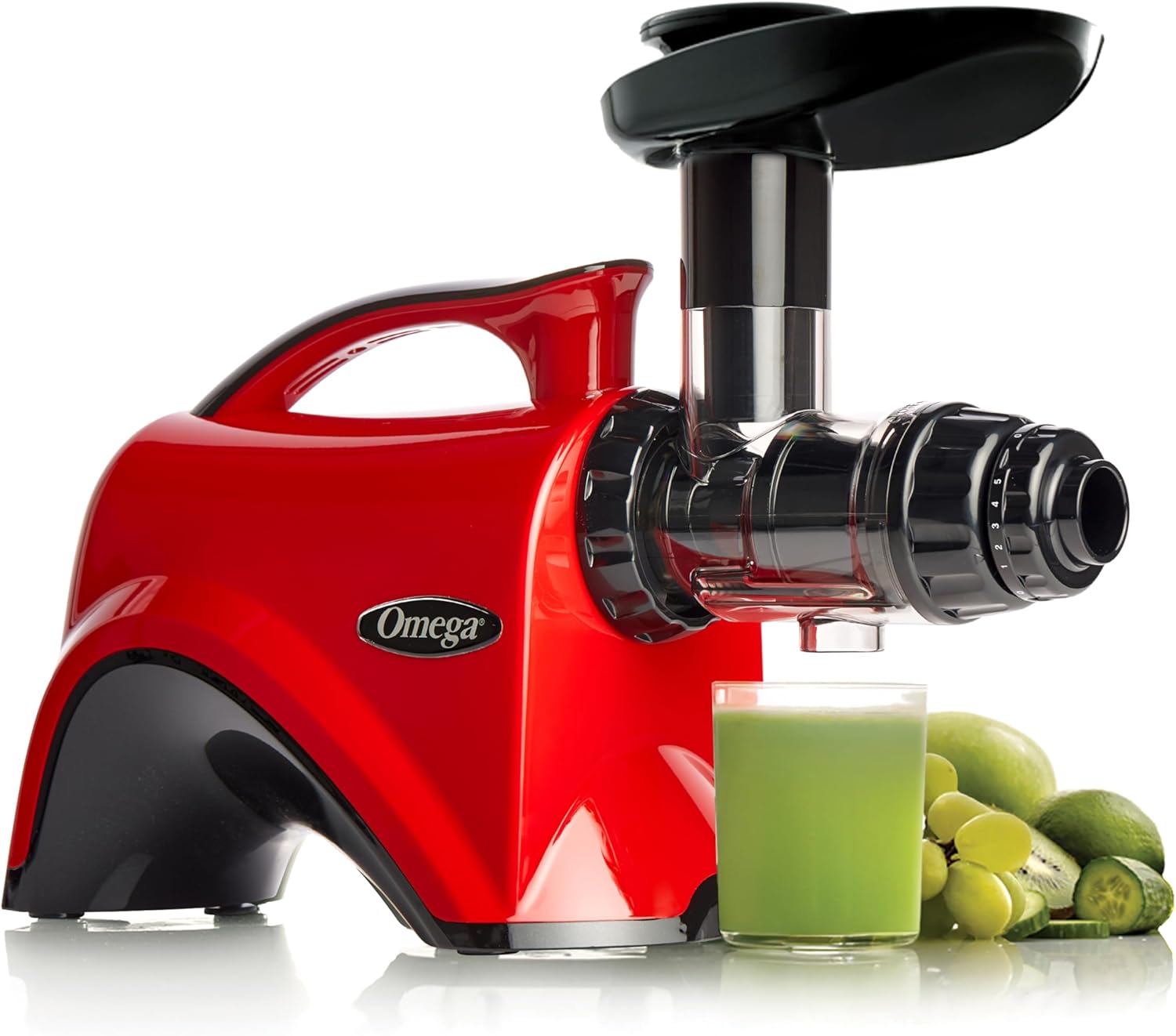
Omega Nutrition System NC900HRD19
| Wattage | 150 watts |
|---|---|
| Power Source | Corded Electric |
| Voltage | 120 |
| Number of Speeds | 1 |
| Capacity | 0.9 liters |
The Omega Nutrition System NC900HRD19 is a single-auger, low-speed (80 RPM) masticating juicer built for extracting juice from fruits, vegetables, leafy greens and for making nut milks, nut butters, baby food and sorbets. It uses a dual-stage auger and adjustable pressure settings to squeeze more liquid from produce while minimizing heat and oxidation, which helps preserve enzymes and flavor during longer extraction. The unit includes multiple nozzles and screens so you can switch from juicing to extrusion or homogenizing without adding separate appliances. Practical benefits include a larger feed chute than some Omega models, continuous pulp ejection for longer runs, and a robust 150-watt motor backed by a long manufacturer motor warranty. Expect quieter operation and higher juice yield compared with centrifugal machines, but plan on more prep for dense nuts and occasional manual cleaning since most parts require hand washing and the plastic housing adds weight on the counter. For nut milk specifically, the slower masticating action produces smoother results and better milk extraction, though producing very fine nut milks may take extra passes or soaking to maximize yield.
Best for: Buyers who prioritize extraction efficiency, enzyme preservation, and versatile nutrition-system capabilities for homemade nut milks and other cold-press preparations.
Less Ideal for: Casual users who want ultra-fast single-step juicing or a compact, lightweight countertop appliance for occasional use should consider simpler centrifugal models or smaller compact juicers.
- Low 80 RPM masticating action that reduces oxidation and preserves enzymes.
- Dual-stage auger with adjustable pressure settings for higher juice and milk yield.
- Includes multiple nozzles and screens for nut milks, nut butters, and other food processing tasks.
- Continuous pulp ejection enables longer batch runs without frequent stops.
- 150-watt motor with extensive manufacturer motor coverage.
- Requires hand washing for most parts, adding cleaning time after nut milk batches.
- Plastic construction and heavier weight make it less compact or travel-friendly.
Verdict: Choose this Omega if you want a performance-focused masticating nutrition system that extracts higher-quality nut milks and handles multiple food-processing tasks.
TUUMIIST Cold Press Juicer TM880SJ

| Capacity | 3 liters |
|---|---|
| Maximum Power | 350 watts |
| Wattage | 300 |
| Voltage | 120 volts |
| Number of Speeds | 60 |
The TUUMIIST TM880SJ is a cold-press single-auger juicer built to handle whole fruits and vegetables and to make juice, nut milk, or sorbet. It uses a slow masticating auger and a 6.5-inch feed chute so you can feed larger pieces or whole produce and its 100 oz hopper supports batch preparation. Controls are via a smart touch panel with an auto-reverse feature and built-in overheat protection to reduce jams and protect the motor. In practice it produces high-yield, low-oxidation juice and makes nut milk smoothly when nuts are pre-soaked, and the metal-free filter mesh is positioned for finer extraction and easier cleanup. Parts are dishwasher-safe and the simplified three-part assembly speeds rinsing. Downsides to consider are its 300–350 watt motor, which is typical for masticating machines but means tougher nuts or very dense mixtures may require more time or multiple passes, and the unit is relatively heavy. For someone who prioritizes hands-off batch making and straightforward cleaning, it delivers solid performance for nut milk and everyday juicing.
Best for: Buyers who want a practical, batch-capable masticating juicer that minimizes prep and cleanup and can reliably make nut milk and larger-volume juice for meal prep.
Less Ideal for: If you need a lightweight, ultra-fast centrifugal juicer for single servings or you frequently process very hard, unsoaked nuts, choose a different machine tailored to those needs.
- 6.5-inch extra-wide feed chute accepts larger produce and reduces pre-chopping
- Large 100 oz hopper supports making batches without constant refilling
- Auto-reverse and overheat protection reduce jams and protect the motor
- Metal-free filter mesh and dishwasher-safe parts simplify cleaning
- Smart touch controls for one-touch selection of juice, nut milk, or sorbet
- 300–350W motor can be slower with very dense or hard ingredients
- Relatively heavy unit may be less convenient to move or store
Verdict: A practical, high-yield cold-press juicer built for hands-off batch nut milk and juice prep with easy cleaning and jam-reduction features.
ECOSELF 3-in-1 Cold Press Juicer

| Wattage | 350 watts |
|---|---|
| Voltage | 120 volts |
| Capacity | 6.3 pounds |
The ECOSELF 3-in-1 Cold Press Juicer is a single-auger masticating machine built for gentle, low-speed extraction that preserves nutrients and yields smooth liquids. It is typically used for fresh fruit and vegetable juices, soaked nut milks, and frozen-fruit sorbets; the unit ships with three interchangeable filters for smooth juice, pulp juice, and sorbet blanking. A wide 6.0" feed chute and a large feeding chamber with a pusher reduce prep and let you process bigger pieces or family batches, while the 350 W motor and all-metal gearbox aim to keep torque steady and noise low during long runs. Parts are few and feature a simple locking design, so assembly, rinsing, and cleanup are quick compared with some multi-part slow juicers. Important limitations are that nut milk requires pre-soaking nuts and some thick nut milks may need extra straining for a silky texture, and the machine is sized for countertop use rather than compact storage.
Best for: Home cooks who prioritize reliable, nutrient-preserving extraction and want a machine that can handle regular nut milk and juice batches without fuss.
Less Ideal for: Buyers who need a compact travel or small-kitchen appliance or those who want instant centrifugal-style juicing without pre-soaking nuts.
- Cold-press extraction preserves nutrients and produces smoother juice and nut milk than centrifugal models.
- Extra-large 6.0" feed chute cuts prep time by fitting larger pieces and whole fruits.
- Three interchangeable filters allow making smooth juices, pulp-forward juice, or sorbets and nut blends.
- Quiet, high-torque 350 W motor with an all-metal gearbox provides steady, lower-vibration operation.
- Fewer parts and a simple locking design make assembly and cleaning faster and easier.
- Nut milk requires soaking and may need additional straining for ultra-smooth texture.
- Bulky countertop footprint limits storage in small kitchens.
Verdict: Choose this model if you want a dependable, low-speed juicer that reliably produces homemade nut milk and smooth cold-pressed juices for regular household use.
EanOruus 3-in-1 Cold Press Juicer

| Capacity | 100 fluid ounces |
|---|---|
| Wattage | 250 watts |
| Power Source | ac |
| Voltage | 110 volts |
The EanOruus 3-in-1 Cold Press Juicer is a masticating single-auger machine designed for household and small-batch kitchen use. It accepts whole fruit through a 6.5-inch wide chute into a 100oz hopper, then slowly crushes ingredients with a high-torque 250W AC motor to extract juice, produce creamy nut milk, or churn sorbet using interchangeable strainers. Built features such as auto-reverse and overheat protection make it easier to clear clogs and handle tougher fibrous ingredients, while the detachable pulp outlet and removable parts simplify cleanup compared with fully integrated designs. The whisper-quiet AC motor and whole-fruit processing let you prep larger batches with less prep time, which is useful when making several servings of almond or cashew milk. Trade-offs include a heavier, more appliance-like footprint and plastic construction for some internals, and the unit requires hand-washing of parts. For buyers focused on making nut milks, the slow masticating action and included nut-milk strainer translate to higher yield and creamier texture than typical centrifugal juicers.
Best for: Buyers who want a quiet, high-yield masticating juicer for homemade nut milks and prefer a machine that handles whole fruits and larger batches with minimal prep.
Less Ideal for: Anyone seeking a compact, ready-to-go appliance with dishwasher-safe parts or those who need a very lightweight travel-friendly juicer should look elsewhere.
- Large 100oz hopper reduces refills for batch nut-milk or juice prep
- 6.5-inch extra-wide chute accepts whole fruits to cut prep time
- 250W high-torque AC motor delivers steady low-speed extraction for better yield and creamier nut milk
- Auto-reverse and overheat protection help prevent jams and protect the motor
- Comes with interchangeable strainers to switch between juice, nut milk and sorbet
- Removable parts are hand-wash only which adds cleaning time
- Many key components are plastic rather than metal, which may affect long-term durability
Verdict: If you want a batch-friendly cold press juicer that reliably produces creamy homemade nut milk, this EanOruus model delivers strong extraction and convenient whole-fruit feeding.
Ninja NeverClog Cold Press Juicer JC151

| Maximum Power | 150 watts |
|---|---|
| Number of Speeds | 2 |
| Capacity | 24 fluid ounces |
| Included Components | 24 oz juice jug; 36 oz pulp container; 2 pulp filters |
The Ninja NeverClog JC151 is a slow masticating juicer built to push fibrous fruits and vegetables through a high-torque auger for steady cold-pressed output. It is designed for non-stop juicing of ingredients like nuts, leafy greens, celery, and carrots, with two one-touch programs (start/stop and reverse) to help clear jams and extract more liquid. You get two pulp filters to control texture, a 24 oz juice jug and 36 oz pulp container for larger batches, and an anti-drip lever to reduce mess when pausing. Cleanup is eased by dishwasher-safe juice-contact parts and a relatively compact footprint that fits under most cabinets. Important limitations are a modest 150-watt motor compared with some heavy-duty nut-milk machines and a single-speed design, so very dense nut pastes may require more time or the reverse function to maintain throughput. For everyday homemade nut milk, green juices, and mixed produce blends the JC151 balances ease of use, pulp control, and approachable cleaning.
Best for: Buyers who want a reliable, easy-to-use cold press juicer for occasional to moderate nut milk and daily produce juices and who prioritize low-risk, straightforward operation and cleanup.
Less Ideal for: People who regularly make very large batches of nut milk or need a commercial-grade nut press should choose a higher-power, dedicated nut-milk machine instead.
- High-torque 150W auger handles fibrous produce and nuts for steady cold-pressed extraction
- Two interchangeable pulp filters let you choose smoother or thicker textures
- Large 24 oz juice jug and 36 oz pulp container support batch juicing
- Dishwasher-safe juice-contact parts simplify cleanup
- Reverse program helps clear jams and improve yield
- Single-speed motor may be slower on very dense nut blends compared with higher-wattage models
- Not intended as a dedicated heavy-duty nut-milk press for very large volumes
Verdict: A user-friendly cold press juicer that delivers controlled pulp texture and reliable extraction for home nut milk and everyday juices without complicated upkeep.
Choosing the Right Juicer for Nut Milk: Key Factors to Consider
Extraction Yield
Extraction yield determines how much liquid you get from a given weight of soaked nuts. Higher yield reduces waste and makes each batch more cost effective over time.
Yield can vary with juicer type, screen or filter geometry, and feed method. Machines that squeeze or press the pulp tend to return more milk than devices that simply grind. Consider how much milk you typically prepare and whether you want to run small single-serve batches or larger quantities at once.
Milk Texture And Smoothness
Texture is the primary quality metric for nut milk. A smooth, velvety mouthfeel indicates fine particle suspension and effective separation of coarse solids.
Some juicers leave noticeable grit unless the nuts are soaked longer or additional passing through a fine cloth is used. Think about whether you want to eliminate all grittiness with minimal post-processing or are comfortable doing extra straining steps.
Ease Of Cleaning And Maintenance
Nut milks can leave oily residue that clings to filters and chambers, so cleanup time and the effort required are significant considerations.
Look for removable parts that are dishwasher-safe or that can be rinsed quickly, and for simple assembly that reduces trapped pulp. Regular maintenance also affects long-term performance; units that are easy to disassemble encourage consistent cleaning and reduce odor buildup.
Motor Strength And Durability
A reliable motor sustains torque during the thicker loads created by nut pulp. Motors that stall or overheat will interrupt batches and shorten the appliance lifespan.
Consider the rated continuous duty, thermal protection, and whether the design handles repeated starts and stops. Stronger motors are more tolerant of denser preparations such as almond or cashew pastes.
Noise, Vibration, And Stability
Noise and excessive vibration can make regular use unpleasant and limit where you place the machine in the kitchen.
Stable units with good damping operate quietly and sit securely on counters without walking. If you plan to process small batches frequently, prioritize lower noise for morning or shared living situations.
Accessory And Filter Options
The quality and variety of included filters or accessory screens influence what textures you can achieve and how versatile the device is.
Interchangeable screens allow you to aim for thinner or thicker milks and can simplify switching between nut types. Consider whether the machine supports additional attachments or replacement filters and how easy those parts are to source.
Preparing Nuts For Best Results
Soaking nuts softens them and helps release oils, which improves both yield and texture. Most nuts benefit from several hours of soaking, though duration varies by type and desired creaminess.
After soaking, rinse and drain thoroughly and use the shortest possible milling or pressing cycle needed to reach your target texture. Overworking can warm the mixture and affect flavor. For very fine texture, a quick pass through a fine cloth or mesh bag after juicing can remove residual grit without losing much liquid.
- Soak almonds 8 to 12 hours for best texture.
- Cashews and macadamias often need shorter soak times or can be blended raw for creamier results.
- Rinse to remove soak water before processing to avoid off flavors.
Batch Size And Workflow Tips
Match batch size to the juicer's capacity to avoid overloading the motor or forcing repeated short runs. Smaller units may be ideal for daily single-serve milk, while larger-capacity machines save effort when making several servings at once.
Workflows that include a short cooling interval between batches help prevent overheating and keep motor stress low. Plan your kitchen setup so you have a draining vessel or bowl ready and a dedicated place to dump pulp for composting or reuse.
- Run consistent batch sizes to optimize extraction and reduce cleanup frequency.
- Allow a brief rest between consecutive batches on smaller motors.
Managing Pulp After Juicing
Nut pulp can be repurposed in baking, smoothies, or dehydrated for flour. Drying or freezing pulp reduces waste and gives an additional use for what would otherwise be discarded.
If you are not using the pulp immediately, transfer it to an airtight container and refrigerate or freeze. Fresh pulp left at room temperature can develop off flavors rapidly due to residual oils and moisture.
- Use pulp in cookies or crackers for added fiber.
- Dehydrate pulp for a shelf-stable nut flour alternative.
Troubleshooting Common Issues
If milk has a gritty texture, try increasing soak time, passing the liquid through a finer filter, or reducing processing speed. For machines that struggle with thick loads, thinner initial blends or additional water can help.
If the motor overheats or stalls, reduce batch size, allow cooling periods, and ensure parts are assembled correctly. Regular cleaning prevents clogged screens that reduce flow and increase motor strain.
- Gritty milk: longer soak or finer straining.
- Motor stalls: smaller batches and cooling breaks.
- Persistent odors: deep clean removable parts with warm soapy water.
Sanitation And Storage Best Practices
Clean all removable parts immediately after use to prevent oil buildup and bacterial growth. Use a brush to clear mesh screens and a mild dish detergent for oily residues.
Store assembled units with parts dry and separated when possible to avoid trapped moisture. For longer-term storage, keep filters clean and wrapped to prevent dust accumulation that can affect performance.
- Brush filters promptly to avoid clogging.
- Air-dry components fully before storing to prevent mildew.
How We Chose the Best Juicer for Nut Milk
We evaluated units that are commonly employed to make fresh nut milks and focused on performance dimensions that matter for repeatable home use. Key filters included extraction yield on soaked nuts, ability to produce smooth milk without large particulate, and compatibility with typical nut-milk prep (soaked nuts, small seeds). We also considered ease and time of cleaning since residue can be tedious and affect frequency of use. Build quality and motor durability were assessed to gauge whether a machine can handle repeated small-batch runs without overheating. Noise and vibration were considered because quieter, stable machines are easier to use in a home kitchen. Finally, we checked for accessory quality and how straightforward it is to integrate a juicer into a simple nut-milk workflow. We excluded centrifugal-only machines that cannot manage fine nut pulp or that consistently produced gritty results. Units that require extensive modification or unconventional procedures to make nut milk were also left out. The products included all demonstrated reliable separation of liquid from finely ground nut solids, reasonable cleanup time, and robust construction suitable for regular kitchen use.
Our full evaluation process is outlined in our review methodology.
FAQ
Can any juicer make nut milk?
Not all juicers produce satisfactory nut milk. Centrifugal juicers often leave gritty pulp because they shred and spin rather than press. Machines designed for cold-press or with fine screens tend to yield smoother milk and higher liquid recovery.
Do I need to soak nuts before juicing?
Soaking softens nuts and releases oils, which improves texture and extraction. Soak durations vary by nut type; almonds typically need longer soaks, while cashews can require less time or sometimes be processed raw for creaminess.
How long will homemade nut milk last?
Shelf life depends on sanitation and storage but is usually 3 to 5 days refrigerated. Freshly made milk without preservatives should be kept cold in a sealed container and checked for off smells or separation before use.
Can I use the leftover pulp in recipes?
Yes. Leftover pulp is versatile and can be incorporated into baked goods, energy bars, or dehydrated into flour. Using the pulp reduces waste and adds fiber and protein to recipes.
Will nut oils clog the juicer filter?
Nut oils can cling to screens and filters, slowing flow and requiring more frequent cleaning. Regular post-use cleaning and occasional deep cleaning help maintain flow and prevent buildup that strains the motor.
Final Verdict
Choose a juicer for nut milk by prioritizing extraction yield and the level of smoothness you want in the finished milk. Balance those goals against ease of cleaning and motor durability since frequent use and oily residues demand reliable construction and straightforward maintenance. If you value quick, everyday production, favor units with fast cleanup and stable motors. If you prioritize maximum yield and the creamiest texture, accept a bit more cleanup or a slightly longer prep routine. With the tradeoffs clear, pick the machine that best fits your batch size, kitchen workflow, and how you plan to use leftover pulp.