
Note: This article contains affiliate links. If you click on these links and make a purchase, we may earn a small commission at no extra cost to you. This helps support our research and content. Read our full affiliate disclosure here.
If you run a busy foodservice operation, the juicer you choose affects speed of service, consistency, and kitchen workflow. A restaurant-grade juicer needs to deliver steady throughput during peak hours, be simple to sanitize between shifts, and tolerate heavy daily use. This guide covers seven shortlisted juicers selected for commercial kitchens, focusing on extraction rate, durability, and maintenance demands. We evaluate units across the metrics that matter to professional operators so you can find a reliable machine that fits your menu and service model. Read on for quick takeaways and practical buying guidance before the product list.
Top Picks at a Glance
| Best Overall The best all-around choice for most situations | Nemco 55850 Manual Citrus Juicer |  |
| Best Quality Built to a higher standard if you want something more solid | Robot Coupe J80 Ultra Juicer |  |
| Best Value The sweet spot between price and what you get | VINCI Hands-Free Citrus Juicer E19010 |  |
| Best Budget The cheapest option that still gets the job done reliably | Elite Gourmet ETS623 Citrus Juicer |  |
| Top Rated A top-rated pick with lots of positive feedback | BLACK+DECKER Citrus Juicer CJ625 |  |
| Most Popular A crowd favorite that many people choose with confidence | Zulay Cast Iron Juicer |  |
| Best Seller A high-volume bestseller chosen again and again | Zulay Metal 2-in-1 Lemon Squeezer | 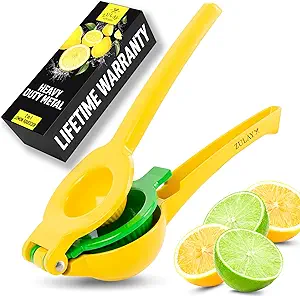 |
Nemco 55850 Manual Citrus Juicer

| Capacity | 0.65 liters |
|---|---|
| Material | Steel |
| Power Source | Manual |
The Nemco 55850 is a commercial-style manual citrus juicer designed to deliver consistent, high-yield extraction without electricity. It uses a stainless steel rack-and-pinion mechanism supported by two self-lubricating bronze bearings and heavy-duty steel posts so each lever pull applies smooth, uniform pressure for efficient juicing. The removable strainer cone and ergonomic handle make it straightforward to press whole citrus halves and separate pulp while cleaning, and its all-metal construction and stainless fasteners are built to withstand frequent use in a restaurant or café. Because it is manual, it avoids motor maintenance and power needs, but it requires physical effort and is better suited to moderate to high throughput where an operator is present. The unit is NSF listed, which helps meet commercial sanitation expectations, though hand-wash care is required. Overall, it is a robust, reliable choice when you want durable, high-yield manual juicing for a professional kitchen.
Best for: Professionals running juice bars, restaurants, or cafés who need a rugged, nonpowered juicer that delivers consistent extraction and is built for frequent use.
Less Ideal for: Operators who need fully automated or high-speed motorized juicing or kitchens without staff time to operate a manual press should consider powered alternatives.
- Sturdy aluminum and stainless steel construction for heavy commercial use
- Rack-and-pinion drive with bronze bearings for smooth, consistent pressure
- Removable strainer cone simplifies cleaning and pulp separation
- Ergonomic handle reduces operator fatigue during repeated use
- NSF listing indicates compliance with commercial sanitation standards
- Manual operation requires physical effort and a dedicated operator
- Hand wash only rather than dishwasher-safe components
Verdict: A rugged, NSF-listed manual juicer made for commercial kitchens that need reliable, high-yield citrus extraction without electric motors.
Robot Coupe J80 Ultra Juicer

| Power Source | Corded Electric |
|---|---|
| Voltage | 120 |
| Wattage | 746 watts |
| Capacity | 6.5 liters |
| Special Features | Automatic Juicer with Pulp Ejection |
The Robot Coupe J80 Ultra is a professional centrifugal juicer built for continuous, high-volume use in restaurants, cafes, and juice bars. It pairs a powerful motor with automatic feed and pulp ejection so operators can load whole or halved produce and let the machine run without frequent stops to clear waste. The stainless steel motor base, anti-drip spout, and large 6.5 quart waste container keep counters cleaner and reduce downtime during service, while the included grating disc and fine mesh filter basket help produce clear juice from fruits and vegetables. Controls are simple push-button operations suited to busy staff and the unit is constructed for heavy use, though it requires hand washing for parts and will occupy a substantial footprint on a prep counter. Expect brisk extraction speeds and reliable performance but plan for regular cleaning and a dedicated space for the unit in a professional kitchen.
Best for: Operators at restaurants, juice bars, or cafes seeking a rugged, high-throughput centrifugal juicer that speeds service and minimizes refill interruptions.
Less Ideal for: Small home users or occasional juicers who need a compact, low-maintenance countertop appliance; also not ideal where dishwasher-only cleaning is required.
- Automatic feed and pulp ejection greatly reduces manual clearing and speeds continuous operation
- 6.5 quart waste container minimizes downtime during busy service periods
- Stainless steel motor base and anti-drip spout help keep worktops cleaner and improve durability
- Includes grating disc and fine mesh filter basket for clearer juice extraction
- Requires hand washing of parts which increases cleaning labor in a busy kitchen
- Large and heavy footprint demands a dedicated counter space
Verdict: A workhorse centrifugal juicer engineered for restaurants and juice bars that need fast, continuous extraction with minimal downtime.
VINCI Hands-Free Citrus Juicer E19010

| Capacity | 12 fluid ounces |
|---|---|
| Wattage | 50 watts |
| Power Source | Corded Electric |
| Voltage | 120 volts |
| Special Features | Pressure-Sensitive Extraction; Interchangeable Fine/Coarse Pulp Filters |
The VINCI Hands-Free Citrus Juicer automates single-button extraction for fast fresh citrus juice without manual squeezing. It uses a pressure-sensitive system and a high-torque 50 W motor to adapt to rind thickness, which helps avoid bitter flavors while maximizing yield from fruits ranging from key limes to 4.5-inch grapefruit. Two interchangeable pulp filters let you choose fine or coarse texture, and a 12 oz BPA-free Tritan bowl with a locking spout collects juice for easy transfer. Removable parts are top-rack dishwasher-safe and the unit incorporates an auto-suspend safety/reset feature to protect the motor under excessive force. For continuous heavy commercial use the motor and small reservoir limit throughput compared with pro-grade juicers, and the single-speed operation reduces control for delicate tasks, but for light back-of-house prep, cocktail stations, or small-service brunch shifts it delivers quick, consistent cups of juice with minimal cleanup.
Best for: Busy small restaurants, bars, or cafes that need fast, hands-free citrus for cocktails and recipes without adding cleaning overhead and that prioritize consistent results and compact footprint.
Less Ideal for: High-volume kitchens or operations that require continuous commercial-scale juicing should choose a dedicated commercial citrus press with larger capacity and industrial motor durability.
- Automatic pressure-sensitive extraction reduces bitterness and improves yield.
- High-torque 50 W motor provides rapid juicing in seconds.
- Includes fine and coarse pulp filters for texture control.
- Removable parts are top-rack dishwasher-safe for quick cleaning.
- Locking spout and 12 oz reservoir make juice transfer tidy and convenient.
- 12 oz reservoir and single-speed motor limit continuous high-volume commercial throughput.
- Designed for countertop home use rather than heavy-duty restaurant production.
Verdict: A compact, easy-to-clean automatic citrus juicer that fits small restaurant and bar stations needing quick, consistent fresh citrus without a large footprint.
Elite Gourmet ETS623 Citrus Juicer

| Maximum Power | 40 watts |
|---|---|
| Power Source | Corded Electric |
| Voltage | 120 |
| Capacity | 24 oz |
The Elite Gourmet ETS623 is a small, corded electric citrus juicer built for quick home-style extraction. Its 40-watt motor and auto-reversing reamer spin in dual directions as you press fruit onto the cone, which helps pull more juice from each half compared with weaker 25-watt units. Juice collects in a 24 oz pitcher with an integrated pulp and seed filter and an easy-pour spout, so you can make a couple of servings without transferring vessels. The removable parts are mostly dishwasher-safe on the top rack and the compact footprint fits tight counters or service stations. Practical limits are its modest motor and 24 oz capacity, which are fine for light to moderate daily use but unsuitable for sustained high-volume restaurant pressing; the unit is optimized for convenience rather than continuous commercial workloads. Assembly and cleaning are straightforward and the BPA-free construction plus ETL listing covers basic safety expectations.
Best for: Buyers looking for an inexpensive, space-efficient citrus juicer to produce fresh juice for small batches or occasional service and who prioritize simplicity and low upfront cost.
Less Ideal for: High-volume restaurant kitchens or juice bars that need heavy-duty, continuous extraction and larger throughput should choose commercial-grade juicers instead.
- 40-watt motor with auto-reversing reamer for better juice extraction than many basic models
- Integrated 24 oz pitcher with built-in pulp and seed filter and easy-pour spout
- Compact footprint fits small counters, apartments, dorms, or tight service areas
- Detachable parts are top-rack dishwasher safe for faster cleanup
- BPA-free materials and ETL listing for basic safety compliance
- 24 oz capacity and 40W motor are not designed for continuous, high-volume commercial use
- Some removable parts recommended hand wash for longest life despite dishwasher-safe claim
Verdict: A compact, budget-friendly citrus juicer that delivers better extraction than basic home models and is best for light-duty, small-batch fresh juice needs.
BLACK+DECKER Citrus Juicer CJ625

| Wattage | 150 watts |
|---|---|
| Maximum Power | 900 watts |
| Power Source | Corded Electric |
| Voltage | 120 volts |
| Special Features | Auto-Reversing |
The BLACK+DECKER CJ625 is a small, corded electric citrus juicer meant for straightforward juice extraction of lemons, limes, oranges, and similar fruit. It uses auto-reversing reamer cones and a stirring action to improve extraction and comes with two cone sizes to fit different fruit; pulp is collected in a removable basket so you can choose a clearer juice or a pulpier result. The clear measuring pitcher with a drip-free spout doubles as the collection container, making it easy to pour and measure for recipes. Its dishwasher-safe plastic parts and stainless steel blade simplify cleanup after busy shifts. Limitations for restaurant use are its consumer-minded capacity and motor power rating, which suit batch home juicing or light front-of-house service but are not designed for continuous heavy commercial workloads.
Best for: Small restaurants, cafes, or bars that need a reliable, easy-to-clean citrus juicer for moderate daily volume and accurate portioning.
Less Ideal for: High-volume commercial kitchens that require continuous-duty, heavy-duty commercial juicers built for nonstop extraction.
- Auto-reversing cones increase juice extraction from each fruit
- Adjustable pulp basket lets you control juice clarity
- Clear pitcher with measurement markings and drip-free spout for easy portioning
- Dishwasher-safe removable parts and stainless steel blade for easy cleaning
- Designed for light to moderate use rather than continuous commercial workloads
- Plastic construction and small capacity limit durability and throughput in a busy kitchen
Verdict: A compact, easy-to-clean citrus juicer that reliably extracts juice for small establishments needing moderate daily output and precise portions.
Zulay Cast Iron Juicer

| Capacity | 0.6 liters |
|---|---|
| Material | Cast Iron & Stainless Steel |
| Special Features | Manual |
| Power Source | Manual |
This is a sturdy, lever-action cast iron juicer built to squeeze a lot of citrus quickly without electricity. The large 5-inch bowl and stainless steel strainer keep seeds out while handling fruit from limes to grapefruits, and the long cast iron arm delivers strong mechanical advantage so bartenders and kitchen staff can extract juice with minimal effort. Rubberized feet and a solid base reduce slipping during repeated use, and removable strainers make the parts accessible for hand cleaning. Because it is fully manual there is no motor to fail and no power required, which suits busy commercial counters or a high-volume bar. The unit is heavy and built for permanence, so it is best used as a stationary press rather than a portable tool, and hand-wash care means cleaning duty is more hands-on than a dishwasher-safe device. For restaurants and juice bars seeking simple, durable mechanical extraction, this model focuses on reliability and yield rather than automation or ultra-fast throughput.
Best for: Busy restaurant bars and juice stations that prioritize durable, low-tech equipment for consistent fresh citrus extraction and long service life.
Less Ideal for: Small cafés or pop-up operators who need portable, lightweight, or fully automated electric juicers for faster single-operator throughput.
- Heavy cast iron construction built for continuous commercial use
- Large 5-inch bowl accommodates small to large citrus for versatile juicing
- Long lever arm provides strong mechanical advantage for high yield with minimal effort
- Stainless steel detachable strainers keep seeds out and simplify cleaning
- Requires hand washing and regular maintenance due to cast iron and stainless parts
- Heavy weight and permanent footprint make it impractical to move frequently
Verdict: A rugged, no-power cast iron press made for restaurants and bars that need reliable, high-yield citrus extraction.
Zulay Metal 2-in-1 Lemon Squeezer

| Power Source | Manual |
|---|---|
| Material | Aluminum |
| Blade Material | Stainless Steel |
| Capacity | 0.5 liters |
The Zulay Metal 2-in-1 Lemon Squeezer is a compact, manual citrus press that uses a hinged bowl and press to force juice through a perforated bowl while catching seeds and pulp. Made from aluminum with stainless-steel cutting edges, it is built for repeated countertop use and is easy to operate: place a halved citrus in the bowl, squeeze the ergonomic handle, and the juice collects below while seeds stay out. Its manual design means no power, minimal maintenance, and quick cleanup by hand washing. For high-volume settings this unit is sturdy and simple, but its small size and manual leverage limit throughput compared with commercial electric juicers, so it is best used for occasional fresh-squeezing tasks, garnishes, or table-side service rather than continuous back-of-house juicing. The seed-filter holes and ergonomic handle make single-handed operation straightforward, and the solid-metal construction should hold up to regular use if handled properly and cleaned after each shift.
Best for: Restaurant operators who need a reliable, no-power tool for occasional fresh-squeezing tasks like table-side cocktails, garnish prep, or small-batch recipes and who prioritize predictable, low-risk tools.
Less Ideal for: Busy kitchens that require large quantities of juice or continuous extraction should choose a commercial electric juicer built for high throughput and faster processing.
- Heavy-duty aluminum construction for durable manual use
- Perforated bowl filters seeds and pulp for cleaner juice
- Ergonomic handle reduces hand strain during repeated squeezes
- Simple manual operation requires no power or consumables
- Small capacity and manual operation are slow for continuous high-volume juicing
- Hand wash recommended rather than dishwasher for longevity
Verdict: A sturdy, foolproof manual press ideal for small-scale restaurant tasks and table service when no-power, low-risk juicing is needed.
Choosing the Right Juicer for Restaurants: Key Factors to Consider
Throughput and Extraction Yield
Throughput determines how many drinks or servings a machine can produce per hour. In a restaurant setting you need a juicer that keeps pace with order volume during peak periods. Extraction yield measures how much usable juice you get from a given amount of produce. Higher yield lowers ingredient cost and reduces prep time because staff spend less effort producing the same volume of beverage.
When assessing throughput, look for rated continuous run times and manufacturer throughput specs. Yield is influenced by juicer type and feed system; comparing expected liters or ounces per minute helps set expectations for staff scheduling and ingredient ordering.
Durability and Construction
Commercial kitchens are harsh environments with constant use, temperature swings, and frequent washdowns. Machines with stainless steel housings, robust motor assemblies, and reinforced feed components will last longer and tolerate professional demands. Durable construction also affects safety and reliability; fewer failures mean less interruption to service.
Consider the duty cycle rating and whether parts subject to heavy wear are replaceable without sending the machine out of service. Evaluate mounting or anchoring options if the unit will be used on a prep counter that experiences vibration or heavy traffic.
Cleaning, Sanitation, and Food Safety
Sanitation protocols in commercial kitchens are stricter than at home. Juicers must be easy to disassemble, clean, and sanitize between uses to prevent bacterial growth and cross-contamination. Smooth, nonporous surfaces and removable components that fit in commercial dishwashers or are compatible with sanitizers speed turnaround.
Pay attention to crevices where pulp can accumulate and to whether seals and gaskets are easily removable for thorough cleaning. Machines that require lengthy teardown or delicate hand-washing add labor time and may be impractical during busy shifts.
Serviceability and Parts Availability
Even well-built machines need maintenance. Choose models with accessible service points and widely available replacement parts. Quick access to common wear items like screens, blades, and seals reduces downtime and keeps operating costs predictable.
Check whether the manufacturer provides clear service documentation and whether local technicians can perform routine repairs. Machines that allow in-kitchen part swaps without specialized tools are preferable for restaurants that cannot afford extended downtime.
Noise, Vibration, and Location Suitability
Noise and vibration affect both staff comfort and the dining experience when juicing happens in front-of-house. Lower-noise units are better suited for open kitchens or bar counters, while louder, heavier-equipment models may be fine in back-of-house prep areas.
Assess mounting options and anti-vibration feet to reduce movement during operation. Consider whether the juicer will be used intermittently at a bar station or continuously in a high-volume prep area, and choose accordingly to minimize impact on service and communication.
Power Requirements and Installation
Commercial juicers may demand higher voltage or dedicated circuits. Ensure your kitchen electrical infrastructure can support the intended machine without tripping breakers or requiring costly upgrades. Hardwired units or those needing specific amperage should be verified by an electrician prior to purchase.
Also check space and ventilation needs; some high-capacity machines generate heat and require clearance for service access. Planning for proper installation reduces surprises during setup and ensures the unit performs reliably under continuous loads.
Types of Commercial Juicers
Commercial juicers for restaurants generally fall into a few functional types, each suited to different menu and volume needs. Centrifugal-style systems are fast for whole-fruit processing but can produce more foam and heat. Masticating or cold-press systems extract juice more slowly but usually deliver higher yields and a smoother texture, which can be important for premium menu items.
Citrus-specific press machines are common for establishments with high citrus demand because they deliver consistent yields with minimal prep. For restaurants focused on leafy greens or wheatgrass, look for slow auger designs that handle fibrous material without clogging.
- Centrifugal: High speed, good for bulk fruit, may increase foam.
- Masticating/Cold-Press: Better yield, gentler on produce, slower.
- Citrus Press: Fast and consistent for lemons, limes, oranges.
- Leaf/Fiber-Oriented Machines: Designed for greens and wheatgrass.
Workflow Integration and Staff Training
Integrate the juicer into existing kitchen stations to minimize extra steps. Position the machine near prep sinks and refrigeration to reduce handling time for produce and to streamline cleaning. Consider counter space and whether the machine requires a drainage line or dedicated disposal for pulp.
Staff should be trained on quick teardown, safe operation, and basic troubleshooting. Simple visual guides and a short hands-on session reduce errors and help keep throughput steady during busy shifts.
- Place near prep sink and refrigeration when possible.
- Provide concise cleaning and operation checklists for staff.
- Assign daily and weekly maintenance tasks to specific roles.
Sanitation Best Practices
Establish a sanitation schedule that fits service patterns. For front-of-house juicing, clean components between service periods or after a set number of uses. For back-of-house machines used continuously, schedule regular deep cleans during lull periods to prevent buildup.
Use food-safe sanitizers recommended for commercial kitchens and follow contact-time instructions. Rinse thoroughly and inspect seals and gaskets for wear as part of the cleaning routine.
- Rinse and remove pulp immediately after use to prevent drying.
- Sanitize removable parts on a daily basis; deep clean weekly.
- Keep spare seals and gaskets on hand to avoid extended downtime.
Planning Capacity and Menu Impacts
Match juicer capacity to the menu and expected volume rather than purchasing the largest available unit by default. High-capacity machines are useful for centers with heavy juice programing, but smaller commercial units may be more economical and easier to maintain for limited-juice menus.
Consider menu variety. If you offer juice flights or delicate green blends, choose equipment that preserves flavor and texture. If you mainly serve citrus-based drinks, a specialized citrus press will usually be more efficient and easier to sanitize.
- Estimate daily liters or pounds of produce to size equipment.
- Factor in peak-period demand rather than average usage.
- Choose machines that support the specific produce types on your menu.
Maintenance Planning and Replacement Parts
Create a maintenance log that tracks cleaning, part replacements, and any repairs. Routine inspection catches small problems before they interrupt service. Budget for replacement wear parts such as screens, blades, and seals and source these before they are needed.
If possible, choose equipment with modular components so staff can swap parts quickly during a shift. Clarify warranty and service-response expectations at purchase so you have a plan if a unit needs professional repair.
- Keep a small stock of common wear parts on site.
- Log hours of operation to predict when service items will wear.
- Train a staff member on simple in-house repairs and part swaps.
How We Chose the Best Juicer for Restaurants
We prioritized attributes that matter in commercial kitchen environments and excluded small domestic countertop machines that are not designed for repeated, back-to-back use. Primary evaluation criteria included continuous throughput and extraction efficiency, because restaurants need machines that process high volumes without significant drops in yield or speed. Durability and build quality were measured by materials, duty-cycle ratings, and serviceability to ensure the unit can withstand daily commercial use. Ease of cleaning and sanitation protocols were critical; we favored designs with accessible components and compatibility with common sanitizing practices. Noise and vibration levels were considered where they affect front-of-house ambiance or staff comfort. Finally, we looked at parts availability and how straightforward routine maintenance is, since downtime has a direct cost in foodservice. Units that lacked clear commercial ratings or had impractical cleaning requirements were excluded from consideration.
Our full evaluation process is outlined in our review methodology.
FAQ
How often should a commercial juicer be deep-cleaned?
Deep cleaning should be scheduled at least weekly for most commercial juicers, with removable parts sanitized daily. High-volume use may require more frequent deep cleans to prevent buildup and ensure food safety.
Can restaurant staff perform routine maintenance themselves?
Often staff can handle routine maintenance like replacing seals, cleaning screens, and lubricating specified parts. More complex repairs should be handled by qualified technicians to avoid voiding service agreements.
What electrical considerations should I check before buying a juicer?
Confirm the unit's voltage and amperage requirements and verify that your kitchen has the appropriate dedicated circuit. Some commercial machines require higher voltages or hardwired connections that need an electrician.
Is a cold-press juicer always better for restaurants?
Not always. Cold-press systems typically deliver higher yields and better flavor retention but are slower. For very high-volume, quick-turn environments, faster systems may be more practical depending on the menu.
How do I calculate the right capacity for my restaurant?
Estimate the number of juice servings per service period and multiply by average ounces per serving to get a target hourly throughput. Choose a machine whose rated throughput comfortably exceeds that peak figure to avoid bottlenecks.
Final Verdict
Choose a juicer that aligns with your restaurant's volume, menu composition, and staffing model. Prioritize throughput and yield when peak service speed matters, but do not overlook cleaning and serviceability since labor cost and downtime are decisive in commercial settings. Plan installation, sanitation, and spare-part availability before committing so the machine integrates cleanly into your workflow and stays reliable over time.