
Note: This article contains affiliate links. If you click on these links and make a purchase, we may earn a small commission at no extra cost to you. This helps support our research and content. Read our full affiliate disclosure here.
If you prefer glass-clear, pulp-free juices, picking the right juicer makes all the difference. A juicer that leaves no pulp streamlines mornings, produces smoother textures for delicate produce, and reduces the need for secondary straining. This guide covers seven top-performing juicers that prioritize dry pulp and easy maintenance, with picks selected for consistent extraction, user convenience, and durability. Below you will find concise product summaries and a breakdown of the evaluation criteria we used to shortlist these models, followed by practical buying guidance to help you match a machine to your routine.
Top Picks at a Glance
| Best Overall The best all-around choice for most situations | Kuvings AUTO10 Cold Press Juicer |  |
| Best Quality Built to a higher standard if you want something more solid | Hurom H330 Cold Press Juicer |  |
| Best Value The sweet spot between price and what you get | TUUMIIST Cold Press Juicer TM-580SJ |  |
| Best Budget The cheapest option that still gets the job done reliably | Juilist Centrifugal Juicer AMR526 |  |
| Top Rated A top-rated pick with lots of positive feedback | NAMA J2 Cold Press Juicer |  |
| Most Popular A crowd favorite that many people choose with confidence | Breville Juice Fountain Plus JE98XL |  |
| Best Seller A high-volume bestseller chosen again and again | EanOruus E-18 Masticating Juicer |  |
Kuvings AUTO10 Cold Press Juicer

| Capacity | 3 liters |
|---|---|
| Wattage | 240 watts |
| Power Source | Corded Electric |
| Maximum Power | 240 watts |
The Kuvings AUTO10 is a slow masticating juicer built for hands-free, bulk juicing sessions. Its Auto-Cut double-crushing blade and self-feeding design let you drop in larger pieces or whole fruits and vegetables with minimal prep, while the 50 RPM auger and 240W motor extract juice slowly to reduce heat and preserve nutrients. Practical touches include a large 100 oz capacity for multi-day batches or family servings, simplified removable parts and cleaning tools that speed post-juicing cleanup, and a quiet motor capable of continuous runs up to 30 minutes. That slow press produces silky juice with low pulp, which fits this article's focus on low-residue juicers. The unit is relatively heavy and fairly large, so it suits a dedicated countertop rather than occasional counter-top storage, and the acrylic/plastic food-path parts mean you should follow care instructions to maintain longevity. For buyers who value convenience, nutrient retention and frequent batch juicing, the AUTO10 is a strong, user-friendly choice.
Best for: Buyers who want a convenient, low-pulp cold-press juicer for regular or batch juicing and who prioritize nutrient retention and hands-free operation.
Less Ideal for: Users who need a lightweight, highly portable unit or only an occasional small-quantity juicer should consider simpler or more compact models instead.
- Auto-Cut double-crushing blade and self-feeding hopper reduce prep time by accepting larger pieces or whole produce
- Low-speed 50 RPM auger and 240W motor extract juice slowly for higher nutrient retention and low pulp output
- Large 3 L (100 oz) capacity lets you make multi-serving batches without frequent emptying
- Simplified removable parts and included cleaning tools make cleanup quicker after use
- Quiet operation and up to 30 minutes continuous run time for extended juicing sessions
- Relatively heavy and sizable, so it requires a permanent countertop spot
- Key food-path components use acrylic and plastic, which may need careful cleaning to avoid wear
Verdict: If you want hands-free, low-pulp cold-press juice in family-sized batches, the AUTO10 delivers convenient, nutrient-focused extraction.
Hurom H330 Cold Press Juicer

| Capacity | 2 liters |
|---|---|
| Power Source | Corded Electric |
| Special Features | Easy to Clean |
| Blade Material | Stainless Steel |
The Hurom H330 is a single-auger cold-press juicer built for batch juicing and minimal prep work thanks to its 2-liter self-feeding hopper that accepts whole fruits and vegetables. It runs at about 50 RPM using Hurom's patented slow squeeze technology to reduce heat and oxidation, producing relatively dry pulp and juice that stores well for up to 72 hours. The unit includes fine and coarse strainers for low-pulp or fuller textures and can also be used for nut milk and blended-style smoothies with the appropriate strainer. Practical benefits include quiet operation, quick disassembly for hand-washing, a safety shut-off on the hopper lid, and a detachable power cord for neater storage. The H330 is fairly heavy and uses mostly plastic components, so expect a substantial countertop footprint and hand-wash maintenance rather than dishwasher convenience. It is positioned toward users who want high-yield, nutrient-preserving cold press performance in family-size batches rather than a compact, lightweight daily squeezer.
Best for: Buyers who prioritize extraction efficiency and nutrient retention and who want to batch juice whole produce for family-size servings.
Less Ideal for: People who need a lightweight, ultra-compact juicer for occasional single servings or who want fully dishwasher-safe parts.
- Large 2-liter self-feeding hopper lets you run whole apples, carrots, celery, and leafy greens without chopping
- Low 50 RPM auger and slow squeeze tech preserve nutrients and reduce oxidation for longer-lasting juice
- Fine and coarse strainers give control over pulp level and allow making nut milks and thicker blends
- Quiet motor with safety shut-off and detachable power cord improves usability and storage
- Most removable parts are hand-wash only, adding cleanup time compared with dishwasher-safe models
- Plastic-heavy construction and substantial weight make it less portable and take more countertop space
Verdict: Choose the H330 if you want a high-yield cold-press juicer that handles whole produce and preserves nutrients for batch juicing with minimal prep.
TUUMIIST Cold Press Juicer TM-580SJ
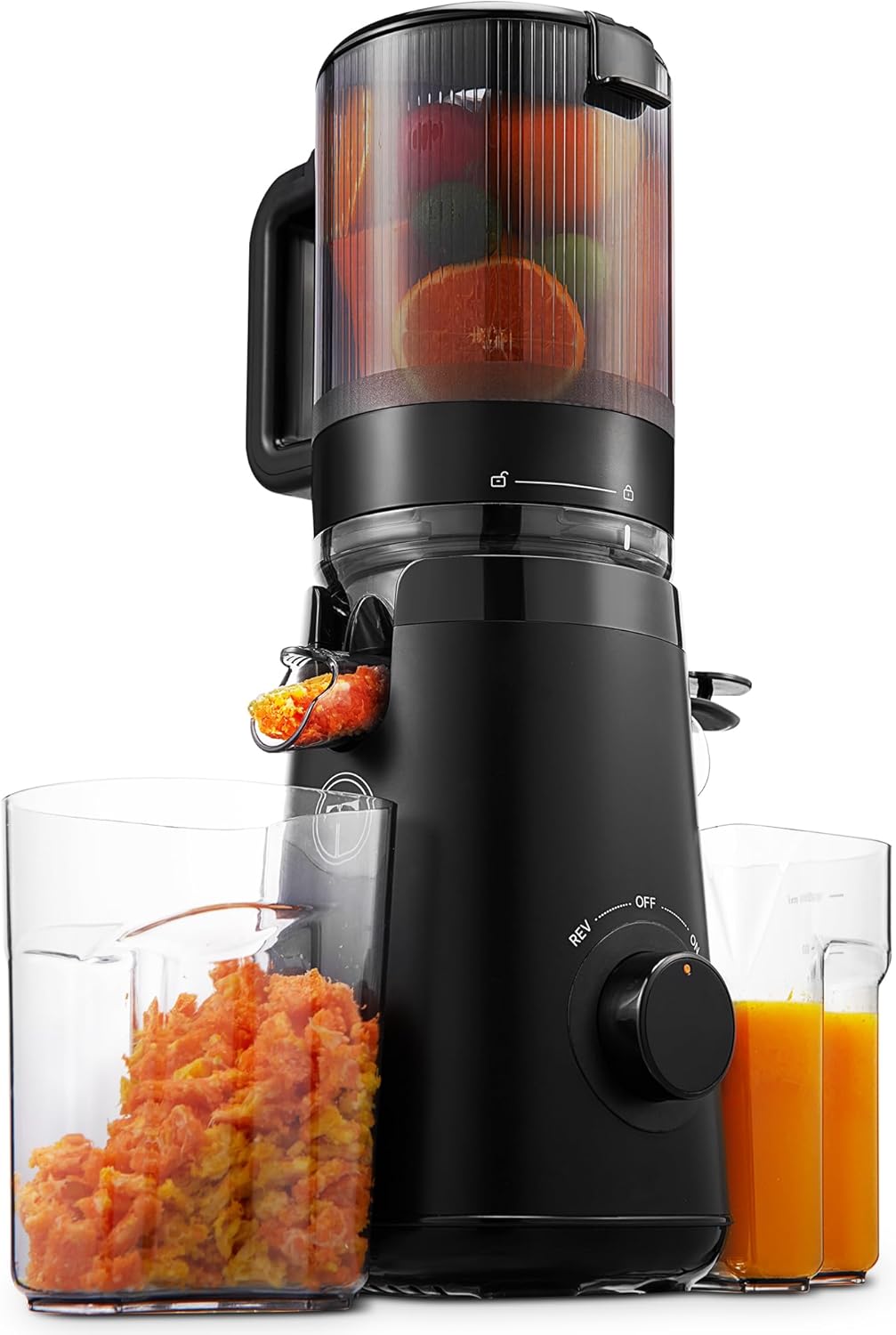
| Maximum Power | 300 watts |
|---|---|
| Wattage | 300 |
| Power Source | AC |
| Voltage | 120 volts_of_alternating_current |
| Number of Speeds | 55 |
The TUUMIIST TM-580SJ is a masticating cold-press juicer built around a wide feed chute so you can feed whole fruits and many vegetables without extensive prep. It runs at 55 RPM with a 300 W motor and a single auger that squeezes produce slowly to maximize juice yield while minimizing heat and foam, which helps retain nutrients and reduce visible pulp in the cup. The unit ships with a cleaning brush, juice cup and pulp cup and disassembles into a few simple parts that are mostly dishwasher safe for faster cleanup. Practical features include a no-mesh-filter design and a knob controller for straightforward operation. Expect good juice yield from leafy greens and soft fruit, but very hard produce may require some trimming and occasional clearing. The plastic construction keeps weight and cost down but is less premium-feeling than metal-bodied machines. For people who prioritize efficient, low-pulp extraction and easy everyday use, this model delivers a strong value proposition.
Best for: Buyers who want a practical, low-maintenance cold-press juicer that prioritizes high juice yield and minimal prep for everyday fresh juices.
Less Ideal for: People seeking a heavy-duty, all-metal commercial machine or those who need ultra-quiet operation and the premium feel of higher-end models.
- Extra-large feed chute accepts whole fruits and many vegetables to reduce prep time
- Slow 55 RPM masticating action maximizes juice yield and reduces heat and foam
- No-mesh-filter setup simplifies juicing and can lower visible pulp in the juice
- Included cleaning brush and mostly dishwasher-safe parts make cleanup easier
- ABS plastic construction feels less durable than metal alternatives
- May need occasional trimming or clearing with very hard or oversized produce
Verdict: Choose this juicer if you want a budget-friendly masticating machine that extracts high-yield, low-pulp juice with minimal prep.
Juilist Centrifugal Juicer AMR526

| Maximum Power | 800 watts |
|---|---|
| Wattage | 400 watts |
| Feed Chute | 3" Wide Mouth |
| Number of Speeds | 3 |
| Product Care Instructions | Dishwasher Safe |
The Juilist Centrifugal Juicer AMR526 is a budget-focused countertop juicer that processes most fruits and vegetables quickly thanks to its high-speed motor and 3" wide feed chute. It offers three speed settings for soft, firm, and pulsed/high-speed extraction, a visible window to monitor juicing, and a reinforced stainless-steel filter and cutting disc to help separate pulp. Accessories like a cleaning brush and dishwasher-safe parts simplify cleanup, and safety features include a double lock arm and overheating protection. In practice it works well for everyday juice: you can drop in larger pieces with less prep, switch speeds for different produce, and finish a single batch in under a minute. Expect typical centrifugal results — fast extraction with reasonable juice yield but more fine pulp than slow masticating machines and a bit more foam. The unit is compact so it fits small counters, though very fibrous or frozen items are not recommended. For someone prioritizing fast, no-fuss juicing on a tight budget, this hits the essentials without premium frills.
Best for: Buyers who want an affordable, fast juicer that minimizes prep time and is easy to clean for regular home use.
Less Ideal for: Users seeking the highest juice yield with minimal pulp or who plan to juice very fibrous greens and frozen produce should consider slow masticating models instead.
- 3" wide feed chute reduces chopping and speeds prep
- Three speed settings plus pulse let you match speed to produce
- Stainless-steel cutting disc and 304 filter designed for durable extraction
- Dishwasher-safe parts and included brush make cleaning easier
- Compact footprint fits small countertops
- Centrifugal design leaves more fine pulp and foam than slow masticating juicers
- Not intended for very fibrous or frozen ingredients
Verdict: A fast, budget-friendly centrifugal juicer that saves prep time and cleans up easily for everyday home juicing.
NAMA J2 Cold Press Juicer

| Capacity | 30 fluid ounces |
|---|---|
| Wattage | 200 watts |
| Power Source | Corded Electric |
| Number of Speeds | 1 |
The NAMA J2 is a slow, cold-press (masticating) juicer built for hands-free batch juicing: its wide self-feeding hopper accepts whole or large pieces so you can load a full recipe and walk away while the 200 W motor spins the auger at low speed. In everyday use it excels on leafy greens and soft fruits, producing relatively dry pulp and higher juice yield compared with centrifugal machines, and the included coarse strainer and juice containers make serving straightforward. Noise is low thanks to the slow 50 RPM operation, and parts are mostly stainless steel and Tritan which rinse clean or can be hand-washed; a spinning brush and quick-release components are provided to speed cleanup. Limitations are that it has a single speed and a 30 fl oz capacity so very large batches require multiple cycles, and it is not dishwasher-safe. For buyers prioritizing consistent, low-pulp juice and long-term reliability, the J2 is practical and durable, but those who need faster high-volume processing or dishwasher convenience should consider other designs.
Best for: Buyers who want dependable, low-pulp cold-pressed juice on a regular basis and value hands-free operation and durable construction for daily use.
Less Ideal for: People who need very large-volume, continuous juicing or prefer dishwasher-safe components for minimal cleanup.
- Self-feeding wide hopper for hands-free batch loading
- Masticating cold-press design yields more juice with less pulp from greens
- Quiet 50 RPM operation driven by a 200 W motor
- Easy-to-clean, quick-release parts with a cleaning brush included
- Durable materials (stainless steel and Tritan) suited for daily use
- Single speed limits control for delicate ingredients
- 30 fl oz capacity may require repeated cycles for large batches
- Parts require hand washing rather than dishwasher cleaning
Verdict: Choose the NAMA J2 when you want a reliable cold-press juicer that produces higher-yield, low-pulp juice with quiet, hands-free operation.
Breville Juice Fountain Plus JE98XL

| Power | 850 watts |
|---|---|
| Number of Speeds | 2 |
| Feed Chute | 3 inch extra-wide |
| Capacity | 1 liters |
| Power Source | Corded Electric |
The Breville Juice Fountain Plus JE98XL is a straightforward centrifugal juicer built for fast, everyday juice prep. It uses an 850W motor and a titanium-reinforced disc with a stainless steel micro-mesh filter to extract juice from fruits and vegetables, and the 3-inch feed chute means many items can be juiced whole or with minimal prep. Two speed settings let you run softer produce on low and harder items on high, while the included juice jug has a built-in froth separator to reduce foam when pouring. Cleanup is simplified by a detachable pulp container and dishwasher-safe parts, though centrifugal machines typically leave more pulp and produce slightly frothier results than slow press juicers. The unit is solidly built with heavy-grade polymer housing and stainless-steel cutters, and cord storage under the base keeps the counter tidy. For buyers prioritizing speed and convenience, this model delivers reliable daily performance, but those seeking the maximum dry pulp or highest nutrient yield may prefer a masticating design instead.
Best for: Buyers who value quick, low-effort juicing and want a dependable machine for daily use backed by many user reviews and proven performance.
Less Ideal for: Users focused on extracting the absolute driest pulp or maximizing nutrient retention should consider a slow masticating juicer instead.
- Extra-wide 3-inch chute reduces prep time by handling larger fruit and vegetable pieces
- 850W motor and reinforced extraction disc for efficient juice output
- Built-in froth separator in the juice jug for cleaner pours
- Dishwasher-safe detachable parts and cord storage simplify cleanup and storage
- Centrifugal design leaves more moist pulp compared with slow masticating juicers
- Can produce more froth and slightly warmer juice during high-speed extraction
Verdict: Choose the JE98XL when you want fast, no-fuss juicing with minimal prep and practical features that make daily use and cleanup easy.
EanOruus E-18 Masticating Juicer

| Capacity | 100 fluid ounces |
|---|---|
| Maximum Power | 250 watts |
| Power Source | ac |
| Voltage | 110 volts |
The EanOruus E-18 is a single-auger masticating juicer built to handle whole fruits and high-volume jobs without much prep. It accepts large produce through a 6.5-inch chute into a 100 oz hopper, then slowly crushes ingredients with a 250 W AC motor to extract juice, make nut milk, or churn fruit into sorbet using interchangeable strainers. The unit emphasizes convenience for family use: the wide chute reduces chopping, the auto-reverse and overheat protection help prevent jams, and many detachable parts simplify cleaning. Because it is a slow masticating design, it runs quietly and yields dryer pulp, which fits the article goal of leaving minimal pulp in the finished juice. Limitations to note are the hand-wash care requirement and plastic blade/materials that may feel less premium than metal alternatives, and the machine is relatively heavy so it is more of a semi-permanent countertop appliance than something you store away daily.
Best for: Buyers who prioritize reliable, low-pulp extraction for family-sized batches and who value quiet, hands-off operation and jam-protection features.
Less Ideal for: Those seeking a lightweight, easily storable juicer or a unit with primarily metal components and fully dishwasher-safe parts should look elsewhere.
- Extra-wide 6.5-inch chute reduces chopping and speeds prep
- Large 100 oz hopper lets you juice multiple batches without constant refilling
- Slow single-auger masticating action produces high yield and dryer pulp
- Auto-reverse and overheat protection help prevent jams and extend motor life
- Whisper-quiet AC motor suitable for morning use without loud noise
- Key components require hand washing rather than dishwasher-safe care
- Mostly plastic construction and plastic blade instead of metal may feel less durable
Verdict: Choose the EanOruus E-18 when you want a quiet, high-capacity masticating juicer that minimizes pulp and handles whole fruits with minimal prep.
Choosing the Right Juicer That Leave No Pulp: Key Factors to Consider
Extraction Efficiency
How completely a juicer separates juice from fiber directly affects the amount of pulp left behind and the yield you get from produce. Machines with stronger mechanical separation, multiple-stage extraction, or slow auger systems typically produce drier pulp and higher liquid yield.
Efficiency matters because it determines both the texture of the final juice and the long-term cost-per-glass. For buyers who prioritize clear, drinkable juice with minimal filtering, choose units designed and tested to leave visibly dry pulp across soft fruits, hard roots, and leafy greens.
Ease of Cleaning
Cleaning methodology influences how often you will actually use the juicer. Models with fewer parts, tool-free disassembly, and wide chutes make cleanup quicker and reduce the likelihood of leftover residue that can degrade flavor.
Brushes and rinse-friendly components speed post-use cleanup. Consider whether parts are dishwasher-safe or require hand washing, and whether the machine's crevices are accessible. A quick cleanup process keeps a frequently used juicer convenient rather than a chore.
Motor Power and Durability
The motor determines how well a machine handles tough, fibrous produce without bogging down. Higher-torque motors sustain consistent extraction and resist overheating during longer juicing sessions. Durable motors and robust gearing also increase the lifespan of the appliance.
If you plan to juice hard roots or a high volume of produce regularly, prioritize models with proven longevity and thermal protection. For occasional users, a mid-range motor may be adequate but expect lower throughput.
Feed System and Versatility
Feed chute size and the machine's ability to process different textures influence convenience and performance. Wide chutes reduce prep time for whole or large pieces, while smaller chutes can require more chopping but sometimes offer more control for delicate items.
Versatility includes how well the juicer handles citrus, leafy greens, and hard vegetables. Some systems include attachments or modes optimized for specific produce types; those features can expand the machine's usefulness beyond basic fruit juicing.
Noise, Heat, and Operating Speed
Noise and heat affect the usability of a juicer in shared living spaces or early mornings. High-speed centrifugal units are often louder and can introduce more heat, which may slightly alter flavor or nutritional properties for sensitive ingredients.
Slower extraction tends to be quieter and gentler on enzymes while producing drier pulp. Consider where and when you will use the juicer and whether sound or heat generation is a deciding factor for daily use.
Build Quality and Maintenance Needs
Material selection and construction quality impact durability and how the unit performs over time. Stainless steel parts, reinforced plastics, and well-designed seals reduce wear and minimize leaks or component failure.
Also consider replacement-part availability and whether routine maintenance items like screens and gaskets are easy to service. A well-built unit with accessible maintenance guidance will stay productive and leave less pulp consistently over its lifetime.
Cold-Press Vs High-Speed Extraction
Two primary mechanical approaches dominate the juicer market: slow, cold-press extraction and high-speed centrifugal extraction. Cold-press or masticating juicers use a slow auger to crush and press produce, often yielding drier pulp and less oxidation. High-speed centrifugal models shred produce rapidly and rely on force to separate juice, which can be faster but may leave wetter pulp with some textures.
Choose cold-press systems if minimal pulp and longer shelf life are priorities. Opt for centrifugal models only if you need very fast throughput and are willing to accept slightly wetter pulp for certain produce types.
- Cold-press: typically better for leafy greens and wetter pulp output
- Centrifugal: faster but may produce wetter pulp from soft produce
- Two-stage or dual-extraction systems can bridge the gap for higher yield
How Pulp Dryness Affects Juice Use
Drier pulp means you get more juice per pound of produce and less waste to manage. For people who plan to drink juice as-is, drier pulp reduces the need for additional straining or settling.
If you plan to use pulp for cooking or baking, consider texture. Very dry pulp is fibrous and better for composting or recipes that tolerate dryness, while wetter pulp retains more moisture and may be easier to repurpose in smoothies or baked goods.
- Drier pulp is easier to compost and stores better
- Wetter pulp may be preferable if you want to reuse it in recipes
Preparing Produce to Minimize Pulp
How you prepare fruits and vegetables affects extraction quality. Cut large fruits into sizes that fit the feed chute rather than overloading it. Remove large, tough seeds and thick rinds that can gum up mechanisms and produce inconsistent pulp.
For leafy greens, roll or pack them to create a consistent feed. Alternate between soft and hard items when possible to encourage steady throughput and more uniform pulp dryness.
- Trim rinds and large cores before juicing
- Alternate produce types to avoid clogs
- Use the machine's recommended speed/mode for each category
Maintenance Tips to Keep Pulp Minimal
Regular cleaning and periodic inspection of screens and seals keep extraction efficient. Clogged filters or worn screens reduce separation capability and increase wet pulp. Rinse parts immediately after use and perform a deeper clean weekly if you juice daily.
Replace any worn gaskets or screens as recommended. Keeping the feed chute and auger free of buildup prevents drag on the motor and preserves consistent extraction, which in turn keeps pulp drier.
- Rinse components promptly to prevent dry buildup
- Inspect screens for wear and replace when performance drops
- Store the unit assembled or partly disassembled to allow drying
Matching Capacity to Your Routine
Consider how much juice you make per session. If you regularly prepare large batches, pick a model with a higher throughput and a durable motor designed for sustained use. Smaller units can be ideal for single servings or occasional use and may be lighter and easier to clean.
Throughput also influences pulp dryness. Machines designed for commercial or heavy home use often maintain extraction efficiency under load, producing consistently drier pulp across longer sessions.
- Assess daily batch size before choosing a capacity
- High-throughput units are better for frequent, large-volume juicing
- Compact units suit single-serve or low-frequency routines
How We Chose the Best Juicer That Leave No Pulp
We focused on machines specifically engineered to minimize leftover pulp and produce clear, smooth juice. Our selection criteria emphasized measurable extraction efficiency, meaning how thoroughly a juicer separates liquid from solids across a range of fruits and vegetables. We also weighed ease of cleaning since even the most efficient extractor is less useful if upkeep is onerous. Build quality and motor durability were factored to ensure consistent performance over time, especially when processing fibrous or hard produce. Noise level and operating speed were considered because excessive vibration or heat can affect juice yield and flavor. Finally, we evaluated the versatility of feed systems and accessories for users who want to switch between leafy greens, citrus, and hard roots. We excluded machines that rely solely on manual strainers or systems that produce visibly wet pulp. Units with opaque, unserviceable parts or poor customer service histories were also not considered. The result is a shortlist of models that meet strict performance and user-experience thresholds for producing minimal pulp and hassle-free maintenance.
Our full evaluation process is outlined in our review methodology.
FAQ
Will a juicer that leaves no pulp remove all fiber from my juice?
No. Even highly efficient juicers reduce most pulp but do not remove every trace of soluble fiber. The result is a much smoother beverage with substantially less particulate, but some soluble fiber and nutrients remain in the liquid.
Are slow juicers always better at leaving no pulp?
Slow juicers often produce drier pulp because they crush and press more thoroughly, but performance varies by design. Some high-speed or dual-stage systems can also achieve low-pulp results depending on build and screening.
How often should I clean the juicer to maintain pulp performance?
Rinse components immediately after each use and perform a more thorough cleaning after every few sessions. Regular maintenance prevents screen clogging, which is the most common cause of wetter pulp over time.
Can I improve pulp dryness with technique rather than a new machine?
Yes. Properly preparing produce, alternating hard and soft items, and avoiding overloading the feed chute can all improve extraction. However, mechanical limits mean some machines will still leave wetter pulp.
Is wetter pulp a sign the juicer is failing?
Not always. Wetter pulp can result from the type of produce, the juicing technique, or clogged screens. If pulp becomes persistently wet despite correct use and cleaning, inspect screens and gaskets for wear or buildup.
Final Verdict
Focus on extraction efficiency, cleaning convenience, and motor durability when choosing a juicer that leaves minimal pulp. Tradeoffs include speed versus dryness and throughput versus ease of maintenance. If you prioritize very dry pulp and longer shelf life, favor slower, higher-torque systems with accessible screens. For faster results where slightly wetter pulp is acceptable, more compact high-speed options may be suitable.