
Note: This article contains affiliate links. If you click on these links and make a purchase, we may earn a small commission at no extra cost to you. This helps support our research and content. Read our full affiliate disclosure here.
If you prefer clear, pulp-free juice for smoothies, cocktails, or a lighter mouthfeel, choosing the right juicer matters. A juicer with no pulp reduces sediment in the final cup, improves mouthfeel, and makes it easier to mix juice into recipes. This guide covers our shortlisted top picks for no-pulp extraction and explains the performance and practical tradeoffs you should expect. We evaluate machines for juice yield, pulp separation, and daily usability so you can find a model that fits your routine. Read on to see the top options and what to consider before buying.
Top Picks at a Glance
| Best Overall The best all-around choice for most situations | NAMA J2 Cold Press Juicer |  |
| Best Quality Built to a higher standard if you want something more solid | Hurom H-200 Slow Juicer |  |
| Best Value The sweet spot between price and what you get | AMZCHEF Cold Press Juicer ZM1939 |  |
| Best Budget The cheapest option that still gets the job done reliably | TUUMIIST Cold Press Juicer TM-580SJ |  |
| Top Rated A top-rated pick with lots of positive feedback | ECOSELF Cold Press Juicer |  |
| Most Popular A crowd favorite that many people choose with confidence | Ninja NeverClog Cold Press Juicer JC151 |  |
| Best Seller A high-volume bestseller chosen again and again | EanOruus 3-in-1 Cold Press Juicer |  |
NAMA J2 Cold Press Juicer

| Maximum Power | 200 watts |
|---|---|
| Power Source | Corded Electric |
| Number of Speeds | 1 |
| Capacity | 30 fluid ounces |
The NAMA J2 is a slow, cold-press juicer built for hands-free batch juicing using a self-feeding wide-mouth hopper and a 200 W motor that runs at low RPM for quiet operation. You load whole or large pieces of produce into the hopper, walk away while the auger crushes and presses out juice, and collect liquid in the included juice container while pulp is pushed to a separate bin. Notable features include a large-capacity 30 fl oz container, stainless steel and Tritan parts, quick-release components and a cleaning brush to simplify rinsing and light scrubbing. The low-speed masticating action preserves nutrients and reduces foam and heat, which helps produce clearer, lower-pulp juice compared with centrifugal machines. Practical limitations are a single speed operation and a modest 200 W motor, so processing very tough roots or large commercial volumes will be slower than high-power or twin-speed models, and hand washing is required for parts care. For home buyers focused on high-yield, low-pulp fresh juice, the J2 offers a quiet, user-friendly solution with easy cleanup and consistent results.
Best for: Buyers who want a quiet, hands-free home juicer that maximizes juice yield and minimizes pulp for daily fresh juices without complex controls.
Less Ideal for: Those needing a commercial-capacity or high-speed juicer for heavy-duty root vegetables or continuous large-volume juicing should consider more powerful or multi-speed options.
- Self-feeding wide-mouth hopper for hands-free batch juicing
- Low-speed masticating action yields more juice with less pulp
- Includes juice and pulp containers plus strainers for tidy operation
- Quick-release parts and cleaning brush make routine cleanup easier
- Single speed limits control for very dense or fibrous produce
- Parts require hand washing rather than dishwasher-safe cleaning
Verdict: Choose the NAMA J2 if you want a quiet, hands-free cold-press juicer that produces high-yield, low-pulp juice for everyday home use.
Hurom H-200 Slow Juicer

| Capacity | 0.6 liters |
|---|---|
| Wattage | 150 watts |
| Power Source | Corded Electric |
| Number of Speeds | 1 |
| Special Features | BPA Free |
The Hurom H-200 is a slow, self-feeding masticating juicer built to maximize juice yield while minimizing pulp. It uses Hurom's slow squeeze mechanism and a low-speed auger to gently press fruits, vegetables, and leafy greens, producing smooth, low-pulp juice that stays fresher longer. The oversized hopper accepts whole or large produce pieces so you spend less time prepping, and the grooved strainer design and detachable parts make rinsing easier than traditional fine-mesh strainers. With a quiet 150-watt motor and a single-speed button control, the H-200 is straightforward to operate for daily juicing, nut milks, and sorbets. Expect strong extraction for soft fruits and most vegetables, but the single speed limits manual control for denser ingredients and it requires hand washing rather than dishwasher convenience. Its stainless steel construction and Ultem components feel durable and factory-quality, making it a solid choice for buyers prioritizing smooth, low-pulp juice and high yield.
Best for: Buyers who want high-yield, extremely smooth juice with minimal prep and value a quiet, durable masticating machine for daily use.
Less Ideal for: People who need adjustable speed settings for dense ingredients or those who prefer fully dishwasher-safe parts and instant cleanup.
- Large self-feeding hopper reduces chopping and speeds prep
- Slow masticating extraction produces very low pulp and high yield
- Grooved strainer and detachable parts allow fast rinsing with minimal scrubbing
- Quiet 150W motor suitable for morning use
- BPA-free construction with durable Ultem and stainless steel parts
- Only a single speed so no fine control for very hard produce
- Requires hand washing rather than dishwasher-safe cleaning
Verdict: Choose the Hurom H-200 if your priority is extracting very smooth, low-pulp juice with high yield and minimal produce prep.
AMZCHEF Cold Press Juicer ZM1939

| Maximum Power | 600 watts |
|---|---|
| Number of Speeds | 2 |
| Power Source | dc |
| Voltage | 120 volts |
| Special Features | 3-in-1 Function, Anti-Clogging Design |
The AMZCHEF Cold Press Juicer ZM1939 is a single-auger masticating machine designed to extract juice, make nut milk, and turn frozen fruit into sorbet. It uses a 6.5-inch reversible wide chute with built-in cutting blades so you can feed larger pieces or whole fruits with less prep, and a 600W DC motor with two speeds plus reverse to reduce clogging. The package includes two interchangeable strainers for juice or sorbet and a larger auger intended to press ingredients at low speed for higher yield and drier pulp. Removable parts are dishwasher-safe and the unit disassembles quickly for cleaning, while the reverse function and anti-clogging design help with fibrous produce. Limitations to note are that it is a single-auger, slow-speed juicer so it is not as fast as centrifugal models and best for users willing to trade speed for yield and nutrient preservation, and it requires some attention to avoid blockages with very stringy greens or soft fruits.
Best for: Buyers who want maximum juice yield and nutrient retention from whole fruits and who prefer a versatile slow juicer that can also make nut milk and sorbet while minimizing prep time.
Less Ideal for: People who prioritize speed and want quick, single-serving juices in under a minute or who need a compact travel-friendly appliance should look elsewhere.
- Wide 6.5-inch reversible chute reduces chopping and speeds up prep
- 600W motor with reverse and two speeds helps prevent clogging and handle tougher produce
- Comes with juice and sorbet strainers for multi-function use (juice, nut milk, sorbet)
- Larger auger and slow cold-press action maximize juice yield and produce drier pulp
- Removable parts are dishwasher-safe for easier cleaning
- Slower extraction process compared with high-speed centrifugal juicers
- May need occasional manual intervention with very stringy greens or overly soft ingredients
Verdict: Choose this AMZCHEF masticating juicer if you want a versatile cold-press machine that extracts high yields from whole fruits while also making nut milk and sorbet.
TUUMIIST Cold Press Juicer TM-580SJ
| Wattage | 300 W |
|---|---|
| Number of Speeds | 55 RPM |
| Power Source | AC |
| Special Features | No Mesh Filter, Whole Fruit Processing |
| Included Components | Cleaning Brush, Fruit Residue Cup, Juice Cup |
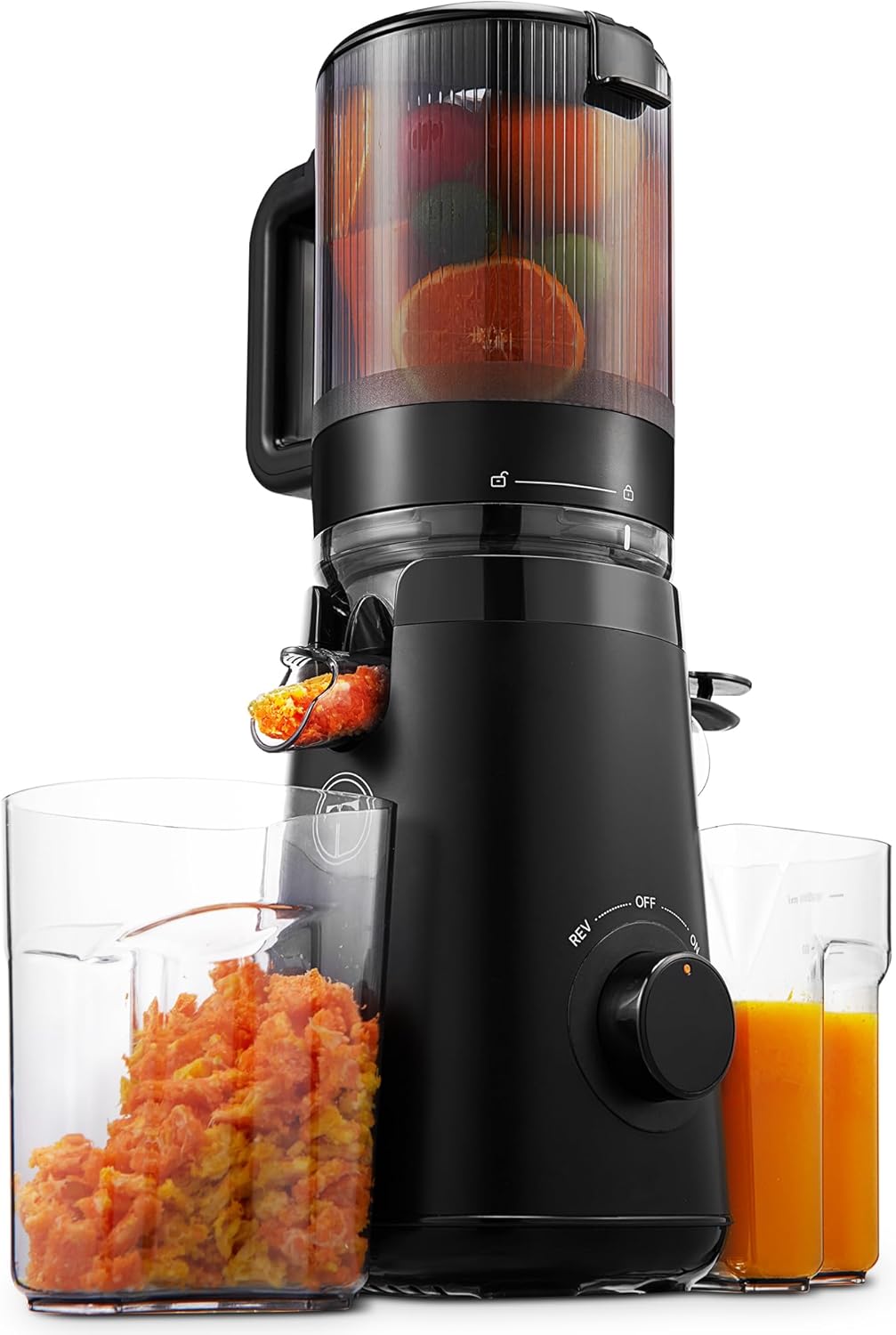
This TUUMIIST masticating juicer uses a slow 55 RPM auger to cold-press whole fruits and vegetables through a wide feed chute, producing high juice yield while minimizing pulp. It is built for straightforward daily use: drop in whole produce, let the auger squeeze out juice into the cup while pulp is expelled into the residue container, then rinse parts with the included brush. Notable features include a 5.8-inch extra-large feed chute that reduces prep time, a no-mesh-filter/whole-fruit design to simplify cleaning, and a 300 W motor sized for household use. Practical benefits are efficient nutrient retention from the slow-squeeze action and the convenience of hands-free batch juicing. Important limitations are the consumer-grade motor and ABS construction, which are typical at this price point and mean it is not intended for heavy commercial workloads; also some users may need to disassemble for thorough cleaning despite the simplified design. For buyers prioritizing low-pulp results on a budget, this model hits the key marks without unnecessary complexity.
Best for: Buyers who want a low-pulp, nutrient-preserving juicer on a budget and value a large feed chute to minimize prep time for everyday home juicing.
Less Ideal for: People needing a heavy-duty commercial machine or a long-term stainless steel workhorse for continuous high-volume juicing should look at more robust, higher-powered options.
- Extra-large 5.8" feed chute accepts whole fruits and reduces prep time
- Slow 55 RPM cold-press auger preserves nutrients and increases juice yield
- No-mesh-filter, whole-fruit design simplifies juicing flow and routine cleaning
- Includes cleaning brush and dedicated juice and pulp containers for tidy operation
- Plastic (ABS) construction rather than metal may feel less durable
- 300 W motor is suitable for home use but not heavy continuous commercial juicing
Verdict: A budget-friendly cold-press juicer that delivers low-pulp, nutrient-rich juice with minimal prep thanks to its extra-large feed chute and slow 55 RPM extraction.
ECOSELF Cold Press Juicer

| Special Features | Easy to Clean; High Juice Yield; Reverse Function; Low Noise Motor; Self Feeding |
|---|---|
| Material | Acrylonitrile Butadiene Styrene (ABS) |
The ECOSELF Cold Press Juicer is a slow masticating juicer designed for daily home use, especially when you want smooth, low-foam juices with minimal pulp. It accepts large fruits and vegetables via a wide feed chute and its self-feeding design means you can drop items in whole and let the auger pull them through, which speeds up mornings and reduces prep. The low-speed cold-press extraction and upgraded auger aim to maximize juice yield and limit heat and oxidation for fresher flavor and retained nutrients, while a reverse function clears clogs. Assembly is straightforward and the integrated hopper and included brush make cleaning quicker than many other masticating machines, though some small parts still need rinsing. The one-touch rotary control keeps operation simple, and the advertised high juice yield makes it efficient for squeezing leafy greens as well as firmer produce. Expect quieter operation than centrifugal models, but slower processing times—this is a device built for steady, reliable extraction rather than fast batch juicing.
Best for: Home buyers who prioritize consistent, low-pulp juice and dependable daily performance will appreciate this unit for weekday breakfasts and regular green juice routines.
Less Ideal for: If you need very fast high-volume juicing for parties or commercial use, a faster centrifugal or commercial juicer would be a better fit.
- Wide feed chute accepts whole fruits and vegetables to reduce prep time
- Slow masticating cold-press preserves nutrients and produces low-pulp, smooth juice
- Self-feeding, hands-free design speeds routine use
- Reverse function helps clear jams for uninterrupted operation
- Included brush and simple assembly make cleaning faster than many slow juicers
- Slower extraction speed compared with centrifugal juicers, so longer run time for large batches
- Claims of up to 99% yield may vary with produce type and require correct feeding technique
Verdict: Choose this ECOSELF cold press juicer when you want reliable, low-pulp home juicing with minimal prep and consistent nutrient-preserving extraction.
Ninja NeverClog Cold Press Juicer JC151

| Maximum Power | 150 watts |
|---|---|
| Number of Speeds | 2 |
| Capacity | 24 fluid ounces |
| Power Source | Corded Electric |
The Ninja NeverClog JC151 is a slow masticating juicer designed to extract nutrient-rich juice from fibrous fruits and vegetables without frequent clogging. It uses a 150-watt high-torque motor and auger to press produce at low speed, which reduces foam and helps preserve nutrients while the two interchangeable pulp filters let you choose less pulp for smoother, clearer juice or more pulp when you want texture and fiber. Practical features include a 24 oz juice jug, a 36 oz pulp container for larger batches, an anti-drip lever to avoid messes, simple one-touch Start/Stop and Reverse controls to clear jams, and dishwasher-safe juice-contact parts for easier cleanup. The machine is compact enough for countertop use but is a masticating design so it juices more slowly than centrifugal models, which matters if you need single-glass speed. While it handles tough greens and root vegetables well, users seeking instant throughput or ultra-fine commercial-level clarification may still notice some fine pulp in particularly fibrous blends.
Best for: Buyers who value clear, nutrient-preserving cold-pressed juice and want a reliable home juicer with adjustable pulp control and easy cleanup guided by broad user feedback.
Less Ideal for: People who need very fast single-glass juicing or fully commercial-level clarification should consider faster or specialty clarification systems instead.
- High-torque 150W auger extracts juice efficiently from fibrous produce
- Two interchangeable pulp filters allow control over pulp level and texture
- Large juice jug and pulp container support batch juicing without frequent emptying
- Reverse function and NeverClog design help prevent and clear jams
- Dishwasher-safe juice-contact parts simplify cleanup
- Slower extraction speed compared with centrifugal juicers, so single-glass prep takes longer
- May leave fine particles in very fibrous mixtures, so not absolutely pulp-free for all ingredients
Verdict: Choose the Ninja JC151 if you want a countertop cold-press juicer that minimizes clogging and gives you clear, controllable pulp levels for everyday batch juicing.
EanOruus 3-in-1 Cold Press Juicer

| Capacity | 100 fluid ounces |
|---|---|
| Maximum Power | 250 watts |
| Power Source | ac |
| Voltage | 110 volts |
The EanOruus 3-in-1 Cold Press Juicer is a single-auger masticating machine built for heavy home use and batch preparation. It accepts whole fruits through a 6.5-inch chute into a 100oz hopper so you can feed larger pieces and make multiple servings without constant refilling. The 250W AC brushless motor runs quietly and includes auto-reverse and overheat protection to handle fibrous produce and reduce jams. Two interchangeable strainers let you switch between juice extraction and making sorbet or nut milk, and detachable parts plus a removable pulp outlet simplify rinsing and cleanup. In practice it delivers high-yield, low-foam juice typical of slow masticating designs, and the wide chute noticeably speeds prep compared with narrow-feed juicers. Important practical limits are its hand-wash-only parts and plastic auger components, which may wear faster than metal alternatives, and the unit is fairly heavy for countertop storage. For buyers focused on smooth, low-pulp juice and large-batch prep, this model balances capacity and durability.
Best for: Practical home cooks who value low-pulp, high-yield juice and want a machine that can handle large batches with minimal prep time and reliable jam protection.
Less Ideal for: Buyers who need a lightweight, compact juicer for occasional single servings or who prefer all-metal, commercial-grade construction.
- Extra-wide 6.5-inch chute accepts whole fruits to reduce prep time
- Large 100 oz hopper supports batch juicing without frequent refills
- 250W AC brushless motor offers steady, whisper-quiet extraction with auto-reverse and overheat protection
- Includes interchangeable strainers for juice, nut milk, and sorbet versatility
- Detachable pulp outlet and removable parts make cleaning faster than fixed-pulp designs
- Most removable parts require hand washing rather than dishwasher-safe cleaning
- Plastic auger and components may be less durable than metal alternatives
- Relatively heavy for moving or storing between uses
Verdict: Choose this juicer if you want quiet, low-pulp cold-pressed juice and the ability to process large batches with minimal prep.
Choosing the Right Juicer with No Pulp: Key Factors to Consider
Extraction Method
Different extraction systems—centrifugal, masticating, and triturating—affect how much pulp ends up in the juice. Centrifugal machines chop and spin produce at high speed and rely on a fine mesh filter to separate solids. That can yield fast juice but sometimes leaves more microscopic particulates. Masticating and triturating systems crush and press produce more slowly, often producing clearer juice and drier pulp.
Understanding the extraction method helps you predict how much work the machine will do to separate pulp and whether you will need additional filtering or settling. If near-zero pulp is the priority, choose mechanisms and filter designs that emphasize pressing and multi-stage separation.
Filter and Separation Design
A juicer's filter geometry, mesh size, and any secondary straining steps are central to pulp control. Finer meshes trap smaller fibers but can clog faster, increasing cleaning time and reducing throughput. Some models use multi-stage separation or built-in pulp ejection to keep the filter clear and the juice cleaner.
Look for designs that balance fine filtration with accessible cleaning. Removable filter baskets and tools that make it simple to clear trapped fibers will reduce the chore factor. If you plan on processing a lot of leafy greens or soft fruit, ensure the separation method handles those without excessive clogging.
Juice Yield Versus Dryness of Pulp
A key tradeoff is between extracting the most liquid and delivering truly pulp-free juice. Machines that press produce thoroughly tend to leave drier pulp, which means higher yield and cleaner juice. Fast, high-speed models may extract quickly but leave wetter pulp with more suspended solids.
Consider whether you prioritize the largest possible volume of juice or the clearest, smoothest cup. For some users, a minor drop in yield is acceptable to achieve nearly pulp-free results; for others, maximizing volume is the goal. Evaluate how much pulp you mind in the glass and whether you are willing to accept extra prep or filtering to remove it.
Ease of Cleaning and Maintenance
Effective pulp separation is only useful if you will actually use the machine regularly. Cleaning time and the complexity of disassembly have a big impact on whether the juicer becomes a daily tool. Filters that require scrubbing or fiddly reassembly can discourage use. Dishwasher-safe parts, simple snap-together assemblies, and included cleaning brushes are practical advantages.
Also consider how easy it is to clear jammed pulp or leafy material mid-cycle. A machine that requires minimal downtime for cleaning encourages consistent use and preserves performance over time.
Throughput and Speed
How quickly a juicer processes produce matters when you are preparing several servings. High-throughput units can handle large quantities with fewer stops, which is important for families or entertainers. However, faster throughput sometimes correlates with coarser separation, increasing pulp in the juice.
Balance the need for speed against your quality expectations. If you routinely juice large volumes, prioritize models built for sustained operation with reliable pulp handling rather than small single-serve units.
Footprint, Noise, and Daily Convenience
Counter space and noise influence where and how often you use a juicer. Larger, heavier units may perform better at separating pulp but require permanent counter real estate. Loud machines can be disruptive in small homes or early-morning routines.
Consider where the unit will live, how often you will run it, and whether you need a quieter model for shared living situations. Also account for storage of detachable parts and whether accessories will fit in your cabinets.
Why Some Juicers Leave Pulp Behind
Pulp levels come down to mechanics and filtration. High-speed shredding breaks fibers into fine particulates that can remain suspended in juice if the filter or separator does not catch them. Slower, compressive systems physically press liquids out of solids, often creating much clearer juice.
Produce type also affects pulp. Soft fruits and fibrous greens behave differently than hard apples or carrots. A machine that clears pulp well with citrus might struggle with leafy greens unless it has a tailored mechanism or accessory.
- High-speed shredding tends to increase microscopic particulates
- Pressing and crushing usually yield clearer juice and drier pulp
- Filter mesh size controls clarity but impacts clogging and cleaning
Tips to Get Nearly Pulp-Free Juice at Home
Prepping produce correctly and using the right settings reduces pulp carryover. Cut produce into pieces that match the feed throat and avoid overloading the machine. For leafy greens, bundle them tightly before feeding to improve extraction.
Use a secondary strainer or cheesecloth for an extra-clear cup when the juicer's filter does not meet your clarity standard. Letting freshly pressed juice rest briefly will also let heavier particulates settle for a clearer top layer.
- Bundle leafy greens to improve throughput
- Use a fine mesh strainer for second-stage clarification
- Process firmer items first, then softer fruits to reduce foaming
Maintaining Filter Performance Over Time
Filters and baskets accumulate residue that reduces clarity and throughput. Regular cleaning after each session prevents buildup that can trap pulp and then release it into subsequent batches. Inspect the mesh for tears or warping, as damaged filters will no longer separate effectively.
For heavy users, periodic deep cleaning or a replacement filter schedule preserves performance. Avoid abrasive cleaners that can deform mesh and follow manufacturer guidance for safe cleaning materials and methods.
- Rinse immediately after use to prevent dried residue
- Use appropriate brushes to clear mesh without damage
- Replace worn filters to maintain separation efficiency
Common Misconceptions About 'No Pulp' Juice
No-pulp marketing can be misleading. Some machines reduce visible pulp but leave microfibers and suspended solids that change texture and mouthfeel. Expect a spectrum from visibly clear to microscopically particulate juice rather than an absolute guarantee.
Another misconception is that higher speed always equals better juice. In many cases, slower, pressure-based extraction yields a clearer cup despite longer processing times.
- Absolute zero-pulp is rare; aim for low-residue instead
- Extraction method matters more than advertised labels
- Post-straining is a valid and sometimes necessary step
Everyday Workflow for Minimal Pulp
Plan a streamlined routine: prep produce, process in logical order, and clean right away. Keep the most commonly used accessories and cleaning tools nearby to reduce friction. Small habits like running water through the filter during the last few seconds of extraction can help dislodge trapped fibers.
If you routinely make single servings, consider a quick post-strain rather than using the fastest juicer on the market. For batch juicing, assign a cleanup window immediately after to prevent residue buildup that will affect subsequent batches.
- Prep produce to match feed throat size
- Run water through mesh during extraction to reduce clogs
- Clean filters immediately after use to preserve performance
How We Chose the Best Juicer with No Pulp
We focused on machines that consistently produce low-pulp or virtually pulp-free juice while remaining practical for home use. Our selection criteria prioritized measurable extraction and separation performance plus real-world usability. Key evaluation points included juice yield, effectiveness of pulp separation, and the clarity of the finished juice. We also weighed ease of cleaning and maintenance because even a high-performing juicer becomes a poor daily choice if upkeep is onerous. Durability and build quality were considered through inspection of materials and common serviceability features. Noise level and countertop footprint were included as secondary but important filters for everyday convenience. We excluded hybrid appliances or devices designed primarily for blending or puréeing, since those do not reliably remove pulp. We also filtered out specialty or commercial-only extractors that are impractical for most households. The result is a curated set of home-friendly juicers that balance production of low-residue juice with straightforward operation and upkeep.
Our full evaluation process is outlined in our review methodology.
FAQ
Can I get completely pulp-free juice from a home juicer?
Completely pulp-free juice is rare at home without additional straining. Many machines produce very low-residue juice, but microfibers can remain. For truly pulp-free results, use a fine secondary strainer or cloth after extraction.
Which produce creates the most pulp and how to handle it?
Fibrous produce such as celery and leafy greens tends to create more pulp. Bundle greens before feeding, alternate firm and soft items, and consider a slow-press extraction method to reduce suspended fibers.
How often should I clean the filter to maintain pulp separation?
Clean the filter after every use to prevent buildup that reduces clarity and throughput. For heavy users, deep-cleaning or inspecting for wear every few weeks helps maintain performance.
Does juicer speed affect pulp levels?
Speed can influence pulp but not in a simple way. High-speed shredders are fast but can leave more microscopic particulates. Slower pressing methods are often better at producing clearer juice, though they take longer.
Is post-straining worth the extra step?
Post-straining with a fine mesh or cloth is an effective way to remove residual pulp when clarity is very important. It adds time but can transform low-residue juice into near-clear juice without changing the extraction process.
Final Verdict
Prioritize the extraction method and filter design when choosing a juicer for minimal pulp. Decide whether you value maximum juice yield or the clearest possible cup, and weigh that against cleaning time and daily convenience. For many home users, a slower press-style extractor or a model with effective multi-stage separation delivers the best balance of clarity and yield. Choose a machine that matches your workflow and maintenance tolerance. If near-zero pulp is essential, plan for occasional post-straining and consistent filter care to keep performance high.