
Note: This article contains affiliate links. If you click on these links and make a purchase, we may earn a small commission at no extra cost to you. This helps support our research and content. Read our full affiliate disclosure here.
If you work with heavy paper projects, picking the right laminator for cardstock makes a big difference in finish and durability. Cardstock is thicker and stiffer than normal paper, and not all tabletop laminators handle its weight, edge thickness, or composite coatings without jams or uneven adhesion. This guide highlights seven shortlisted laminators that suit cardstock projects, focusing on consistent heat, solid feeding mechanisms, and ease of use. We evaluate features that matter for craft, classroom, and small business use so you can choose a machine that protects prints, maintains crisp edges, and minimizes waste.
Top Picks at a Glance
| Best Overall The best all-around choice for most situations | Fellowes Saturn 125 Laminator |  |
| Best Quality Built to a higher standard if you want something more solid | SINCHI 13" Laminator LM350 |  |
| Best Value The sweet spot between price and what you get | bonsaii 9-Inch Laminator |  |
| Best Budget The cheapest option that still gets the job done reliably | bonsaii 9-Inch Laminator L421 |  |
| Top Rated A top-rated pick with lots of positive feedback | Scotch TL901X Thermal Laminator |  |
| Most Popular A crowd favorite that many people choose with confidence | Amazon Basics 9-Inch Laminator |  |
| Best Seller A high-volume bestseller chosen again and again | Crenova A4 Laminator |  |
Fellowes Saturn 125 Laminator

| Warm up time | 1 minute |
|---|---|
| Rollers | 1 |
| Maximum width | 12.5 in. |
| Lamination speed | 19 in./minute |
The Fellowes Saturn 125 is a compact desktop thermal laminator aimed at classroom and small-office use that heats in about 60 seconds and accepts up to 12.5-inch wide pouches. It runs 19 inches per minute and supports 3, 4, and 5 mil hot pouches as well as a cold setting for self-adhesive sheets, so it handles everything from flashcards and cardstock to posters. Practical features like an integrated jam release lever, CleanAlert maintenance reminder, and energy-saving auto shutoff make it reliable during frequent short runs, and the built-in handle helps move it between workspaces. Because it uses a single roller, heavy or very thick cardstock may require slower feeding and careful alignment to avoid curling, but the quick warm up and steady output make repeat jobs fast. The included starter kit and jam detection reduce setup fuss, making this a sensible choice when you need consistent, school-friendly laminating without a bulky commercial machine.
Best for: Buyers who need a compact, reliable laminator for regular classroom or home-office projects that include cardstock, flashcards, and occasional posters and who value fast warm up and straightforward maintenance.
Less Ideal for: Users who need heavy-duty, continuous commercial throughput or who laminate very thick board stock frequently should consider larger, multi-roller machines instead.
- Very fast 60-second InstaHeat warm up reduces wait time between jobs
- Wide 12.5-inch entry accommodates larger sheets and poster-style cardstock
- Supports 3, 4, and 5 mil hot pouches plus a cold mode for self-adhesive projects
- Jam release lever and CleanAlert sensors simplify maintenance and recoveries
- Single-roller design can cause slight curling or requires careful feeding with very thick cardstock
Verdict: A fast-warming, easy-to-maintain laminator that handles cardstock and posters well for classrooms and home offices.
SINCHI 13" Laminator LM350

| Warm Up Time | 48 second |
|---|---|
| Number of Rollers | 4 |
| Pouch Thickness Range | 3 – 10 mil per side |
The SINCHI 13" laminator is built for high-volume, performance-focused users who need fast, reliable lamination of cardstock, posters, and IDs. It uses a 4-roller system and an anti-jamming roller design to keep pouches moving smoothly, while a 48-second warm-up and up to 40 inches per minute throughput let you process large batches quickly—about ten 3‑mil letter pouches in roughly four minutes. The wide 13" inlet and support for 3–10 mil per side means it handles heavy cardstock, dark prints, and thicker protective pouches without constant adjustments. It is noticeably louder than consumer models because of its industrial metal gearbox, but that noise accompanies robust, consistent results and a built-in auto-shutdown plus sensors for temperature and motor faults for safer operation. The unit also includes a starter kit with ten 3‑mil sheets and a cleaning sheet, and a foil applicator for decorative heat-transfer accents. It is not intended for industrial transfer films or DTF/sublimation use, and the heavier construction trades off quieter operation for durability.
Best for: Buyers who prioritize speed, durability, and the ability to laminate thick cardstock or mixed pouch batches in an office, classroom, or small-business setting.
Less Ideal for: Users who need a near-silent home laminator or who plan to laminate specialized transfer films and industrial materials.
- Fast warm-up (48 seconds) and high laminating speed up to 40 inches per minute for batch jobs
- 4-roller anti-jam system keeps misaligned pouches moving and reduces interruptions
- Handles a wide pouch thickness range (3–10 mil per side) and accepts 13" wide media
- Durable metal gearbox and built-in safety sensors for long-term, heavy-duty use
- Includes starter kit with 10 sheets and a cleaning sheet to maintain rollers
- Louder operation due to industrial-grade gearbox compared with consumer models
- Not suitable for DTF, sublimation films, vinyl rolls, or industrial transfer materials
Verdict: Choose this laminator when you need robust, high-speed lamination that reliably handles thick cardstock and mixed pouch jobs.
bonsaii 9-Inch Laminator
| Warm Up Time | 1-3 Minute |
|---|---|
| Speed | 0.98 feet_per_minute |
| Number of Rollers | 2 |
| Unit Count | 50 Count |
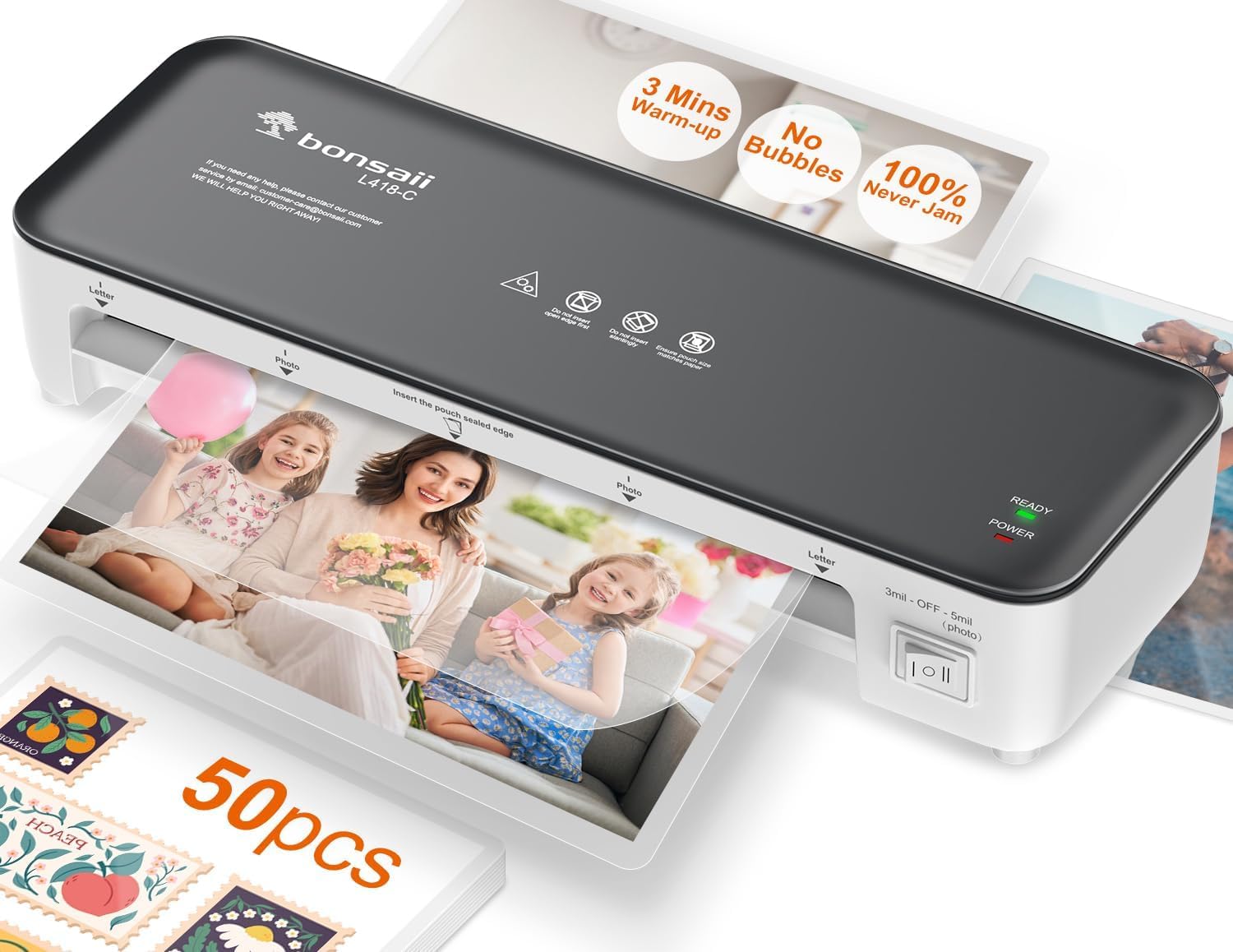
The bonsaii 9-inch laminator is a small thermal machine meant for light office, classroom, and home use; it accepts up to 9-inch wide pouches and ships with 50 starter pouches. It heats up in about 1–3 minutes and runs with two rollers at roughly 0.98 feet per minute, so you can laminate photos, ID cards, and small documents quickly without a long wait. The unit emphasizes jam prevention with a patented never-jam feature and supports both 3 mil and 5 mil pouches for thin paper or thicker card-like items. Its compact, lightweight footprint makes it easy to store or move between rooms, and the simple two-setting guidance (3 mil for standard paper, 5 mil for thicker items) keeps operation straightforward for teachers and parents. Limitations are its intended 9-inch width and modest speed, so very heavy-duty or high-volume laminating of large cardstock sheets will be slow or require a larger A3/industrial model. Also the small size and pouch-based thermal process mean thickness and size limits compared with cold or roll-based laminators.
Best for: Practical users who need a reliable, compact laminator for occasional to moderate projects like classroom materials, ID cards, photos, and small cardstock pieces and who prefer straightforward operation and jam protection.
Less Ideal for: People who regularly laminate large-format cardstock, high volumes, or thick board stock should choose a wider, higher-capacity or roll-fed laminator instead.
- Patented anti-jam technology reduces blocked jobs and protects documents
- Fast warm-up (1–3 minutes) so you can start laminating quickly
- Supports 3 mil and 5 mil pouches for standard paper and thicker items like cards
- Compact and lightweight design is easy to store and move between rooms
- Limited to 9-inch width so cannot laminate larger cardstock sheets
- Modest throughput speed not ideal for high-volume laminating
Verdict: An easy-to-use, compact 9-inch thermal laminator with jam-prevention and support for 3/5 mil pouches, best for occasional to moderate cardstock and card projects.
bonsaii 9-Inch Laminator L421

| Warm Up Time | less 4 min |
|---|---|
| Number of Rollers | 2 |
| Unit Count | 5 Count |
| Compatible Film Thickness | up to 3 mil |
The bonsaii 9-inch laminator is a small thermal pouch laminator aimed at basic home, classroom, and office tasks. It heats in about four minutes and runs at roughly 270 mm/min, so it will handle ID cards, photos, classroom projects, and single sheets of cardstock with steady, quiet operation. The unit has two rollers and a built-in ABS jam-release button that makes clearing misfeeds straightforward. It ships with five pouches and accepts up to 3 mil (about 0.5 mm) film, which is fine for preserving prints and light duty cardstock projects but limits thicker or heavy-duty cardstock laminating. The compact footprint and low weight make it easy to store and move between rooms, and the simple ready light keeps operation intuitive for teachers and budget-minded crafters. If you need to laminate thicker board stock or high-volume batches, a wider machine or one rated for heavier pouch thickness is a better fit, but for occasional cardstock projects and document protection this model is an economical, no-frills option.
Best for: Buyers on a tight budget who need an inexpensive, simple laminator for occasional classroom projects, photos, ID cards, and light cardstock work.
Less Ideal for: Users who plan to laminate heavy or very thick cardstock, large-format sheets, or run frequent high-volume batches should choose a wider, higher-capacity laminator.
- Compact and lightweight for easy storage and portability
- Fast warm-up (about 4 minutes) so you can start jobs quickly
- ABS jam-release system simplifies clearing misfeeds
- Quiet operation suitable for classrooms and home use
- Includes 5 starter pouches to get you going immediately
- Limited to pouch thickness up to 3 mil, so very thick cardstock may not laminate well
- 9-inch width restricts laminating to A4/letter-sized items only
Verdict: A compact, budget-friendly 9-inch laminator that delivers quick, easy lamination for occasional cardstock and classroom projects.
Scotch TL901X Thermal Laminator

| Warm Up Time | 5 minutes |
|---|---|
| Speed | 1 feet_per_minute |
| Number of Rollers | 2 |
| Included Components | Two 9.4" x 11" laminating pouches |
The Scotch TL901X is a small thermal laminator built for straightforward everyday protection of documents, photos, and craft projects. It uses two heated rollers and offers two temperature settings for compatible 3- and 5-mil pouches, producing smooth, bubble-reduced finishes suitable for signs, cards, and photos. The machine warms up in about five minutes and feeds at roughly one letter-size page per minute, with a release lever to clear misfeeds. Its 9-inch width limit and compact footprint make it handy on a desk or in a classroom. Practical benefits include a simple setup, reliable pouch sealing for tear- and water-resistance, and compatibility with standard Scotch pouches for consistent results. The main limits are the 9-inch maximum width and the relatively slow feed speed, which mean it is not ideal for wide-format or high-volume industrial laminating tasks; trimming may be needed for custom sizes. For routine home, school, or small-office projects the TL901X offers dependable, professional-looking laminates without a steep learning curve.
Best for: Buyers who prioritize a reliable, no-fuss laminator for protecting cards, photos, and classroom or craft projects that fit within a 9-inch width.
Less Ideal for: Those who need to laminate wider than 9 inches or who require a fast, high-volume production laminator for frequent commercial use should look elsewhere.
- Two heated rollers with two temperature settings for smooth, bubble-reduced seals
- Accepts both 3-mil and 5-mil pouches for versatile thicknesses
- Release lever helps clear jams and misfeeds quickly
- Compact, desktop-friendly footprint suitable for home, school, or small office use
- Maximum pouch width is 9 inches, limiting wider cardstock and large-format projects
- Warm-up time and 1 ft/min feed speed make it slower for batches of laminating
Verdict: A dependable, compact thermal laminator for everyday cardstock and photo protection up to 9 inches wide.
Amazon Basics 9-Inch Laminator

| Warm Up Time | 5 minute |
|---|---|
| Number of Rollers | 2 |
| Compatible Pouch Thickness | 3 mil or 5 mil |
| Max Width | 9 inches |
This Amazon Basics 9-inch thermal laminator handles basic home and small-office lamination tasks like photos, letters, business cards, and light cardstock. It offers two heat settings for use with 3-mil and 5-mil pouches, a 3–5 minute warm-up and an indicator light that shows when the unit is ready. The two-roller system feeds pouches smoothly and the built-in jam-release lever makes clearing misfeeds straightforward. Included starter pouches get you going right away, and the machine fits on a small desk or shelf when not in use. For thicker or heavier cardstock the 3-mil setting covers a broader paper weight range, but very heavy or textured cardstocks may require multiple passes or a professional pouch designed for thicker stock. The unit is not designed for unconventional materials like fabric, wood, or foil. For everyday laminating of photos, certificates, and lightweight cardstock projects it is reliable and easy to use, but crafters who work with heavy-duty cardstock should verify pouch compatibility first.
Best for: Buyers who want an affordable, easy-to-use laminator for photos, certificates, business cards, and light to medium cardstock projects backed by plenty of user feedback and dependable basic performance.
Less Ideal for: People who frequently laminate very heavy or textured cardstock, craft materials, or non-paper substrates should look at heavy-duty or commercial laminators instead.
- Two heat settings for 3-mil and 5-mil pouches to match common pouch thicknesses
- Quick 3–5 minute warm-up with ready indicator for minimal wait time
- Jam-release lever simplifies clearing misfeeds without disassembly
- Compact footprint fits small desks or craft stations
- Includes starter laminating pouches to begin immediately
- Not suitable for heavy, textured, or unconventional materials like fabric or wood
- May struggle or require special pouches for very thick cardstock
Verdict: A straightforward, compact laminator that reliably handles photos, documents, and light to medium cardstock projects with minimal fuss.
Crenova A4 Laminator

| Warm Up Time | 1 minute |
|---|---|
| Speed | 320 rpm |
| Number of Rollers | 2 |
| Unit Count | 1 Count |
The Crenova A4 laminator handles single-sheet lamination tasks with a simple one-button hot or cold switch and a fast 1–2 minute warm-up, making it convenient for occasional use at home, school, or a small office. It accepts A4/9-inch inlet pouches and comes with 10 laminating sheets so you can start right away; the two-roller, 320 rpm mechanism delivers smooth, bubble-reduced finishes on photos, certificates, menus, and ID cards. Cold mode lets you laminate heat-sensitive or older documents, while a manual ABS lever and recommended jam-clearing steps reduce the chance of damage from feed issues. The unit is very compact and lightweight so it stores easily or moves between workspaces, but its small footprint means it is best for light-volume jobs rather than continuous heavy use. Expect basic, reliable performance for everyday protective lamination rather than pro-grade speed or large-format capability.
Best for: Buyers who prioritize a low-risk, straightforward laminator for occasional protective lamination of photos, cardstock projects, and documents at home, school, or a small office. They want an easy-to-use, portable unit with both hot and cold options and simple jam recovery steps.
Less Ideal for: Users who need a heavy-duty machine for frequent, high-volume laminating or who require larger than A4/9-inch capacity should consider a larger commercial model.
- Fast 1–2 minute warm-up for quick use
- Hot and cold modes for heat-sensitive items
- Includes 10 starter laminating pouches
- Two rollers provide smooth, bubble-reduced lamination
- Compact and lightweight for easy storage and portability
- Designed for light or intermittent use rather than high-volume continuous laminating
- Only accepts up to A4/9-inch width, not suitable for larger documents
Verdict: A compact, easy-to-use A4 laminator that gives risk-averse buyers a reliable hot-and-cold option for occasional cardstock and document protection.
Choosing the Right Laminator for Cardstock: Key Factors to Consider
Heat Control and Temperature Settings
Cardstock requires higher or more consistent heat than standard paper to fully activate the adhesive inside laminating pouches. Adjustable temperature settings let you tune the laminator for different pouch thicknesses and coated surfaces. Reliable thermostatic control prevents hot spots that create bubbles and cold zones that cause weak seals. When a machine offers clear temperature ranges or specific settings labeled for thicker pouches, you reduce trial-and-error and lower the chance of ruining a sheet.
For repeated batches of the same pouch thickness, stable temperature control also improves repeatability, so each piece comes out with the same finish. If you plan to laminate a mix of photos and heavy cardstock, look for a model that remembers or quickly switches between temperature presets.
Feed Mechanism and Roller Pressure
How the laminator pulls material through is critical when sheets are stiff. Synchronized heavy-duty rollers and a straight feed path minimize skewing, wrinkling, and jams. Machines with stronger roller pressure compress the pouch and cardstock together more uniformly, which helps create solid edge seals and prevents trapped air pockets.
Consider whether the unit supports a manual feed tray or has alignment guides to keep cards square. Some units include reverse or jam-release functions that help clear stuck pieces without damaging the job. For frequent cardstock work, prioritize a laminator with positive, consistent feeding over models that rely on lighter friction drives.
Maximum Pouch and Sheet Thickness
Manufacturers rate the maximum pouch thickness or the maximum millimeters a unit will accommodate. Cardstock projects often use thicker pouches or require sealing multiple stacked layers, so verify a laminator's maximum specification. Choosing a machine rated for suitably thick pouches reduces the risk of under-sealing or motor strain.
Additionally, check the maximum laminating pouch size and whether standard cardstock dimensions fit without trimming. If you plan to laminate very small cards or odd sizes, look for units that handle different pouch widths or include carrier options to protect the machine when using thin pouches.
Warm-Up Time and Throughput
Warm-up time affects how quickly you can start a project, and throughput or speed influences how many pieces you can process per session. For occasional hobby use, a longer warm-up may be acceptable. For classroom or small business batches, faster warm-up and consistent lamination speed save time and reduce interruptions.
Keep in mind that maximum speed often trades off with heat, so very fast settings may not fully seal thicker pouches. Look for machines that specify both warm-up times and recommended speeds for different pouch weights so you can plan realistic batch rates.
Ease of Maintenance and Durability
Frequent laminate work can expose rollers to adhesive residue, dust, and paper fibers. Machines with removable or accessible roller assemblies are easier to clean and service, which extends lifespan. Durable housings and metal gears resist wear when feeding thicker sheets repeatedly.
Also consider whether the laminator includes a jam-release or reverse function for clearing misfeeds without dismantling the unit. Clear indicator lights and a simple control layout reduce operator error and make upkeep straightforward for nontechnical users.
Size, Portability, and Workspace Fit
Cardstock laminators range from compact tabletop models to larger desktop units. Think about where you will laminate and whether you need a portable machine that tucks away or a more substantial one that stays on a workbench. Larger units may accept wider pouches and have more robust feeding systems but require more surface area and storage space.
Noise and power draw also matter in classrooms or shared workspaces. If you need to move the machine between rooms, lighter weight and a protective carrying handle can be useful features to prioritize.
Preparing Cardstock for Lamination
Trim and square cardstock edges before laminating to reduce the risk of uneven seals and to prevent snags in the feed path. Sharp corners and irregular edges are more likely to catch on rollers, which can produce creases or jams.
Use a soft dust brush or compressed air to remove loose fibers or debris from the sheet surface. If you are bonding printed material, allow ink and toner to fully dry before inserting the piece into a pouch to avoid smearing or adhesion issues.
- Score very thick card bases or fold lines before laminating to preserve bend points
- Use alignment guides or a straight edge when inserting single cards to keep them square
- Place small items centered in the pouch and leave recommended margins around the edges
Choosing Pouch Types and Thicknesses
Pouch thickness is expressed in mils or microns and directly affects rigidity and protection level. For cardstock, mid- to heavy-weight pouches usually produce the best results in terms of stiffness and edge sealing. Make sure the laminator supports the pouch weight you plan to use.
Gloss, matte, and textured finishes offer different aesthetics and practical outcomes. Gloss tends to enhance color saturation, while matte reduces glare and hides fingerprints. Textured or soft-touch finishes require specific adhesive behavior, so confirm compatibility before committing to a large run.
- Test one pouch and sheet combination before batch laminating
- Avoid overfilling pouches; leave a sufficient seal margin from edges
- Match pouch finish to the intended use—display, handling, or archival
Avoiding and Clearing Jams
When a jam happens, stop feeding immediately and use the unit's reverse or jam-release function if available. For units without a reverse control, power down and gently pull the pouch back along the feed path following the manufacturer's safety guidance.
Regularly clean rollers with the recommended cleaning materials. Adhesive buildup increases the chance of slippage and jammed sheets. Keeping the feed path clear of dust and paper scraps reduces operational interruptions.
- Always feed the pouch straight and centered to reduce skew
- Allow warm-up time and stable temperature before beginning large batches
- If repeated jams occur with the same pouch thickness, try a slower speed or a higher temperature
Working with Laminated Cards After Sealing
After lamination, allow pieces to cool flat on a clean surface to avoid curl. Cooling time is especially important with thicker pouches because trapped heat can cause edges to separate as the adhesive sets.
Trim laminated cards with a sharp guillotine or rotary cutter for clean, professional edges. Use a slight overlap margin when trimming to ensure the seal is not cut through, which could allow moisture ingress or delamination.
- Store laminated cards flat and away from direct heat or sunlight
- For items that will be handled frequently, consider a slightly larger sealing margin
- Inspect a few test pieces from each batch for adhesion and finish before trimming the entire run
Safety and Operating Best Practices
Keep hands and loose clothing away from the feed opening while the machine is running. Heat-assisted rollers can cause burns if contacted during operation.
Use the recommended power source and avoid extension cords that may drop voltage and affect temperature stability. Follow any manufacturer guidance about ventilation and duty cycle to prevent overheating.
- Unplug the unit before attempting any cleaning or roller access
- Supervise younger users and provide instruction on safe feeding technique
- Let the machine cool fully before storing or transporting
How We Chose the Best Laminator for Cardstock
We focused on attributes that directly affect how well a laminator handles cardstock and similar heavy media. Our evaluation emphasized heat control and temperature consistency because insufficient or uneven heat produces bubbles, delamination, or poor bond on thicker sheets. We also prioritized feeder design and roller pressure, since robust, synchronized rollers reduce skewing, misfeeds, and jams when working with stiff card stock. Warm-up time and usable speed were included because slow warm-ups or inconsistent speeds make batch work inefficient. Build quality and ease of maintenance mattered for regular use: sturdier housings and accessible rollers reduce downtime and repair needs. Finally, we considered pouch compatibility and maximum thickness rating to ensure each machine can accept the common laminating pouch or film thicknesses used with cardstock. We excluded tabletop laminators designed strictly for very light paper, single-use novelty units, and any industrial roll laminators intended for high-volume commercial production. Products that lacked clear specs on maximum pouch thickness or that had reports of frequent jamming on heavier sheets were removed from consideration. The final shortlist balances practical stamina for heavy-cardstock use with straightforward operation for craftroom and classroom settings.
Our full evaluation process is outlined in our review methodology.
FAQ
Can I laminate heavy cardstock with any tabletop laminator?
Not all tabletop laminators handle heavy cardstock. Check the unit's maximum pouch thickness and roller pressure specifications. Machines rated for thicker pouches and with stronger rollers are better suited for heavy card stock.
What pouch thickness should I use for business cards or thick invitations?
Mid- to heavy-weight pouches are common for cards and invitations because they add stiffness and protection. The right thickness depends on your base cardstock weight and desired rigidity. Test one piece to confirm adhesion and finish before a full run.
How can I prevent bubbles and wrinkles when laminating cardstock?
Ensure the laminator is up to temperature and use an appropriate speed for the pouch thickness. Center the item in the pouch, feed it straight, and allow the machine's rollers to apply even pressure. If problems persist, raise the temperature slightly or slow the feed speed within recommended ranges.
Is a carrier required when laminating cardstock?
A carrier can protect the laminator's rollers, especially with thin pouches or if adhesive residue is a concern. For heavier pouches and well-behaved sheets, some users omit the carrier, but using one reduces the risk of contaminating the machine and simplifies jam recovery.
How often should I clean the rollers?
Clean rollers as part of routine maintenance, especially after noticeable adhesive buildup or when you change pouch thicknesses. Frequency depends on usage, but a quick inspection after each heavy session and a cleaning every few weeks under moderate use helps prevent problems.
Final Verdict
Choosing the right laminator for cardstock means balancing heat control, feed reliability, and pouch compatibility with the volume and finish you need. Prioritize machines with stable temperature settings and robust rollers if you frequently work with thicker sheets. Consider warm-up time and maintenance access when you expect regular batch work. By focusing on these practical tradeoffs, you can pick a laminator that delivers consistent seals, minimizes jams, and produces professional, durable laminated cards.