
Note: This article contains affiliate links. If you click on these links and make a purchase, we may earn a small commission at no extra cost to you. This helps support our research and content. Read our full affiliate disclosure here.
If you need protective, professional-looking lamination without spending a lot, a budget-friendly laminator can be a practical tool for home projects, schoolwork, or occasional small-office tasks. Picking the right low-cost unit matters because cheaper machines vary widely in heat-up time, feed reliability, and how well they handle different pouch thicknesses. This guide shortlists the top picks in the budget segment and explains the features that matter most for everyday lamination. Below you will find compact, easy-to-use options tested for consistent sheet output, sensible speed, and straightforward maintenance to help you choose the best laminator for your needs.
Top Picks at a Glance
| Best Overall The best all-around choice for most situations | Scotch PRO TL906 Thermal Laminator |  |
| Best Quality Built to a higher standard if you want something more solid | Chilino 13" 4-Roller Laminator |  |
| Best Value The sweet spot between price and what you get | MAXDONE 9-Inch Laminator |  |
| Best Budget The cheapest option that still gets the job done reliably | SINCHI 9-Inch Thermal Laminator |  |
| Top Rated A top-rated pick with lots of positive feedback | Qfun 13-Inch Laminator |  |
| Most Popular A crowd favorite that many people choose with confidence | Scotch TL901X Thermal Laminator |  |
| Best Seller A high-volume bestseller chosen again and again | Amazon Basics 9-Inch Thermal Laminator |  |
Scotch PRO TL906 Thermal Laminator

| Speed | 1.25 feet_per_minute |
|---|---|
| Warm Up Time | 5 Minutes |
| Number of Rollers | 2 |
The Scotch PRO TL906 is a small, user-friendly thermal laminator aimed at home, school, and light office tasks. It accepts 3- and 5-mil pouches up to 9 inches wide, heats with two temperature settings and two heated rollers to produce bubble- and wrinkle-free results. Setup is straightforward with LED controls and a roughly five to six minute warm-up time, and the machine laminates at about 15 inches per minute for quick single-sheet jobs. Never Jam Technology reduces misfeeds and auto shutoff after an hour conserves energy, which makes it low-maintenance for occasional users. The device is compact and portable, so it fits easily on a desk or in a classroom. Limitations include a single feed width (no wider documents) and a modest speed intended for light to moderate throughput rather than continuous heavy use, so it is best for personal projects, handouts, photos, and school supplies rather than high-volume office laminating.
Best for: Buyers who want an affordable, easy-to-use laminator for home, classroom, or small office tasks that need occasional professional-looking protection for documents and photos.
Less Ideal for: Users who need to laminate large-format items, very thick materials, or high daily throughput should look at heavier-duty commercial laminators instead.
- Accepts both 3-mil and 5-mil pouches for flexible laminate thickness
- Two heated rollers and selectable temperature settings for smooth, bubble-free finishes
- Never Jam Technology reduces misfeeds and protects documents
- Fast warm-up (about 5–6 minutes) and roughly 15 inches per minute laminating speed
- Compact, lightweight design that fits on a desk or in a classroom
- Maximum pouch width limited to 9 inches, so larger documents will not fit
- Designed for light to moderate use rather than continuous high-volume laminating
Verdict: A budget-friendly, compact laminator that delivers quick, reliable results for home and classroom projects.
Chilino 13" 4-Roller Laminator
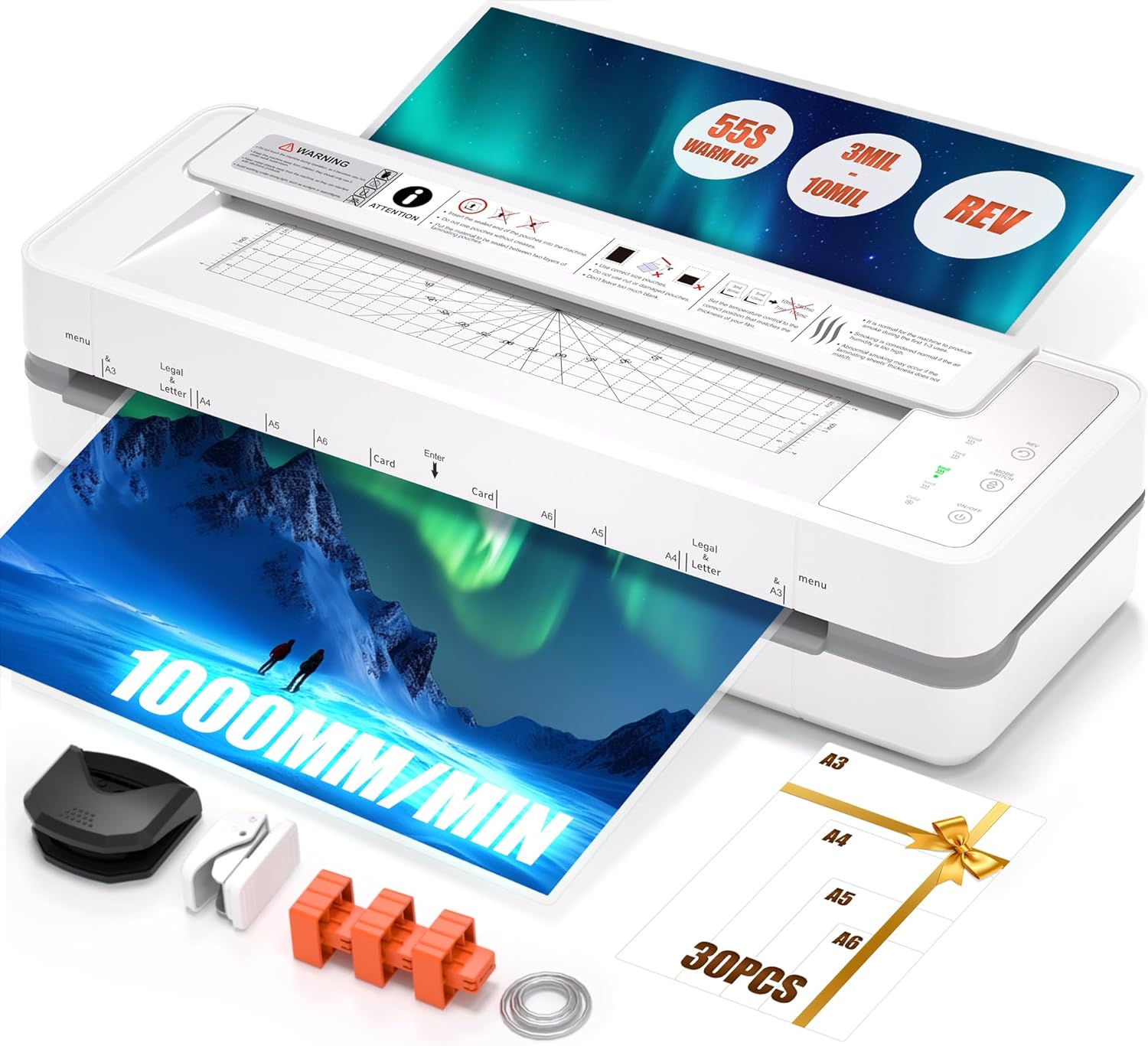
| Warm Up Time | 55 seconds |
|---|---|
| Speed | 1000 rpm |
| Number of Rollers | 4 |
| Supported Pouch Thickness | 3-10 mil |
This Chilino 13" 4-roller laminator brings commercial-level speed and consistency to small offices or classrooms. Its four-roller system (two heating and two pressing rollers) improves heat transfer and pressure so pouches feed smoothly with minimal bubbling or wrinkling, and the 55-second warm-up plus 1000 mm/min throughput lets you finish individual A4 sheets in under 20 seconds. It accepts pouches from 3 to 10 mil and a wide 13-inch inlet handles up to 11×17/A3 media, which is handy for posters, menus, and larger art pieces. A REV jam-prevention and one-touch reverse make recovering misfeeds straightforward, while auto-shutoff and built-in sensors add safety and protect the machine. The unit ships with a starter kit of 30 pouches and basic finishing tools so you can start laminating immediately. Expect a solid, fast workhorse for moderate to heavy daily use, though the machine is optimized for office and school workflows rather than occasional home crafting tasks where smaller, cheaper units might suffice.
Best for: Buyers who prioritize fast, reliable output and professional-looking results for frequent office or school laminating tasks will appreciate this machine.
Less Ideal for: If you only laminate occasionally or need a small portable unit for hobby use, a compact consumer laminator would be a better fit.
- Commercial-style 4-roller system for even heat and pressure and reduced bubbles
- Fast 55-second warm-up and high laminating speed (1000 mm/min) for quick throughput
- Wide 13-inch inlet supports up to 11×17/A3 documents
- Smart REV reverse to clear jams and protect documents
- Includes starter kit with 30 pouches and finishing tools so it is ready to use
- Relatively large footprint compared with compact home laminators
- Designed for continuous office use so it may be overkill for very occasional personal projects
Verdict: Pick this Chilino laminator when you want fast, consistent, bubble-free laminating for frequent office or school jobs without paying for full commercial equipment.
MAXDONE 9-Inch Laminator
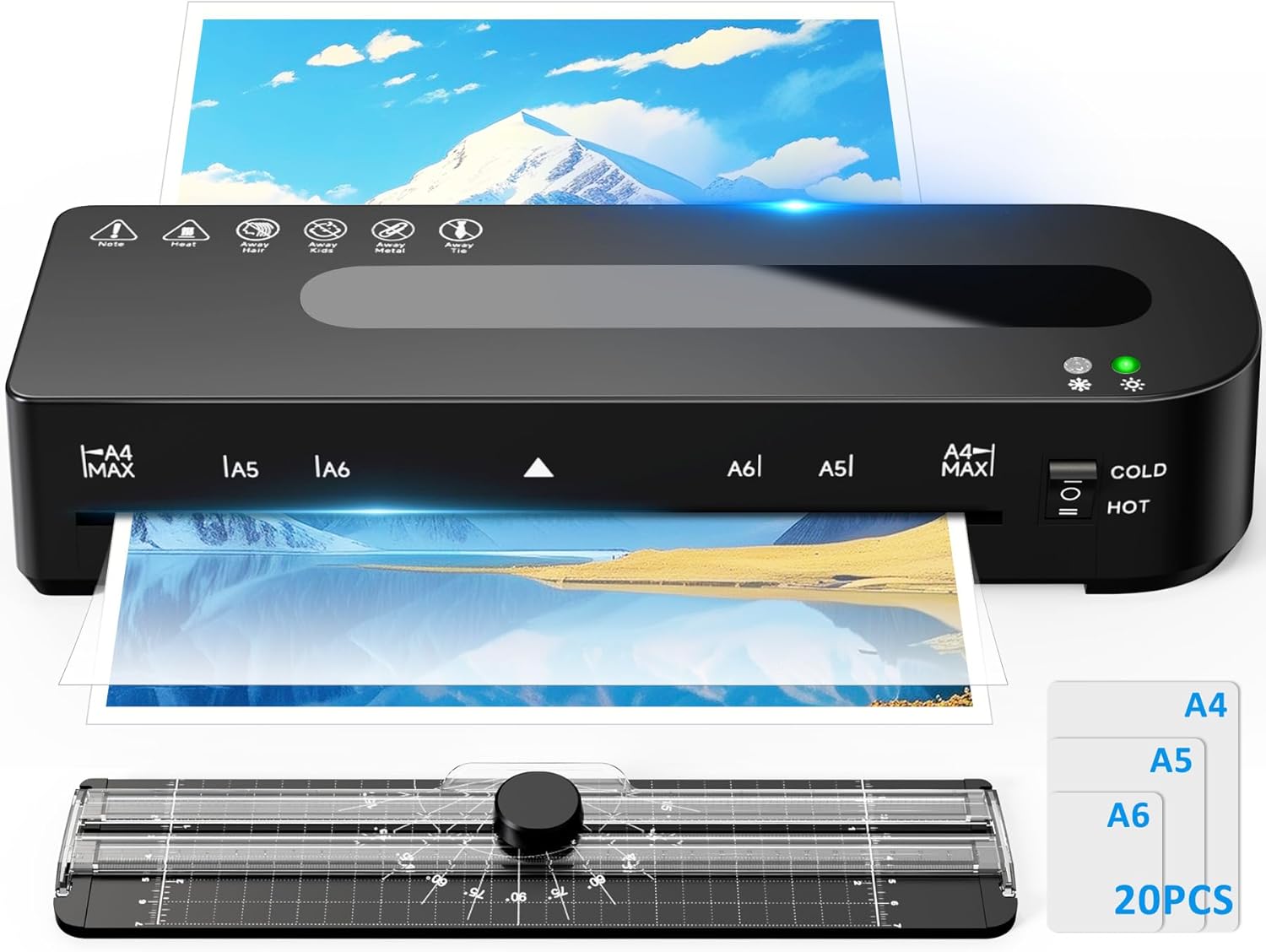
| Warm up time | 90S |
|---|---|
| Speed | 320 rpm |
| Number of Rollers | 2 |
The MAXDONE 9-inch laminator is a compact hot-and-cold machine aimed at basic document preservation tasks at home, school, or a small office. It warms up in about 90 seconds and runs at a steady 320 mm/min, so you can laminate A4, A5, and A6 items quickly; the included 20 pouches and a cutter let you start right away. Dual rollers and NTC temperature control help produce smooth, bubble-free results while the ABS quick-release button makes clearing jams straightforward. Cold mode supports self-adhesive pouches without heat when needed. The unit is lightweight, runs quietly at about 30 dB, and handles common pouch thicknesses (80 to 100 microns). Limitations are that cold mode requires separate self-adhesive pouches and the machine is sized for small-format jobs rather than large or heavy-duty batch lamination. For routine personal and classroom use it offers a useful balance of speed, ease of use, and safety features at an economical level.
Best for: Buyers who want a practical, affordable laminator for everyday home, classroom, or small office tasks and who prioritize quick setup, quiet operation, and simple jam recovery.
Less Ideal for: Users who need heavy-duty, high-volume commercial lamination or frequent large-format lamination should consider a more powerful, larger-capacity machine.
- Quick 90 second warm-up and consistent 320 mm/min laminating speed for fast jobs
- Dual-roller system with NTC temperature control for smoother, bubble-free lamination
- Includes 20 starter pouches and a paper cutter so you can begin using it immediately
- Quiet operation around 30 dB makes it suitable for home or classroom environments
- ABS quick-release button simplifies jam clearing and protects documents
- Cold mode does not include self-adhesive pouches so an additional purchase is needed for that function
- Designed for small-format sheets only, not intended for large or heavy commercial workloads
Verdict: A budget-friendly 9-inch laminator that delivers fast, quiet, and reliable lamination for everyday home, school, and small office needs.
SINCHI 9-Inch Thermal Laminator

| Warm Up Time | 3 to 4 minutes |
|---|---|
| Pouch Thickness | 3–5 mil |
| Number of Rollers | 2 |
The SINCHI 9-Inch Thermal Laminator is a small, budget-friendly hot laminator aimed at everyday tasks like ID badges, photos, business cards, and letter-size documents. It uses 3–5 mil pouches and reaches operating temperature in roughly 3 to 4 minutes, laminating at about 12 inches per minute so a letter sheet finishes in around a minute. Practical touches include a jam-release lever to clear stuck pouches quickly and a 30-minute auto shut-off for safety and energy savings. The unit ships with ten starter pouches (letter and photo sizes) so you can begin projects immediately, and its slim footprint stores easily in a drawer or on a small desk. Limitations for power users are clear: it only performs hot lamination, so cold pouch projects or heat-sensitive materials are not supported, and its small, single-purpose design is best for light to moderate throughput rather than heavy production work. For the price, it covers common household and classroom laminating needs with straightforward operation.
Best for: Buyers seeking an inexpensive, no-frills laminator for occasional home, classroom, or small office projects who value ease of use and compact storage.
Less Ideal for: People who need cold lamination, frequent high-volume laminating, or industrial-strength equipment should choose a different model.
- Accepts common 3–5 mil pouches for versatile document protection
- Fast warm-up (3–4 minutes) and roughly 12 inches per minute lamination speed
- Includes 10 starter pouches so you can begin immediately
- Jam-release lever simplifies clearing stuck pouches
- Compact, lightweight design easy to store
- Only supports hot lamination, so heat-sensitive items require alternative methods
- Not intended for high-volume or heavy-duty commercial use
Verdict: A low-cost, compact thermal laminator that handles common home and classroom laminating tasks reliably and with minimal fuss.
Qfun 13-Inch Laminator

| Feed width | 13 inch |
|---|---|
| Warm-up time | 60 seconds |
| Laminating speed | 450 mm/min |
| Supported pouch thickness | 3 mil, 5 mil |
The Qfun 13-inch laminator is a compact all-in-one kit that handles both hot and cold lamination and includes cutters, a corner rounder, hole punch, binding rings, and 30 pouches so you can start right away. It reaches operating temperature in about 60 seconds and runs at roughly 450 mm/min, letting you laminate standard A4 sheets quickly; the dual roller and NTC temperature control aim to reduce bubbles and deliver consistent seals. The 13-inch feed accepts 11×17 posters and supports 3 mil and 5 mil pouches for light or heavier protection. Practical safety and usability features include an ABS one-touch jam-release and a 45-minute auto shut-off, and the accessories store inside the unit to keep a tidy workspace. Expect simple four-step operation with no complicated settings, which makes it friendly for teachers and crafters. The main limitations are that it is a personal/desktop machine rather than a production laminator and speed is modest compared with commercial models, so very high-volume shops may prefer heavier equipment.
Best for: Buyers who prioritize a dependable, easy-to-use laminator for regular home, classroom, or small-office tasks and want a complete kit that works reliably out of the box.
Less Ideal for: People who need nonstop, high-volume commercial lamination or industrial durability should consider heavier-duty machines instead.
- Fast 60-second warm-up reduces waiting time before laminating
- Supports both hot and cold modes for heat-sensitive and regular materials
- 13-inch wide feed handles up to 11×17 posters and larger documents
- Includes cutters, corner rounder, hole punch, binding rings, and 30 pouches for immediate use
- Safety features like ABS jam-release and 45-minute auto shut-off
- Designed for home, classroom, or small-office use, not heavy commercial throughput
- Speed and durability may not match higher-end or dedicated production laminators
Verdict: A reliable, ready-to-use 13-inch laminator kit that delivers consistent hot and cold lamination and useful built-in tools for budget-minded home and school users.
Scotch TL901X Thermal Laminator

| Warm Up Time Description | 5 minutes |
|---|---|
| Speed | 1 feet_per_minute |
| Number of Rollers | 2 |
| Included Components | Two 9.4" X 11" Laminating Pouches |
The Scotch TL901X is a small, user-friendly thermal laminator designed for protecting documents, photos, and craft projects. It uses two heated rollers and offers two temperature settings for 3-mil or 5-mil pouches, which helps produce smooth, bubble-reduced laminates. Setup is quick: the unit warms up in about five minutes and laminates at roughly one letter-size page per minute, and a release lever helps free misfed pouches without forcing them through. The machine handles items up to 9 inches wide, so it covers common tasks like certificates, signs, and kids artwork. Because it is compact and lightweight it works well on a desk or shelf, and it comes with two 9.4
Best for: Buyers who want a reliable, easy-to-use laminator for occasional home, school, or small office projects and who value consistent, jam-reducing performance backed by strong user feedback.
Less Ideal for: Users needing to laminate large-format materials, high daily volumes, or faster commercial throughput should consider wider, faster models instead.
- Two heated rollers with selectable temperature for 3- and 5-mil pouches produce smooth, professional-looking laminates
- Short warm-up time of about five minutes gets you laminating quickly
- Release lever reduces the risk of jams and makes pouch removal easier
- Compact and lightweight footprint fits small desks and classrooms
- Max width limited to 9 inches, so oversized documents cannot be laminated
- Relatively slow speed at about one letter-size page per minute compared with larger models
Verdict: A compact, dependable thermal laminator that delivers professional-looking, low-jam laminates for home and classroom use on a budget.
Amazon Basics 9-Inch Thermal Laminator

| Warm Up Time | 3-5 minute |
|---|---|
| Number of Rollers | 2 |
| Compatible Pouch Thickness | 3 mil or 5 mil |
This compact thermal laminator is built for everyday home and small-office use, laminating letter, legal, photos, business cards, and similar media up to 9 inches wide. It offers two heat settings for 3-mil and 5-mil pouches, a 3 to 5 minute warm-up with an indicator light, and a jam-release lever to clear jams without disassembly. The machine ships with a couple of 3-mil pouches so you can start laminating right away, and dual rollers help deliver an even finish on typical papers and photos. It is not intended for laminating hardware, cloth, or thick craft materials, and the 5-mil setting is recommended only for thinner papers per the manufacturer's guidance. For buyers who want a straightforward, low-cost laminator that reliably protects documents and photos, this unit covers the common tasks without complicated controls or bulky footprints.
Best for: Buyers who want a reliable, no-frills laminator for protecting documents and photos at home or in a small office and who prefer simple, risk-minimizing features like clear heat settings and a jam release.
Less Ideal for: Crafters or users who need to laminate bulky or non-paper items, or those who need to process sheets wider than 9 inches.
- Quick warm-up with indicator light gets the machine ready in about 3–5 minutes
- Two heat settings support common 3-mil and 5-mil laminating pouches
- Jam-release lever makes clearing jams fast and tool-free
- Compact footprint fits small desks or craft areas and handles letter and legal sizes
- Not suitable for laminating non-paper materials like fabric, wood, or metal
- Limited to 9-inch width so larger sheets require a different machine
Verdict: A straightforward, budget-friendly laminator that reliably protects everyday documents and photos with simple controls and a jam-release feature.
Choosing the Right Laminator on a Budget: Key Factors to Consider
Heat-Up Time and Ready Indicators
How quickly a laminator reaches operating temperature affects workflow, especially when you are doing several items in one session. Short heat-up times reduce idle waiting and make occasional use feel more convenient. Clear ready lights or a temperature indicator are valuable on budget models because they prevent feeding pouches too early, which causes bubbles or incomplete seals.
When evaluating cheap laminators, prefer units with explicit ready signals and documented heat-up ranges. This reduces guesswork and improves first-time success rates, particularly for users new to lamination.
Feed Mechanism and Sheet Handling
Reliable feeding prevents wrinkles, skewing, and jams. Budget laminators use a variety of drive systems and roller configurations that differ in how smoothly they pull pouches through the heated zone. A stable, centered feed path and anti-jam design features greatly increase usable yield on a low-cost machine.
Look for a laminator that aligns sheets consistently and has a simple reverse or release function to clear misfeeds. Consistent feeding is more important than raw speed for many buyers because it reduces wasted pouches and the time spent rehabbing ruined items.
Supported Pouch Thicknesses
Even budget models should specify compatible pouch thicknesses, usually measured in mils. Thinner pouches are faster to heat and seal, while thicker pouches add rigidity and a more professional feel. Knowing the supported range helps you plan which projects the laminator can handle, from ID cards and small photos to posters and craft work.
Confirm the machine's compatibility with the pouch sizes you intend to use. A laminator with a modest range that includes the most common 3–5 mil options covers most home and classroom tasks without adding complexity.
Operational Controls and User Feedback
Simple, intuitive controls make lamination approachable for occasional users. Budget laminators should have straightforward power and mode switches, a visible ready light, and ideally a temperature or pouch-thickness setting. These controls reduce mistakes and speed up learning for new users.
Good user feedback also includes an accessible feed tray and a clear path to perform routine tasks like aligning items or clearing small jams. Minimal but meaningful indicators matter more than many advanced features on low-cost machines.
Size, Portability, and Storage
Space considerations are important for home or classroom environments. Compact laminators save desk space and are easier to store when not in use. Weight affects portability if you need to move the unit between rooms or bring it to events.
A balance between a compact footprint and a stable base is ideal. Too-small units can be harder to feed accurately, while larger ones take up more storage space. Consider where you will use the laminator most often to choose the right size.
Maintenance Needs and Long-Term Reliability
Maintenance matters more on budget devices because cheaper components can wear faster. Check whether the unit allows access to the rollers and feed path for cleaning residual adhesive or paper debris. Models that tolerate occasional thicker pouches without permanent damage tend to last longer in real use.
Routine cleaning, a recommended duty cycle, and the availability of straightforward troubleshooting steps will extend the useful life of a low-cost laminator and limit inconvenient downtime.
How to Match a Laminator to Your Projects
Start by listing the typical items you will laminate and their sizes. Small photos and ID cards need different handling than laminated posters or craft sheets. Match the laminator's pouch-size limits and throat width to the largest items you plan to process.
Consider frequency of use. For occasional home tasks, a compact machine with fast heat-up and reliable feeding is ideal. For steady classroom use, choose a model with stronger feed reliability and easier maintenance even if it is slightly larger.
- Check maximum pouch width against your largest planned project.
- Verify supported mil thicknesses for desired rigidity.
- Prefer machines with explicit ready indicators for sporadic use.
Common Lamination Mistakes and How to Avoid Them
Many problems stem from feeding a pouch before the unit reaches the correct temperature. Wait for the ready indicator and avoid forcing items through when the machine feels cool. Also center items in the pouch to reduce skew and edge bubbles.
Another frequent issue is using wrong pouch thickness or overstuffing. Thicker pouches require longer time and more consistent pressure. If your laminator has a cold setting or manual speed control, use it carefully and run a test pouch first.
- Always pre-align items inside the pouch and use the pouch's sealing edge correctly.
- Run a scrap sheet through after warm-up to confirm proper sealing.
- Use the reverse function or power cycle the unit for minor jams rather than pulling hard on the pouch.
Safe Operation and Basic Care
Budget laminators still generate heat, so place the unit on a stable, heat-resistant surface and allow clearance around vents. Keep children and pets away during operation. Unplug the unit after use if it will sit idle for long periods.
For routine care, wait for the machine to cool before cleaning. Remove adhesive build-up with manufacturer-recommended materials or a soft cloth according to general lamination maintenance guidance. Avoid aggressive solvents that can damage rollers.
- Let rollers cool completely before attempting any cleaning.
- Perform occasional test runs with cleaning sheets or scrap pouches to dislodge residue.
- Store in a dry place away from direct sunlight to protect plastics and electrical components.
Choosing Pouches and Consumables on a Budget
Pouch quality matters as much as the laminator in the final look. Cheaper pouches can wrinkle or cloud when heated. Choose pouches that match the specified mil thickness and are sized correctly for your projects. Buying a small sample pack first helps you confirm compatibility.
Consider standard sizes used in schools and offices to keep consumable choices simple. Thicker pouches add stiffness but require more consistent heating and pressure, so balance the desired finish against what your budget unit can reliably handle.
- Match pouch mil rating to the laminator's supported range.
- Avoid cutting pouches after lamination to maintain edge seals.
- Store pouches flat to prevent creasing before use.
When a Budget Laminator Isn't Enough
If you frequently laminate very large items, heavy card stock, or require industrial-grade throughput, a budget machine may become a bottleneck. Signs it is time to upgrade include repeated jams, inconsistent seals on thicker pouches, and excessive maintenance demands.
For heavier workloads, look for units specified for higher duty cycles and wider throat widths. Those models are typically outside the budget segment but justify their cost through improved reliability and lower consumable waste over time.
- Track failure modes: frequent misfeeds indicate a feed mechanism limit.
- If you need archival-quality permanence, consider professional-grade lamination solutions.
How We Chose the Best Laminator on a Budget
We focused on real-world usability for buyers seeking a low-cost laminator while still wanting dependable results. Selection prioritized machines that balance rapid heat-up and consistent pouch feeding, since those two factors determine how practical a budget unit feels during repeat use. We also required straightforward controls and visible status indicators so casual users can avoid misfeeds and overheating. Durability and serviceability were assessed through reported build quality and common repairability indicators, such as replaceable rollers or clear access to paper paths. Energy efficiency and idle power behavior were considered for home users who leave units plugged in. We excluded heavy-duty commercial laminators, industrial pouch systems, and machines designed only for high-volume production. The resulting shortlist reflects devices that handle typical home and small-office workloads, work with common pouch thicknesses, and keep operating complexity low.
Our full evaluation process is outlined in our review methodology.
FAQ
What pouch thickness should I use with a budget laminator?
Most budget laminators handle common pouch thicknesses like 3 to 5 mil reliably. Thicker pouches may work but can require slower feeding and more heat. Check the machine's specified range and test a sample pouch before a large run.
How long does a cheap laminator take to warm up?
Warm-up times vary, but many low-cost laminators reach operating temperature within a few minutes. Units with longer warm-up times are still usable; the important part is a clear ready indicator so you know when to feed pouches.
Can I laminate photos and documents without bubbles?
Yes. Center the item in the pouch, allow full warm-up, and feed at a steady pace. If bubbles occur, try a slightly thinner pouch or run a scrap pouch first to confirm temperature and feed consistency.
Is there special care required after occasional use?
Occasional users should still unplug the laminator after use and perform light cleaning to remove adhesive residue. Running a cleaning sheet or a scrap pouch occasionally keeps rollers clear and reduces the chance of future jams.
What should I do if my pouch gets stuck?
Switch to the unit's reverse or release function if available and gently back the pouch out. If the machine lacks a reverse, power it down, let it cool, and follow the manufacturer's instructions for clearing jams to avoid damaging rollers.
Final Verdict
Budget laminators can deliver dependable results for home, school, and light office use when you prioritize quick heat-up, consistent feeding, and straightforward maintenance. Focus on models that support the pouch sizes and thicknesses you need, offer clear ready indicators, and provide an accessible feed path for routine care. For occasional projects, prioritize ease of use and reliable seals; if you anticipate heavy or specialized lamination demands, plan to invest in a higher-duty machine instead. With the right expectations, a low-cost laminator can be a practical and long-lasting addition to your workspace.