
Note: This article contains affiliate links. If you click on these links and make a purchase, we may earn a small commission at no extra cost to you. This helps support our research and content. Read our full affiliate disclosure here.
If you drink carrot juice regularly, the right masticating juicer makes the difference between a fibrous, low-yield pulp and smooth, high-yield glasses you will actually drink. A juicer built for slow, cold-press extraction preserves nutrients and separates dry pulp, which matters with dense root vegetables like carrots. This guide presents seven shortlisted masticating juicers that perform well with carrots, evaluated on extraction efficiency, ease of cleaning, build durability, and continuous-use reliability. Read on to see how these selections match different kitchens and lifestyles, plus the practical criteria you should weigh when choosing.
Top Picks at a Glance
| Best Overall The best all-around choice for most situations | Omega Cold Press Juicer J8006HDC |  |
| Best Quality Built to a higher standard if you want something more solid | NAMA J2 Cold Press Juicer |  |
| Best Value The sweet spot between price and what you get | ACOQOOS AMJ-90 Juicer |  |
| Best Budget The cheapest option that still gets the job done reliably | NEWBULIG Cold Press Juicer |  |
| Top Rated A top-rated pick with lots of positive feedback | ECOSELF Cold Press Juicer |  |
| Most Popular A crowd favorite that many people choose with confidence | Jocuu Slow Masticating Juicer |  |
| Best Seller A high-volume bestseller chosen again and again | EanOruus E-18 Masticating Juicer |  |
Omega Cold Press Juicer J8006HDC

| Wattage | 200 watts |
|---|---|
| Power Source | Corded Electric |
| Voltage | 120 |
| Number of Speeds | 1 |
| Capacity | 32 fluid ounces |
The Omega J8006HDC is a slow masticating cold-press juicer built for thorough extraction, especially from vegetables like carrots and leafy greens. It runs at 80 RPM with a triple-stage auger that squeezes out a high yield of juice while minimizing heat and oxidation so juice can be stored longer. The unit is versatile: included cones and nozzles let you make nut butter, baby food, extruded pasta, and more, and an automatic pulp ejection system supports continuous juicing. Its 200-watt motor delivers steady torque to process tougher produce and wheatgrass without the high-speed noise and foaming of centrifugal machines. Removable parts are sink-rinseable and top-rack dishwasher safe for easier cleanup, though the machine is fairly heavy and benefits from a stable counter surface to reduce vibration. For carrot juice specifically, the low speed and adjustable end cap help maximize extraction and preserve enzymes, but be prepared for longer prep and run times compared with high-speed models.
Best for: Buyers who want maximum nutrient retention and high juice yield from carrots and leafy vegetables and who value a multifunction machine that can also make nut butters and baby food.
Less Ideal for: People who need very fast single-serving juicing or a lightweight, portable unit for occasional use should consider high-speed centrifugal models instead.
- Low 80 RPM masticating action preserves enzymes and reduces oxidation for longer-lasting carrot juice
- Triple-stage extraction and adjustable end cap increase juice yield from fibrous vegetables
- Versatile attachments let you make nut butters, baby food, pasta and other foods in addition to juice
- Removable parts are top-rack dishwasher safe for easier cleanup
- Heavier, bulkier design requires a stable countertop and takes more prep time than fast centrifugal juicers
- Single-speed operation limits on-the-fly control for different ingredients
Verdict: Choose this Omega cold-press juicer if you prioritize maximum carrot juice extraction and nutrient preservation plus the flexibility to make nut butters and baby food.
NAMA J2 Cold Press Juicer

| Maximum Power | 200 watts |
|---|---|
| Wattage | 200 watts |
| Power Source | Corded Electric |
| Voltage | 120 |
| Capacity | 30 fluid ounces |
The NAMA J2 is a hands-free, single-auger cold press juicer built for steady, high-yield extraction of fruits and vegetables. You load whole or large-cut produce into its wide self-feeding hopper and the slow 50 RPM, 200 W motor crushes and presses ingredients to separate juice from pulp with minimal heat and oxidation. Its included coarse strainer and juice containers make it easy to collect juice and the quick-release parts plus cleaning brush simplify rinse-and-scrub cleanup. In practice the J2 is effective with harder roots like carrots and gives a higher yield than fast centrifugal units while running quietly. Because it is single-speed and geared for slow extraction, processing very large batches takes longer than high-speed machines, and hand-wash-only components mean more post-juice cleanup than dishwasher-safe models. The compact footprint and solid stainless and Tritan construction make it a durable daily driver for someone prioritizing nutrient-rich carrot juice and consistent extraction.
Best for: Buyers who want maximum juice yield and nutrient retention from carrots and other hard roots and prioritize quiet, hands-free cold-press extraction for daily use.
Less Ideal for: Those who need very fast throughput for large batches or prefer fully dishwasher-safe parts should consider other models better matched to high-volume or low-cleanup needs.
- Self-feeding wide-mouth hopper for hands-free loading and faster prep
- Slow 50 RPM masticating action preserves nutrients and increases juice yield from carrots
- 200 W motor provides steady, quiet operation for continuous juicing
- Quick-release parts and included cleaning brush make disassembly and rinsing straightforward
- Stainless steel and Tritan components provide durable, long-lasting construction
- Single-speed operation can be slower for very large volumes compared with high-speed juicers
- Parts are hand-wash only, which adds time to cleanup
Verdict: Choose the NAMA J2 when you want quiet, hands-free cold-press extraction that maximizes juice yield and preserves nutrients from carrots.
ACOQOOS AMJ-90 Juicer

| Maximum Power | 350 watts |
|---|---|
| Number of Speeds | 60 |
| Material | BPA-Free ABS |
| Capacity | 100 OZ hopper |
| Included Components | Juicer machine, 2 cups |
The ACOQOOS AMJ-90 is a slow cold-press juicer aimed at hands-off batch juicing and multipurpose use. It uses a single-augur, 60 RPM motor and a 100 oz gravity-fed hopper so you can load whole or large pieces and walk away while it extracts juice. The extra-wide 6.5-inch chute and self-precut guidance reduce prep time, which is helpful when juicing firmer vegetables like carrots. Detachable BPA-free parts are dishwasher-safe (motor excluded) and the included brush and easy-clean design make pulp removal straightforward. The unit also converts to make frozen fruit sorbets and nut milks, expanding utility beyond just juice. Practical limits include a 350 W motor that may struggle with very hard pits or whole large seeds and the recommendation to remove hard pits means some prep remains; the hopper and gravity feed can layer leafy greens inefficiently without attention. For buyers focused on nutrient retention and yield, the 60 RPM cold-press method and claims of high extraction are useful, but expect typical masticating speed rather than instant output.
Best for: Buyers who prioritize time-saving prep and high-yield cold-press extraction for daily vegetable juices like carrot juice, and who value a single machine that also makes nut milk and sorbet.
Less Ideal for: Someone who wants the fastest centrifugal juicing or who frequently processes very hard items without removing pits or seeds should consider a different style of juicer.
- 6.5-inch extra-wide feed chute reduces chopping and speeds prep for carrots and other produce
- 100 oz gravity-fed hopper supports larger batch runs without constant feeding
- 60 RPM cold-press operation preserves nutrients and increases juice yield
- Dishwasher-safe BPA-free detachable parts plus included cleaning brush simplify cleanup
- 3-in-1 functionality for juice, sorbet, and nut milk adds versatility
- 350 W motor and single auger design may require removing hard pits and can slow processing of very tough produce
- Gravity-fed hopper can need some layering technique for best feed of leafy greens and mixed batches
Verdict: Choose the AMJ-90 if you want a low-speed, large-hopper masticating juicer that minimizes chopping and maximizes yield for regular carrot and vegetable juicing.
NEWBULIG Cold Press Juicer
| Wattage | 200 watts |
|---|---|
| Voltage | 120 volts |
| Feed chute | 4.25 inches |
| Material | ABS, PC, Silicone, Stainless Steel |
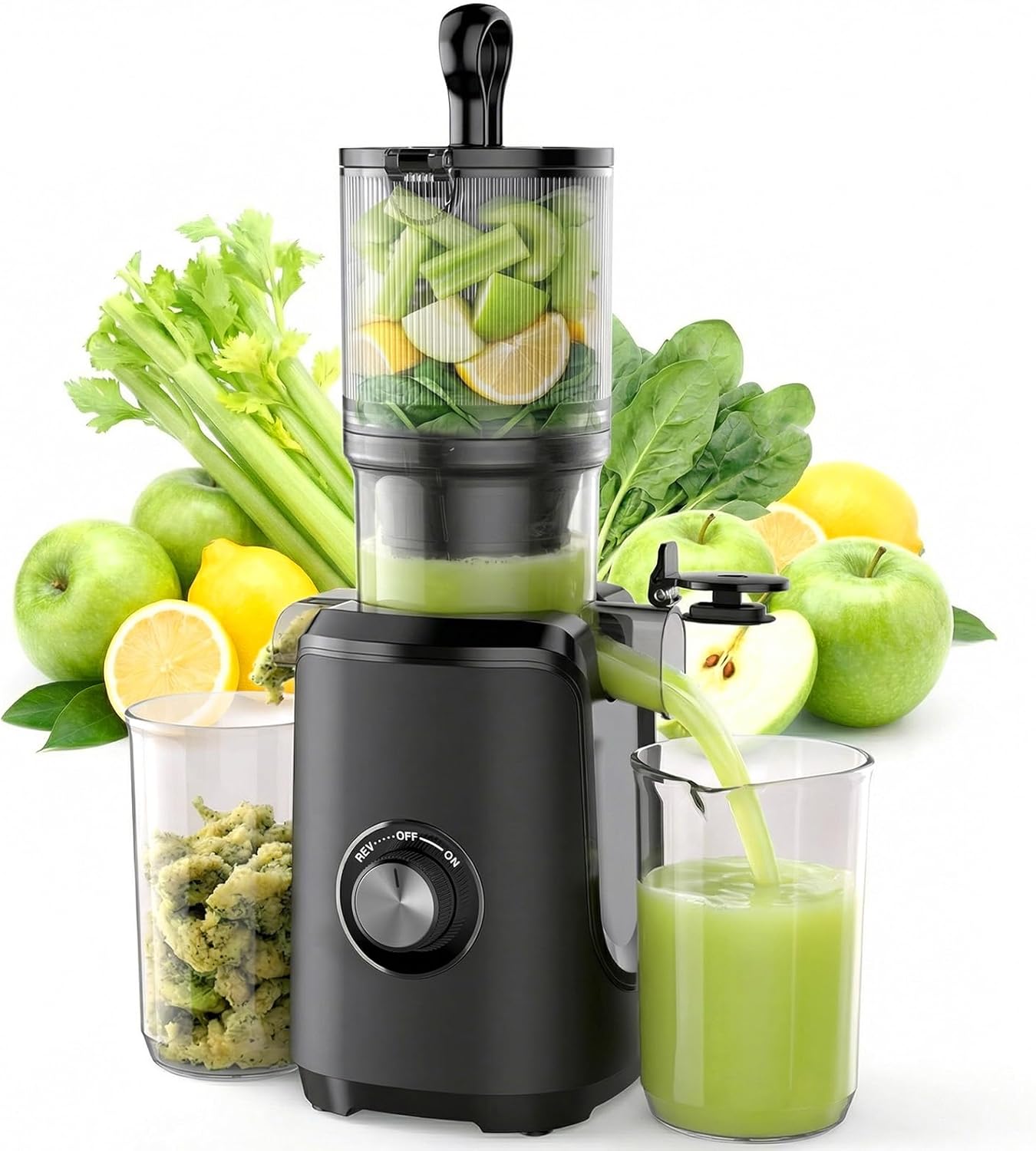
The NEWBULIG Cold Press Juicer is a single-auger masticating juicer built for everyday home use, especially for extracting juice from whole fruits and vegetables. It uses a slow 200-watt motor and a wide 4.25-inch feed chute so you can fit long items like carrots with less prep, while the low-speed masticating action reduces heat and oxidation to preserve more nutrients and flavor. A reverse function clears clogs quickly without disassembly, and the unit includes a pulp cup, juice cup, and a cleaning brush for faster cleanup; parts detach for hand washing. Safety features include a blade-free design and an automatic safety lock that stops operation if opened. Expect quieter operation than fast centrifugal models but slower processing speed, and hand washing is required rather than dishwasher-safe parts. For carrot juice specifically, the wide chute and reverse function make it practical and less fiddly when handling whole carrots, though extraction will be slower than high-powered juicers.
Best for: Buyers on a budget who want a nutrient-preserving masticating juicer for daily carrot and vegetable juices and prefer fewer prep steps over top speed.
Less Ideal for: People who need very fast throughput for large batches or want dishwasher-cleanable parts should consider different models.
- 4.25-inch feed chute fits long produce like whole carrots with minimal pre-cutting
- Slow masticating motor preserves nutrients and reduces oxidation for richer juice
- Reverse function clears clogs quickly without full disassembly
- Includes cleaning brush and easily detachable parts for simpler hand cleaning
- Automatic safety lock and blade-free design improve kitchen safety
- Requires hand washing of parts rather than dishwasher-safe cleaning
- Slower juicing speed compared with high-speed centrifugal models
Verdict: A budget-friendly slow juicer that handles whole carrots with minimal prep while prioritizing nutrient-rich extraction and easy clog clearing.
ECOSELF Cold Press Juicer

| Brand Name | ECOSELF |
|---|---|
| Special Features | Easy to Clean; High Juice Yield; Reverse Function; Low Noise Motor; Self Feeding |
| Material | Acrylonitrile Butadiene Styrene (ABS) |
The ECOSELF Cold Press Juicer is a slow masticating single-auger machine built to extract juice from whole fruits, vegetables, and leafy greens with minimal prep. It uses a wide feed chute and auto-feeding hopper so you can drop in larger pieces or whole produce for hands-free juicing, and a reverse function helps clear clogs during tougher runs. The low-speed extraction is designed to reduce heat and oxidation, which helps preserve nutrients and yields smoother, lower-pulp juice — useful when making carrot juice to get consistent flow and drier pulp. Assembly and cleaning are straightforward thanks to an integrated hopper and included brush, and a simple rotary knob offers one-touch control for everyday use. Claims of up to 99% yield and a high-torque, low-noise motor suggest efficient extraction, though real-world yield will depend on produce and preparation. This model emphasizes convenience and gentle juicing over speed, so it can be slower than centrifugal machines and better suited to users who prioritize nutrient retention and steady performance.
Best for: Buyers who want a dependable, low-oxidation juicer that handles whole produce with minimal prep and prioritizes consistent, nutrient-preserving extraction for daily carrot and vegetable juices.
Less Ideal for: People who need very fast single-serving juices on tight schedules or who prefer minimal hands-on time per cycle and prioritize speed above juice quality.
- Wide feed chute and self-feeding hopper reduce prep time by fitting larger pieces or whole fruits and vegetables.
- Slow masticating extraction preserves enzymes and reduces oxidation for smoother, nutrient-rich juice.
- Reverse function and one-touch rotary control help prevent and clear clogs for uninterrupted use.
- Easy assembly and included cleaning brush make daily cleaning quicker and less messy.
- Slower juicing speed compared with centrifugal models, which extends prep-to-glass time.
- Claimed yield rates may vary with produce type and require proper feeding technique.
Verdict: Choose this ECOSELF cold-press juicer if you want a reliable, hands-free masticating machine that prioritizes high-yield, low-oxidation extraction for carrot and vegetable juices.
Jocuu Slow Masticating Juicer

| Wattage | 150 watts |
|---|---|
| Number of Speeds | 2 |
| Power Source | Corded Electric |
| Special Features | Auto-Reversing, Portable |
The Jocuu Slow Masticating Juicer is a single-auger cold-press machine meant for extracting high-purity juice from both soft and hard produce. It offers two speed settings (soft and hard) so you can switch between delicate fruits and fibrous roots like carrots, and a reverse function and auto-reverse feature to clear clogs. The unit emphasizes low-noise operation and runs at around 60 dB, and its motor has built-in protection that shuts the machine off after extended runs to prevent overheating. Detachable parts are dishwasher-safe and made from BPA-free plastic, which makes cleanup straightforward, and the package includes a cleaning brush and accessories for assembly. On the downside the feeder chute is small, so larger pieces must be pre-cut, and the 150 W motor and compact design mean processing large batches will be slower than high-power commercial models. For routine home use, especially for juicing carrots and other roots, it balances yield and ease of cleaning but is not optimized for heavy continuous throughput.
Best for: Buyers who prioritize consistent cold-press extraction with low noise and straightforward cleanup and who want a reliable home juicer for daily vegetable and carrot juices backed by user feedback and manufacturer support.
Less Ideal for: Avoid this model if you need to juice very large volumes frequently or want a heavy-duty, high-throughput commercial-style juicer that handles whole produce without prep.
- Two speed spiral system for soft and hard produce to improve extraction from carrots and fibrous vegetables
- Reverse and auto-reverse functions help clear jams and reduce downtime
- Dishwasher-safe detachable parts and included brush make cleaning simple
- Quiet motor operation suitable for early-morning juicing without loud noise
- Small feeding chute requires chopping produce into smaller pieces
- 150-watt motor and compact capacity make large or continuous batches slower to process
Verdict: A quiet, user-friendly cold-press juicer that reliably extracts carrot and vegetable juice at home while keeping cleanup simple.
EanOruus E-18 Masticating Juicer

| Wattage | 250 watts |
|---|---|
| Power Source | ac |
| Voltage | 110 volts |
| Capacity | 100 fluid ounces |
The EanOruus E-18 is a single-auger masticating juicer built for high-capacity home use and multiple functions beyond juice, including nut milk and sorbet with interchangeable strainers. It accepts large whole fruit and veg through a 6.5-inch chute, which cuts prep time for carrots and other produce, and its 100 oz hopper is useful for batch juicing. The 250 W AC brushless motor is designed for steady, high-torque extraction and includes auto-reversing and overheat protection to reduce jams and protect the unit during heavy use. Detachable parts and a removable pulp outlet make cleanup easier than some masticators, though parts are hand-wash only. Practical limits include a relatively heavy, upright footprint and plastic auger/blade components rather than metal, which may affect long-term durability under daily commercial-style use. For someone prioritizing quiet, nutrient-preserving extraction and the ability to juice large runs of carrots at once, this juicer delivers a sensible balance of capacity and features.
Best for: Buyers who want a quiet, high-capacity masticating juicer that can handle large batches of carrots and also make nut milk or sorbet while minimizing jams and motor stress.
Less Ideal for: Those seeking a lightweight, countertop-friendly unit for occasional single servings or buyers who need fully dishwasher-safe parts or metal commercial-grade internals.
- Extra-wide 6.5-inch chute reduces prep time by allowing whole fruits and large pieces
- Large 100 oz hopper supports batch juicing for families or meal prep
- 250 W AC brushless motor provides steady, high-torque extraction suited to fibrous produce like carrots
- Auto-reversing and overheat protection help prevent jams and protect the motor
- Detachable pulp outlet and removable parts simplify cleaning compared with some masticating models
- Major components use plastic rather than metal which could affect long-term durability under heavy daily use
- Removable parts require hand washing rather than dishwasher-safe convenience
- Relatively tall and heavier unit takes more counter or storage space
Verdict: Choose the EanOruus E-18 if you need a quiet, high-capacity masticating juicer that handles whole carrots and large batches while offering nut milk and sorbet functions.
Choosing the Right Masticating Juicer for Carrot Juice: Key Factors to Consider
Extraction Method and Speed
Masticating juicers operate at low RPMs to crush and press produce rather than shred it. That slow, high-pressure extraction yields more liquid from dense root vegetables like carrots and preserves heat-sensitive nutrients.
When comparing models, look for the published operating speed and any notes about suitability for hard produce. Lower speeds typically mean less oxidation and better nutrient retention, but very low speeds require more torque to avoid stalling when processing carrots.
Motor Torque and Continuous Run Capability
Carrots are dense and require steady torque to keep the auger turning without overheating. A motor with higher torque or a gearbox designed for low-speed resistance reduces the chance of stalling or burning out when pushing through batches of carrots.
Also check maximum continuous run time and thermal protection features. If you plan to juice large quantities at once, models rated for longer continuous operation are safer and more practical.
Auger and Screen Design
The shape and material of the auger, along with the screen or filter geometry, determine how effectively the machine separates juice from pulp. Robust, well-shaped augers compress carrots more uniformly, producing drier pulp and higher yield.
Screens with fine, even perforations create smoother juice but can clog more easily with fibrous carrot pieces. Look for designs that balance filtration with anti-clog geometry or include a reverse option to clear blockages.
Feed-Chute Size and Feeding Workflow
Feed-chute diameter affects prep time. A wider chute reduces trimming and speeds up loading, but very wide chutes can allow whole carrot segments that increase jamming risk if the motor torque is insufficient.
Consider how much prep you are willing to do versus throughput needs. Smaller chutes are fine for single servings and give more controlled feeding, while larger chutes work better when juicing batches but need robust anti-jam features.
Ease of Cleaning and Maintenance
Regular use means frequent disassembly. Models designed for quick teardown and with smooth, accessible surfaces cut cleaning time significantly. Dishwasher-safe components help, but parts that require hand-scrubbing or have many small crevices increase long-term hassle.
Also factor in how simple it is to clear clogs and whether replacement parts like screens and gaskets are straightforward to access. A design that minimizes trapped pulp reduces mold risk and keeps performance consistent.
Build Quality and Warranty Support
Housing materials, auger composition, and seal quality affect durability when processing abrasive, fibrous carrots over months or years. Metal housings and reinforced augers resist wear better than thin plastics.
Warranty length and the clarity of customer support policies matter for peace of mind. For frequent juicers, prioritize models with longer warranties and documented part availability to avoid downtime.
Why Masticating Juicers Work Best for Carrots
Carrots are firm and fibrous, so extracting their juice efficiently requires pressure and time rather than high-speed cutting. Masticating juicers compress and press the vegetable slowly, which forces out more liquid and leaves behind drier pulp. That results in higher yield per carrot and a smoother mouthfeel compared with centrifugal alternatives.
Slow extraction also reduces heat and oxygen exposure during juicing. That helps preserve delicate vitamins and enzymes that can degrade quickly when juice is exposed to heat or excessive air.
- Higher yield from dense root vegetables
- Drier pulp reduces waste and boosts output
- Lower oxidation preserves nutrients and flavor
Preparing Carrots for Best Results
Proper prep improves throughput and reduces jamming. Trim tough ends and remove any leafy tops to prevent extra moisture and stringy fiber entering the auger. Wash thoroughly to remove soil, which can abrade internal parts, and peel if the skin is waxed or very dirty.
Cut carrots into pieces that match the feed-chute size. For small-chute models, halve or quarter carrots lengthwise. For wide-chute units, you can often feed longer segments, but avoid forcing oversized pieces into the inlet to prevent strain on the motor.
- Wash and trim tops
- Peel only if necessary
- Match cut pieces to chute diameter
Common Causes of Jams and How to Avoid Them
Jams most often happen when large, solid pieces enter the auger too quickly or when fibrous strings accumulate against the screen. Feeding at a steady pace and alternating carrot pieces with smaller, softer items like apple slices can ease the load on the auger and reduce blockages.
Use reverse or anti-jam functions as designed, and avoid forcing stale or dried produce through the machine. Regularly check and clear the hopper area between batches to prevent buildup.
- Feed in steady, moderate pace
- Alternate carrots with softer produce to prevent compaction
- Use reverse function to clear blockages when needed
Maintaining Performance Over Time
Routine maintenance extends machine life and keeps juice quality consistent. After each use, remove and rinse the auger and screen to prevent pulp hardening. Wipe seals and the housing interior to prevent sticky residues and odors.
Periodically inspect gaskets and moving parts for wear. Replace screens or augers at the first sign of deformation to avoid efficiency loss. Store the juicer disassembled or with vents open until fully dry to reduce mold risk.
- Rinse components immediately after use
- Inspect seals and replace worn parts
- Store dry to prevent mildew
Recipe Ideas and Blends with Carrot Juice
Carrot juice pairs well with citrus for brightness, ginger for spice, and apple for sweetness. When blending flavors, cold-press carrot juice keeps a smooth body that balances tart or spicy additions without becoming gritty.
For a nutrient boost, blend carrot juice with leafy green purées rather than juicing the leaves directly. Greens yield poorly in single-auger units, but a small amount of blended greens added to carrot juice preserves texture and nutrients.
- Try carrot with orange and ginger
- Use apple to add natural sweetness
- Blend, do not juice, leafy greens for best texture
How We Chose the Best Masticating Juicer for Carrot Juice
We focused on machines designed for single-auger, slow-speed extraction because that method consistently produces higher juice yield and drier pulp from carrots. Our shortlist criteria emphasized measurable performance metrics and everyday usability. We tested specification sheets and user feedback across several dimensions: extraction efficiency on hard root vegetables, motor torque and continuous-run heat management, feed-chute design and clog resistance, ease and time required for cleaning, and structural durability for weekly use. We also considered noise levels for early-morning juicing and the availability of a reverse or anti-jam function to clear dense carrot segments. Excluded from consideration were high-speed centrifugal models and compact citrus-only machines, since they do not handle carrots efficiently. We prioritized slow-speed masticating designs with documented torque ratings or manufacturer guidance for root vegetables, robust auger materials, and straightforward disassembly for cleaning. The resulting picks aim to balance consistent carrot yield, long-run reliability, and user-friendly maintenance.
Our full evaluation process is outlined in our review methodology.
FAQ
Is a masticating juicer necessary for carrot juice?
Often yes. Masticating machines extract more liquid and leave drier pulp when juicing carrots, so they deliver higher yield and smoother texture compared with high-speed alternatives.
Do I need to peel carrots before juicing?
It depends. If the carrots are clean and unwaxed, peeling is optional. Peel carrots that have thick skins, visible damage, or a waxed surface to avoid off flavors and reduce residue on internal parts.
How often should I clean the juicer when juicing carrots regularly?
You should rinse removable parts immediately after each use and perform a full clean at least once per day if you juice frequently. Prompt cleaning prevents pulp from drying and reduces odor and bacterial growth.
Will juicing many carrots at once damage the motor?
It can if the model is not rated for long continuous runs. Check the continuous operation rating and motor torque. For large batches, use models designed for extended use and allow the unit to rest between extended cycles.
Can I use a masticating juicer for other produce besides carrots?
Yes. Masticating juicers work well with leafy greens, celery, and soft fruits in addition to root vegetables. However, extraction characteristics vary by produce, so adjust feeding technique and recipes accordingly.
Final Verdict
For consistent, high-yield carrot juice, prioritize machines that combine strong torque, well-designed auger and screen geometry, and easy teardown for cleaning. Expect tradeoffs between feed-chute size and anti-jam reliability, and choose based on how much prep time you want to invest. Focus on juice yield, pulp dryness, and maintenance overhead when making a decision. With those priorities clear, you can select a masticating juicer that produces smooth, nutrient-dense carrot juice reliably over years of regular use.