
Note: This article contains affiliate links. If you click on these links and make a purchase, we may earn a small commission at no extra cost to you. This helps support our research and content. Read our full affiliate disclosure here.
If you rely on leafy greens for daily juices, a masticating juicer tailored to those fibrous ingredients can make a big difference in yield, nutrient retention, and ease of use. The right machine will extract more liquid from softer, stringy vegetables and leafy herbs without heating or oxidizing the juice, giving you better flavor and longer-lasting fresher juice. This guide shortlists the top masticating juicers designed for leafy greens and evaluates them on practical criteria like extraction efficiency, maintenance, and reliability. Read on to see the features that matter and which options best suit different household routines.
Top Picks at a Glance
| Best Overall The best all-around choice for most situations | Omega Cold Press Juicer J8006HDBLK |  |
| Best Quality Built to a higher standard if you want something more solid | Hurom H400 Slow Juicer |  |
| Best Value The sweet spot between price and what you get | ACOQOOS AMJ-90 Masticating Juicer |  |
| Best Budget The cheapest option that still gets the job done reliably | NEWBULIG Cold Press Juicer |  |
| Top Rated A top-rated pick with lots of positive feedback | ECOSELF Cold Press Juicer |  |
| Most Popular A crowd favorite that many people choose with confidence | Jocuu Slow Masticating Juicer |  |
| Best Seller A high-volume bestseller chosen again and again | EanOruus 3‑in‑1 Masticating Juicer E-18 |  |
Omega Cold Press Juicer J8006HDBLK

| Maximum Power | 200 watts |
|---|---|
| Wattage | 200 watts |
| Power Source | Corded Electric |
| Number of Speeds | 1 |
The Omega J8006HDBLK is a triple-stage, low-speed (80 RPM) masticating juicer built for high-yield extraction from fruits, vegetables and leafy greens while minimizing heat and oxidation. It is used for batch juicing and also functions as a nutrition system for nut butters, milks, baby food, pasta and sorbets thanks to included cones, nozzles and a homogenizing accessory. The 200-watt single-speed motor runs quietly compared with high-speed machines, and removable parts are sink-rinseable or top-rack dishwasher safe for straightforward cleanup. Practical benefits include efficient leafy-green and wheatgrass extraction from the triple-stage auger and an adjustable end cap to fine-tune yield. The unit is heavier and larger than compact juicers, and it offers only one speed so it is less flexible for delicate vs hard produce beyond the end-cap adjustment. Buyers should expect some bench space taken up and a brief learning curve assembling the parts for non-juicing modes like pasta or nut butter.
Best for: Buyers who want a dependable, nutrient-preserving cold-press system that excels at leafy greens and wheatgrass extraction and also doubles as a small nutrition workstation.
Less Ideal for: Users seeking a compact travel-style juicer or those who need multiple motor speeds for highly varied produce processing.
- Triple-stage masticating auger maximizes juice yield from leafy greens and wheatgrass.
- Low 80 RPM speed reduces heat and oxidation to preserve nutrients.
- Quiet 200-watt motor suitable for early-morning juicing without much noise.
- Includes accessories for nut butters, baby food, pasta and sorbets, expanding functionality.
- Removable parts are top-rack dishwasher safe for easier cleanup.
- Single fixed speed limits control compared with multi-speed models.
- Relatively large and heavy footprint requires counter space.
Verdict: Choose this Omega when you want high-yield, nutrient-preserving extraction of leafy greens plus the versatility to make nut butters and baby food in one durable machine.
Hurom H400 Slow Juicer

| Wattage | 150 watts |
|---|---|
| Power Source | Corded Electric |
| Number of Speeds | 1 |
| Capacity | 550 ml |
The Hurom H400 is a slow, single-auger masticating juicer built to extract high yields with minimal pulp and minimal cleanup. It uses a 150 W motor running at a low rpm and a two-part auger chamber that meshes to perform a strainer-free extraction, which makes it especially good for leafy greens and soft produce. The large self-feeding hopper lets you add whole or large pieces while the unit runs, and the front gauge window helps you monitor fill level without disassembly. Parts are dishwasher-safe and the simplified internal design reduces pieces to assemble and clean compared with many other slow juicers. On the downside, the 550 ml capacity means you may need to empty the chamber for larger batches, and the unit is relatively heavy. For daily green-juice drinkers who prioritize yield and low pulp, the H400 delivers quiet, efficient extraction and noticeably less scrubbing than strainer-based models.
Best for: Buyers focused on getting maximum juice from leafy greens and soft produce who want a quiet, high-yield masticating juicer that minimizes cleanup.
Less Ideal for: People who need a very lightweight, highly portable juicer or who routinely make very large batch output without interruptions should consider other options.
- High juice yield with low pulp thanks to the two-part meshing auger and strainer-free design
- Large self-feeding hopper accepts whole or large produce for easier continuous juicing
- Quiet 150 W motor suitable for early-morning or frequent use
- Simplified assembly and dishwasher-safe parts reduce cleaning time
- 550 ml capacity requires frequent emptying for larger batches
- Heavier unit may be less convenient to move or store
Verdict: Choose the H400 if you want a quiet, high-yield masticating juicer that excels at extracting juice from leafy greens while keeping cleanup quick.
ACOQOOS AMJ-90 Masticating Juicer

| Maximum Power | 350 watts |
|---|---|
| Number of Speeds | 60 |
| Capacity | 100 OZ hopper |
| Material | BPA-Free ABS |
The ACOQOOS AMJ-90 is a single-auger cold press juicer designed for hands-off batch juicing and multi-use kitchen tasks. It features a very wide 6.5-inch feed chute and a 100 oz gravity-fed hopper so you can load whole or large produce and walk away while the auger slowly extracts juice at about 60 RPM. The slow masticating action aims to preserve nutrients and reduce foam, and the manufacturer claims high juice yield with dry pulp which is useful when processing leafy greens. Extras include a nut-milk and sorbet function that broaden how you use the machine, dishwasher-safe detachable parts for quicker cleanup, and built-in overheat protection for longer runs. Practical limitations are its 350-watt motor and single-speed design, which means very tough ingredients or continuous heavy commercial use may strain performance, and you should remove hard pits or big seeds first to protect the auger. For home kitchens focused on efficient, nutrient-rich juice from greens and batch prep, this model balances capacity and convenience.
Best for: Buyers who want an efficient home juicer that minimizes prep and maximizes nutrient retention for leafy greens and batch juicing while also handling nut milk and frozen-fruit treats.
Less Ideal for: Those who need commercial-grade throughput, frequent heavy-duty extraction, or multi-speed control for varied ingredient textures should consider higher-powered or multi-speed alternatives.
- 6.5-inch extra-wide feed chute and 100 oz hopper let you process whole or large pieces with minimal prep
- Slow 60 RPM masticating action preserves nutrients and produces low-foam juice with higher yield
- 3-in-1 capability for juice, sorbet, and nut milk increases versatility in one appliance
- Detachable BPA-free parts are dishwasher safe for faster cleanup
- Single-speed 350 W motor may struggle with very hard ingredients or heavy continuous use
- Requires removal of hard pits and seeds to avoid damaging the auger
Verdict: Choose this juicer if you want a high-yield, low-prep cold press machine that excels at leafy greens and batch extraction while adding nut milk and sorbet functions.
NEWBULIG Cold Press Juicer
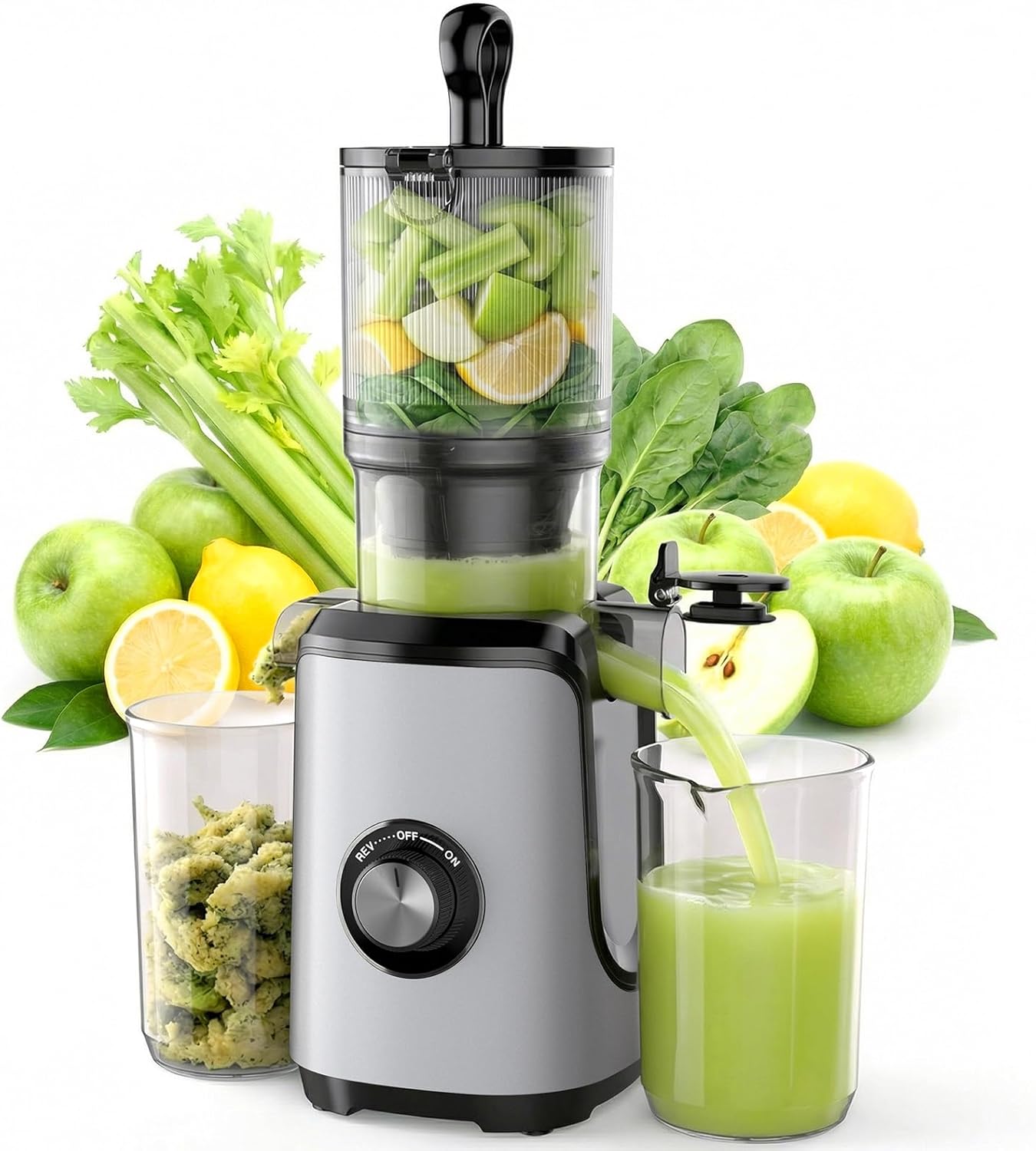
| Wattage | 200 watts |
|---|---|
| Voltage | 120 volts |
| Material | ABS, PC, Silicone, Stainless Steel |
| Feed chute | 4.25 inches |
The NEWBULIG Cold Press Juicer is a budget-friendly single-auger masticating machine aimed at everyday home juicing. It uses a slow-speed, cold-press method to reduce heat and oxidation, which helps preserve nutrients and flavor from leafy greens and other produce. The 4.25-inch feed chute accepts whole carrots and many fruits with minimal prep, and the reverse function clears jams quickly without disassembly. Safety features include a blade-free design and an automatic safety lock, and the unit disassembles for hand washing with a supplied cleaning brush. At 200 watts the motor is quiet but not fast, so expect longer extraction times compared with centrifugal models; very fibrous or large batches will take more time. Materials are a mix of ABS, polycarbonate, silicone, and stainless steel, and care instructions call for hand washing only. For buyers focused on getting higher juice yield and gentler processing of leafy greens without a high price, this model is a practical pick.
Best for: Home juicers who prioritize nutrient-rich extraction from leafy greens and want a low-cost, easy-to-use masticating machine that reduces prep time.
Less Ideal for: People who need very fast throughput for large volumes or want fully dishwasher-safe parts should consider faster or more premium models.
- Wide 4.25-inch feed chute reduces chopping and speeds prep
- Slow masticating action minimizes heat and oxidation for better nutrient retention
- Reverse function clears clogs quickly without disassembly
- Automatic safety lock and blade-free design improve everyday safety
- Detachable parts and included cleaning brush make cleaning straightforward
- Hand wash only; not dishwasher safe
- 200W slow-speed motor means longer extraction time for large or dense batches
Verdict: A wallet-friendly masticating juicer that delivers nutrient-preserving extraction for leafy greens with minimal prep and easy clog clearing.
ECOSELF Cold Press Juicer

| Brand | ECOSELF |
|---|---|
| Type | Single Auger Masticating Juicer |
| Special Features | Reverse Function; Self Feeding; Wide Feed Chute |
| Material | Acrylonitrile Butadiene Styrene (ABS) |
The ECOSELF Cold Press Juicer is a slow masticating single-auger machine designed to extract juice from whole fruits, vegetables, and leafy greens with minimal prep. It uses a wide feed chute and an auto-feeding, hands-free design so you can drop in larger pieces or whole produce rather than finely chopping everything. The low-speed cold-press action and upgraded auger focus on high juice yield and reduced oxidation for smoother, nutrient-rich juice and lower pulp content. A one-touch rotary control and a reverse function help prevent clogs and make operation straightforward, while the included cleaning brush and simple three-step assembly speed up daily cleanup. Practical limits include the typical slower processing time compared with centrifugal juicers and a mostly plastic ABS build that may feel less heavy-duty than metal-bodied models, though it keeps noise and weight down. For routine juicing of greens and mixed produce, it balances yield, ease of use, and user-friendly maintenance.
Best for: Buyers who prioritize reliable, daily cold-press extraction for leafy greens and mixed produce and want a hands-free, low-oxidation juicer that is easy to operate and maintain.
Less Ideal for: If you need ultra-rapid juice output or a heavier, commercial-grade metal build, a high-speed centrifugal unit or metal-bodied masticating model would be a better fit.
- Wide feed chute and auto-feeding let you juice larger pieces or whole produce for faster prep
- Slow masticating extraction preserves nutrients and reduces oxidation for smoother juice
- High reported juice yield that minimizes waste from produce
- Reverse function and simple rotary control reduce clogging and make operation intuitive
- Designed for easy assembly and quick cleaning with included brush
- ABS plastic construction may feel less rugged than metal-bodied juicers
- Slower extraction speed typical of masticating juicers compared with centrifugal models
Verdict: A reliable, user-friendly cold-press juicer that delivers high juice yield from greens and whole produce with minimal prep and easy maintenance.
Jocuu Slow Masticating Juicer

| Wattage | 150 watts |
|---|---|
| Number of Speeds | 2 |
| Power Source | Corded Electric |
| Special Features | Auto-Reversing, Portable |
The Jocuu Slow Masticating Juicer is a single-augur cold-press machine built to extract juice from a wide range of produce using a low-speed spiral system and two speed settings for soft or hard ingredients. It is typically used for leafy greens, fibrous vegetables, and fruits where slow masticating action preserves nutrients and reduces oxidation, and the automatic shutoff after 20 minutes protects the motor during longer sessions. Notable features include an auto-reverse function to clear clogs, a relatively quiet 150-watt motor, and dishwasher-safe detachable parts that simplify cleanup. In practice the small feeding chute encourages cutting produce into smaller pieces and improves safety around kids, while the two speeds help dial in extraction for delicate leafy greens versus harder roots. Limits to expect are a modest feeding chute and 150-watt motor that make it slower than larger commercial machines, and the capacity info suggests it is sized for household rather than heavy daily batch juicing. For buyers focused on nutrient-preserving cold press juice at home, it balances performance and practical convenience.
Best for: Buyers who prioritize nutrient-preserving cold-press juice from leafy greens and want a quiet, user-friendly home juicer with safety and easy cleaning.
Less Ideal for: People who need fast, high-volume or commercial-grade juicing for frequent large batches should consider larger-capacity, higher-power machines instead.
- Two-speed spiral system for soft and hard produce yields better extraction control
- Auto-reverse function reduces clogging and eases processing of leafy greens
- Dishwasher-safe detachable parts and included brush simplify cleaning
- Quiet 150-watt motor suitable for home use with an automatic 20-minute shutoff for motor protection
- Small feeding chute requires more pre-cutting and slows batch processing
- 150-watt motor and compact capacity are less suited for heavy or commercial juicing
Verdict: A compact, quiet cold-press juicer that preserves nutrients in leafy greens while offering easy cleanup and clog-reducing features for home use.
EanOruus 3‑in‑1 Masticating Juicer E-18

| Wattage | 250 watts |
|---|---|
| Power Source | ac |
| Voltage | 110 volts |
| Capacity | 100 fluid ounces |
| Special Features | Auto-Reversing, Overheat Protection |
The EanOruus E-18 is a single-auger masticating juicer designed to handle whole fruits and vegetables, make nut milk, and produce sorbets using two interchangeable strainers. In everyday use you feed produce into the extra-wide 6.5-inch chute and the slow masticating auger extracts juice while minimizing heat and foam, which helps preserve nutrients and is particularly good for leafy greens and soft produce. The unit includes a very large 100 oz hopper for batch juicing, an AC brushless 250W motor that runs quietly, and safety features like auto-reverse and overheat protection to reduce jams and motor strain. Detachable parts and a removable pulp outlet simplify cleaning by allowing hand washing of components. Practical limitations include a relatively heavy, tall footprint that needs counter space and plastic-based parts rather than metal, and the product care instruction calls for hand washing rather than dishwasher-safe parts. For buyers who prioritize quiet, high-yield cold-press extraction and large batch capacity, this model makes leafy-green juicing straightforward but you should plan for manual cleaning and stable countertop placement.
Best for: Buyers who want a quiet, high-yield masticating juicer for regular leafy-green and whole-fruit juicing and who prioritize reliable motor protection and large batch capacity.
Less Ideal for: People with very small kitchens or who need dishwasher-safe parts and ultra-compact appliances should consider smaller or different models.
- Large 6.5-inch feed chute accepts whole fruits to reduce prep time
- 100 oz hopper supports large batches for family or meal prep
- 250W AC brushless motor designed for quiet, consistent masticating extraction
- Auto-reverse and overheat protection reduce clogging and protect the motor
- Includes interchangeable strainers for juice, nut milk, and sorbet versatility
- Many removable parts are plastic rather than metal
- Requires hand washing of parts instead of dishwasher-safe cleaning
- Relatively heavy and tall footprint demands clear counter space
Verdict: Choose the EanOruus E-18 if you want a quiet, high-capacity masticating juicer built for large batches and reliable leafy-green extraction.
Choosing the Right Masticating Juicer for Leafy Greens: Key Factors to Consider
Extraction Method and Auger Design
The auger and internal geometry determine how gently and thoroughly the machine crushes leafy material. A slow-turning single auger with a tight press chamber squeezes out more liquid with less heat buildup. That matters for leafy greens because they have high surface area and delicate cell walls that release valuable micronutrients when crushed slowly.
Different auger profiles and screen configurations also affect how much pulp carries through into the juice. For leafy-heavy use, choose designs that minimize channeling and refeeding, since repeated passes or frequent jamming reduces convenience and can introduce more oxidation.
Yield Per Bunch and Juice Clarity
Yield is the single most noticeable difference between models when juicing greens. Higher-yielding units leave drier pulp and produce more ounces from the same amount of produce. Juice clarity affects texture and mouthfeel; some users prefer a bit of body, while others want a clearer, smoother finished drink.
Consider how the machine handles foam and air incorporation. Excess foam can change perceived flavor and reduce usable volume. For leafy greens, look for systems that separate foam and send drier pulp to the waste chute so you get consistent glass-to-glass results.
Cleaning, Disassembly, and Maintenance
Leafy-green pulp is moist and fibrous, which can cling to mesh screens and auger flights. Models that disassemble quickly with minimal small parts and that allow easy access to the strainer and auger will save time daily. Dishwasher-safe components help but do not replace a design that resists clogging.
Also consider parts that are easy to inspect for wear and that can be serviced or replaced without complex tools. For daily juicing, a realistic maintenance expectation will determine whether you keep up with the habit or abandon it after the novelty wears off.
Throughput and Feed Chute Design
Throughput measures how much produce you can process in a given time without repeated stoppages. A wider or well-shaped feed chute reduces cutting and pre-prep time, while efficient auger geometry prevents bridging where fibrous greens bunch up. For frequent juicers, throughput affects morning routine time and overall convenience.
Some machines benefit from shorter, frequent feeding of small quantities, while others can accept larger handfuls. Think about how you plan to use it: quick single servings or batch prep for several glasses at once.
Build Materials and Long-Term Reliability
Durable materials in the auger, housing, and screens extend service life, especially under the abrasive action of leafy fibers over time. Look for high-strength plastics or metal components in wear-prone areas and robust motor cooling to prevent thermal stress.
A unit that feels solid and well-sealed will also reduce leaks and stray pulp, which improves both the juicing experience and cleanliness. Availability of replacement parts and straightforward warranties are also practical indicators of long-term reliability.
Noise, Vibration, and Heat Management
Masticating machines operate slowly but can still generate noticeable vibration and motor heat during extended runs. Lower noise and stable operation make it easier to integrate juicing into morning routines without disturbing others. Effective heat management preserves nutrient quality by avoiding temperature rises that can accelerate oxidation.
If you plan to run long leafy batches or wheatgrass, consider models with thermal cutoff protection and quiet motors that maintain consistent torque under load.
Why Masticating Juicers Are Best for Leafy Greens
Masticating juicers operate at low speeds that crush and press plant cells rather than shredding them. That method extracts juice more gently from thin, fibrous leaves and herb stems, producing higher yield and less oxidation than high-speed centrifugal machines.
For leafy greens, the slow, steady pressure also reduces foam and separates liquid from pulp more effectively. That means you get a smoother texture and a fresher-tasting glass that holds up better in the refrigerator for a day or two.
- Low-speed extraction preserves enzymes and reduces heat-related degradation.
- Tighter press chambers typically yield drier pulp from leafy material.
- Gentle action reduces foam and air incorporation, improving flavor stability.
Prep Tips to Improve Yield and Reduce Jamming
Proper produce preparation can significantly affect throughput and yield. Remove large woody stems and bundle very fine leaves to feed evenly. For compact greens, folding or loosely rolling bunches gives the auger something to bite into without creating long fibrous ribbons that wrap around the auger.
If you encounter frequent bridging, try alternating handfuls of greens with a firmer vegetable, like a cucumber or celery stalk, to push material through the press chamber. Consistent portioning avoids overpacking the feed chute and reduces the need to stop and clear the unit.
- Bundle delicate herbs and small leaves to prevent clogging.
- Alternate leafy batches with firmer produce to maintain throughput.
- Cut or fold very large leaves to promote even feeding.
Cleaning Routines That Save Time
Rinse components immediately after juicing to prevent sticky residue from drying. A quick brush of the strainer under running water prevents pulp from packing into the mesh. For daily users, a 3- to 5-minute wipedown plus a deeper weekly clean strikes a good balance between hygiene and convenience.
Consider keeping a small dedicated brush and a container for soaking parts to soften stuck fibers. Some owners find that a short rinse cycle while the unit is partly assembled helps dislodge trapped pulp before full disassembly.
- Rinse parts immediately to avoid dried pulp build-up.
- Use a narrow brush for strainers and mesh screens.
- Soak stubborn parts briefly in warm water to loosen fibers.
How to Store and Preserve Leafy-Green Juice
Leafy-green juices oxidize faster than fruit juices. Store freshly made juice in airtight glass bottles or jars and fill them as full as possible to minimize headspace. Keep bottles refrigerated and consume within 24 to 48 hours for best flavor and nutrient retention.
If you prepare batches in advance, consider separating juice into single-serving containers for easier daily use. Cold temperatures slow oxidation but do not stop it, so plan consumption accordingly and avoid leaving juice at room temperature for extended periods.
- Use airtight glass containers and minimize headspace.
- Refrigerate immediately and use within 48 hours.
- Portion into single-serving bottles for convenience and freshness.
Daily Use Habits to Extend Machine Life
Avoid overloading the auger with long runs of dense material without short pauses. Give the motor brief rests during heavy sessions to reduce heat stress. Regularly inspect the auger and screen for fiber buildup or signs of wear and replace parts as needed to maintain consistent yield.
Rotate your cleaning routine so that some weeks include a deeper inspection of seals and fasteners. Tighten loose fittings and ensure all parts seat correctly to prevent leaks and reduce mechanical wear.
- Allow brief pauses during long juicing sessions to prevent overheating.
- Inspect and replace worn screens or seals promptly.
- Tighten fittings and check for pulp buildup at connection points.
How We Chose the Best Masticating Juicer for Leafy Greens
We selected machines that consistently deliver strong results with leafy greens by focusing on measurable, user-centric criteria. First, we prioritized extraction efficiency, looking for slow-speed auger designs and juice separation that consistently produce higher liquid yield from spinach, kale, wheatgrass, and other greens. Second, we evaluated build and sealing quality so the units maintain low oxidation and steady pressure during long leafy runs. Third, ease of cleaning and maintenance was a major filter because leafy-green pulp can be wet and clingy; models with fewer parts, straightforward disassembly, and accessible strainers scored better. Fourth, throughput and feed design were considered to assess how quickly you can process bunches without frequent jamming. Finally, we looked at noise levels and motor thermal management for comfortable home use during morning routines. We excluded centrifugal and citrus-only machines and any unit lacking a slow-turning, low-heat extraction mechanism because those do not suit leafy-green performance. We also discounted models with fragile plastic components or poor customer-supported repairability. The result is a curated set of masticating juicers that meet practical home-use requirements for leafy greens while balancing durability and everyday convenience.
Our full evaluation process is outlined in our review methodology.
FAQ
Can I juice only leafy greens or do I need to mix them with other produce?
You can juice strictly leafy greens, but some machines perform better when greens are alternated with firmer produce to maintain consistent feed. Mixing is not required but can improve throughput and reduce bridging in many models.
How much juice can I expect from a bunch of kale or spinach?
Yield varies by produce condition and machine design, but you should expect significantly more liquid from a masticating process than a centrifugal one. Leaves that are fresher and more compact typically yield better results.
How often should I deep-clean the juicer parts?
Daily rinsing and a quick brush after each use is recommended, with a deeper clean at least once a week. Frequent heavy leafy use may require more regular inspection and cleaning of the strainer to prevent clogging.
Will juicing leafy greens remove fiber from my diet?
Juicing separates most insoluble fiber into the pulp, so the liquid contains fewer solids than whole-vegetable consumption. For dietary fiber benefits, consider consuming some of the pulp or balancing juices with whole produce in your meals.
Does cold-press masticating juicing preserve nutrients better?
The low-speed, low-heat extraction typical of masticating juicers reduces heat-related degradation and oxidation compared with high-speed shredding. While 'preserve' depends on many factors, gentle extraction generally helps retain more heat-sensitive compounds.
Final Verdict
Focus on extraction efficiency, ease of cleaning, and durable construction when choosing a masticating juicer for leafy greens. Higher-yield designs and solid seals will save time and produce more juice per bunch, while easy disassembly keeps daily maintenance manageable. Balance throughput and noise considerations against how often you plan to juice. Prioritize models that match your routine: if you juice daily, choose a unit with quick cleaning and reliable parts; if you juice occasionally, a simpler, robust design may suffice. These tradeoffs will help you pick a machine that sustains healthy juicing habits over the long term.