
Note: This article contains affiliate links. If you click on these links and make a purchase, we may earn a small commission at no extra cost to you. This helps support our research and content. Read our full affiliate disclosure here.
If you rely on a standing pilot gas heater or older gas-fired appliance, choosing the right millivolt thermostat matters for steady, safe temperature control and long-term reliability. You want a control that works with low-voltage millivolt circuits, offers accurate sensing, and is simple to wire and maintain. This guide presents six shortlisted millivolt thermostats chosen for practical home use, each evaluated on installability, sensing accuracy, and durability. Below we outline the selection process and the evaluation criteria used, then walk through decision points to help you pick the best millivolt thermostat for your heating setup.
Top Picks at a Glance
| Best Overall The best all-around choice for most situations | TPI UT1001 Millivolt Thermostat |  |
| Best Quality Built to a higher standard if you want something more solid | Southbend Range 1191727 Thermostat |  |
| Best Value The sweet spot between price and what you get | Empire TMV Wall-Mount Thermostat |  |
| Best Budget The cheapest option that still gets the job done reliably | Honeywell Home CT30A1005 Thermostat |  |
| Top Rated A top-rated pick with lots of positive feedback | White-Rodgers Economy Millivolt Stat |  |
| Most Popular A crowd favorite that many people choose with confidence | Honeywell Home CT33A Thermostat |  |
TPI UT1001 Millivolt Thermostat

| Controller Type | Mechanical knob, Push Button |
|---|---|
| Voltage | 24 volts |
| Temperature Control Type | Heating |
| Mounting Type | Wall Mount |
| Display Type | LCD or LED |
The TPI UT1001 is a straightforward mechanical thermostat designed for heat-only millivolt or low-voltage (24VAC) systems. It uses a rotary knob and push-button control with an included anticipator and sealed contacts for reliable on/off switching, and it accepts Fahrenheit or Celsius settings across a 50°F to 90°F range. Installation is basic: the unit mounts to a wall in either horizontal or vertical orientation with terminal connections for R and W, so it fits common retrofit and replacement scenarios. Because it is mechanical it does not need leveling and has no programming or digital scheduling, which keeps operation intuitive but limits energy-saving automation. The white minimalist faceplate blends into most utility spaces, and UL listing and RoHS compliance cover safety and environmental expectations. If you want a simple, durable thermostat to control heat-only systems without wiring complexity, this delivers; if you need programmable schedules, remote control, or cooling control, look elsewhere.
Best for: Buyers who want a no-frills, durable thermostat to replace or control a simple heat-only millivolt or low-voltage system and value straightforward, reliable operation.
Less Ideal for: People who need programmable features, Wi-Fi/remote control, or combined heating and cooling thermostat functionality should consider a digital or smart model instead.
- Works with millivolt and 24VAC heat-only systems
- Mechanical control is simple and easy to operate
- Sealed long-life contacts for reliable switching
- Can be mounted horizontally or vertically for flexible placement
- Includes anticipator for better temperature cycling control
- Heat-only device with no cooling or multi-stage support
- No programmable schedules or remote connectivity
Verdict: A tough, no-nonsense mechanical thermostat that reliably controls heat-only millivolt or 24VAC systems without programming complexity.
Southbend Range 1191727 Thermostat

| Power Source | Ac/dc |
|---|---|
| Voltage | 250 volts |
| Connectivity Technology | Wired |
| Display Type | touchscreen |
| Temperature Control Type | thermostatic |
The Southbend Range 1191727 RX-Millivolt 550 is a factory replacement thermostat intended to restore temperature control on compatible Southbend ranges and ovens. It uses a millivolt thermostatic control with a touchscreen display and wired connectivity for surface mounting, so installation replaces the original factory control and preserves the range's designed behavior. In typical use it provides straightforward temperature display and touch control suited to heavy-duty cooking equipment where reliable, repeatable heat settings matter. As an OEM part it prioritizes fit, safety, and durability over aftermarket flexibility, and the AC/DC 250-volt rating and wired interface reflect commercial electrical expectations. The unit is compact and finished in polished metal to match factory aesthetics, but it does not add programmability or wireless features, so it is best when you need a direct replacement rather than an upgrade. If you value factory-spec performance and minimal fuss when repairing a Southbend appliance, this thermostat delivers a simple, dependable solution.
Best for: Buyers seeking a direct, factory-quality replacement to restore accurate temperature control on Southbend commercial ranges and who prioritize reliable, original-spec operation.
Less Ideal for: Users looking to add Wi-Fi, remote control, or programmable scheduling to their appliance should consider other modern thermostat solutions.
- Genuine OEM part for Southbend equipment ensures exact fit and factory-quality performance
- Touchscreen display and touch control give clear temperature readout and intuitive adjustments
- Wired, surface-mount design matches factory installation for straightforward replacement
- Built to commercial electrical specs (AC/DC 250 volts) suitable for heavy-duty ranges
- Nonprogrammable millivolt design offers no scheduling or smart connectivity options
- Limited to use on specified Southbend models and not a universal thermostat
Verdict: Choose this authentic Southbend millivolt thermostat when you want a factory-spec replacement that restores reliable, predictable temperature control for commercial ranges.
Empire TMV Wall-Mount Thermostat

| Voltage | 750 volts |
|---|---|
| Power Source | Hardwired |
| Controller Type | Remote |
| Connectivity Technology | Wi-Fi |
| Mounting Type | Wall Mount |
The Empire TMV is a straightforward wall-mounted thermostat intended for use with GWT series heaters that run on 750 mV. It provides analog temperature control via a hardwired connection and lists Wi‑Fi as its connectivity protocol, although the control interface is described as analog and remote. Installation is typical for line‑level heater thermostats and the product is built to a simple, modern design that blends into utility spaces. The practical appeal is in its compatibility with millivolt heater systems and its low-voltage focus, which keeps wiring requirements familiar to HVAC installers. Limitations include a basic analog display and minimal on-device features, so users seeking advanced programmable schedules, touchscreen controls, or clear digital readouts will find this unit minimal. The thermostat is best when you need a reliable, no-frills controller for compatible millivolt heaters rather than a smart, feature-rich home thermostat.
Best for: Buyers who want a practical, no-frills thermostat to control millivolt GWT series heaters and value straightforward installation and operation over advanced smart features.
Less Ideal for: Users seeking programmable schedules, touchscreen interfaces, precise digital temperature readouts, or a full-featured smart thermostat should look elsewhere.
- Designed specifically for 750 mV millivolt heater systems for straightforward compatibility
- Hardwired power source suits permanent wall installation and HVAC wiring practices
- Simple analog control reduces complexity and is easy to operate
- Modern, unobtrusive wall-mount design that fits utility and mechanical spaces
- Analog display and minimal on-device features limit programmability and precision
- Listed Wi‑Fi connectivity may not provide a full smart thermostat experience
Verdict: Choose the Empire TMV if you need a simple, reliable wall thermostat specifically built to control 750 mV millivolt heaters without extra smart thermostat complexity.
Honeywell Home CT30A1005 Thermostat

| Controller Type | Hand Control |
|---|---|
| Additional Features | Heat Only |
| Power Source | Low Voltage Control |
| Control Type | Dial Control |
| Mounting Type | Wall Mount |
The Honeywell Home CT30A1005 is a basic manual thermostat that uses a bimetal sensor and snap-action switch to control a heating-only system. It mounts to the wall with the included decorative backplate and hardware and is operated via a simple dial for straightforward temperature adjustments, making it an easy DIY swap for older systems. The unit is mercury-free and wired for low-voltage control, so it works well with standard furnaces that need a mechanical, non-digital controller. Because it is non-programmable and has no display or off switch, it lacks modern scheduling, remote access, and fine-grain digital accuracy, but those omissions keep the device inexpensive and very durable. Installation is quick for anyone comfortable with basic wiring and homeowners replacing a failed manual stat will appreciate the familiar, no-frills operation. If you want reliable, low-cost heating control without smart features, this thermostat delivers.
Best for: Buyers who prioritize a low-cost, easy-to-install replacement for a single-stage heating system and prefer straightforward mechanical controls over digital features.
Less Ideal for: People who need programmable schedules, remote or smart-home control, or who have heat pump or multi-stage systems should look elsewhere.
- Simple dial control with bimetal sensor for easy, familiar operation
- Includes decorative backplate and mounting hardware for straightforward DIY installation
- Mercury-free mechanical design is durable and reliable for basic heating systems
- Wired low-voltage compatibility with standard furnace systems
- Non-programmable with no display or scheduling features
- Not compatible with heat pump, multi-stage, or electric baseboard systems
Verdict: Choose this thermostat if you want a rugged, no-frills mechanical controller that replaces a heating-only stat at minimal cost.
White-Rodgers Economy Millivolt Stat
| Operating Voltage | 12 volts |
|---|---|
| Current Rating | 20 A |
| Wattage | 240 watts |
| Contact Type | Normally Open |
| Connectivity Protocol | X-10 |
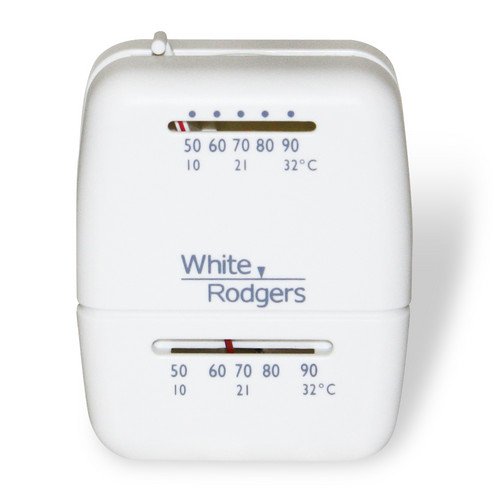
This White-Rodgers millivolt thermostat is a no-frills mechanical control meant for basic single-circuit heating systems. It mounts on a panel and uses a rotary actuator with screw terminals for a straightforward, installer-friendly connection. The unit is rated for 20 A and 240 watts and uses normally open contacts and a manual push-button control, so it will reliably switch millivolt gas or oil heating controls without the complexity of electronic thermostats. Materials include metal construction with copper and brass contacts and it meets cULus safety standards, which supports long-term durability. Limitations are its heat-only design and single position control, so it does not support cooling, multi-stage systems, or modern programmable features and it relies on mechanical parts that require occasional calibration or replacement if heavily used. For someone replacing a failed millivolt stat or keeping an older heating system simple, this model is dependable and easy to install.
Best for: Buyers who prioritize a rugged, straightforward replacement for an existing millivolt heat-only system and want a reliable, easy-to-service mechanical thermostat.
Less Ideal for: Users seeking programmable schedules, cooling control, multi-stage HVAC support, or smart/home automation features should choose an electronic or programmable thermostat instead.
- Designed specifically for millivolt heat-only systems so compatibility is clear
- Simple mechanical rotary control and screw terminals make installation and service easy
- Copper and brass contacts with metal housing for durable, long-lasting connections
- cULus specification met for basic safety and reliability
- No cooling or programmable features and limited to single-circuit heat control
- Mechanical parts offer less precision than modern electronic thermostats
Verdict: A rugged, no-nonsense millivolt heat-only thermostat built for dependable replacement service in older heating systems.
Honeywell Home CT33A Thermostat

| System type | Millivolt Heating |
|---|---|
| Power Source | 750 mV |
| Connectivity Technology | Wired |
| Control Type | Dial Control |
| Display Type | Digital |
The Honeywell Home CT33A is a basic millivolt, heat-only thermostat that uses a bimetal sensor and snap-action switch for straightforward temperature control. It is wired and powered by a 750 mV millivolt source, so installation is typically a direct swap on older gas or millivolt heating systems and includes a wall plate and hardware to simplify DIY mounting. The dial control and lack of a display or programming mean it is easy to set and operate for households that only need manual temperature adjustments. Its practical strengths are reliability and simplicity: no complex menus, no batteries, and a factory-style mechanical switch that works with millivolt valves. The limitations are clear for buyers seeking features: there is no scheduling, no digital readout, and it is not compatible with electric baseboard, heat pump, or multi-stage HVAC systems. For anyone wanting a low-maintenance, purpose-built thermostat for a millivolt heating setup, this model covers the basics well.
Best for: Buyers who need a straightforward, reliable replacement for a millivolt heating thermostat and prioritize proven mechanical operation and ease of installation over modern smart features.
Less Ideal for: People who want programmable schedules, remote control, or compatibility with heat pumps and multi-stage HVAC systems should look at feature-rich digital or smart thermostats instead.
- Designed specifically for millivolt heating systems and powered by 750 mV so it works with older gas field controls
- Snap-action magnetic switch and bimetal sensor provide simple, reliable mechanical control
- Wired connection and included mounting hardware make it suitable for a DIY replacement
- Non-programmable dial is easy to use with no setup or batteries required
- No programmable schedules or digital temperature readout
- Not compatible with electric baseboard, heat pump, or multi-stage systems
Verdict: Choose the CT33A when you want a no-frills, factory-style millivolt thermostat that reliably replaces older heat-only controls.
Choosing the Right Millivolt Thermostat: Key Factors to Consider
Millivolt Circuit Compatibility
Not all thermostats are wired or designed to switch the low currents and voltages produced by pilot-powered millivolt systems. Confirming electrical compatibility ensures the thermostat's internal switch and contacts will close reliably without requiring added relays. A thermostat that lists millivolt operation will typically have a mechanical SPST or SPDT switch rated for the small current from a thermopile or thermocouple.
If a thermostat is incompatible, the contacts may fail to close consistently, causing intermittent heating or premature contact wear. For retrofit installs, check mounting and terminal labeling to verify that the unit accepts the two or three conductors commonly used in millivolt applications.
Temperature Sensing and Accuracy
How accurately a thermostat senses and holds a set temperature affects comfort and energy use. Millivolt systems are often paired with simple mechanical thermostats or basic electronic sensors; prioritize units with stable sensing elements and small temperature differentials. Look for thermostats that allow minor calibration or that specify a narrow accuracy tolerance.
Accuracy influences how often your heating cycles and how steady room temperatures remain. A thermostat with poor sensing may lead to wide swings, excessive cycling, or uncomfortable overshoot. Consider the mounting location too, since wall placement, drafts, or direct sunlight can skew readings regardless of the thermostat's intrinsic accuracy.
Installation Simplicity
Many homeowners and contractors prefer thermostats that are straightforward to mount and wire. For millivolt systems, clear terminal labeling, accessible wiring clamps, and compact backplates simplify retrofits. A thermostat that fits common electrical boxes and includes simple wiring diagrams reduces installation time and the chance of wiring mistakes.
Installation simplicity also matters if you need to replace an existing mechanical thermostat with a like-for-like millivolt unit. Snap-on covers, detachable subbases, and reversible mounting brackets help accommodate a variety of wall box locations and line-up with existing wiring runs.
Mechanical Reliability and Durability
With millivolt controls, the thermostat's mechanical switch endures each on/off cycle, so contact construction and materials matter. Prioritize thermostats with robust switches and corrosion-resistant contacts to minimize failure over years of cycling. Sturdy housing and well-designed internal linkages reduce the chance of mechanical wear or drift in setpoint.
Durability also includes resistance to moisture and dust because many heating areas have variable humidity or particulate. A well-built thermostat requires less maintenance and provides more consistent performance over the long term.
User Controls and Precision
Thermostat controls determine how precisely you can dial in a comfortable temperature. Options range from simple lever or rotary dials to more graduated mechanical sliders. A fine-grain adjustment lets you set closer to preferred temperatures and reduces overshoot. Evaluate how the device indicates setpoint and whether the scale or detents make it easy to repeatably choose the same temperature.
Control precision also affects how the thermostat handles differential and short-cycling. Some units offer adjustable anticipator or differential settings that can be tuned to the heating system's response, improving comfort and reducing unnecessary cycling.
Wiring Basics for Millivolt Thermostats
Millivolt thermostats typically use two or three low-voltage conductors connected to the thermopile or thermocouple circuit. Terminals are usually labeled with simple markings; follow the wiring diagram included with the thermostat and ensure power to the appliance's pilot circuit is isolated before you start. For multi-location installations, confirm wire runs are intact and free of corrosion at terminal ends.
Because the current is low, terminal screws must be tightened to ensure a reliable connection without crushing the conductor. Use proper wire stripping and avoid over-bending the conductor near the terminal. If you encounter existing wiring with paint or corrosion on the ends, clean or re-terminate the conductors to ensure consistent contact.
- Turn off any gas appliance pilot per the manufacturer's safety guidance before wiring.
- Use solid copper conductors when possible; avoid heavily corroded wires.
- Label wires during removal to preserve original connections for reference.
Mounting Location and Temperature Readings
Where you mount the thermostat affects how representative the reading will be for the living space. Place the unit on an interior wall about 54 to 60 inches above the floor, away from drafts, direct sunlight, and heat sources like vents or appliances. Avoid exterior walls that may be colder and skew the sensing toward over-heating.
If the room has uneven heating, choose a location that reflects the primary living area rather than a corner or behind furniture. For homes with multiple heating zones, repeat the placement considerations for each thermostat to ensure consistent comfort across rooms.
- Avoid drafts from windows or doors
- Keep away from direct sunlight and heat-producing devices
- Place on an interior wall at standing height
Maintaining Millivolt Thermostats
Maintenance for millivolt thermostats is generally minimal but should include periodic checks of the mounting, terminal tightness, and cleanliness. Dust and debris can affect mechanical linkages and contact surfaces, so gently vacuum or use a soft brush around the unit during annual heating system checks.
If you notice inconsistent operation, check for loose wiring, corroded terminals, or a drifted setpoint. Mechanical contacts may need inspection for pitting after many years; when contacts show significant wear or intermittent closure, replacement is a safer option than attempting repairs.
- Inspect wiring and terminal tightness annually
- Keep the thermostat face and surrounding area clean
- Replace units showing contact pitting or intermittent switching
Adjusting Differential and Anticipator Settings
Some millivolt thermostats include an adjustable differential or anticipator that lets you tune how long the system runs and how tight the temperature band remains. Narrow differentials give steadier temperature but increase cycling frequency, while wider differentials reduce cycling at the expense of larger temperature swings. Adjust these settings to match the thermal response of your heating appliance and the size of the space.
Start with a moderate setting and observe how the room temperature behaves for a few days before making further changes. Small adjustments can make a noticeable difference in both comfort and the lifetime of switching contacts.
- Narrow differential = tighter control, more cycles
- Wider differential = fewer cycles, larger swings
- Tune gradually and monitor performance over several days
Retrofit Tips for Older Homes
When replacing an older thermostat in a retrofit, match the terminal layout and confirm the replacement is explicitly rated for millivolt circuits. Many older installations have paint-clad screws or brittle wiring; plan to re-strip or replace short sections of conductor to ensure a clean connection. Consider the backplate footprint so the new thermostat covers any old mounting holes and provides a clean finish.
If the existing thermostat includes a mechanical anticipator, note its setting before removal. Transferring that setting or replicating it on the new unit can expedite tuning and reduce trial-and-error. For complicated or unclear wiring, photograph the old connections and consult a qualified technician if you are unsure about compatibility.
- Verify millivolt rating before purchase
- Re-terminate old, brittle wiring for reliable contact
- Preserve or note anticipator settings when swapping units
How We Chose the Best Millivolt Thermostat
We focused on thermostats designed specifically for millivolt gas systems and evaluated options by features that directly affect in-home performance and installation risk. Primary evaluation criteria included electrical compatibility with millivolt control circuits, temperature sensing accuracy and calibration options, mechanical and user-interface reliability, and ease of wiring and installation for typical residential setups. We considered build quality and the robustness of the switch mechanism because many millivolt systems rely on mechanical switching and longevity matters for safety and fewer service calls. Usability factors included mounting flexibility, retrofit wiring access, and whether the unit provides clear temperature feedback or simple adjustment dials. Temperature differential and deadband behavior were checked as indicators of comfort and cycling frequency. We excluded thermostats intended only for line-voltage heating, digital smart thermostats that require common wires or batteries incompatible with millivolt circuits, and any devices lacking explicit millivolt compatibility. Final selections prioritize direct-fit operation on millivolt circuits and components that handle the modest switching currents typical of pilot-powered systems.
Our full evaluation process is outlined in our review methodology.
FAQ
Can I use a standard low-voltage thermostat on a millivolt system?
Usually not. Standard low-voltage thermostats often expect higher voltages and may rely on batteries or a common wire. Millivolt systems produce very low current and require thermostats designed to switch that specific circuit without additional power.
How can I tell if my thermostat is millivolt compatible?
Check the product documentation for explicit millivolt rating or reference to thermopile/thermocouple operation. Physically, millivolt thermostats often have simple two-terminal wiring and lack battery compartments or indicators that need external power.
What maintenance does a millivolt thermostat need?
Minimal routine maintenance is required. Inspect wiring and terminal tightness annually, keep the thermostat and surrounding area clean, and replace the thermostat if contacts become pitted or operation becomes intermittent.
Will wall location affect my millivolt thermostat's performance?
Yes. Mounting on an exterior wall, near drafts, or in direct sunlight can skew temperature readings and cause inappropriate cycling. Place the thermostat on an interior wall away from heat sources and drafts for the most representative measurements.
Can I adjust how often my heating cycles with a millivolt thermostat?
Many millivolt thermostats include adjustable differential or anticipator settings that change how tightly the thermostat regulates temperature. Narrower settings increase cycle frequency for steadier temperatures, while wider settings reduce cycling but allow larger swings.
Final Verdict
When choosing a millivolt thermostat, prioritize units explicitly rated for millivolt circuits, reliable mechanical contacts, and accurate sensing. Balance control precision against cycling behavior by using differential or anticipator settings to match your heating system and living space. Focus on compatibility and installation simplicity first, then fine-tune controls for comfort. With the right millivolt thermostat, you can achieve consistent, dependable temperature control without additional power wiring or complex electronics.