
Note: This article contains affiliate links. If you click on these links and make a purchase, we may earn a small commission at no extra cost to you. This helps support our research and content. Read our full affiliate disclosure here.
When you cannot rely on a municipal supply or grid electricity, the right off grid water heater keeps showers, dishes, and washing functioning without constant fuss. You need equipment that runs on the fuels and power you have available, heats water quickly enough for daily use, and fits the layout and water demand of your dwelling. This guide shortlists the top options available for off grid setups and explains why each type can be the best fit depending on system size and fuel choice. We evaluate installation needs, energy efficiency, and real-world usability to help you pick the model that matches your off grid priorities.
Top Picks at a Glance
| Best Overall The best all-around choice for most situations | CAMPLUX AY132 Portable Water Heater |  |
| Best Quality Built to a higher standard if you want something more solid | FOGATTI InstaShower 9 Pro |  |
| Best Value The sweet spot between price and what you get | GASLAND BE158L Propane Tankless Heater |  |
| Best Budget The cheapest option that still gets the job done reliably | Cothb X Portable Shower Kit SK01 |  |
| Top Rated A top-rated pick with lots of positive feedback | Ranein Portable Propane Water Heater RO6K |  |
| Most Popular A crowd favorite that many people choose with confidence | CAMPLUX AY132 Portable Tankless Heater |  |
| Best Seller A high-volume bestseller chosen again and again | LanBlu Portable Shower Unit HT2000W |  |
CAMPLUX AY132 Portable Water Heater

| Flow Rate | 1.32 gpm |
|---|---|
| Maximum Temperature | 167 °F |
| Heat Output | 34,000 BTU |
| Power Source | Battery Powered |
The CAMPLUX AY132 portable water heater kit provides on-demand hot water for off-grid camping, RV boondocking, and outdoor cleaning tasks by combining a 1.32 GPM propane tankless heater with a 12V pump and long power cables. Setup is straightforward using the included quick-connect hoses, gas regulator, shower head, and pump power leads so you can draw water from a bucket, lake, or RV tank without campsite hookups. Safety features such as dry combustion protection, flame failure protection, low-flow protection, and an antifreeze protection mode help it run reliably in varied conditions, and the battery ignition (two D cells) removes the need for AC power. The heater delivers up to about 167 F and a 34,000 BTU input for fairly hot water at low flow, but the modest 1.32 GPM flow rate means showers are best for rinsing and quick washes rather than long, luxurious showers. The included pump and long cables make placement flexible, though reliance on propane and batteries means you must manage fuel and battery supply for extended remote use.
Best for: Campers, RVers, and off-grid users who prioritize a self-contained, easy-to-set-up hot water solution for quick showers and campsite cleaning without relying on mains power.
Less Ideal for: People who want high-flow, long-duration indoor-style showers or those who prefer an electric or permanently mounted water heater solution.
- Complete off-grid kit includes heater, 12V pump, gas regulator, shower head, and extension hoses
- Battery-powered ignition requires no mains electricity
- Safety protections for dry combustion, flame failure, low water flow, and antifreeze
- Long pump power cables allow flexible placement from vehicle or battery source
- Relatively low flow rate (1.32 GPM) limits shower length and pressure for some users
- Requires propane and batteries which need replenishing for extended trips
Verdict: Buy this kit if you need a ready-to-run, battery-ignited propane tankless heater with a pump that delivers usable hot water for off-grid showers and campsite cleaning.
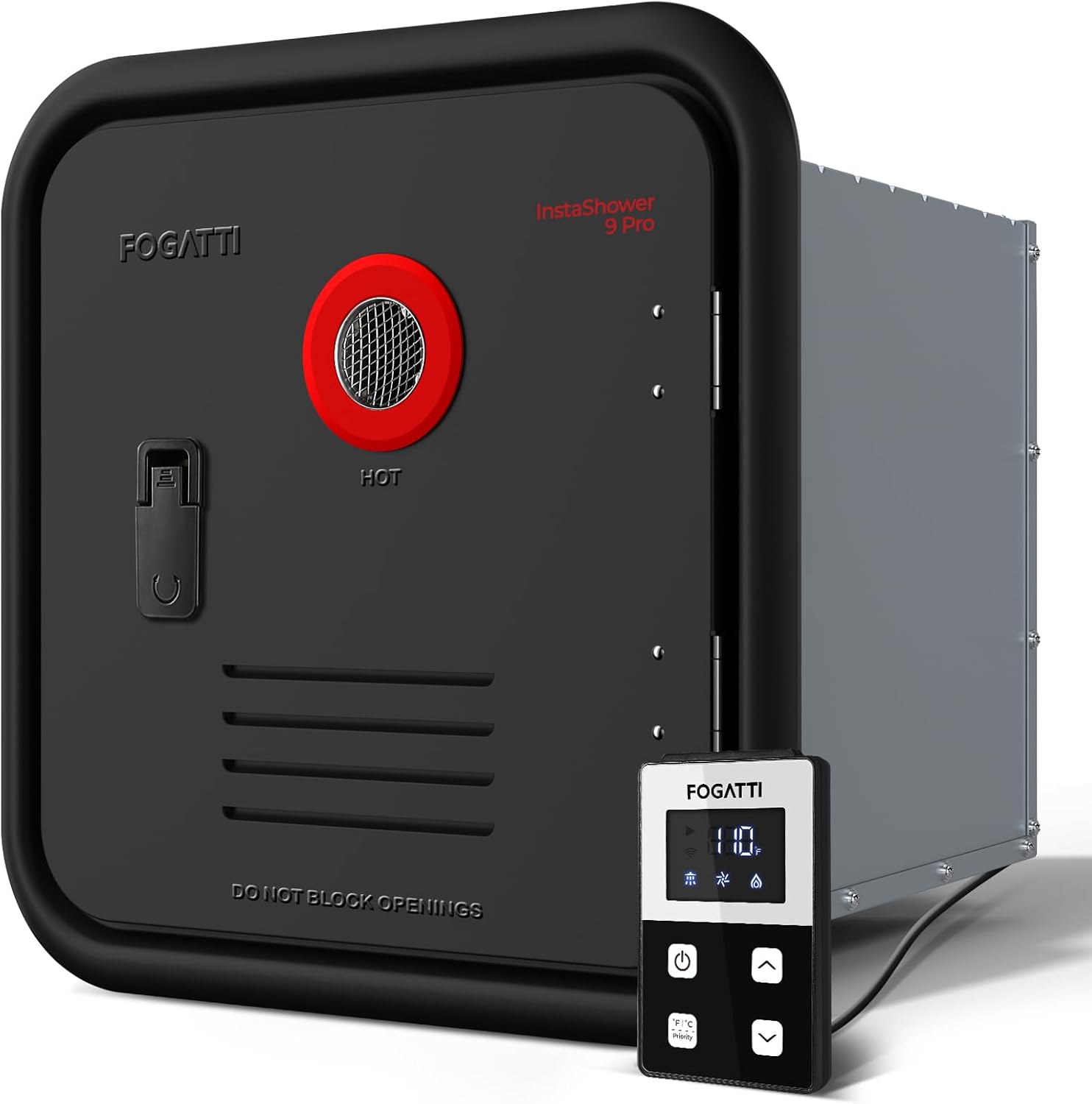
FOGATTI InstaShower 9 Pro
| Power Source | Liquid Propane |
|---|---|
| Heat Output | 66,000 BTU |
| Flow Rate | 3.6 gpm |
| Voltage | 12 volts of DC |
| Maximum Pressure | 150 psi |
The FOGATTI InstaShower 9 Pro is a high-output tankless water heater built for RV use and off-grid conditions where strong on-demand performance matters. It runs on liquid propane and produces 66,000 BTU to deliver up to 3.6 gallons per minute, letting one person shower while the sink runs without long waits. The unit includes a small mixing tank for temperature stabilization and an LED display with an intelligent wired controller for straightforward adjustments from inside the rig. Built-in protections such as anti-freeze, dry combustion cut-off, overheat protection, and a 150 PSI pressure relief valve improve reliability in varied conditions, and the upgraded NIDEC DC fan and CSA certification support safer operation at altitude. Practical limits include a 3.6 gpm flow rate that is strong for a single or light dual use but may not sustain multiple high-flow uses simultaneously, and installation requires matching the built-in mount and propane/12V connections typical of RV retrofits. For off-grid owners who need immediate, stable hot water with robust safety features, this unit focuses on dependable performance rather than minimal plumbing changes.
Best for: Buyers who prioritize steady, high-output hot water in off-grid or high-altitude RV use and want a performance-focused tankless replacement for a tank heater.
Less Ideal for: Those seeking the simplest DIY swap without matching a built-in opening or users who need very high simultaneous flow for multiple full-use zones.
- High heat output (66,000 BTU) for strong hot-water delivery under load
- On-demand tankless design eliminates long waits and reduces standby losses
- Built-in safety features including anti-freeze, dry combustion protection, overheat protection, and a 150 PSI relief valve
- Mixing tank and LED controller provide stable temperatures and convenient control
- Designed for high-altitude operation with an upgraded DC fan and CSA certification
- 3.6 gpm max flow is limited for simultaneous high-demand uses
- Requires proper propane and 12V hookups and a compatible built-in mounting opening for retrofit
Verdict: Choose the InstaShower 9 Pro when you need robust, on-demand hot water performance and reliable operation for off-grid or high-altitude RV use.
GASLAND BE158L Propane Tankless Heater

| Power Source | Liquid Propane |
|---|---|
| Flow Rate | 1.58 gpm |
| Heat Output | 41,000 BTU/hour |
| Capacity | 6 liters |
| Maximum Pressure | 110 psi |
The GASLAND BE158L is a compact propane tankless unit built for outdoor and off-grid hot water needs, producing up to 1.58 gallons per minute from a 20 lb propane supply and using battery-powered electronic ignition. It is typically used for camping, RV showers, washing animals, or outdoor cleaning where grid power is unavailable. Notable features include a bright LED temperature display for easy monitoring, CSA safety certifications, and a suite of protections such as overheat, low-flow, dry combustion, flame failure, anti-freezing, and high-pressure safeguards. Practical benefits are instant hot water without electrical hookup, low-pressure start at about 3.6 PSI, and included fittings and a regulator that simplify setup. Trade-offs include a modest flow rate that limits simultaneous fixtures and a maximum temperature rise that depends on incoming water temperature, so it is best for single-point use rather than whole-house demand. It is splash-resistant but not rated for prolonged exposure to heavy rain, so sheltered placement and winter drainage are important for longevity.
Best for: Buyers who need a reliable, portable hot-water source for outdoor, RV, or off-grid tasks and prioritize safety features and easy setup over high flow rates.
Less Ideal for: Households seeking a whole-house or multi-fixture solution or users who need high continuous flow for multiple simultaneous uses.
- Runs on standard 20 lb liquid propane for true off-grid operation
- Battery electronic ignition so no electrical hookup required
- CSA certified with multiple built-in safety protections
- Bright digital temperature display for straightforward control
- Includes regulator, hose, shower head and adapter fittings for faster setup
- Maximum flow of 1.58 GPM limits use to one shower or fixture at a time
- Not waterproof for prolonged rain exposure so it needs sheltered installation
Verdict: Choose the GASLAND BE158L when you want a compact, safety-focused propane tankless heater that delivers instant hot water off-grid for single-point outdoor use.
Cothb X Portable Shower Kit SK01

| Power Source | Battery Powered |
|---|---|
| Heat Output | 1500 watts |
| Maximum Temperature | 194 °F |
| Capacity | 5.3 gallons |
| Included Components | Immersion heater, rechargeable pump, 5.3-gallon bucket |
This kit pairs a 1500W immersion heater with an LCD temperature display and a rechargeable 6800mAh pump to deliver hot water for outdoor bathing, pet washing, and basic cleaning tasks. The heater claims to warm roughly 5 gallons to about 100°F in five minutes and offers adjustable temperatures up to 194°F, while the pump provides dual power modes and around 90 minutes of runtime per charge. The collapsible 5.3-gallon bucket and included shower head make setup simple for campsites or emergency use, and the LCD readouts for water temperature and battery level help avoid guesswork. Built-in dry-burn protection improves safety during heating but users must keep clear of the hot immersion element while it operates. Expect this system to be best for short showers or rinses rather than continuous household use, and note that performance depends on battery charge and available water volume.
Best for: Buyers who need an affordable, self-contained hot-water solution for weekend camping, pet washing, or emergency off-grid use and value simple setup and battery operation.
Less Ideal for: People seeking a full-size or continuous hot-water system for regular household showers or long-duration use should look at larger, plumbed solutions instead.
- 1500W immersion heater with LCD lets you monitor and adjust water temperature.
- Rechargeable 6800mAh pump offers up to about 90 minutes of use and shows battery level on an LCD.
- Complete kit includes collapsible 5.3-gallon bucket and shower head for quick setup.
- Dry combustion/anti-dry burn protection increases safety during heating.
- Compact, foldable bucket and lightweight components make the kit easy to carry and store.
- Heater is an immersion type that requires careful handling and supervision while operating.
- 5.3-gallon capacity limits run time and is suited to short showers or rinses rather than full household use.
Verdict: A budget-friendly, all-in-one portable hot-water kit that delivers quick warm water for short off-grid showers and cleaning tasks.
Ranein Portable Propane Water Heater RO6K

| Fuel type | 1 lb propane cylinders |
|---|---|
| Heat output | 20,000 BTU |
| Battery | 4000mAh rechargeable |
| Runtime | Up to 100 minutes |
The Ranein RO6K is a self-contained outdoor water heater kit built for camping, RVing, and other off-grid showers. It runs on 1 lb propane cylinders and uses an auto-ignition burner to heat water to a stated 70°F–120°F range while a 12V pump circulates water through the included showerhead and hose. A 4,000 mAh rechargeable battery provides up to about 100 minutes of operation and supports charging while in use, and the unit accepts 110V AC, 12V DC, and portable power-station inputs for flexible recharging. The package includes the heater, 12V pump, car adapter, gas regulator, shower bracket, showerhead, and quick-connect hoses so setup is straightforward at a campsite or on an RV. Notable practical benefits are the fast heat-up and the ability to run without shore power, plus a one-hand shower-head flow control. Important limitations are the small 1 lb propane cylinder requirement and the temperature ceiling, which mean shorter runtime and moderate maximum temperatures compared with larger, tank-style or larger-propane models.
Best for: Buyers who need a reliable, portable hot-water solution for short off-grid trips and value quick setup, flexible charging, and consistent ignition without depending on shore power.
Less Ideal for: People planning extended remote stays or heavy daily use who want long continuous runtime from large propane tanks or higher maximum temperatures.
- All-in-one kit includes heater, 12V pump, showerhead, hoses, and regulator for quick setup
- Rechargeable 4000mAh battery supports up to ~100 minutes and can charge while operating
- Multiple charging options (110V AC, 12V DC, portable power stations) for off-grid flexibility
- Auto-ignition and one-hand flow control make outdoor showers easy to start and use
- Designed for 1 lb propane cylinders only, limiting runtime compared with larger tanks
- Maximum temperature capped around 120°F, which may be insufficient for very cold conditions
Verdict: A compact, ready-to-run portable propane shower kit that reliably delivers hot water off grid with flexible charging for short trips.
CAMPLUX AY132 Portable Tankless Heater

| Power source | Battery Powered (2 D batteries) |
|---|---|
| Fuel type | Liquid Propane |
| Flow rate | 1.32 gpm |
| Heat output | 34,000 BTU |
| Water pressure range | 3–130 PSI |
The CAMPLUX AY132 is a compact, wall‑mountable portable tankless heater built for outdoor and off‑grid use. It runs on a 20 lb propane tank and two D batteries for ignition, delivering up to 1.32 gallons per minute of instant hot water while supporting low pressure starts from about 3 PSI. The unit ships with a 5 ft gas regulator, shower head and hose, and simple mounting hardware, so setup is straightforward for campsite showers, washing gear, or small cabin use. Safety is emphasized with CSA certification and multiple protections including anti‑freeze, flame failure, overheat, and low/high pressure shutoffs. Practical limits are its modest flow rate and maximum temperature around 114°F, so it is best for single showers, rinsing pets, or washing dishes rather than supplying multiple fixtures. Because it is propane powered and battery‑ignited it works well off grid but requires regular propane and occasional battery changes.
Best for: Buyers who prioritize reliable, CSA‑certified hot water away from mains power and want a ready‑to‑install solution for camping, RVs, or remote cabins backed by many user reviews.
Less Ideal for: Not a good fit for households needing higher flow or to run multiple taps simultaneously or for installations that require higher maximum outlet temperatures.
- Operates off‑grid using propane and D batteries so no mains power required
- Low pressure startup down to ~3 PSI works with gravity bags or small 12V pumps
- CSA certified with multiple built‑in safety protections
- Includes regulator, shower head, hose and mounting hardware for quick setup
- Maximum flow of 1.32 GPM limits it to solo showers and light washing tasks
- Max temperature around 114°F may be inadequate in very cold conditions
Verdict: A compact, CSA‑certified propane tankless heater that reliably delivers instant hot water off grid for solo showers and light outdoor use.
LanBlu Portable Shower Unit HT2000W

| Heater power | 2000W |
|---|---|
| Battery capacity | 6000mAh |
| Charge port | Type-C |
| Included components | Shower head, pump, Type-C cable, user manual, auto-off heater |
The LanBlu Portable Shower pairs a small pump unit with a 2000W auto-off heating element and a 6000mAh rechargeable battery to deliver warm water on the go. It is used by filling a water source, placing the heater in the water, and operating the pump via a single-button interface that shows power, temperature, and battery level on an LED display. The heater warms water up to a stated safe maximum and will automatically stop heating to avoid scalding, while the pump offers adjustable flow and four spray modes for washing, rinsing pets, or quick campsite showers. Practical benefits include a compact footprint, Type-C charging for easy recharging, and a 3-hour charge time yielding up to roughly 140 minutes of pumping per the manufacturer. Important limitations are the need to keep the heater submerged during operation to avoid dry burn and the modest battery capacity that may not support repeated long warm showers without recharge or additional water mixing for temperature control.
Best for: Buyers who prioritize straightforward, safe portable hot-water capability for camping, outdoor cleaning, or emergency use and want simple controls and a compact rechargeable unit.
Less Ideal for: People who need long continuous hot-water supply for multiple users or full-family showers without access to recharging or a larger power source should consider a higher-capacity or hardwired solution.
- Built-in 2000W auto-off heater provides rapid water warming and prevents overheating.
- LED display shows temperature, battery level, and simplifies controls to a single button.
- Type-C rechargeable battery and 6000mAh capacity offer convenient recharging and portable use.
- Multiple spray modes and adjustable flow make it usable for showering, pet washing, and rinsing gear.
- Requires the heater to remain submerged during use to avoid risk of dry burning.
- Battery capacity is limited, so multiple long hot showers may need additional charging or water mixing.
Verdict: A compact, easy-to-use rechargeable shower with a built-in auto-off heater that delivers convenient warm water for solo camping and outdoor cleanup.
Choosing the Right Off Grid Water Heater: Key Factors to Consider
Energy Source and Availability
The fuel or power you can reliably supply defines which off grid water heater type will work. Solar-electric systems, battery-backed electric heaters, propane units, and wood-fired tanks each have different input needs and efficiencies.
Assess daily hot water volume and match it to the realistic continuous or burst energy you can provide. If you rely on stored battery power, consider low-wattage or on-demand electric options. If using propane or wood, factor in fuel storage and delivery logistics. Energy source choice affects both operation cost and system design.
Efficiency and Recovery Rate
Efficiency dictates how much usable hot water you get per unit of fuel or electricity, which matters when supplies are limited. Look at standby heat loss for tank systems and the recovery rate for tanked heaters to understand how quickly the unit can replenish hot water after use.
On-demand systems eliminate most standby losses but require sufficient instantaneous energy. For battery or solar-reliant installations, pick systems with low draw per gallon of output or that can run in short bursts aligned with your energy production window.
Installation Footprint and Plumbing
Off grid installations often face space constraints and simplified plumbing. Wall-mounted or compact units free up floor area, while tank systems need room for the tank plus clearances for venting or access.
Consider whether the heater requires special venting, a dedicated combustion air source, or additional components like expansion tanks and pressure-relief plumbing. Simpler connection requirements reduce the need for professional work and make relocation or maintenance easier.
Control Options and Safety
Good controls let you adapt output to limited energy and avoid overheating or freezing. Digital thermostats, low-voltage control options, and temperature-limiting features are particularly useful for remote systems.
Safety features such as pressure-relief valves, over-temperature cutoffs, and flame failure protection for combustion units are essential. In remote settings, automatic safe-shutdown behavior reduces the chance of damage when the system is unattended.
Durability and Maintenance Needs
Off grid systems often operate intermittently and in harsher environments, so material quality and serviceability matter. Corrosion-resistant tanks, accessible anodes or heat exchangers, and simple replaceable components extend system life and reduce maintenance trips.
Plan for water quality impact, such as sediment or high mineral content, which can accelerate wear. Units designed for easier maintenance lower the total cost of ownership in remote setups.
Hot Water Demand and Sizing
Estimate your peak and daily hot water needs to choose a heater with the right capacity. Undersized systems lead to frequent cold-water interruptions while oversized systems waste energy and space.
For intermittent households, consider systems with good recovery rates or that can be paired with small buffer tanks to smooth demand spikes. Matching heater output to typical usage patterns keeps fuel and battery use predictable.
Types of Off Grid Water Heaters and Where They Fit
Several distinct technologies serve off grid hot water needs. Tank-style heaters provide buffered hot water storage and are forgiving of intermittent fuel, but they incur standby losses. On-demand or instantaneous units heat water only while needed, eliminating standing losses but requiring sufficient instantaneous energy delivery.
Combustion-based options like propane or wood-fired systems can operate independently of the electrical system, which is useful when batteries are limited. Electric options paired with solar and batteries are quiet and compact but must be sized to match available wattage. Hybrid approaches, such as small tank buffers with on-demand boosters, can balance the tradeoffs.
- Tank systems: good for steady, moderate daily demand and simpler controls
- On-demand electric: minimal standby loss, needs high instantaneous power
- Propane/combustion: independent of electrical storage, needs safe venting
- Wood-fired: very low ongoing fuel cost but higher maintenance and space needs
- Hybrid setups: combine a tank buffer with a booster for flexible performance
Sizing Your System for Peak Use and Storage
Sizing starts with estimating peak simultaneous use, such as shower plus dishwasher, and the daily total consumption. For tank systems, get a tank size that covers typical morning or evening peaks with some buffer. For on-demand systems, ensure the maximum flow rate and temperature rise match your peak fixtures.
Also plan for storage of fuels or batteries. A system that demands brief high-power draws might necessitate larger battery storage or a generator to cover peak moments. Conversely, a larger tank can smooth high-demand moments at lower power input.
- Calculate typical flow rates for showers and appliances
- Match on-demand kW rating to required temperature rise at expected flow
- For tanks, size to cover peak event plus 20 to 30 percent buffer
Installation Considerations for Remote Sites
Installation in remote or off grid locations often requires attention to venting, frost protection, and ease of service. Combustion units need proper venting clearances and a reliable combustion air source. Electric units may need low-voltage wiring that is compatible with battery inverters or solar charge setups.
Plan for freeze protection if the heater or associated piping will be exposed to cold temperatures. Routing for fuel lines, access for maintenance, and the ability to isolate the unit for winterization are all important practical considerations.
- Ensure venting and combustion air for combustion heaters
- Provide freeze protection or ability to drain components in winter
- Place units where routine service is accessible without heavy equipment
Integrating With Solar, Battery, and Backup Power
Electric off grid heaters must be evaluated for compatibility with solar and battery systems. Consider whether the heater can accept variable voltage input or if it requires an inverter sized to handle peak draw. Some systems allow phased or timed heating tied to solar production windows to reduce battery stress.
Backup options such as small generators or secondary fuel supplies can allow the use of higher-power on-demand units while keeping routine operation on lower-capacity energy sources. Control logic that prioritizes renewable input can maximize off grid resource use.
- Time heating to coincide with peak solar production when possible
- Use inverters sized for startup and continuous draw of electric heaters
- Consider backup fuel or generator for occasional high-demand events
Maintenance Tips for Longevity
Regular maintenance extends the life of off grid water heaters. Flush tanks or strainers to remove sediment, inspect anode rods if present, and check seals and temperature/pressure relief valves. For combustion systems, clean burners and inspect venting paths periodically.
Keep a simple maintenance log and a small set of spare parts on hand. In remote locations, the ability to perform basic repairs without specialized tools can prevent long downtime and reduce the need for service visits.
- Flush tanks annually or more often with hard water
- Inspect and replace anodes as needed for corrosion protection
- Keep spare filters, gaskets, and a basic tool kit on site
How We Chose the Best Off Grid Water Heater
We focused on the features that matter most to people building or maintaining off grid hot water systems. Our selection filters prioritized energy-source flexibility, because many off grid sites rely on batteries, solar, propane, or wood. We also weighted heating efficiency and standby losses so units that stretch limited fuel or battery capacity scored higher. Installation footprint and connection requirements were important since off grid spaces often need compact or wall-mounted equipment and straightforward plumbing. Durability and materials were included to favor units that tolerate intermittent use and variable water quality. Finally, we considered safety features and user controls that reduce risk in remote settings. We excluded models that require continuous grid power or that depend on specialized infrastructure unavailable to small off grid systems. We also omitted units with consistently poor durability reports or unclear safety mechanisms. The practical criteria we applied were then translated into measurable scoring areas that reflect energy use, installation complexity, heating performance, reliability, and user safety.
Our full evaluation process is outlined in our review methodology.
FAQ
Can I run an electric on-demand heater from a solar-battery system?
Often you can, but it depends on available inverter capacity and battery size. On-demand electric units require significant instantaneous power, so either an inverter that can handle the surge or a heater sized to your sustained inverter output is necessary.
Is a tank or tankless system better for off grid use?
It depends on your energy profile. Tanks are simpler and provide buffered hot water with lower instantaneous power needs. Tankless units save standby energy but need higher peak power. Choose based on whether you have steady energy or prefer occasional high-power capability.
How important is venting for propane or wood water heaters?
Venting is essential for safe combustion and to prevent carbon monoxide buildup. Proper clearances, sealing, and routing to the exterior are required, and periodic inspection is important to maintain safe operation.
What maintenance should I plan for in remote installations?
Plan regular flushing to remove sediment, inspection of safety valves and anodes, and cleaning of combustion parts for fuel-burning units. Keep spare consumables and follow a simple maintenance schedule to avoid extended downtime.
Can I combine a small tank with an on-demand unit?
Yes. A small buffer tank smooths flow and reduces the instantaneous power needed from an on-demand unit, which can make the overall system easier to size for limited energy sources.
Final Verdict
Choosing the right off grid water heater means balancing available energy sources, hot water demand, and the practicalities of installation and upkeep. Prioritize units that match your primary energy type and that offer the efficiency and recovery characteristics you need for daily routines. Consider durability, safety features, and maintenance accessibility to reduce long-term hassle. With those tradeoffs in mind, you can select a system that provides reliable hot water while fitting your off grid constraints.