
Note: This article contains affiliate links. If you click on these links and make a purchase, we may earn a small commission at no extra cost to you. This helps support our research and content. Read our full affiliate disclosure here.
If you need parts with multiple colors, soluble supports, or distinct material properties in a single build, a multi-extruder 3D printer can make those workflows practical. The right multi-extruder system reduces print failures, speeds multi-material jobs, and widens the range of viable applications from functional prototypes to finished parts. This guide shortlists the top options in the multi-extruder 3D printer category and evaluates them on the technical traits that matter most to builders and small-scale manufacturers. Read on to compare shortlisted printers by print quality, filament handling, and workflow readiness before diving into product details.
Top Picks at a Glance
| Best Overall The best all-around choice for most situations | FLASHFORGE Creator 5 |  |
| Best Quality Built to a higher standard if you want something more solid | Original Prusa XL 5-Toolhead |  |
| Best Value The sweet spot between price and what you get | Creality K2 Combo |  |
| Best Budget The cheapest option that still gets the job done reliably | Anycubic Kobra X 4-Color 3D Printer |  |
| Top Rated A top-rated pick with lots of positive feedback | QIDI Max4 Combo |  |
| Most Popular A crowd favorite that many people choose with confidence | FLASHFORGE AD5X | 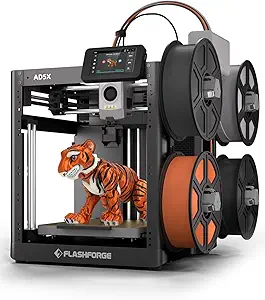 |
| Best Seller A high-volume bestseller chosen again and again | Bambu Lab P2S Combo 3D Printer |  |
FLASHFORGE Creator 5

| Extruder Quantity | 4 Independent Toolhead |
|---|---|
| Max Extruder Temp | Max.320℃ Direct Drive |
| Travel Speed | 600mm/s and 30,000mm/s² |
| Build Volume | 256 x 256 x 256 mm |
| Multi-Color Printing | Yes |
The FLASHFORGE Creator 5 is a CoreXY FDM machine built around four independent toolheads that enable true multi-color and multi-material prints without the large purge towers single-nozzle systems require. It is typically used for production-style multi-color prototypes, detailed models with soluble or breakaway supports, and rapid iterations where color or material changes are frequent. Notable features include 7-second FlashSwap tool changes with intelligent preheating, a near-zero purge waste workflow, compatibility with PLA, PETG, TPU and carbon-fiber blends, and a fully automatic calibration system coupled with vibration compensation for stable high-speed prints up to 600 mm/s. In practice the Creator 5 cuts filament waste and saves time on multi-tool jobs, and dedicating one toolhead to support material makes support removal cleaner and faster. The trade-offs are complexity and likely higher setup and maintenance demands compared with single-extruder machines, plus a larger learning curve for multi-material slicing and toolhead management, but for users who need reliable multi-color output the hardware and workflow deliver clear real-world gains.
Best for: Buyers who want production-capable multi-color or mixed-material prints and are willing to manage a more advanced machine to save time and filament on complex jobs.
Less Ideal for: Casual hobbyists who only print simple single-color parts or users who prefer minimal maintenance and a plug-and-play single-extruder experience.
- Four independent toolheads for simultaneous multi-color and multi-material printing
- FlashSwap preheating enables ~7 second tool changes and reduces downtime
- Near-zero purge waste lowers filament consumption compared with single-nozzle multi-color methods
- Auto calibration and vibration compensation support stable high-speed CoreXY printing
- Higher mechanical and firmware complexity increases maintenance and setup effort
- Steeper learning curve for slicing multi-tool jobs and managing multiple filaments
Verdict: Choose the Creator 5 if you need fast, low-waste multi-color and multi-material printing with production-oriented hardware.
Original Prusa XL 5-Toolhead

| Build volume | 14.17 × 14.17 × 14.17 inches |
|---|---|
| Toolheads | Up to 5 |
| Control platform | 32-bit with Input Shaper and Pressure Advance |
| Included filament | 1 kg Prusament PLA |
The Original Prusa XL 5-Toolhead is a high-performance CoreXY system built for demanding prototyping and multi-material work, with a 14.17 × 14.17 × 14.17 inch build volume and a five-tool multi-material configuration. It uses a 32-bit embedded platform with native Input Shaper and Pressure Advance to enable faster, more precise motion, and the next-generation Nextruder with a loadcell to help guarantee consistent first-layer adhesion across the full print surface. Practical features like a segmented heated bed reduce warping and improve energy efficiency on larger parts, and the machine ships ready to print with a Satin sheet and a 1 kg spool of PLA. Expect straightforward on-site assembly of a few fragile components after transport, and close integration with Prusa software and Printables.com for workflow convenience. This rig is geared toward professional users who need reliable multi-tool switching and material flexibility, though its size, complexity, and industrial focus mean it is heavier and more involved to set up than simpler desktop printers.
Best for: Engineers, prototypers, and performance-focused makers who need reliable multi-material printing and high throughput for professional prototypes and visual models.
Less Ideal for: Hobbyists seeking a compact, plug-and-play desktop printer or buyers who need a lightweight, transportable machine for occasional use.
- Five-tool multi-material system for simultaneous multi-color or multi-material jobs
- 32-bit control with Input Shaper and Pressure Advance for faster, accurate prints
- Nextruder with loadcell improves first-layer consistency across the bed
- Segmented heated bed reduces warping and improves energy efficiency
- Includes Satin print sheet and 1 kg spool to get started immediately
- Large, heavy industrial machine requires space and more involved setup
- Some fragile parts are shipped separately and need careful assembly
Verdict: Choose the Prusa XL 5-Toolhead when you need a robust, high-performance multi-extruder platform for professional multi-material prototyping.
Creality K2 Combo

| Build Volume | 260×260×260 mm |
|---|---|
| Max Printing Speed | 600mm/s,20000mm/s² |
| Max Nozzle Temperature | ≤300℃ |
| Max Heatbed Temperature | 100℃ |
| Storage | 8GB EMMC |
The Creality K2 Combo is a mostly ready-to-run desktop FDM printer aimed at multicolor and high-speed hobby or light‑production use. It ships pre-assembled with one CFS unit (it can chain up to four CFS units for more colors) and a 260×260×260 mm build volume that handles most common prints. The machine pairs next‑gen direct‑drive extrusion and step‑servo motors for faster acceleration and tighter extrusion control, and a targeted smart auto leveling routine reduces setup time by probing only the print area. An onboard AI camera helps monitor prints for failures, and a low‑noise mode keeps operation quieter than older open‑frame machines. Practical benefits include quick out‑of‑the‑box printing, multicolor capability without manual filament swaps, and sturdy mechanicals for consistent surface quality at higher speeds. Limitations are that the multicolor setup requires additional CFS units to reach maximum color counts and advanced users may still need post‑processing for perfect color transitions; also large or very high‑temperature materials may be constrained by the stated nozzle and bed limits of the platform.
Best for: Buyers who want a fast, mostly turnkey multicolor-capable desktop printer that reduces setup time and emphasizes reliable, quieter high‑speed prints.
Less Ideal for: Users needing very large-format printing or who require extreme high‑temperature printing for specialty engineering materials should consider other platforms.
- Pre-assembled for fast setup and plug-and-play printing
- Supports multicolor printing via CFS with up to four chainable units
- Smart auto leveling that probes only the target print area for faster, precise bed leveling
- Step‑servo motors and next‑gen direct drive improve speed, extrusion consistency, and reduce noise
- AI camera provides real-time monitoring to catch print failures and idling
- Full multicolor capability requires purchasing additional CFS units
- 260×260×260 mm build volume may be small for very large projects
- Maximum nozzle and heatbed temperatures limit some high‑temperature engineering filaments
Verdict: If you want a practical, mostly plug‑and‑play desktop printer that delivers multicolor capability and faster, quieter prints, the Creality K2 Combo is a strong choice.
Anycubic Kobra X 4-Color 3D Printer

| Build volume | 260 x 260 x 260 mm |
|---|---|
| Max nozzle temperature | 300℃ |
| Native extruders | 4 ACE 2 Pro |
| Connectivity | 2.4G/5G Wi‑Fi and LAN |
The Anycubic Kobra X is a multicolor FDM printer designed to simplify multi-extruder printing for hobbyists, families, and classrooms. It ships with four native ACE 2 Pro extruders and hardware that can expand the palette up to 19 colors, which reduces purging and material waste compared with naive multi-extruder setups. Key user-facing features include LeviQ 3.0 49-point auto bed leveling for consistent first layers, a hardened steel nozzle and vibration compensation for finer layer quality at higher speeds, and an AI camera with spaghetti and foreign-object detection for live monitoring and problem detection. Anycubic emphasizes speed, claiming up to 600 mm/s travel for very fast prints and shorter print times on small models. The printer supports a wide range of filaments including PLA, PETG, TPU, PVA, and ASA and offers dual-band Wi-Fi and LAN for remote control and app monitoring. Practical limitations are that true multicolor setups still need careful tuning for color transitions and material changes, very high-speed modes trade surface finish for velocity, and advanced users may prefer more modular pro-grade multi-extruder systems for heavy production use.
Best for: Buyers who want a budget-conscious multicolor 3D printer that reduces filament purge and simplifies getting colorful prints at home, school, or a makerspace.
Less Ideal for: Those who need an industrial production machine or a highly modular professional multi-extruder rig for continuous, high-volume manufacturing should look elsewhere.
- Native multi-extruder hardware (4 ACE 2 Pro units) for multicolor prints without complex rewiring
- LeviQ 3.0 49-point auto bed leveling yields reliable first layers out of the box
- Supports soft and hard materials including PLA, PETG, TPU, PVA, and ASA for versatile projects
- AI camera with spaghetti and foreign-object detection enables remote monitoring and basic error recovery
- Dual-band Wi-Fi and LAN let you control and monitor prints from the Anycubic app
- Very high advertised travel speeds may compromise surface finish and require tuning
- Multicolor printing still requires calibration to avoid color bleeding and blending artifacts
Verdict: If you want an affordable, ready-for-multicolor desktop printer that cuts purge waste and makes multicolor projects approachable, the Kobra X is a strong choice.
QIDI Max4 Combo

| Build volume | 390×390×340 mm |
|---|---|
| Max nozzle temperature | 370°C |
| Chamber temperature | ≤65℃ |
| Max tool head speed | ≤800 mm/s |
The QIDI Max4 Combo is a production-focused, enclosed 3D printer aimed at printing large engineering parts and multi-material projects. It offers a 390×390×340 mm build area and a 370°C capable hotend paired with an actively heated chamber up to 65°C, which together make printing PC, Nylon, and carbon-fiber composites far more reliable than open-frame hobby machines. The machine uses closed-loop XY motors, dual Z lead screws with anti-backlash nuts, and a uniform silicone heated bed to reduce layer shifts and warping on long prints. High-speed mechanics claim up to 800 mm/s travel and aggressive acceleration, but practical extrusion rates depend on material and hotend flow; QIDI plans a high-flow nozzle to extend throughput. The built-in AI camera and a large touch screen help monitor prints and pause on detected failures, and network options include Wi-Fi, Ethernet, and cloud control for remote jobs. It does not include the optional Polar Cooler for multi-material setups, and achieving the highest speeds and reliable exotic-material prints requires tuning and suitable nozzles, but as a platform for reliable, large-format engineering prints it is well equipped.
Best for: Engineers, small production shops, and experienced makers who need a robust, factory-quality platform for large engineering prints and frequent use where material variety and print stability matter most.
Less Ideal for: Casual hobbyists or first-time buyers who prefer plug-and-play consumer printers with minimal setup and tuning, or anyone who only needs small-format hobby prints.
- Large 390×390×340 mm build volume for single-piece industrial-size parts
- 370°C hotend and 65°C heated chamber support engineering and abrasive materials
- Closed-loop XY motors and dual Z lead screws improve dimensional accuracy and stability
- AI camera and networked controls (Wi‑Fi/ethernet/cloud) enable remote monitoring and failure detection
- Polar Cooler for advanced multi-material printing is sold separately
- Top claimed speeds (800 mm/s) depend on material, nozzle, and tuning to realize in practice
Verdict: Choose the QIDI Max4 Combo when you need a stable, large-format printer built to handle engineering materials and continuous production work.
FLASHFORGE AD5X

| Build Volume | 220x220x220mm |
|---|---|
| Extruder Max Temp | 300°C |
| Structure | Open, Core XY |
| Travel Speed | 600mm/s |
| Filament Types | PLA/ABS/PETG/TPU/CF |
The FLASHFORGE AD5X is a Core XY desktop FDM printer aimed at users who need faster multi-color and multi-part throughput. It supports up to four-color printing through an intelligent filament system, a 300°C direct-drive extruder, and selectable nozzle sizes from 0.25mm to 0.8mm, which lets you trade detail for speed depending on the job. The machine uses one-click auto leveling and automatic filament feeding/retraction to reduce setup time, and resume-printing handles power interruptions. Its advertised travel speed and acceleration (600mm/s and 20,000mm/s²) and vibration compensation target rapid prototyping and small-batch production rather than ultra-fine resin-level detail. Practical benefits include flexible material support (PLA, ABS, PETG, TPU, carbon-fiber blends), quick nozzle changes, and remote monitoring via the Flash Maker app. Expect a learning curve tuning high-speed settings and ensuring multi-color prints stay color-accurate and aligned; the open-frame design also means dust and drafts can affect sensitive prints. For buyers focused on speed and multi-color capability, it delivers a strong balance of features, but fine-detail hobbyists or users wanting a fully enclosed, dust-controlled environment may prefer different models.
Best for: Buyers who prioritize faster multi-color prototyping and reliable, everyday multi-material printing and value proven features and user-focused automation.
Less Ideal for: Users who need the absolute highest surface-finish detail or a fully enclosed, climate-controlled build chamber for sensitive engineering materials.
- Supports up to four-color printing for multi-material or multi-color parts
- Core XY structure with high travel speed and acceleration for faster prints
- 300°C direct-drive extruder broadens filament compatibility
- One-click auto leveling and automatic filament feed simplify setup
- Multiple nozzle sizes (0.25–0.8mm) allow tuning between detail and speed
- Open-frame design may expose prints to dust and drafts
- High-speed settings require tuning to maintain dimensional accuracy
Verdict: Choose the AD5X if you want a fast Core XY printer that handles multi-color and a wide range of filaments while minimizing setup time with automated features.
Bambu Lab P2S Combo 3D Printer

| Print speed | Up to 600 mm/s |
|---|---|
| Filament drying | AMS 2 Pro up to 65 °C |
| Chamber temperature | Up to 50 °C |
| Extruder | PMSM servo extruder |
The Bambu Lab P2S Combo combines a high-speed CoreXY printer with the AMS 2 Pro automated multi-spool system to deliver fast, multi-color FDM prints with an emphasis on a smooth workflow. The P2S core prints at very high travel speeds while the PMSM servo extruder and Active Flowrate Compensation help keep layers consistent and corners sharp, and quick-swap nozzles plus automatic calibration get the machine ready in about 15 minutes. The AMS 2 Pro adds filament drying (up to 65 °C) and automated filament changes for multi-color prints and better reliability with hygroscopic materials. Adaptive Airflow and a 50 °C capable chamber make it easier to print engineering filaments, and the carbon filter helps control fumes. For risk-averse buyers the combo's AI error detection and automated systems reduce trial-and-error, but the high speeds and sophisticated subsystems mean a steeper initial learning curve and greater complexity than basic single-extruder machines. This setup is best if you want fast, reliable multi-material prints without building a custom toolchain, and you are prepared to follow recommended maintenance and settings for consistent results.
Best for: Someone who wants dependable multi-color and multi-material prints with automated features that reduce failure risk and who prefers a polished, integrated ecosystem over DIY setups.
Less Ideal for: Hobbyists who want the simplest, lowest-maintenance single-extruder printer or buyers unwilling to manage a more complex multi-component system.
- Very high print speeds enabled by CoreXY mechanics and optimized extruder
- AMS 2 Pro supports automated multi-color/multi-material printing with filament drying
- Automated calibration, quick-swap nozzles, and AI error detection reduce setup failures
- Adaptive Airflow and heated chamber support printing tougher engineering filaments
- Integrated ecosystem (Bambu Studio, MakerWorld) simplifies model sourcing and workflow
- Higher system complexity increases setup and maintenance compared with basic single-extruder printers
- Combo requires understanding multi-spool workflow to avoid filament management issues
Verdict: Buy this combo if you want a turnkey, high-speed multi-extruder solution that minimizes print failures and handles multi-color and engineering filaments reliably.
Choosing the Right Multi-Extruder 3D Printer: Key Factors to Consider
Nozzle and Hotend Configuration
The hotend layout and nozzle arrangement determine how cleanly multiple filaments are deposited. Dedicated hotends for each filament reduce cross-contamination but add mechanical complexity and thermal load. When hotends share a single melt zone, you must rely on precise retraction and wipe routines to prevent color bleed.
Consider whether the printer uses independent dual extruders, a multi-nozzle carriage, or a mixing hotend. Each approach has tradeoffs for maintenance frequency, part cleanliness, and achievable layer bonding when combining dissimilar materials.
Filament Path Reliability
Smooth, guided filament paths with proper strain relief reduce jams and filament slipping, which are more likely when multiple feedstocks are active. Bowden setups can work with multiple filaments but demand carefully tuned retraction and often stiffer filament types; direct-drive feeders typically offer better control for flexible or specialty materials.
Look for robust feed mechanisms, accessible filament tension adjustments, and clear routing that minimizes friction and sharp bends. Reliable filament sensors and easy spool changes also cut downtime in multi-material jobs.
Retraction and Oozing Management
Oozing becomes a significant issue with several active nozzles. Effective retraction strategies, parking and wipe routines, and physical wipers or shields help maintain clean transitions between filaments. Software-level features in slicers that optimize tool changes are equally important to reduce stringing and blobs.
Examine how the machine and its recommended slicer handle tool changes, purge towers, and nozzle parking. Better systems minimize material waste and required post-processing while improving first-time-right success rates for complex multi-color builds.
Calibration Tools and Workflow
Multi-extruder machines require more calibration steps than single-extruder printers. Accurate nozzle-offset calibration, automated bed leveling, and straightforward filament mapping streamline setup and daily use. Without good tools, users spend excessive time aligning nozzles, tuning temperature offsets, and troubleshooting layer registration.
Prefer printers that include guided calibration routines, clear documentation for multi-extruder setups, and slicer profiles that make tool-assignment and purge strategies simple. Those features shorten the learning curve and reduce failed prints when switching projects.
Mechanical Rigidity and Motion Control
Precise multi-material prints demand a motion system that minimizes vibration and maintains accurate layer registration during tool changes. Stiff frames, rigid gantries, and quality linear motion components help preserve dimensional accuracy across each extruder swap. Slow or imprecise tool-change movements can introduce layer shifts and misalignment between colors or materials.
Assess the build of the motion system, stepper driver quality, and whether the firmware supports advanced motion planning for tool changes. Strong mechanical design reduces compensatory tuning and improves repeatability for longer multi-extruder prints.
Thermal Management and Enclosure
Different materials used simultaneously may have distinct thermal requirements. A stable build chamber temperature and reliable hotend cooling are vital to prevent warping, delamination, or uneven layer bonding when combining filaments with different glass transition temperatures. Enclosures help with ABS-like materials and improve inter-layer adhesion on larger multi-material assemblies.
Consider whether the printer offers an enclosure or supports aftermarket solutions, how well it controls part cooling fans during tool changes, and whether thermal sensors and power delivery are sized for multiple active hotends.
Multi-Extruder Architectures Explained
Multi-extruder printers achieve multi-material prints through a few common architectures: independent tool heads, multiple nozzles on a single carriage, or mixing hotends. Independent tool heads allow each extruder to move separately and can eliminate nozzle collisions, but they add weight and complexity. Multiple nozzles on one carriage are simpler mechanically but require precise nozzle height alignment.
Understanding these approaches helps you evaluate tradeoffs between maintenance, print speed, and part cleanliness. Consider how the chosen architecture affects tool-change time, ease of servicing, and the types of materials you intend to combine.
- Independent tool heads: better for complex multi-color work and less cross-contamination risk
- Single-carriage multi-nozzle: simpler but requires tight calibration
- Mixing hotends: good for blending materials but limited for discrete color changes
Slicer Settings and Toolchange Strategies
Slicer configuration has an outsize impact on multi-extruder success. Toolchange routines, purge towers or shields, and retraction tuning must be balanced to minimize waste and avoid defects. Different slicers offer varying levels of automation for toolchange timing and purge volumes.
Plan your slicer strategy around the parts you print. For multi-color decorative pieces, small purge towers might be acceptable. For functional multi-material parts, targeted prime blobs or wipe sequences that preserve tolerances are preferable.
- Use minimal necessary purge volume to reduce waste
- Tune retraction for each filament type independently
- Test and save profiles for common material pairings
Material Pairing and Adhesion Considerations
Not all filament combinations bond well. Pairing dissimilar materials can cause layer separation or incompatible thermal expansion. When blending rigid and flexible materials or combining soluble supports with high-temperature filaments, prioritize compatibility and adhesion strategies.
Plan part geometry and toolpath so that weak interfaces are reinforced, and use appropriate print temperatures, surface preparation, and cooling settings to encourage strong inter-layer bonds.
- Prefer proven material pairings for critical assemblies
- Use soluble support materials for complex overhangs
- Adjust cooling and print speed per material during tool changes
Maintenance and Upkeep for Multi-Extruder Systems
With more moving parts and hotends, upkeep becomes more important. Regular nozzle cleaning, prompt replacement of worn PTFE liners or drive gears, and periodic realignment reduce downtime and improve print reliability. Keep spare nozzles and essential tools on hand to minimize interruptions during multi-material jobs.
Document your maintenance intervals for each extruder and track filament types used to anticipate when more frequent service is needed. A scheduled checklist prevents small issues from turning into failed long prints.
- Inspect nozzles and heatblocks regularly
- Clean filament paths and extruder gears often
- Log calibration changes and filament-specific settings
Workflow Tips for Faster Multi-Material Prints
Batch similar jobs, reuse calibrated profiles, and keep common filament combinations loaded to reduce setup time. Pre-slicing parts with consistent purge and toolchange settings saves tuning between prints. For production-like workflows, automate spool mounting and label feeds to avoid mixups.
Small process improvements such as standardized purge towers, dedicated support materials, and print-farm style part staging can dramatically increase throughput while reducing scrap on multi-extruder printers.
- Maintain labeled spools and repeatable filament paths
- Use consistent slicing templates for repeatability
- Stage multiple prints to reduce machine idle time
How We Chose the Best Multi-Extruder 3D Printer
We focused on features and real-world behaviors that determine whether a multi-extruder 3D printer will reliably deliver multi-material prints. Key evaluation criteria included nozzle and hotend configuration, filament-path reliability, and how well the machine manages oozing and cross-contamination when multiple filaments are active. We also weighed motion-system rigidity and extrusion consistency because those directly affect dimensional accuracy on multi-color and multi-material parts. Usability factors such as calibration tools, slicer integration, and maintenance complexity were scored, since multi-extruder systems demand more setup and upkeep. Thermal management and enclosure options were considered for heat-sensitive materials and consistent layer adhesion. We excluded single-extruder machines and experimental prototype rigs lacking documented multi-filament reliability. The resulting shortlist prioritizes machines that blend dependable multi-filament handling with practical tooling for everyday multi-material printing.
Our full evaluation process is outlined in our review methodology.
FAQ
Do multi-extruder 3D printers require special filament types?
Not necessarily. Many common filaments like PLA and PETG work fine, but you may need stiffer filament for Bowden paths or better-controlled flexible filaments for direct-drive setups. Choose materials that match your adhesion and thermal requirements when used together.
How much extra maintenance does a multi-extruder system need?
Typically more than a single-extruder machine. Expect more frequent nozzle checks, occasional re-calibration of nozzle offsets, and periodic maintenance on additional feeders. A simple maintenance schedule cuts the extra overhead significantly.
Can I mix a soluble support material with a structural filament?
Yes. Mixing soluble supports with standard structural filaments is a common use case. Ensure the slicer handles support assignment correctly and that temperatures and adhesion settings are tuned for both materials to prevent delamination.
Will multi-extruder printing slow down my print times?
Tool changes and additional purge steps can increase print time, especially when using large purge towers or extensive wipe routines. Optimized toolchange strategies and minimal purge volumes help keep time penalties manageable.
Is calibration harder with more than one extruder?
Calibration complexity increases because you must align nozzle heights, XY offsets, and temperature profiles across extruders. Printers with guided multi-extruder calibration routines reduce the burden considerably.
Final Verdict
When choosing a multi-extruder 3D printer, prioritize reliable filament handling and the tool-change behavior that best matches your intended projects. Balance the mechanical and thermal design against ease of calibration and maintenance, since tradeoffs between complexity and part cleanliness are inevitable. Focus on machines that offer clear setup tools, robust filament paths, and slicer support for multi-material workflows to minimize downtime and maximize first-print success. With those priorities in mind, you can confidently pick a multi-extruder system that matches your production pace and material needs.