
Note: This article contains affiliate links. If you click on these links and make a purchase, we may earn a small commission at no extra cost to you. This helps support our research and content. Read our full affiliate disclosure here.
If you want a 3D printer that the whole household can use without constant troubleshooting, pick one designed for family life. Family-focused printers prioritize safety, simple setup, and easy maintenance so parents and kids can move from idea to finished object quickly and with minimal risk. This guide highlights a curated shortlist of the top 3D printers for families, and explains why each made the cut. We evaluated models for features that matter to everyday home users: safety and enclosure, print reliability, user interface, and maintenance effort. Read on to find a family-friendly printer that fits your space and skill level.
Top Picks at a Glance
| Best Overall The best all-around choice for most situations | Bambu Lab P1S 3D Printer |  |
| Best Quality Built to a higher standard if you want something more solid | QIDI Max4 Combo |  |
| Best Value The sweet spot between price and what you get | ELEGOO Neptune 3 Pro |  |
| Best Budget The cheapest option that still gets the job done reliably | Tangxi Mini FDM 3D Printer |  |
| Top Rated A top-rated pick with lots of positive feedback | Creality Ender 3 V3 SE |  |
| Most Popular A crowd favorite that many people choose with confidence | Creality K1C 3D Printer |  |
| Best Seller A high-volume bestseller chosen again and again | FLASHFORGE Adventurer 5M |  |
Bambu Lab P1S 3D Printer
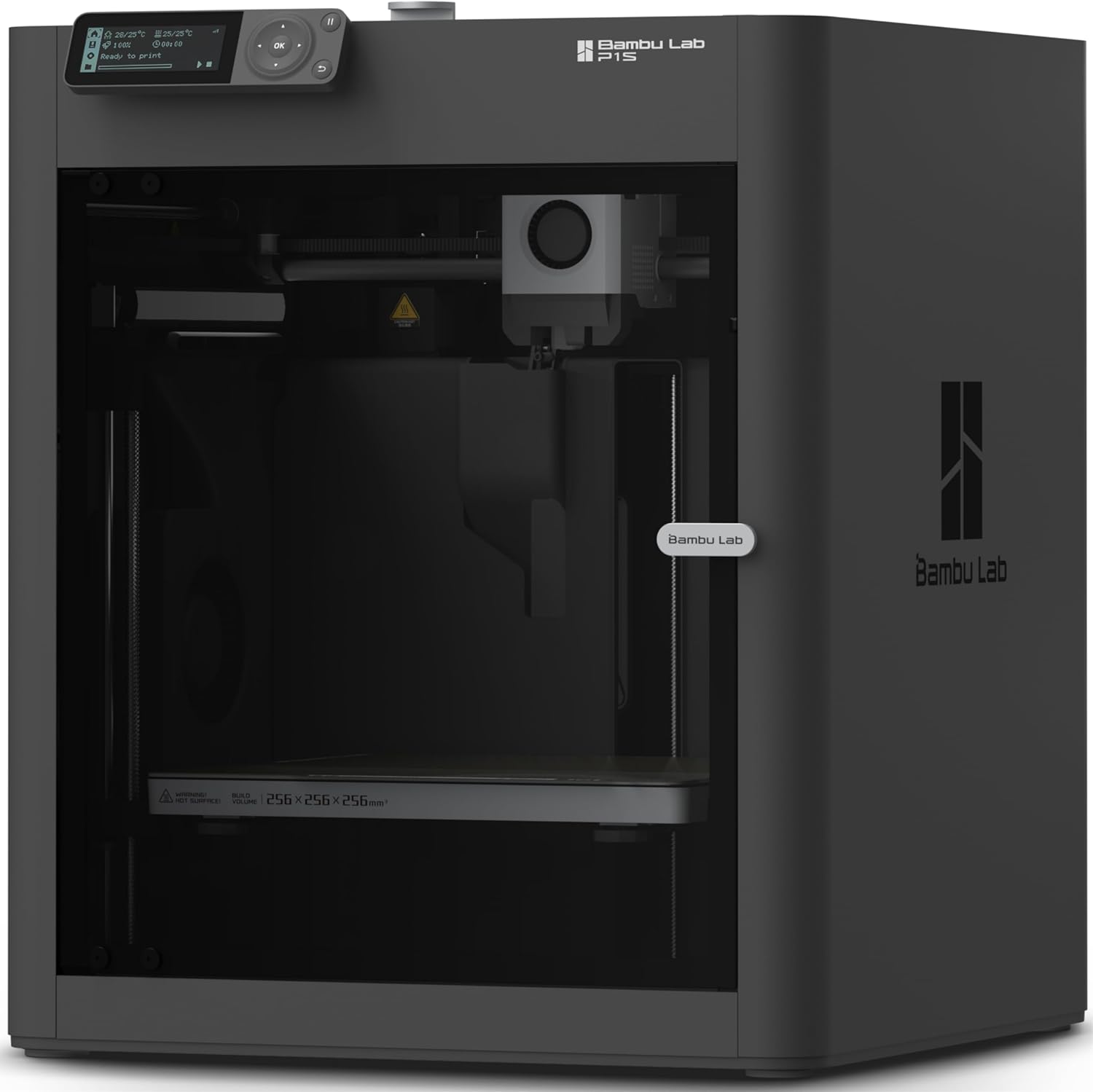
| Build Volume | 256×256×256 mm³ |
|---|---|
| Supported Filaments | PLA, PETG, TPU, PVA, PET, ABS, ASA |
| Max Speed | 500 mm/s |
| Max Acceleration | 20 m/s² |
The Bambu Lab P1S is a compact, enclosed CoreXY FDM printer aimed at making high-speed, reliable printing accessible to hobbyists and families. It ships ready to use and pairs with Bambu Lab's MakerWorld model library for quick project starts, while features like automatic bed leveling and a direct-drive extruder broaden filament compatibility and reduce setup headaches. The enclosed frame helps with temperature stability for materials such as ABS and ASA and the integrated camera supports time-lapse capture of prints. Performance specs claim very high travel speeds and acceleration, so prints can complete much faster than on typical hobby machines, though peak speeds depend on chosen settings and material. The printer supports a wide range of common filaments including PLA, PETG and TPU, but reinforced fiber filaments are not recommended. Setup is straightforward and the user experience focuses on minimizing fiddly calibration, which is a plus for family use, but advanced users wanting open-frame modability or explicit multi-material hardware included will need optional accessories for multi-color prints.
Best for: Buyers who want a family-friendly printer that balances speed, ease of use, and material versatility so projects finish quickly with minimal tinkering.
Less Ideal for: Users who need out-of-the-box multi-material or reinforced-fiber printing or those who prefer a highly moddable open-frame machine.
- Enclosed CoreXY design improves thermal stability and print quality with advanced filaments
- Automatic bed leveling simplifies setup and increases first-print success for beginners
- Direct-drive extruder expands usable filament types including TPU and PETG
- Fast travel speeds and high acceleration shorten print times compared with typical hobby printers
- Integrated camera for time-lapse and print monitoring
- Multi-color or multi-material printing requires connecting Bambu Lab AMS accessory
- Not recommended for carbon or glass fiber reinforced filaments
Verdict: A fast, enclosed, beginner-friendly CoreXY printer that delivers reliable family projects with minimal setup and broad filament support.
QIDI Max4 Combo

| Build volume | 390×390×340 mm |
|---|---|
| Max hotend temperature | 370°C |
| Chamber temperature | ≤65℃ |
| Max tool head speed | ≤800 mm/s |
The QIDI Max4 Combo is a suitcase-style, large-build 3D printer aimed at demanding projects that need engineering materials or big parts. It offers a 390×390×340 mm build volume, a 370°C-capable hotend and an actively heated chamber up to 65°C, which together let you print PC, Nylon, carbon-fiber composites and other high-temp materials with much reduced warping. The machine uses closed-loop X/Y motors, dual Z lead screws and an anti-backlash nut for stable, precise layers and can push tool-head speeds up to 800 mm/s while the full-surface silicone heated bed helps first-layer adhesion. Practical touches include a 5-inch touchscreen, onboard AI camera that detects and pauses failed prints, and multiple network options (Wi‑Fi, Ethernet, cloud and USB). It is built more like a light industrial machine than an entry-level hobby printer, so setup, tuning and consumable costs for high-temp filaments are higher, and the optional Polar Cooler for improved airflow is sold separately. For families that need professional-capable prints or large prototypes, it brings performance and material flexibility in one package.
Best for: Families that value performance and want a single machine capable of large-format prints and engineering-grade materials for serious hobby projects, school STEAM work, or small-scale prototyping.
Less Ideal for: Households seeking a plug-and-play, compact printer for simple PLA toys and casual use should consider smaller, more beginner-friendly models instead.
- Very large 390×390×340 mm build volume for big parts and whole-project prints
- 370°C hotend and 65°C heated chamber let you print engineering materials like PC, PA, and carbon-fiber composites
- Closed-loop X/Y motors and dual Z lead screws improve precision and layer consistency
- Built-in AI camera and touchscreen simplify monitoring and basic operation
- Multiple connectivity options including 2.4/5 GHz Wi‑Fi, Ethernet, cloud and USB
- Higher complexity and cost to run when using high-temperature or abrasive filaments
- Optional Polar Cooler is not included and must be purchased separately
- Large footprint and weight make it less suitable for small home spaces
Verdict: Choose the QIDI Max4 Combo when you need a family-ready 3D printer that can handle large parts and demanding engineering materials with reliable speed and stability.
ELEGOO Neptune 3 Pro

| Build volume | 225 x 225 x 280 mm |
|---|---|
| Extruder | Dual-gear direct drive |
| Filament diameter | 1.75 mm |
| Noise level | 47 dB |
The ELEGOO Neptune 3 Pro is a ready-to-use FDM printer sized for common household projects and hobby use. It ships with most main parts pre-assembled and a toolkit so families can start printing quickly, and the 225 x 225 x 280 mm build volume handles toys, prototypes, and household fixtures. Key features include a dual-gear direct drive extruder for more reliable flexible filament feeding, 36-point auto bed leveling for a consistent first layer, and a PEI magnetic removable platform that makes part removal easier. Filament runout detection and power-loss resume help avoid failed prints during long jobs, while a titanium throat and improved heat dissipation reduce clogs. The machine runs quietly thanks to silent stepper motors, and the dual Z lead screws with POM V‑guide wheels improve Z stability for taller prints. Trade-offs are minimal but include a modest build volume compared with larger hobby printers and the usual learning curve for parents introducing kids to slicer settings and filament handling.
Best for: Parents or hobbyists who want a reliable, easy-to-start desktop printer for household projects and learning, with features that reduce common print failures.
Less Ideal for: Families needing very large-format prints or those seeking a fully enclosed, ready-for-kids turnkey system with no slicer learning curve.
- One-click 36-point auto bed leveling simplifies setup and improves first-layer reliability
- Dual-gear direct drive extruder offers consistent feeding for PLA, TPU, PETG, and ABS
- PEI magnetic removable build plate speeds part removal and cleanup
- Filament runout sensor and power-loss resume reduce failed prints on long jobs
- Quiet operation with silent stepper motors makes it suitable for home use
- Build volume is mid-sized and may not suit very large family projects
- Some users will need to learn slicer and filament handling to get best results
Verdict: A family-friendly, mid‑sized desktop FDM printer that prioritizes reliable feeding, easy setup, and features that reduce failed prints.
Tangxi Mini FDM 3D Printer

| Build volume | 100 x 100 x 100 mm |
|---|---|
| Filament diameter | 1.75 mm |
| Supported materials | PLA, TPU |
| Max layer resolution | 0.05 mm |
This compact Tangxi Mini FDM printer is aimed at first-time builders and families who want a simple, low-cost way into 3D printing. It ships fully assembled and uses G-code files on a memory card so you can print without learning complex slicer workflows, and material is loaded and unloaded using simple + and – keys. The 100 x 100 x 100 mm build area is small but useful for toys, school projects, and household trinkets, and the all-metal nozzle plus support for 1.75 mm PLA and TPU can produce fine layers down to 0.05 mm for good detail on small models. Heating is relatively quick—the nozzle reaches about 180°C in roughly five minutes—so prints start promptly. The frame is ABS plastic rather than metal, which keeps weight and cost down but reduces rigidity compared with larger hobby machines. Noise, print speed, and advanced controls are modest, reflecting its budget orientation, but for teaching kids, prototyping small parts, or casual hobby use this printer offers a straightforward, low-friction experience.
Best for: Families or educators seeking an inexpensive, easy-to-use 3D printer for learning, small classroom projects, and kid-friendly prototyping without a steep setup curve.
Less Ideal for: Users who need large-format printing, high throughput for many parts, or a heavy-duty metal frame for precision engineering projects should look at larger hobby or prosumer machines.
- Fully assembled and simple controls let beginners start printing right away from a memory card
- Supports 1.75 mm PLA and TPU with an all-metal nozzle capable of fine 0.05 mm layer resolution
- Fast nozzle warm-up (about 5 minutes to 180°C) reduces idle time before prints
- Compact footprint suitable for desks, classrooms, and family spaces
- Small 100 x 100 x 100 mm build volume limits the size of printable objects
- ABS plastic construction is less rigid than metal-framed printers, which can affect long-term stability
Verdict: A compact, budget-friendly, fully assembled 3D printer that makes it easy for families and beginners to start printing small educational and hobby projects.
Creality Ender 3 V3 SE

| Model | Ender 3 V3 SE |
|---|---|
| Print speed | Up to 250 mm/s |
| Extruder type | Sprite direct extruder |
| Mainboard | 32-bit silent mainboard |
The Ender 3 V3 SE is a beginner-friendly desktop 3D printer aimed at quicker, dependable prints for home and family projects. It uses a Sprite direct extruder for reliable feeding of PLA, PETG and flexible filaments, and includes CR Touch auto bed leveling plus an auto Z-offset strain sensor to help get a good first layer without fiddly manual adjustment. Creality pairs a dual Z-axis and sturdy Y-axis linear shafts for stable motion, while a 32-bit silent mainboard reduces operational noise during long prints. Practical touches include a flexible spring-steel build plate for easy part removal and one-touch filament load/unload to simplify filament changes. Print speed claims are high, but faster speeds may require tuning for best surface finish. Assembly is straightforward and quick, but advanced users seeking larger build volume or factory-calibrated out-of-the-box precision may want a higher-end machine. For family use it balances ease of use, quiet operation and material versatility in a compact footprint.
Best for: Families and hobbyists who want a reliable, quiet, easy-to-start printer that tolerates various common filaments and minimizes fiddly leveling steps.
Less Ideal for: Users who need a very large build volume or who want a factory-perfect, professional-grade printer for high-precision industrial parts.
- Auto bed leveling and strain-sensor Z-offset reduce setup frustration for beginners
- Sprite direct extruder handles PLA, PETG and TPU reliably
- Dual Z-axis and robust Y-axis shafts improve print stability and dimensional accuracy
- 32-bit silent mainboard keeps noise low during long prints
- Flexible spring-steel build plate makes part removal quick and simple
- High advertised top speeds may need tuning to maintain print quality
- Build volume is modest compared with larger, more professional printers
Verdict: A family-friendly, reliable desktop printer that prioritizes easy setup, quiet operation and versatile filament handling.
Creality K1C 3D Printer

| Printing speed | 600 mm/s (max) |
|---|---|
| Supported filaments | PLA/ASA/ABS/TPU/PLA-CF/PET-CF |
| Max hotend temperature | 300 ℃ |
| Build volume | 8.66 x 8.66 x 9.84 inch |
The Creality K1C is a plug-and-play FDM printer aimed at quick setup and fast printing. It arrives pre-assembled so families can be printing within minutes and the auto calibration features handle Z offset and leveling without manual fiddling. The clog-free direct extruder with a steel-tipped copper nozzle and titanium-alloy heat break supports higher-temperature filaments including carbon-fiber blends and is advertised to reach 300 C for more durable parts. An onboard AI camera offers real-time monitoring and time-lapse capture, which is handy for supervising prints remotely or spotting filament issues early. The upgraded multi-fan cooling and a solid framed cabinet with a glass door improve part quality and reduce warping on small to medium models. Limitations to keep in mind are the modest build volume (about 8.66 x 8.66 x 9.84 inches) that constrains large projects and the emphasis on speed may require tuned slicer settings for best detailed prints; advanced users may still want to tweak cooling and input-shaping settings. For family use it simplifies common pain points, but it is not targeted at very large-format printing or highest-detail professional resin work.
Best for: Families who want a low-hassle, fast FDM printer for learning and making everyday projects with close supervision and quick setup.
Less Ideal for: Users who need large-format printing, ultra-fine resin-level detail, or a printer dedicated to industrial-scale production should look elsewhere.
- Ready-to-run out of the box with pre-assembly and quick boot-up guide
- Auto calibration (auto Z offset and auto leveling) reduces setup time and user frustration
- Clog-free direct extruder with high-temp capability supports engineering filaments including carbon-fiber blends
- AI camera enables real-time monitoring and time-lapse recording for easier supervision
- Upgraded multi-fan cooling and enclosed frame help reduce warping and improve surface finish
- Relatively small build volume limits large prints
- High advertised speeds may require tuning to retain fine detail
Verdict: A family-friendly, fast plug-and-play FDM printer that minimizes setup fuss while letting households print tougher filaments and monitor jobs easily.
FLASHFORGE Adventurer 5M
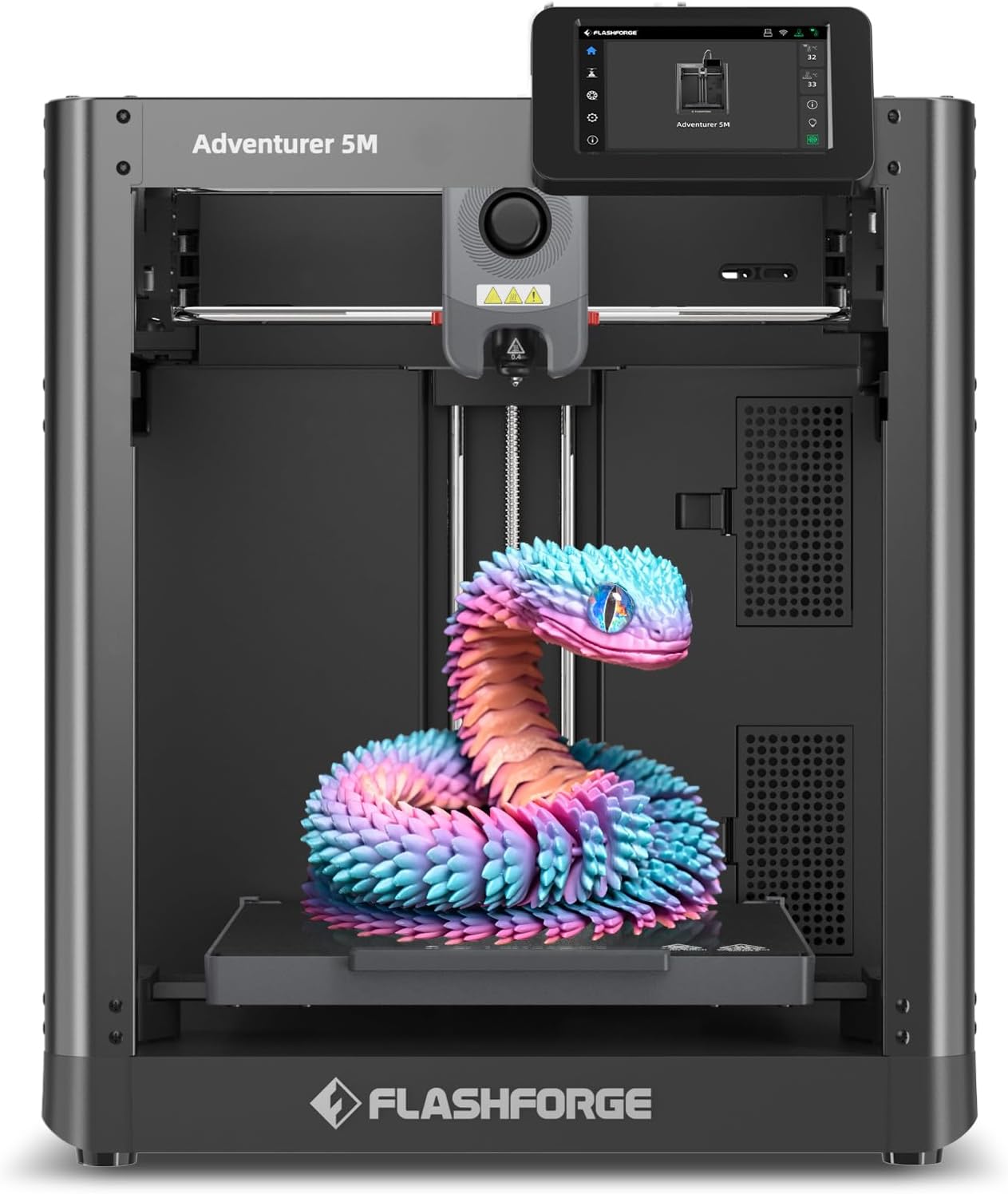
| Build Volume | 220 x 220 x 220 mm |
|---|---|
| Max Extruder Temp | 280°C |
| Travel Speed | 600 mm/s |
| Platform Type | Double-Sided PEI Platform |
| Structure | All-metal Core XY Structure |
The Flashforge Adventurer 5M is a sealed CoreXY desktop printer designed for faster small-batch printing and prototyping. It uses one-button automatic bed leveling and a 280°C direct-drive extruder with quick, tool-free 3-second nozzle changes so you can switch nozzle sizes or swap clogged tips quickly. The machine targets speed with a 600 mm/s travel rate and high acceleration while a double-sided PEI platform and dual-fan nozzle arrangement help with adhesion and print cooling. Practical conveniences include a fast warm-up time, mobile app monitoring, and multiple nozzle sizes for fine or high-flow prints. For families the enclosed frame and safer operation reduce exposure to hot parts, and the combo of auto-leveling and app control lowers setup friction. Expect strong results with PLA and common engineering filaments, but very high-speed settings may require tuning to balance surface finish versus speed, and advanced materials beyond listed types could need enclosure upgrades or special profiles.
Best for: Families and hobbyists who want a safer, easier-to-use desktop printer that minimizes manual setup and supports faster prototyping with reliable results.
Less Ideal for: Users seeking a budget toy printer for occasional crafts or professionals who need certified industrial-temperature capabilities beyond the listed extruder range.
- One-click automatic bed leveling reduces setup time and failed first layers.
- CoreXY all-metal structure enables higher travel speeds and stable motion.
- Quick 3-second nozzle changes and multiple nozzle sizes for flexible print profiles.
- Dual-sided PEI platform simplifies part removal and improves adhesion options.
- Mobile app monitoring allows remote oversight of prints.
- Very high advertised travel speeds may require tuning to maintain surface quality.
- Some advanced filaments or workflows may need enclosure upgrades or special settings not detailed here.
Verdict: A family-friendly CoreXY printer that prioritizes reliable first layers, fast setup, and higher-speed desktop printing for consistent home use.
Choosing the Right 3D Printer for Families: Key Factors to Consider
Safety Features
A family-oriented 3D printer should minimize burn, pinch, and fume exposure risks. Enclosed build chambers, filament runout detection, auto-shutdown on errors, and insulated hotend covers all reduce accident potential. Built-in filtration or compatibility with add-on HEPA/activated-carbon filters helps manage ultrafine particles and odors during typical PLA or PETG printing.
Prioritize machines with clear physical guards and auto-pause or resume on door open. For households with younger children, look for printers with locked enclosures or optional child locks to prevent unsupervised access.
Ease of Setup
A gentle learning curve is essential when multiple family members will use the printer. Machines that offer guided calibration wizards, pre-sliced sample files, and straightforward filament loading reduce the time from unboxing to first print. Simplified bed leveling, whether manual assisted or automatic, prevents early frustration and failed prints.
Consider printers that include clear documentation, video tutorials, or app-based walkthroughs. Fewer required adjustments and reliable out-of-the-box settings make a big difference for busy households.
Print Reliability
Consistent results matter more than absolute speed for family projects. A reliable printer delivers repeatable first-layer adhesion, stable extrusion, and predictable dimensional accuracy so toys and classroom models print successfully. Look for solid frame construction and a heated bed that holds temperature steadily to avoid warping on larger pieces.
Reliability also means the printer tolerates different filament brands and can run longer prints without intervention. Stable spool mounting and good filament path design reduce jams and underextrusion events.
Maintenance Effort
Consider the routine tasks needed to keep the printer working. Cleaning the build surface, swapping nozzles, and occasional belt or rod adjustments are normal, but some models minimize these chores with removable beds, user-friendly tool access, and self-cleaning or easy nozzle-change systems. Lower maintenance reduces the time parents need to invest while keeping machines available for kids.
Also account for consumables: how often the filament needs replacing, whether the bed surface needs re-taping, and how easy it is to source replacement parts. Machines with modular, widely available components tend to be easier to maintain long-term.
User Interface & Controls
An intuitive interface makes the printer accessible to nontechnical family members. Touchscreen menus, clear status indicators, and mobile app control streamline common tasks like starting prints, updating filament, or monitoring progress. Previewing sliced models on the device or via a companion app reduces mistakes.
Consider whether the printer supports remote monitoring through a camera or app alerts. Visual and audio cues that indicate print status or errors help parents supervise prints while multitasking.
Print Volume and Material Flexibility
Choose a build volume that matches typical household projects. Larger beds are useful for school models and multi-part prints, but a compact footprint might be preferable for limited spaces. Check whether the printer supports common filaments like PLA and PETG; family machines often avoid high-temperature materials that require specialized enclosures and ventilation.
Material flexibility also includes compatibility with TPU for flexible toys or tougher filaments for functional parts. Machines that handle a range of filaments without complex upgrades provide more creative options for family projects.
Setting Up a 3D Printing Area for Families
Designate a stable, level surface away from direct sunlight and drafts for the printer. Place it where children can see prints progress without being able to touch the hot components. A small table or dedicated cart with enough clearance around the printer makes loading filament and removing finished parts easier.
Keep basic maintenance supplies nearby: spare filament spools, a scraper for the build plate, a small tool kit with hex keys and nozzle-cleaning needles, and a washable mat to protect the workspace from glue or adhesive residues.
- Place printer on a vibration-absorbing surface to improve print quality
- Store filaments in dry containers to prevent moisture-related failures
- Use a camera or clear window for remote monitoring
Safe Materials and Filament Choices
For family use, PLA is the safest and simplest filament choice. It prints at lower temperatures, has minimal odor, and is biodegradable compared with many engineering plastics. PLA is excellent for toys, models, and lightweight household parts.
If you need tougher or heat-resistant parts, PETG offers a balance of strength and ease of use but emits more fumes. Use adequate ventilation or a filtered enclosure when printing anything beyond PLA. Flexible TPU is useful for soft toys or grips, but requires a printer with a suitable filament path to avoid jams.
- Start with PLA for most projects
- Use sealed storage and desiccant packs for filaments
- Ventilate or filter when printing PETG or ABS
Age-Appropriate Projects and Teaching Ideas
Plan projects that match your child's age and patience level. Young children enjoy simple token prints like name tags, basic figurines, or cookie-cutter shapes. Older kids can work on functional items like phone stands, plant pots, or simple mechanical assemblies that teach design principles.
Turn printing into a learning experience by involving kids in the design and post-processing steps. Basic CAD tools with kid-friendly modes help children personalize projects. Teach simple finishing techniques such as light sanding, gluing parts, and painting to complete prints safely.
- Preslice sample models to ensure quick wins
- Involve kids in safe post-processing like sanding with supervision
- Use printing projects to teach geometry and problem solving
Managing Noise, Odor, and Workspace Comfort
3D printers vary in noise output. For family spaces, look for quieter machines or place the printer in a partially enclosed cabinet with ventilation. Rubber feet can dampen motor and fan vibrations that transmit through furniture. Soft surfaces around the machine help absorb sound.
Filament odor can be minimized by choosing low-odor materials like PLA and by adding filtration to the enclosure. If the printer will run overnight or while family members sleep, ensure it is on a hard, fire-safe surface and has safety features that handle power interruptions.
- Use low-odor filaments in shared living spaces
- Consider printed enclosures with filter mounts
- Place printers away from sleeping areas if running long prints
Simple Troubleshooting Tips for Common Issues
Many printing problems have straightforward fixes. Poor first-layer adhesion is often due to bed leveling or a dirty build surface. Relevel the bed, clean the surface with isopropyl alcohol, and try a skirt or brim to improve adhesion. Filament jams typically occur from poor filament path routing or incorrect nozzle temperature for the material.
Keep a log of recurring errors to identify patterns. Regularly check belts, pulleys, and guides for proper tension and lubrication. If prints start showing layer shifts, inspect the stepper motor connections and ensure the printer is on a rigid, stable surface.
- Clean the nozzle and bed regularly to prevent adhesion and extrusion issues
- Use manufacturer-recommended temperatures as a starting point
- Document changes to settings to revert if needed
How We Chose the Best 3D Printer for Families
We selected 3D printers that suit a family environment by applying practical, hands-on editorial filters focused on safety, usability, and long-term ownership costs. Key criteria included enclosed or partially enclosed build areas and active safety features that reduce burn and pinch risks. We prioritized printers with simple, guided setup and intuitive touchscreen or app interfaces so newcomers and kids can start printing with minimal guidance. Reliable first-layer adhesion and consistent print quality were required to cut down on wasted filament and frustration. Maintenance demands such as bed leveling frequency, nozzle access, and filament loading procedures were evaluated to estimate typical upkeep time. We also considered print speed and acceptable print volume for common family projects like toys, household fixes, and school assignments. We excluded open-framed, industrial-style machines that require frequent tuning or advanced ventilation for safe home use. Machines that demand specialized tools or constant firmware fiddling were removed from consideration. The resulting list focuses on printers that balance safety, predictable results, and manageable upkeep for family users.
Our full evaluation process is outlined in our review methodology.
FAQ
What age is appropriate for kids to use a 3D printer?
Younger children can participate with supervision for tasks like choosing models and removing cooled prints. Direct interaction with hot or moving parts should be limited to older children who understand safety, usually around age 10 or older, depending on maturity and supervision level.
How noisy are family-friendly 3D printers?
Noise varies by model, but family-friendly units tend to be quieter with lower vibration and smaller fans. Expect some whirring and occasional fan noise. Placing the printer on a vibration-absorbing surface and using quieter filaments or enclosures can reduce perceived loudness.
Is ventilation required when printing PLA at home?
PLA produces minimal odor and lower ultrafine particle emissions compared with high-temperature filaments, so basic room ventilation is usually adequate. For extended or frequent printing, or when using PETG or ABS, additional filtration or active ventilation is recommended.
How much space do I need for a family 3D printer?
Allow room for the printer footprint plus clearance for loading filament and removing parts. A small table or dedicated cart with a few inches of clearance on all sides is sufficient for most family printers. Also reserve space for filament storage and basic maintenance tools.
What maintenance should parents expect?
Routine tasks include cleaning the build plate, ensuring the nozzle is clear, checking belt tension, and replacing worn bed surfaces. Frequency depends on usage but budgeting a short weekly check and occasional minor adjustments keeps the printer reliable.
Final Verdict
Choosing a 3D printer for families means balancing safety, ease of use, and predictable prints. Prioritize enclosed or guarded machines with guided setup, steady first-layer reliability, and low maintenance demands to reduce frustration and supervision time. Consider build volume and filament flexibility based on the projects your household is likely to attempt. Focus on models that minimize hazards and require minimal tuning so kids can enjoy design and creation while parents manage occasional upkeep. With the right priorities, a family 3D printer becomes a durable educational tool rather than a constant source of troubleshooting.