
Note: This article contains affiliate links. If you click on these links and make a purchase, we may earn a small commission at no extra cost to you. This helps support our research and content. Read our full affiliate disclosure here.
If you bake bread at home regularly, the materials and coatings inside the machine matter for long-term health and flavor. A non-toxic bread maker reduces exposure to concerning finishes and questionable coatings while still delivering evenly browned loaves and dependable crumb structure. This guide covers the top shortlisted non-toxic bread makers available for home kitchens, focusing on safe construction, consistent bake cycles, and ease of cleaning. Below you will find our top picks, plus the evaluation criteria we used and practical advice to help you pick a machine that suits your baking habits.
Top Picks at a Glance
| Best Overall The best all-around choice for most situations | Neretva Bread Machine PE9706U |  |
| Best Quality Built to a higher standard if you want something more solid | Zojirushi Home Bakery Virtuoso Plus BB-PPC20 |  |
| Best Value The sweet spot between price and what you get | Hamilton Beach Bread Maker 2 lb |  |
| Best Budget The cheapest option that still gets the job done reliably | Elite Gourmet 2‑lb Bread Maker EBM8103CG |  |
| Top Rated A top-rated pick with lots of positive feedback | KBS Pro Bread Maker MBF-010 |  |
| Most Popular A crowd favorite that many people choose with confidence | Neretva Bread Maker 2LB |  |
| Best Seller A high-volume bestseller chosen again and again | KBS 2.2lb Bread Maker |  |
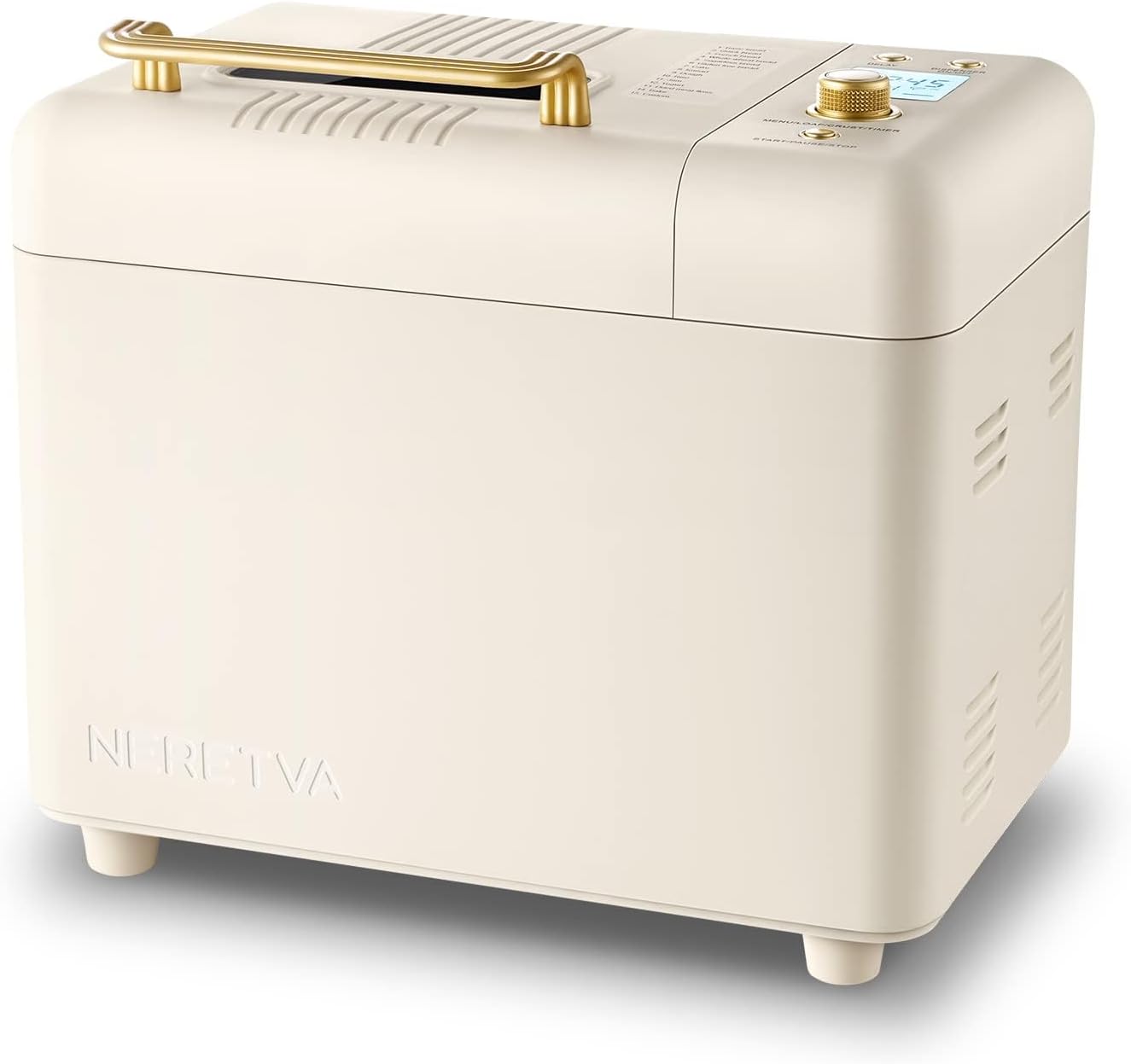
Neretva Bread Machine PE9706U
| Capacity | 2.2 pounds |
|---|---|
| Wattage | 600 watts |
| Number of Programs | 15 |
| Voltage | 120 volts |
This Neretva bread machine is aimed at home bakers who want fresh loaves with minimal fuss. You load ingredients, pick one of 15 programs and the machine handles mixing, kneading, rising and baking; the 15-hour delay timer and 1-hour keep-warm make it easy to plan fresh bread for mealtimes. Dual heaters (top and bottom) and a 360-degree heat circulation design help produce more even crust and crumb, while the 600 W motor speeds some cycles so bake times can be shorter than older models. The included automatic fruit and nut dispenser drops add-ins at the right time, and the upgraded ceramic nonstick pan is marketed as chemical-free and easy to clean. A clear viewing window lets you monitor progress and the motor runs quietly under typical kitchen noise. Limitations to note are the single loaf paddle and the fixed loaf shape common to countertop machines, and recipes that require very specific oven conditions like artisan hearth breads will still need a conventional oven. For everyday sandwich loaves, gluten-free mixes, and quick homemade jams this unit is practical and convenient.
Best for: Buyers who want a reliable, all-purpose countertop bread maker that produces everyday sandwich loaves, handles specialty presets like gluten-free, and minimizes hands-on baking time.
Less Ideal for: Bakers seeking true artisan crusts, variable loaf shapes, or those who prefer baking entirely by hand or in a conventional oven for full control.
- Nonstick ceramic bread pan advertised as chemical-free and easy to clean
- 15 preset programs cover basic, whole wheat, gluten-free, sourdough and more
- Dual top-and-bottom heating with 360-degree circulation for more even baking
- Automatic fruit and nut dispenser times mix-ins without manual intervention
- 15-hour delay timer and 1-hour keep-warm for scheduled fresh bread
- Single paddle and fixed pan limit loaf shape and crumb options compared with hand-shaped loaves
- Not suited for high-temperature artisan or hearth-style breads that need an oven
Verdict: A feature-rich, easy-to-use bread maker that delivers chemical-free nonstick cooking and scheduled fresh loaves for everyday home baking.
Zojirushi Home Bakery Virtuoso Plus BB-PPC20

| Number of Programs | 15 |
|---|---|
| Included Components | Breadmaker |
| Material | Metal, Stainless Steel |
| Item Type Name | Home Bakery Virtuoso® Plus Breadmaker |
| ASIN | B0GMP87TV6 |
The Zojirushi Home Bakery Virtuoso Plus is a high-performance automatic breadmaker built to deliver consistent, bakery-style loaves at home. It uses dual kneading blades and heaters on both the bottom and the lid to promote thorough kneading, a strong rise, and even browning across the top and bottom crust. The machine offers 15 programs — including whole wheat, gluten-free, rapid cycles, sourdough starter, dough, cake and jam — plus three user memory settings and a 13-hour delay timer for scheduled baking. Practical touches include a large viewing window, easy-to-read LCD control panel, removable ceramic nonstick pan and included measuring tools and recipe book. A key safety and health advantage is PFAS-free and BPA-free food contact surfaces. Trade-offs are its fairly large footprint and focus on a single 2-lb loaf size, which limits batch flexibility for very small households or larger families that want bigger loaves. For home bakers who prioritize reliable results and clean materials, this model aims to deliver consistently excellent bread with minimal fuss.
Best for: Home bakers who want reliable, bakery-quality results and care about non-toxic materials and program flexibility for a range of breads and doughs.
Less Ideal for: People who need very small single-serving loaves, larger-than-2-lb batches, or minimal-countertop appliances for tiny kitchens.
- Dual kneading blades for thorough dough development and higher rise
- Heaters on both bottom and lid for more even baking and browning
- 15 program settings including gluten-free, sourdough starter and rapid cycles for versatility
- PFAS-free and BPA-free food contact surfaces for safer baking
- Removable ceramic nonstick pan and included measuring tools simplify cleanup and setup
- Limited to a single traditional 2-lb loaf shape and size
- Relatively large footprint that requires countertop space
Verdict: Choose this breadmaker if you want dependable, bakery-style loaves made on a machine with PFAS-free food contact surfaces and advanced kneading and heating for even results.
Hamilton Beach Bread Maker 2 lb

| Capacity | 2 pounds |
|---|---|
| Wattage | 550 watts |
| Number of Programs | 12 |
| Voltage | 120 |
This Hamilton Beach bread maker simplifies homemade loaves with a three-step workflow: add ingredients, pick a program, and start. It supports 1, 1.5, and 2 pound loaves and offers 12 cycles including basic, French, whole grain and gluten-free, plus express bake and jam settings. The digital display and countdown timer make programming and monitoring straightforward, and a delay-start plus one-hour keep-warm let you time fresh bread for meals. A beep signals when to add fruit or nuts, and the removable PFAS-free nonstick pan and dishwasher-safe paddle and accessories cut cleanup time. At 550 watts it bakes reliably without a complicated setup, but it does not include an automatic fruit and nut dispenser and warm time is limited to one hour. For someone focused on non-toxic materials and dependable everyday baking, this machine hits the essentials without extra complexity.
Best for: Buyers who prioritize simple, reliable home baking and want a bread maker built with non-toxic cooking surfaces and straightforward programmable options.
Less Ideal for: Bakers who want fully automated add-in dispensing or extended warming times should consider models with those specific features instead.
- PFAS-free removable nonstick bread pan and dishwasher-safe accessories for easier, safer cleanup
- 12 program cycles including gluten-free and express options for versatile baking
- Digital display with countdown timer, delay start, and audible add-in prompt for convenient control
- Supports three loaf sizes and three crust shades to customize results
- No automatic fruit and nut dispenser for hands-off add-ins
- Keep-warm only holds bread for about one hour
Verdict: Choose this model if you want a practical, non-toxic bread maker that delivers reliable, customizable loaves without unnecessary complexity.
Elite Gourmet 2‑lb Bread Maker EBM8103CG

| Capacity | 2 pounds |
|---|---|
| Wattage | 550 watts |
| Number of Programs | 19 |
| Voltage | 120 volts |
This Elite Gourmet bread maker is aimed at home bakers who want a simple, safer way to make fresh loaves without fuss. It uses a PFAS-free CERALAST ceramic-coated pan and kneading blade to reduce sticking and simplify cleanup, and offers one-touch convenience with 19 preset programs that cover everything from gluten-free and whole wheat to pizza dough, jam, and yogurt. You can choose 1, 1.5, or 2 lb loaf sizes, pick crust shade, and set a 15-hour delay timer so bread is ready when you want it. At 550 watts it runs efficiently for countertop use and the 60-minute keep-warm holds loaves after baking. Practical limitations include a single pan size and standard kneading blade design, so you will not get artisan-style shaping or very large batches, and users should handle the ceramic pan with care to avoid chipping. For its price and feature set it delivers a straightforward, lower-risk way to bake at home with non-toxic surfaces.
Best for: Buyers wanting an affordable, lower-risk bread maker that prioritizes a non-toxic cooking surface and easy one-touch baking for everyday loaves and specialty presets.
Less Ideal for: People seeking large-capacity machines, commercial-level output, or machines that produce artisan-style freeform loaves should consider other options.
- PFAS-free CERALAST ceramic-coated pan and kneading blade for easier cleanup and non-toxic cooking surface
- 19 preset programs handle a wide range of breads and doughs including gluten-free and specialty options
- Selectable loaf sizes (1, 1.5, 2 lb) and crust shade control for basic customization
- 15-hour delay timer and 60-minute keep-warm for fresh bread on your schedule
- Single baking pan limits loaf shape and maximum batch size
- Ceramic parts require careful handling to avoid chips or damage
Verdict: A budget-friendly, PFAS-free bread maker that delivers convenient one-touch baking and safer ceramic contact surfaces for everyday home loaves.
KBS Pro Bread Maker MBF-010

| Capacity | 2 pounds |
|---|---|
| Wattage | 710 watts |
| Number of Programs | 17 |
| Voltage | 120 volts |
The KBS Pro MBF-010 is a countertop bread machine built for hands-off baking and cleaner nonstick surfaces. It uses a 710W motor and 360° convection-style heating to knead and bake loaves up to 2.2 pounds, and offers 17 preset programs plus a custom mode and three crust settings for different recipes. The ceramic pan and paddle provide a PFOA-free, naturally nonstick surface that is easier to avoid chemical coatings with, and the automatic dispenser adds nuts or fruits during the cycle so you do not have to open the machine mid-cycle. A tempered glass touch panel, a large viewing window, a 15-hour delay timer, keep-warm, and power-failure recovery make scheduled baking simple. Practical limits include its single-basin design—so you cannot bake two sizes at once—and the unit is moderately heavy and takes countertop space. For reliability-minded cooks the build quality and included spare parts and support are reassuring, though those needing industrial capacity or multiple simultaneous loaves should look elsewhere.
Best for: Home bakers who prioritize a durable, factory-quality build and non-toxic ceramic cooking surfaces and want reliable, scheduled loaves with minimal hands-on time.
Less Ideal for: People who need commercial-scale throughput or who want a very small, travel-friendly bread maker for occasional use.
- Ceramic nonstick pan and paddle reduce reliance on chemical coatings.
- Automatic ingredient dispenser for timed additions of nuts and fruit.
- Wide program selection including gluten-free and custom settings for recipe flexibility.
- 360° convection heating and a 710W motor aimed at consistent crust and crumb results.
- Smart touch panel with delay timer, keep-warm, and power-failure recovery for scheduled baking.
- Single baking chamber limits output to one loaf at a time.
- Relatively heavy footprint compared with compact or travel models.
Verdict: Choose this machine if you want a dependable, non-toxic ceramic bread maker that reliably produces bakery-style loaves with hands-off convenience.
Neretva Bread Maker 2LB

| Capacity | 2 pounds |
|---|---|
| Wattage | 565 watts |
| Voltage | 120 volts |
| Number of Programs | 20 |
The Neretva Bread Maker is a countertop machine designed to make a wide range of loaves and doughs with minimal fuss. You pick a program from 20 presets—everything from basic and gluten-free to jam and yogurt—set the crust color and delay timer, and the machine mixes, kneads, proofs, and bakes up to a 2 lb loaf. Its dual heater system and 360° surrounding heating aim to produce more even crust color and a less dense crumb, while the upgraded nonstick ceramic pan reduces sticking and avoids chemical coatings common on some pans. The metal body feels sturdy and the included accessories (extra paddle, measuring tools, removal hook) make setup and maintenance straightforward. Noise is kept low and the 15-hour preset plus power-interruption recovery are convenient for planned baking. Important limitations are that loaf size is fixed to the machine's pans and some specialty recipes may require manual timing tweaks, and the control panel locks during operation which requires a three-second press to stop or change settings. For someone prioritizing a non-toxic cooking surface and reliable preset options, this covers the basics well.
Best for: Home bakers who want a compact, low-chemical bread machine with many automatic programs and predictable, hands-off baking.
Less Ideal for: Bakers who need variable loaf sizes, artisan shaping, or full manual control over baking cycles should look elsewhere.
- 20 built-in programs covering basic, whole-wheat, gluten-free, jam, yogurt and specialized doughs.
- Nonstick ceramic bread pan that avoids chemical coatings and eases cleanup.
- Dual top-and-bottom heaters designed for more even baking and faster cycle times.
- Includes useful accessories (extra kneading paddle, measuring cups/spoons, paddle removal hook) for immediate use.
- Loaf capacity and pan size are fixed so you cannot bake larger or custom-shaped loaves.
- Control panel locks during operation, requiring a hold to stop or change a cycle.
Verdict: Choose this bread maker if you want a compact machine with a ceramic nonstick pan and many presets for low-chemical, fuss-free home baking.
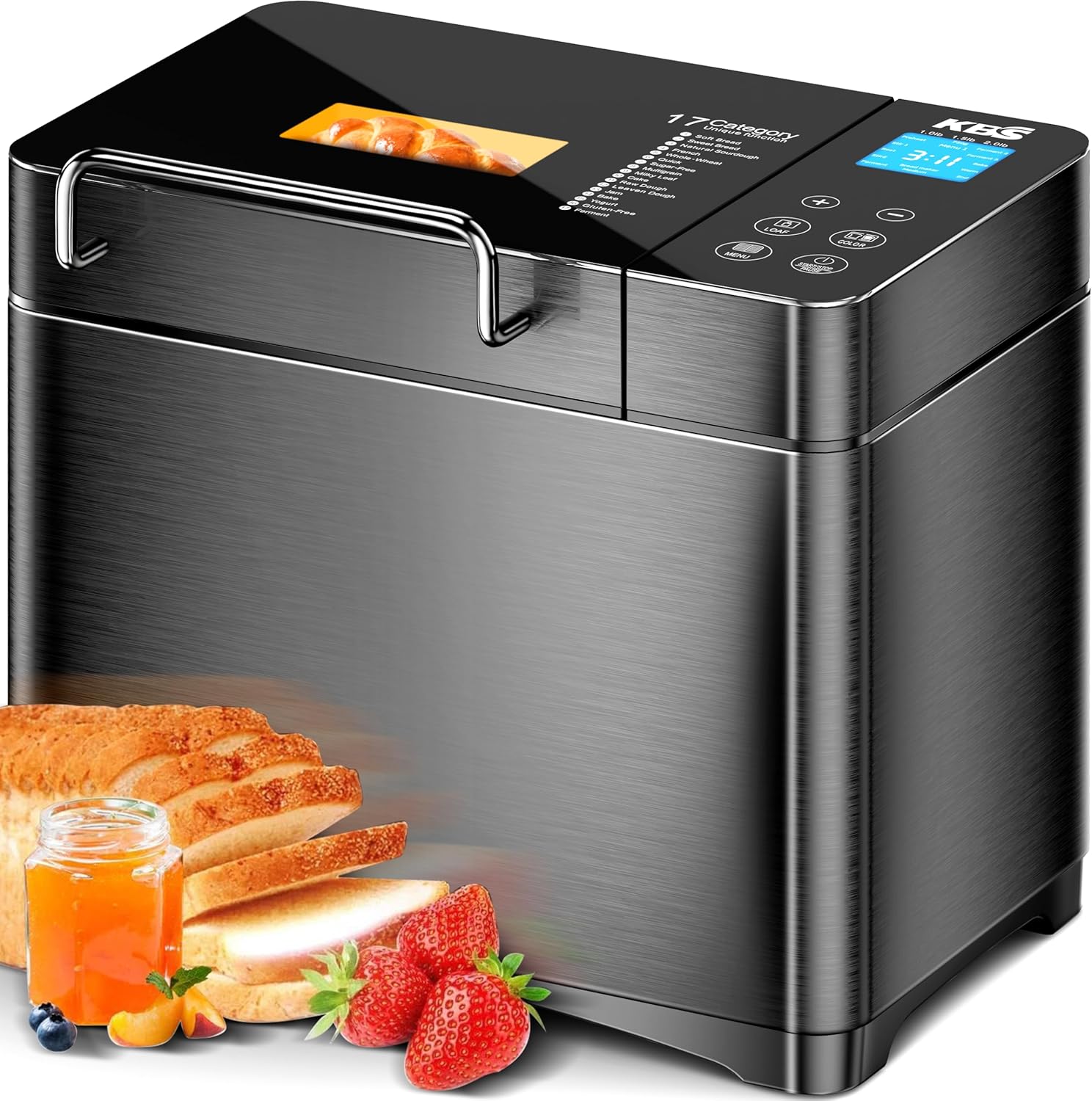
KBS 2.2lb Bread Maker
| Capacity | 2.2 pounds |
|---|---|
| Wattage | 710 watts |
| Number of Programs | 17 |
| Voltage | 120 volts_of_alternating_current |
This KBS bread maker is designed for hands-off home baking with features that target consistent, healthier loaves. It uses dual heaters and 360° convection to encourage even browning and a crisper crust while the plasma-fused ceramic horizontal pan is promoted as PTFE/PFOA-free for safer nonstick performance. The unit offers 17 programs plus a 15-hour delay timer, automatic nut/fruit dispenser and a touchscreen for straightforward operation, so you can set it overnight and wake to warm bread. Practical extras include two kneading paddles, a viewing window, recipe book and a keep-warm function. Trade-offs are its fairly large footprint and heavier weight compared with compact models, and full-loaf removal and cleaning of the ceramic pan and paddles still require some effort. The 710W motor and low-noise DC design make kneading and rising efficient for most home loaves, and the 15-minute power interruption recovery helps protect longer cycles.
Best for: Buyers who prioritize safer nonstick cooking surfaces and want a reliable, mostly hands-off machine that produces even, bakery-style loaves with preset programs and timed baking.
Less Ideal for: People who need a very small, lightweight appliance for limited counter space or those who prefer minimal cleaning and ultra-compact storage.
- Ceramic nonstick pan marketed as PTFE/PFOA-free for lower chemical exposure
- Dual heaters and convection baking for more even crust and interior
- Automatic nut and fruit dispenser for hands-free mix-ins
- Long delay timer and 15-minute power-interruption recovery for reliable timed baking
- Includes multiple accessories and a 53-recipe book to get started
- Relatively heavy and bulky compared with compact bread machines
- Ceramic pan and paddles require manual cleaning and careful handling to avoid damage
Verdict: Choose this machine if you want a higher-capacity bread maker with a factory-quality ceramic nonstick pan and convection heating for safer, more consistent home-baked loaves.
Choosing the Right Non-Toxic Bread Maker: Key Factors to Consider
Interior Material and Coating
What the bread pan and paddle are made from matters because those surfaces contact dough at warm to hot temperatures for extended periods. Look for stainless steel, unglazed ceramic, or explicitly PTFE-free finishes. Avoid machines that list vague 'nonstick' coatings without clarifying the chemistry.
Materials that resist scratching and degradation reduce the risk of particulates or degraded coatings mixing with your dough. Also consider whether removable pans are finished on the inside or have an additional liner that could wear over time.
Heat Distribution and Baking Consistency
Uniform heat prevents underbaked centers and overbrowned crusts. Machines with well-engineered heating elements and insulated enclosures help maintain even chamber temperatures during long cycles. Look for features that control temperature ramps and offer stable, repeatable results.
Consistent baking matters more with whole-grain and dense doughs because they require sufficient internal temperature to gelatinize starches and set crumb. If you plan to experiment with different flours, prioritize machines known for steady thermal performance.
Program Flexibility and Manual Controls
Preset cycles are convenient, but the ability to adjust crust darkness, loaf size, knead duration, and proof time lets you tailor results based on recipe and flour type. Manual timers and custom programs help when you want to adapt for sourdough mixes or longer cold rises.
Control granularity also affects how well you can compensate for environmental changes such as humidity or room temperature. Buyers who bake frequently will appreciate machines that let them fine-tune kneading intensity and rest intervals.
Cleaning Accessibility and Maintenance
Easily removable pans and paddles simplify cleanup and reduce the risk of trapped residue that could degrade materials. Smooth, durable interiors that tolerate gentle scrubbing or included dishwasher-safe parts extend useful life.
Pay attention to how seals, vents, and crevices are designed. Hard-to-reach nooks accumulate flour and oil, which can polymerize over repeated use and negate the benefits of safer base materials.
Paddle Design and Dough Handling
The kneading paddle should thoroughly mix and degas dough without leaving large pockets of unmixed flour. Paddle geometry affects how well the machine handles sticky, high-hydration doughs and dense whole-grain recipes.
Some designs use collapsible or removable paddles to reduce the hole left in a loaf, while others optimize placement and motion to minimize cleaning. Consider the paddle style you prefer based on the types of bread you bake most often.
Long-Term Durability and Repairability
Durable housings, easily replaceable pans and paddles, and accessible customer support help a bread maker stay serviceable for many years. Machines built with standard fasteners and common replacement parts are easier to maintain than sealed units.
Consider warranty coverage and the availability of replacement parts when planning for long-term ownership. Durability matters not only for cost of ownership but also because worn surfaces can compromise material safety over time.
Why Non-Toxic Materials Matter for Home Baking
Interior finishes and paddles are in direct contact with dough during mixing and baking. Repeated heating cycles can cause inferior coatings to flake or break down, introducing unwanted compounds into your food. Choosing machines with clearly specified, inert food-contact materials reduces these risks.
Beyond chemical exposure, safe materials often age more predictably and tolerate rigorous cleaning. That stability supports consistent baking performance because the machine's thermal and mechanical behavior does not change as finishes degrade.
- Inert materials like stainless steel and ceramic resist chemical breakdown
- Specified PTFE-free or silicone-free interiors avoid controversial coatings
- Durable finishes make maintenance and cleaning simpler over the long term
How to Test a Bread Maker at Home for Safety and Performance
Start by checking the product documentation for explicit material details. If the interior material is unclear, look for removable pans you can inspect for coatings and seams. When you have the unit, perform a neutral test: run a basic white-flour loaf and inspect the pan and paddle afterward for any residue or flaking.
Also evaluate the machine's temperature behavior by timing a standard bake and checking for even crust color and consistent internal temperature across multiple loaves. Repeatability over several bakes is more informative than a single test.
- Inspect pans and paddles for clearly labeled materials
- Run a neutral white-loaf test to spot flaking or residue
- Bake multiple loaves to assess repeatability and evenness
Recipes and Settings That Reduce Stress on Materials
High-sugar or high-fat doughs tend to bake hotter at the surface and can accelerate wear on interior finishes. Using recipes balanced for the machine and avoiding excessive sugars or degreasers helps preserve interior surfaces. For sticky doughs, let initial mixing finish with short pauses rather than extended high-heat cycles.
When possible, favor lower-temperature proofs and avoid forcing extremely long high-heat bakes. Many machines include 'rapid' or 'express' cycles; use them sparingly because they push elements harder and may strain coatings over time.
- Avoid repeatedly using extreme rapid-bake cycles
- Reduce excessive sugars and fats that can stick to surfaces
- Use recommended loaf sizes to avoid overworking the motor
Cleaning Routines That Preserve Non-Toxic Finishes
Always let the unit cool before cleaning to avoid warping removable parts. Use nonabrasive cleaners and soft brushes to remove stuck dough. For stubborn spots, soak pans in warm water rather than heavy scrubbing to protect finishes.
If a manufacturer specifies dishwasher safety for certain parts, prioritize handwashing for coated interiors unless explicitly allowed. Regularly inspect seals and vents for accumulated flour and dust and clean them gently to maintain airflow and safety.
- Cool completely before cleaning to protect finishes
- Prefer soaking and soft brushes over abrasive pads
- Inspect seals and vents regularly to prevent buildup
When to Replace Parts or Retire a Machine
Replace paddles or pans at the first sign of visible wear such as deep scratches, flaking, or permanent discoloration. Even small surface damage can worsen with heat and use. If replacement parts are not available, consider retiring the machine to avoid prolonged exposure to degraded materials.
Retire a machine if it consistently produces uneven bakes despite proper maintenance or if mechanical issues like a wobbling paddle or inconsistent kneading occur. Mechanical problems can increase heat cycling and accelerate material breakdown.
- Replace parts with visible wear immediately
- Use manufacturer-specified replacements when available
- Retire machines that show persistent mechanical or baking failures
How We Chose the Best Non-Toxic Bread Maker
We prioritized machines built with inert, food-safe interior surfaces and minimal synthetic coatings that can degrade with heat. Our selection criteria focused on construction materials, bake performance, control over temperature and timing, and long-term maintenance needs. We chose models with documented safety features for food contact areas, such as stainless steel pans, ceramic-lined options, or proven PTFE-free interiors. Consistent bake cycles and even heat distribution were central because material safety is only useful if the machine also produces properly cooked bread. Ease of cleaning and replaceable parts were included as practical filters since residue buildup can negate material benefits over time. We excluded any units lacking clear material specifications or with ambiguous interior finishes. Final picks balance verified material safety, reliable baking results, straightforward controls, and serviceability.
Our full evaluation process is outlined in our review methodology.
FAQ
How can I tell if a bread maker interior is truly non-toxic?
Check product documentation for specific materials such as stainless steel, ceramic linings, or explicitly PTFE-free finishes. If documentation is vague, removable pans that can be inspected are a safer bet.
Are ceramic-lined pans always safer than nonstick coatings?
Ceramic linings are generally inert and resist scratching, but not all ceramics are created equal. Look for specifications about glaze composition and durability because poorly finished ceramics can crack or chip, which also poses issues.
Does using silicone bakeware inside a machine affect safety?
Food-grade silicone molds are typically stable at baking temperatures, but confirm the temperature rating and ensure they fit properly to avoid contact with heating elements. Silicone can be a practical option when machine interiors are questionable.
How often should I replace the kneading paddle or baking pan?
Replace any part that shows deep scratches, flaking, or deformity. For regular home use, inspect parts every few months and replace them as needed to maintain material integrity and baking performance.
Can I ignore cleaning instructions if the parts are stainless steel?
No. Even stainless steel benefits from regular cleaning and proper drying. Residue buildup can trap oils and flour that degrade surfaces over time, so follow the recommended cleaning routine to extend part life.
Final Verdict
Prioritize clear, inert interior materials and consistent bake performance when choosing a non-toxic bread maker. Balance your need for program flexibility and ease of cleaning against long-term durability and availability of replacement parts. If you bake frequently, opt for machines with replaceable pans and paddles and well-documented material specs. With those priorities in mind, you can select a bread maker that delivers healthy results and dependable loaves for years.