
Note: This article contains affiliate links. If you click on these links and make a purchase, we may earn a small commission at no extra cost to you. This helps support our research and content. Read our full affiliate disclosure here.
If you bake occasionally or have limited counter and cabinet space, a compact bread machine can make fresh loaves practical rather than cumbersome. Small bread makers save room and often use less flour and energy while still producing sandwich loaves, artisan-style crusts, or specialty doughs. In this guide we shortlisted the five best small bread makers for home use and tested criteria like loaf consistency, program flexibility, and cleanup effort. Use the guide to match capacity, cycle options, and ease-of-use features to how and how often you plan to bake.
Top Picks at a Glance
| Best Overall The best all-around choice for most situations | Cuisinart Bread Maker CBK-110P1ES |  |
| Best Value The sweet spot between price and what you get | Amazon Basics 2-Pound Bread Maker |  |
| Best Budget The cheapest option that still gets the job done reliably | VEVOR Bread Maker MBF-016 |  |
| Most Popular A crowd favorite that many people choose with confidence | Elite Gourmet Bread Maker EBM8103B |  |
| Best Seller A high-volume bestseller chosen again and again | OSIPOTO Bread Maker BM8205 | 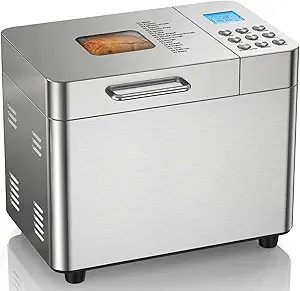 |
Cuisinart Bread Maker CBK-110P1ES

| Capacity | 2 pounds |
|---|---|
| Wattage | 550 watts |
| Voltage | 120 volts |
| Number of Programs | 12 |
The Cuisinart CBK-110P1ES is a compact, fully automatic bread machine that mixes, kneads, and bakes loaves up to 2 pounds using 12 preset programs. You pick loaf size and crust color on the LCD panel, set a 13-hour delay timer if you want fresh bread in the morning, and the machine handles the rest with audible reminders and a 60-minute keep-warm function. Its vertical nonstick pan and removable paddle make loading and clean-up straightforward, and the unit is small enough to sit on most counters without occupying too much space. Practical extras include program options for cakes, jams, and gluten-free recipes, which expand what you can make beyond standard loaves. Trade-offs are the reliance on hand washing for care and the plastic-stainless exterior that is not as heavy-duty as some professional machines, but for home use it balances performance and footprint well.
Best for: Home cooks who want a reliable, space-conscious bread machine that handles a wide range of recipes and scheduled baking without fuss.
Less Ideal for: Bakers seeking a commercial-grade, heavy-duty machine or those who need fully dishwasher-safe components should look elsewhere.
- 12 preprogrammed menus for bread, cake, jam and specialty options
- Three loaf sizes and three crust color choices for customization
- Compact footprint fits most countertops while baking full vertical loaves
- 13-hour delay start and 60-minute keep-warm for scheduled baking
- Requires hand washing for some components rather than dishwasher-safe parts
- Plastic elements in the exterior make it less heavy-duty than commercial-style machines
Verdict: A versatile, countertop-friendly bread maker that delivers customizable loaves and convenient scheduled baking for everyday home use.
Amazon Basics 2-Pound Bread Maker

| Capacity | 2 pounds |
|---|---|
| Wattage | 550 watts |
| Number of Programs | 14 |
| Voltage | 120 volts |
This Amazon Basics bread maker is a straightforward countertop machine for baking fresh loaves at home. It handles mixing, kneading, rising, and baking automatically, and the 14 programs cover standard breads, doughs, gluten-free options, and even jams. The 550-watt unit includes an ExpressBake mode that can produce a loaf in under 90 minutes, and three crust color settings let you choose light, medium, or dark finishes. The nonstick pan simplifies loaf removal and cleanup, and the LCD display with programmable timer makes scheduling convenient for morning bread. Limitations include a single 2-pound capacity so it is best for small households, and the machine is basic compared with higher-end models that offer dual paddles, steam or specialty loaf shapes. For buyers who want reliable, no-fuss home baking without extra bells and whistles, this unit delivers consistent results at a compact size.
Best for: Buyers who prioritize a simple, reliable machine to bake small loaves at home and want convenient preset programs and quick bake capability.
Less Ideal for: Those who need larger loaves, advanced artisan controls, or specialty loaf sizes should consider larger or more feature-rich bread machines.
- All-in-one automation for mixing, kneading, rising, and baking
- 14 preset programs including gluten-free and dough cycles
- ExpressBake option for a finished loaf in under 90 minutes
- Nonstick baking pan for easier loaf removal and cleaning
- Single loaf capacity limited to 2 pounds
- Basic feature set without advanced options like dual paddles or steam
Verdict: A compact, no-nonsense bread maker that reliably produces small homemade loaves with a wide set of preset programs.
VEVOR Bread Maker MBF-016

| Capacity | 2 pounds |
|---|---|
| Wattage | 650 watts |
| Number of Programs | 19 |
| Voltage | 110 volts |
This VEVOR bread maker is a budget-friendly compact machine aimed at small households that want fresh bread without fuss. It offers 19 programs including whole wheat, gluten-free, dough, cake, and jam, plus three loaf sizes and three crust color settings so you can tailor results for different recipes and household sizes. The food-grade ceramic inner pan and Teflon mixing blade promise nonstick performance and straightforward cleanup, while a 15-hour delay timer and 1-hour keep-warm make it easy to schedule baking around your day. Practical touches like a viewing window, ingredient addition reminder, and power-outage memory add reliability for routine use. At 650 watts it heats evenly for good rises, though the 2-pound maximum means it is best for 1 to 4 people rather than large families. The unit is basic in styling and requires hand-washing some components, but for the price it delivers solid functionality and consistent loaves for everyday baking.
Best for: Buyers seeking an affordable, easy-to-use countertop bread maker for daily small-batch loaves and simple custom recipes.
Less Ideal for: Those who need large loaves, frequent high-volume baking, or a fully dishwasher-safe machine should consider larger or more feature-rich models.
- 19 preset programs cover bread, dough, cake, jam, and gluten-free options
- Food-grade ceramic nonstick inner pan for easier release and safer heating
- 15-hour delay start and 1-hour keep-warm for scheduled baking
- Ingredient addition reminder and power-off memory improve reliability
- Maximum 2 lb capacity limits output for larger households
- Some parts require hand washing rather than dishwasher-safe care
Verdict: A capable, no-frills small bread maker that delivers a wide range of preset breads and scheduled baking at a budget-friendly price.
Elite Gourmet Bread Maker EBM8103B

| Capacity | 2 pounds |
|---|---|
| Wattage | 550 watts |
| Number of Programs | 19 |
| Voltage | 120 volts |
The Elite Gourmet EBM8103B automates kneading, rising, and baking so you can make fresh loaves with minimal effort. You pick a loaf size and crust darkness, add ingredients, and choose from 19 one-touch programs that cover everything from gluten-free and rye to pizza dough, cake, and jam. A 15-hour delay timer and 60-minute keep-warm let you schedule baking to fit your day, and the machine ships with a nonstick bread pan, kneading blade, and measuring tools to get started. At 550 watts it uses far less energy than a full oven and the compact footprint fits small kitchens and apartments. Practical limitations include the fixed pan shape that sets loaf size and crust profile, and aluminum construction that may show wear over long daily use. For straightforward home baking the interface and presets make predictable results easy for beginners, while the variety of programs gives more experienced bakers room to experiment without constant supervision.
Best for: Buyers who want an easy, reliable way to bake fresh bread at home with the reassurance of many positive reviews and established presets for predictable results.
Less Ideal for: Bakers who need highly artisanal or large-format loaves or who prefer full control over loaf shape and oven-style crust development should consider other methods.
- 19 preset programs covering standard breads, gluten-free, dough, jam, and more
- Three loaf size options (1 lb, 1.5 lb, 2 lb) for portion flexibility
- 15-hour delay timer and 60-minute keep-warm for scheduled baking
- Compact, lower-wattage design that saves space and energy
- Includes starter accessories: nonstick pan, kneading blade, measuring cup and spoon
- Loaf shape and size are limited by the fixed pan and paddle, which affects crust and crumb compared with oven loaves
- Aluminum construction can show wear over heavy use and is less durable than some cast models
Verdict: A compact, beginner-friendly bread maker with a wide preset selection and scheduling features that reliably produces fresh loaves without the fuss.
OSIPOTO Bread Maker BM8205

| Capacity | 2 pounds |
|---|---|
| Wattage | 600 watts |
| Number of Programs | 17 |
| Voltage | 120 |
The OSIPOTO BM8205 is a compact, beginner-friendly bread machine that handles the full baking cycle from kneading to cooling. You choose a program on the LCD, add ingredients, and the unit kneads, proofs, and bakes loaves up to 2 pounds with three size and crust options. Notable features include 17 preset programs covering basics like whole wheat and gluten-free plus non-bread options such as jam or yogurt, a 15-hour delay timer for overnight baking, and a keep-warm function. The stainless steel housing and nonstick pan make cleanup straightforward, and the 600 W motor is designed for even heating with relatively low noise. Practical limitations are its single-basin design, which means you cannot mix and bake separate batches at once, and the keep-warm time is limited to about an hour. The machine includes basic accessories and safety features such as overheat protection, which helps give predictable results for routine home baking rather than specialist artisan bread workflows.
Best for: Buyers who want a low-risk, easy-to-use machine for reliable everyday loaves and scheduled baking without a steep learning curve.
Less Ideal for: Bakers seeking advanced artisanal features like multiple pans, steam injection, or long cold fermentation control should look elsewhere.
- Wide program selection with 17 presets for diverse recipes
- Large 2 lb capacity with three loaf sizes and three crust settings
- 15-hour delay timer and keep-warm for scheduled baking
- Stainless steel exterior and nonstick pan simplify cleaning
- Overheat protection for safer, more reliable operation
- Single-basin design limits batch flexibility and specialty techniques
- Keep-warm holds bread for only about one hour before quality declines
Verdict: A straightforward, safety-minded 2 lb bread maker that delivers consistent, beginner-friendly loaves with flexible presets and a handy delay timer.
Choosing the Right Small Bread Maker: Key Factors to Consider
Capacity and Loaf Size
Capacity directly determines how much bread you can produce per cycle and whether the machine suits your household. Small machines typically bake single loaf sizes ranging from about 1 to 2 pounds. If you mostly bake for one or two people, a 1-pound loaf conserves ingredients and fits small freezers. For occasional guests, a slightly larger small machine that supports up to 2-pound loaves offers more flexibility.
Pay attention to loaf pan dimensions as well as weight ratings. Narrow, tall pans give different crumb structure than wider, shorter pans. Choosing the right capacity reduces waste and ensures you can reliably slice and store loaves without repeated half-batches.
Program Selection and Custom Cycles
Program variety affects what kinds of bread and doughs you can make. Basic presets cover white, whole wheat, and quick cycles, while more advanced small machines include settings for gluten-free mixes, sweet breads, and dough-only functions. Custom or delay-start options let you time fresh bread for meals, and a crust control setting lets you dial in browning.
For small machines, look for presets optimized for lower-volume batches; some full-size recipes do not scale down well without program adjustments. The ability to modify knead and bake durations is helpful when you experiment with different flours or hydration levels.
Mixing and Kneading Performance
With smaller batches, the kneading mechanism must still develop gluten evenly. Machines that use a well-shaped paddle and correctly timed knead cycles produce more consistent crumbs and better rise. Poor mixing in small pans can lead to dense or uneven loaves, so assess how thoroughly ingredients are incorporated early in the cycle.
Some small bread makers include double paddles or a single low-profile paddle to reduce air pockets and improve dough formation. Durability of the paddle and the drive coupling also matters since these endure the most mechanical stress.
Ease of Cleaning and Maintenance
A small machine that is hard to clean quickly becomes inconvenient. Removable nonstick pans and detachable kneading paddles make cleanup faster and reduce the chance of leftover dough burning onto surfaces. Check whether the pan and paddle are dishwasher-safe or require hand washing, and whether the machine's interior is accessible for wiping.
Also consider how easy it is to remove stuck bits of dough and whether replacement paddles and pans are straightforward to source. Regular maintenance, like cleaning vents or checking seals, should be simple to avoid downtime.
Countertop Footprint and Storage
Physical size matters more for small bread makers than full-size units because buyers choosing a small machine often have limited counter or storage space. Measure the available countertop area and overhead clearance; some machines have taller domes for crust color that affect vertical space.
Lightweight units are easier to move into storage between bakes, but stability during kneading should not be compromised. Consider where you will store the machine when not in use and whether its shape stacks well with other items or slides onto narrower shelves.
Which Small Bread Maker Capacity Is Right For You
Think about how much fresh bread you consume per week and how often you want to run the machine. Single-person households often benefit from 1-pound loaf capacity to avoid stale leftovers, while small families may prefer up to 2-pound capacity to reduce bake frequency. Also consider whether you want a machine primarily for loaves or if you plan to make pizza dough, rolls, or jam using the dough function.
- 1-pound loaves: economical for individuals or couples
- 1.5–2-pound loaves: better for families and batch freezing
- Dough-only cycles extend use beyond baking loaves
Understanding Cycle Times and When Faster Is Better
Shorter cycles and quick-bake settings can be convenient, but they sometimes sacrifice crumb development and crust depth. For everyday sandwich bread, a normal cycle that includes adequate knead and rise time generally gives better texture. Reserve quick cycles for last-minute needs, and use longer artisanal or crust-heavy programs when you want a more complex crust and interior structure.
- Normal cycles balance texture and time
- Quick cycles for urgent bakes
- Longer cycles for crust development and richer flavor
Tips for Baking Consistently in Small Machines
Weighing ingredients and following scaled recipes for the machine capacity reduces variability. Small variations in water or flour scale can disproportionately affect small batches, so measure carefully. Place ingredients in the order the manufacturer recommends to avoid premature yeast activation during delay-starts. If the top crust darkens too quickly, try lowering crust settings or wrapping the top with foil after the initial bake period.
- Weigh ingredients for repeatability
- Follow ingredient order for delay-start recipes
- Adjust crust settings if top browns too fast
Storage and Care to Keep Performance Consistent
After each bake, allow pans and paddles to cool before cleaning to preserve nonstick coatings. Wipe the interior and exterior to remove flour dust that can accumulate and affect vents or controls. Store the machine somewhere dry and free from temperature extremes to prolong seals and electronic components. Inspect the kneading paddle and pan regularly for wear and replace them if coating starts to flake.
- Cool components before cleaning
- Wipe away flour dust from vents
- Store in a dry, temperature-stable spot
How We Chose the Best Small Bread Maker
We evaluated machines specifically sized and marketed as small bread makers, focusing on attributes that matter in tight kitchens and for lighter household baking. Our selection favored units with reliable loaf consistency across different recipes, well-implemented mixing and kneading systems that handle smaller batches without overworking dough, and a range of program options that remain useful at reduced capacity. We also prioritized intuitive controls and clear displays for straightforward day-to-day use, plus removable, easy-to-clean baking pans and kneading paddles. Excluded were full-size home bakery machines, commercial units, or niche countertop appliances not designed primarily for bread. We filtered out models that lacked basic safety features or had limited documentation for common baking adjustments. Final picks represent machines that balance compact footprint, useful program variety, consistent results, and practical cleanup for home bakers who need smaller loaves or have limited counter space.
Our full evaluation process is outlined in our review methodology.
FAQ
Can a small bread maker handle whole-grain doughs?
Often yes, but whole-grain doughs are denser and may need adjustments. Use the whole-grain preset when available or increase hydration slightly and allow a longer knead or rise to avoid dense loaves.
Will a small bread maker fit in a kitchen cabinet?
Dimensions vary, so measure your cabinet's interior before buying. Many small machines are designed to be stored on a shelf, but check height for lids or domes and whether the cord wraps neatly for storage.
How often should I replace the kneading paddle or pan?
Replace items when nonstick coatings show wear, when paddles no longer mix thoroughly, or if the drive coupling shows play. Frequency depends on use, but occasional inspection after several months of regular baking is prudent.
Can I use a small bread maker to make dough for pizza or rolls?
Yes. Many small machines include a dough-only cycle suitable for pizza dough, rolls, and buns. For larger batches, you may need to run multiple cycles or finish shaping by hand after the machine's dough cycle.
Is delay start safe with recipes containing milk or eggs?
Delay start is convenient but can be risky with perishable wet ingredients at room temperature. If a recipe calls for milk or eggs and will sit before baking, refrigerate those ingredients or use dry mixes and add perishables just before the knead cycle begins.
Final Verdict
For buyers wanting fresh bread without a large countertop commitment, prioritize machines that deliver consistent loaf structure, have program options useful at smaller capacities, and are easy to clean and store. Tradeoffs typically involve capacity versus convenience: smaller loaves reduce waste and free up space but may limit batch size. Choose the machine whose capacity, kneading performance, and cycle options align with how often and what type of bread you bake most. With the right small bread maker, you can enjoy daily homemade loaves with minimal fuss.