
Note: This article contains affiliate links. If you click on these links and make a purchase, we may earn a small commission at no extra cost to you. This helps support our research and content. Read our full affiliate disclosure here.
If you cook on an induction range and want a pressure cooker that keeps food free from harmful coatings, your choice matters for both health and performance. Non-toxic induction pressure cookers use safe interior finishes, durable seals, and induction-compatible bases to deliver fast, even cooking without chemical concerns. This guide shortlists the top models built for induction cooking and highlights the features that matter in daily use. Below are our top picks and an explanation of how we evaluated each option for safety, durability, ease of use, and compatibility with induction cooktops.
Top Picks at a Glance
| Best Overall The best all-around choice for most situations | Kuhn Rikon Duromatic 7.0L Pressure Cooker |  |
| Best Quality Built to a higher standard if you want something more solid | Fissler Vitavit Premium 4.8 Quart |  |
| Best Value The sweet spot between price and what you get | MICHELANGELO Classical 6L Pressure Cooker |  |
| Top Rated A top-rated pick with lots of positive feedback | KOCH SYSTEME CS 8.5-Quart Pressure Cooker |  |
| Most Popular A crowd favorite that many people choose with confidence | Presto 6-Quart Stainless Pressure Cooker |  |
Kuhn Rikon Duromatic 7.0L Pressure Cooker

| Capacity | 7 liters |
|---|---|
| Material | 18/10 stainless steel |
| Base | Superthermic aluminum sandwich, induction compatible |
| Controller Type | Mechanical knob |
| Included Components | Trivet, Quick Cuisine cookbook |
The Kuhn Rikon Duromatic is a heavy-duty stovetop pressure cooker built for fast, energy-efficient home cooking. It uses a Superthermic aluminum sandwich base under 18/10 stainless steel so it heats evenly on induction and other stovetops, and the manual mechanical knob and locking lid keep operation straightforward. In everyday use it speeds stews, grains, beans, and tougher cuts of meat, shrinking cook times and retaining more nutrients compared with conventional methods. Safety is emphasized with an auto-lock lid and four separate steam-release mechanisms, and the package includes a trivet and a Quick Cuisine cookbook to help get started. The cooker is substantial in weight and construction, which translates to durability but also means it is less nimble for one-handed handling or very small portions. If you want a simple, metal-only cooker without electronic controls or nonstick coatings, this delivers reliable, long-lived performance ideal for frequent use.
Best for: Cooks who want a durable, metal-only stovetop pressure cooker that prioritizes safety, even heating on induction, and nutrient-preserving fast cooking for everyday meals.
Less Ideal for: Those seeking a lightweight, ultra-compact cooker for solo meals or users who prefer electric pressure cookers with electronic programs and timers.
- Swiss-made stainless steel construction for durability and non-reactive cooking surfaces
- Induction-compatible Superthermic base for even, energy-efficient heating
- Secure locking lid and four steam-release safety features
- Includes trivet and cookbook to support immediate use
- Heavier, bulkier construction makes it less convenient for very small tasks or frequent single-handed use
Verdict: A robust, stainless-steel stovetop pressure cooker that delivers fast, energy-efficient cooking and strong safety features for cooks who want a durable, non-toxic induction-ready option.
Fissler Vitavit Premium 4.8 Quart

| Capacity | 4.5 liters |
|---|---|
| Material | 18/10 stainless steel |
| Voltage | 220 volts |
| Special Features | Induction Compatible Base, Locking Lid |
The Fissler Vitavit Premium is a performance-focused stovetop pressure cooker built from 18/10 stainless steel and designed for induction and other cooktops. It offers four cooking modes including three pressure levels plus a pressure-free steam setting, and ships with a steamer insert and tripod for multi-level cooking. In practice it speeds common recipes dramatically while preserving flavor and nutrients, and the audible locking click, pressure indicator, and side control button make sealing and controlled steam release straightforward. The induction-compatible Novogrill base also lets you brown ingredients before pressurizing, which improves texture and depth of flavor. Removable parts are dishwasher-safe for easier cleanup, and the solid construction and German engineering promise long-term durability. The main trade-offs are the premium price and the need to learn timing adjustments for the higher-pressure settings, and its 4.8-quart capacity may be small for very large families or big-batch canning projects.
Best for: Buyers who prioritize fast, restaurant-quality results and durable, non-reactive cookware for everyday and performance cooking will appreciate this cooker.
Less Ideal for: If you need a large-capacity pot for frequent big-batch meals or want a budget-oriented, entry-level pressure cooker, choose a larger or simpler model instead.
- Four cooking modes including three pressure levels plus pressure-free steaming for versatile results
- Induction-compatible Novogrill base lets you brown foods before pressure cooking
- Secure locking system with audible click and pressure indicator for safer operation
- Includes steamer insert and tripod for multi-level cooking and steaming
- Removable parts are dishwasher-safe for easier cleanup
- Smaller 4.8-quart capacity may not suit very large households or big-batch cooking
- Higher price point compared with basic pressure cookers
Verdict: Choose the Vitavit Premium if you want a durable, induction-ready stainless steel pressure cooker that delivers fast, nutrient-preserving performance and precise control.
MICHELANGELO Classical 6L Pressure Cooker
| Capacity | 6 liters |
|---|---|
| Material | Stainless steel |
| Included Components | Glass Lid, Sealing Gasket, Stand, Steamer basket |
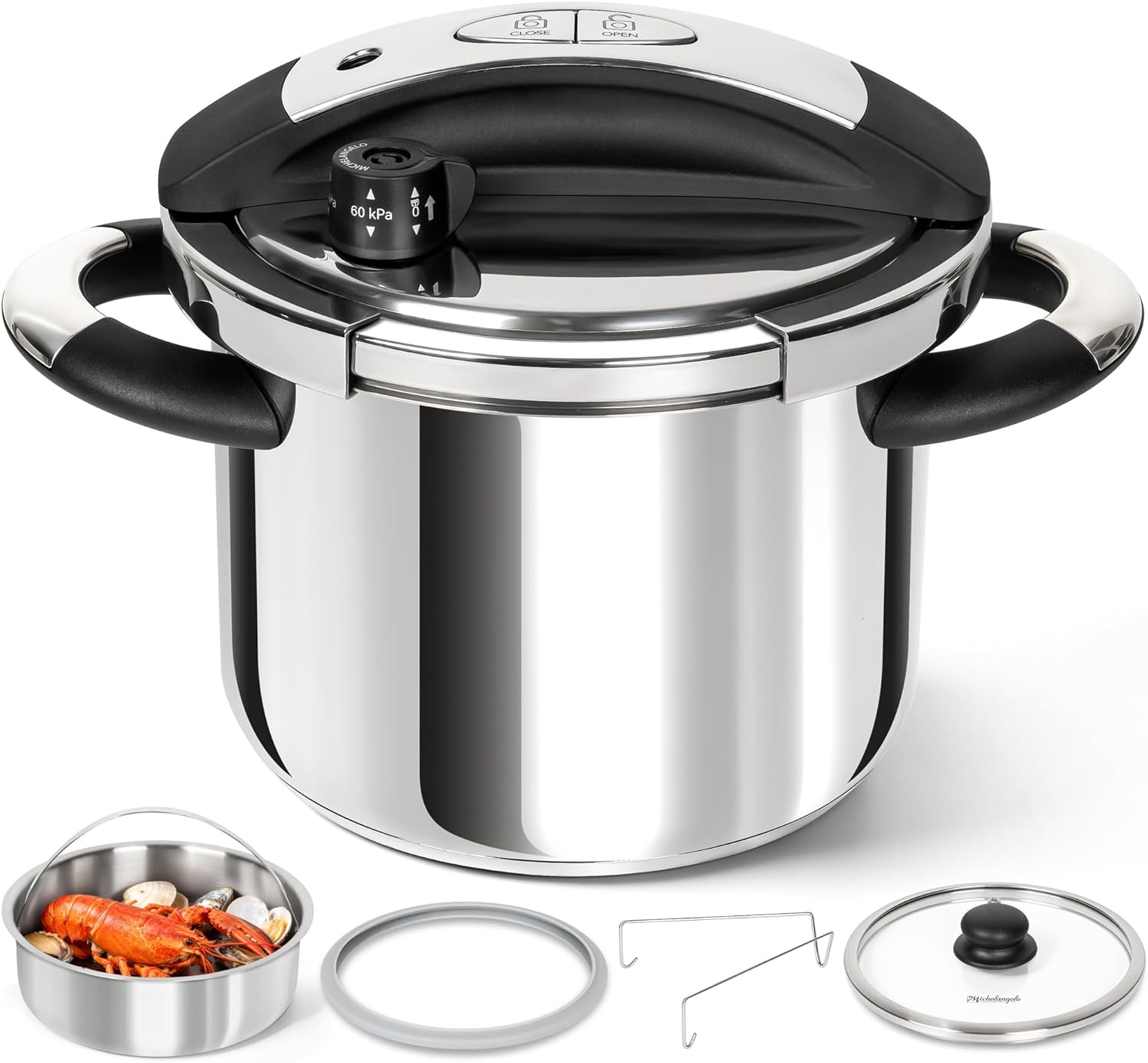
This stainless steel pressure cooker is built for fast, everyday stovetop cooking and aims to replace longer braises, soups, and beans with shorter, nutrient-preserving runs. The one-touch push-button lid and push-to-seal closure make it easy to lock and open with one hand, and the cooker includes a glass lid, steamer basket, stand, and spare sealing gasket so you can steam vegetables, make broths, or pressure-cook tougher cuts. Manual control and a rotate-to-adjust pressure feel familiar to home cooks who like hands-on adjustment, while multiple safety functions and a robust locking system reduce worry during use. The mirror-finish stainless steel body is induction-ready and dishwasher-safe for the pot, and the removable sealing ring and pressure valve simplify cleaning. On the downside, control is manual rather than fully automated preset programs, so it requires more attention on the stovetop, and the unit is relatively heavy compared with lightweight aluminum alternatives. For cooks who prioritize durable, factory-quality stainless construction and simple mechanical controls, this is a practical, reliable pressure cooker for everyday family use.
Best for: Buyers who want a durable, induction-capable stovetop pressure cooker with straightforward mechanical controls and included accessories for regular family cooking and meal prep.
Less Ideal for: People who prefer electric programmable pressure cookers with automated presets or those who need a very lightweight, travel-friendly cooker.
- Durable stainless steel construction that is induction-ready
- One-touch push-button locking lid for easy single-hand operation
- Includes glass lid, steamer basket, stand, and spare sealing gasket
- Removable sealing ring and dishwasher-safe pot make cleaning easier
- Manual controls require active stovetop monitoring rather than set-and-forget presets
- Heavier stainless body is less portable than lightweight alternatives
Verdict: A solid, induction-ready stainless steel stovetop pressure cooker that delivers durable, no-nonsense performance for cooks who prioritize build quality and hands-on control.
KOCH SYSTEME CS 8.5-Quart Pressure Cooker

| Capacity | 8.5 quarts |
|---|---|
| Material | 18/10 stainless steel |
| Pressure settings | 100 / 60 / below 60 kPa |
| Compatible cooktops | Induction, gas, electric, ceramic |
| Special Features | Dishwasher Safe, Induction Compatible Base, Locking Lid |
The KOCH SYSTEME CS 8.5-quart pressure cooker is a heavy-duty stainless steel stovetop pot built for fast, everyday cooking. It works as a pressure cooker, steamer, and simmer pot and includes a steaming rack and glass lid for flexible use. Three pressure settings (100, 60, and below 60 kPa) let you tailor heat for tough meats, stews, or delicate foods, while the triple-layer encapsulated base promotes even heating on induction, gas, electric, and ceramic cooktops. Practical design touches include a one-hand locking lid, removable silicone sealing ring, and an easy-to-read steam whistle and pressure regulator that together support safe operation. The maker highlights an eight-point safety system that prevents pressure buildup unless the lid is locked and provides overpressure venting and anti-block protection. Cleaning is straightforward since the pot is dishwasher-safe (lid hand-wash recommended). Trade-offs are typical for stainless stovetop pressure cookers: it is bulky for small kitchens and requires learning the pressure settings and venting behavior compared with electric models, but it delivers durable, low-reactivity cooking for those prioritizing non-toxic materials and dependable performance.
Best for: Buyers who prioritize durable, non-reactive cookware and want a reliable stovetop pressure cooker with clear safety features for everyday family cooking.
Less Ideal for: Those who need a compact electric pressure cooker with automatic programs or frequent one-pot portability for very small kitchens should look elsewhere.
- 18/10 stainless steel construction avoids nonstick coatings and minimizes food-reactive surfaces
- Triple-layer encapsulated base provides even heating and induction compatibility
- One-hand locking lid and steam whistle simplify safe, single-person operation
- Three adjustable pressure settings let you match pressure to different foods
- Removable sealing ring and dishwasher-safe pot make cleanup easier
- Relatively large and heavy which may be awkward in small kitchens
- Lid should not be placed in the dishwasher which adds a manual cleaning step
Verdict: A robust, non-reactive 8.5-quart stainless steel pressure cooker that prioritizes safety and reliable induction-ready performance for home cooks focused on long-term durability.
Presto 6-Quart Stainless Pressure Cooker
| Capacity | 6 quarts |
|---|---|
| Material | Stainless Steel |
| Special Features | Dishwasher Safe, Induction Compatible Base, Locking Lid |
| Wattage | 1000 watts |
| Voltage | 220 volts |
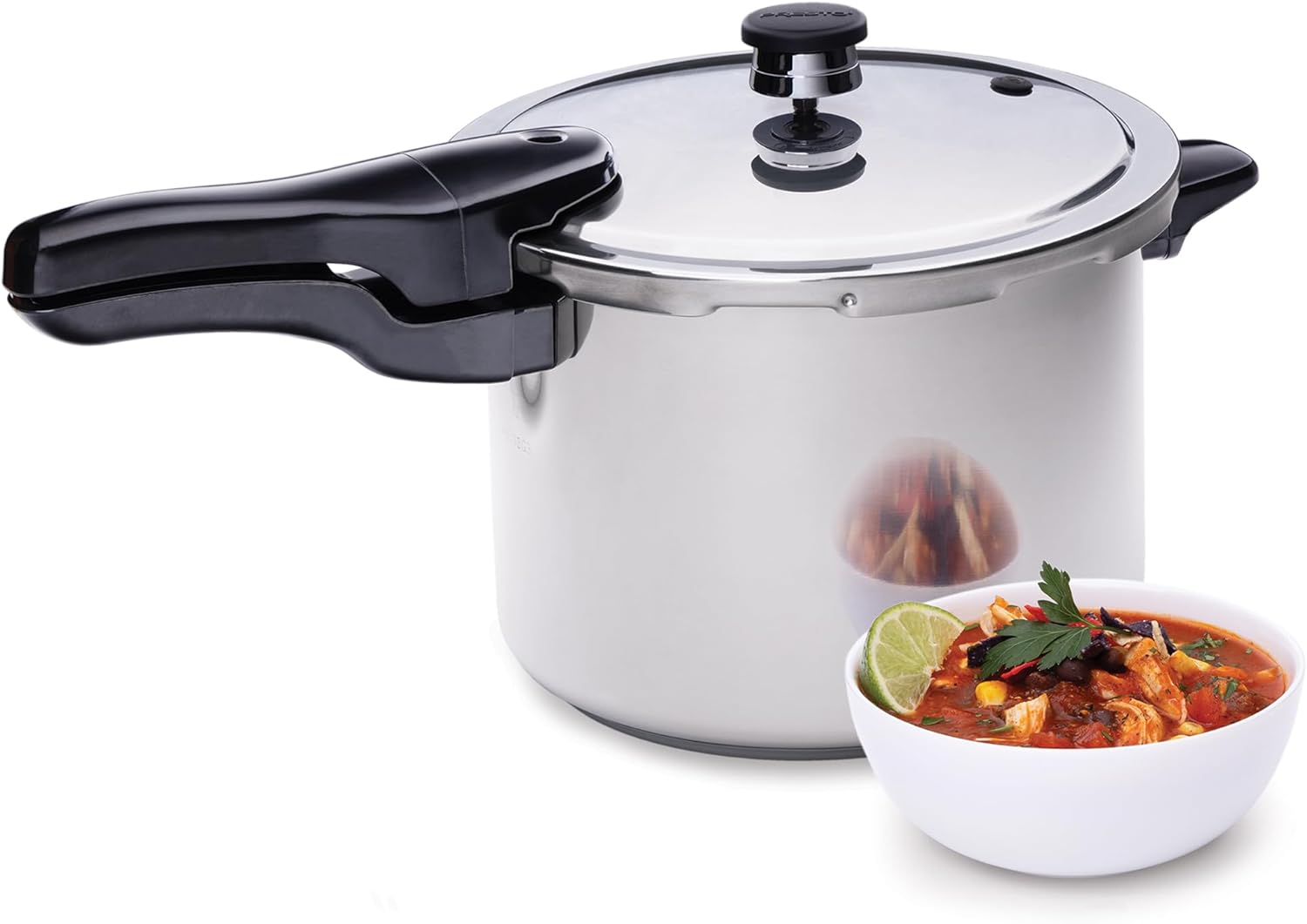
The Presto 6-quart stainless steel pressure cooker is a traditional stovetop cooker that speeds up braises, soups, and vegetables by trapping steam under a locking lid and maintained pressure. It is used like a conventional pot but seals for pressure cooking with a visible cover lock indicator, a pressure regulator that maintains safe cooking pressure automatically, and an overpressure plug for extra safety. The tri-clad base (aluminum sandwiched between stainless layers) delivers even heat on gas, electric, smooth-top, and induction ranges, and the included cooking rack lets you cook multiple foods separately. Practical benefits include faster cook times that tenderize inexpensive cuts, dishwasher-safe body parts for easier cleanup, and a 64-page recipe book to get started. Trade-offs are that it is a manual stovetop model rather than an electric, programmable unit, so you need to monitor heat to maintain pressure and use stovetop-compatible release methods; some small parts like the sealing ring and overpressure plug require hand washing. Overall it is a solid, durable option for cooks who want a straightforward, metal-only pressure cooker with proven safety features.
Best for: Buyers who prioritize durable, metal-only cookware and want a proven, safety-focused stovetop pressure cooker that works on induction and other ranges.
Less Ideal for: People who need an electric, fully automated pressure cooker with preset programs or those who prefer a hands-off, plug-and-play appliance.
- Tri-clad base for fast, even heating on induction and other stovetops
- Locking lid with cover lock indicator and overpressure plug for safety
- Dishwasher-safe body and removable parts simplify cleaning
- Includes cooking rack and 64-page recipe/instruction book
- Manual stovetop operation requires active heat adjustment rather than automated programs
- Some small components must be hand washed and maintained separately
Verdict: Choose this sturdy stainless steel stovetop pressure cooker if you want a factory-quality, non-coated pot that delivers fast, even cooking and proven safety features on induction and other ranges.
Choosing the Right Non-Toxic Induction Pressure Cooker: Key Factors to Consider
Interior Finish and Materials
The interior finish determines whether food contacts inert surfaces or coatings that may degrade over time. Stainless steel interiors are preferred for non-toxicity because they do not leach and are resistant to acidic foods. Some products use ceramic-like coatings that are touted as safer than older nonstick treatments; however, their long-term durability varies and you should check the manufacturer's material specification.
A thicker gauge of stainless or an uncoated finish typically resists scratching and staining better than thin metal or delicate coatings. Consider how you cook: frequent searing or stirring benefits from robust stainless. Also look for clear documentation about alloy grade and whether any adhesives or bonding agents are present at the seams.
Induction Compatibility and Base Construction
Induction cooking requires a magnetic base and even contact with the cooktop for efficient heat transfer. A multi-layer bottom with a magnetic stainless layer or an encapsulated disc improves responsiveness and prevents hot spots under pressure. Thicker, flatter bases will sit more stably on glass-top induction ranges and distribute heat more evenly during long pressure cycles.
If you plan to move the cooker on and off the hob frequently, check that the base resists warping. Also consider how the cooker size matches your induction element: an undersized base on a large element will heat unevenly and reduce energy efficiency.
Seal System and Safety Mechanisms
A reliable gasket and lid-lock system are essential for both safety and consistent cooking results. Gaskets should be easy to remove for cleaning and made from food-safe materials that resist odor retention. Look for designs with redundant pressure-release mechanisms and clear, visible pressure indicators so you can confirm when the unit is safe to open.
Maintenance access matters. If replacing a gasket is a frequent chore, confirm availability and ease of replacement. Avoid designs with hidden or hard-to-clean seal channels where food debris can accumulate and degrade the sealing surface over time.
Ease of Cleaning and Maintenance
Regular cleaning preserves both food safety and the cooker's lifespan. Interiors that tolerate manual scrubbing and dishwasher cycles simplify upkeep. Avoid interiors that require special cleaners or have delicate coatings prone to flaking when scrubbed. Handles, lid hinges, and pressure valves should be accessible for routine cleaning because trapped food and grease can compromise seals and moving parts.
Consider how disassembly works: lids that come apart easily for valve cleaning reduce the chance of blockages. Also check whether the base and exterior finishes show fingerprints or stains easily if appearance matters in your kitchen.
User Controls, Indicators, and Ergonomics
Clear, intuitive controls and visible pressure indicators reduce the learning curve and help prevent misuse. Ergonomic handles and a lid that locks and unlocks without excessive force make loading and unloading hot food safer. Mechanical indicators are often easier to read at a glance during cooking, while some models include simple visual cues for sealing status.
Think about how you plan to use the cooker. If you will be multitasking, straightforward controls that do not require constant attention are preferable. Also evaluate whether the lid orientation and handle placement work well with your range and kitchen layout.
Why Non-Toxic Construction Matters for Pressure Cooking
Pressure cooking concentrates flavors and often involves acidic ingredients that can react with weak or damaged interior finishes. Choosing a cooker with verified inert materials reduces the risk of unwanted leaching and helps preserve clean flavors. Non-toxic construction also tends to be easier to maintain because durable surfaces resist pitting and corrosion.
Beyond health concerns, build quality affects longevity and reliability. A well-made induction pressure cooker offers consistent performance over years, reducing the chance of unexpected failures that can interrupt meal prep.
- Acidic foods can accelerate degradation of inferior coatings
- Durable materials maintain taste neutrality over time
- Well-specified construction reduces long-term maintenance
Maintaining Seals and Valves for Long-Term Safety
Routine inspection and cleaning of gaskets and pressure valves are essential. After each use, remove and rinse the gasket if the design permits, and wipe valve pathways to clear food particles. Replace gaskets at the first sign of cracking or permanent deformation to preserve a reliable seal.
Keep a small schedule for maintenance tasks so you spot wear early. For example, inspect the gasket monthly if you pressure cook regularly and check the valve action before each heavy use.
- Clean gasket grooves to prevent buildup
- Test pressure indicators periodically for correct movement
- Store gaskets dry and avoid prolonged heat exposure when not in use
Optimizing Performance on Your Induction Range
Match the cooker diameter to your induction zone and avoid sudden, high-heat bumps that stress seals. Start with moderate heat to build pressure, then reduce to maintain steady cooking. Induction heats quickly, so watch initial pressure-up closely until you understand how a specific cooker behaves on your hob.
If you use multiple induction elements, choose the zone that offers the best contact area and stability. A stable base and centered placement reduce wobble and improve heat distribution under pressure.
- Center the cooker on the induction zone for even heating
- Avoid maximum power settings once pressure is reached
- Use consistent liquid volumes recommended for pressure cooking
Cleaning Tips That Protect Interior Finishes
Use nonabrasive cleaners and soft sponges to protect finishes, especially if the interior has a delicate ceramic-like coating. For stainless interiors, a paste of baking soda and water can remove stubborn stains without scratching. Avoid metal scouring pads unless the manufacturer explicitly permits them.
For valve and gasket maintenance, a small brush can clear channels without damaging parts. Dry all components thoroughly before reassembly to prevent mold or odor development in the seal.
- Soak burnt residues in warm soapy water before scrubbing
- Use gentle, nonchlorinated cleaners on coated interiors
- Rinse and air-dry gaskets to prevent odor retention
Sizing and Capacity Considerations
Select a size that fits typical meal volumes. Oversized cookers use more energy and may be harder to handle when full, while undersized units limit meal options. Consider how many portions you normally prepare and whether you will use the cooker for batch cooking or occasional meals.
Remember that physical capacity and usable cooking volume can differ. A cooker with a wide base and taller walls may behave differently on an induction hob than a compact, deep pot of the same nominal capacity.
- Match capacity to family size and meal plans
- Consider storage space and lid orientation when storing
- Factor in the total weight when filled for one-person handling
How We Chose the Best Non-Toxic Induction Pressure Cooker
We focused on products that prioritize inert interior finishes, such as high-grade stainless steel or ceramic-like coatings, and verified that construction methods avoid potentially harmful surface treatments. Durability under pressure, including lid lock systems and seal longevity, was a core filter because a compromised seal can cause uneven cooking and safety issues. Induction compatibility and base thickness were assessed to ensure efficient heat transfer on magnetic cooktops. We also considered ergonomics: handle design, lid operation, and clear pressure indicators that reduce user error. Ease of cleaning and maintenance factored into selection because trapped residue and scratched interiors can affect long-term safety. We excluded any model that relied on unknown or unlisted interior coatings or that lacked documented induction compatibility. Units with poor customer-reported longevity or absent pressure-relief redundancies were not included. The final shortlist therefore favors well-documented construction, reliably durable components, and straightforward user interfaces that matter in everyday pressure cooking.
Our full evaluation process is outlined in our review methodology.
FAQ
Are stainless steel interiors always non-toxic?
High-quality stainless steel interiors are generally inert and safe for food contact. The grade and manufacturing process matter, so look for documented stainless types and a lack of questionable bonding agents or coatings.
Can I use abrasive cleaners on the interior?
Abrasive cleaners can scratch delicate finishes and expose sublayers. For stainless steel, gentle scrubbing with nonabrasive pads and mild cleaners is usually sufficient. Avoid harsh scouring on coated surfaces unless the manufacturer permits it.
How often should I replace the gasket?
Replacement frequency depends on usage intensity. Inspect the gasket regularly and replace it when you see cracking, permanent deformation, or loss of elasticity. For frequent users, a yearly check is a good starting point.
Does induction cooking affect the lifespan of seals?
Induction itself does not harm seals, but faster heat-up cycles can stress components if you habitually use maximum power. Building pressure gently and avoiding repeated thermal shocks helps prolong seal life.
Is a ceramic-like interior safer than stainless steel?
Ceramic-like interiors can offer nonstick properties without traditional nonstick chemistries, but their long-term durability varies. Stainless steel remains the most proven inert option for heavy use and acidic cooking.
Final Verdict
Prioritize interior material and seal reliability when choosing a non-toxic induction pressure cooker. Durable stainless or well-documented inert finishes reduce chemical risks, while a robust gasket and clear pressure indicators protect safety and consistency. Balance capacity and base design to match your induction hob and cooking habits. Focusing on these tradeoffs will help you select a cooker that performs reliably and stays safe over years of use.