
Note: This article contains affiliate links. If you click on these links and make a purchase, we may earn a small commission at no extra cost to you. This helps support our research and content. Read our full affiliate disclosure here.
If you cook for one or two people or need a compact countertop solution, choosing a small pressure cooker that uses safe, non-reactive materials matters. A non-toxic small pressure cooker reduces the risk of unwanted coatings or metal leaching into food while still delivering the fast, hands-off cooking that pressure does best. This guide narrows the field to the top shortlisted options that balance material safety, size, and real-world usability. We evaluate build materials, sealing systems, and ease-of-cleaning to help you find a compact cooker that fits your kitchen and health priorities. Read on for the top picks and what to consider before you buy.
Top Picks at a Glance
| Best Overall The best all-around choice for most situations | MICHELANGELO 3.2QT Pressure Cooker |  |
| Best Quality Built to a higher standard if you want something more solid | Fissler Vitavit Premium 2.6 Qt |  |
| Best Value The sweet spot between price and what you get | CARORI Electric Pressure Cooker 3Qt |  |
| Best Budget The cheapest option that still gets the job done reliably | OLIXIS 3-Quart Electric Pressure Cooker |  |
| Top Rated A top-rated pick with lots of positive feedback | NEWBULIG 3-Quart Pressure Cooker |  |
MICHELANGELO 3.2QT Pressure Cooker

| Capacity | 3 liters |
|---|---|
| Material | Stainless steel |
| Special Features | Gas Stovetop Compatible |
| Control Method | Push Button |
This MICHELANGELO 3.2-quart pressure cooker is a compact stainless steel stovetop model designed for fast, everyday cooking. It uses a push-to-seal one-touch lid and mechanical controls to simplify sealing and pressure release, and it ships with a glass lid, steamer basket, stand, and a spare sealing gasket for flexible use. In practice it shortens cook times for beans, stews, rice, and broths while retaining nutrients, and the stainless steel interior avoids nonstick coatings that can raise concerns about chemical treatments. The removable gasket and pressure valve make cleaning straightforward and the pot is labeled dishwasher-safe for the body. Its manual operation and mechanical knob give control but require a bit of attention during pressure adjustments, and the 3.2-quart capacity suits singles or couples but is small for larger families or batch canning. Safety features and a robust locking mechanism help with stovetop use, though electric programmability and hands-off timers are not available on this model.
Best for: Buyers who want a compact, metal-only stovetop pressure cooker that prioritizes straightforward, low-chemical cooking and everyday convenience for one- to two-person meals.
Less Ideal for: Households that need large-capacity or fully automated electric pressure cookers with preset programs and timers should consider larger or electric models instead.
- Stainless steel construction with no nonstick coating, reducing exposure to coating-related chemicals
- One-touch push-to-seal lid and secure locking mechanism for easier stovetop use
- Includes glass lid, steamer basket, stand, and spare sealing gasket for versatile cooking
- Removable gasket and dishwasher-safe body simplify cleaning
- Manual mechanical controls lack electric timers or programmable automation
- 3.2-quart capacity is small for families or large-batch cooking
Verdict: A compact stainless steel stovetop cooker that delivers fast, low-chemical cooking for singles or couples who want a simple, durable pressure pot.
Fissler Vitavit Premium 2.6 Qt
| Capacity | 2.5 liters |
|---|---|
| Material | Stainless steel |
| Control Method | Touch |
| Operation Mode | Automatic |
| Special Features | Induction Compatible Base, Locking Lid |
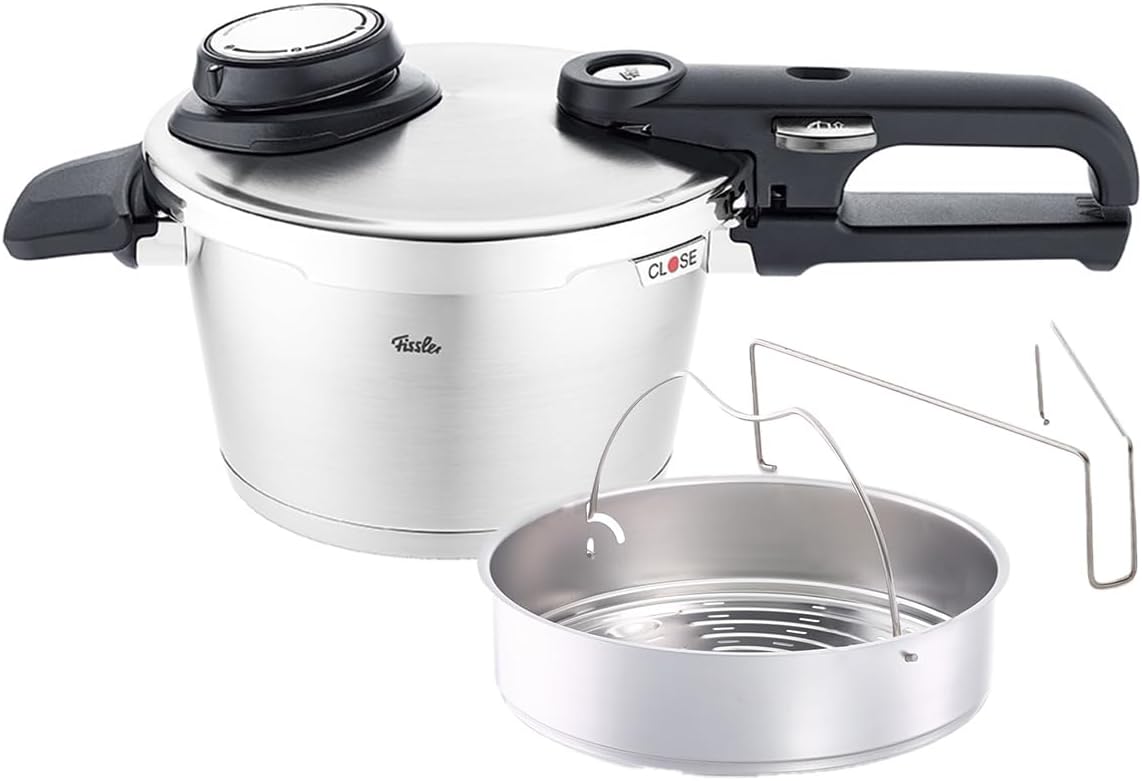
The Fissler Vitavit Premium is a compact, high-quality pressure cooker built from 18/10 stainless steel for everyday performance and long-term durability. It offers four cooking modes including three pressure levels and a pressure-free steam option, plus a steamer insert and tripod for multi-level cooking. Use it to speed up weeknight meals, make tender meats and stocks, or gently steam vegetables while retaining nutrients. Practical features include an induction-compatible Cookstar base for even browning, a clear pressure indicator, an audible locking click, and a controlled steam-release button that make operation straightforward and safe. The cooker is dishwasher-safe with removable parts for easier cleanup. At this size it is best for singles or small households and for cooks who value precise, fast results in a compact package; larger families will need a bigger model. Expect a premium build and reliable safety features but a higher upfront cost compared with basic budget cookers.
Best for: A home cook who prioritizes performance, safety, and long-term durability in a compact, non-toxic stainless steel cooker for quick, nutrient-preserving meals for one to two people.
Less Ideal for: Buyers who need larger capacity for frequent family-sized meals or those seeking the lowest-cost, no-frills pressure cooker should look elsewhere.
- Durable 18/10 stainless steel construction made in Germany for long service life.
- Four intelligent cooking settings including three pressure levels and pressure-free steaming for versatile results.
- Induction-compatible Cookstar base allows even heating and browning on all stovetops.
- Clear safety features including pressure indicator, audible locking click, and controlled steam release.
- Steamer insert and tripod enable multi-level cooking to save time and dishes.
- 2.6-quart capacity is small and may not suit larger households or batch cooks.
- Premium materials and features mean a higher purchase cost than basic pressure cookers.
Verdict: Choose the Vitavit Premium if you want a compact, factory-quality stainless steel pressure cooker built for fast, safe, nutrient-preserving cooking.
CARORI Electric Pressure Cooker 3Qt

| Capacity | 3 quarts |
|---|---|
| Wattage | 700 watts |
| Control Method | Push Button, Touch |
| Cooking Programs | Cook, Keep Warm, Reheat, Simmer, Steam |
The CARORI 3Qt electric pressure cooker is a compact multi-cooker aimed at singles or couples who want fast, small-batch meals without a complicated interface. It offers eight simple functions including saute, pressure cook, slow cook, rice, and steam, controlled by push buttons so you can set meals quickly. The included ceramic nonstick pot simplifies cleanup and is dishwasher safe, and the unit supports delay start and keep-warm for planned meal timing. At 700 watts it brings food to pressure quickly, cutting typical cook times while preserving flavor. Safety is a focus here with lid lock, sealing ring, pressure control, safety float, and overheat protection among the built-in safeguards. The trade-offs are its small 3-quart capacity, which limits batch sizes, and the lower wattage compared with larger models that can mean slightly longer high-volume heat-up times. For kitchens where counter space and minimal fuss matter, this cooker delivers reliable, everyday pressure-cooking performance in a non-toxic-feeling ceramic pot.
Best for: Buyers who want a compact, no-fuss pressure cooker for everyday small meals and who prioritize straightforward controls and easy cleanup.
Less Ideal for: Those who need to cook for large families, meal-prep large batches, or require higher wattage for faster large-volume cooking should choose a bigger model.
- Ceramic nonstick inner pot that is dishwasher safe and easier to clean
- Simple push-button controls with eight preset cooking programs
- Delay start and keep-warm functions for planned meals
- Multiple built-in safety features including lid lock, pressure control, and overheat protection
- 3-quart capacity is limited for larger families or batch cooking
- 700W power is lower than many larger pressure cookers, which can slow heat-up under heavy loads
Verdict: A compact, user-friendly 3-quart pressure cooker with a ceramic nonstick pot and strong safety features ideal for small households wanting simple, quick meals.
OLIXIS 3-Quart Electric Pressure Cooker

| Capacity | 3 quarts |
|---|---|
| Wattage | 700 watts |
| Controller Type | Digital |
| Operation Mode | Automatic |
| Special Features | Programmable |
The OLIXIS 3-quart electric pressure cooker is a compact, programmable multi-cooker for small households that handles rice, stews, steam, yogurt and more via ten one-touch presets. It uses high-pressure cooking to speed meals and includes a 24-hour delay start and automatic keep-warm so you can have hot food ready on your schedule. The inner pot has a food-grade ceramic nonstick coating for easier release and cleaning while the stainless steel outer shell gives a durable, scratch-resistant finish. Digital controls and built-in safety valves and heat sensors make operation straightforward and reassuring for everyday use. At 700 watts and a 3-quart capacity it is best for singles or couples and smaller batch cooking rather than large family meals, and the ceramic coating, while convenient, may require gentle utensils to avoid wear over time. If you want a small, affordable cooker that emphasizes simple presets and a nonstick ceramic pot, this model covers the essentials without extra complexity.
Best for: Buyers looking for an inexpensive, small-footprint pressure cooker that focuses on simple programmable presets and easy cleanup for everyday meals.
Less Ideal for: People who regularly cook for large families, need high-powered fast pressure builds, or want large batch canning capabilities should look for larger capacity or higher-watt models.
- Compact 3-quart size suited to small households or limited counter space
- Food-grade ceramic nonstick inner pot for easier food release and cleaning
- Ten smart presets with one-touch digital controls for hands-off cooking
- 24-hour delay start and automatic keep-warm for flexible meal timing
- Triple safety features including pressure release valves and heat sensors
- 3-quart capacity is too small for large families or big batch cooking
- Lower 700-watt power means longer pressure build times compared with higher-watt models
Verdict: A budget-friendly, small-capacity pressure cooker with a ceramic inner pot and simple presets that works well for singles or couples who want easy, non-toxic everyday cooking.
NEWBULIG 3-Quart Pressure Cooker

| Capacity | 3 quarts |
|---|---|
| Wattage | 700 watts |
| Controller Type | Digital |
| Special Features | Programmable |
The NEWBULIG 3-quart electric pressure cooker is a compact multi-cooker built for everyday meals in small kitchens. It offers ten preset programs including rice, meat, stew, yogurt, canning, and steam, all accessed via push-button digital controls and a programmable 24-hour delay start. The unit heats under 700 watts and uses high-pressure cooking to shorten cook times while its ceramic nonstick inner pot simplifies food release and cleanup. The stainless steel exterior looks durable and the cooker includes integrated safety features such as pressure release valves and heat sensors plus an automatic keep-warm mode to maintain temperature after cooking. Because it is a smaller 3-quart capacity it is best for singles, couples, or side dishes rather than large family batches, and the ceramic-coated inner pot will require some care to avoid abrasive cleaners that could shorten its life. For buyers prioritizing dependable operation and straightforward presets, this unit delivers solid, safe performance without complicated settings.
Best for: Buyers who want a reliable, straightforward small cooker for daily meals and easy cleanup with safety features prioritized.
Less Ideal for: Not a good fit for users who need to cook large family meals or want the fastest possible pressurizing times for very frequent heavy use.
- Ten preset programs for common recipes make one-touch cooking convenient
- Compact 3-quart size fits small households and limited counter space
- Ceramic nonstick inner pot simplifies food release and cleaning
- Triple safety protections including pressure release valves and heat sensors enhance safe operation
- 3-quart capacity limits batch sizes for larger households
- 700-watt power may result in longer pressurizing times compared with higher-watt models
Verdict: A dependable, safety-minded 3-quart pressure cooker that simplifies everyday meals for small households.
Choosing the Right Non-Toxic Small Pressure Cooker: Key Factors to Consider
Cooking Vessel Material
The material of the inner pot directly affects food safety and flavor. Look for vessels made from non-reactive metals such as stainless steel or fully vitrified ceramic linings. Avoid unspecified nonstick coatings and poorly documented enamel that can chip over time.
A durable, non-reactive material resists corrosion and prevents metal ions from leaching into acidic foods. It also influences heat distribution and sticking. For small cookers, a thicker stainless steel base or a ceramic-coated interior helps maintain even cooking while keeping the surface free of questionable chemicals.
Sealing and Pressure Control
Reliable gaskets and pressure release mechanisms are essential for both safety and consistent results. A tight sealing ring ensures the cooker reaches and holds proper pressure, while well-designed valves let you control pressure buildup and release without risk.
Check that the unit uses replaceable gaskets and has clear, redundant safety features such as pressure indicators, locking lids, and overpressure relief valves. For compact cookers, ease of removing and replacing the gasket matters because smaller seals can wear faster with frequent use.
Capacity Relative to Household Needs
Small pressure cookers come in capacities best suited to single cooks, couples, or small families. Choosing the right size prevents wasted energy and ensures portions are appropriate. Think about typical batch sizes for grains, soups, or stews when selecting capacity.
Also consider usable internal shape. Tall, narrow pots are good for small stews and beans, while wider, shallower pots may be easier to stir and clean. Match capacity to your most frequent recipes to avoid under- or overfilling the cooker.
Ease of Cleaning and Maintenance
Regular cleaning preserves both safety and performance. Models with simple, accessible interiors and removable seals reduce the chance that food residue will trap odors or degrade materials. Dishwasher-safe components can save time, but confirm that high-heat dishwasher cycles will not warp gaskets or damage finishes.
Pay attention to how easily valves and vents can be cleared of debris. A cooker that disassembles without tools for cleaning will generally last longer and maintain safer operation. Routine replacement parts like gaskets should be readily available to keep the unit non-toxic over its lifespan.
Safety Features and User Controls
Even compact pressure cookers must include robust safety systems. Look for mechanical locks that prevent opening under pressure, visible pressure indicators, and manual and automatic pressure-release options. Clear, tactile controls reduce user error, especially for inexperienced cooks.
Safety features also include vent protection to prevent clogging and thermal indicators to warn if the unit runs dry. For non-toxic concerns, a cooker that avoids hidden crevices where food can burn is preferable because burnt deposits can degrade linings and complicate cleaning.
Build Quality and Long-Term Durability
Solid construction reduces the likelihood of coating failure or mechanical breakdown that could expose underlying materials. Inspect seam quality, hinge robustness, and the way handles attach to the lid and body. Metals that feel thin or plasticky components that flex easily may signal shorter lifespan.
A well-built small pressure cooker will maintain its sealing performance and surface integrity through many cycles. Durable units are less likely to require early replacement of parts that could be hard to source, keeping the cooker safe and usable for longer.
Why Non-Toxic Materials Matter in Pressure Cooking
Pressure cooking concentrates heat and often uses acidic ingredients. If the cooking surface or liner is reactive or coated with unstable materials, there is a higher chance of chemical transfer into food. Choosing clearly specified non-reactive materials helps preserve flavor and reduces health concerns.
Non-toxic construction also supports longevity and better maintenance. For everyday small-cooker use, a robust stainless interior or a high-quality ceramic finish will stand up to frequent cleaning and avoid flaking or wear that exposes lower-grade materials.
- Non-reactive metals prevent metallic taste and leaching.
- Stable linings resist chipping and degradation.
- Clear material disclosure simplifies safe use and care.
Sizing Tips for Small Households
Estimate typical batch sizes for the meals you prepare. A small pressure cooker should be large enough for a typical stew, grain side, or soup for one to three people without overfilling the vessel. Pressure cookers require headspace, so do not fill beyond the recommended maximum.
Also think about storage. Small units should be easy to store but still comfortable to handle. Consider whether you want extra room for doubling recipes occasionally or prefer the most compact footprint possible.
- Leave recommended headspace to prevent clogging of vents.
- Choose a size that minimizes wasted energy when cooking small batches.
Routine Care to Keep Your Cooker Non-Toxic
Regular maintenance preserves material integrity. Rinse and wash the inner pot after each use, inspect gaskets for cracks, and clean vent paths to avoid pressure inconsistencies. Remove and replace worn seals promptly to maintain a proper seal and avoid overheating that could damage linings.
Avoid abrasive scrubbers on sensitive finishes. Use soft cloths or nylon pads and mild detergents for ceramic or stainless interiors. If parts are dishwasher-safe, confirm that the manufacturer permits dishwasher cycles for seals and lids to avoid premature wear.
- Inspect gasket and vent before every use.
- Use non-abrasive cleaners to protect linings.
- Replace consumable parts on a schedule based on use.
Cooking Performance Expectations for Compact Models
Small pressure cookers reach pressure more quickly and use less energy per batch than larger models. Expect slightly different timing for certain recipes; liquids boil off faster relative to the pot size, and heat distribution depends on the pot base thickness.
For dense items like dried beans, allow for soak times or slightly longer cook times recommended for small volumes. Some models will have presets or markings to guide you, but manual timing adjustments are common when scaling recipes down to a compact cooker.
- Smaller volumes may require adjusted cook times.
- Thicker bases help reduce hot spots in compact pots.
Replacement Parts and Long-Term Support
A non-toxic cooker is only safe if you can maintain it. Confirm that common replacement parts such as gaskets and pressure valves are available and straightforward to install. Having access to replacement parts reduces the temptation to use improvised repairs that could compromise safety.
Consider the simplicity of the lid and valve assembly. Units with easy-to-source, standardized parts make long-term upkeep simpler and keep the cooker operating on safe, known components rather than degraded or improvised fixes.
- Keep a spare gasket on hand for frequent users.
- Document part sizes or identifiers at purchase for easier replacement.
How We Chose the Best Non-Toxic Small Pressure Cooker
We focused on compact pressure cookers that prioritize safe, non-reactive cooking surfaces and reliable, user-friendly operation. Our selection filters favored small-capacity designs suitable for one to three servings, construction that avoids potentially harmful surface coatings, and hardware that supports long-term, safe use. Key evaluation criteria included the cooking vessel material and its corrosion resistance, the integrity of gasket and sealing systems, safety features that prevent overpressure and accidental opening, ease of disassembly for cleaning, and documented durability for daily use. We excluded units with unknown material disclosure, single-use accessory kits that do not affect primary safety, and any models lacking basic overpressure protections. The final list highlights compact cookers that scored well across these dimensions and represent practical, safer choices for small households and health-minded cooks.
Our full evaluation process is outlined in our review methodology.
FAQ
Are stainless steel interiors always non-toxic?
Stainless steel is widely regarded as non-reactive and safe for most cooking, but quality varies. Higher-grade stainless resists corrosion and leaching better. Check manufacturer material specifications and avoid units that do not disclose the steel grade or construction details.
Can I use a pressure cooker with a ceramic-coated pot safely?
High-quality ceramic coatings that are fully vitrified and free of heavy metals are generally safe. Avoid thin or poorly bonded coatings that can chip. Follow care instructions to prevent abrasive wear and inspect the surface regularly for damage.
How often should I replace the gasket on a small pressure cooker?
Gasket lifespan depends on frequency of use and cleaning practices. Inspect the gasket before each use for cracks or deformation and replace it as soon as wear appears. Many home users find replacing the gasket annually keeps sealing performance reliable.
Does smaller size change cooking times significantly?
Yes. Smaller volumes typically come to pressure faster and may require slightly shorter active cooking times for some recipes. Dense or large items may still need similar or slightly longer times because heat distribution differs in compact pots.
Can I safely use dishwasher cycles on non-toxic cookers?
Some parts may be dishwasher-safe, but high-heat cycles can degrade gaskets and certain finishes. Check the care instructions and, when in doubt, hand-wash seals and lids to extend their service life.
Final Verdict
Prioritize a small pressure cooker with a clearly specified non-reactive interior, reliable sealing, and straightforward maintenance. Material safety, gasket integrity, and accessible replacement parts are the key tradeoffs that determine long-term non-toxic performance. Focus on a size that fits your typical meal batches and a construction that stands up to routine cleaning. With those priorities in mind, you can confidently choose a compact cooker that delivers fast, safe, and healthy results.