
Note: This article contains affiliate links. If you click on these links and make a purchase, we may earn a small commission at no extra cost to you. This helps support our research and content. Read our full affiliate disclosure here.
If you need continuous hot water for an outdoor living area, secondary dwelling, or workshop, an outdoor gas tankless water heater can deliver on-demand heat without a bulky tank. Choosing the right unit matters because flow rate, freeze protection, and venting affect real-world performance and long-term reliability in exterior installations. This guide covers the top shortlisted outdoor gas tankless water heaters and explains the criteria we used to evaluate them, including flow capacity, cold-weather readiness, and installation considerations. Use the summaries below to match a unit to your household demand and climate, then read the buying guidance to refine your choice.
Top Picks at a Glance
| Best Quality Built to a higher standard if you want something more solid | Rinnai RX180iN 10 GPM Tankless Water Heater |  |
| Best Value The sweet spot between price and what you get | GASLAND BE528 20L Propane Tankless | 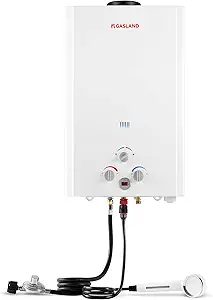 |
| Best Budget The cheapest option that still gets the job done reliably | forimo 10L Propane Tankless Heater |  |
| Top Rated A top-rated pick with lots of positive feedback | Rheem RTG-84XLN-3 Tankless Gas Heater |  |
| Most Popular A crowd favorite that many people choose with confidence | CAMPLUX AY132 Portable Tankless Heater |  |
Rinnai RX180iN 10 GPM Tankless Water Heater

| Power Source | Dual-Fuel (Natural Gas or Propane) |
|---|---|
| Flow Rate | 10 gpm |
| Heat Output | 180000 british thermal units |
| Efficiency | 0.98 UEF |
| Maximum Temperature | 140 °F |
The Rinnai RX180iN is a compact, performance-focused condensing tankless water heater designed to deliver continuous hot water for multiple fixtures. It supports both natural gas and propane via a Smart Sense gas control, and the Versa Vent option lets you mount it indoors or outdoors, which is handy for flexible placement. With a rated flow of 10 GPM and 180,000 BTU heat output, it can handle several simultaneous draws and reaches a maximum temperature of 140 F. The unit emphasizes efficiency with a UEF of 0.98 and includes practical features like an easy interface and Quick Flush to simplify maintenance. It is sized to save space compared with tanks and is Wi-Fi capable with an optional module for remote monitoring. Expect professional installation and periodic flushing despite simplified access. The main trade-offs are the need for proper venting and fuel hookup for high output, and the optional smart module and professional installation add to total cost and setup complexity.
Best for: Buyers who prioritize high continuous hot-water performance and operating efficiency and need a flexible outdoor-ready solution for several simultaneous fixtures.
Less Ideal for: If you want a plug-and-play electric or very low-maintenance water heater with minimal installation work, a conventional tank or electric on-demand model would be a better fit.
- High condensing efficiency (UEF 0.98) for lower energy use
- Convertible to natural gas or propane for installation flexibility
- Compact wall-mounted design that frees up space compared with tanks
- 10 GPM flow and 180,000 BTU output suitable for multiple simultaneous fixtures
- Quick Flush and user interface that simplify maintenance and setup
- Requires professional installation and appropriate venting for outdoor/indoor use
- Wi-Fi control requires a separately sold module
Verdict: Choose the RX180iN when you need a compact, high-output condensing unit that delivers efficient, reliable hot water for multiple simultaneous demands and outdoor installation.
GASLAND BE528 20L Propane Tankless
| Power Source | Propane |
|---|---|
| Flow Rate | 5.28 gpm |
| Maximum Temperature | 176 °F |
| Maximum Pressure | 110 psi |
| Capacity | 5.28 gallons |
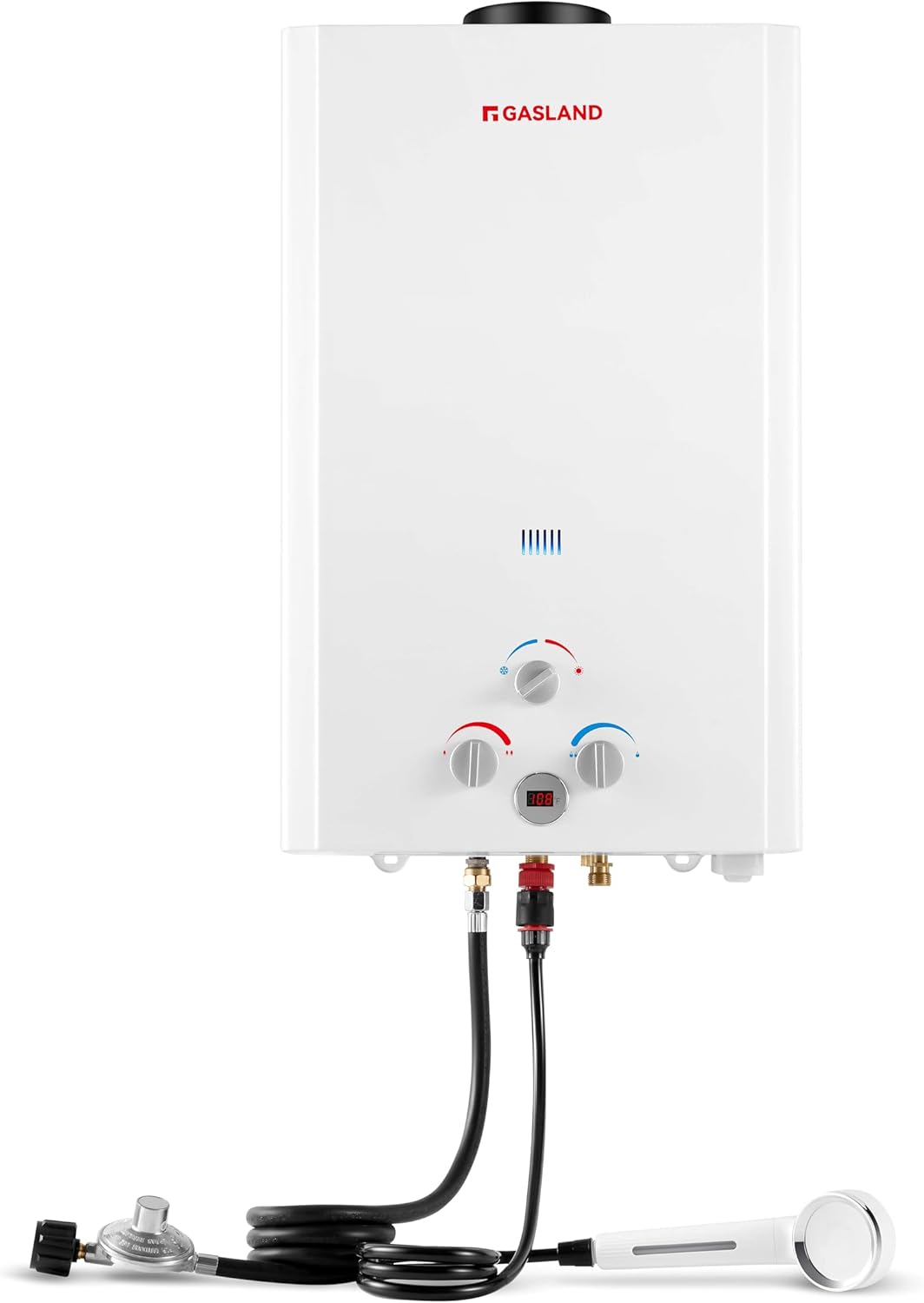
The GASLAND BE528 is an outdoor propane tankless water heater designed to provide on-demand hot water for mobile homes, RVs, outdoor kitchens, and off-grid setups. It runs on a standard 20 lb. propane tank and uses two D-cell batteries for electronic ignition and the LED temperature display. In use it supplies up to 5.28 gallons per minute and a maximum temperature near 176°F, with a high heat output rating to support multiple outdoor tasks like showering, washing gear, or rinsing animals. The unit includes a wall-mount design, a CSA-certified gas regulator and hose, a shower head and mounting hardware, and several built-in safety features such as overheat protection, low-flow and flame-failure shutoff, and pressure protection. Practical benefits include simple portable installation, a readable digital temperature readout, and robust safety systems for outdoor use. Important limitations are that it is intended for outdoor installation only, is not rated for high-altitude or very windy sites, and depends on propane and batteries rather than mains power.
Best for: Buyers who want a practical, ready-to-install outdoor hot water source for RVs, cabins, or outdoor kitchens and prioritize reliable on-demand output and simple setup.
Less Ideal for: People needing an indoor or permanently hardwired water heater, those at high elevation or in exposed windy locations, or buyers who prefer electric-powered units.
- High flow rate up to 5.28 gpm suitable for showers and outdoor cleaning
- Electronic ignition with LED temperature display for easy temperature monitoring
- Includes regulator, hose, shower head and mounting hardware for quicker setup
- Multiple safety protections including overheat, low-flow and flame-failure shutoffs
- Designed for outdoor use only and prolonged rain exposure can damage internal components
- Not suitable for high altitude locations above 3300 feet and strong wind conditions
- Requires a 20 lb propane tank and D-cell batteries so it is not hardwired
Verdict: If you need a practical, high-flow outdoor propane unit that delivers reliable on-demand hot water with easy setup and safety features, the GASLAND BE528 is a strong choice.
forimo 10L Propane Tankless Heater

| Power Source | dc |
|---|---|
| Maximum Temperature | 167 °F |
| Heat Output | 68000 british thermal units |
| Capacity | 10 liters |
This compact propane tankless heater is built for outdoor showers, pet washing, and remote cabin use where a small, portable hot water source is needed. It runs on propane and is rated to deliver about 2.64 gallons per minute with a maximum temperature rise up to 167°F, and the unit includes a CSA-approved regulator, folding handles, and a digital display. The package ships with a high-pressure shower head, a pet shower head, extension hoses, and a 2 GPM water pump with dual power leads so you can run it from a vehicle or battery setup. Safety features such as flame failure protection, anti-freeze protection, and overheating protection are useful when using the unit outdoors. Because it is portable and intended for outdoor use, expect lower continuous flow versus large residential units and plan for safe propane setup and ventilation. For buyers who want a self-contained, accessory-rich outdoor heater without complex installation, this model is a practical budget choice.
Best for: Buyers who need an inexpensive, self-contained source of hot water for camping, boating, or off-grid cabins and value a complete accessory kit and simple setup over household-level flow.
Less Ideal for: Homeowners seeking a full-rate replacement for indoor residential tankless systems or anyone needing high continuous hot water for multiple simultaneous fixtures.
- Portable design with folding handles and included shower and pet shower heads
- Includes CSA-approved gas regulator and multiple plumbing/pump accessories out of the box
- Dual-power 2 GPM water pump with vehicle and clip leads for flexible off-grid use
- Built-in safety features: flame failure, anti-freeze, and overheating protection
- Flow rate and output suitable for single-person outdoor showers but below residential tankless capacity
- Operates only on propane so requires safe fuel setup and ventilation
Verdict: A budget-friendly, accessory-packed portable propane heater that delivers ready-to-use hot water for outdoor and off-grid showers.
Rheem RTG-84XLN-3 Tankless Gas Heater

| Power Source | Natural Gas |
|---|---|
| Flow Rate | 8.4 gpm |
| Maximum Temperature | 140 °F |
| Heat Output | 180000 british thermal units |
| Wattage | 132 watts |
The Rheem RTG-84XLN-3 is an outdoor, non-condensing natural gas tankless water heater built to supply continuous hot water for multi-bath homes. It delivers up to 8.4 gpm with a 180,000 BTU burner and a digital LED control that allows precise temperature adjustments to avoid cold-water bursts. Key features for everyday use include Hot Start Programming to keep the unit ready between back-to-back draws, an Overheat Film Wrap for added heat-exchanger protection, and built-in freeze and flame-failure protections for outdoor mounting. Its compact wall‑mount design saves floor space and the Water Saving setting reduces wasted cold water during startup. Expect energy savings compared with a conventional 50-gallon tank thanks to a reported 0.82 UEF and reduced NOx emissions. Important practical notes: this is a non-condensing outdoor model so it requires certified professional installation and appropriate gas supply; it is optimized for outdoor exposure rather than indoor venting and does not include condensing efficiency gains. The unit comes with a long heat-exchanger warranty that supports its reliability-focused design.
Best for: Buyers seeking a dependable outdoor tankless heater that delivers steady hot water to multi-bath homes and prioritizes long-term reliability and protective features.
Less Ideal for: Homeowners who need the highest possible fuel efficiency or plan to install the heater indoors should consider condensing or indoor-rated alternatives.
- High continuous flow of 8.4 gpm suitable for multiple simultaneous showers
- Powerful 180,000 BTU output for consistent temperature at higher flow rates
- Hot Start Programming reduces cold-water bursts between uses
- Built-in safety features including overheat protection, freeze protection, and flame-failure protection
- Compact wall-mount design saves floor space and allows flexible outdoor placement
- Non-condensing design means lower max efficiency than condensing models
- Outdoor-specific model requires suitable exterior installation and professional hookup
Verdict: Choose the Rheem RTG-84XLN-3 when you want a robust, reliability-focused outdoor tankless gas heater that delivers steady hot water for larger households.
CAMPLUX AY132 Portable Tankless Heater

| Flow Rate | 1.32 gpm |
|---|---|
| Heat Output | 34,000 BTU |
| Power Source | Propane + 2 D batteries |
| Water Pressure Range | 3-130 PSI |
| Capacity | 5 liters |
The CAMPLUX AY132 is a lightweight outdoor tankless water heater that runs on liquid propane and two D batteries for ignition, delivering up to 1.32 gallons per minute for on-demand hot showers or washing tasks. It is built for camping, RVs, cabins, and other off-grid uses and includes a folding handle, wall-mount options, a 5-foot gas regulator, shower head and hose, and simple hookups so you can have hot water quickly. Safety features such as anti-freeze protection, flame-failure and overheat protection, and low-flow/low-pressure startup (works from about 3.0 PSI) make it practical where water pressure is limited or conditions are cold. Because it is rated at roughly 34,000 BTU and a maximum output temperature near 114°F, expect steady warm showers but not high-flow, whole-house performance; the 1.32 GPM flow suits one-person outdoor showers, pet rinsing, and dishwashing. Setup is straightforward and the CSA certification plus multiple built-in protections reduce safety concerns, though you will need to manage propane supply and battery replacement for continued use.
Best for: Buyers who want a proven, safety-focused portable propane heater for camping, RV trips, or remote cabins and value social validation and built-in protections over high flow rates.
Less Ideal for: People seeking whole-house or multiple simultaneous hot-water outlets, higher flow rates, or electric-powered models for indoor installation should look elsewhere.
- Runs off propane and two D batteries so no mains electricity is required
- Low-pressure start works with gravity feeds or small 12V pumps (minimum ~3 PSI)
- Compact and lightweight with folding handle for easy transport and mounting
- Multiple safety protections including overheat, flame-failure, and anti-freeze
- Includes regulator, shower head, hose, and basic installation hardware
- Maximum 1.32 GPM flow limits use to single-person showers and light tasks
- Top temperature around 114°F may be insufficient in very cold inlet conditions
Verdict: Choose the CAMPLUX AY132 if you need a lightweight, CSA-certified propane tankless heater that reliably delivers on-demand hot water for solo outdoor showers and off-grid use.
Choosing the Right Outdoor Gas Tankless Water Heater: Key Factors to Consider
Flow Rate and Temperature Rise
Flow capacity determines how many fixtures you can run at once and how strong the spray will feel. Look for specs that show gallons per minute at realistic incoming cold-water temperatures for your climate. A unit that lists a high GPM at room temperature may drop significantly when inlet water is very cold.
Temperature rise is the difference between incoming water temperature and desired output temperature. Calculate the expected inlet temperature for your region and choose a heater whose rated flow at that temperature meets your peak simultaneous demand. Under-sizing leads to lukewarm showers when multiple fixtures run.
Freeze Protection and Weather Resistance
Outdoor-installed units face freezing cycles, wind, and precipitation. Effective freeze protection can include internal heating elements, condensate management, and frost-preventing control logic. Weatherproof housings and gasketing prevent moisture ingress and reduce corrosion risk.
Consider how the unit handles standing water in pipes, condensate run-off, and sensors that might be exposed to the elements. Robust weather resistance reduces service calls and the need for additional protective enclosures.
Fuel Delivery and Combustion Efficiency
Consistent gas delivery and efficient combustion influence both output and operating cost. A heater that maintains steady combustion under varying gas pressures and altitude changes will provide more reliable hot water. Look for units with modulating burners that adjust flame size to match demand and maintain temperature.
Higher thermal efficiency means more of the gas energy becomes hot water instead of being lost as exhaust. Efficient combustion reduces the length of time the burner runs at high output, which can improve lifespan and reduce fuel consumption.
Installation Requirements and Venting
Outdoor units simplify venting compared with indoor models, but clear installation requirements still matter. Check minimum clearances from walls, rooflines, and nearby openings, and confirm gas line sizing and pressure requirements. Some units need a dedicated gas regulator or larger supply lines for peak output.
Mounting options and access for condensate drainage influence where you can place the unit. Consider whether you have suitable wall space near required utilities and whether the installer will need to run new gas lines or water piping.
Maintenance, Serviceability, and Controls
Regular maintenance keeps tankless heaters operating efficiently. Easy access to filters, burner assemblies, and diagnostic ports reduces labor time for routine service. Units with accessible front panels and straightforward control interfaces make troubleshooting simpler.
Built-in diagnostics and clear error codes speed repairs and help homeowners or technicians identify issues quickly. Consider how easy it is to flush the heat exchanger and replace consumable parts when assessing long-term ownership costs.
Sizing Your Outdoor Unit for Real-World Use
Sizing starts with listing simultaneous fixtures you expect to run at peak. Add up typical fixture flow rates to estimate required gallons per minute under your expected inlet temperature. Remember that many fixtures do not operate at their maximum advertised flow all the time, but plan for worst-case simultaneous use if comfort is a priority.
Account for the inlet water temperature in winter in your region. Use local groundwater temperature charts or a simple rule of thumb for your climate zone. Then match a heater's rated flow at that temperature rather than at a standard 60°F lab condition.
- Calculate combined GPM for showers, sinks, and appliances you might run together
- Adjust required capacity downward if you will restrict fixture flow with low-flow aerators
- Factor in temperature rise: colder inlet water reduces available GPM at a fixed output temperature
Installation Tips for Outdoor Placement
Select a mounting location with proper clearance from operable windows, doors, and air intakes as required by installation codes. Elevate the unit if local conditions risk splash or flood exposure, and ensure the wall substrate and fasteners can support the heater weight.
Provide unobstructed access for maintenance and condensate drainage. If your area has freezing temperatures, confirm that piping runs are insulated and sloped to avoid standing water. Follow the manufacturer guidance on separation from combustible materials and easily routed gas lines.
- Mount at a height that keeps controls and indicators reachable
- Use corrosion-resistant fittings for coastal or high-humidity installations
- Ensure condensate can drain safely away from foundations and walkways
Cold-Climate Considerations
Not all outdoor models handle sub-freezing conditions the same way. Some incorporate active freeze prevention with internal heaters or controlled recirculation, while others rely on passive insulation and proper drainage. For climates with prolonged freezes, choose a unit with explicit low-temperature ratings and fail-safe strategies.
Also consider where supply lines enter the structure. Minimizing exposed pipe length and placing shutoff valves in heated spaces can reduce freeze risk. Regular winter maintenance and periodic visual inspections can catch ice buildup or gasket wear before failure.
- Prefer units with documented freeze-protection systems in consistently cold areas
- Protect external shutoffs and valves with insulated covers
- Plan for occasional manual winterization if the unit will be unused for extended cold spells
Energy Use and Operating Cost Drivers
Two main factors drive operating cost: how often the unit fires and how efficiently it converts gas to hot water. Modulating burners match output to demand and reduce cycling losses. Higher thermal efficiency ratings mean less fuel per gallon produced, especially during partial-load conditions.
Behavioral choices like lowering thermostat settings and installing low-flow fixtures can significantly reduce runtime. Also weigh expected maintenance needs that can affect long-term efficiency, such as descaling in hard-water areas.
- Lower setpoint temperatures reduce natural gas consumption
- Regular descaling preserves heat-exchange efficiency in hard-water regions
- Consider adding a small recirculation loop if long waits for hot water waste energy
Common Installation Pitfalls to Avoid
Underestimating gas line requirements is a frequent issue. A unit that needs a higher BTU feed may not reach full output on an undersized or low-pressure supply. Verify supply pressure and pipe sizing during planning to avoid performance shortfalls after installation.
Another pitfall is poor condensate routing. Insufficient slope or restricted drains can cause condensate to pool and freeze, damaging components. Finally, do not assume every outdoor space is appropriate; exposure to direct spray, salt air, or heavy debris loads may require additional protection.
- Confirm gas pressure and pipe size before finalizing the unit selection
- Provide a dedicated condensate drain with proper slope
- Avoid locations exposed to direct spray from sprinklers or lawn equipment
How We Chose the Best Outdoor Gas Tankless Water Heater
We focused on the characteristics that most directly affect performance and long-term use for outdoor gas tankless water heaters. Key evaluation criteria included sustained flow rate at realistic incoming water temperatures, built-in freeze protection and weatherproofing, combustion efficiency and fuel delivery stability, venting and mounting flexibility for exterior use, and serviceability including access to controls and replaceable components. We prioritized units with clear specifications so we could judge capacity against common domestic uses such as showering and simultaneous fixture use. We excluded models lacking documented cold-weather safeguards or with ambiguous flow-rate data. Units intended only for indoor installation or that required extensive custom enclosures were not considered. The resulting list balances reliable hot-water output, durability in outdoor conditions, and practical installation requirements that matter to homeowners and installers.
Our full evaluation process is outlined in our review methodology.
FAQ
How do I know what flow rate I need for my outdoor setup?
Estimate the combined flow of fixtures you expect to run simultaneously, then choose a unit whose rated GPM at your region's inlet temperature meets or exceeds that total. Account for temperature rise because colder inlet water reduces available flow.
Will an outdoor unit freeze in winter?
Many outdoor units include built-in freeze protection, but capabilities vary. For areas with prolonged sub-freezing temperatures, pick a model with explicit low-temperature safeguards and follow installation guidance for piping and drainage.
Can an outdoor tankless heater be installed on any exterior wall?
Not always. You need to meet clearance and mounting requirements, access gas and water connections, and ensure condensate drains properly. Structural support, exposure to elements, and local code restrictions also affect placement choices.
How often should I schedule maintenance?
Typically, annual maintenance is recommended, including descaling in hard-water areas and inspecting filters and burners. Frequency depends on water hardness, usage patterns, and the unit's diagnostic indicators.
Do outdoor units need special venting?
Outdoor models generally simplify venting because they are designed to operate in open air, but you still must follow manufacturer clearance and exhaust routing rules. Proper air supply and unobstructed exhaust areas are important for safe combustion.
Final Verdict
Selecting the right outdoor gas tankless water heater comes down to matching flow capacity to real household demand and ensuring the unit can survive local weather conditions. Prioritize models that provide reliable flow at your inlet temperature, robust freeze protection if you face cold winters, and clear installation requirements that fit your site. Weigh tradeoffs between higher capacity and fuel efficiency, and confirm gas supply and condensate routing during planning. With the right sizing and proper installation, an outdoor tankless heater can deliver steady hot water with minimal footprint and dependable year-round performance.