
Note: This article contains affiliate links. If you click on these links and make a purchase, we may earn a small commission at no extra cost to you. This helps support our research and content. Read our full affiliate disclosure here.
If you want lab-caliber snapshots without leaving the house, choosing the right photo printer matters. Under $200 you'll find compact models designed for casual photographers, families, and hobbyists that prioritize color accuracy, simple operation, and reasonable running costs. This guide shortlists the top options in the under-$200 category and explains the practical tradeoffs you should expect between print speed, per-photo cost, and portability. Below you'll find our top picks and concise evaluation criteria to help you match a printer to how you actually print and store photos.
Top Picks at a Glance
| Best Overall The best all-around choice for most situations | Liene 4×6 Photo Printer DHP513 |  |
| Best Quality Built to a higher standard if you want something more solid | Canon SELPHY CP1500 |  |
| Best Value The sweet spot between price and what you get | Canon IVY 2 Mini Photo Printer |  |
| Best Budget The cheapest option that still gets the job done reliably | Nelko PP01 Photo Printer |  |
| Top Rated A top-rated pick with lots of positive feedback | Fujifilm INSTAX MINI Link 2 |  |
| Most Popular A crowd favorite that many people choose with confidence | KODAK Dock Plus PD460 |  |
| Best Seller A high-volume bestseller chosen again and again | Epson EcoTank ET-2800 |  |
Liene 4×6 Photo Printer DHP513

| Printer Type | Dye Sublimation |
|---|---|
| Maximum Media Size | 4 x 6 inch |
| Maximum Sheet Capacity | 20 |
| Printer Connectivity Type | USB, Wi-Fi |
| Maximum print Resolution Color | 300 x 300 dpi |
The Liene DHP513 is a small, app-controlled 4×6 dye-sublimation photo printer that targets casual home and event use where quick, durable color prints are needed. It connects via built-in Wi-Fi hotspot or USB Type-C so you can print directly from iPhone, Android, Windows, or Mac without joining a separate network, and the companion app offers simple editing, borders, and filters before printing. Dye-sublimation output produces laminated, water- and scratch-resistant photos with vivid color at a 300 x 300 dpi resolution, and the unit ships with cartridges and photo paper so you can start printing right away. Paper loads into a single cassette and the tray holds up to 20 sheets for short print runs; a typical 4×6 print takes about a minute. Expect the best results for snapshots and keepsakes rather than high-end professional enlargements because resolution and single-tray capacity limit throughput and fine-detail output. If you want a compact, user-friendly printer to turn phone pictures into durable 4×6 prints quickly, this handles that role well.
Best for: Buyers who want an easy-to-use, portable 4×6 printer to turn smartphone photos into durable keepsakes and party prints with minimal setup and app-based editing.
Less Ideal for: Photographers who need high-resolution archival prints, high-volume users who require large paper capacity, or anyone prioritizing professional-grade color accuracy.
- Dye-sublimation prints with laminated surface that resists water, scratches, and fading
- Built-in Wi-Fi hotspot plus USB Type-C for direct printing from phones and computers
- Includes cartridges and photo paper starter pack so it is ready to use out of the box
- App offers basic editing, filters, and print status for quick customization
- Print speed and 300 x 300 dpi resolution are modest, making it less suitable for pro-level detail
- Single tray capacity (20 sheets) limits longer continuous print jobs
Verdict: A compact, user-friendly 4×6 dye-sublimation printer that delivers durable, ready-to-share photo prints from phones with minimal fuss.
Canon SELPHY CP1500

| Printer Type | Dye Sublimation |
|---|---|
| Maximum Media Size | 4 x 6 inch |
| Print Resolution | 300 x 300 dpi |
| Printer Connectivity Type | Wi-Fi |
| Wattage | 7.2 watts |
The Canon SELPHY CP1500 is a small, travel-friendly dye-sublimation photo printer built for quick, durable snapshots. It prints classic 4×6 photos plus square and mini sticker sizes using dedicated paper and an ink cassette, and outputs dry, water-resistant prints suitable for albums and crafts. Connectivity is flexible: print over Wi‑Fi or AirPrint, from a USB flash drive, camera memory card, or the Canon/SELPHY Layout apps, and the 3.5-inch LCD lets you preview and apply simple edits and effects before printing. Print quality is serviceable for everyday photos at 300 x 300 dpi with vibrant color and three finish options, and Canon claims prints last up to 100 years in optimal storage. The CP1500 is aimed at occasional high-quality snapshots rather than high-volume document work: single-sheet capacity and relatively slow per-page throughput mean you reload paper and wait between prints. An optional battery pack makes it genuinely portable, but running costs depend on the proprietary paper and ink cassettes required for the dye-sublimation process.
Best for: Buyers who want a compact, photo-focused printer for high-quality snapshots and creative prints to use at events, travel, or home projects and who prioritize print appearance over speed or page yield.
Less Ideal for: Users who need a fast, high-volume printer for documents or bulk photo printing should choose a different class of printer built for throughput and lower per-page cost.
- True portable design that works with an optional battery for on‑the‑go printing
- Multiple connection options including Wi‑Fi, AirPrint, USB and memory card support
- Prints are instantly dry, water resistant, and available in glossy, semi‑gloss or satin finishes
- 3.5-inch LCD and companion apps let you preview, edit, and create collages or mini stickers
- Slower per-photo throughput and very small paper cassette make it poor for high-volume printing
- Uses proprietary paper and ink cassettes which affect ongoing cost and supply
Verdict: Choose the CP1500 when you want a genuinely portable photo printer that produces durable, camera‑ready 4×6 and mini prints with flexible wireless and memory‑card connectivity.
Canon IVY 2 Mini Photo Printer

| Printer Type | Zink Technology |
|---|---|
| Print Size | 2 x 3 in |
| Maximum Print Resolution Color | 313×512 dots_per_inch |
| Connectivity | Bluetooth |
| Maximum Sheet Capacity | 10 |
The Canon IVY 2 is a compact portable photo printer that uses ZINK zero-ink technology to produce 2 x 3 inch peel-and-stick prints directly from a smartphone or tablet using the Canon Mini Print app and Bluetooth 5.0. It is designed for casual, on-the-go use—load up to 10 sheets, pair your device, apply filters, frames or stickers in the app, and print a glossy sticker photo in under a minute. Notable practical features include fast USB-C charging (full charge in roughly 45 minutes), a built-in sticky back on each print for easy placement, and app editing tools for quick customization. Image quality is tuned for improved skin tones and contrast but is limited by the ZINK 313×512 dpi resolution, so prints look best for small keepsakes, scrapbooks, and decorations rather than gallery-grade photos. Expect slow per-print times and a modest sheet capacity, so it is not ideal for large batches. The printer is straightforward to set up and convenient when you want immediate physical photos without ink cartridges.
Best for: Buyers who prioritize portability and easy, no-ink instant prints for parties, scrapbooks, and casual keepsakes and value quick setup and app-based editing.
Less Ideal for: Photographers or users who need high-resolution, large-format prints or frequent bulk printing should choose a higher-capacity or dye-sublimation model instead.
- Pocketable and highly portable for printing anywhere
- Zero-ink ZINK technology eliminates cartridges
- Bluetooth 5.0 pairing and Canon Mini Print app for quick editing and printing
- Peel-and-stick backing on every 2×3 print for easy display
- USB-C fast charging shortens downtime between uses
- Low print resolution and small 2×3 size limit print quality and framing options
- Slow single-print time and only a 10-sheet capacity make large runs impractical
Verdict: Choose the IVY 2 when you want a truly pocketable, zero-ink printer that delivers instant 2×3 peel-and-stick photos for parties, crafts, and on-the-spot keepsakes.
Nelko PP01 Photo Printer

| Printer Type | Inkjet |
|---|---|
| Print media | Glossy photo paper |
| Print Resolution | 600 x 600 |
| Printer Connectivity Type | Bluetooth |
| Paper Size | 52x90mm |
The Nelko PP01 is a pocketable 2×3-inch inkjet photo printer designed to produce small adhesive photos from iOS and Android phones via Bluetooth and the Nelko app. You load 2×3 sticky-backed glossy paper and an ink cartridge, pair the printer with the app, edit or apply filters, then print a 600 DPI color image in roughly under 90 seconds. Its small footprint and included USB cable make it convenient for parties, scrapbooks, travel journals, and on-the-spot mementos. The app adds value with collage templates, stickers, and simple AI edits, and Nelko supplies starter paper and an ink cartridge in the box. Expect straightforward setup but be prepared to follow the app prompts for cartridge seating and occasional cleaning cycles to avoid clogs; paper jams are usually solved by limiting the tray to short stacks and smoothing sheets before loading. Print size is fixed to 2×3 so it is not suitable for larger prints, and color fidelity and speed reflect its budget portable class rather than a full-size photo lab.
Best for: Buyers who want an inexpensive, pocketable printer for instant 2×3 photos, craft projects, party favors, and travel mementos and who prioritize portability and low upfront cost over large-format or professional output.
Less Ideal for: Users who need larger prints, high-volume photo production, or a multifunction home printer with scanning and copying features.
- True portable form factor that fits in a pocket or small bag
- Prints on adhesive 2×3 glossy paper for scrapbooking and labels
- 600 DPI output for reasonably detailed small prints
- Bluetooth app workflow with built-in editing, templates, and filters
- Includes starter ink cartridge, 20 sheets of paper, and USB cable in the box
- Limited to 2×3-inch prints so no larger photo options
- Single-function print-only device without scanning or duplexing
- May require occasional cartridge cleaning and careful paper handling to prevent jams
Verdict: If you want a budget-friendly, pocketable printer for quick 2×3 sticky-backed photos and on-the-spot craft and event prints, the Nelko PP01 delivers the essentials without frills.
Fujifilm INSTAX MINI Link 2

| Print media | Glossy film |
|---|---|
| Maximum Media Size | 2 x 3 inches |
| Maximum Sheet Capacity | 10 |
| Printer Connectivity Type | Bluetooth, USB |
| Maximum print Resolution Color | 800 x 600 dpi |
The INSTAX MINI Link 2 is a pocketable instant photo printer that pairs with your smartphone over Bluetooth and prints 2 x 3-inch INSTAX MINI film. You use the free INSTAX MINI LINK app to select images, edit with filters, frames, or text, and trigger special modes like VIDEO PRINT and the motion-driven INSTAXAiR doodle feature before swiping to print. The unit is lightweight and designed for casual, social use — it holds up to 10 sheets and prints at roughly photo pace rather than high-volume throughput. Connectivity is straightforward with Bluetooth and a USB port for power, and print resolution is listed at 800 x 600 dpi for consistent, vibrant instant-film results. Limitations are inherent to instant-film printers: you must buy proprietary INSTAX MINI film, print size is fixed at 2 x 3 inches, and it is optimized for fun, small-run prints rather than photo-lab quality enlargements or heavy daily use. For people who want quick, tangible photos from their phone and some playful editing tools, it delivers a reliable, portable experience under $200.
Best for: Buyers who prioritize a dependable, easy-to-use way to get physical prints from their smartphone for parties, gifts, and memory-keeping without fuss or complex setup.
Less Ideal for: Photographers who need large, high-resolution prints or a device for heavy daily batch printing should consider desktop photo printers instead.
- Compact, lightweight design for easy portability
- Bluetooth app control with editing features and special modes like VIDEO PRINT and INSTAXAiR
- Produces consistent 2 x 3-inch instant prints on Fujifilm INSTAX MINI film
- Accepts USB power and has a simple one-tray, 10-sheet capacity for casual use
- Requires proprietary INSTAX MINI film which is an ongoing consumable cost
- Fixed small print size limits use to pocket photos and crafts
Verdict: A portable, reliable instant-printer that converts smartphone pics to fun 2×3 INSTAX prints with easy app control and creative features.
KODAK Dock Plus PD460

| Printer Type | 4PASS Dye Sublimation |
|---|---|
| Maximum Media Size | 4×6 inches |
| Maximum Sheet Capacity | 10 |
| Connectivity | wired, wireless (Bluetooth) |
The KODAK Dock Plus PD460 is a compact desktop photo printer made to turn smartphone pictures into durable 4×6 prints using 4PASS dye-sublimation. It docks and charges a phone while you print, connects over Bluetooth and through the KODAK Photo Printer app, and produces borderless 4×6 glossy photos with a laminated finish that resists water, fingerprints, and fading. Setup is simple: load the all-in-one cartridge and paper, pair your phone, edit in the app, and print — each sheet takes roughly a minute. The integrated dock and app control make it convenient for casual home use, albums, and small event prints, and the 10-sheet capacity keeps the unit small and tidy on a desk. Trade-offs include slow per-print speed compared with office printers and a small tray capacity that requires frequent refills for larger batches, and it is print-only with no scanning or PC-native USB printing highlighted. For buyers wanting easy smartphone-to-photo workflow and durable 4×6 prints under $200, it is a practical, user-friendly option.
Best for: Buyers who prioritize easy smartphone-to-photo printing, durable 4×6 results, and a simple, docked desktop setup for home albums and occasional event prints.
Less Ideal for: People who need fast, high-volume printing, larger paper formats, or a multi-function device with scanning and heavy-duty office use.
- 4PASS dye-sublimation printing with laminated finish for water, fingerprint, and fade resistance
- Built-in smartphone dock that charges while printing for a stable connection
- Bluetooth and app-based control with simple smartphone editing and printing
- Borderless 4×6 prints and compact desktop footprint suitable for home use
- Slow single-sheet print speed (about one print per minute) compared with multi-function or office printers
- Small paper capacity (10 sheets) that is inconvenient for high-volume printing
Verdict: Choose the KODAK Dock Plus if you want a straightforward smartphone-first desktop printer that delivers durable, borderless 4×6 photos with a built-in charging dock.
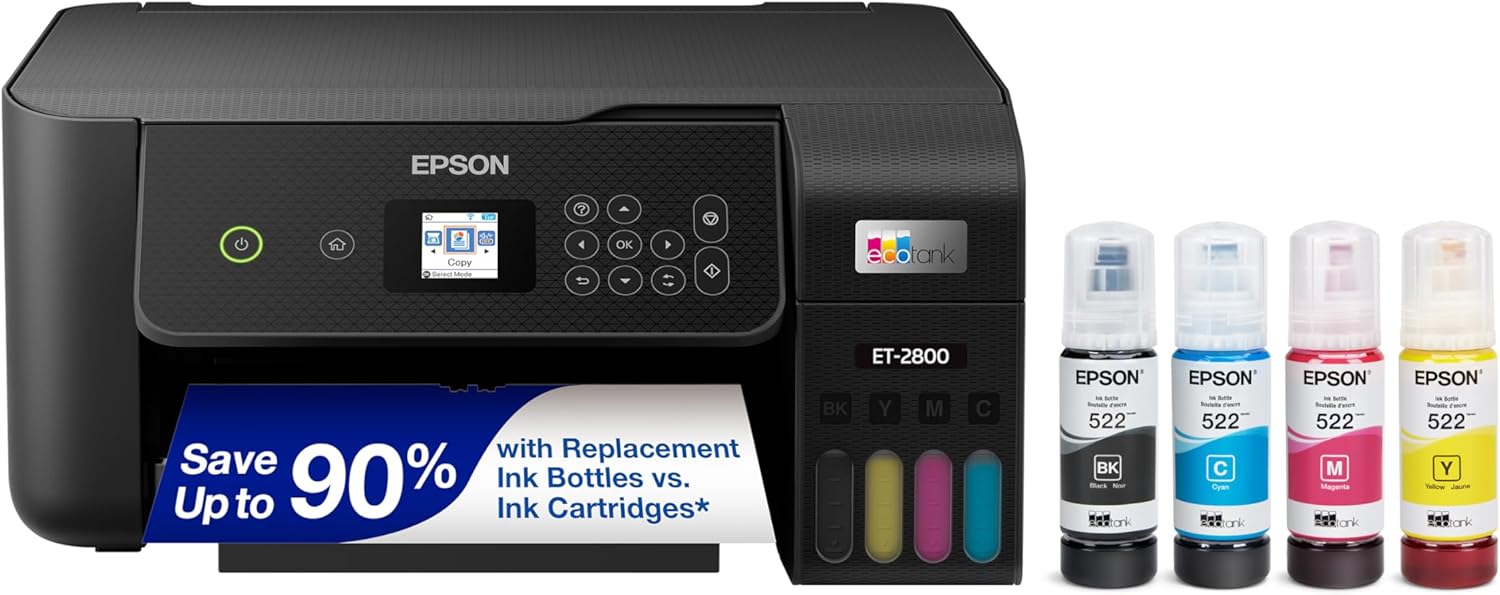
Epson EcoTank ET-2800
| Printer Type | Inkjet |
|---|---|
| Printer Connectivity Type | USB, Wi-Fi |
| Maximum print Resolution Color | 5760 x 1440 dpi |
| B&W Pages per Minute | 10 |
| Color Pages per Minute | 5 |
The Epson EcoTank ET-2800 is a home-oriented all-in-one inkjet that replaces cartridges with refillable high-capacity ink tanks to cut running costs and reduce interruptions. It prints, copies, and scans, connects via Wi-Fi or USB, and supports mobile and voice-activated printing for quick jobs from phones. Photo and document output benefit from Epson PrecisionCore Micro Piezo technology and a high maximum resolution, so color prints look detailed for the price; borderless photo sizes and glossy paper are supported. The included ink set aims to cover months of typical home use and lowers the frequency of replacements compared with cartridges. On the downside the ET-2800 is simplex only so automatic two-sided printing is not available, and its photo speed is modest compared with faster office models. Setup and regular refilling require a bit more care than swapping cartridges, and Epson recommends genuine ink to maintain print quality and warranty coverage. For a budget photo-capable home printer that minimizes cartridge waste and ink costs, the ET-2800 is a practical pick.
Best for: Buyers who want a low-maintenance home photo printer that lowers ongoing ink costs and prioritizes reliability and straightforward wireless printing over advanced office features.
Less Ideal for: Users who need fast duplexing, high-volume office throughput, or professional photo lab color matching should consider higher-end or specialized photo printers instead.
- Cartridge-free EcoTank system greatly reduces how often you replace ink
- High maximum print resolution for detailed color and photo prints
- Wireless and mobile printing with voice-activated options for convenient home use
- Includes enough ink to handle many months of typical home printing
- No automatic double-sided printing (simplex only)
- Slower color page speeds compared with higher-end models
Verdict: If you want a reliable, budget-friendly home photo printer that slashes cartridge waste and long-term ink costs, the EcoTank ET-2800 is a stand-out option under $200.
Choosing the Right Photo Printer: Key Factors to Consider
Print Quality and Color Accuracy
Photo appearance is the primary reason you buy a photo printer. Look beyond advertised DPI to how the printer renders skin tones, gradients, and saturated colors on actual photo paper. Profiles and color-management features matter if you edit photos before printing, but many budget models include automatic color correction or selectable photo modes that improve results for casual use.
Paper choice interacts with the printer more than model specs do. Matte, luster, and glossy papers all produce different perceived sharpness and saturation, so confirm the printer supports the paper sizes and finishes you prefer. If you plan to crop or print borderless images, check borderless capability and how the printer handles edge-to-edge inks.
Running Cost and Ink Options
An inexpensive printer can be costly to operate if replacement cartridges are expensive or if the printer uses multiple cartridges with small capacities. Assess the cost per 4×6 or 5×7 photo by comparing cartridge yields or refill options where available. Some models support high-yield cartridges or third-party refill packs that lower per-photo expenses, though using non-OEM consumables can affect warranty or long-term reliability.
Also consider whether the printer uses separate color cartridges or combined color packs. Separate cartridges let you replace only the depleted color, reducing waste and cost when one color runs out faster than the others. Factor ink shelf life too if you print infrequently; inks can dry in heads on some designs, leading to more frequent cleaning cycles.
Connectivity and Mobile Printing
Printing from phones and tablets is a common use case for photo printers. Look for robust Wi-Fi support, reliable mobile-printing services, or direct wireless modes like Wi-Fi Direct. A simple, well-implemented app can let you crop, apply basic color fixes, and print from social media or cloud accounts without a computer.
Wired USB connections are fine for tethered use but are less flexible for household sharing. If you need to print from multiple devices, check whether the printer supports networked use and whether setup is straightforward for nontechnical users.
Paper Handling and Supported Sizes
Practical paper handling affects daily convenience. Check how many sheets the input tray holds, whether the printer supports common photo sizes (4×6, 5×7, 8.5×11), and whether it can do borderless printing. A rear feed or dedicated photo tray simplifies loading thicker photo paper and reduces curling.
Also consider whether the printer can handle mixed media without a manual feed. If you switch between photo paper and plain paper frequently, a model with a simple feed path and minimal paper shuffling will save time and reduce jams.
Speed, Throughput, and Duty Cycle
Photo printing speed varies widely. If you print many snapshots for events or projects, look for a printer that maintains good image quality at reasonable speeds. Manufacturers often quote fast draft speeds that do not reflect photo quality, so aim to find realistic print-time figures for the paper sizes you use most.
Also consider duty cycle and how many pages the device is designed to handle monthly. Even under $200 models have practical limits; choosing one rated comfortably above your expected monthly output reduces strain and the likelihood of early failure.
Size, Design, and Placement
Photo printers range from compact tabletop units to larger all-in-one devices. Measure your available space and consider whether you need a vertical or low-profile model. A compact printer is convenient for occasional printing and easy storage, but may trade off paper capacity or a dedicated photo tray.
Think about noise, lid clearance for stackable placement, and where you will store paper and extra ink. A design with easy-access cartridges and a clear front-loading tray simplifies everyday use and routine maintenance.
Understanding Photo Paper Types
Different photo papers produce distinct finishes and affect how inks appear. Glossy paper typically offers the most saturated, punchy look and the sharpest perceived detail, while luster and satin finishes reduce glare and fingerprint visibility. Matte paper yields a softer, lower-contrast result and can be easier to frame without glass.
Match your paper finish to the intended use. Glossy is ideal for bright, vivid images and casual albums. Luster works well for portraits and display prints. Also confirm that the printer supports the paper weight and thickness of the finishes you prefer to avoid feeding issues.
- Glossy: highest saturation and shine
- Luster/satin: balanced sheen and reduced glare
- Matte: subdued finish, easier to frame
Mobile Apps and On-Device Editing
A good mobile app can make a budget photo printer far more useful. Look for apps that let you crop to standard photo sizes, apply simple exposure or color corrections, and preview borderless printing. Some apps also provide templates for collages or multiple small prints per page.
If you edit photos before printing, confirm the app preserves image resolution and does not apply heavy automatic compression. Reliable connectivity between device and printer reduces failed jobs and repeated prints.
- Crop and size presets for common photo formats
- Basic color and exposure adjustments
- Direct access to phone galleries and cloud storage
Maintenance Tips to Extend Printer Life
Routine maintenance keeps prints consistent and prevents costly downtime. Regularly run the manufacturer's recommended head-cleaning cycles and perform nozzle checks when colors look uneven. If you print infrequently, consider running a small test print every few weeks to keep inks flowing.
Store photo paper flat and in its original packaging when possible to prevent curling. Keep spare cartridges sealed until needed, and follow any recommendations for storing partially used cartridges to limit drying or contamination.
- Perform nozzle checks and head cleaning as needed
- Run occasional test prints if usage is sporadic
- Store paper and ink properly to avoid curling and drying
When to Choose Compact Versus Full-Size Units
Compact photo printers are great for small spaces and light, occasional use. They usually have lower paper capacity and fewer advanced features but are convenient and easier to tuck away. Choose compact models if you print a handful of photos each week and value space savings.
Full-size units within the under-$200 range typically offer larger trays, more robust paper handling, and sometimes faster output. If you expect regular printing for events, albums, or small business use, a larger unit gives more convenience and fewer interruptions for reloading paper.
- Compact: space-saving, ideal for light use
- Full-size: larger capacity, better for frequent printing
Color Management Basics for Better Prints
Color management ensures what you see on the screen matches what prints on paper. For casual users, printers that offer simple color profiles or automatic color correction provide the best balance of ease and accuracy. If you do color-critical work, learn basics about color space differences between displays and print, and consider editing in sRGB for consumer-level printers.
Profiles and soft-proofing are useful when you want repeatable results. Some budget models include presets for specific paper types that help get closer to intended colors without complex setup.
- Use sRGB editing for most consumer printers
- Enable paper-specific presets when available
- Preview prints at actual size to check tones and saturation
How We Chose the Best Photo Printer
We evaluated models for real-world photo printing needs under a strict budget ceiling. Primary selection criteria were measurable and practical for home users: print quality on common photo papers, the total cost to operate including ink usage and refill options, connectivity and mobile printing support, and physical footprint for typical home setups. We also prioritized reliability signals such as paper handling design and basic maintenance ease to reduce jams and wasted prints. Models were excluded if they lacked dedicated photo-print modes, required proprietary paper sizes only available through limited channels, or had no straightforward ink-replacement path. Final choices balance accurate color rendering, affordable long-term ownership, and straightforward setup and use, reflecting what matters most to people who print photos at home on a budget.
Our full evaluation process is outlined in our review methodology.
FAQ
Can I print borderless 4×6 photos with budget photo printers?
Often, yes. Many budget photo printers support borderless 4×6 printing, but print margins and final crop can vary. Check the printer's specifications for borderless support and test with the paper you plan to use to confirm edge-to-edge coverage.
How can I reduce the cost per photo?
Reduce cost per photo by choosing models with high-yield cartridges or refillable ink options, printing in bulk to reduce wasted head-clean cycles, and using appropriate print modes for everyday snapshots rather than highest-quality settings when not needed.
Will a wireless photo printer work reliably from my phone?
Wireless printing usually works well, but reliability depends on the printer's Wi-Fi implementation and app quality. For frequent mobile printing, prioritize models with a well-rated mobile app and support for direct wireless connections like Wi-Fi Direct.
How do I keep colors consistent between prints?
Use the same paper type and print settings consistently, and avoid switching between generic and photo-specific paper mid-project. If possible, use color presets tied to the paper and avoid heavy automatic filters that alter tones unpredictably.
Is ink drying a problem if I print infrequently?
It can be. Infrequent use increases the chance of ink drying in printheads, which may trigger cleaning cycles that consume ink. Running a small test print periodically helps maintain ink flow and reduces the need for extensive cleaning.
Final Verdict
When shopping for a photo printer under $200, focus on the tradeoffs that matter most to how you print. Prioritize print quality and ink economy if you print photos regularly, or choose compact, easy-to-use models if you print only occasionally. Also weigh connectivity, paper handling, and realistic throughput against your expected monthly volume. By matching features to your workflow and printing habits, you can choose an affordable printer that delivers satisfying, durable photos without unexpected running costs.