
Note: This article contains affiliate links. If you click on these links and make a purchase, we may earn a small commission at no extra cost to you. This helps support our research and content. Read our full affiliate disclosure here.
Living in an apartment often means limited space and thin walls, so a dehumidifier that controls moisture without making constant noise can make a big difference. A quiet dehumidifier for apartments helps prevent mold, reduce musty odors, and protect belongings while preserving the calm of shared living spaces. This guide spotlights the top shortlisted units that balance sound levels, moisture-removal capability, and apartment-friendly features. We evaluated each option across relevant criteria so you can quickly find a compact, low-noise model that suits your layout and daily routine.
Top Picks at a Glance
| Best Overall The best all-around choice for most situations | NineSky CT2 Dehumidifier |  |
| Best Quality Built to a higher standard if you want something more solid | LG PuriCare 50 Pint Dehumidifier |  |
| Best Budget The cheapest option that still gets the job done reliably | POOYUPPC ZQB-201A Dehumidifier |  |
| Top Rated A top-rated pick with lots of positive feedback | Globexis CS10D Dehumidifier |  |
| Most Popular A crowd favorite that many people choose with confidence | TABYIK 35OZ Dehumidifier DH-CS01 |  |
| Best Seller A high-volume bestseller chosen again and again | ToLife TZ-C2 Dehumidifier |  |
NineSky CT2 Dehumidifier

| Floor Area | 1000 square_feet |
|---|---|
| Tank Volume | 95 fluid ounces |
| Operation Mode | Intermittent |
| Other Special Features of the Product | Automatic Shutoff |
| Capacity | 5.9 pounds |
The NineSky CT2 is a compact, quiet dehumidifier that uses semiconductor technology to remove moisture from rooms up to about 1,000 sq ft. It is typically placed in bedrooms, bathrooms, closets, basements or small apartments where low noise and a small footprint matter. The unit offers two operating modes including a high-speed setting for faster moisture removal and a night mode that turns off the lights and reduces noise. A 95 oz removable tank and automatic shutoff protect against overflow and make maintenance straightforward, while built-in ambient LED lighting provides seven color options and a soft night-light effect. Because it relies on a Peltier-style system rather than refrigerant compression, it is quieter and lighter but will remove less water per hour than larger compressor models and can be less efficient in very cold rooms. The CT2 works well for maintaining comfortable humidity and reducing musty smells in living spaces where silence and compact size are priorities.
Best for: Buyers who value low noise and a small footprint for apartments or bedrooms and want an easy-to-use unit that handles routine humidity control without drawing attention.
Less Ideal for: People needing heavy-duty moisture removal for very damp basements or large, open spaces should consider a higher-capacity compressor dehumidifier instead.
- Very quiet semiconductor operation suitable for bedrooms and apartments
- Compact, lightweight footprint that fits closets, bathrooms, and small rooms
- Large 95 oz removable tank with automatic shutoff to prevent spills
- Night mode and seven-color ambient LED that doubles as a gentle night light
- High-speed mode for faster dehumidification when needed
- Peltier-style dehumidification extracts less moisture per hour than compressor units, limiting performance in very damp spaces
- Performance can drop in colder environments compared with compressor-based models
Verdict: A quiet, compact dehumidifier built for apartments and bedrooms where low noise, easy maintenance, and a small footprint matter most.
LG PuriCare 50 Pint Dehumidifier

| Capacity | 50 pints |
|---|---|
| Tank Volume | 14.3 pints |
| Number of Speeds | 4 |
| Wattage | 480 watts |
The LG PuriCare 50 Pint Dehumidifier is a compact, Energy Star rated unit built to remove up to 50 pints of moisture per day while offering quiet low‑speed operation suited to living spaces. It works in automatic mode with four fan speeds and adjustable humidity control, and can either collect condensate in a 14.3 pint tank or run continuous drainage via a side hose for longer unattended use. The unit includes auto‑defrost to prevent freeze‑up in colder rooms and an internal drying cycle to limit residual moisture after use. For connected households the ThinQ app lets you monitor humidity and change settings remotely and the LED display and filter indicator make routine maintenance straightforward. The dehumidifier is relatively powerful at 480 watts which helps performance but contributes to its weight and footprint, so placement matters in small apartments; expect to plan for drainage or occasional emptying of the tank. Its focus on quiet operation and practical features makes it a sensible choice where steady moisture control is the priority.
Best for: Buyers who prioritize steady, quiet moisture removal in apartment living and want smart controls to monitor humidity remotely.
Less Ideal for: People needing an ultra‑lightweight or ultra‑compact unit for a very small studio or temporary spot use should consider smaller portable models instead.
- Removes up to 50 pints per day for strong moisture control in damp rooms
- ENERGY STAR certified for more efficient daily operation
- Quiet low‑speed mode suitable for bedrooms and apartments
- Flexible drainage with a 14.3 pint tank plus side hose option for continuous draining
- Wi‑Fi and LG ThinQ app for remote monitoring and control
- Relatively high wattage and heavier build compared with small portable units, so it is less ideal for very tight spaces
- 14.3 pint tank still requires periodic emptying if not using continuous drain
Verdict: Choose this unit if you want a powerful, quiet, app‑connected dehumidifier that reliably handles apartment moisture control.
POOYUPPC ZQB-201A Dehumidifier

| Floor Area | 1000 |
|---|---|
| Tank Volume | 2800 ml |
| Dehumidification Capacity | 22 pints_per_day |
| Operation Mode | Automatic |
This compact POOYUPPC dehumidifier is built for apartments, bathrooms, and small basements where quiet, continuous moisture control matters. It removes up to about 22 pints per day (manufacturer listing) and is rated to cover roughly 1,000 sq ft, using a visible 95 oz (2800 ml) tank with an included drain hose for continuous drainage. A touch LED control panel offers normal and sleep modes, a child lock, and an auto shutoff that flashes when the tank is full. In practice the sleep mode and low reported noise levels make it suitable for nighttime use in bedrooms. The unit is lightweight and portable, so you can move it between rooms easily. Limitations include modest daily extraction compared with larger compressor dehumidifiers and a plastic construction that feels budget-oriented, so it is best where space and quiet are priorities rather than heavy-duty basement drying. For renters or anyone on a tighter budget who needs a quiet, straightforward dehumidifier, this covers the basics well.
Best for: Buyers looking for an affordable, easy-to-move dehumidifier for apartments or single rooms who prioritize quiet nighttime operation and simple controls.
Less Ideal for: People who need heavy-duty moisture removal for very damp basements, large open areas, or continuous commercial use should choose a larger-capacity compressor dehumidifier.
- Visible 95 oz water tank with auto shutoff and full-tank indicator for simple monitoring
- Includes drain hose for optional continuous drainage
- Sleep mode and low reported noise levels make it suitable for bedroom use
- LED touch controls and child lock simplify operation and safety
- Plastic build and lightweight construction feel budget-level rather than premium
- Extraction capacity is modest compared with larger whole-house units
Verdict: A budget-friendly, quiet portable dehumidifier that delivers straightforward, low-noise humidity control for apartments and bedrooms.
Globexis CS10D Dehumidifier
| Capacity | 2.5 liters |
|---|---|
| Dehumidification Capacity | 2.2 liters_per_day |
| Floor Area | 1500 square_feet |
| Number of Speeds | 2 |
| Wattage | 270 watts |
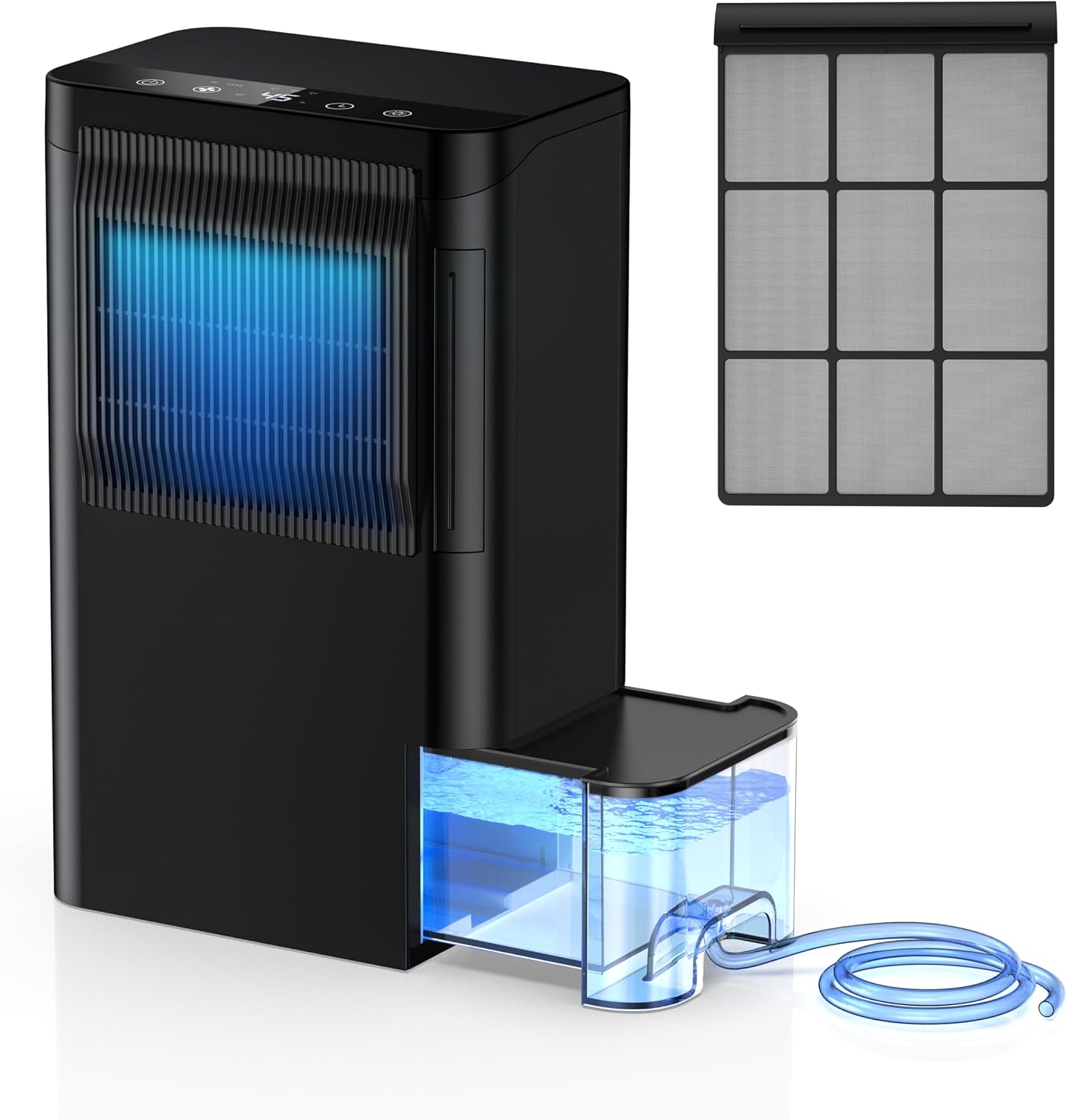
The Globexis CS10D is a small, apartment-friendly dehumidifier built around a rotary dehumidification system that works in cold conditions down to 34°F. It is designed for everyday use in bedrooms, basements, closets, and RVs, with a 2.5 liter tank plus a continuous-drain port and included hose for unattended operation. The unit has two fan speeds, an easy touch control panel, a soft ambient LED status light, and safety features like overheat protection and auto shutoff with a full-tank alarm. At under 35 dB it is quiet enough for bedrooms and home offices, and the washable dust filter helps keep maintenance simple. Its rated extraction is modest at 2.2 liters per day, so it is best for small to medium damp spaces rather than heavy-water problem areas. The simple controls and programmable timer make it straightforward to run on a schedule, but buyers who need very high daily capacity or commercial-grade drying should look at larger compressor models.
Best for: Someone who prioritizes a quiet, reliable dehumidifier for an apartment or small living space and values unattended operation and simple controls over high capacity.
Less Ideal for: Homes or spaces with severe humidity problems, large basements, or frequent water intrusion that require high-capacity commercial-style dehumidifiers.
- Operates down to 34°F so it will not freeze in cool basements or unheated rooms
- Included continuous drain hose and auto shutoff make unattended use easy
- Runs below 35 dB, suitable for bedrooms and apartments
- Washable dust filter and simple touch controls reduce maintenance and learning curve
- Built-in safety features like overheat protection and full-tank alarm enhance reliability
- Low daily extraction rate (2.2 L/day) limits effectiveness in very damp or large spaces
Verdict: A quiet, low-temperature-capable dehumidifier that delivers dependable, low-maintenance moisture control for apartments and small rooms.
TABYIK 35OZ Dehumidifier DH-CS01

| Tank Volume | 1000 ml |
|---|---|
| Dehumidification Capacity | 0.45 liters_per_day |
| Floor Area | 280 square_feet |
| Wattage | 40 watts |
| Number of Speeds | 1 |
The TABYIK 35OZ DH-CS01 is a small Peltier dehumidifier pitched at bedrooms, bathrooms, closets and RVs where space and noise matter. It runs on about 40 watts in continuous mode and uses thermoelectric cooling to pull moisture into a 1000 ml (35 oz) transparent tank; the brand reports up to roughly 450 ml (16 oz) per 24 hours in warm, humid conditions. Operation is simple: one button to start plus a separate light control for seven color LED options, and the unit will auto shut off when the tank nears full to prevent spills. Its ultra-quiet 28 dB noise rating and compact footprint make it easy to leave running overnight or place on a shelf, and the removable tank with groove handles keeps emptying and cleaning straightforward. Limitations are inherent to Peltier designs—lower dehumidification capacity compared with compressor models and best performance only in warmer, higher-humidity rooms—so it is not suited to large damp basements or whole-apartment dehumidifying. For small spaces where silence and portability are priorities, this model is a practical, easy-to-use choice.
Best for: Buyers who want a low-noise, easy-to-use dehumidifier for a single small room, bedroom or RV and prioritize quiet overnight operation and simple maintenance.
Less Ideal for: People needing to remove large volumes of moisture from big or very damp spaces, or those who require adjustable fan speeds and faster extraction.
- Very quiet operation at about 28 dB suitable for bedrooms and offices.
- Compact and lightweight with a built-in handle for easy placement and portability.
- Transparent 1000 ml tank with groove design makes emptying and cleaning simple.
- Auto shutoff prevents overflow and notifies you with a flashing light when near full.
- Low power draw (around 40 W) keeps daily energy use modest for continuous operation.
- Peltier-based dehumidification yields modest daily extraction (about 0.45 L/day), so it is slow in very damp spaces.
- Single speed control limits ability to tune output to varying humidity levels.
Verdict: If you need a whisper-quiet, portable dehumidifier for a single small room, this 35 oz TABYIK unit delivers simple, low-energy moisture control.
ToLife TZ-C2 Dehumidifier

| Floor Area | 1000 |
|---|---|
| Capacity | 95 fluid ounces |
| Number of Speeds | 2 |
| Wattage | 93 watts |
| Air Flow Capacity | 95 liters per minute |
The ToLife TZ-C2 is a compact, portable dehumidifier aimed at bedrooms, bathrooms, and small apartments where quiet operation matters. It uses semiconductor condensation technology and offers two modes: a high-power setting for faster moisture removal and a low-speed sleep mode that claims under 30 dB noise. The unit holds 95 fluid ounces of water in a removable tank and will automatically shut off when the tank is full or not seated correctly, which simplifies maintenance and prevents spills. A seven-color LED night light with a lock function is a useful extra for bedrooms. Practical benefits include low wattage operation and easy relocation thanks to built-in handles. Limitations to consider are that semiconductor-style dehumidifiers are typically less efficient than compressor models in very humid conditions and the stated 1000 sq ft coverage is optimistic for continuous dehumidification in larger or very damp rooms. Also the unit runs on 220 volts, which affects compatibility in some settings. For quiet, small-space use the TZ-C2 performs as advertised but it is best paired with reasonable expectations about capacity and runtime.
Best for: Buyers who prioritize quiet, low-maintenance humidity control in small apartments or bedrooms and want an easy-to-move unit with automatic tank shutoff.
Less Ideal for: People needing heavy-duty continuous dehumidification for large, very damp spaces or those who require appliance operation on standard 110–120V circuits without a step-up transformer.
- Sleep mode with low-noise operation (under 30 dB) suited for bedrooms
- Large 95 oz removable tank with automatic shutoff to prevent overflow
- Lightweight and portable with handles for easy moving between rooms
- Low power draw at 93 watts for energy-conscious households
- Semiconductor condensation is generally less efficient than compressor units in very humid environments
- Coverage claim of 1000 sq ft may be optimistic for continuous dehumidification in larger or very damp spaces
Verdict: A quiet, portable choice for small apartments that prioritizes low-noise sleep operation and spill-safe tank management.
Choosing the Right Quiet Dehumidifier for Apartments: Key Factors to Consider
Noise Level and Sound Signature
How loud the unit runs matters for apartments because thin walls and shared spaces make noise more noticeable. Look for models with published decibel ratings measured at standard fan speeds, and consider whether manufacturers list both low and high-speed noise levels.
Beyond raw dB numbers, the sound signature matters. A steady low hum is generally less disruptive than irregular rattles or high-pitched tones. If you plan to run the dehumidifier overnight in a bedroom, prioritize units engineered for low-speed quiet operation and with rubberized feet or vibration dampening to minimize transmitted sound through floors and furniture.
Moisture Removal Capacity Relative to Room Size
Capacity ratings (usually pints or liters per 24 hours) indicate how much moisture a dehumidifier can remove, but apartment buyers should match that to the room size and typical humidity levels. A high-capacity unit may be overkill in a small studio and waste energy; too small a unit will run constantly and struggle to reduce humidity effectively.
Estimate the square footage and whether humidity sources include showers, cooking, or an attached bathroom. For apartments, consider units optimized for single rooms or multi-room open layouts rather than whole-house models. Also factor in seasonal changes—a unit that handles damp summers should still manage persistent dampness in cooler months without excessive cycling.
Energy Use and Long-Term Operating Cost
Dehumidifiers run for extended periods, so energy consumption matters for both environmental impact and monthly utility costs. Check energy efficiency indicators like energy factor or power draw at different fan speeds. Models with automatic humidistats and ECO modes avoid unnecessary runtime by cycling only when humidity exceeds set thresholds.
Some apartment-oriented units include features like night modes or programmable timers that help reduce energy use. Consider whether the unit's efficiency justifies a higher upfront cost by lowering operating expenses over a season of heavy use.
Water Management and Drainage Options
Emptying a water tank multiple times per day can be impractical in apartment life. Look for dehumidifiers with appropriately sized tanks for the expected moisture load and clear indicators for tank-full status. Continuous drain options with a gravity drain hose are handy, but they require suitable placement and a nearby drain. Pump-assisted drainers allow more flexible placement by pumping condensate to a sink or high-mounted drain.
If you cannot install permanent plumbing, ensure the default bucket is easy to remove and reinsert without spills. A splash-proof design and a clear fill line help avoid messes in compact living spaces.
Physical Size, Weight, and Placement
Apartment buyers often contend with limited space and need a unit that fits in closets, bathrooms, or beside furniture without obstructing traffic. Check dimensions and consider whether the intake and exhaust areas have clearance. Taller, narrower units can fit into tight corners while wider, low-profile designs might slide under windows or against cabinets.
Portability features like integrated handles, caster wheels, and lighter weight make it easier to move the unit between rooms. Also think about storage when not in use—compact or stackable designs are easier to stow during dry seasons.
Controls, Display, and Maintenance Accessibility
User-friendly controls reduce frustration in daily use. Look for clear digital displays that show current humidity and allow setting a target humidistat. Simple push-button or rotary controls perform better in rental situations where quick adjustments are common.
Maintenance access is equally important. Removable washable filters extend time between service intervals, and straightforward access to coils and internal panels simplifies occasional cleaning. Clear indicator lights for full tank, filter change, and error codes make troubleshooting faster without needing a manual at hand.
How Noise Ratings Translate to Real Apartment Quiet
Decibel numbers give a baseline, but perceived loudness depends on distance, room acoustics, and vibration transfer. In a small apartment, even a unit rated in the high 40s dB at 1 meter can seem louder if placed on a hard floor or next to a shared wall.
When possible, place quieter units on a soft surface or use a vibration-damping mat. Running at the lowest effective fan speed during sleeping hours often reduces noticeable noise without compromising moisture control for most apartment bedrooms.
- Compare low-speed dB ratings rather than only maximum output.
- Use anti-vibration pads to reduce structure-borne sound.
- Place unit away from bedroom walls or thin partitions.
Placement Tips for Best Performance in Small Layouts
Position the dehumidifier in the room's most humid area and allow free airflow around the intake and exhaust. Avoid corners and tight closets unless the unit is specifically designed for restricted spaces. For bathrooms and laundry corners, ensure the unit is protected from water splashes and has a stable surface.
If you need whole-apartment coverage, try moving a compact unit between rooms as needed rather than buying a single high-capacity device. Portable units are often more cost-effective and reduce unnecessary runtime in unoccupied rooms.
- Keep 6–12 inches clearance around vents when possible.
- Elevate small units slightly off the floor to improve airflow in homes with low-level carpeting.
- Use a hose for continuous drain only if a suitable drain is nearby.
Night Modes, Timers, and Smart Controls
Many apartment-friendly dehumidifiers include night modes that lower fan speed and dim displays to limit sleep disturbances. Timers allow you to schedule operation during peak-humidity times, such as after showers or during cooking, reducing overall runtime.
Some units offer Wi-Fi or smart-home integration so you can monitor humidity remotely and adjust settings without entering rooms late at night. For renters, verify that smart features do not require permanent installation or complex setup.
- Use timers to run the unit during known humidity peaks.
- Night mode can reduce perceived noise and save energy.
- Smart controls provide remote monitoring but add complexity.
Dealing with Odors and Mold Prevention
Effective dehumidification reduces the humidity that supports mold growth and lingering odors. For apartments with persistent damp smells, consistent use at a target relative humidity between 45 and 55 percent typically prevents most odor-forming issues without over-drying the air.
Combine source control, like bathroom exhaust fans and prompt laundry drying, with a properly sized dehumidifier. Regular cleaning of the unit's coils and filter prevents the dehumidifier itself from becoming an odor source.
- Aim for 45–55 percent relative humidity for comfort and mold prevention.
- Run the unit longer after activities that add moisture, like showering.
- Clean filters routinely to avoid stale smells from trapped dust.
Maintenance Checklist for Long-Term Quiet Operation
Routine maintenance keeps a dehumidifier running quietly and efficiently. Regularly empty tanks or check drain hoses, clean washable filters, and vacuum any grille dust that can force fans to work harder. Inspect rubber feet and casters for wear that could increase vibration noise.
Periodically inspect coils and airflow paths. In humid climates, coils can build up frost or scale; following manufacturer-recommended defrost or cleaning steps prevents noisy operation and preserves capacity.
- Empty the bucket or check the continuous drain weekly during heavy use.
- Wash or replace filters per the schedule to maintain airflow.
- Check for loose panels or screws that can cause rattles.
How We Chose the Best Quiet Dehumidifier for Apartments
We focused our selection on units that meet the practical needs of apartment living. Key evaluation dimensions included measured operating noise at typical fan speeds, moisture removal capacity relative to compact size, and energy efficiency for long-run use in small spaces. We also considered controls and user experience factors such as adjustable humidistats, timer functions, and ease of emptying or draining condensate. Other filters eliminated oversized whole-house units, models without clear noise specifications, and devices that require permanent plumbing modifications unsuited to rental units. Durability indicators like corrosion-resistant coils and simple filter access were weighed alongside portability features such as manageable weight and integrated handles. Safety features, including auto-shutoff at full tank and tip-over protection where applicable, were also required. The final list emphasizes practical tradeoffs: low noise and compact form factor balanced against realistic moisture-removal performance for typical apartment rooms.
Our full evaluation process is outlined in our review methodology.
FAQ
How loud is a dehumidifier that is considered "quiet" for apartment use?
Quiet apartment units typically operate under 50 dB at low fan speeds, which is comparable to a quiet conversation. Perceived loudness varies by placement and room acoustics, so look for models with low-speed ratings and vibration control.
Can a small dehumidifier handle an entire apartment?
It depends on the apartment layout and humidity sources. A single small unit can manage a studio or a single bathroom, but multi-room coverage often requires moving the unit between rooms or selecting a larger-capacity model sized to the combined area.
Is continuous drain necessary in an apartment?
Continuous drain is convenient when a drain or sink is nearby and you want unattended operation. If plumbing access is limited, a larger tank with easy emptying may be a better choice to avoid frequent trips to pour out condensate.
Will running a dehumidifier increase my energy bills significantly?
Energy use depends on capacity, runtime, and efficiency features. Units with automatic humidistats and ECO or night modes will use less power than models that run constantly. Matching capacity to the room size reduces unnecessary runtime and energy consumption.
How often should I clean the dehumidifier filter in an apartment setting?
Check washable filters every 2 to 4 weeks during heavy use and clean as needed. In less humid seasons, monthly inspections are usually sufficient. Regular cleaning maintains airflow, efficiency, and quiet operation.
Final Verdict
Choose a dehumidifier for apartment living by prioritizing low operating noise, the right moisture-removal capacity for your room sizes, and practical drainage options. Portability and easy maintenance reduce friction in daily use, while energy-efficient features lower long-term operating costs. Balance quieter operation against the capacity you actually need. For most apartments, a compact, quiet unit with an accurate humidistat and sensible drainage will deliver the best combination of comfort, health, and minimal disruption.