
Note: This article contains affiliate links. If you click on these links and make a purchase, we may earn a small commission at no extra cost to you. This helps support our research and content. Read our full affiliate disclosure here.
When you need cooler air in a small sleeping space without loud fans or high energy bills, a portable evaporative cooler for bedroom use can be an effective choice. These units cool by moving air across a wet pad, using far less electricity than many refrigerated air conditioners and creating a gentle, humidified airflow that suits dry climates and dry indoor air. This guide covers five shortlisted portable evaporative coolers for bedroom settings. We evaluated each option on real-world criteria that matter for night use, including cooling output, noise, and ease of setup and upkeep. Read on to find a unit that matches your room size, sleep preferences, and maintenance tolerance before the product list below.
Top Picks at a Glance
| Best Quality Built to a higher standard if you want something more solid | CENSTECH L242Y Evaporative Cooler |  |
| Best Value The sweet spot between price and what you get | FODFINU Evaporative Air Cooler GDS-620 |  |
| Best Budget The cheapest option that still gets the job done reliably | SOLEEY F001 Portable Air Cooler |  |
| Top Rated A top-rated pick with lots of positive feedback | VeRosky Portable Evaporative Cooler FK2508Y |  |
| Most Popular A crowd favorite that many people choose with confidence | Arctic Air Pure Chill 2.0 |  |
CENSTECH L242Y Evaporative Cooler
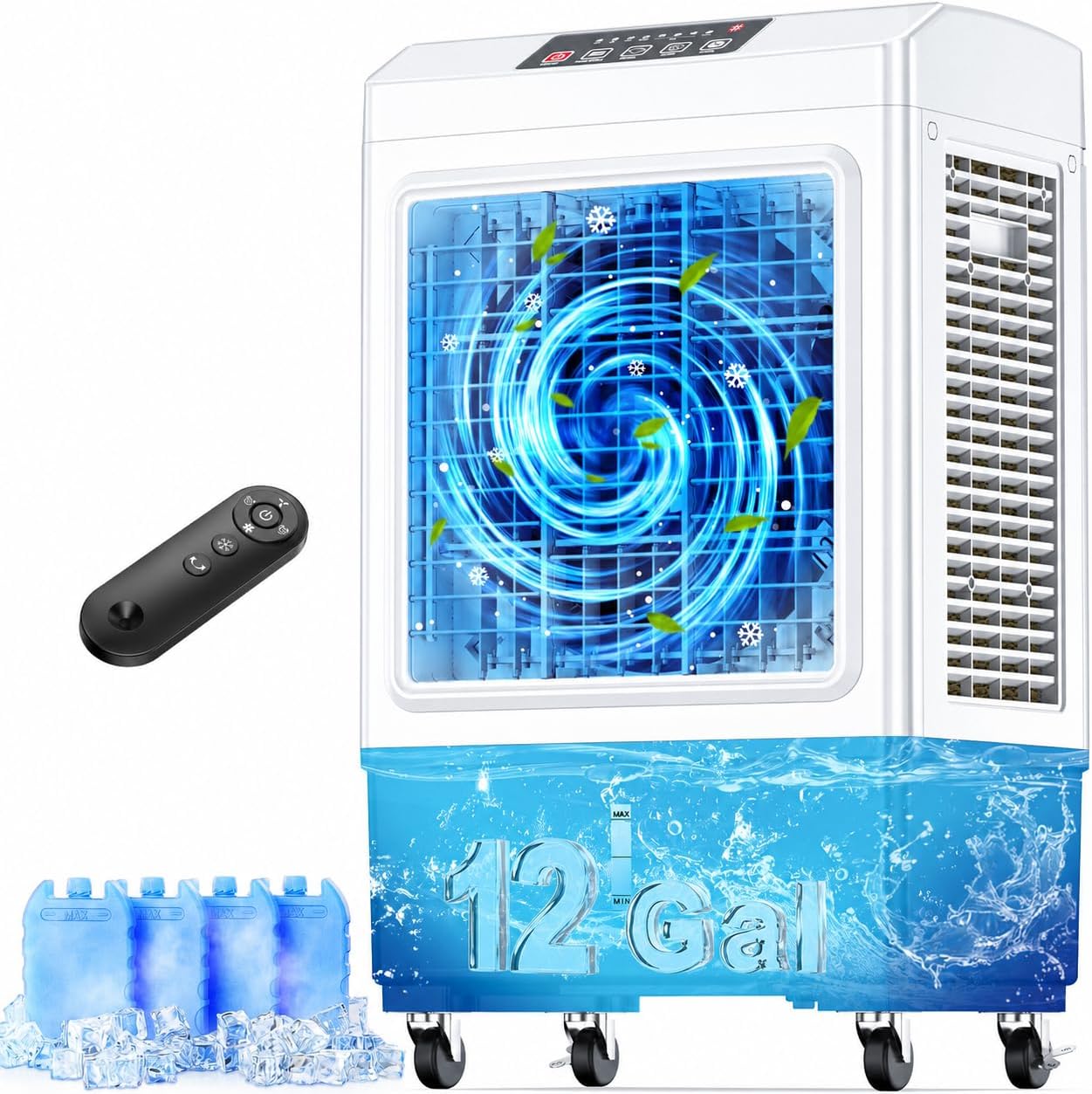
| Wattage | 100 watts |
|---|---|
| Noise | 45 db |
| Voltage | 120 volts |
| Included Components | Remote control; 4 ice packs |
The CENSTECH L242Y is a plug-and-play evaporative cooler designed to deliver fast, energy-efficient airflow without a window kit or exhaust hose. It uses a 100 W motor and claims an instant cooling response with up to 3600 CFM airflow, 120 degree horizontal sweep and 70 degree vertical oscillation to move air across large rooms. Controls are simple via the top touch panel or included remote, and the unit offers three speeds, four modes (fan, cooling, humidifier, timer), a 7-hour timer and bladeless outlet for safer use around kids and pets. Practical touches like a top-fill dual-tank system with a visible water level, four reusable ice packs, retractable cord, bottom drain and caster wheels make daily use and maintenance easier. Trade-offs are inherent to evaporative cooling: performance is best in dry climates and it humidifies the room while it cools, and claimed coverage figures will depend on room layout and ventilation. Noise is rated under 45 dB on low settings but can be louder on high fan speeds.
Best for: Buyers who prioritize strong airflow and versatile control in a plug-and-play cooler for bedroom or larger living spaces and who live in relatively dry climates where evaporative cooling works well.
Less Ideal for: People in consistently humid climates or anyone who needs true refrigerated cooling should consider a refrigerated portable AC instead.
- High airflow and wide oscillation for broader coverage in open rooms
- Top-fill dual-tank design plus visible water level for easy refills and up to 24 hours runtime with ice packs
- Multiple modes and speeds with remote and touch controls for convenient, flexible operation
- Low power draw (100 W) for energy-efficient continuous use
- Effectiveness depends on dry ambient conditions and it increases indoor humidity
- Performance claims (1000 sq ft, 3600 CFM) will vary with room layout and distance from the unit
Verdict: If you want energy-efficient, high-airflow cooling for a bedroom in a dry climate without window installation, the L242Y delivers practical, easy-to-use performance.
FODFINU Evaporative Air Cooler GDS-620

| Air Flow Capacity | 650 cfm |
|---|---|
| Reservoir Capacity | 6.87 gallons |
| Floor Area | 400 square_feet |
| Wattage | 65 watts |
| Noise | 45 db |
The FODFINU GDS-620 is a ventless evaporative cooler designed to deliver breezy, humidified cooling where a refrigerant AC is not practical. It works as a fan, humidifier, aromatherapy unit, or an ice-enhanced swamp cooler using the included ice packs and a 3.5-gallon tank that claims up to 10 hours runtime. Operation is straightforward via the top touch panel or a 20-foot remote and the unit sits on swivel casters for easy placement. Notable features include a washable filter, 120° oscillation to spread airflow, three fan speeds, and a child lock for safer use. At about 65 watts and 650 cfm airflow, it is energy efficient compared with compressor-based portable ACs and runs at a quoted 45 dB on low, making it reasonable for bedrooms or offices. Limitations are inherent to evaporative technology: it cools best in dry climates and adds humidity, so results will be modest in very humid areas and it will not lower room temperature like a refrigerant AC. The plastic build and periodic refilling and maintenance of the tank and filter are typical upkeep buyers should expect.
Best for: Buyers who prioritize low-energy, portable cooling without installation and want a practical, easy-to-move unit for bedrooms, offices, or other indoor spaces where added humidity is acceptable.
Less Ideal for: Those needing strong, temperature-lowering air conditioning in humid climates or anyone who requires precise cooling comparable to a refrigerant-based AC.
- Multiple modes: fan, humidifier, aromatherapy, and ice-boosted evaporative cooling.
- Large removable water tank for extended run time up to about 10 hours.
- Remote plus top touch controls and 120° oscillation for convenient, room-filling airflow.
- Washable filter and caster wheels make maintenance and repositioning simple.
- Low power draw (65 watts) and relatively quiet operation around 45 dB on low.
- Performance depends on dry ambient conditions and will be limited in high humidity climates.
- Made of plastic with basic construction that may feel less durable than higher-end units.
Verdict: Choose the GDS-620 when you want a low-power, portable ventless cooler that delivers extended, easy-to-use evaporative cooling for dry indoor spaces.
SOLEEY F001 Portable Air Cooler
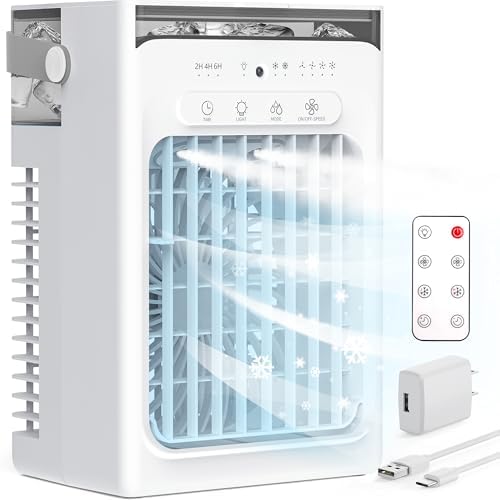
| Power Source | Corded Electric |
|---|---|
| Additional Features | Remote Controlled |
| Item Weight | 2.2 pounds |
| Item Dimensions D x W x H | 7.28"D x 8"W x 9.72"H |
The SOLEEY F001 is a small, lightweight evaporative cooler intended for personal or single-room use, especially in bedrooms. It uses dual ultrasonic nebulizers, an upgraded motor and triple refrigeration technology to produce cooler airflow, and an 1100 ml top-fill water tank plus a lower condensation collection tank for continuous operation in both dry and humid conditions. Controls include a remote, four fan speeds, three modes and an auto timer for 2, 4 or 6 hours, and a seven-color night light for bedroom ambiance. At roughly 8 watts and with a quoted low noise level near 50 dB, it is energy efficient and quiet enough for sleeping. The unit is powered by a corded adapter or USB and is easy to move at about 2.2 pounds. Important limits are its small cooling capacity—it chills the immediate area rather than a whole room—and its reliance on evaporation means performance drops in very humid climates. For buyers who need inexpensive, low-power personal cooling in a bedroom or near a bedside, it offers a convenient, feature-rich option.
Best for: Buyers on a tight budget who want an energy-efficient, low-noise personal cooler for a bedroom or small personal space and value portability and simple controls.
Less Ideal for: Those who need a true room air conditioner or strong cooling in humid climates should consider higher-capacity refrigerant ACs instead.
- Compact and lightweight for easy placement and portability
- Large 1100 ml top-fill tank with lower condensation collection for up to 10 hours of operation
- Multiple fan speeds, modes, timer and remote control for flexible bedside use
- Low power draw (about 8W) and quiet operation suitable for sleeping
- Evaporative cooling only cools localized air and is less effective in high humidity
Verdict: An affordable, low-power personal evaporative cooler that is perfect for budget-conscious buyers wanting quiet bedside cooling.
VeRosky Portable Evaporative Cooler FK2508Y

| Air Flow Capacity | 300 cfm |
|---|---|
| Reservoir Capacity | 3 gallons |
| Floor Area | 150 square_feet |
| Wattage | 75 watts |
| Noise | 40 db |
The VeRosky FK2508Y is a windowless evaporative cooler aimed at adding quiet, energy-efficient cooling to bedrooms and small rooms. It uses a 3-gallon pull-out reservoir and reusable ice packs to extend cooling runs while offering three fan speeds plus Natural and Sleep modes and a 120 degree oscillation to spread airflow. Controls are touch-based with a 12-hour timer and child lock, and the unit rolls on four casters for easy repositioning. Maintenance is straightforward thanks to a removable water tank and washable cooling pad. At 75 watts and roughly 40 dB on low, it runs far cheaper and quieter than most portable refrigerant air conditioners, but like all evaporative coolers it works best in dry environments and will not produce the same low temperatures in high humidity. The 150 sq ft coverage makes it a solid bedroom option, but buyers in very humid climates or those needing strong, A/C-style cooling should consider alternatives.
Best for: Buyers who prioritize a reliable, low-maintenance bedroom cooling solution that runs quietly and cheaply and performs best in drier climates.
Less Ideal for: People living in high-humidity areas or those who need strong, A/C-style cooling for large rooms should choose a refrigerated portable air conditioner instead.
- Large 3-gallon pull-out reservoir reduces refill frequency
- Four reusable ice packs provide extra short-term cooling boost
- Quiet operation (about 40 dB) and Sleep mode suitable for bedrooms
- Touch controls, 12-hour timer, and child lock simplify daily use
- Removable cooling pad and tank make cleaning easy
- Effective cooling depends on low ambient humidity and will be limited in very humid climates
- Not a refrigerant air conditioner so it cannot reach A/C-level low temperatures
Verdict: A dependable, low-power evaporative cooler that delivers quiet, easy-to-maintain bedroom cooling when you live in a dry climate.
Arctic Air Pure Chill 2.0

| Form Factor | Personal |
|---|---|
| Voltage | 120 volts |
| Power Consumption | 8-10 watts |
| Speeds | 4 speed settings |
The Arctic Air Pure Chill 2.0 is a small, lightweight evaporative cooler intended for personal spot cooling in bedrooms, offices, or on a desk. You fill the top reservoir with water, plug it in, and choose one of four fan speeds using the touch controls; the unit uses Hydro-Chill technology and dual vents to direct airflow and adds a seven-color LED night light. It runs on about 8–10 watts, so it uses very little electricity and can operate for several hours between fills depending on settings and room humidity. The design is easy to move and the adjustable vents help aim the airflow, but its cooling effect is limited to a small area and performance depends heavily on ambient humidity and ventilation. There is no refrigerant-based cooling, so it will not lower whole-room temperature like a portable air conditioner, and the water tank needs periodic refills and cleaning to avoid odors. For a low-cost, energy-efficient personal cooler it is simple and straightforward to use, but expect modest results in hot, humid spaces.
Best for: Buyers who want an inexpensive, energy-frugal way to cool a personal workspace or bedside area and prioritize portability and simple operation over whole-room cooling.
Less Ideal for: People who need consistent whole-room temperature reduction or reliable cooling in hot, humid environments should consider a refrigerant-based portable air conditioner instead.
- Very low power consumption (8–10 watts) for long run times
- Top-fill water tank for simple refilling
- Four fan speeds and adjustable vents for directed airflow
- Lightweight, compact design makes it easy to move and place on a desk
- Effective cooling is limited to a small personal zone and depends on ambient humidity
- Requires regular refilling and occasional cleaning to prevent odors
Verdict: A very affordable, ultra-low-power personal cooler that delivers simple spot cooling and humidification for desks and bedside use.
Choosing the Right Portable Evaporative Cooler for Bedroom: Key Factors to Consider
Room Size and Cooling Coverage
Matching an evaporative cooler to your bedroom size is the first priority. Manufacturers often specify a recommended square-foot coverage or an airflow rate in CFM. A unit rated for a space larger than your bedroom will deliver better circulation and more consistent perceived cooling. If the cooler is undersized, you will get only a mild breeze that may not noticeably reduce temperature or improve comfort.
Also consider ceiling height and room layout. High ceilings or open-plan bedrooms need more airflow to move conditioned air throughout the space. Check whether a unit's airflow is directional or diffused; tilt or venting options can help aim air where you sleep without overcooling other areas.
Noise Level and Sleep Comfort
Nighttime noise is crucial for bedroom use. Look for decibel ratings for different fan speeds and modes. Many evaporative coolers offer a low or sleep mode that substantially lowers fan speed. A quieter unit will let you sleep undisturbed while still delivering airflow, whereas louder models can disrupt sleep or require the fan to be set farther from the bed.
Beyond raw decibel numbers, pay attention to fan design and available speed increments. Some machines produce more tonal or high-frequency noise that is more noticeable even at similar dB levels. Adjustable speeds and a sleep mode give you control over the balance between airflow and quiet operation.
Water Tank Capacity and Runtime
Evaporative coolers rely on water, so tank capacity determines how long a unit can run between refills. Larger tanks extend runtime but can add weight and take up more cabinet space. Consider how long you typically run the cooler overnight and whether you are comfortable refilling once per night or prefer multi-night capacity.
Also check for useful features like low-water auto-shutoff, visible water-level indicators, and the ability to attach an external hose for continuous fill when available. Efficient water use and sensible runtime reduce interruptions and the burden of upkeep.
Maintenance and Filter/Pad Accessibility
Evaporative pads and water reservoirs require periodic cleaning and replacement to prevent mineral buildup and odors. Easy access to the cooling pad and a washable or replaceable pad design simplifies maintenance. Units with simple tool-free panels or slide-out trays make pad cleaning faster and reduce time spent on upkeep.
Consider the availability and cost of replacement pads and whether the pad material is compatible with your water quality. If your water has high mineral content, look for units with pads and cleaning recommendations that help limit scale accumulation.
Humidity Considerations
Evaporative cooling adds moisture to the air, which helps cooling in dry climates but can be a drawback in humid regions. Assess your local indoor humidity and whether additional moisture is acceptable in a bedroom. In already humid environments, an evaporative cooler may feel muggy and less effective.
Some bedroom setups mitigate this by running the cooler in short cycles or using it only during lower-humidity times of day. Ventilation matters too; a slightly open window or door can allow moisture to escape and keep humidity from rising excessively.
Size, Portability, and Placement
A bedroom cooler should be easy to move, position, and store. Weight, handle design, and caster quality affect portability. Smaller footprint units fit better in tight rooms but may compromise on tank size or airflow. Decide whether you need a unit you can easily tuck away during daytime or one that remains in place year-round.
Also consider cord length and whether you need to place the unit near a window or power outlet. Stable placement is important to avoid tipping and to keep noise consistent; units with adjustable feet or wide bases tend to be more stable on bedroom flooring.
How Evaporative Cooling Works in Bedrooms
Evaporative coolers lower air temperature by passing warm air over a wet pad so that evaporation removes heat from the air stream. The result is cooler, moister air that feels refreshing in dry conditions and can be pleasant for sleeping with the right humidity balance.
In bedroom applications, performance depends on airflow and water evaporation rate rather than refrigerant-based temperature drops. Proper placement and ensuring enough fresh air exchange help the unit perform optimally without making the room feel overly humid.
- Works best in dry climates with lower ambient humidity
- Provides gentle airflow rather than aggressive temperature drops
- Can add beneficial moisture to dry indoor air
Placement Tips for Best Nighttime Performance
Position the cooler so it blows toward the sleeping area but not directly at the pillow to avoid drafts. A bedside table or a low stand can work if the unit's airflow is adjustable. If your bedroom has a window or an adjoining room, placing the cooler to draw some fresh air while allowing moisture to vent will improve effectiveness.
Avoid placing the unit in tight enclosed spaces where moisture can accumulate. Keep several inches of clearance on intake and exhaust sides to maintain airflow and reduce noise produced by restricted vents.
- Aim airflow across the room, not directly at the bed
- Leave clearance for intake and exhaust vents
- Consider a slightly open window or door for airflow exchange
Managing Indoor Humidity While Cooling
Because evaporative coolers add moisture, monitor bedroom humidity with a basic hygrometer if you are unsure about indoor conditions. Aim to keep relative humidity comfortable for sleep; many people find 40 to 60 percent suitable, but tolerance varies. If humidity climbs too high, reduce run time or increase ventilation.
Using the cooler intermittently or on a lower fan speed overnight can balance cooling benefits with humidity control. For very humid nights, consider alternative cooling solutions instead of continuous evaporative cooling.
- Use a hygrometer to track humidity changes
- Lower fan speed or intermittent cycles reduce moisture buildup
- Ventilate the room periodically to prevent excessive humidity
Cleaning and Winter Storage Advice
Regular cleaning prevents mineral buildup, odors, and reduced cooling efficiency. Empty and dry the water reservoir before storage, and allow the cooling pads to dry completely to inhibit mold. Wipe down external surfaces and remove any trapped debris from intake grills.
For winter storage, drain all water and store the unit in a dry place. Consider replacing pads annually or as recommended, and inspect seals and hoses before reinstalling for the cooling season.
- Empty and dry tank after each use when possible
- Clean or replace pads according to manufacturer guidance
- Store dry in winter to prevent mold and scale
How We Chose the Best Portable Evaporative Cooler for Bedroom
We selected products that match the needs of bedroom cooling with a focus on practical, measurable criteria. Primary filters included rated cooling coverage and airflow capacity to ensure each unit can handle typical bedroom sizes. Noise performance was a hard filter because quiet operation is essential for sleep; we prioritized models that list low-decibel modes or have multiple fan speeds with a whisper-quiet setting. Water management and evaporative pad access were evaluated to minimize maintenance time and prevent indoor humidity issues. Energy use and fan efficiency were considered so that units deliver effective airflow without large electricity draws. Build quality and safety features such as tip-over protection and stable casters were included to ensure safe overnight use. We excluded units designed exclusively for outdoor or industrial use and any products that lack clear specifications for room coverage or noise levels. The final list emphasizes units that balance cooling effectiveness, low noise, and straightforward upkeep for bedroom use.
Our full evaluation process is outlined in our review methodology.
FAQ
Will an evaporative cooler work in a small bedroom?
Often yes, if the unit is sized for the room and the climate is dry. Small bedrooms benefit from compact units with sufficient CFM and adjustable airflow. In humid climates performance will be limited.
How noisy are portable evaporative coolers at night?
Noise varies by model and fan speed. Many units offer a sleep or low mode that reduces noise to levels suitable for most sleepers. Look for decibel ratings and multiple speed settings when evaluating options.
How often do I need to refill the water tank?
It depends on tank size and runtime. Smaller tanks may need nightly refills during continuous use, while larger tanks can run multiple nights. Continuous-fill options or external hoses can reduce the need for frequent refills.
Do evaporative coolers make the room humid?
Yes, they add moisture as part of the cooling process. This is beneficial in dry climates but can be undesirable in already humid conditions. Ventilation and intermittent use help control humidity buildup.
What maintenance is required to keep the unit sanitary?
Regularly empty and rinse the water reservoir, clean or replace pads as recommended, and remove any scale or deposits. Allow components to dry before storage to prevent mold growth.
Final Verdict
For bedroom use, prioritize quiet operation, appropriate cooling coverage, and manageable water maintenance. Balance tank size and runtime with how often you want to refill and choose a unit with an effective low-noise mode for sleeping. Remember that evaporative coolers work best in dry environments, so consider humidity and ventilation when deciding. Focus on models that match your room size, offer clear maintenance access, and list low fan-speed noise levels. That approach will help you pick a portable evaporative cooler that keeps your bedroom comfortable through warm nights while minimizing disruption and upkeep.