
Note: This article contains affiliate links. If you click on these links and make a purchase, we may earn a small commission at no extra cost to you. This helps support our research and content. Read our full affiliate disclosure here.
Cooling a bedroom requires a different balance than other rooms in the house. You want steady, effective cooling without disruptive noise, excessive humidity, or complicated maintenance. An evaporative cooler designed for bedrooms focuses on whisper-quiet operation, controllable airflow, and energy-efficient running time so you can sleep comfortably. This guide shortlists the top evaporative coolers suitable for bedroom use. Each pick was evaluated for airflow, noise, energy use, and ease of upkeep to help you find an option that matches your room size and nightly routine. Read on for the criteria we used and practical buying advice before the product list.
Top Picks at a Glance
| Best Overall The best all-around choice for most situations | DREO TurboCool Misting Fan 516 |  |
| Best Quality Built to a higher standard if you want something more solid | Hessaire MC37M Evaporative Cooler |  |
| Best Budget The cheapest option that still gets the job done reliably | SOLEEY Portable Air Cooler F001 |  |
| Top Rated A top-rated pick with lots of positive feedback | CENSTECH L242Y Evaporative Cooler |  |
| Most Popular A crowd favorite that many people choose with confidence | Arctic Air Pure Chill 2.0 |  |
| Best Seller A high-volume bestseller chosen again and again | Ylkf TT-20 Portable Air Cooler |  |
DREO TurboCool Misting Fan 516

| Air Flow Capacity | 512 cfm |
|---|---|
| Reservoir Capacity | 1.3 liters |
| Noise | 20 db |
| Number of Speeds | 6 |
| Controls Type | Remote |
The DREO TurboCool Misting Fan 516 is a small tabletop evaporative cooler that mixes an ultrafine ultrasonic mist with a focused fan to lower perceived temperature by up to 5°F while delivering a strong 512 CFM airflow. It is typically used on a desk or bedside table; the visible 1.3 liter reservoir runs about 12 hours so it can cover a full workday or a night without refilling. Controls include a remote and a digital display, and the unit offers six speeds, timed operation, and multi-angle oscillation (wide horizontal sweep plus a 30° vertical tilt) so you can direct airflow where you need it. Noise is very low at around 20 dB, which makes it suitable for bedrooms and home offices. Practical limitations are that it is a personal cooler intended for close-range use rather than whole-room conditioning and it requires occasional refilling and basic cleaning of the reservoir and misting components. The plastic construction is lightweight and portable, which helps placement but is less robust than heavier units.
Best for: Buyers who want a quiet, portable bedside or desk cooler that gives strong directional airflow and long single-fill runtime for personal comfort during sleep or focused work.
Less Ideal for: People seeking a whole-room air conditioner or a unit to significantly lower ambient temperature across large bedrooms should consider larger HVAC or air conditioner options instead.
- Combines ultrasonic ultrafine mist with 512 CFM airflow for noticeable cooling at close range
- 1.3 liter visible tank provides up to about 12 hours of runtime between refills
- Very quiet operation around 20 dB, suitable for bedrooms and workspaces
- Remote control and digital display with 6 speed settings and timer for convenient use
- Adjustable oscillation with multiple horizontal angles and vertical tilt for targeted airflow
- Designed as a personal/tabletop cooler so it will not effectively cool large rooms
- Plastic, lightweight construction is less durable than heavier, premium coolers
Verdict: A quiet, portable misting cooler built for bedside or desk use that delivers strong directional airflow and long runtime from a single tank fill.
Hessaire MC37M Evaporative Cooler

| Air Flow Capacity | 3100 cfm |
|---|---|
| Reservoir Capacity | 10.3 gallons |
| Wattage | 250 watts |
| Noise | 59 db |
| Number of Speeds | 3 |
The Hessaire MC37M is a powerful portable evaporative cooler built to move a lot of air in dry conditions. It pulls air through three high-density media panels and uses a proprietary axial propeller to deliver up to 3,100 CFM, making it effective at lowering perceived temperature across a wide area. Typical use is filling the 10.3-gallon reservoir, placing the unit in a well-ventilated spot, and switching between its three fan speeds with the simple knob controls; a garden-hose adapter and float valve let you run it continuously without frequent refills. The unit is molded from polypropylene and sits on casters for easier repositioning, and the oscillating louvers help spread airflow. Trade-offs for the strong performance include noise around 59 dB at typical operation and the fact that evaporative coolers work best in low-humidity environments rather than humid bedrooms. The manual controls keep operation straightforward but lack timers or smart features some buyers expect.
Best for: Buyers who prioritize raw cooling performance and wide airflow coverage in dry climates and want a portable, low-electricity solution for cooling larger bedroom spaces.
Less Ideal for: Those who need quiet, whisper-quiet operation for sensitive sleepers or live in humid climates where evaporative cooling provides limited benefit should look elsewhere.
- High airflow capacity at 3,100 CFM for rapid cooling of large areas
- Large 10.3-gallon tank with float valve and garden hose adapter for continuous operation
- Three high-density media panels and proprietary propeller improve evaporation and throw
- Simple knob controls and oscillating louvers make the unit easy to use and distribute air
- Durable polypropylene construction and caster wheels for outdoor or portable use
- Performance drops in high-humidity environments where evaporative cooling is less effective
- Noise level around 59 dB may be noticeable in quiet bedroom settings
- Manual-only controls lack timers, remote, or smart connectivity
Verdict: Choose the MC37M if you need a portable, high-CFM evaporative cooler that delivers strong airflow and continuous runtime for cooling dry, larger bedroom spaces.
SOLEEY Portable Air Cooler F001
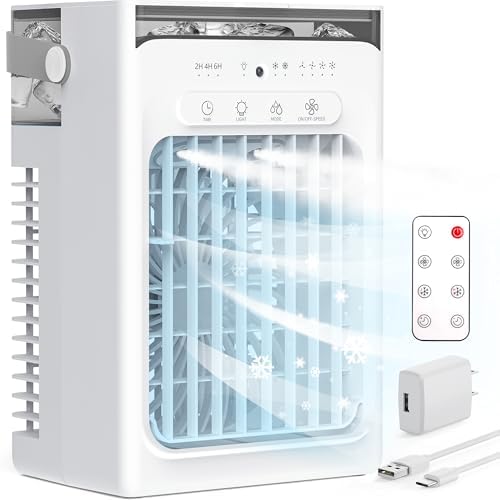
| Power Source | Corded Electric |
|---|---|
| Water Tank Capacity | 1100 ml |
| Noise Level | ~50 dB |
| Timer | 2/4/6H |
The SOLEEY F001 is a small, lightweight evaporative cooler meant to provide personal cooling in bedrooms and small spaces. It uses dual ultrasonic nebulizers, an upgraded motor and a fan to blow cooled, humidified air from its 1100 ml top tank; the lower reservoir captures condensation to support cooling in more humid conditions. Controls include a remote, four fan speeds, three modes, a 2/4/6 hour timer and a seven-color night light, so it works as a bedside unit for sleeping or a desktop cooler for office and camping use. At roughly 8W it is very energy efficient and quiet enough for nighttime use, though it cools by evaporation rather than refrigerant so it is best for single-person zones and will not lower whole-room temperatures like a portable refrigerant AC. Setup is simple—fill with water and ice or run via USB—and the compact size makes it easy to move, but expect modest cooling power and added humidity while it runs. For a low-cost, low-power bedroom cooler the F001 delivers useful, fuss-free performance with clear limitations on coverage.
Best for: Buyers seeking an inexpensive, ultra-low-energy bedside cooler for small bedrooms or personal zones who prioritize portability and quiet operation over whole-room cooling.
Less Ideal for: People who need to cool medium to large bedrooms or who live in humid climates that reduce evaporative cooler effectiveness should consider stronger refrigerant-based units instead.
- Compact and very lightweight for easy moving and storage
- 1100 ml water tank with upper and lower reservoirs for both humid and dry use
- Remote control, timer and multiple fan speeds add useful convenience
- Low power draw (about 8W) and quiet operation suitable for night use
- Evaporative cooling is limited to personal or small-area use and will not cool larger bedrooms effectively
- Adds humidity to the room which may be undesirable in already humid climates
Verdict: If you want an affordable, energy‑sipping bedside evaporative cooler for a single-person bedroom, the SOLEEY F001 is a practical, portable choice.
CENSTECH L242Y Evaporative Cooler
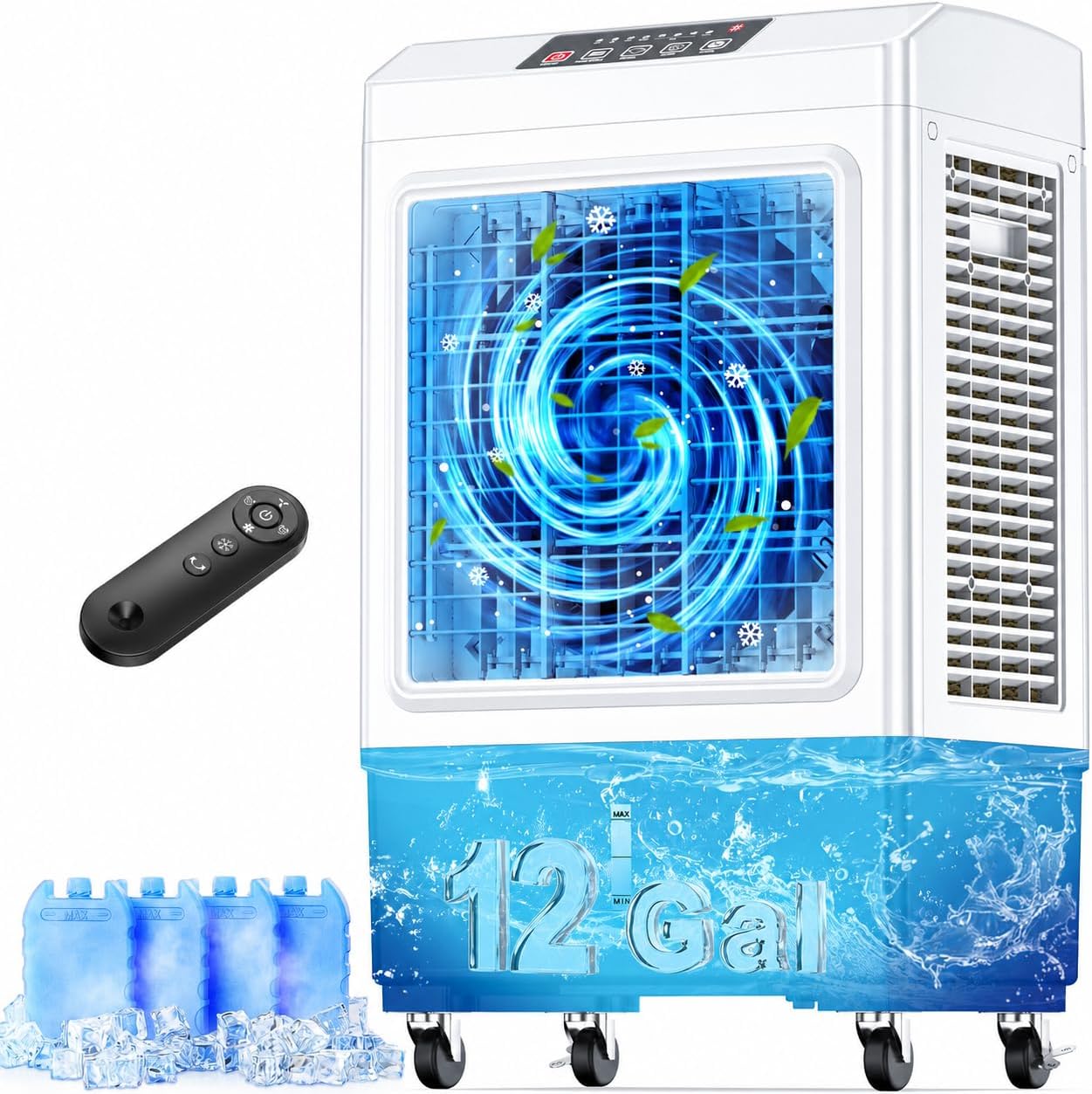
| Wattage | 100 watts |
|---|---|
| Noise | 45 db |
| Voltage | 120 volts |
| Included Components | Remote control and 4 ice packs |
The CENSTECH L242Y is a plug-and-play evaporative cooler intended to cool indoor spaces without a window kit or exhaust hose. It works by adding water (and optional ice packs) to dual tanks and running one of three fan speeds and four modes to circulate cooled, humidified air; 120° horizontal and 70° vertical oscillation help spread airflow across a room. Practical features include top-fill access for easier refills, a clear water level indicator, a 7-hour timer, remote and touch controls, and quiet operation under 45 dB for bedroom use. The unit claims high airflow (up to 3600 CFM) and includes reusable ice packs for stronger cooling bursts, plus washable honeycomb meshes for filter maintenance. Trade-offs are inherent to evaporative cooling: performance is best in dry climates and it raises indoor humidity, and it does not chill air to the temperatures a refrigerated air conditioner can reach. For renters or anyone who needs a factory-quality, low-effort cooler for bedrooms or garages, it offers simple setup, mobility on swivel wheels, and safety-minded design features.
Best for: Buyers who prioritize a reliable, low-maintenance bedroom cooler that is easy to set up and operate without permanent installation and who live in drier climates.
Less Ideal for: People seeking strong refrigerated air conditioning or users in consistently humid climates should consider conventional AC units instead.
- No installation or window/hose needed for immediate use
- Top-fill dual-tank design with clear level indicator simplifies refills and enables long runtimes
- Remote plus touch controls and 7-hour timer make bedroom use convenient
- Bladeless outlet, UL-listed plug and quiet <45 dB operation improve safety and suitability for sleeping spaces
- Effectiveness depends on ambient humidity so cooling is limited in humid climates
- Adds moisture to the room which may be undesirable for some bedrooms
Verdict: A user-friendly, safety-focused evaporative cooler built for dependable, windowless bedroom cooling in dry climates.
Arctic Air Pure Chill 2.0

| Form Factor | Personal |
|---|---|
| Voltage | 120 volts |
| Power Consumption | 8-10 watts |
| Speeds | 4 speed settings |
The Arctic Air Pure Chill 2.0 is a small, lightweight evaporative cooler intended for personal spot cooling in bedrooms, offices, or on a desk. You fill the top reservoir with water, plug it in, and choose one of four fan speeds using the touch controls; the unit uses Hydro-Chill technology and dual vents to direct airflow and adds a seven-color LED night light. It runs on about 8–10 watts, so it uses very little electricity and can operate for several hours between fills depending on settings and room humidity. The design is easy to move and the adjustable vents help aim the airflow, but its cooling effect is limited to a small area and performance depends heavily on ambient humidity and ventilation. There is no refrigerant-based cooling, so it will not lower whole-room temperature like a portable air conditioner, and the water tank needs periodic refills and cleaning to avoid odors. For a low-cost, energy-efficient personal cooler it is simple and straightforward to use, but expect modest results in hot, humid spaces.
Best for: Buyers who want an inexpensive, energy-frugal way to cool a personal workspace or bedside area and prioritize portability and simple operation over whole-room cooling.
Less Ideal for: People who need consistent whole-room temperature reduction or reliable cooling in hot, humid environments should consider a refrigerant-based portable air conditioner instead.
- Very low power consumption (8–10 watts) for long run times
- Top-fill water tank for simple refilling
- Four fan speeds and adjustable vents for directed airflow
- Lightweight, compact design makes it easy to move and place on a desk
- Effective cooling is limited to a small personal zone and depends on ambient humidity
- Requires regular refilling and occasional cleaning to prevent odors
Verdict: A very affordable, ultra-low-power personal cooler that delivers simple spot cooling and humidification for desks and bedside use.
Ylkf TT-20 Portable Air Cooler

| Reservoir Capacity | 1200 ml |
|---|---|
| Air Flow Capacity | 200 cfm |
| Wattage | 7 watts |
| Noise | 40 db |
| Number of Speeds | 3 |
The Ylkf TT-20 is a USB-powered personal evaporative cooler designed to deliver close-range cooling with a 1200 ml reservoir and three fan speeds. It is used by filling the tank with water and optional ice, then placing the unit on a desk, nightstand, or in an RV where it blows mist-enhanced air to create a cooler breeze. Notable features include touch controls, a low 7-watt draw, a quiet operation rated under 40 dB, and a simple 2/4/8 hour timer for overnight use. Practical benefits are fast, energy-efficient personal cooling without the complexity or power needs of a traditional air conditioner, plus portable USB compatibility for power banks, laptops, or car chargers. Important limitations are that it is an evaporative cooler not a refrigerated AC so it only cools a small personal area rather than an entire room, and performance depends on ambient humidity and regular refilling and cleaning of the reservoir. The unit is lightweight and compact, making it easy to move, but buyers should expect spot cooling rather than whole-room temperature drops.
Best for: Buyers who prioritize a low-risk, easy-to-use personal cooling option for a desk, nightstand, or small travel setup and want energy-efficient USB power and quiet operation.
Less Ideal for: People who need to cool whole rooms or rely on refrigerated air conditioning should look at true portable AC units instead.
- Large 1200 ml tank lets you run longer between refills
- USB power makes it easy to use with power banks, laptops, or car chargers
- Low power draw (7 watts) keeps operating costs and heat output minimal
- Quiet operation under 40 dB suitable for bedrooms and offices
- Cooling is limited to a close personal area and is less effective in high-humidity environments
- Requires regular refilling and occasional cleaning of the reservoir and pads
Verdict: Choose the TT-20 if you want a low-power, quiet USB personal cooler that delivers effective spot cooling and easy portability under $100.
Choosing the Right Evaporative Cooler for Bedrooms: Key Factors to Consider
Room Size and Airflow Needs
Match the evaporative cooler's stated coverage or airflow rate to your bedroom's square footage. A unit rated for a much larger area may cycle air too aggressively or use more power than needed, while an undersized unit will struggle to maintain comfortable conditions.
Consider ceiling height and room layout. High ceilings or obstructed airflow from furniture can reduce effective cooling. Look for specification metrics like cubic feet per minute (CFM) or recommended room area to estimate how well a unit will perform in your specific bedroom.
Noise Performance
Bedrooms demand low noise, so pay close attention to decibel ratings and owner feedback about real-world sound. Lower fan speeds and dedicated night modes can significantly reduce audible distraction during sleep.
Also evaluate sound character. Some units produce a steady, unobtrusive white-noise hum that many people find tolerable, while others have intermittent rattles or tonal frequencies that are more likely to disturb light sleepers. Quiet operation at typical bedside distances matters more than peak fan output.
Humidity Impact and Climate Suitability
Evaporative coolers add moisture to the air as they cool, which helps in dry climates but can be problematic in humid environments. Assess your local relative humidity before choosing this type of cooler.
If you live in a place with moderate to high humidity, an evaporative cooler may provide limited cooling and increase indoor dampness. For arid regions, these units can be extremely efficient and comfortable. Consider how added humidity will affect bedding, electronics, and your personal comfort.
Energy Use and Running Costs
One advantage of evaporative cooling is generally lower electricity draw compared with compressor-based air conditioners. Still, energy use varies by fan motor size, speed settings, and how often you run the unit overnight.
Check manufacturer power ratings and look for energy-saving features like ECO modes, programmable timers, and sleep settings. Lower sustained power draw reduces operating cost and heat generation inside the room.
Maintenance and Filter/Pads
Regular maintenance keeps an evaporative cooler operating efficiently. Cooling pads or filters need periodic cleaning or replacement, and the water reservoir should be emptied and sanitized occasionally to prevent odors and buildup.
Assess how easy it is to access and change pads, whether replacement pads are readily available, and if the unit includes anti-microbial treatments or washable parts. Simpler maintenance means less downtime and more consistent cooling performance.
Controls, Timers, and Usability
Bedroom use benefits from intuitive controls that let you set precise schedules and gentle fan levels. Look for models with programmable timers, multiple speed settings, remote control, or smartphone integration if you prefer digital convenience.
Physical placement and portability also matter. A compact unit that can be moved easily or a model with caster wheels and handles is useful if you want to reposition it seasonally or store it when not in use.
Sizing the Cooler to Your Bedroom
Estimate the cubic volume of your bedroom by multiplying square footage by ceiling height to get a clearer sense of required airflow. Manufacturers sometimes list CFM or recommended coverage; use those numbers to compare units on an apples-to-apples basis.
If you plan to use the cooler in a partially open layout or with an adjacent bathroom or closet, account for the extra air volume. For small bedrooms, a lower-CFM unit at close range often provides more comfortable, consistent airflow than a higher-power unit placed farther away.
- Measure floor area and ceiling height for better sizing.
- Prefer adjustable airflow or multiple speed settings to fine-tune comfort.
- Consider where you will place the unit relative to the bed for optimal circulation.
Placement and Airflow Direction
Position the evaporative cooler so that air moves across the room rather than blowing directly at the head of the bed unless you prefer a targeted breeze. Placing the unit near a window or doorway can help with cross ventilation and improve evaporative performance.
Keep several feet of clearance around intake and outlet panels to avoid restricted airflow. Elevated placement on a small stand can help distribute air more evenly in rooms with low furniture blocking circulation.
- Avoid tight corners or enclosed closets.
- Aim for unobstructed intake openings and clear outlet direction.
- Test different positions for the least noisy and most effective airflow.
Managing Indoor Humidity
Track indoor relative humidity to ensure the evaporative cooler is beneficial. In consistently humid conditions, the added moisture may make a bedroom feel clammy instead of comfortable. A humidistat or separate hygrometer can guide usage decisions.
Use ventilation strategies such as intermittent window opening or brief exhaust fan use to prevent excessive buildup of humidity when necessary. Running the cooler at lower speeds overnight reduces moisture output while still providing gentle cooling.
- Aim to keep bedroom humidity in a comfortable range, typically between 40 and 60 percent.
- Reduce continuous high-speed operation in already humid conditions.
- Consider combining brief ventilation with the cooler for improved comfort.
Quiet Operation Tips
If you are a light sleeper, prioritize units with documented low decibel ratings and night modes that lower fan speed. Place the unit a few feet away from the bed and orient the airflow to avoid direct blasts at the headboard.
Sound-absorbing pads or soft surfaces near the unit can help dampen vibrations. Regular maintenance that secures loose panels and cleans fan blades will also reduce rattles and turbulent noise over time.
- Look for night mode or low-speed presets.
- Place the cooler on a stable, level surface to minimize vibration noise.
- Maintain the unit to prevent noise from loose parts or buildup.
Practical Upkeep and Seasonal Storage
Empty and dry the water reservoir before long-term storage to avoid mold and odor. Clean cooling pads and treat any plastic surfaces per the manufacturer's cleaning guidance to keep the unit sanitary for bedroom use.
Label replacement pad sizes and stock numbers so you can obtain replacements quickly when needed. Seasonal maintenance prevents surprises when temperatures rise and ensures reliable operation when you need it most.
- Dry and clean the reservoir before storing seasonally.
- Keep a maintenance checklist for pad cleaning and replacement intervals.
- Store in a dry place away from direct sunlight to preserve plastic parts.
How We Chose the Best Evaporative Cooler for Bedrooms
We evaluated options specifically for bedroom use, prioritizing criteria that matter for overnight comfort and low-disruption performance. Our selection process focused on measurable features and user-centric design points: effective airflow and distribution for typical bedroom sizes, low operational noise at sleeping distances, energy consumption during continuous use, and ease of maintenance including pad replacement and cleaning. We also considered control precision such as variable fan speeds, timer functions, and night modes that reduce wake-ups. Products were excluded if they lacked explicit noise ratings, did not offer variable speed or timer features, or were intended only for outdoor use. We favored units with clear documentation of cooling coverage and airflow delivery rather than vague marketing claims. Durability and access to replaceable cooling media were also factored into inclusion. These filters ensured the shortlist emphasizes practical bedroom performance, low upkeep, and energy-conscious operation.
Our full evaluation process is outlined in our review methodology.
FAQ
Are evaporative coolers good for bedrooms in humid climates?
They are usually less effective in high-humidity areas because evaporative cooling relies on dry air to evaporate water. In humid climates, these units can add moisture without much temperature drop, so performance often depends on local typical humidity levels.
How loud are bedroom-appropriate evaporative coolers?
Noise varies by model and fan speed. Many bedroom-focused units offer night modes or low-speed settings that keep sound levels comparable to a quiet fan. Check decibel ratings and user reports for real-world examples.
How often do cooling pads need to be replaced or cleaned?
Cleaning frequency depends on water quality and usage but plan to rinse pads monthly during heavy use and replace them annually or as recommended by the manufacturer. Regular cleaning preserves airflow and prevents odors.
Can an evaporative cooler dry or damage bedding or electronics?
Evaporative coolers add moisture to the room rather than drying it out. They generally will not damage bedding, but increased humidity can affect sensitive electronics if condensation occurs. Maintain sensible distance and monitor room humidity.
Is it safe to run an evaporative cooler overnight in a bedroom?
Yes, when used as intended. Ensure the unit is placed on a stable surface, filled according to guidelines, and maintained to avoid microbial growth. Using night modes and timers helps manage noise and humidity through the night.
Final Verdict
For bedrooms, prioritize quiet operation, correct sizing, and simple maintenance when choosing an evaporative cooler. Consider how your local humidity will interact with evaporative cooling and pick a unit with adjustable fan speeds, timer options, and easily serviceable cooling pads. Balancing airflow and noise is the key tradeoff. Focus on coverage and noise ratings first, then evaluate energy draw and upkeep. With those priorities in mind, you can confidently choose a bedroom evaporative cooler that delivers comfortable, low-disruption cooling through warm nights.