
Note: This article contains affiliate links. If you click on these links and make a purchase, we may earn a small commission at no extra cost to you. This helps support our research and content. Read our full affiliate disclosure here.
Picking the right printer for a business affects daily productivity, operating cost, and workflow efficiency. Whether you need high monthly page volumes, secure network printing, or low per-page costs, the wrong choice can bottleneck work and increase expenses. This guide shortlists the top printer options for businesses and explains the real-world tradeoffs that matter for offices and workgroups. We evaluated models for speed, reliability, security features, and ownership costs so you can quickly find a machine that fits your team size and workload. Read on for focused guidance before you compare product details.
Top Picks at a Glance
| Best Overall The best all-around choice for most situations | Brother DCP-L2640DW Laser MFP |  |
| Best Quality Built to a higher standard if you want something more solid | HP LaserJet Enterprise MFP M635 |  |
| Best Value The sweet spot between price and what you get | Epson EcoTank ET-4800 |  |
| Top Rated A top-rated pick with lots of positive feedback | HP LaserJet Pro MFP 3101sdw |  |
| Most Popular A crowd favorite that many people choose with confidence | Canon PIXMA TS6520 |  |
| Best Seller A high-volume bestseller chosen again and again | Epson EcoTank ET-2800 |  |
Brother DCP-L2640DW Laser MFP

| Printer Type | Laser |
|---|---|
| Printer Output Type | Monochrome |
| Print Speed | 36 pages_per_minute |
| Maximum Print Resolution Black and White | 1200 x 1200 dots_per_inch |
| Printer Connectivity Type | Ethernet, USB, Wi‑Fi |
The Brother DCP-L2640DW is a compact monochrome laser multifunction printer designed for small business users who need dependable black-and-white output, scanning, and copying in a single unit. It prints up to 36 ppm and delivers factory-quality 1200 x 1200 dpi output for text and basic graphics, while a 50-sheet auto document feeder speeds multi-page scans and copies. Connectivity is flexible with dual-band Wi-Fi, Ethernet, and USB so multiple users can print from computers and mobile devices, and the Brother Mobile Connect app lets you print and scan from a phone. The 250-sheet tray and automatic duplex printing reduce refills and paper waste for moderate-volume workflows, and toner save plus eligible Refresh subscription options help manage running costs. Expect a straightforward monochrome feature set rather than color or advanced finishing; the unit is optimized for text-heavy documents and office productivity rather than photo-quality imaging. Setup and routine maintenance are typical for laser printers, including occasional drum and toner replacement for higher monthly page counts.
Best for: Buyers who want a reliable, compact workhorse for high-volume black-and-white printing, scanning, and copying in a small office or shared workspace.
Less Ideal for: If you need color printing, photo-quality output, or advanced finishing (stapling/binding), look at color laser or dedicated office printers with those features.
- Fast monochrome printing up to 36 pages per minute.
- 50-sheet auto document feeder for efficient multi-page scanning and copying.
- Dual-band Wi-Fi, Ethernet, and USB give flexible multi-user connectivity.
- 250-sheet input tray and automatic duplex reduce refill frequency and paper use.
- High maximum print resolution (1200 x 1200 dpi) for crisp text and business graphics.
- Monochrome only so no color printing capability.
- Not designed for photo-quality prints or advanced finishing features.
Verdict: A compact, fast monochrome multifunction laser that reliably handles high-volume text printing and basic scanning for small business users.
HP LaserJet Enterprise MFP M635

| Printer Type | Laser |
|---|---|
| Functions | Print, Copy, Scan, Fax |
| Print Speed | 65 pages_per_minute |
| Maximum Print Resolution Black and White | 1200 x 1200 dpi |
| Printer Connectivity Type | Ethernet |
The HP LaserJet Enterprise MFP M635 is a business-grade monochrome all-in-one that prioritizes speed, security, and high-volume handling. It delivers up to 65 ppm and a 5.2 second first‑page-out time, making it suitable for busy workgroups that need fast black-and-white output. The 9" touchscreen and auto document feeder simplify everyday workflows for copying, scanning and faxing, while the extra 550-sheet tray plus included wheeled stand raise the total input capacity to 1,200 sheets so you spend less time refilling paper. Built-in Ethernet and a single USB port support networked deployments and centralized management via HP Web JetAdmin, and security features such as HP Sure Start help detect and repair compromised firmware. Print quality is sharp for text and basic graphics at 1200 x 1200 dpi, and the JetIntelligence toners are tuned for long page yields. Limitations include monochrome-only output and a large physical footprint and weight that require a dedicated location and likely professional installation.
Best for: Businesses and busy workgroups that prioritize fast, reliable black-and-white throughput, centralized management, and built-in security for shared networked printing.
Less Ideal for: Small offices or users who need color printing, portable machines, or a compact desktop printer for light occasional use.
- Very fast black-and-white printing up to 65 pages per minute for high-throughput environments
- High total paper capacity (up to 1,200 sheets with extra tray and stand) reduces refill frequency
- Robust security including HP Sure Start to detect and repair firmware attacks
- 9-inch touchscreen and auto document feeder simplify scanning, copying and workflow tasks
- Monochrome only, so no color printing capability
- Heavy and bulky unit that needs dedicated floor space and likely professional setup
Verdict: Choose this MFP when you need a secure, high‑speed monochrome workhorse that handles large paper loads and centralized network management for business printing.
Epson EcoTank ET-4800

| Printer Type | Inkjet |
|---|---|
| Printer Connectivity Type | Wi-Fi, wired |
| Maximum print Resolution Color | 5760 x 1440 dots_per_inch |
| B&W Pages per Minute | 10 pages_per_minute |
| Color Pages per Minute | 5 pages_per_minute |
The Epson EcoTank ET-4800 is a cartridge-free inkjet designed to cut running costs for small offices while providing everyday multifunction capability. It uses large refillable ink tanks and EcoFit bottles so a full set of included bottles replaces many cartridge sets, which reduces both cost and cartridge waste. The ET-4800 prints color graphics and sharp text at a high maximum resolution and offers a flatbed scanner, automatic document feeder, copier and fax alongside an LCD and Ethernet/Wi-Fi connectivity for shared use. Paper handling supports up to 100 sheets and legal-size media, and print speeds are modest at about 10 ppm black and 5 ppm color, making it better suited to light to moderate office volumes rather than heavy production. Setup and refills are straightforward, and voice and Android controller options make basic operations accessible, but duplex is manual so two-sided runs require user intervention. For a practical business looking to lower ink costs and avoid frequent cartridge changes, the ET-4800 is a sensible multifunction choice with a clear cost-per-page advantage.
Best for: Small businesses that prioritize low ongoing ink costs and need a compact all-in-one for scanning, copying and light shared printing.
Less Ideal for: Teams with heavy monthly print volumes or a need for fast, automatic duplex production should consider higher-capacity office printers instead.
- Refillable high-capacity EcoTank ink system included, greatly reducing ink replacement frequency
- All-in-one functions with flatbed scanner, ADF, copier and fax for business workflows
- Wired Ethernet and Wi-Fi connectivity for easy sharing on a small office network
- High maximum print resolution for sharp text and good color output
- Relatively slow color print speed compared with higher-volume office printers
- Automatic duplexing is not supported and two-sided printing is manual
Verdict: Choose the ET-4800 when you want an affordable, cartridge-free multifunction that cuts ink costs for light to moderate office use.
HP LaserJet Pro MFP 3101sdw

| Printer Type | Laser |
|---|---|
| Scanner Type | ADF, flatbed |
| Maximum Print Resolution Black and White | Up to 1200 x 1200 dpi |
| Maximum Sheet Capacity | 250 |
| Printer Connectivity Type | Apple AirPrint; Ethernet networking; Mopria; USB; Wireless (Wi-Fi) |
The HP LaserJet Pro MFP 3101sdw is a business-focused monochrome multifunction laser that handles printing, copying, scanning and basic faxing for small teams. It delivers fast black-and-white output with stated speeds up to 35–40 pages per minute and a quick first-page time, and includes a 250-sheet input tray plus a 50-sheet auto document feeder for batch scanning and copying. Connectivity covers Wi‑Fi, Ethernet, USB, AirPrint and Mopria, and the HP app simplifies mobile printing and remote management. Print quality is sharp for text and business documents thanks to its 1200 x 1200 dpi capability, and automatic two-sided printing helps reduce paper use. The unit is built for steady office throughput and includes an introductory toner cartridge so you can get started quickly. Expect the usual laser trade-offs: it only prints in monochrome and power consumption is higher than a basic inkjet, but for teams that need reliable, fast black-and-white output and centralized management this model is a practical choice.
Best for: Managers buying a dependable office printer for a small team who prioritize consistent, fast black-and-white output and easy network management.
Less Ideal for: Users who need color printing, photo-quality output, or a very low-power home printer should consider alternatives.
- Fast monochrome printing up to 35–40 ppm for quick document throughput
- 250-sheet input tray and 50-sheet ADF reduce frequent paper refills and speed batch jobs
- Automatic duplex printing lowers paper use and supports professional two-sided documents
- Wide connectivity including Ethernet, Wi‑Fi, USB, AirPrint and Mopria for flexible setup
- 1200 x 1200 dpi resolution produces crisp text and business graphics
- Prints only in black and white, so no color output for graphics or presentations
- Higher power consumption compared with consumer inkjets
Verdict: Choose this LaserJet Pro when you need a reliable, fast monochrome MFP that keeps small business workflows moving.
Canon PIXMA TS6520

| Printer Type | Inkjet |
|---|---|
| Printer Connectivity Type | USB, Wi-Fi |
| Duplex | Automatic |
| Display Type | OLED |
| Color Pages per Minute | 9 pages_per_minute |
The Canon PIXMA TS6520 is a small, user-friendly all-in-one inkjet aimed at home and light business use. It prints color documents and photos using a two-cartridge hybrid ink system, scans on a flatbed glass, and copies basic pages; the 1.42-inch OLED and simple control panel make setup and status checks straightforward. For everyday office tasks you get reliable Wi‑Fi (2.4/5 GHz), mobile printing via Canon PRINT, AirPrint and Mopria, and automatic two-sided printing to save paper. Print quality is good for text and casual photos, and the hybrid pigment/dye cartridge arrangement keeps text sharp while producing vibrant colors. Limits for heavier business use include a very small input capacity and no automatic document feeder, so high-volume scanning or multi-page copying requires manual feeding and frequent paper replenishment. The compact footprint and low power draw suit tight workspaces, but expect slower speeds and more hands-on scanning compared with business-focused MFPs.
Best for: Budget-conscious small office or home-business buyers who prioritize compact, easy-to-set-up printers for occasional document and photo printing and want reliable wireless and mobile printing.
Less Ideal for: Businesses that need high daily page volumes, automated multi-page scanning, or large paper capacity should choose a dedicated office MFP instead.
- Automatic two-sided (duplex) printing reduces paper use and manual flipping
- Supports dual-band Wi‑Fi and common mobile print standards for easy wireless printing
- Compact footprint fits small workspaces and is easy to tuck into a home office
- Hybrid ink system gives sharp black text and reasonably vibrant color prints
- Very small paper capacity and only one tray limits daily throughput
- No automatic document feeder makes multi-page scanning and copying manual
Verdict: Choose the PIXMA TS6520 when you need a compact, easy-to-use all‑in‑one that delivers solid print quality and wireless convenience for low-volume business tasks.
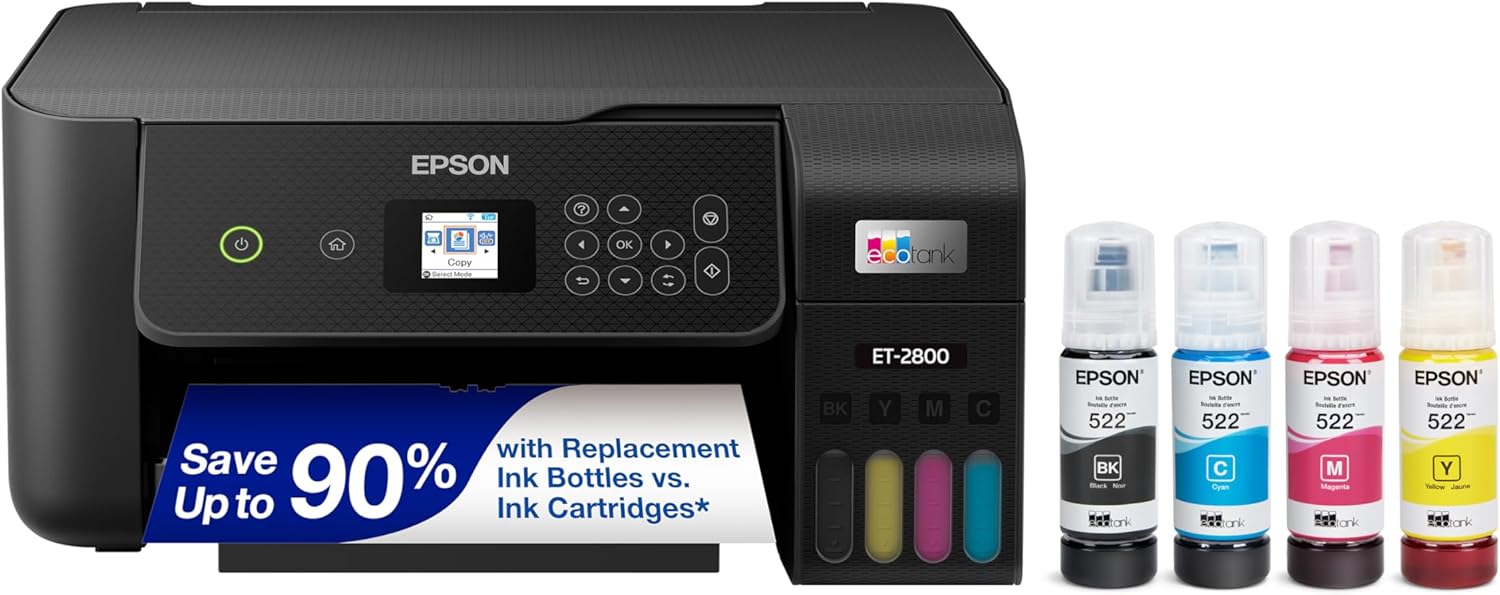
Epson EcoTank ET-2800
| Printer Type | Inkjet |
|---|---|
| Printer Connectivity Type | USB, Wi-Fi |
| Maximum print Resolution Color | 5760 x 1440 dpi |
| B&W Pages per Minute | 10 |
| Color Pages per Minute | 5 |
The Epson EcoTank ET-2800 is a cartridge-free all-in-one inkjet that prints, scans and copies using large refillable ink tanks and wireless connectivity. It is typically used by households or small offices that want frequent color and document printing without swapping cartridges; Epson includes high-capacity ink bottles that Epson says equal about 90 cartridges, which reduces refill frequency and landfill waste. The printer delivers up to 10 ISO pages per minute for black and 5 ppm for color, a high-resolution flatbed scanner, and a 5760 x 1440 dpi color print capability for sharper photos and graphics. Setup and everyday use are simplified by Wi-Fi printing, mobile/app control and a small color LCD, while heat-free PrecisionCore technology aims to produce consistent text and images. Limitations include simplex-only printing (no automatic duplex) and relatively modest color speed, so it is less efficient for heavy two-sided or high-volume office workflows; Epson also recommends genuine ink to maintain performance. For buyers who prioritize low ongoing ink costs and straightforward wireless printing, the ET-2800 is a practical, low-fuss choice.
Best for: Buyers who want dependable, low-cost-per-page color printing with minimal ink hassles and straightforward wireless setup for small office or home business use.
Less Ideal for: Workplaces that need fast, heavy two-sided printing or large daily page volumes should consider higher-capacity business printers with duplex and faster ppm.
- Cartridge-free refillable ink tanks that greatly reduce frequency of replacements
- Wireless and mobile app control for easy printing from phones and computers
- High color print resolution (5760 x 1440 dpi) for detailed photos and graphics
- Includes high-capacity ink bottles equivalent to many cartridges, lowering running costs
- No automatic duplex printing, so two-sided jobs require manual handling
- Color print speed is relatively slow compared with higher-volume office printers
Verdict: Choose the ET-2800 when you want a low-maintenance, cartridge-free color all-in-one that cuts ink costs and simplifies home or small office printing.
Choosing the Right Printer for Businesses: Key Factors to Consider
Print Volume and Duty Cycle
Estimate your monthly page volume and choose a printer with a higher rated duty cycle than your current need. Printers designed for business use list monthly duty cycles and recommended monthly print ranges; staying within those limits reduces wear and lowers the chance of service interruptions.
A model rated well above your typical usage gives headroom for occasional spikes, while a lower-rated unit may work initially but degrade faster or require more frequent maintenance. Consider growth over the next two to three years so the device remains adequate as your team expands.
Print Speed and Productivity
Print speed, usually measured in pages per minute, directly affects how long staff wait for documents during busy periods. In shared workgroup settings, faster first-page-out times and higher sustained PPM help reduce queues and keep people moving.
Also evaluate duplex speed and the printer's time to first page for small jobs. A high-rated PPM is most useful when the device can sustain that speed for larger jobs and when the internal memory and processor support complex print files without slowdowns.
Total Cost of Ownership
Beyond the purchase price, consumable costs and yield drive long-term expenses. Look at toner or ink yield figures and factor in how frequently cartridges or drums will be replaced. Energy use and the availability of high-yield options or subscription supply programs can significantly affect operating cost.
Maintenance parts such as fusers, drums, and rollers should be considered too. Lower upfront cost models can end up more expensive if they require frequent part replacements or use low-yield consumables.
Network Connectivity and Security
Business printers must integrate with wired and wireless networks and support secure printing workflows. Features like user authentication, secure print release, and encrypted data transfer prevent unauthorized access to sensitive documents. Remote management protocols and support for directory services simplify deployment for IT teams.
Also check for software update processes and whether administrative controls allow you to limit features or access. Security features reduce risk and help meet data-handling requirements in regulated environments.
Paper Handling and Media Support
Assess the standard and expandable paper capacity, supported paper sizes, and specialty media handling. A larger input tray and optional additional trays reduce user trips to refill paper in busy departments. Automatic duplexing and finishing options like stapling or hole-punching may be important for in-house document production.
If your office prints envelopes, labels, or thick stock, verify the machine's maximum media weight and recommended feed paths to avoid jams and poor output quality.
Administration and Serviceability
Consider how easily IT staff can monitor and administer the printer. Features such as a clear control panel, remote diagnostics, consumable alerts, and easy access to replaceable parts speed troubleshooting and minimize downtime. Availability of service contracts and the simplicity of common maintenance tasks affect total uptime.
For multi-unit fleets, consistent management tools and reporting capabilities help consolidate support and predict expenses across the office.
Choosing the Right Print Technology
For business environments, the two primary technologies are laser and high-capacity ink. Laser printers are common for high-volume black-and-white or mixed printing because of their fast output and durable toner-based consumables. High-capacity ink or inkjet-based business models can offer competitive color quality and lower per-page cost for color-heavy workflows.
Match the technology to your workload: use laser when volume and text crispness matter most, and consider high-capacity ink if you regularly produce color marketing materials and need lower color cost per page.
- Laser: strong for fast monochrome and mixed-volume workloads
- High-capacity ink: better for frequent color printing with lower color costs
- Consider maintenance cycle differences between technologies
Security Features That Matter
Prioritize features that protect data both in transit and at rest. Look for support for encrypted printing, secure boot, and controls that require user authentication at the device before output is released. These capabilities prevent sensitive documents from sitting unattended on trays.
Administrative controls like firmware update management and the ability to disable unused services reduce attack surface. If you handle regulated data, choose machines that support centralized logging and role-based access to administrative functions.
- User authentication and secure print release
- Encrypted network protocols and storage
- Firmware update and administrative control options
Paper Handling and Finishing Options
Think beyond single-tray basics when your office produces finished documents. Additional trays increase capacity and let you load different paper sizes without swapping stock. Built-in duplexing saves time and paper for two-sided jobs.
If your workflow includes in-house collating, stapling, or booklet production, select a printer with optional finishing modules. These options reduce manual post-processing and support more professional output without relying on external services.
- Multiple trays for reduced refills
- Automatic duplexing for two-sided jobs
- Finishing modules for stapling and booklet creation
Managing Consumables and Supplies
Track expected yield and replacement intervals so you can plan supply orders and avoid unexpected downtime. Some business printers support high-yield consumables or separate toner and drum systems that lower ongoing costs. Check how straightforward part replacement is for routine items to keep service calls rare.
Consider setting up supply alerts and centralized reorder processes to keep critical devices stocked. For large fleets, consistent part types across similar models simplify logistics and spare-parts management.
- High-yield consumables reduce change frequency
- Separate imaging components can lower long-term cost
- Automate alerts to prevent supply shortages
Sizing for Team and Location
Place higher-capacity printers in central print rooms or departments with heavy demand, and keep smaller units near individuals or small teams for occasional printing. Centralizing heavy print jobs reduces equipment duplication and lets you invest in a more robust machine for volume work.
Also consider physical footprint, noise level, and ventilation when locating printers. Busy machines generate heat and noise, so choose a location that minimizes disruption and provides adequate airflow for device longevity.
- Centralized high-capacity units for heavy workloads
- Smaller networked units for satellite teams
- Account for footprint and noise when planning placement
How We Chose the Best Printer for Businesses
We focused on attributes that make a printer suitable for sustained business use rather than casual home printing. Primary evaluation criteria included print speed and duty cycle to ensure devices can handle the expected monthly volume. We measured how security and network management features are implemented because businesses need user authentication, secure release, and remote administration to reduce risk and simplify IT support. Total cost of ownership was estimated from consumable yield, replacement-supply pricing, and energy efficiency to reflect real operating expenses. Reliability signals came from documented duty ratings and serviceability design, indicating how likely a device is to avoid downtime and how easy it is to maintain. We excluded consumer-focused small-format machines that lack business-grade network or security features, and we filtered out devices intended solely for low-volume home use. Our selection prioritized printers that balance throughput, security, and predictable running costs for office environments, plus administrative controls that ease fleet management. The scoring emphasized measurable specs and business-centric features rather than aesthetic or hobbyist extras.
Our full evaluation process is outlined in our review methodology.
FAQ
How do I estimate monthly printing volume for my office?
Add the average pages printed per user per day across a representative week, multiply by working days, and include peaks for busy periods. Factor in expected growth over the next year to choose a device with appropriate headroom.
Can printers be integrated with directory services for user authentication?
Often, yes. Many business printers support integration with directory services to authenticate users and apply access controls. Integration methods and supported protocols vary, so verify that the device supports your environment.
Are multifunction printers a good fit for small offices?
Multifunction devices combine printing, scanning, copying, and sometimes faxing, which can consolidate space and reduce the number of separate machines. They are convenient for small offices but be sure the chosen model has the paper capacity and durability to handle your volume.
How important is duplexing for business printing?
Automatic duplexing saves paper and gives documents a professional look, especially for reports and presentations. For offices trying to reduce costs and waste, duplexing is a highly valuable feature.
What maintenance tasks should my staff be prepared to do?
Routine tasks usually include replacing toner or ink, refilling paper, clearing common jams, and cleaning the scanner glass. More complex maintenance typically requires a service technician, but choosing an easy-to-service model reduces downtime.
Final Verdict
Prioritize the factors that will most affect your daily operations: sufficient monthly duty capacity, fast and consistent print speed, secure network features, and predictable consumable costs. Balance upfront capability with long-term ownership expenses and the administrative tools your IT team needs to keep devices running smoothly. Choose a machine that offers headroom for growth and the specific finishing or media handling features your workflows require. That approach helps you pick a business-ready printer that minimizes disruption and controls ongoing costs.