
Note: This article contains affiliate links. If you click on these links and make a purchase, we may earn a small commission at no extra cost to you. This helps support our research and content. Read our full affiliate disclosure here.
If you run a business from home, the right printer can keep operations smooth and costs predictable. You need dependable print quality for invoices, shipping labels, and marketing flyers, plus features that fit your workflow such as duplexing, network connectivity, and manageable ink or toner costs. This guide shortlists the top printers for home businesses and explains the practical tradeoffs so you can pick the best fit for your daily tasks. Below you will find our top picks followed by clear criteria we used to evaluate them and guidance to help you decide.
Top Picks at a Glance
| Best Overall The best all-around choice for most situations | Canon PIXMA TS6520 |  |
| Best Quality Built to a higher standard if you want something more solid | Brother MFC-L8930CDW |  |
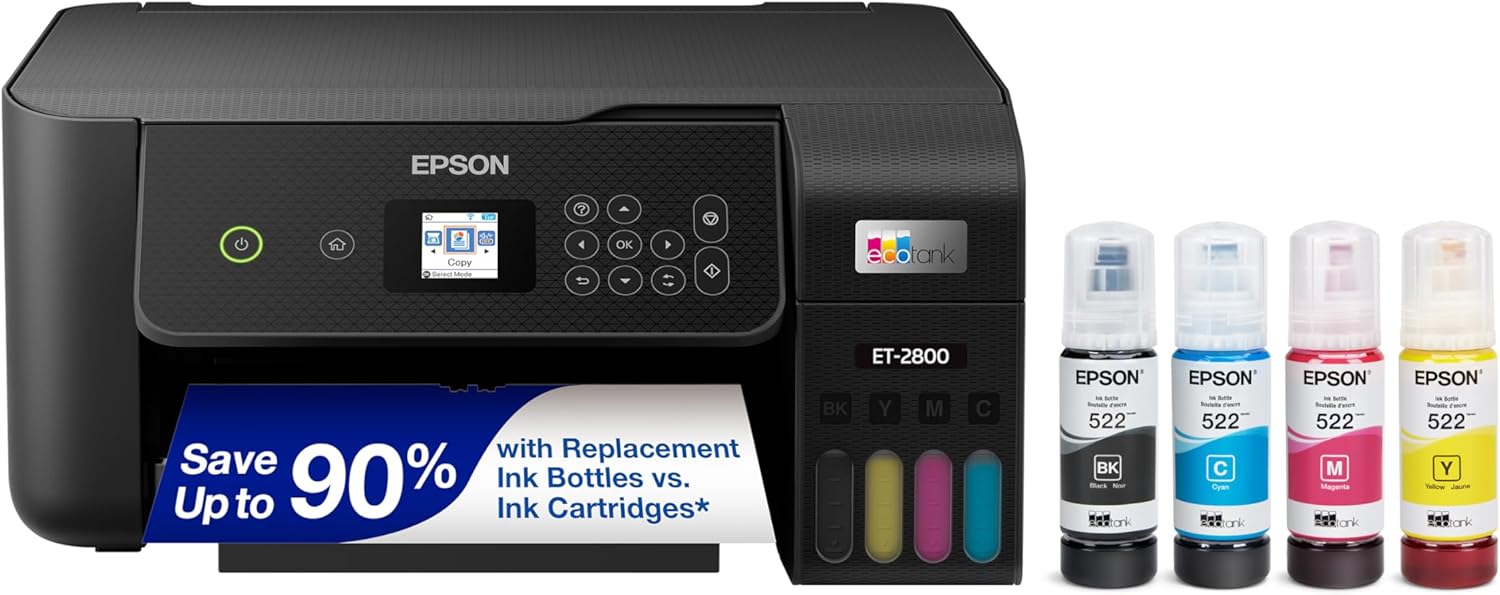
| Best Value The sweet spot between price and what you get | Epson EcoTank ET-2800 |  |
| Best Budget The cheapest option that still gets the job done reliably | HP DeskJet 2855e |  |
| Top Rated A top-rated pick with lots of positive feedback | HP LaserJet Pro MFP 3101sdw |  |
| Most Popular A crowd favorite that many people choose with confidence | Canon PIXMA TR4720 |  |
| Best Seller A high-volume bestseller chosen again and again | Brother DCP-L2640DW Laser Printer |  |
Canon PIXMA TS6520

| Printer Type | Inkjet |
|---|---|
| Display Type | OLED |
| Printer Connectivity Type | USB, Wi-Fi |
| Duplex | Automatic |
| Compatible Cartridge | PG-295 & CL-286 |
The Canon PIXMA TS6520 is a small, budget-friendly all-in-one aimed at home and small business users who need reliable document and occasional photo printing. It uses a two-cartridge hybrid ink system (pigment black and dye color) to deliver sharp text and vibrant color, and supports up to letter-size media with borderless photo printing. Setup is straightforward via the Canon PRINT app, AirPrint, or Mopria, and dual-band Wi‑Fi plus a USB port make mobile and laptop printing convenient. The 1.42-inch OLED gives simple status and ink-level feedback, and automatic two-sided printing helps reduce paper use. Scanning is handled by a flatbed scanner suitable for documents and photos, but there is no automatic document feeder so batch scanning or high-volume copying requires manual pages. Paper capacity is limited and print speeds are modest for heavier workloads, so it is best for moderate home-business tasks rather than continuous high-volume printing.
Best for: Buyers who want a capable, easy-to-use multifunction printer for moderate home-business printing, scanning, and photo tasks without needing high-volume features.
Less Ideal for: Businesses that need fast, high-volume printing, frequent multi-page scanning, or large paper capacity should consider more robust office-focused models.
- Compact footprint fits small home offices
- Automatic duplexing saves paper and time
- Dual-band Wi‑Fi plus USB and mobile print support for flexible connectivity
- Hybrid ink system produces sharp text and good color photo prints
- Easy setup and a simple OLED status display
- No automatic document feeder for multi-page scanning or copying
- Small paper capacity and modest print speeds limit heavy daily use
Verdict: A compact, user-friendly all-in-one that delivers good document and photo quality for moderate home-business use where simplicity and wireless convenience matter.
Brother MFC-L8930CDW

| Printer Type | Laser |
|---|---|
| Print Speed (Color) | 33 pages_per_minute |
| Duplex | Automatic |
| ADF Capacity | 80 pages |
| Connectivity | Ethernet, USB, Wi-Fi |
The Brother MFC-L8930CDW is a heavy-duty color laser all-in-one built for busy small offices and home businesses that need dependable, high-volume output. It prints and copies at up to 33 ppm in color and black, supports automatic duplex printing and single-pass duplex scanning via an 80-page ADF, and includes a 7" color touchscreen for workflow shortcuts and scan preview. Connectivity options cover dual-band Wi-Fi, Gigabit Ethernet, USB and mobile printing, while included standard-yield toner and compatibility with high- and super-high-yield replacement cartridges keep running costs lower for frequent printing. Notable business features include triple-layer security and an integrated NFC card reader for secure release, plus expandable paper capacity with optional trays for busier sites. Trade-offs are its large physical footprint and relatively high power draw compared with small desktop inkjets, and replacement toners, while long-lasting, are an ongoing cost to budget for. For performance-focused home businesses that need speed, scanning power, and security, this printer covers the essentials well.
Best for: Home business owners who prioritize reliable, fast color printing and robust scanning workflows for frequent document handling and who value security features for sensitive paperwork.
Less Ideal for: Users who need a compact, low-power desktop printer for occasional home use or who have very tight budgets for ongoing toner expenses.
- Fast color and mono print speeds up to 33 ppm for higher daily throughput
- Single-pass duplex scanning with 80-sheet ADF for quick two-sided document capture
- Dual-band Wi-Fi and Gigabit Ethernet plus mobile printing for flexible connectivity
- Supports high- and super-high-yield Brother toner cartridges to lower per-page costs
- Built-in security features including triple-layer protections and NFC badge authentication
- Large and heavy unit that requires substantial desk or cabinet space
- Higher power consumption than consumer inkjet alternatives
Verdict: Choose this Brother if you run a performance-focused home business that needs fast, secure color printing plus high-speed duplex scanning and flexible network connectivity.
Epson EcoTank ET-2800
| Printer Type | Inkjet |
|---|---|
| Printer Connectivity Type | USB, Wi-Fi |
| Maximum print Resolution Color | 5760 x 1440 dpi |
| B&W Pages per Minute | 10 |
| Maximum Sheet Capacity | 100 |
The EcoTank ET-2800 replaces disposable cartridges with large refillable ink tanks that ship with enough ink for many months of home printing, which cuts running costs and reduces interruptions for ink changes. It prints, copies, and scans; uses Wi-Fi and USB connectivity and supports mobile and voice-activated printing for easy jobs from phones or laptops. Print quality is good for documents and basic photos thanks to Epson PrecisionCore and high resolution, while a flatbed scanner and simple LCD control make everyday tasks straightforward. The printer is geared to simplex printing only and its sheet capacity is modest, so it is better suited to periodic bulk jobs rather than continuous heavy office output. Setup and ink refills are generally user-friendly, though Epson recommends genuine ink to maintain reliability. For small home businesses that want low ongoing ink costs and decent document/photo quality without cartridge hassle, the ET-2800 is a practical, economical choice.
Best for: Small home-business owners who prioritize low ongoing ink costs and reliable color document and photo printing with occasional bulk jobs and easy mobile connectivity.
Less Ideal for: Businesses that need high-volume, two-sided printing or large paper trays for continuous daily production should consider higher-capacity office printers.
- Cartridge-free EcoTank system with high-capacity refillable ink tanks for much lower ink replacement frequency
- Includes wireless and mobile printing plus voice-activated control for convenient home and remote printing
- High maximum print resolution for sharp text and detailed color prints
- All-in-one functionality with a flatbed scanner and easy-to-use LCD control
- Simplex-only printing and modest paper capacity limit throughput for heavy sustained printing
- Manufacturer recommends genuine ink, which restricts third-party refill options
Verdict: Choose the ET-2800 if you want an affordable, cartridge-free all-in-one that cuts ink costs and handles home-business printing with good quality and mobile convenience.
HP DeskJet 2855e
| Printer Type | Inkjet |
|---|---|
| Print Output Type | Color |
| Paper Capacity | 60-sheet input tray |
| Connectivity | single band wi-fi (2.4ghz only), USB 2.0 |
| Compatible Cartridge | HP 67 |
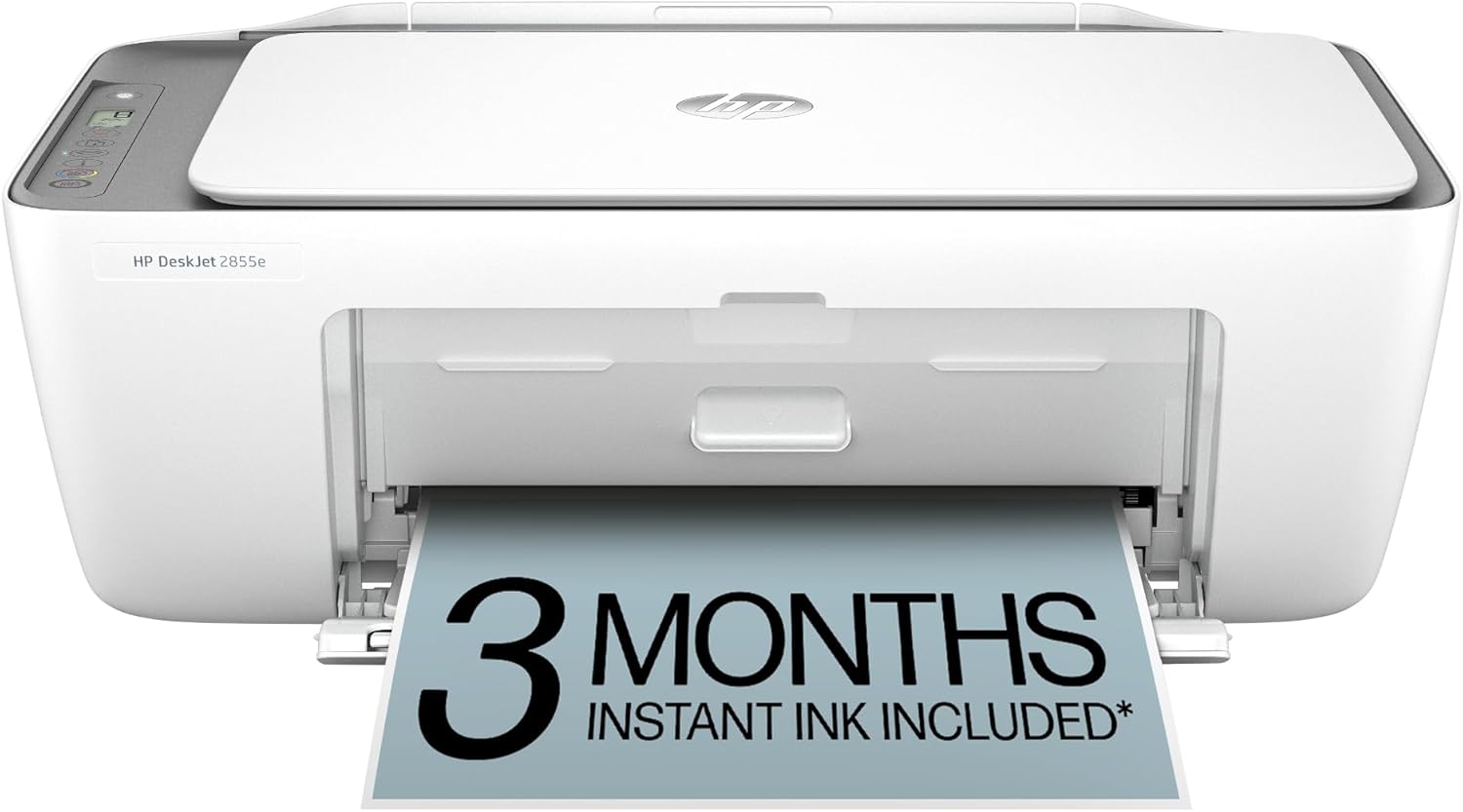
The HP DeskJet 2855e is an entry-level all-in-one designed for light home-business use, offering color printing, flatbed scanning, and copying in a compact footprint. It connects via single-band 2.4 GHz Wi‑Fi or USB 2.0 and is controlled through the HP app for printing from smartphones and PCs. Notable features include HP AI print formatting to remove unwanted web page clutter, a 60-sheet input tray, and a three-month Instant Ink trial with HP+ activation for easier supply management. Print speeds are modest at about 7.5 ppm black and 5.5 ppm color, and duplexing is manual, so it is best for intermittent document and occasional color jobs rather than high-volume or fast-paced output. The printer uses HP 67 cartridges and produces respectable photo-quality color resolution at up to 4800 x 1200 dpi, but the single-band 2.4 GHz Wi‑Fi and limited paper capacity reflect its budget positioning. For small home businesses needing an affordable, space-saving printer with app convenience, it covers core tasks without advanced workflow features.
Best for: Buyers running a small home business who prioritize a low-cost, space-saving all-in-one for occasional documents, basic color prints, and easy mobile setup.
Less Ideal for: Businesses that need fast first-page times, high monthly print volumes, automatic two-sided printing, or advanced network features should consider higher-capacity models.
- All-in-one functionality for printing, scanning, and copying in a compact chassis
- Wireless printing with smartphone app control for easy mobile workflows
- Includes a 3-month Instant Ink trial to simplify initial supply management
- High color resolution (up to 4800 x 1200 dpi) for better-looking color prints than many budget models
- Single-band 2.4 GHz Wi-Fi only and basic USB 2.0 connectivity limit networking flexibility
- Manual duplexing requires flipping pages for two-sided printing
- 60-sheet input tray is small for moderate-volume use
Verdict: A budget-friendly, compact all-in-one that handles basic home-business printing, scanning, and mobile workflows without the speed or capacity of higher-end office printers.
HP LaserJet Pro MFP 3101sdw

| Printer Type | Laser |
|---|---|
| Print Speed (B&W) | 40 ppm |
| Maximum Print Resolution | Up to 1200 x 1200 dpi |
| Input Capacity | 250 sheets |
| Scanner | ADF and flatbed |
The HP LaserJet Pro MFP 3101sdw is a compact monochrome laser multifunction printer aimed at small businesses and home offices that need dependable document workflows. It prints up to 35–40 pages per minute and produces 1200 x 1200 dpi black-and-white output, while the 50-sheet automatic document feeder and flatbed scanner make batch scanning and copying straightforward. A 250-sheet input tray and automatic duplexing reduce manual paper handling for multi-page jobs, and connectivity options include Wi‑Fi, Ethernet, USB, AirPrint and mobile printing through the HP app for flexible placement and easy smartphone printing. Practical benefits include fast first-page time and a starter toner cartridge good for roughly 1000 pages, which helps during initial setup. Expect typical laser trade-offs: it only handles monochrome output so no color printing, and firmware enforces use of HP-chipped cartridges. For reliability-minded buyers the solid build, proven workflow features, and enterprise-style security and management tools make it a sensible daily driver for a home business that prints heavy volumes of black-and-white documents.
Best for: Small business owners or home-office managers who prioritize consistent, high-speed black-and-white printing and dependable daily operation for reports, invoices, and multi-page workflows.
Less Ideal for: Users who need color printing, photo output, or those who want broad third-party consumable compatibility should consider other options.
- Fast monochrome printing up to 35–40 ppm for quick document throughput
- Automatic duplexing and 250-sheet tray reduce manual paper handling for multi-page jobs
- 50-sheet ADF plus flatbed scanner for efficient batch scanning and copying
- Multiple connectivity options including Wi‑Fi, Ethernet, USB and mobile printing via HP app
- High print resolution (up to 1200 x 1200 dpi) for crisp text and business documents
- Monochrome only so it cannot print color documents or images
- Firmware restricts use to cartridges with HP chips which limits third-party toner options
Verdict: Choose this LaserJet Pro when you need a reliable, fast monochrome all-in-one that handles high daily volumes for a home business.
Canon PIXMA TR4720

| Printer Type | Inkjet |
|---|---|
| Printer Output Type | Color |
| Maximum Copy Speed Black and White | 8.8 pages_per_minute |
| Printer Connectivity Type | USB, Wi-Fi |
| Duplex | Automatic |
The Canon PIXMA TR4720 is a small 4-in-1 inkjet aimed at home offices and light business use. It handles everyday document tasks with automatic two-sided printing, a 100-sheet front tray and an auto document feeder for multi-page scanning or copying. Print quality is solid for text thanks to Canon's hybrid ink system, and it can produce borderless photos up to letter size when you need them. Connectivity includes USB and Wi-Fi plus mobile app control so you can print from smartphones or cloud services, and the 2-line LCD keeps basic tasks simple. Expect modest speeds—about 8.8 ipm for black and 4.4 ipm for color—so it is best for moderate volumes rather than heavy daily printing. Ink uses Canon CL-276 and PG-275 cartridges, which are easy to install but add ongoing operating cost. Overall the TR4720 is a compact, easy-to-set-up machine that covers printing, scanning and faxing for a home business that values space, simplicity and solid text quality more than high throughput or low per-page cost.
Best for: Buyers who need a compact, easy-to-use multifunction printer for a home business where reliability, simple mobile printing and space savings matter more than high-volume throughput.
Less Ideal for: Businesses that print large volumes daily or prioritize the lowest possible cost per page should consider a higher-capacity or laser-based model instead.
- Auto duplex printing and a 100-sheet front tray reduce manual steps and paper handling.
- Auto document feeder lets you scan or copy multi-page documents without babysitting.
- Wi-Fi and mobile app support make printing from smartphones and cloud services straightforward.
- Hybrid ink system yields sharp black text and decent color/photo output for office tasks.
- Print speeds are modest, so large daily print runs will be slow.
- Uses Canon CL-276/PG-275 cartridges which can be more expensive per page than high-yield alternatives.
Verdict: A compact, easy-to-set-up 4-in-1 that fits home business needs for reliable text printing, mobile connectivity and occasional photo output.
Brother DCP-L2640DW Laser Printer

| Printer Type | Laser |
|---|---|
| Printer Output Type | Monochrome |
| Print Speed | 36 pages_per_minute |
| Paper Capacity | 250-sheet tray |
| Connectivity | Ethernet, USB, Wi-Fi |
The Brother DCP-L2640DW is a small-footprint monochrome laser multifunction designed for home businesses that need reliable, fast black-and-white output. It prints up to 36 ppm, offers automatic duplexing, and includes a 50-page auto document feeder for batch scanning and copying, which speeds routine tasks like invoices, contracts, and multipage reports. Connectivity is flexible with dual-band Wi-Fi, Ethernet, and USB so multiple users and devices can print or scan via the Brother Mobile Connect app. The 250-sheet tray reduces refill frequency and Brother Genuine TN830/TN830XL toners and an optional Refresh subscription simplify supply management. Practical limitations include monochrome-only output and an LCD resolution and feature set aimed at productivity rather than photo quality; this is not suited for color materials. Setup and everyday use are straightforward, and eco features like Toner Save Mode and automatic duplexing help control consumable costs and paper waste.
Best for: Small-business owners or home entrepreneurs who prioritize fast, dependable black-and-white printing and efficient document workflows with simple network connectivity and low fuss maintenance.
Less Ideal for: Creators or offices that need color printing or photographic-quality scans, or users seeking extensive touchscreen controls and advanced finishing options.
- Fast monochrome printing up to 36 pages per minute for high-volume jobs
- 50-page auto document feeder speeds multi-page scanning and copying
- Dual-band Wi-Fi plus Ethernet and USB give flexible network and local connections
- 250-sheet paper tray reduces how often you need to refill paper
- Automatic duplex printing and Toner Save Mode help lower paper and consumable costs
- Prints only in black and white so it cannot produce color documents or images
- No advanced color photo scanning or high-resolution display features
Verdict: A dependable, fast monochrome MFP that keeps home-business document workflows simple and economical.
Choosing the Right Printer for Home Businesses: Key Factors to Consider
Running Cost Per Page
Running cost per page is one of the most important long-term considerations for a home business. Inkjet models often have lower upfront cost but higher per-page ink expense, while laser printers usually offer lower per-page toner costs for black-and-white documents. Calculate monthly page volume and multiply by estimated cost per page to compare total spend over a year.
Low running costs matter for routine items like invoices, packing slips, and client packets. If you print marketing materials or color brochures regularly, factor color yield and the price of individual color cartridges into the overall budget.
Print Speed and Duty Cycle
Print speed affects how quickly you can process orders, print invoices, and produce multi-page documents. Measured in pages per minute, speed differences become significant when you regularly print batches of documents.
Duty cycle and recommended monthly volume indicate how robust a machine is for business use. Choose a model with a duty cycle comfortably above your expected monthly pages to reduce wear and avoid downtime.
Connectivity and Mobile Workflow
Modern home businesses benefit from flexible connectivity. Built-in Wi-Fi, Ethernet, and reliable mobile printing protocols let you print from phones, tablets, and multiple computers without constant file shuttling.
Look for features like automatic reconnection, cloud printing support, and a straightforward setup process. Advanced workflow options such as scan-to-email, scan-to-cloud, and simple duplex copying can save time when handling receipts, contracts, and client documents.
Paper Handling and Media Types
Paper handling determines how much manual intervention you will need. A larger input tray and an automatic document feeder reduce interruptions when printing multi-page jobs or scanning stacks of documents.
Consider support for envelopes, label sheets, and heavier cover stocks if you produce mailers or small-run brochures. Adjustable trays and a rear feed for thick paper expand the range of tasks a single machine can handle.
Print Quality for Text and Graphics
For a home business, text clarity is essential for invoices, contracts, and forms; graphics quality matters for logos and basic marketing materials. Look for resolution specs and reviews that note sharp text and consistent color for business graphics.
High-quality color printing helps when producing client-facing materials, but understand that premium photo-level color is not necessary for most business documents. Consistency and legible small type are more important than glossy photo finish.
Maintenance and Reliability
Reliability reduces downtime and unexpected costs. Machines with easy access to paper paths, replaceable maintenance parts, and clear error reporting tend to be simpler to keep running.
Consider routine maintenance tasks such as replacing cartridges, cleaning heads, and managing firmware updates. A printer designed for straightforward upkeep will minimize interruptions to a small business workflow.
Which Type Fits Your Workload
Deciding between an inkjet and a laser printer depends on your typical print mix. Laser printers usually outperform inks for high-volume black-and-white printing and have lower ongoing toner costs. Inkjets excel at occasional color jobs and lightweight promotional prints but can become costly when volume is high.
Assess your monthly page count first. If you print mostly invoices and labels in monochrome and produce dozens to hundreds of pages monthly, a monochrome laser or high-yield laser-multifunction is often the practical choice. If you need occasional color for flyers or sample images and volumes are small, a business-oriented inkjet with high-capacity cartridges may work better.
- Monochrome laser: best for high-volume text printing
- Color laser: useful for frequent color documents without photo emphasis
- Business inkjet: flexible media handling and lower initial cost for light color work
Setting Up for a Smooth Workflow
Plan where the printer will live and how you will connect to it. For shared home-office setups, wired Ethernet can provide stability, while a reliable dual-band Wi-Fi network supports mobile devices. Keep the printer on an accessible network and test mobile printing and scanning before relying on it for critical tasks.
Configure default settings that match your common jobs, such as automatic double-sided printing, draft mode for internal documents, or high-quality mode for client presentations. These presets save time and prevent accidental use of premium modes that increase costs.
- Enable duplexing as the default for internal documents
- Use draft mode for internal proofs to save ink or toner
- Name the device clearly on your network to avoid printing to the wrong unit
Managing Consumables and Supplies
Track cartridge yields and keep spares for items that are critical to your operation. For businesses that cannot tolerate downtime, having at least one spare black cartridge or a spare toner can prevent workflow interruptions. Also, consider subscription or bulk refill options if available for your printer model.
Understand how yield is calculated and be wary of manufacturer page-yield numbers that assume sparse coverage. If you print heavy graphics, expect lower real-world yield and adjust supply ordering accordingly.
- Store cartridges in a cool, dry place to preserve shelf life
- Rotate stock to avoid expired supplies
- Check for high-yield or XL consumable options to reduce replacement frequency
Optimizing for Shipping Labels and Envelopes
If your home business ships physical goods, confirm that the printer supports label sheets and envelopes without frequent jams. Look for rear feed or multipurpose trays that handle nonstandard media sizes and adhesives used on labels.
Print a few sample labels and envelopes to test alignment, adhesive compatibility, and feed reliability before committing to a model for regular shipping use.
- Use the correct media type settings to avoid smudging
- Test adhesive label sheets to ensure safe feeding
- Consider dedicated label printers only if you produce high volumes of shipping labels
Scanning and Document Management
A multifunction printer with a reliable scanner and an automatic document feeder makes it easier to digitize receipts, contracts, and client paperwork. Look for optical resolution suitable for document archiving and software that supports searchable PDF creation.
Batch scanning features such as duplex scanning and single-pass feeders save time when processing multi-page documents, and integrated scan-to-email or cloud workflows reduce manual file handling.
- Prefer single-pass duplex ADFs for two-sided originals
- Check software compatibility with your operating system and cloud services
- Look for OCR support to convert scans into searchable documents
How We Chose the Best Printer for Home Businesses
We focused on features and real-world operating costs that matter to small business owners working from home. Key evaluation criteria included print cost per page, because long-term ink or toner expense quickly affects margins; print speed, which impacts productivity when producing invoices, forms, or client materials; connectivity and workflow features such as wired Ethernet, Wi-Fi, mobile printing, and automatic duplexing that reduce manual steps; and print quality for both text and common business graphics so documents and client-facing pieces look professional. We also examined paper handling capacity and media flexibility to ensure machines can handle envelopes, labels, and heavier paper stocks often used for marketing collateral. Reliability and serviceability were considered by reviewing build features that reduce jams and make routine maintenance straightforward. We excluded models aimed strictly at casual home use or photo-optimized compact units that lack business-friendly features. The result is a selection focused on sustainable running costs, everyday speed, and practical connectivity for home-based businesses.
Our full evaluation process is outlined in our review methodology.
FAQ
How often should I replace toner or ink for a home business?
Replacement frequency depends on your monthly page volume and the type of print jobs. High text volumes will deplete black consumables faster, while color-heavy marketing prints reduce color cartridge life. Monitor actual usage and keep a spare to avoid interruptions.
Is a multifunction printer necessary for a home business?
A multifunction printer is helpful if you regularly scan invoices, sign contracts, or copy documents. If your workflow is strictly print-only, a dedicated printer may suffice, but MFPs add convenience for document management tasks.
Should I choose Wi-Fi or Ethernet for my home office printer?
Ethernet offers stable, consistent connectivity for a shared home office, while Wi-Fi provides flexibility for mobile devices and remote printing. If reliability is paramount and a wired connection is feasible, Ethernet is preferable.
How do I lower the ongoing cost of printing?
Use draft mode for internal documents, enable duplexing to cut paper use, choose high-yield consumables, and select models with lower cost per page. Regularly reviewing print settings and eliminating unnecessary color prints reduces expenses.
Can label sheets and envelopes cause more jams?
They can if the printer is not designed to handle thicker or adhesive-backed media. Use the multipurpose tray or rear feed when available, and test a small batch to ensure reliable feeding and print alignment.
Final Verdict
Choosing the right printer for a home business comes down to balancing monthly volume, print quality needs, and ongoing costs. Prioritize cost per page and duty cycle if you print large quantities of invoices and labels, and emphasize connectivity and scan workflow when you need to digitize documents frequently. Accept that there are tradeoffs between upfront cost and long-term supply expenses, and select the option whose running costs and feature set align with your typical tasks. With those priorities clear, you can pick a reliable machine that minimizes downtime and keeps business documents professional.