
Note: This article contains affiliate links. If you click on these links and make a purchase, we may earn a small commission at no extra cost to you. This helps support our research and content. Read our full affiliate disclosure here.
If you need cooling that does not drown out conversation or disturb sleep, a quiet evaporative cooler can be a smart choice for dry or semi-dry climates. These units use water and airflow to lower temperature without the high compressor noise of other systems, so picking a model with the right airflow, water capacity, and acoustic performance matters more than ever. This guide covers the top shortlisted quiet evaporative coolers across typical home and light-commercial uses. We evaluated candidates for their cooling output, measured noise levels, tank and drainage design, and how simple they are to maintain. Read on for practical buying guidance to match a quiet model to your room size and use case, followed by our top picks and clear evaluation criteria.
Top Picks at a Glance
| Best Overall The best all-around choice for most situations | DREO Evaporative Air Cooler DR-HEC002S |  |
| Best Quality Built to a higher standard if you want something more solid | Hessaire MC18M Evaporative Cooler |  |
| Best Value The sweet spot between price and what you get | FODFINU Evaporative Air Cooler GDS-620 |  |
| Best Budget The cheapest option that still gets the job done reliably | Arctic Air Turbo Chill |  |
| Top Rated A top-rated pick with lots of positive feedback | CENSTECH TS05 Windowless Air Cooler |  |
| Most Popular A crowd favorite that many people choose with confidence | Arctic Air Pure Chill 2.0 |  |
| Best Seller A high-volume bestseller chosen again and again | Ylkf TT-20 Portable Air Cooler |  |
DREO Evaporative Air Cooler DR-HEC002S

| Air Flow Capacity | 1327 cfm |
|---|---|
| Controls Type | App |
| Reservoir Capacity | 6 liters |
| Floor Area | 500 square_feet |
| Wattage | 70 watts |
The DREO DR-HEC002S is a tower-style evaporative cooler that blows a strong, moisture-infused breeze rather than mechanically lowering room temperature. It uses a 6 liter reservoir and an IceWind-style cooling pad with a 35-blade turbine to boost evaporation and airflow (rated 1327 cfm), and it can oscillate and run on four speeds for targeted or room-wide circulation. Controls are available on the unit, with remote and app/voice support for scheduling and monitoring temperature and humidity, and caster wheels make it easy to move between rooms. Practical benefits include low power draw (70 watts) and very quiet operation (about 33 dB) compared with window air conditioners, plus added humidification that helps comfort in dry environments. Important limits are inherent to evaporative cooling: it is most effective in dry climates and will raise indoor humidity, and it will not achieve the same temperature drop as a refrigerated air conditioner in hot, humid conditions. The 6L tank requires refilling for extended use and regular pad maintenance for consistent performance.
Best for: Buyers who prioritize quiet, energy-efficient spot cooling in dry climates and want easy remote or app control for bedroom or small-room comfort.
Less Ideal for: People in hot, humid regions who need true temperature reduction like a refrigerated air conditioner or who prefer a maintenance-free sealed cooling solution.
- High airflow (1327 cfm) for strong, noticeable breeze
- App and voice control plus remote for convenient scheduling and monitoring
- Quiet operation around 33 dB suitable for bedrooms
- Low power consumption at 70 watts compared with compressor-based ACs
- Portable with caster wheels and oscillation for flexible coverage
- Evaporative cooling raises indoor humidity and performs poorly in already humid climates
- Requires regular refilling of the 6L reservoir and maintenance of the cooling pad
Verdict: Choose this unit if you want a quiet, low-power evaporative cooler with smart control for effective spot and small-room comfort in dry climates.
Hessaire MC18M Evaporative Cooler
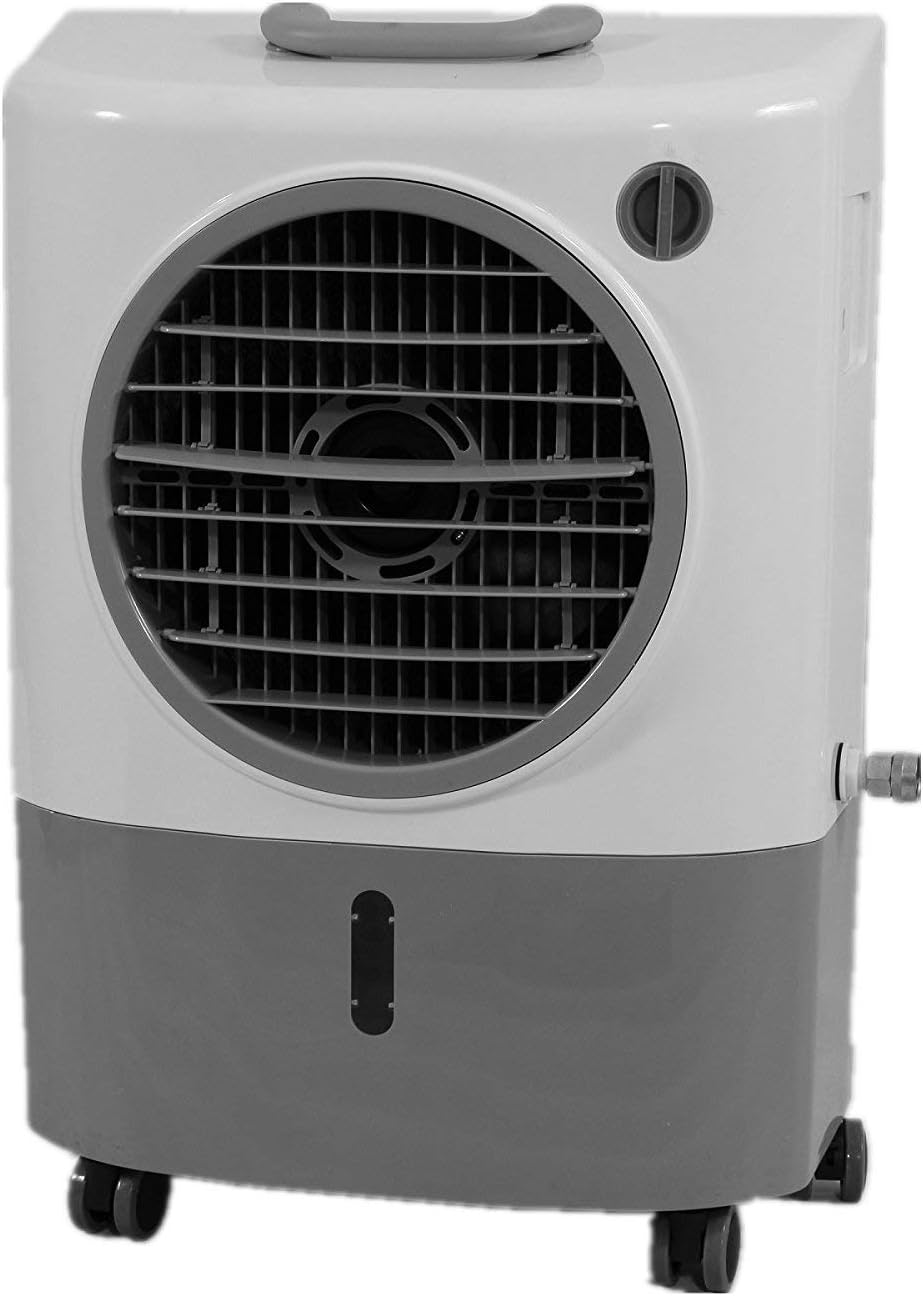
| Air Flow Capacity | 1300 cfm |
|---|---|
| Reservoir Capacity | 4.8 gallons |
| Floor Area | 500 square_feet |
| Wattage | 85 watts |
| Noise | 53.4 db |
The Hessaire MC18M is a high-airflow evaporative cooler built to move a lot of air quietly for its class. It uses high-density XeL50 media and an axial propeller to push up to 1,300 CFM, making it useful for patios, garages, tailgates, or large open rooms where you can provide cross ventilation. Operation is simple: fill the 4.8-gallon reservoir (or attach a garden hose), select fan-plus-pump or fan-only mode, and set low or high. The unit is lightweight with casters and a handle, so repositioning is easy. Practical benefits include long runtime between refills, low energy draw around 82-85 watts, and relatively low noise for that airflow level at about 53.4 dB. Limitations are inherent to evaporative cooling: it performs best in hot, dry conditions and requires an open exhaust path to work effectively, and it will not match the dehumidifying or temperature control of refrigerant air conditioners. Basic knob controls and manual operation mean fewer convenience features but also simpler maintenance.
Best for: Buyers who prioritize raw airflow and quiet operation for cooling large open areas in hot, dry conditions and who prefer a simple, low-energy portable solution.
Less Ideal for: People who need precise temperature control or dehumidification indoors, or those who live in humid climates where evaporative cooling is ineffective.
- High airflow rating of 1,300 CFM for strong cooling coverage up to 500 sq ft
- Large 4.8-gallon reservoir with hose adapter for hours of runtime or continuous fill
- Relatively low power use around 82–85 watts for energy-efficient operation
- Lightweight with caster wheels and handle for easy portability
- Lower noise level for its class at about 53.4 dB
- Effectiveness drops significantly in high-humidity environments
- Manual controls only, no digital settings or timers
Verdict: Choose the MC18M if you want a powerful, energy-efficient evaporative cooler that moves a lot of air quietly across large open spaces in dry conditions.
FODFINU Evaporative Air Cooler GDS-620

| Air Flow Capacity | 650 cfm |
|---|---|
| Reservoir Capacity | 6.87 gallons |
| Floor Area | 400 square_feet |
| Wattage | 65 watts |
| Noise | 45 db |
The FODFINU GDS-620 is a ventless evaporative cooler designed to deliver breezy, humidified cooling where a refrigerant AC is not practical. It works as a fan, humidifier, aromatherapy unit, or an ice-enhanced swamp cooler using the included ice packs and a 3.5-gallon tank that claims up to 10 hours runtime. Operation is straightforward via the top touch panel or a 20-foot remote and the unit sits on swivel casters for easy placement. Notable features include a washable filter, 120° oscillation to spread airflow, three fan speeds, and a child lock for safer use. At about 65 watts and 650 cfm airflow, it is energy efficient compared with compressor-based portable ACs and runs at a quoted 45 dB on low, making it reasonable for bedrooms or offices. Limitations are inherent to evaporative technology: it cools best in dry climates and adds humidity, so results will be modest in very humid areas and it will not lower room temperature like a refrigerant AC. The plastic build and periodic refilling and maintenance of the tank and filter are typical upkeep buyers should expect.
Best for: Buyers who prioritize low-energy, portable cooling without installation and want a practical, easy-to-move unit for bedrooms, offices, or other indoor spaces where added humidity is acceptable.
Less Ideal for: Those needing strong, temperature-lowering air conditioning in humid climates or anyone who requires precise cooling comparable to a refrigerant-based AC.
- Multiple modes: fan, humidifier, aromatherapy, and ice-boosted evaporative cooling.
- Large removable water tank for extended run time up to about 10 hours.
- Remote plus top touch controls and 120° oscillation for convenient, room-filling airflow.
- Washable filter and caster wheels make maintenance and repositioning simple.
- Low power draw (65 watts) and relatively quiet operation around 45 dB on low.
- Performance depends on dry ambient conditions and will be limited in high humidity climates.
- Made of plastic with basic construction that may feel less durable than higher-end units.
Verdict: Choose the GDS-620 when you want a low-power, portable ventless cooler that delivers extended, easy-to-use evaporative cooling for dry indoor spaces.
Arctic Air Turbo Chill

| Number of Speeds | 4 |
|---|---|
| Wattage | 1764 watts |
| Form Factor | Personal |
| Operation Mode | manual |
| Recommended Uses For Product | Residential |
The Arctic Air Turbo Chill is a small, portable evaporative cooler meant for personal spaces such as a desk, bedside, or small office. You fill the top tank with water (add ice for extra chill) and the unit uses HydroChill evaporative technology plus a mist control to produce a focused, humidified breeze. It offers four speeds including a Turbo mode, wide-angle oscillation and an adjustable grill to aim airflow, and a 7-color LED night light for mood lighting. Touch controls and a visible water window make it simple to operate, and the built-in handle keeps it easy to move from room to room. It runs quietly enough for bedroom use and claims up to eight hours per fill at lower settings, while drawing much less power than a small AC. Limitations are inherent to compact evaporative coolers: it is intended for very small areas and performance depends on room humidity, so it will not replace a full-size air conditioner for cooling larger rooms or in humid climates.
Best for: Buyers who need an inexpensive, energy-light solution to cool a single person at a desk, nightstand, or small room and prioritize quiet, portable operation.
Less Ideal for: Anyone seeking whole-room cooling, strong temperature drops, or reliable performance in humid climates should consider a larger refrigerated AC or whole-room solution instead.
- Very compact and highly portable with a built-in handle
- Four-speed fan plus mist control for adjustable personal cooling
- Quiet operation suitable for bedrooms and offices
- Top-fill tank with visible water window and up to 8 hours runtime on low settings
- Meant only for localized cooling and not effective in large or very humid rooms
- Airflow and cooling depend on ambient humidity and will be limited compared with refrigerated air conditioning
Verdict: A budget-friendly, quiet personal evaporative cooler that provides movable, low-energy relief for one person in small indoor spaces.
CENSTECH TS05 Windowless Air Cooler

| Cooling Power | 0.07 KW |
|---|---|
| Noise | 25 db |
| Wattage | 65 watts |
| Capacity | 4 liters |
| Controller Type | Remote Control |
The CENSTECH TS05 is a windowless evaporative air cooler intended to deliver portable cooling without installation. It works as a fan, humidifier, and evaporative cooler: add water and the included ice packs for stronger cooling or run it dry as a ventilating fan. The unit offers three fan speeds and four modes including a quiet sleep mode that the manufacturer rates at about 25 dB, and a 120 degree oscillation to spread airflow across a room. Controls include an LCD panel and a 20 ft remote for easy adjustments, plus a 12 hour timer and a visible water level indicator. Practical benefits are low energy use at 65 watts, a 4 liter tank for long runtime, and a bladeless design with UL and ETL safety certifications. Important limitations are inherent to evaporative coolers: performance depends on ambient humidity and it will not reach the temperatures of a refrigerant air conditioner in very humid climates, and the unit requires periodic refills and maintenance of the tank and ice packs.
Best for: Buyers who want a versatile, low-energy portable cooler that doubles as a humidifier and fan and who prioritize quiet operation and easy setup over true refrigerated cooling.
Less Ideal for: People in consistently humid climates or those who need strong, room-wide refrigerated air conditioning should consider a refrigerated portable AC instead.
- Three speeds and four modes including a quiet sleep mode for flexible comfort
- Large 4 L water tank with water level indicator for extended runtime up to 24 hours
- No window or installation required, making it easy to move between rooms
- Low power draw (65 W) for energy-efficient operation
- Evaporative cooling effectiveness drops in high-humidity conditions compared with refrigerant AC
- Requires periodic refilling and upkeep of the tank and ice packs
Verdict: Choose the TS05 if you want a quiet, energy-efficient portable swamp cooler that requires no installation and provides flexible fan, humidifier, and evaporative cooling modes.
Arctic Air Pure Chill 2.0

| Form Factor | Personal |
|---|---|
| Voltage | 120 volts |
| Power Consumption | 8-10 watts |
| Speeds | 4 speed settings |
The Arctic Air Pure Chill 2.0 is a small, lightweight evaporative cooler intended for personal spot cooling in bedrooms, offices, or on a desk. You fill the top reservoir with water, plug it in, and choose one of four fan speeds using the touch controls; the unit uses Hydro-Chill technology and dual vents to direct airflow and adds a seven-color LED night light. It runs on about 8–10 watts, so it uses very little electricity and can operate for several hours between fills depending on settings and room humidity. The design is easy to move and the adjustable vents help aim the airflow, but its cooling effect is limited to a small area and performance depends heavily on ambient humidity and ventilation. There is no refrigerant-based cooling, so it will not lower whole-room temperature like a portable air conditioner, and the water tank needs periodic refills and cleaning to avoid odors. For a low-cost, energy-efficient personal cooler it is simple and straightforward to use, but expect modest results in hot, humid spaces.
Best for: Buyers who want an inexpensive, energy-frugal way to cool a personal workspace or bedside area and prioritize portability and simple operation over whole-room cooling.
Less Ideal for: People who need consistent whole-room temperature reduction or reliable cooling in hot, humid environments should consider a refrigerant-based portable air conditioner instead.
- Very low power consumption (8–10 watts) for long run times
- Top-fill water tank for simple refilling
- Four fan speeds and adjustable vents for directed airflow
- Lightweight, compact design makes it easy to move and place on a desk
- Effective cooling is limited to a small personal zone and depends on ambient humidity
- Requires regular refilling and occasional cleaning to prevent odors
Verdict: A very affordable, ultra-low-power personal cooler that delivers simple spot cooling and humidification for desks and bedside use.
Ylkf TT-20 Portable Air Cooler

| Water tank capacity | 1200ML |
|---|---|
| Wattage | 7 watts |
| Noise level | 45 db |
| Power | 5 volts |
| Timer | 2/4/8 hours |
The Ylkf TT-20 is a small evaporative cooler designed to create a chilled bubble of air at a desk, bedside, or in an RV rather than cool an entire room. You fill the 1200ml top-fill tank with water and optional ice, set one of three fan speeds and a 2/4/8 hour timer, and the unit blows a mist-enhanced breeze that feels noticeably cooler than a plain fan. At 7 watts and about 45 dB it runs quietly enough for sleep or focused work, and the silicone-sealed tank plus auto-off when empty reduce spill risk and user maintenance. The unit is USB powered and lightweight, making it easy to move between a workstation and bedside table, and the built-in soft color lights add ambiance. Limitations are inherent to evaporative cooling: it works best for a single-person zone and is less effective in very humid climates or for whole-room cooling, and it relies on periodic refilling for extended use.
Best for: Buyers who want a quiet, low-power personal cooler for a desk, bedside, or small travel space and prioritize simple, low-maintenance operation.
Less Ideal for: People looking to cool multiple occupants or large living areas or those in very humid climates should consider a different cooling approach.
- Large 1200ml top-fill tank that can accept ice for extended cool mist
- Ultra-low power draw (7 watts) suitable for USB power and travel
- Quiet operation around 45 dB makes it usable at night or for work
- Auto-off and spill-proof silicone seal reduce mess and safety concerns
- Designed for personal cooling only and will not cool large rooms
- Performance drops in high-humidity environments
Verdict: A quiet, USB-powered evaporative cooler that delivers effective, low-energy personal cooling for desks and bedsides.
Choosing the Right Quiet Evaporative Cooler: Key Factors to Consider
Room Size and Airflow Requirements
Match the cooler's rated coverage and airflow to the space you plan to cool. Evaporative coolers move air rather than lowering temperature dramatically, so a unit that lists sufficient airflow for your room size will provide better perceived cooling. In a bedroom or home office, prioritize models with focused airflow and adjustable louvers to direct the airstream toward occupants while keeping overall noise down.
Undersizing a unit forces higher fan speeds, which increases noise and reduces comfort. Oversizing can waste energy and water. Consider placement so the intake can draw fresh air and the exhaust can circulate across the room, which is critical for effective evaporative cooling.
Measured Noise Levels and Fan Speeds
Pay attention to decibel ratings for each fan speed and whether manufacturers provide measured noise data. Quiet operation typically comes from lower RPM fans, sound-damping housings, and vibration isolation. Look for models with multiple low-speed settings and a documented quiet mode for night use.
Also consider where the unit will sit relative to sleeping or working areas. An otherwise capable cooler with high fan noise at usable speeds will be disruptive. Noise matters both in absolute decibels and in tonal quality. Units with harsh high-frequency noise can feel louder than their numbers suggest, while those with a steady low hum are often easier to tolerate.
Water Tank Design and Refill Convenience
Tank capacity determines how long the cooler can run between refills. Larger tanks reduce refill frequency but add weight and footprint. Check whether the design allows easy top-up without moving the unit and whether a continuous water hookup or gravity-fed refill option is supported.
Consider also how the tank drains for winter storage and whether the fill and drain ports are accessible. A poorly designed refill system increases the likelihood of spills and will make routine use more cumbersome, which is especially important if you plan to run the cooler overnight.
Cooling Media and Maintenance Needs
The cooling pads or media are where water evaporates into the airflow. Denser or thicker pads often provide stronger cooling but can restrict airflow if not matched to the fan. Check pad material, replacement frequency, and how easily they can be removed and cleaned. Antimicrobial treatments can slow biological growth but do not eliminate the need for periodic cleaning.
Regular maintenance also includes filter cleaning, pump access, and checking seals to prevent leaks. Units with tool-free access panels and clear maintenance instructions reduce long-term upkeep time and keep the cooler operating quietly.
Energy Use and Fan Efficiency
Evaporative coolers are typically more energy efficient than compressor-based systems, but wattage can vary significantly between models and fan speeds. Review typical power draw at low and high settings to estimate running costs. Efficient fans and pump designs allow a unit to deliver similar airflow with lower energy consumption and less acoustic output.
If you intend to run the cooler for extended periods, especially in hot weather, choose a model with a pump and fan optimized for continuous operation and a low standby draw. Energy efficiency also impacts heat added by the unit itself, which can affect perceived comfort in smaller rooms.
Where Quiet Evaporative Coolers Shine
Quiet evaporative coolers are most effective in dry climates and open-plan spaces where cross-ventilation can carry humid air away. They work by evaporating water into the airflow, which lowers temperature without the compressor noise common to refrigeration systems. This makes them ideal for bedrooms, home offices, and covered outdoor living areas where a low sound signature is important.
Use them in rooms with a steady source of fresh air or near an open window so the evaporated moisture can exit. In sealed rooms, humidity can build up and reduce effectiveness. For night or concentrated work use, prioritize models with night modes or low-speed settings to keep noise levels down while maintaining gentle airflow.
- Best in dry climates where evaporative cooling is most effective
- Low sound output compared with compressor-based air conditioners
- Works well in spaces with good fresh-air exchange
Placement and Installation Tips for Low Noise
Place the cooler on a stable, level surface to minimize vibration-related noise. Avoid locating it on hollow floors or resonant shelving. If it has caster wheels, lock them or use rubber pads to reduce transmission of mechanical vibration.
Keep the intake clear of curtains and soft fabrics that can flutter and add noise. Ensure the exhaust direction is optimized for circulating air across the room rather than blowing directly at walls, which can create reflective noise. If a continuous water line is used, secure plumbing connections to avoid drip noise.
- Use a stable base and vibration-damping pads
- Lock casters or remove them for stationary use
- Orient airflow to minimize reflective noise off hard surfaces
Maintaining Quiet Performance Over Time
Routine maintenance preserves both cooling effectiveness and quiet operation. Clean or replace cooling pads according to the manufacturer schedule and flush the tank occasionally to prevent mineral buildup that can restrict flow and make pumps louder. Lubricate or check fan mounts if the design allows, and tighten fasteners that can loosen with vibration.
Store the unit dry and drained during off-seasons to avoid mold and odor. Regular upkeep prevents the unit from having to run at higher speeds to compensate for reduced airflow, which keeps noise low and extends component life.
- Replace or clean cooling media regularly
- Flush the tank to prevent mineral deposits
- Inspect fan mounts and tighten loose fittings
When to Choose a Quiet Evaporative Cooler Vs. Alternatives
Opt for a quiet evaporative cooler when you live in a low-humidity area and need gentle, energy-efficient cooling without compressor noise. They are best for occupancy-focused cooling rather than whole-home climate control. For someone sensitive to noise, the lower sound profile at usable fan speeds can make a big quality-of-life difference.
If you face high humidity, need precise temperature control, or require significant temperature drops, consider other cooling approaches. However, for many indoor and semi-outdoor applications where humidity is manageable, quiet evaporative coolers offer a low-energy, low-noise solution.
- Great for spot cooling in dry conditions
- Less appropriate in high-humidity climates
- Consider alternatives for precise temperature control
How We Chose the Best Quiet Evaporative Cooler
We focused on features that directly affect how well a quiet evaporative cooler performs in real homes. Key evaluation criteria included: measured noise levels across fan speeds, effective airflow and distribution relative to rated area, water tank capacity and refilling options, energy draw at typical settings, and ease of maintenance such as access to cooling pads and filter replacement. We prioritized products that balanced low audible output with sufficient airflow so a unit is quiet without sacrificing cooling effectiveness. Units were excluded if they lacked basic leak protection, had inaccessible cooling media, or provided only anecdotal noise claims without specs or clear user feedback on quiet operation. We also filtered out devices with impractical maintenance demands or fragile drainage designs. Final selections represent solutions suitable for bedrooms, home offices, and living areas where low noise is a high priority alongside reliable evaporative cooling performance.
Our full evaluation process is outlined in our review methodology.
FAQ
How quiet is a typical quiet evaporative cooler?
Quiet models often report lower decibel levels on their lowest fan settings, typically comfortable for bedrooms and offices. Actual perceived noise depends on fan speed, housing design, and placement near reflective surfaces.
How often do I need to refill the water tank?
Refill frequency depends on tank capacity and operating fan speed. Larger tanks and lower fan speeds can run many hours between fills, while small tanks on high speed will need topping up more frequently.
Can I run an evaporative cooler overnight without raising humidity too much?
In dry climates, overnight use is usually fine and can improve comfort without excessive humidity. In spaces without ventilation, humidity can build up, so ensure some fresh-air exchange or use low fan speeds to balance cooling and moisture.
What maintenance keeps noise levels down?
Regularly cleaning or replacing cooling pads, flushing the water tank, and checking fan mounts and fasteners prevents airflow restriction and vibration that can increase noise. Prompt maintenance keeps the unit running smoothly and quietly.
Are evaporative coolers energy efficient compared with other cooling options?
They typically use less electricity than compressor-based systems because they rely on a fan and water pump rather than a compressor. Actual energy use varies by fan and pump efficiency and chosen operating settings.
Final Verdict
When choosing a quiet evaporative cooler, prioritize models that balance low measured noise with adequate airflow for your room size. Focus on noise ratings across fan speeds, tank capacity that fits your refill preferences, and accessible cooling media for simple upkeep. Expect tradeoffs between maximum cooling power and quiet operation; selecting a unit that meets your coverage needs at lower fan speeds will deliver the most comfortable, low-noise performance. Decide first on where and how long you will run the cooler, then match those needs to the noise, airflow, and maintenance profiles discussed here to pick a confident, long-lasting option.