
Note: This article contains affiliate links. If you click on these links and make a purchase, we may earn a small commission at no extra cost to you. This helps support our research and content. Read our full affiliate disclosure here.
If you keep a modest wine collection at home, noise and temperature stability are the two biggest practical concerns. A Quiet Freestanding Wine Cooler that runs smoothly without humming or rattling preserves the tasting environment while blending into living spaces. This guide covers the top shortlisted, freestanding wine coolers selected for low-noise operation and reliable temperature control. We evaluated models for vibration damping, cooling method, and layout so you can pick a unit that protects delicate wines and fits your room. Read on for the key features that matter and the reasons each cooler earned a spot on the list.
Top Picks at a Glance
| Best Overall The best all-around choice for most situations | Antarctic Star 36 Bottle Wine Cooler |  |
| Best Quality Built to a higher standard if you want something more solid | Tylza 24" Wine Cooler TYWC408S |  |
| Best Value The sweet spot between price and what you get | ROVSUN 18-Bottle Wine Fridge |  |
| Top Rated A top-rated pick with lots of positive feedback | Cuisinart 8-Bottle Wine Cellar CWC-800CEN |  |
| Best Seller A high-volume bestseller chosen again and again | EUHOMY Wine Cooler BR001-110 |  |
Antarctic Star 36 Bottle Wine Cooler

| Capacity | 4.4 cubic feet |
|---|---|
| Bottle Capacity | 36 bottles |
| Temperature Range | 32°F-61°F |
| Cooling Method | Compressor |
| Number Of Shelves | 4 |
This Antarctic Star 36 Bottle Wine Cooler is a compact freestanding unit intended for home wine storage and beverage chilling. It uses a compressor cooling system with an inverter and rotary scroll compressor to hold temperatures between 32°F and 61°F, so it can chill cans or store bottles at a stable serving or aging temperature. The unit has four wire shelves, a reinforced glass door with an airtight seal, interior blue LED lighting, and adjustable leveling legs for placement on an even surface. In practice it is relatively quiet and built for countertop or freestanding installation rather than built-in use, and the manual defrost system means occasional maintenance to remove frost. Practical benefits include straightforward temperature control for both wine and general beverages, horizontal racking that saves space, and a visible glass door that showcases the collection. Limitations are the manual defrosting and compact capacity that may not suit larger collections, and the glossy finish and glass door mean it should be kept out of direct sunlight to protect wines.
Best for: Buyers who want a compact, display-ready freestanding cooler that keeps bottles and beverages at consistent temperatures without complicated controls.
Less Ideal for: Collectors who need a large-capacity cellar, those seeking built-in installation, or buyers who want a frost-free automatic-defrost unit.
- Compressor cooling with inverter and rotary_scroll compressor for steady temperatures
- Wide temperature range (32°F–61°F) suitable for chilling cans and storing wines
- Reinforced glass door with airtight seal and interior LED lighting for display
- Adjustable leveling legs and freestanding design make placement flexible
- Manual defrost requires occasional maintenance
- Capacity and countertop/frеestanding orientation may be small for serious collectors
Verdict: A compact freestanding cooler that reliably stores up to 36 bottles at selectable temperatures while showcasing them behind a sealed glass door.
Tylza 24" Wine Cooler TYWC408S

| Capacity | 14.41 cubic feet |
|---|---|
| Number Of Shelves | 14 |
| Cooling Method | Compressor |
| Temperature Range | 40-65°F (5-18°C) |
| Installation Type | Built-in or Freestanding |
The Tylza 24" TYWC408S is a tall, compressor-cooled wine refrigerator built for high-capacity storage and steady temperature control. It uses an advanced compressor and internal fan to circulate air across 14 beech wood and steel shelves, keeping temperatures in the 40 to 65°F range and producing fast, even cooling suitable for long-term wine storage and display. Notable touches include removable sliding shelves for easy bottle access, a lockable glass door for security, and a temperature memory function that restores the last set temperature after power interruptions. In practice the unit is meant for dedicated wine storage in kitchens, finished basements, or home bars where you need both large capacity and stable conditions; the compressor cooling delivers stronger, faster temperature recovery than thermoelectric systems, though it is inherently louder and may produce more vibration than silent fan-only designs. Installation is flexible as either built-in or freestanding, and the frost-free air circulation helps maintain consistent humidity and reduces maintenance. If your priority is a high-capacity, performance-focused cooler that holds temperature well, this model delivers with practical shelf design and a stable compressor system.
Best for: Buyers who prioritize performance and large-capacity wine storage and need reliable, fast temperature control for long-term preservation and display.
Less Ideal for: People seeking the quietest possible wine cooler for a bedroom or noise-sensitive space or those who need a lightweight, easy-to-move unit.
- Very large 154-bottle capacity across 14 removable shelves for organized storage
- Compressor plus internal fan delivers fast, even cooling and good temperature recovery
- Temperature memory restores last set temperature after power interruptions
- Built-in or freestanding installation and a lockable glass door for display and security
- Compressor-based cooling is typically noisier and may cause more vibration than thermoelectric units
- Large footprint and weight make placement and installation more demanding
Verdict: Choose this cooler if you need a high-capacity, performance-focused compressor wine fridge that delivers fast, even cooling and reliable temperature recovery.
ROVSUN 18-Bottle Wine Fridge

| Capacity | 1.8 cubic feet |
|---|---|
| Size | 18 Bottle |
| Temperature range | 41-64°F |
| Cooling Method | Compressor refrigeration |
| Power | 115 volts |
This ROVSUN 18-bottle wine fridge uses a compressor refrigeration system to cool bottles faster and across a wider temperature range than thermoelectric units, making it suitable for storing reds, whites, champagne, or beer between 41 and 64°F. It is designed as a freestanding unit with removable chrome-plated metal shelves, a soft LED interior light, and an exterior touch control panel so you can adjust temperature without opening the door. The compressor is described as whisper quiet and the double-layer glass door plus good sealing help maintain steady internal temperatures. Practical features include an automatic defrost system, a keyed lock, and ETL specification compliance. Expect typical small-fridge trade-offs such as limited internal capacity for oversized bottles and the footprint of a 30-inch-tall cabinet, but the compressor cooling and touch controls deliver reliable, consistent performance for everyday home use.
Best for: Buyers who want a compact, budget-friendly wine cooler that prioritizes reliable compressor cooling and easy temperature control for everyday home use.
Less Ideal for: Collectors needing storage for large-format or long-term cellaring should look at larger or dedicated wine cellar options instead.
- Compressor refrigeration provides faster, more stable cooling than thermoelectric designs
- External touch control panel lets you change temperature without opening the door
- Removable chrome-plated metal shelves for flexible bottle arrangement
- Double-layer glass door with LED light and good sealing helps keep temperature steady
- 18-bottle capacity may not fit oversized or international-format bottles
- Freestanding footprint requires planning in tight spaces
Verdict: A compact, budget-conscious compressor wine fridge that delivers faster, steadier cooling and simple touch controls for everyday home wine storage.
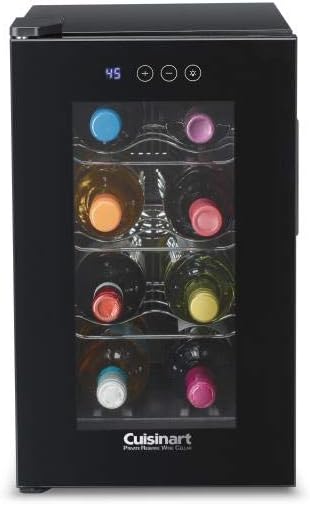
Cuisinart 8-Bottle Wine Cellar CWC-800CEN
| Cooling Method | Thermoelectric |
|---|---|
| Number Of Shelves | 8 |
| Capacity | 6 liters |
| Power Source | Electric |
The Cuisinart 8-Bottle Private Reserve Wine Cellar is a small freestanding cooler designed to keep a selection of reds, whites, or sparkling wines at controlled serving temperatures. It uses a thermoelectric cooling system, which runs quietly and is more energy efficient than compressor units, and a touchscreen control with LED readout lets you set temperatures from 39°F to 68°F. Inside, contoured chrome racks and soft interior lighting make bottle access and display simple, and the unit ships with three removable racks to organize various bottle shapes. Typical use is for short- to medium-term storage and serving in an apartment, kitchen, or home bar where vibration-free, quiet operation matters. Limitations include the small 8-bottle capacity and thermoelectric cooling, which performs best in moderate ambient temperatures and is not suited for long-term cellar aging or very warm rooms. For buyers prioritizing quiet performance and a compact footprint, this is a practical countertop or freestanding option; buyers needing larger capacity or cooler performance for hot spaces should look at compressor-based models instead.
Best for: Buyers who want a quiet, energy-conscious small wine cooler to keep a few bottles at serving temperature and prefer a compact freestanding unit for a kitchen, office, or home bar.
Less Ideal for: Collectors who need long-term proper cellar conditions, those with larger collections, or people who will place the cooler in consistently hot rooms.
- Quiet thermoelectric cooling with low vibration suitable for delicate wines
- Touchscreen controls and LED display for easy temperature setting
- Soft interior lighting and contoured chrome racks for neat presentation and access
- Compact freestanding design fits small kitchens, apartments, or bars
- Only holds up to eight bottles, limiting larger collections
- Thermoelectric cooling is less effective than compressor units in very warm ambient temperatures
Verdict: Choose this Cuisinart if you want a quiet, compact 8-bottle cooler that maintains serving temperatures with energy-efficient thermoelectric performance.
EUHOMY Wine Cooler BR001-110

| Capacity | 3.2 cubic feet |
|---|---|
| Bottle capacity | Up to 25 standard 750ml bottles |
| Temperature range | 41°F to 64°F |
| Cooling method | Compressor |
| Door orientation | Reversible |
This EUHOMY wine cooler is a compact freestanding unit aimed at steady, long-term beverage storage. It uses a compressor cooling system with a 41 to 64°F temperature range controlled by a digital touchscreen, so you can keep reds, whites, and sparkling bottles at appropriate serving temperatures. The interior offers four chrome full-width racks, a flat shelf and a bottom compartment to fit up to 25 standard 750ml bottles and to reconfigure storage as needed. The double-layer thermopane glass door reduces temperature swings and blocks UV light, and soft LED lighting helps with visibility without harsh heat. Practical touches include adjustable leveling legs, a built-in handle and a reversible door for flexible placement under counters or freestanding in a bar or office. Expect manual defrosting and typical small-fridge energy use; for buyers prioritizing quiet, vibration-free operation the compressor is described as high-performance and low-vibration but compressor units can still be noisier than thermoelectric models. The unit is supported by a one-year warranty and arrives with a user manual for setup and operation.
Best for: Buyers who want a compact, reliable freestanding cooler for steady storage of a small to medium wine collection and value precise temperature control and flexible placement.
Less Ideal for: Those seeking a zero-maintenance built-in cellar replacement, ultra-low energy operation, or very large bottle capacity should consider larger or different-style units.
- Compressor cooling with a wide 41–64°F range for storing different wine styles
- Double-pane glass door that insulates and blocks UV to protect wine quality
- Adjustable shelves and mix of racks allow flexible storage up to 25 standard bottles
- Digital touchscreen control and internal LED lighting simplify temperature monitoring and viewing
- Reversible door and leveling legs make placement under counters or freestanding easier
- Manual defrost requires occasional user maintenance
- Annual energy consumption is relatively high compared with the smallest thermoelectric units
Verdict: A compact, compressor-cooled freestanding wine cooler that delivers precise temperature control and flexible storage for a small commercial or bar setting.
Choosing the Right Quiet Freestanding Wine Cooler: Key Factors to Consider
Operating Noise Level
How loud a wine cooler runs affects where you can place it in the home and whether it will be a distraction. Decibel ratings and real-world noise reports offer a baseline, but consider measured idle and active noise so you know how the unit sounds when cooling cycles start.
Lower noise comes from quieter compressors, better fan design, and effective insulation. If you plan to put the cooler in an open-plan living area or near sleeping spaces, prioritize verified low-dB figures and noise-reducing design features.
Temperature Stability
Consistent internal temperature is critical to preserving wine quality. Look for units with precise thermostats, uniform airflow, and minimal temperature swings during compressor cycles. Dual-zone models can maintain different temperatures for reds and whites, but even single-zone coolers must avoid hot spots.
Temperature stability reduces the risk of premature aging and flavor changes. Assess claimed temperature ranges and seek documentation or tests showing small variance across shelves.
Vibration Control
Excess vibration disturbs sediment in aged wines and can accelerate chemical reactions. Vibration originates from compressors and from airflow disturbances. Effective vibration control uses cushioning mounts, sturdy shelving, and layout choices that prevent bottles from contacting vibrating surfaces.
If you collect older or bottle-conditioned wines, prioritize models with explicit vibration-damping features or passive compressor mounting to protect delicate bottles.
Shelving and Storage Layout
The internal layout determines how many bottles you can store safely and how accessible they are. Pull-out shelves, fixed racks, and shallow tiers each have tradeoffs for capacity and bottle stability. Adjustable shelving helps accommodate odd-sized bottles and decanters.
Count usable bottle positions, not just theoretical capacity, and check whether racks cradle bottles securely to reduce movement and noise from shifting glass.
Door Seal and Glass Construction
Door sealing affects both noise and temperature retention. A tight seal prevents warm air ingress that would force the compressor to run more often and create additional noise. Double- or triple-pane tinted glass reduces thermal transfer and can also buffer sound.
Look for strong magnetic seals, low-emissivity glass options for UV protection, and doors that close softly to avoid rattling in daily use.
Energy Use and Cycling Frequency
How often a cooler cycles on influences cumulative noise exposure and operating cost. More efficient insulation and compressors run less frequently and for shorter durations, lowering average sound levels. Energy-efficient units also generate less heat, which helps maintain a quieter room environment.
Look at energy efficiency ratings and specifications around duty cycle or power draw. Consider how your ambient room temperature affects cycling if the cooler will sit in a warmer area like a kitchen.
Cooling Methods and Noise Implications
Freestanding wine coolers commonly use either compressor-based or thermoelectric cooling. Compressors are more efficient at lower temperatures and in warm rooms but can generate more mechanical noise. Thermoelectric units are quieter mechanically because they have no compressor, but they struggle to maintain low temperatures and perform poorly with high ambient heat.
Choosing the cooling method depends on where the cooler will live and the temperatures you need. If you keep the unit in a climate-controlled room and only store a modest number of bottles, a thermoelectric unit can be an exceptionally quiet choice. For larger collections or warmer locations, compressor systems with good vibration control and insulated cabinets typically deliver better temperature stability while still achieving low noise with modern designs.
- Thermoelectric: lower mechanical noise, limited cooling range
- Compressor: stronger cooling, requires vibration mitigation
- Cabinet insulation reduces compressor run time and noise exposure
Where to Place a Quiet Freestanding Wine Cooler
Positioning affects perceived noise. Put the cooler on a level, stable surface that dampens vibration transfer to floors and nearby furniture. Avoid tight cabinetry enclosures that trap heat and force more frequent compressor cycles.
If the cooler will sit near living or sleeping areas, allow some clearance on the sides and rear for airflow. Even a quiet unit can become noticeably louder if it must work harder due to poor ventilation.
- Keep 2 to 4 inches clearance from walls when possible
- Use a rubber mat or vibration pads on hard floors
- Avoid hallways or bedrooms for compressors with higher cycle sounds
Maintaining Quiet Operation Over Time
Routine maintenance helps sustain quiet performance. Clean condenser coils periodically, check that door seals remain tight, and verify shelving fasteners are secure. Loose parts are a common source of intermittent rattles.
Monitor the cooler for changes in noise profile after moving it or adding many new bottles. Early attention to loose racks or an imbalanced load prevents long-term wear that can increase vibration and sound.
- Clean vents and coils annually to improve efficiency
- Tighten shelving screws and check for worn rubber mounts
- Balance heavy and light bottles across shelves to avoid rattling
Controls, Displays, and User Experience
User interfaces matter for everyday satisfaction. Digital thermostats with fine temperature adjustment let you set a precise point and avoid frequent cycling. Soft-touch buttons and discreet displays reduce light pollution in living areas.
Consider whether the model offers alarms or indicator lights for open doors or temperature excursions. These features can prevent conditions that force long compressor runs and increased noise.
- Digital controls provide finer temperature tuning than simple dials
- Low-brightness displays avoid disturbing nearby rooms
- Door-open alerts reduce prolonged compressor operation
Capacity Vs Footprint Tradeoffs
A larger capacity often requires a larger compressor and can mean more noise during active cooling. Decide how many bottles you realistically plan to store and choose the smallest unit that meets that need. A compact quieter unit may run more frequently, but smaller compressors can be engineered for lower sound levels.
Think about future needs and whether you want adjustable shelving to convert a few positions for larger-format bottles. Efficient use of space often yields quieter day-to-day operation because bottles are stored securely and airflow is unobstructed.
- Match capacity to actual collection size to avoid oversized units
- Adjustable racks let you prioritize stable storage over maximum count
- Smaller footprint units can still offer excellent noise performance
How We Chose the Best Quiet Freestanding Wine Cooler
We focused on features that directly affect noise and bottle care. Primary evaluation criteria included measured operating noise in decibels, temperature consistency across shelves, vibration isolation, and storage layout that reduces bottle movement. We also considered build quality factors that influence long-term quiet performance such as compressor type, fan design, and insulation thickness. Energy efficiency and usability features like controls, shelving flexibility, and door sealing were weighed because they affect how often the compressor runs and therefore the overall sound profile. Units excluded from consideration were those designed exclusively for built-in installation, models with unclear noise specifications, and products without temperature control zones suitable for mixed storage. The final selections balance documented noise performance with consistent internal temperatures and practical shelving arrangements. The scoring emphasized measurable sound output and thermal stability, while also valuing features that reduce vibration and user adjustments that limit compressor cycling.
Our full evaluation process is outlined in our review methodology.
FAQ
How many decibels is considered quiet for a freestanding wine cooler?
Quiet freestanding wine coolers usually operate in the mid-30s dB range at idle. Anything under about 40 dB is typically unobtrusive in living spaces, but look at both idle and active cycle measurements for a complete picture.
Is a thermoelectric cooler always quieter than a compressor unit?
Thermoelectric systems are mechanically quieter because they lack a compressor, but they may not maintain low temperatures reliably in warm rooms. For some users the tradeoff is acceptable, while others require compressor cooling for consistent cellar-like temperatures.
Will vibration from a wine cooler damage my bottles?
Excessive vibration can disturb sediment and subtly affect wine development over time. Most modern freestanding units include design elements to minimize vibration, but collectors of aged wines should prioritize models with explicit vibration-damping features.
Can I place a freestanding cooler in my kitchen next to appliances?
You can, but be mindful of heat sources. Placing the cooler beside ovens or dishwashers increases ambient temperature and forces the cooler to run more often, which raises average noise. Provide clearance and ensure adequate ventilation for best performance.
How do I reduce rattling or intermittent noises from my cooler?
Check that the cooler sits level, tighten shelving fasteners, and use rubber pads under the feet to isolate vibration. Also ensure bottles are seated properly and not contacting adjacent glass or metal surfaces.
Final Verdict
When choosing a Quiet Freestanding Wine Cooler, prioritize measured operating noise and temperature stability above raw capacity. Balance the cooling method against where you will place the unit: thermoelectric systems can be very quiet in mild environments, while compressor-based coolers typically deliver better control when paired with effective vibration isolation. Pay attention to shelving that secures bottles, solid door seals, and energy characteristics that reduce compressor cycling. Choosing a unit that aligns with your storage needs and room placement will deliver the best combination of silence and bottle protection.